
Sound at MLA 2012
 Unlike MLA 2011 in Los Angeles, which overflowed with audio-themed research delights–see our last year’s round up here —MLA 2012 in Seattle seems, well, a lot less sonic. I have a few theories as to why this may be (and of course, I would love to hear your thoughts as to MLA’s relative silence in the comment section. Drop us a line!). First off, even in our networked universe, conferences always seem to take on some local flavor, so last year’s event in L.A., whose main industry continues to be entertainment, may have been a magnet for panels about music, sound, and other audio-visual inquiries. Without implying that sound studies is mutually exclusive with Digital Humanities–quite the opposite–perhaps the move to Seattle, long a technology hub thanks to Amazon.com and Microsoft, helps account for the veritable explosion of DH panels in the PMLA this year. Being the Editor-in-Chief of a blog, I have included some of the many excellent DH panels in this round up that I think are of interest to fellow research bloggers and sound studies peeps; see Professor (and ProfHacker) Mark Sample’s comprehensive Digital MLA listing on his blog Sample Reality for the full line up (and a great discussion of the growth of digital humanities as a field).
While the sharp decline in overtly labeled “sound studies” panels at MLA seems a bit troubling for a fledgling field, it could also be a backhanded marker of its growing success. As sound studies grows and expands into more academic venues, this extremely interdisciplinary field is becoming more diffuse and multivalent. 2011 marked the year that the American Studies Association hosted its first official meeting of the sound studies caucus, for example, and published a sound studies special issue of American Quarterly. Three years strong, the Sound Studies Special Interest Group of the Society for Cinema and Media Studies hosted a full slate of events and sound studies panels in New Orleans this past March. And the Sound Studies Special Interest Group at the Society for Ethnomusicology meeting this year in Philadelphia, two years old, did the same. Perhaps the time has come for us to coalesce at MLA in a similar way, forming a society with standing meetings and panels to ensure that the nexus of sound studies and literary inquiry continues to break new ground and thrive instead of waxing and waning along with the market and successive conference themes. Far from being antithetical or ancillary to studies of soundscapes, recordings, and other audible forms, language constructs and shapes our sensory experience of and the meanings we make from “actual” sound; we are only beginning to understand how.
Or perhaps not. Perhaps the way in which sound studies research has been absorbed into studies of literature and language is not so much a muting but rather a healthy sign of what audio engineers refer to as “bleed.” This year’s slate of panels shows how Sound Studies has proven undeniably useful to some of the core issues of the discipline: identity, translation, poetics, affect, tone, and especially voice. With the advent of sound studies, “voice” in literary study has ceased to be a solely a metaphor or an abstract symbol of agency, but panels like “Pinter’s Voice,” “Dissenting Voices,” and “Dickinson’s Fictions of Voice” suggest that the field now hears “voice” as a living, breathing, and sounding entity in its own right, a sensory element of literary craft bearing material traces (and social consequences–see “Gender and Voice: Orality, Dissent, and Community in the Late Middle Ages” and “Arabic Language and Identity: Transregional Texts and Transnational Discourse”).
Finally, I must mention that the MLA’s strength continues to be its international range; sound studies is frequently critiqued for a largely U.S. and British-based focus, so it is refreshing to see sound studies work from (and on) Germany, France, Australia, Morocco, Jordan, Lebanon, Ireland, and Iraq (among others) as well as inquiries that question the idea of borders and nation-states altogether. Whether revivifying the concept of voice or questioning the rhetorical construction of bodies and spaces across the globe, sound studies emerges as a critical mediator between sound and language at MLA 2012, a rich conversation that has really only just begun.
Please comment to let us know what you think–both before and after MLA 2012. If I somehow missed you or your panel in this round up, please let me know!: jsa@soundingoutblog.com
—
Jennifer Stoever-Ackerman is co-founder, Editor-in-Chief and Guest Posts Editor for Sounding Out! She is also Assistant Professor of English at Binghamton University and a Fellow at the Society for the Humanities at Cornell University.
Jump to THURSDAY, January 5
Jump to FRIDAY, January 6
Jump to SATURDAY, January 7
Jump to SUNDAY, January 8
.
Back to menu
THURSDAY, January 5
Thursday, 5 January
.
8:30–11:30 a.m.
.1. Evaluating Digital Work for Tenure and Promotion: A Workshop for Evaluators and Candidates
Willow A, Sheraton
Presiding: Alison Byerly, Middlebury Coll.; Katherine A. Rowe, Bryn Mawr Coll.; Susan Schreibman, Trinity Coll. Dublin
The workshop will provide materials and facilitated discussion about evaluating work in digital media (e.g., scholarly editions, databases, digital mapping projects, born- digital creative or scholarly work). Designed for both creators of digital materials (candidates for tenure and promotion) and administrators or colleagues who evaluate those materials, the workshop will propose strategies for documenting, presenting, and evaluating such work.
Preregistration required.
.
1:45–3:00 p.m.
.44. Pinter’s Voice
303, WSCC
Program arranged by the Harold Pinter Society. Presiding: Judith A. Roof, Rice Univ.
Saumya Rajan, Univ. of Allahabad, “Ruth: Harold Pinter’s Voice of Postmodernist Politics”
William Crooke, East Tennessee State Univ., “What Dyou Mean? The Cockney Voice in Harold Pinter’s The Dumb Waiter,”
Susan Hollis Merritt, Pinter Review, “Pinter’s Voices”
.
1:45–3:00 p.m.
67. Race and Digital Humanities
611, WSCC
Program arranged by the Division on Black American Literature and Culture. Presiding: Howard Rambsy, Southern Illinois Univ.
Kimberly D. Blockett, Penn State Univ., Brandywine, “Digitizing the Past: The Technologies of Recovering Black Lives”
Bryan Carter, Univ. of Central Missouri, “Digital Africana Studies 3.0: Singularity, Performativity, and Technologizing the Field”
Maryemma Graham, Univ. of Kansas, “The Project on the History of Black Writing and Digital Possibilities”
For abstracts, write to hrambsy@siue.edu.
.
3:30–4:45 p.m.
.70. Multimediated Brecht
Cedar, Sheraton
Program arranged by the International Brecht Society. Presiding: Kristopher Imbrigotta, Univ. of Wisconsin, Madison
Michael Shane Boyle, Univ. of California, Berkeley, “‘Literarization’ and the Radical Potential of Media”
Julia Draganovic, Modena, Italy, “Brecht’s Radio and Its Italian Legacy”
Michael Ryan, Duke Univ., “Brecht’s Media Theory: A Popular Reassessment”
Respondent: Henning Wrage, Haverford College
.
82. Arabic Language and Identity: Transregional Texts and Transnational Discourses
Columbia, Sheraton
A special session. Presiding: Karin C. Ryding, Georgetown Univ.
Elizabeth M. Bergman, Miami Univ., Oxford, “Animating Linguistic Nationalism in Jordan”
Clara Shea, Georgetown Univ., “The Sound of the People: Popular Music and Identity in Lebanon”
Georgette Jabbour, Defense Language Inst., “The Way Forward to Teaching Arabic: Incorporating Dialect with Modern Standard Arabic (MSA)”
Emily J. Selove, Univ. of California, Los Angeles, “A Baghdadi Party Crasher in Isfahan”
For abstracts, write to rydingk@georgetown.edu
.
97. Voicing Documentary
307, WSCC
Program arranged by the Division on Language and Society. Presiding: James V. Catano, Louisiana State Univ., Baton Rouge
Jose Capino, Univ. of Illinois, Urbana, “Voice- Over Narration in the Cold War Documentary”
Rebecca Sheehan, Harvard Univ., “The Essay Film and the Ontology of the Epistolary Image: Akerman, Marker, Godard”
James V. Catano, Louisiana State Univ., Baton Rouge, “Voicing Authority: Confessing before God and Errol Morris”
.
5:15–6:30 p.m.
115. Gender and Voice: Orality, Dissent, and Community in the Late Middle Ages
Virginia, Sheraton
Program arranged by the Society for Medieval Feminist Scholarship. Presiding: Dorothy Kim, Vassar Coll.
Katherine G. Zieman, Univ. of Notre Dame, “Performing Ourselves: Gendering and Voicing in Pater Noster Commentaries”
Nicole Nolan Sidhu, East Carolina Univ., “Gender and the Unruly Female Voice in Piers Plowman”
Dorian Lugo- Bertrán, Univ. of Puerto Rico, “The Inscription of the Voice and Medieval Materiality in Teresa of Ávila’s Camino de perfección”
Anthony J. Cárdenas- Rotunno, Univ. of New Mexico, Albuquerque, “The Gendered Voices of Leonor López de Córdoba and Teresa de Cartagena”
For abstracts, visit hosted .lib.uiowa .edu/smfs/mff/
.
7:00–8:15 p.m.
142. Affect, Distance, Confession: Emotion and Popular Music
620, WSC
Program arranged by the Division on Popular Culture. Presiding: Sonnet Retman, Univ. of Washington, Seattle
John W. Mowitt, Univ. of Minnesota, Twin Cities, “(I Can’t Get No) Affect”
Barry Shank, Ohio State Univ., Columbus, “Approaching Odd Future (OFWGKTA) from a Distant Place”
David R. Shumway, Carnegie Mellon Univ., “‘A Compulsion to Be Honest with My Audience’: Joni Mitchell and Confession”
Respondent: Sonnet Retman
.
150. Digital Humanities and Internet Research
613, WSCC
A special session. Presiding: John Jones, Univ. of Texas, Dallas
Robin A. Reid, Texas A&M Univ., Commerce, “Creating a Conceptual Search Engine and Multimodal Corpus for Humanities Research”
John Jones, Univ. of Texas, Dallas, “What the Digital Can’t Remember”
Jennifer Sano Franchini, Michigan State Univ., “Toward a Rhetoric of Collaboration: An Online Resource for Teaching and Learning Research”
For abstracts, visit http://robin-anne-reid.dreamwidth.org/
Thursday Individual Papers of Interest
Mark Deggan, Univ. of British Columbia, “‘Not Bleeding, Singing’:The Operatic Legacy of ’Twixt Land and Sea,” 12:00 noon–1:15 p.m., 616, WSCC
Emilie Brancato, Univ. of Toronto, “Exploring Marguerite’s Voice in the Middle English Translation of the Mirouer des simples âmes,” 3:30–4:45 p.m., Virginia, Sheraton
Eric J.Hyman, Fayetteville State Univ., “The Filtered Voices of Margery Kempe,” 3:30–4:45 p.m., Virginia, Sheraton
John Melillo, Univ. of Arizona, “Empathic Noise,” 3:30–4:45 p.m., 608, WSCC2.
Benjamin Conisbee Baer, Princeton Univ, “Césaire’s Voice Lessons,” 5:15–6:30 p.m., 618, WSCC
Robert J. Patterson, Georgetown Univ., “She Heard Nothing: Traumatized Cat and the Unsympathetic Listener in Gayl Jones’s Corregidora,” 5:15–6:30 p.m., 615, WSCC
Yonsoo Kim, Purdue Univ., West Lafayette, “Women’s Voiced Desire and Muted Passions: Teresa de Cartagena and Santa Teresa,” 7:00–8:15 p.m., 620, WSC
.
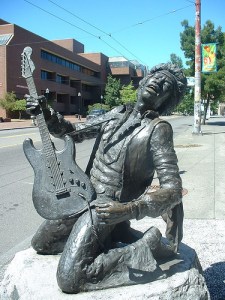
Statue of Jimi Hendrix at the Corner of Pike and Broadway, Seattle, WA by Flickruser bleachers
Friday, 6 January
8:30–9:45 a.m.
166. Tone in Narrative
617, WSCC
Program arranged by the International Society for the Study of Narrative. Presiding: Molly Hite, Cornell Univ.
James Phelan, Ohio State Univ., Columbus, “Dialogue, Voice, and Tone; or, Exploring a Neglected Channel of Narrative Communication”
Debra Fried, Cornell Univ., “Taking a Wrong Tone”
Chris Rideout, Seattle Univ. School of Law, “Voice, Self, and Tonal Cues in Legal Discourse”
.
174. The Opera Libretto
620, WSCC
Program arranged by the Lyrica Society for Word-Music Relations. Presiding: Jeff Dailey, Five Towns Coll.
Edward Anderson, Rice Univ. “Staging Authority—Ariosto, Early Opera, and the Society of Dead Poets”
Matthew Paul Carlson, Univ. of North Carolina, Chapel Hill, “English Verse Translations of Die Zauberlöte: Auden and Kallman versus McClatchy”
Ryan Kangas, Univ. of Houston, “Encountering the Mirror in ‘The Birthday of the Infanta’ and Der Zwerg”
Douglas Fisher, Florida State Univ., “Willie Stark: Carlisle Floyd’s Libretto Based on William Penn Warren’s All the King’s Men”
For abstracts, visit http://www.lyricasociety.org/
.
188. Jimi Hendrix and the Poetics of Song
611, WSCC
A special session. Presiding: Jacob Wilkenfeld, Univ. of North Carolina, Chapel Hill
Jeffrey Carroll, Univ. of Hawai‘i, Mānoa, “Dancing in Dylan’s Head: Jimi Hendrix and the Folk Tradition”
Daniel Barlow, Univ. of Pittsburgh, “Jimi Hendrix and the Politics of Blackness”
Michael New, Penn State Univ., University Park, “Voodoo Child: Jimi Hendrix and the African American Experimental Tradition”
Jacob Wilkenfeld, Univ. of North Carolina, Chapel Hill, “Are You Experienced? Jimi Hendrix and the Poetics of Black Experience”
.
10:15–11:30 a.m.
236. Remixing Present-Day English
306, WSCC
Program arranged by the Discussion Group on Present-Day English Language. Presiding: Dulce M. Estevez, Arizona State Univ.
Nils Olov Fors, Indiana Univ. of Pennsylvania, “A Critical Analysis of Language Use Constructs in Discourses Related to Language Education in South Texas, 2000–10”
Jennifer M. Santos, Virginia Military Inst., “Agog or a Gag? Lady Gaga’s Remixes Remixed”
Dulce M. Estevez, Arizona State Univ., “Mixteando Languages in the United States”
Sarah Catherine Dean, Arizona State Univ., “Remixing English to Represent Trauma and Identity”
.
12:00 noon–1:15 p.m.
244. Dickinson’s Fictions of Voice
303, WSCC
Program arranged by the Emily Dickinson International Society. Presiding: Elizabeth Petrino, Fairield Univ.
Vivian R. Pollak, Washington Univ. in St. Louis, “Dickinson and Sincerity: The Nineteenth-Century Context”
Margaret Rennix, Harvard Univ., “The Speaking Dead: Animated Corpses and National Crisis in the Poetry of Emily Dickinson and Alfred Tennyson”
Ai’fe Murray, San Francisco, CA, “The Influence of Her Servants’ Ethnic Vernaculars on Emily Dickinson’s Language”
For abstracts, write to epetrino@ fairfield.edu
.
245. Narrativity and Musicality: The Confluence of Language, Literature, and Culture
305, WSCC
Program arranged by the College Language Association. Presiding: Warren Carson, Univ. of South Carolina, Spartanburg
Kameelah Martin Samuel, Georgia State Univ., “Of Blues Narrative and Conjure Magic: A Symbiotic Dialectic in the Fiction of Arthur Flowers and J. J. Phillips”
Dolan Hubbard, Morgan State Univ., “DuBois, Hansberry, and a Knock at Midnight”
Thabiti Lewis, Washington State Univ., Vancouver, “Teaching Hip-Hop and Black Vernacular Tradition While Tackling the Boogie Man”
.
249. Building Digital Humanities in the Undergraduate Classroom
Grand A, Sheraton
A special session. Presiding: Kathi Inman Berens, Univ. of Southern California
Speakers: Kathryn E. Crowther, Georgia Inst. of Tech.; Brian Croxall, Emory Univ.; Maureen Engel, Univ. of Alberta; Paul Fyfe, Florida State Univ.; Kathi Inman Berens; Janelle A. Jenstad, Univ. of Victoria; Charlotte Nunes, Univ. of Texas, Austin; Heather Zwicker, Univ. of Alberta
This electronic roundtable assumes that “building stuff” is foundational to the digital humanities and that the technical barriers to participation can be low. When teaching undergraduates digital humanities, simple tools allow students to focus on the simultaneous practices of building and interpreting. This show-and-tell presents projects of variable technical complexity that foster robust interpretation.
For abstracts, visit briancroxall.net/buildingDH
.
259. Representation in the Shadow of New Media Technologies
304, WSCC
Program arranged by the MLA Committee on the Literatures of People of Color in the United States and Canada. Presiding: Lan Dong, Univ. of Illinois, Springield
Aymar Jean Christian, Univ. of Pennsylvania, “Web Video and Ethnic Media: Linking Representation and Distribution”
Daniel Greene, Univ. of Maryland, College Park, “Among Friends: Comparing Social Networking Functions in the Baltimore Sun and Baltimore Afro-American in 1904 and 1933″
Lisa Nakamura, Univ. of Illinois, Urbana, “Digital Trash Talk: The Rhetoric of Instrumental Racism as Procedural Strategy”
.
273. Queer Performance: Space, Bodies, and Movement(s)
620, WSCC
Program arranged by the GL/Q Caucus for the Modern Languages. Presiding: Francesca Therese Royster, DePaul Univ.
Aimee Carrillo Rowe, Univ. of Iowa“Race-ing Time through Queer Xicana Performance”
Robert McRuer, George Washington Univ., “Crip Out: Freakish Performance and the Rogue Queer History”
Sharon Bridgforth, DePaul Univ., “Ring or Shout”
For abstracts, write to ltorres@ depaul.edu.
.
1:45–3:00 p.m.
283. What Makes Language Literary?
Metropolitan A, Sheraton
A linked session arranged in conjunction with The Presidential Forum: Language, Literature, Learning (202). Presiding: Sabine Wilke, Univ. of Washington, Seattle
Speakers: Charles Francis Altieri, Univ. of California, Berkeley; Daniel Dooghan, Univ. of Tampa; Frances Ferguson, Johns Hopkins Univ., MD; Alexander C. Y. Huang, George Washington Univ.
This roundtable asks whether the familiar pairing “language and literature” is more than just an academic convention. Is literature a necessary function of language, or is language merely the vehicle with which literature pursues its own ends? At stake are questions of rhetoric and criticism, poetic language, the standing of translation, and the tensions between historical experience and aesthetic autonomy.
.
294. Humor and Subversion: Approaches to Pacific Literature and Orature at the Universities of Hawai‘i and Guam
608, WSCC
A special session. Presiding: Caroline Sinavaiana, Univ. of Hawai‘i, Mānoa
Caroline Sinavaiana, Univ. of Hawai‘i, Mānoa, “bro’Town and he Naked Samoans: Ritual Clowning Goes Prime Time”
Ku‘ualoha Ho‘omanawanui, Univ. of Hawai‘i, Manoa, “Mokes with Jokes: Nah Nah Nah Nah—‘Bussing Laugh’ as Colonial Resistance”
Nicholas J. Goetzfridt, Univ. of Guam, “The Illusions of Betrayal: Mudrooroo, Indigenousness, and the Stage I Make”
Brandy Nalani McDougall, Univ. of Hawai‘i, Mānoa, “Anticolonial Humor and Poetic Resistance in the American Colonies of the Pacific”
Respondent: Craig Perez, Univ. of California, Berkeley
For abstracts, write to sinavaia@hawaii.edu
.
298. Reading across Media
Aspen, Sheraton
Program arranged by the Division on Twentieth-Century German Literature. Presiding: Deniz Göktürk, Univ. of California, Berkeley
Lutz Koepnick, Washington Univ. in St. Louis, “Reading on the Move”
Heather Love, Indiana Univ., Bloomington, “Fighting Stupidity and Playing Music: Musil, Adorno, and the Performativity of Interpretation”
Daniel Gilillan, Arizona State Univ., “Literature on the Radio: Sound and the Intermedial Modulation of Knowledge”
.
307. Theorizing Hip- Hop: New Approaches to Hip-Hop as Intellectual Production
618, WSCC
A special session. Presiding: Jill Richardson, Borough of Manhattan Community Coll., City Univ. of New York
Shante Paradigm Smalls, Davidson Coll., “Queer Hip-Hop Diasporas: A History”
James Ford, Occidental Coll., “The Shadows of Tomorrow: Hip- Hop, Madlib, and the Archive”
Michael Ralph, New York Univ., “Hip- Hop Is Not What You Think It Is”
Jill Richardson, Borough of Manhattan Community Coll., City Univ. of New York, “Performing Male Desire: The Intersection of Hip- Hop and Drug Culture”
For abstracts, write to jilltrichardson@msn.com
.
3:30–4:45 p.m.
325. Ireland and the Politics of Language
304, WSCC
Program arranged by the American Conference for Irish Studies. Presiding: Richard Russell, Baylor Univ.
Laura B. O’Connor, Univ. of California, Irvine, “Muse Energy: Releasing and Reinscribing the Spéirbhean”
Spurgeon W. Thompson, Kaplan International Colls., “‘English Is Dead’: Assassinating English in Finnegans Wake”
Kelly Matthews, Framingham State Univ., “‘Johnny, I Hardly Knew You!’: Sean O’Faolain, the Gaelic League, and Debates over Language and Literature in the Mid- Twentieth Century”
.
332. Digital Narratives and Gaming for Teaching Language and Literature
Aspen, Sheraton
Program arranged by the MLA Committee on Information Technology and the American Council on the Teaching of Foreign Languages. Presiding: Barbara Laford, Arizona State Univ.
Steven Thorne, Portland State Univ., “Narrative Expression and Scientific Method in Online Gaming Worlds”
Jonathon Reinhardt, Univ. of Arizona; Julie Sykes, Univ. of New Mexico, Albuquerque, “Designing Narratives: A Framework for Digital Game- Mediated L2 Literacies Development”
Edmond Chang, Univ. of Washington, Seattle; Timothy Welsh, Loyola Univ., New Orleans, “Close Playing, Paired Playing: A Practicum”
Respondent: Dave McAlpine, Univ. of Arkansas, Little Rock
.
5:15–6:30 p.m.
.349. Digital Pedagogy
Grand A, Sheraton
A special session. Presiding: Katherine D. Harris, San José State Univ.
Speakers: Sheila T. Cavanagh, Emory Univ.; Elizabeth Chang, Univ. of Missouri, Columbia; Lori A. Emerson, Univ. of Colorado, Boulder; Adeline Koh, Richard Stockton Coll. of New Jersey; John Lennon, Univ. of South Florida Polytechnic; Kevin Quarmby, Shakespeare’s Globe Trust; Katherine Singer, Mount Holyoke Coll.; Roger Whitson, Georgia Inst. of Tech.
.
Friday Individual Papers of Interest
Kimberly Wedeven Segall, Seattle Pacific Univ., “Heteroglossic Iraq: Voices of Women and War,” 8:30–9:45 a.m., 303, WSCC
Imani Perry, Princeton Univ., “Of Degraded Tongues and Digital Talk: Race and the Politics of Language,” 10:15 a.m.–12:00 noon, Metropolitan A, Sheraton
Emily M. Harrington, Penn State Univ., University Park, “Lyric and Music at the Fin de Siècle: The Cultural Place of Song,” 3:30–4:45 p.m., 611, WSCC
James D. B. McCorkle, Hobart and William Smith Colls., “Of Moan and Stutter: M. Nourbese Philips’s Hauntological Zong!” 5:15–6:30 p.m., 614, WSCC
.
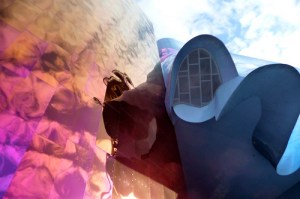
The Experience Music Project, Seattle photo by Flickr user Brad Coy
.
Back to menu
Saturday, January 7
Saturday, 7 January
.
10:15–11:30 a.m.
450. Digital Faulkner: William Faulkner and Digital Humanities
615, WSCC
Program arranged by the William Faulkner Society. Presiding: Steven Knepper, Univ. of Virginia
Speakers: Keith Goldsmith, Vintage Books; John B. Padgett, Brevard Coll.; Noel Earl Polk, Mississippi State Univ.; Stephen Railton, Univ. of Virginia; Peter Stoichef, Univ. of Saskatchewan
A roundtable on digital humanities and its implications for teaching and scholarship on the work of William Faulkner.
For abstracts, visit faulknersociety .com/ panels.htm
Discussions about digital projects and digital tools often focus on research goals. For this electronic roundtable, we will instead demonstrate how these digital resources, tools, and projects have been integrated into undergraduate and graduate curricula.
.
12:00 noon–1:15 p.m.
468. Networks, Maps, and Words: Digital-Humanities Approaches to the Archive of American Slavery
615, WSCC
A special session. Presiding: Lauren Klein, Georgia Inst. of Tech.
Lauren Klein, Georgia Inst. of Tech.,“‘A Report Has Come Here’: Social-Network Analysis in the Papers of Thomas Jefferson”
Cameron Blevins, Stanford Univ., “Slave Narratives in Space: Mapping the World of Venture Smith”
Aditi Muralidharan, Univ. of California, Berkeley, “Using Digital Tools to Explore Narrative Conventions in the North American Antebellum Slave Narratives”
Respondent: Amy Earhart, Texas A&M Univ., College Station
.
477. Postnational Readings of the Audiovisual
Aspen, Sheraton
Program arranged by the Division on Twentieth-Century German Literature and the Division on Film. Presiding: Nora M. Alter, Temple Univ.,Philadelphia; Deniz Göktürk, Univ. of California, Berkeley
Kalani Michell, Univ. of Minnesota, Twin Cities,“Sounds of the Berlin School”
Ian Thomas Fleishman, Harvard Univ., “International ‘Auditorism’: The Postnational Politics of Reading of von Donnersmarck’s The Lives of Others”
Jaimey Fisher, Univ. of California, Davis, “Surveying the Border Crossing: Terrorist Films and the Postnational Imaginary”
.
479. Digital Humanities in the Italian Context
Cedar, Sheraton
A special session. Presiding: Manuela Marchesini, Texas A&M Univ., College Station
Stefano Franchi, Texas A&M Univ., College Station, “Digital Humanities in the Italian Culture Landscape”
Alberto Moreiras, Texas A&M Univ., College Station, “Life and the Digital: On Esposito and Tarizzo’s Inventions of Life”
Massimo Lollini, Univ. of Oregon “Humanist Studies and the Digital Age”
Silvia Stoyanova, Princeton Univ., “Giacomo Leopardi’s Zibaldone: From Card Index to Hypertext”
For abstracts, write to mmarchesini@tamu.edu
.
484. Dissenting Voices
Columbia, Sheraton
Program arranged by the Division on ArabicLiterature and Culture. Presiding: Anouar Majid, Univ. of New England
Ibtissam Bouachrine, Smith Coll., “Why Moroccan Women Rebel”
Nouri Gana, Univ. of California, Los Angeles, “Hip- Hop Insurgency”
Olivier Bourderionnet, Univ. of New Orleans, “Building Bridges with Songs: Amazigh Kateb and Abd al-Malik”
.
499. Literary Multilingualism and Exile in Twentieth-Century Fiction
Ravenna C, Sheraton
A special session. Presiding: Salvatore Pappalardo, Rutgers Univ., New Brunswick
Celine Piser, Univ. of California, Berkeley, “Multilingualism and the Construction of a Hybrid Identity in Twentieth Century Judeo French Literature”
Hassan Melehy, Univ. of North Carolina, Chapel Hill, “Jack Kerouac’s Translingual Exile”
Maria Kager, Rutgers Univ., New Brunswick, “Ahksent on Last Syllable: Mispronunciation in Nabokov’s American Novels”
.
1:45–3:00 p.m.
506. Voice and Identity in Australian Literature
616, WSCC
Program arranged by the American Association of Australian Literary Studies. Presiding: Nathanael O’Reilly, Texas Christian Univ.
Jennifer McGovern, Univ. of Iowa, “Death by Torture in the Country of the Mind: Metaphors of Captivity and Freedom in Patrick White’s Voss (1957)”
Sarah Chihaya, Univ. of California, Berkeley, “The Un-death of Maggs: The Returned Convict as Revenant in Jack Maggs”
Nicholas Dunlop, Univ. of Birmingham, “Suburban Space and Multicultural Identities in Christos Tsiolkas’s The Slap”
Nathanael O’Reilly, Texas Christian Univ., “Rejecting Suburban Identity in George Johnston’s My Brother Jack”
..
522. The Seattle Sound
618, WSCC
Program arranged by the Division on Popular Culture. Presiding: Hillary L. Chute, Univ. of Chicago
Lindsay E. Waters, Harvard Univ. Press, “Theory Alone Nothing; Theory plus Dancing Change the World: The Seattle Sound of Sleater-Kinney and Hendrix”
John Melillo, New York Univ., “Nirvana: Noise and Empathy”
John McCombe, Univ. of Dayton, “Virginia Woolf in the Trailer Park: Isaac Brock; Nowhere, WA; and the Lonesome, Crowded West”
.
3:30–4:45 p.m.
539. # alt- ac: Alternative Paths, Pitfalls, and Jobs in the Digital Humanities
3B, WSCC
Program arranged by the Discussion Group on Computer Studies in Language and Literature. Presiding: Sara Steger, Univ. of Georgia
Speakers: Brian Croxall, Emory Univ.; Julia H. Flanders, Brown Univ.; Jennifer Howard, Chronicle of Higher Education; Matthew Jockers, Stanford Univ.; Shana Kimball, Univ. of Michigan, Ann Arbor; Bethany Nowviskie, Univ. of Virginia; Lisa Spiro, National Inst. for Tech. in Liberal Education
This roundtable brings together various perspectives on alternative academic careers from professionals in digital humanities centers, libraries, publishing, and humanities labs. Speakers will discuss how and whether digital humanities is especially suited to fostering non-tenure- track positions and how that translates to the role of alt-ac in digital humanities and the academy. Related session: “# alt- ac: he Future of ‘Alternative Academic’ Careers” (595).
.
5:15–6:30 p.m.
581. Digital Humanities versus New Media
611, WSCC
Alison Byerly, Middlebury Coll., “Everything Old Is New Again: The Digital Past and the Humanistic Future”
Andrew Pilsch, Penn State Univ., University Park, “As Study or as Paradigm? Humanities and the Uptake of Emerging Technologies”
David Robert Gruber, North Carolina State Univ., “Digital Tunnel Vision: Deining a Rhetorical Situation”
Victoria E. Szabo, Duke Univ., “Digital Humanities Authorship as the Object of New Media Studies”
For abstracts, visit www .duke .edu/ ~ves4/mla201
Saturday Individual Papers of Interest
Erich Nunn, Auburn Univ., Auburn, “Music, Race, and Nation in Johnson’s Autobiography,” 1:45–3:00 p.m., 307, WSCC
Leslie Petty, Rhodes Coll., “‘Every Woman . . . Should Raise Her Voice’: Rethinking White Women’s Activism in William Wells Brown’s Clotel,” 5:15–6:30 p.m., 307, WSCC
.

Flyer for a Seattle Phonographers Union Performance, For information on the artists' collective see http://www.seapho.org/
.
Back to menu
SUNDAY, January 8
Sunday, 8 January
.
8:30–9:45 a.m.
638. Gettin’ Around: Transnational Jazz Literature
618, WSCC
A special session. Presiding: Jürgen E. Grandt, Gainesville State Coll., GA
Rashida Braggs, Williams Coll., “From Harlem to Paris: A Transatlantic Interpretation of James Baldwin’s ‘Sonny’s Blues’”
Marc-Oliver Schuster, Univ. of Vienna, “Swinging Variety: Jazz in the Literature of the German Democratic Republic”
Aldon Lynn Nielsen, Penn State Univ., University Park, “The Transplanetary Nation Blues and the Abstract Truth”
Respondent: DoVeanna Sherie Fulton Minor, Univ. of Alabama, Tuscaloosa
For abstracts, write to jgrandt@gsc.edu.
.
10:15–11:30 a.m.
664. Sound and Voice in the Creative Writing Classroom: Practice-Based Pedagogies
614, WSCC
A special session. Presiding: Christopher Drew, Univ. of Wisconsin, Milwaukee
David Bartone, Univ. of Massachusetts, Amherst, “Avoiding Meaning: A Classroom Exercise to Improve Students’ Homophonic Sensibilities”
David Yost, Univ. of Wisconsin, Milwaukee“Into the Trenches: Breaking the Student-Author Binary with ‘Dulce et Decorum Est’”
Liane LeMaster, Georgia Perimeter Coll., North Campus, “Speciicity of Dialogue: A Coke Is a Soda Is a Pop Is a Cola”
.
665. Debates in the Digital Humanities
615, WSCC
A special session. Presiding: Alexander Reid, Univ. at Buffalo, State Univ. of New York
Matthew K. Gold, New York City Coll. of Tech., City Univ. of New York, “Whose Revolution? Toward a More Equitable Digital Humanities”
Elizabeth Mathews Losh, Univ. of California, San Diego, “Hacktivism and the Humanities: Programming Protest in the Era of the Digital University”
Jeff Rice, Univ. of Missouri, Columbia, “Twenty-First- Century Literacy: Searching the Story of Billy the Kid”
Jentery Sayers, Univ. of Victoria, “Why the Digital Humanities Needs Theory”
For abstracts and discussion, visit dhdebatesmla12.wordpress.com.
.
12:00 noon–1:15 p.m.
691. Gertrude Stein and Music
Cedar, Sheraton
Program arranged by the Lyrica Society for Word-Music Relations and the Association for the Study of Dada and Surrealism. Presiding: Jeff Dailey, Five Towns Coll.
Tanya E. Clement, Univ. of Maryland, College Park, “Sounding Stein’s Texts by Using Digital Tools for Distant Listening”
Judith A. Roof, Rice Univ., “Gertrude’s Glee and Jazz Mislaid Jazz”
Brandon Masterman,Univ. of Pittsburgh, “‘This Is How hey Do Not Like It’: Queer Abjection in Gertrude Stein and Virgil Thomson’s Four Saints in Three Acts”
.
716. Digital Material
613, WSCC
A special session. Presiding: Charles M. Tung, Seattle Univ.; Benjamin Widiss, Princeton Univ.
Speakers: Paul Benzon, Temple Univ., Philadelphia; Cara Elisabeth Ogburn, Univ. of Wisconsin, Milwaukee; Charles M. Tung; Benjamin Widiss; Zachary Zimmer, Virginia Polytechnic Inst. and State Univ.
Is there gravity in digital worlds? Moving beyond both lamentations and celebrations of the putatively free- loating informatic empyrean, this roundtable will explore the ways in which representations in myriad digital platforms—verbal, visual, musical, cinematic—might bear the weight of materiality, presence, and history and the ways in which bodies—both human and hardware—might be recruited for or implicated in the efort.
For abstracts, write to bwidiss@princeton.edu
.
1:45–3:00 p.m
736. Close Playing: Literary Methods and Video Game Studies
University, Sheraton
A special session. Presiding: Mark L. Sample, George Mason Univ.
Speakers: Edmond Chang, Univ. of Washington, Seattle; Steven E. Jones, Loyola Univ., Chicago; Jason C. Rhody, National Endowment for the Humanities; Anastasia Salter, Univ. of Baltimore; Timothy Welsh, Loyola Univ., New Orleans; Zach Whalen, Univ. of Mary Washington
This roundtable moves beyond the games-versus-stories dichotomy to explore the full range of possible literary approaches to video games. These approaches include the theoretical and methodological contributions of reception studies, reader-response theory, narrative theory, critical race and gender theory, disability studies, and textual scholarship.
For abstracts, visit www .samplereality .com/ mla12.
745. Affecting Affect
615, WSCC
A special session, Presiding: Lauren Berlant, Univ. of Chicago
Speakers: Ann L. Cvetkovich, Univ. of Texas, Austin; Neville W. Hoad, Univ. of Texas, Austin;Heather K. Love, Univ. of Pennsylvania; Tavia Nyong’o, New York Univ.
For a list of questions for roundtable participants (and the potential interlocutors from the audience), visit www.supervalentthought.com.
.
Sunday Individual Papers of Interest
Toni Wall Jaudon, Ithaca Coll., “Sound and Separateness: The Hindu Widow’s Cries in Early-Nineteenth-Century United States Print Culture,” 1:45–3:00 p.m., 304, WSCC

Grunge: One of Seattle's Signature Sounds, Photo by Flickr User Sands
Share this:

Sound at SEM/CORD 2011
Sound Studies has been celebrated, as Kara Keeling and Josh Kun recently pointed out in American Quarterly, as both the result of and inspiration for an increasing number of scholars, who “not only take the culture, consumption, and politics of sound seriously but are making it the centerpiece of their research, publishing, and pedagogy.” But what significance does Sound Studies hold for ethnomusicology, a discipline that for over half a century has focused directly on the social and political dimensions of what John Blacking famously called “humanly organized sound”? This question will be one of many circulating in Philadelphia this week at the 56th annual meeting of the Society for Ethnomusicology (SEM).

The Heart of Baltimore Avenue, a mural with accompanying sound broadcast at 91.3 FM.
Despite the centrality of ethnographers of music, including Steven Feld and Veit Erlmann, to the emergence of this new interdisciplinary body of knowledge, many ethnomusicologists saw room for greater dialogue with other disciplines for whom the sonic was a relatively novel epistemological filter. To this end, in early 2009 a group of young SEM members formed the Sound Studies Special Interest Group (SSSIG) in order to foster cross-disciplinary discussions and highlight work within SEM that reimagined sound beyond “the music itself.” This year’s conference will mark the end of my tenure as co-chair of the Sound Studies SIG, and elections will be held for a replacement at our annual lunch meeting on Thursday, November 17th. If you are interested in joining the group and can attend the conference, please join us. If you can’t make it to Philadelphia, you can still join the group’s active discussion forum.
The past few years have witnessed an increasing number of presentations at SEM that fall under the umbrella of Sound Studies, a trend acknowledged in the theme of last fall’s meeting in Los Angeles, “Sound Ecologies.” This year is no different, and from a preliminary glance at the program, I have taken the liberty of highlighting a few acoustic currents running throughout the conference. A large number of panels this year are devoted to issues of embodiment, which can, for the most part, be attributed to the fact that SEM has paired up with the Congress on Research in Dance (CORD) for a joint conference. In the summary below I have noted which group is sponsoring each panel listed, although the conference requires only one registration and all panels are open to all participants and attendees.

Pandemonium, a 2005 sound installation at the Eastern State Penitentiary
The theme of this year’s joint conference is “Moving Music / Sounding Dance: Intersections, Disconnections, and Alignments between Dance and Music.” Many of this year’s panels focus on the relationship between sound and bodies, including embodied practices in music and dance and bodily communications of carnality, empathy and affect, and music and movement, for example. The voice is also prominent this year, in panels on its relationship to the body and music, dance performance in the Pacific Islands, pedagogy and practice, and female Iranian vocalists in exile. As in other years, the relationship between ethnomusicology and medicine is also represented, as are music’s connection to healing and the sporting body.
Technology, another area of interest for Sound Studies, will receive thorough attention this year. Panels on techno-mediated performance, sound and technology, online gamespaces and prosthetic technologies of queer expression, and material culture and labor.
Looking beyond sound toward intersensoriality, many panels discuss the relationship between the aural and other senses, in terms of music visualization, sound, sight and time, ethnographic film, and sensing movement and sound in dance.

- The Painted Bride Art Center
Two events that promise to be of special interest will focus on language, one a roundtable on keywords in music and motion, the other a panel on the lexicon of music, noise, sound, and silence.
A number of panels hearken back to early work on soundscapes, from discussions of field recordings and ethnography and gender and negotiating space, to the sounds of post-industrial society, protest and public spaces, and boomboxes and dance parties. My last official duty as SSSIG co-chair will be to lead a soundwalk through Philadelphia’s city center. This soundwalk is an event that the SSSIG would love to see annually as a way to connect meetings to their immediate environs.
All in all, this year’s joint conference promises to be an enjoyable one, with plenty of fascinating presentations and more good music than you can shake a tailfeather at. Even if you can’t attend, you can follow along virtually on twitter. Both #SEM2011 and #2011SEM seem to be in use.
—
Bill Bahng Boyer is co-chair of the Society for Ethnomusicology Sound Studies Special Interest Group and a lecturer in music, writing and rhetoric at Dartmouth College. He is also a doctoral candidate in music at New York University, completing a dissertation on public listening in the New York City subway system.
Jump to FRIDAY, November 18
Jump to SATURDAY, November 19
Jump to SUNDAY, November 20

THURSDAY PANELS
8:30 am -10:30 am
Sounding Religion in the Public Sphere
SEM: 1E Freedom Ballroom (Section F) Chair: Monique M Ingalls, Rutgers University
Monique M Ingalls, Rutgers University. Worship in the Streets: Performing Religion, Nation, and Ethnicity through Music in Toronto’s Jesus in the City Parade
Carolyn Landau, King’s College London. Pluralism, Tolerance and Engagement with the “Mainstream”: Navigating Ismaili-Muslim Identities in Public Musical Performances
David M Kammerer, Brigham Young University-Hawaii. Anything But a “Silent Night”: Tonga’s Royal Maopa Brass Band and the Tradition of Christmas Eve Serenading
Deborah Justice, Indiana University. When Sacred Space becomes Secular Space: How a Church’s Saturday Dinner Show for Charity Eases Sunday Morning Tensions
.
Recovering and Composing Hybridity through Histories of Music and Violence
SEM: 1I Salon 5/6 Chair: Jessica A Schwartz, New York University
Jessica A Schwartz, New York University. Between Continuity and Disruption: Strategic Hybridity in the Musical Activism of Rongelapese Women
T. Christopher Aplin, independent scholar. Martial Cosmopolitans: Apache War and Song Beyond Borders during the “Loco Outbreak”
Kristy Riggs, Columbia University. Musical Fabulation and the Retelling of Violence in 1840s Algeria
Sarah McClimon, University of Hawaii at Manoa. War Memories Revisited: Hybrid Nationalism and Discourses of Cultural Purity in Japanese Military Song Festivals
.
Dancing Matter(s): Embodied Practices in Music and Dance
SEM: 2A Freedom Ballroom (Section E), Live Video-Streaming Room Chair: Tomie Hahn, Rensselaer Polytechnic Institute
Tomie Hahn, Rensselaer Polytechnic Institute. Dancing with Sensible Objects
Sean Williams, Evergreen State College. Dancing with the Drum: Teaching and Learning Sundanese Jaipongan
Sally Ann Ness, University of California, Riverside. Dancing Instruments; Objectivity in Musical Performance
.
Vocal Epistemologies: Bodies, Pedagogy, Practice
SEM: 2H Salon 3/4 Chair: Robert O Beahrs, University of California, Berkeley
Robert O Beahrs, University of California, Berkeley. Echoing through the Nine Skies: Embodied Knowledge Production in Tuvan Throat-Singing Pedagogy
Marti Newland, Columbia University. Cocolo Japanese Gospel Choir: Mediating Spiritual and Racial Difference through Vocal Adduction
Sumitra Ranganathan, University of California, Berkeley. Dwelling in my Throat: Sound and Experience in a North Indian Classical Dhrupad Tradition
.
Local Philadelphia Communities
CORD: Independence Ballroom D
Laura Vriend. Sufjan Stevens and the Magic Snowflake: Sound and Spatiality in Headlong Dance Theater’s Explanatorium
Christine Dang. My Laudations Shorten for me the Journey to the Saints’: The Poetics of Exile in an Islamic Community of Philadelphia
Abimbola N. Cole. Welcome to the United Stated of Africa: Kwame Nkrumah’s Philadelphia Years, African Nationalism, and Hip-Hop Perspectives on Unity in the New Africa
.
Sacred Journeys, Spaces, Sounds
CORD: Logans 1
Andrea Mantell Seidel. Sacred Sound: Tuning the Cosmic Strings of the Subtle Dancing Body
Emily Wright. Sacred Spaces: History and Practice in Christian Sacred Dance
Lizzie Leopold. Voyager, A Journey into Our Outer Spaces: A Choreographic and Scholarly Exploration
.
1:45-3:45pm
Techno-Mediated Performance: Virtual, Visceral, Spectacular
SEM: 3E Freedom Ballroom (Section F) Chair: Kiri Miller, Brown University
Kiri Miller, Brown University. Virtual Transmission, Visceral Practice: Dance Central and the Cybershala
J. Meryl Krieger, Indiana University-Purdue University Indianapolis. From Live Performance to Mashup: Mediated Performance in Popular Music
Judith Hamera, Texas A&M University. Dances with Zombies: Michael Jackson and Movement in the Age of Post-Industrial Reproduction
Sydney Hutchinson, Syracuse University. Downloading Dance: OK Go, YouTube, and the Future of Pop
Gendered Intimacies and Musical Negotiations of Space
SEM: 3F Freedom Ballroom (Section G) Chair: Ian R MacMillen, University of Pennsylvania
Anna Stirr, St. John’s College, University of Oxford. Sensuality, Exchange, and Violence in Nepali Nightclubs
Gavin Steingo, Columbia University. On the Sonic Politics of Spinning
Ian R MacMillen, University of Pennsylvania. Conscription into Intimacy: Young Men, Power, and the Gendered Inclusion of Croatian Tambura Musicians
Jane Sugarman, CUNY Graduate Center, Discussant
.
Round Table – Sound and Sense in the Muslim World: The Politics of Listening
SEM: 3J Parlor A Chair: Deborah Kapchan, New York University
Jonathan Glasser, College of William and Mary
Rich Jankowsky, Tufts University
Galeet Dardashti, independent scholar
Deborah Kapchan, New York University
Michael Frishkopf, University of Alberta
.
THURSDAY INDIVIDUAL PAPERS
Noel Lobley, University of Oxford, Pitt Rivers Museum. Recording, Remembering and Using the Sounds of Africa
2:15 SEM: 3H Salon 3/4
Gregory Weinstein, University of Chicago. An “Acoustically Perfect Hall”?: Engineering Space in Classical Recordings
3:15 SEM: 3H Salon 3/4
.

Philadelphia Record Exchange
EVENTS
SEM Sound Studies Special Interest Group Meeting
12:30 pm – 1:30 pm Salon 5/6
SEM Audio Visual Committee
12:30 pm – 1:30 pmFreedom Ballroom (Section G)
SEM Student Open Meeting, Sponsored by the Student Concerns Committee
12:30 pm – 1:30 pm Independence Ballroom (Section A)
SEM SSSIG Philadelphia Soundwalk
Led by Bill Bahng Boyer, SSSIG co-chair
4:00 pm – 5:30 pm 4K Hotel Lobby
SEM/CORD Joint First-Time Attendees and New Members Reception
5:30 pm – 6:30 pm Horizons Rooftop Ballroom
.

Philadelphia native Fresh Prince
FRIDAY PANELS
8:30 pm -10:30 pm
Round Table— Keywords of Music and Motion
SEM: 5D Independence Ballroom (Section C) Chair: Christina Zanfagna, Santa Clara University
Christina Zanfagna, Santa Clara University
Jason Stanyek, New York University
Melvin Butler, University of Chicago
Tamara Roberts, University of California, Berkeley
Martin Daughtry, New York University
.
Intimately Political: Bodily Communications of Carnality, Empathy and Affect in Dance Practices and Criticism.
CORD: Freedom Ballroom H
Evandne Kelly. Embodied Affects of Nationalism and Ethnicity in the Dances of Fijian Diasporas in Canada
Emma Doran. Dancing in Your Seat: Reading Empathy in Print Media
Shawn Newman. It’s all in the hips: Sexual and Artistic Minority in Canadian Concert Jazz Dance
.
10:45am-12:15pm
Rethinking Music Visualization
CORD: Independence Ballroom D
Paul Scolieri. Ruth St. Denis, Walter Benjamin, and the Mimetic Faculty
Daniel Callahan. Absolutely Unmanly: The Music Visualizations of Ted Shawn and His Men Dancers
Stephanie Jordan. Troubling Visualisations: Mark Morris Marks the Music
.
1:45-3:45pm
Sounds of Difference and Recognition: Music, Interculturalism, and Belonging in the European Nation-State
SEM: 7C Independence Ballroom (Section B) Chair: Benjamin Teitelbaum, Brown University
Joshua Tucker, Brown University. New Latinos in the Old World: Music, Multiculturalism, and Ethnogenesis in a Changing Spain
Benjamin Teitelbaum, Brown University. Unity Intoned: Music and the Rhetorical Paradoxes of Swedish Radical Nationalism
Adriana Helbig, University of Pittsburgh. The Influence of Paul Robeson?s Musical Legacy on Soviet and Post-Soviet Racial Ideologies
Timothy Rice, University of California, Los Angeles. Discussant
.
SEM: 7I Salon 5/6 Chair: Leslie Gay, University of Tennessee, Knoxville
Trevor S Harvey, Florida State University. Live from Second Life: Social Actualization through Musical Participation in Virtual Worlds
Alan Williams, University of Massachusetts, Lowell. All Hands On Deck: Choreographed Intimacy in the Analog Mixing Process
Tim Miller, University of North Carolina at Chapel Hill. Instruments as Technology: Co-constructing the Pedal Steel Guitar
Lauren Flood, Columbia University. Arduino Revolution: Hacking the Way to New Sounds and Moveable Art with Open Source Technology
.
SEM: 7J Parlor A Chair: Elizabeth Tolbert, Peabody Conservatory, Johns Hopkins University
Max M Schmeder, Columbia University. At One With One’s Instrument: Transcending the Body-Instrument Divide
Katherine L Meizel, Bowling Green State University. Hearing Voices: Toward a Model for the Study of Vocality
Peter Williams, University of Kansas. Docile Bodies Improvising: Gender and Constraint in Improvised Music and Movement
John R Pippen, University of Western Ontario. Moving New Music: Disrupting the Mind/Body Divide in Western Art Music
.
CORD: Independence Ballroom D
Toni Shapiro-Phim. A Sacred Melody and Innovative Choreography in Cambodia
Karen Schaffman. Kinesthetics of Crying and Soundtracks of Tears: Performing Grief in Works by Deborah Hay and Ralph Lemon
Carlos Odria. Improvising Transcendence for Health and Healing: Spontaneous Sounds and Bodies in a Dance Composition Class
Rodrigo Caballero. Sound, healing and the body: acoustemologies of health in the Pacific Northwest
.
4:00-5:30
The Body in Flow: Sport as Dance
SEM: 8A Freedom Ballroom (Section E), Live Video-Streaming Room Chair: Jonathan M Dueck, Duke University
Jonathan M Dueck, Duke University. The Big Dance: Sound, Gender, and Flow in Collegiate Basketball
Timothy J Cooley, University of California, Santa Barbara. To Surf is to Dance: Hawaiian Mele and Hula and the History of Surfing
Judy Bauerlein, California State University, San Marcos. A Wave is A Body In Motion
.
SEM: 8E Freedom Ballroom (Section F) Chair: Gregory Barz, Vanderbilt University
William Cheng, Harvard University. Acoustemologies of the Closet: Online Gamespaces and Prosthetic Technologies of Queer Expression
Sarah E Hankins, Harvard University. “The Disguise Will Never Work All the Way”: Realness, Queerness and Music in a Gender Performance Community
Mark D Swift, Washington and Jefferson College. Dance Style, Masculine Identity, and the Gay Ethnographer in a Suburban Brazilian Scene
.
Sounding Bodies, Moving Voices: Dance Performance in the Pacific Islands
SEM: 8F Freedom Ballroom (Section G) Chair: Adrienne Kaeppler, Smithsonian Institution
Jane Freeman Moulin, University of Hawai’i at Manoa. The Dancer’s Voice
Lisa Burke, Framingham State University. “A Wind that Penetrates the Skin”: Understanding Kiribati Music through Dance
Brian Diettrich, New Zealand School of Music. Stirred Spirits, Adorned Bodies: Sound and Gesture in Chuukese Community Performances
.
Issues of Representation and Presentation in Public Culture Media Production
SEM: 8G Logans 2 Chair: Clifford R Murphy, Maryland State Arts Council
Clifford R Murphy, Maryland State Arts Council. Visiting With Neighbors: Fieldwork on Radio in Maryland
Nathan Salsburg, Lomax Archives/Association for Cultural Equity. Folk Revival 2.0: Presenting and Representing Vernacular Music in 2011
Maureen Loughran, Tulane University. Five Years After the Storm: Authority and Public Engagement in Radio Production
.
Louise J Wrazen, York University. The Displaced Voice: Assertions of Selfhood and Belonging Amidst Change
9:00 am SEM: 5H Salon 3/4
Sharon F Kivenko, Harvard University. Listening for the Call and Knowing When to Come In: “Performance Sociability” in Mande Dance
9:30 am SEM: 5I Salon 5/6
Farzaneh Hemmasi, Hunter College. At a Distance: Voice, Dance, and Display among Female Iranian Vocalists in Exile
2:15 pm SEM: 7E Freedom Ballroom (Section F)
Chun-bin Chen, Tainan National University of the Arts. Hybridity in Taiwanese Aboriginal Cassette Culture
4:30 pm SEM: 8C Independence Ballroom (Section B)
Samuel Araujo, Universidade Federal do Rio de Janeiro. Amidst Walls, Wired Fences and Armored Cars: The Sound Heritage of Post-Industrial Society
5:00 pm SEM: 8K Parlor C

The Sun Ra Arkestra House
EVENTS
British Forum for Ethnomusicology High Tea Party
5:30 pm – 6:30 pm Liberty D
The Drexel University Mediterranean Ensemble Presents
A Mostly Balkan Party . . . Philly Style
7:30 pm – 9:30 pm The Stein Auditorium, Drexel University Campus 3215 Market St.
A.J. Racy and The Arabesque Music Ensemble in Concert
Presented by Al-Bustan Seeds of Culture
8:00 pm – 10:00 pm Trinity Center for Urban Life, 22nd and Spruce Streets
Dance Workshop: Sound and Vibrational Signals in Buto Dance
Led by Tanya Calamoneri
8:00 pm – 10:00 pm Independence Ballroom D, free to all registered CORD attendees
Dance Workshop: Singing Dance and Sensing Sound
Led by Amy Larimer
8:00 pm – 10:00 pm Salon 10, free to all registered CORD attendees
SEM Dance Section, CORD and CCDR Reception
10:00 pm – 11:00 pm Salon 5/6 (Free to all registered attendees)
.
SATURDAY PANELS
8:30-10:30am
Listening to the Field: Sonic Presentations of Ethnographic Material
SEM: 9A Freedom Ballroom (Section E), Live Video-Streaming Room Chair: Ben Tausig, New York University
Ben Tausig, New York University. Playing Under Protest: Diffusion and Decay
Mack Hagood, Indiana University. Audio Production as SEO Services: Sounds and Stories in the Path of I-69
Senti Toy Threadgill, New York University. Voice in the Box: The Politics of Affect and Acoustemology in Nagaland
Deborah Wong, University of California, Riverside. Discussant
.
Engaging Ethnomusicology and the Health Sciences
SEM: 9D Independence Ballroom (Section C) Chair: Frederick J Moehn, New York University
Theresa A Allison, University of California, San Francisco; Jewish Home, San Francisco. Music and Memory, Dementia and Song: Engaging the Health Sciences in Research on Music, Memory and Relationships
Heather B White, University of California, Berkeley. You are the Music, While the Music Lasts: The Neuroscience Behind Social Music Production and Identity
Jeffrey W Cupchik, Eastman School of Music, University of Rochester. Teaching Medical Ethnomusicology: Engaging the Science(s) of Healing
Dane Harwood, independent scholar. Integrating Quantitative Methodology in Ethnomusicological Research: The Challenges to Moving towards Reproducible Results
.
Music, Sound, Noise, Silence: Towards A Conceptual Lexicon
SEM: 9H Salon 3/4 Chair: Matt Sakakeeny, Tulane University
Matt Sakakeeny, Tulane University. Music
Thomas Porcello, Vassar College. Sound
David Novak, University of California, Santa Barbara. Noise
Ana María Ochoa, Columbia University. Silence
.
Music in Oman: Interculturalism, Time, Space, and Politics in the Sultanate
SEM: 9I Salon 5/6 Chair: Anne K Rasmussen, College of William and Mary
Anne K Rasmussen, College of William and Mary. The Musical Design of National Space and Time in Oman
Nasser Al Taee, Oman Royal Opera House. Mozart in Muscat: Politics, Performance, and Patronage in Oman
Majid Al Harthy, Sultan Qaboos University. African Identities, Afro-Omani Music, and the Official Constructions of a Musical Past
Salwa El-Shawan Castelo-Branco, Universidade Nova de Lisboa, Portugal. Discussant
.
The Commercial, the Popular, and the Crazed
CORD: Independence Ballroom D
Mary Fogarty. Musical Tastes in Popular Dance Practices
Mary Elizabeth Anderson. Oprah Feelin’: The Commercial Flash Mob’s Affective Game
Jennifer Fisher. When Good Adjectives Go Bad: “Lyrical Dance,” Romanticism, Brain Science, and the Competition Dance Machine
Ok Hee Jeong. The politics of Korean Wave
Asheley Smith. “Crank That”: The Work of Dance Crazes as Collective Memory and in Mechanical Reproduction
.
CORD: Freedom Ballroom H
Candace Bordelon. Finding “the Feeling” Through Movement and Music: Oriental Dance, Tarab, and Umm Kulthum
W. Eric Aikens. Using Entropy as a Measure of the Dispersal of Temporal Energy in the Music/Dance Relation
Stephanie Schroedter. Music as Movement – “Kinesthetic listening” in the Creation and Reception of Dance
Wendy Rogers. Dancing in a Sound Space
.
The Sonic, the Visual, and the Temporal
CORD: Salon 10
Freya Vass-Rhee. The sounds (and sights) of silence: William Forsythe’s compositions of quiet
Allen Fogelsanger. The Play of Visual and Sonic Actions: Watching Dance and Music
Wen-Chi Wu. Beyond Spontaneity Acquired Through the Lived “Habit-Body” vis-à-vis Performing Techniques
.
10:45-12:15
SEM: 10F Freedom Ballroom (Section G) Chair: Daniel Reed, Indiana University
Kate Galloway, University of Toronto. Ecological Auditory Culture: The Relationship Between Ethnographic Soundscape Composition and How We Listen to the Environment
Devin M Burke, Case Western Reserve University. Sign Language Music Videos: Analyzing Embodied Musicking in a Culturally Hybridistic and Technologically Mediated Audio/Visual Artform
Leona N Lanzilotti, Eastman School of Music. Musical Theatre of the Deaf and Hearing: Understanding Musical Embodiment in a Mixed-Cast Production of Guys & Dolls
.
SEM: 10H Salon 3/4 Chair: Beth K Aracena, Eastern Mennonite University
Rebecca A Schwartz-Bishir, independent scholar. Music that Moves: Musique dansante and the Sensory Experience of the Dancing Body
Lynda Paul, Yale University. Liveness Reconsidered: Sound and Concealment in Cirque du Soleil
Beth K Aracena, Eastern Mennonite University. Towards a “Natural History” of Corpus Christi Processions in the New World
.
INDIVIDUAL PAPERS OF INTEREST
Donna A Buchanan, University of Illinois, Urbana-Champaign. Choreographic Encounters of an Ethnomusicological Kind: Sound, Movement, Spirituality, and Community where the Balkans and Caucasus Converge
9:00 SEM: 9G Logans 2
Rachel Goc, University of Wisconsin, Madison. Global Practices of Motown Visual and Sonic Aesthetic
9:30 SEM: 9F Freedom Ballroom
Michael S O’Brien, Luther College. This is What Democracy Sounds Like: Mediation and Performativity in the Soundscapes of the 2011 Wisconsin Pro-Labor Protests
11:15 SEM: 10J Parlor A
Corinna S Campbell, Harvard University. Sounding the Body, Dancing the Drum: Integrated Analysis of an Afro-Surinamese Performance Genre
11:45 SEM: 10A Freedom Ballroom (Section E), Live Video Streaming Room
Rachel Mundy, Columbia University. O Bird of the Morning: Sound, Silence, and Information at the Species Boundary
11:45 SEM: 10K Parlor C
.
EVENTS
SEM Seeger Lecture
Randy Martin: “Complex Harmonic Movements: Politicalities of Music and Dance”
4:00 pm – 5:30 pm Liberty Ballroom B, C and D
PhillyBloco Dance Party
7:30 pm – 10:30 pm Liberty Ballroom B, C, and D
(Ticket Required – $10.00 per attendee in advance or $15.00 per attendee at the door)

SUNDAY, November 20, 2011
SUNDAY PANELS
8:30-10:30am
Musical Advocacy: Mediation, Creativity, and Social Engagement
SEM: 12A Freedom Ballroom (Section E), Live Video-Streaming Room Chair: Carol Muller, University of Pennsylvania
Marié Abe, Harvard University. Reimagining Oaxacan Heritage through Accordions and Airwaves in Central Valley, California
Michael Birenbaum-Quintero, Bowdoin College. Process, Network, and Knowledge: Theory and Praxis of a Grassroots Music Archive in the Afro-Colombian Hinterlands
Shalini R Ayyagari, American University. “Postcards from Paradise Weren’t Meant for Me”: Community Affiliation and Advocacy Work through South Asian American Hip Hop
Kay Shelemay, Harvard University. Discussant
.
Material Culture and Musical Labor
SEM: 12C Independence Ballroom (Section B) Chair: Allen Roda, New York University
Allen Roda, New York University. Resounding Objects: Scripting Sounds and Making Music in Banaras Tabla Workshops
Darien Lamen, University of Pennsylvania. Crafting Sound: Sound Systems, Skilled Labor, and Artisanship in Belém do Pará, Brazil
John Paul Meyers, University of Pennsylvania. Stickers, Strings, and Sgt. Pepper Jackets: Resources for Re-Creating the Past in the Tribute Band Scene
Paul Greene, Pennsylvania State University. Discussant
.
Screening and Round Table—From Fieldwork to “Film-work”: Representing Realities Through Ethnomusicological Film
SEM: 12F Freedom Ballroom (Section G) Chair: Elizabeth Clendinning, Florida State University
Discussants
Tim Storhoff, Florida State Univeristy
Todd Rosendahl, Florida State Univeristy
Sara Brown, Florida State Univeristy
Kayleen Justus, Florida State Univerisity
.
SEM: 12H Salon 3/4 Chair: Ken Prouty, Michigan State University
Brett S Pyper, Klein Karoo National Arts Festival, South Africa. Listening Made Visible: Dance as Kinetic Listening Within South African Jazz Appreciation Societies
Yoko Suzuki, University of Pittsburgh. She’s a Japanese Jerry Lee Lewis!: Body, Mind, and Spectacle in Hiromi’s Jazz Piano Performance
Michael C Heller, Harvard University. Modeling Community in the Loft Jazz Era
Colter J Harper, University of Pittsburgh. Jazz, Race, and the Visual Narrative: Constructing Identity through the Photography of Charles “Teenie” Harris
.
Modes of Analysis, Modes of Listening
SEM: 12G Logans 2 Chair: Matt J Rahaim, University of Minnesota
Shayna Silverstein, University of Chicago. Microrhythms and Metric Variation in Groove-Based Dance Music of the Arab East
Cornelia Fales, Indiana University. Provoking Modal Listening In Music
Mark Hijleh, Houghton College. World Music Theory: Issues and Possibilities
Michael Tenzer, University of British Columbia, and Matt J Rahaim, University of Minnesota. Discussants
Round Table: Ethnicity, Culture and Body
CORD: Freedom Ballroom H
Dr. Suzana Martins, Dr. Daniela Amoroso, MA. Nadir Nóbrega, Sandra Santana
.
INDIVIDUAL PAPERS OF INTEREST
Marc Gidal, Ramapo College of New Jersey. Audible Boundary-Work: “Crossing” and “Purifying” Afro-Gaucho Religions through Sound and Music
8:30 am SEM: 12I Salon 5/6
Michael B MacDonald. Decentralized Dance Party Manifesto: Boomboxes, Anarchy, and the Commons
10:00 am CORD: Independence Ballroom D
Emily J McManus, University of Minnesota. Listening to a Body and a Sound: Female Leading and Same-Sex Tango in the United States
11:15 am SEM: 13B Independence Ballroom (Section A)
Michael O’Toole, University of Chicago. How the City Sounds: Festivals and Urban Space in Contemporary Berlin
11:45 am SEM: 13I Salon 5/6

Liberty Bell
Share this:


Current Top Posts





April 2021

January 2020

November 2019

October 2019

August 2019

April 2014

November 2017

March 2015

December 2017

October 2015
 Sounding Out!
Recent Comments