
SO! Amplifies: #hearmyhome and the Soundscapes of the Everyday
 SO! Amplifies. . .a highly-curated, rolling mini-post series by which we editors hip you to cultural makers and organizations doing work we really really dig. You’re welcome!
—
Pause for a moment.
Listen.
What do you hear?
Is it the quiet hum of a furnace or fan? Perhaps the muffled chatter of your colleagues or children down the hall? Can you hear sirens or birds or the passing of a car or train? Likely, these are sounds that, over time, you have learned to tune-out. Perhaps you have even complained about such ‘noise’ as something that distracts you from your work or disrupts you from your sleep.
But are these sounds really just noise? What would it mean to move beyond hearing such sounds as noise and instead (re)learn to listen to these soundscapes of the everyday as representative of community?
From February to April of 2016, #hearmyhome encourages users to play, innovate, and compose soundscapes through a series of eight sonic events. In doing so, our goal is to help users ‘tune-in’ to their everyday surroundings. By (re)learning to listen to the sounds that surround them, participants may begin to better understand community. In other words, #hearmyhome considers how hearing difference and listening to community may (re)educate our senses by attuning to the rhythms and reverberations of culture.
Prefer an Audio Overview? Listen here and follow us on SoundCloud!
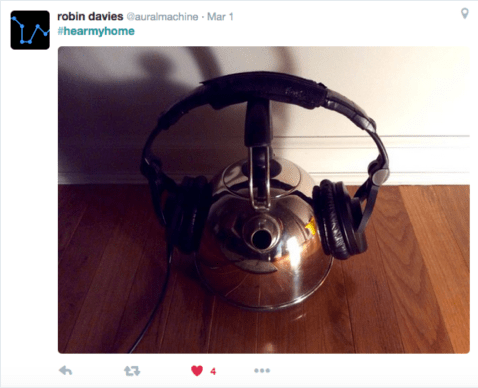
User example from Sonic Event #4: Visualizing Listening
Currently in its earliest phases, #hearmyhome, led by Jon M. Wargo and myself, explores how choosing to ‘tune-in’ facilitates not only an increased awareness of the acoustic territories and rhythmic rituals which surround us, but also the impact of such sonic experiences on our bodies. In doing so, #hearmyhome interrogates how, with and through sound, people write and compose community.
Each of us became interested in studying soundscapes through different avenues. For Jon, his interest in sound and sonic composition emerged from his longitudinal ethnographic examination of LGBT youth writing with mobile media. Sound was a medium used by many of the young people to architect experience and write community. As a traditionally neglected mode, he was curious how historically marginalized youth (LGBT youth of color) used sound to compose counter-narratives of self and community.
Sparked by travels abroad, I first began capturing soundscapes while in Indonesia during Ramadan. Using Snapchat’s video tool, I not only captured the sounds of the call to prayer, but also sounds across Southeast Asia—from the busy streets of Jakarta to the dropping of coins into the 108 bowls within the Temple of Reclining Buddha in Bangkok, Thailand. Through these sonic experiences, I began to question how sound might be used by educators and youth to explore difference and diversity amongst local and global communities.
Developing materials on a multitude of scales—from local community asset maps in teacher education classes to the larger collaborative of networked sounds—each is created with the goal of hearing, recognizing, and sustaining community. #hearmyhome takes heed of the frequencies and rhythms of culture in hopes to architect, design, and teach towards equitable landscapes for learning. Refracted through the aural perspective, we see sound re-teaching the senses by working with participants to compose constructs like ‘home’ and ‘place.’ Geared towards PK-16 teachers and students, #hearmyhome is a pedagogical endeavor. Yet, as a research project, we are interested in examining the following research questions: What are the soundscapes of a networked collaborative? How do users and participants compose with sound, attune towards difference, and write with place?
Towards a Networked Vision for Tuning-In to Sound
#hearmyhome’s vision is guided by three central tenets: collaboration, pedagogy/praxis, and research
Collaboration
Focusing on “everyday” cultural heritage, #hearmyhome invites youth and adult participants to “earwitness” community through expansive personal learning networks (PLN). At the conclusion of the sonic events, participants’ soundscapes and ambient acoustics will be archived on an open-networked soundscapes map. We hope that these will be accessed as curricular resources for youth and teachers globally. #hearmyhome is an “affinity space” wherein participants share both knowledge and life experiences (hosted and inspired through their sonic events series). Through this map, for instance, a teacher in Montana may have access to the sounds of Chicago’s subway while simultaneously youth in Michigan may opt to write with the sounds of a kookaburra captured by second graders in Australia. Ideally, an “affinity space” helps to form interpersonal relationships and collaboratively create a fuller understanding of community and culture for participants. As the community expands through new partnerships and members, we hope it serves as a hub connecting participants with research opportunities, (g)local initiatives—integrating and making the more global knowledge local—and online resources and tools.
Pedagogy/Praxis
One of #hearmyhome’s larger goals is to develop curricular materials for teachers via the collaborative network and shared space on writing with and through sound. As an “open” project, resources will be shared widely via the #hearmyhome website as well as across our social media platforms as we hope to develop powerful practices of hearing, listening, and witnessing sound across communities. Interested in contributing? While our sonic events are available now, throughout the summer #hearmyhome’s homepage will be updated with additional curricular resources. If you are an educator, please consider contributing to this crowd-sourced effort. Join us by signing up for our weekly emails here or like our page on Facebook for more information on each sonic event, or simply ‘lurk and learn’ by following the #hearmyhome hashtag across Instagram, Facebook, and Twitter!
Research
Supported by the Cultural Heritage Informatics Fellowship and the National Council of Teachers of English’s Conference on English Education Research Initiative, #hearmyhome explores the sonic possibilities of writing with sound. We use sound to amplify what Steph Ceraso calls “multimodal listening,” or attending to the bodily, material, and contextual aspects of sonic interactions and relations. Sound allows for more expansive understandings of space, place, and self. We decided to hang our research on the hashtag, #hearmyhome, to aggregate data because it allows us to index user-produced soundscapes while attending to the wider goal of exploring the multiple homes of our global participants. The research component of the project investigates how the acoustic territories of the everyday write culture. For example, how might the writing of a ‘Where I’m From…’ poem shift if one does not choose to write using alphabetic print, but instead chooses to use sound? However, #hearmyhome by its very nature is open to everyone regardless of participation in the formal “research” study. Researchers will always seek members’ consent before sharing any work beyond the online community networked collaborative. For more on this, please see our standards of research statement.
Follow Along with #hearmyhome’s Sonic Events
https://twitter.com/allievoigt/status/701785249454247936
Joining #hearmyhome is as simple as opting in to our sonic events. To do so, visit the #hearmyhome homepage and select “Sonic Events.” Then, after reading across the prompt, use your phone or another device to record the soundscapes that are the focus of the sonic event. You can easily upload and share your recording using Instagram, Twitter, or Soundcloud. By including the #hearmyhome hashtag as well as the appropriate hashtag for the sonic event you are responding to (ex. #SE5 for sonic event 5), your response will be indexed in the #hearmyhome stream. To later be included in our networked map, it is important to also turn on the geotag to demarcate your location. Your contribution will then be accessible to teachers and youth as they explore different communities and writing with and through sound!
While there is no right or wrong way to participate in #hearmyhome, we wanted to share an example from one of our participants, sound scholar Steph Ceraso. By clicking the Soundcloud link below, you can listen to how Steph responded to the prompt for our fifth #hearmyhome sonic event that asked participants to share the sounds of the ‘in-between’ moments of their day. We chose Steph’s example as it illustrates not only the beauty of noise, silence, and everyday hearings, but also for her ability to remix these sounds into a song all of their own.
Although the sonic events go “live” during the weeks listed on the homepage (February 7 to April 1 2016), we encourage you to use these sounds in any way and to join the #hearmyhome collaborative at any time. Reading across the soundscapes of networked participation, we ultimately believe attuning towards difference and “hearing” home and community will help (re)mediate learning about culture by voicing stories of the everyday, highlighting the rhythmic resonances of ritual, and attuning towards community difference.
—
Cassie J. Brownell is a Graduate Fellow in the Residential College in the Arts and Humanities and a doctoral student in Curriculum, Instruction, and Teacher Education at Michigan State University.
Jon M. Wargo, an International Literacy Association (ILA) 30 Under 30 awardee, is a University Fellow and doctoral candidate in Curriculum, Instruction, and Teacher Education at Michigan State University. In Fall 2016, Jon will join the Wayne State University faculty as an Assistant Professor of Reading, Language, and Literacy.
Follow #hearmyhome on Soundcloud, Twitter, and Instagram.
—
REWIND!…If you liked this post, you may also dig:
SO! Amplifies: Ian Rawes and the London Sound Survey–Ian Rawes
SO! Amplifies: Cities and Memory–Stuart Fowkes
Share this:

Deaf Latin@ Performance: Listening with the Third Ear

 This is the fourth and final post in Sounding Out!’s 4th annual July forum on listening in observation of World Listening Day on July 18th, 2015. World Listening Day is a time to think about the impacts we have on our auditory environments and, in turn, their effects on us. For Sounding Out! World Listening Day necessitates discussions of the politics of listening and listening, and, as Trevor Boffone prescribes, a much wider and more corporeal understanding of the practice that goes beyond an emphasis on the ear and even on sound itself. –Editor-in-Chief JS
—
As Kent, a Deaf man, stands on stage in Tamales de Puerco, signing his story of struggling and growing up in a hearing family, the only aural sounds in the theater come from the audience: the sounds of crying. Performed in English, Spanish, and American Sign Language (ASL), Tamales offers a glimpse into the seldom seen realities of life as a single mother to a Deaf child as it intersects with Latinidad. The play presents the story of Norma, a young mother who confronts her abusive husband and challenges a country that rejects and oppresses her as an undocumented immigrant. She overcomes the hardships of being Latina, undocumented, and having a Deaf child (Mauricio) without any support from her husband, her mother, and local and state institutions. Ultimately, Norma must negotiate cultural citizenship and notions of belonging to the Deaf Latin@ community so that her son can have more opportunities. The play uses—and calls attention to—silence as an essential building block in the process of constructing, remixing, and performing the complexities of Latin@ identity.

Listening to the silences in Latin@ theatre performance offers crucial insight into how the Latin@ population and Latinidad fit into the fabric of the United States in the 21st Century, as Marci R. McMahon notes in “Soundscapes of Narco Silence.” In Tamales, the staging of Deafness creates a particular kind of silence that promotes new listening strategies. What I find most compelling is how Deafness on stage–and the particular silences Deafness can create–opens up a space for what Steph Ceraso calls “multimodal listening,” listening as a full-bodied event not solely linked to the ears, but rather connected to “bodies, affects, behaviors, design, space, and aesthetics.” Calling attention to the body as it does, the silences in the play give weight to Kent’s story and affects the viewer beyond the limits of voiced acting by encouraging spectators to concentrate on the actors’ physical emotions and how actors’ bodies work to transmit messages without verbal cues. I argue Tamales promotes multimodal listening by forcing spectators to use their “Third Ear”—a mode of listening across domains of silence, sound, and the moving body—as a device to understand a seemingly silent world.
To do this, I engage with the playscript and recordings of the 2013 production of Mercedes Floresislas’s Tamales de Puerco at CASA 0101 Theater under Edward Padilla’s direction. While Floresislas’s script raised many complex issues surrounding the Deaf Latin@ community, Padilla’s staging focused on the intersections of Deafness and Latinidad by foregrounding the use of silence in the production. [Note: I use the capitalized versions of Deaf and Deafness. A standard dictionary definition of “deaf” represents one who is partially or unable to hear (deaf and hearing impaired are essentially interchangeable). Deaf with a capital D, however, refers to the community that self-identifies as belonging to the Deaf culture. Deafness, therefore, is a sign of health and prognosis of well-being among sign language dependent hearing-impaired people. Likewise, hearing versus Hearing represents a similar biological/cultural binary.]
In Hearing Difference: The Third Ear in Experimental, Deaf, and Multicultural Theater, one of the few studies to devote critical attention to Deaf theater as it relates to multicultural experience and identity, Kanta Kochhar-Lindgren introduces the “Third Ear,” a useful term that facilitates focusing one’s attention on the performative forms of expression. Blending sensory, spatial, and visual elements generates a Third Ear that acts as a “Deaf-gain,” a hybrid mode of hearing and coming to know the world. When specific senses are lost, the mind becomes dynamic in such a way that continues to allow affected individuals to actively engage with their surroundings, with their community. Deaf people, therefore, do not lack a vital sense, but rather they gain a new sense—one typically inaccessible to hearing individuals– that enables them to successfully navigate their surroundings. Kochhar-Lindgren’s work focuses attention on the “sense” of performance and the different movements that work together to form speech sensed by the “Third Ear.” For audience members, learning to perceive the mixing of forms together as communication is fundamental to understanding the messages presented on stage; inevitably, the Third Ear promotes auditory silence yet it establishes that a lack of sound does not necessarily correspond with a lack of understanding. By removing all sound, silence gains power.

The evocation of the Third Ear separates Tamales from the majority of Latin@ theater productions grounded in aural languages such as English, Spanish, and Spanglish. Deafness is seldom represented onstage in any type of theater, aside from revivals of William Gibson’s The Miracle Worker and Mark Medoff’s Children of a Lesser God, more contemporary works such as Suzan Zeder’s Ware Trilogy and Bruce Norris’s Clybourne Park, and the work of Deaf West Theatre in Hollywood, whose most recent production, Spring Awakening received rave reviews and will move Broadway in September 2015. The work of Deaf West has been of particular interest to Sound Studies scholars for its unique contributions to the American Theatre. In Cara Cardinale’s 2012 SO! post, she discusses Deaf West’s production of Tennessee Williams’ A Streetcar Named Desire in which the roles were reversed. The production’s interpreters were for the hearing audience and, thus, sign language took center stage. Yet, all of these more well-known works focus on Anglo experiences, neglecting the specific intersectional challenges that Deaf people of color face such as limited access to state-funded resources such as counseling services, educational inequality and the achievement gap, not to mention that the majority of Deaf Latin@s do not have parents who can sign with them (re: effectively communicate).
The Third Ear, as evoked in Tamales, seems especially suited for representing Latin@ Deafness onstage and evoking a concomitant visceral understanding in audiences. Floresislas’s writing and Padilla’s direction work together to strategically allow audience members to develop a Third Ear at key moments in the play, enabling them to fill silences they might have otherwise perceived as gaps. Entering Tamales’ silent world not only compels hearing audiences to recognize their supposed privilege, but pushes toward a deeper understanding of the relativity of hearing-as-privilege. In a Deaf world, hearing is not a privilege, but rather one of many ways to come to know the world. In this regard, Tamales reiterates Liana Silva’s argument that “deafness complicates what it means to listen” by calling attention to the many non-auditory signals that are vital to the act.
 In addition, Tamales deliberately fosters moments of uncomfortable silences that are one of the production’s strengths. For example, silence plays a key role in an early scene in which Norma decides to leave her abusive husband, Reynaldo. In this violent episode–either by a deafening blow or disassociation–everything in her world goes silent. While Reynaldo yells at her and throws things around the house, his voice fades out. However, as Norma sits in silence, she becomes better able to navigate her abusive marriage. Norma hears the silence. Her hypervigilance increases her ability to identify potential threat(s) and, ultimately, she takes her son and flees from the situation. While Norma taps into her Third Ear on stage, the audience also enters a silent world in which they must seek alternative methods to actively engage with the production. By “losing” their hearing along with Norma, the audience must pay a different kind of attention to her to gain an understanding of the scene.
Along with recognizing certain hearing privileges, listening with the Third Ear both connects and separates the audience. For instance, in the scene in which Norma attends an AA meeting for Deaf people, Padilla’s direction activates the Third Ear by removing sound from the stage. In the original playscript, Floresislas wanted Kent’s monologue to include a voice-over, but during rehearsals, Padilla saw the potential to foreground the silence in this scene (and throughout the piece, as well); his direction transformed the staging from an aural scene to a silent one. Listening with the Third Ear enables the audience to blend sensory and visual hearing in order to understand the emotional depth of the action transpiring on stage. As Kent stands in silence, signing his story about the difficulties of connecting with his hearing father, many in the audience were audibly moved. During Kent’s monologue, the actor remained silent while supertitles revealed his speech:
Yesterday, my father had a heart attack and I got called to his bedside at the hospital. I had not seen him for almost 15 years! I had never had a conversation with my father; yes, he was hearing and I was his only deaf child. (…) I always believed by dad hated me; nothing I did was ever good enough. He was always watching me and looking angry for everything I ever did or asked. I actually wished he’d ignore me like the rest of the family! (15)

Particularly gripping, this scene acts as a crucial building block in the necessity of creating opportunities for her son that drives Norma’s story forward, not to mention that it calls attention to the fact that reading isn’t necessarily a silent act. Kent’s story reveals much to a hearing audience who may be unfamiliar with the Deaf Latin@ community. Kent’s experience is typical of Deaf Latin@s, only 20% of whom have parents that can sign. It compels an understanding of the reasons why Norma learns ASL and pushes for a better life for her son. She does not want him to be in the same position that Kent finds himself in. And, she does not want to have the regret of having never learned to communicate with him. Kent continues:
Yesterday, he looked frail; he was paralyzed on one side. When he saw me, he moved his hand like this (brushes his left hand up the center of his chest then points at). At first, I didn’t understand what he was doing. But when he did it again, I understood. He said, “I’m proud of you.” Then he signed “I love you.” (…) My niece told me he had been learning ASL for the last 3 months because he wanted to tell me how sorry he was for not being able to talk to me. My dad didn’t hate me; he hated himself for not being able to talk to me! (…) But yesterday, I also had my first and last conversation with my dad he signed for me! That…makes me feel very proud! (15-16)
As Kent stands in silence, his emotional journey is given life through his hands and body. Interestingly, the silences enacted onstage by Tamales actually create sound, amplifying the sobbing that emanates from the audience in both its auditory and visual manifestations. The way in which silence allows the audiences’ sonic reactions to become part of the play itself suggests that how—and why–the audience responds may actually be more important than the performance itself. How much are the sobs about the heartbreaking nature of Kent’s story and how much of it is recognizing one’s own privileges? How much of it is the audience connecting with the story? How much of it is about seeing themselves represented? And how does silence amplify “listening” to Kent’s story?
.

.
While not exhaustive, my reading of Tamales widens the conversation about the intricacies of Deaf Latin@ performance. The 2013 production of Tamales best hints at the possibilities of Latin@ performance in Boyle Heights and how community-based theater companies such as CASA 0101 can work to provide more access to Deaf people, thus forging both an inclusive community and theater company. More plays featuring Deaf characters, incorporating Deaf actors, and Deaf dramatists are needed, something Floresislas is already exploring. Still, much research remains as to how Deaf Latinidad is heard and how this identity fits into a performance framework. Through multimodal listening, Tamales urges spectators to leave the theater considering how they may or may not alter their actions to better benefit underprivileged and underrepresented communities such as the Latin@ Deaf community. Quite frankly, Tamales opens the “eyes and ears” of audiences. Now is the time to listen to Deaf Latinidad. What will we choose to hear in the silence?
—
Still Images from Tamales de Puerco, permission courtesy of CASA 0101 Theatre. Featured Image: Olin Tonatiuh and Cristal Gonzalez in “Tamales De Puerco.” Photo by Ed Krieger.
—
Trevor Boffone is a Houston-based scholar, educator, dramaturge, and producer. He is a co-founder of Amaranto Productions and a member of the Latina/o Theatre Commons Steering Committee. Trevor is a doctoral candidate in the Department of Hispanic Studies at the University of Houston where he holds a Graduate Certificate in Women’s, Gender, & Sexuality Studies. His dissertation, Performing Eastside Latinidad: Josefina López and Theater for Social Change in Boyle Heights, is a study of theater and performance in East Los Angeles, focusing primarily on Josefina López’s role as a playwright, mentor, and community leader. He has published and presented original research on Chicana Feminist Teatro, the body in performance, Deaf Latinidad, Queer Latinidad, as well as the theater of Adelina Anthony, Nilo Cruz, Virginia Grise, Josefina López, Cherríe Moraga, Monica Palacios, and Carmen Peláez. Trevor recently served as a Research Fellow at LLILAS Benson Latin American Studies and Collections at the University of Texas at Austin for his project Bridging Women in Mexican-American Theater from Villalongín to Tafolla (1848-2014).
Share this:


Current Top Posts





April 2021

January 2020

November 2019

October 2019

August 2019

April 2014

November 2017

March 2015

December 2017

October 2015
 Sounding Out!
Recent Comments