
“Just for a Few Hours, We Was Free”: The Blues and Mapping Freedom in Sinners (2025)

In the 2025 blockbuster Sinners, Ryan Coogler has a vampire story to tell. But before he can begin, he needs to tell another story—a blues one. Sinners opens with a voiceover thesis statement performed by Wunmi Mosaku (who plays Annie in the film—more on her below) about the work the blues can do, then rambles the narrative through and around 1932 Clarksdale, eventually settling into a juke joint outside of town. Here, the blues story builds to a frenzied climax, ultimately conjuring the vampires propelling the film’s second half. It’s those vampires that most immediately register as cinematic spectacle, but Coogler’s impetus to film in IMAX and leverage all of his professional relationships for the movie wasn’t the monsters—it was to showcase the blues at a scale the music deserves. In Sinners, the blues takes center stage as a generative sonic practice, sound that creates space to be and to know in the crevices of the material world, providing passage between oppression and freedom, life and death, past and future, and good and evil.
I’m not exaggerating in calling the opening voiceover a thesis. In a movie where Coogler trusts his audience with a great deal of interpretation, he puts an incredibly fine point on the role that blues performs here. We’re told that some musicians—be they Irish, West African, Native American, or southern US Black—are so skilled that they can pierce the veil separating the living from the dead, and while this piercing can help heal a community, it can also attract a certain evil that wants to exploit this rupture. The narrator doesn’t say “It’s the blues!” but the next visual information we get is that it’s Clarksdale, MS, in 1932, and an injured, blood-soaked Sammie (Miles Caton) is stumbling into his father’s church, clutching what’s left of the neck of a guitar. No one in Sinners says the word “crossroads,” but here we are, at the place where the blues meets the devil—where the end meets the beginning–and our young hero has a choice about which way he’s going to go.

If Coogler doesn’t fully trust his audience to know what to do with the blues without being told, it’s likely due to decades of commercialized attempts to defang the genre that have filtered out 21st century listeners’ ability to hear most of what makes the blues potent. Drawing on what Clyde Woods in Development Arrested (1998) has termed the “blues epistemology,” a blues way of knowing, B Brian Foster speaks with contemporary Black Clarksdalians in I Don’t Like the Blues (2020) to chart much of the current state of the blues. Pulling on one particular thread of Foster’s ethnography can help clarify what’s happening in Sinners, as he unpacks the many reasons why the blues don’t resonate quite like they used to.
In Woods’s framework, the blues is more than a musical genre; it’s a way of understanding and, crucially, reshaping one’s world. The blues, a genre arising in the late 19th century and reverberating through the 20th, functioned as epistemology in order to explore a way out from under plantation power after Reconstruction and through Jim Crow. Woods chronicles centuries of “plantation power” in the Delta and how that power reconfigures itself over and again through different eras of US history, always with the goal of extracting labor and life from Black Mississippians. The blues pushed against the edge of what was considered possible and sought to imagine and create a world that was free—not just from plantation power but from all the logics that support it or would circumscribe Black self-determination and autonomy. In I Don’t Like the Blues, Foster encapsulates the heart of blues epistemology with a flourish: “While many people hear the blues as performance and play, Black residents of Clarksdale knew it to be flesh and bone, a spirit in the dirt. Their blues was a conduit. A map. A method” (15-16). Throughout his book, Foster demonstrates that what the blues was is no longer what the blues is. One of those reasons is that resistance to plantation power (whether in the Delta or beyond) simply sounds different now, having worked its way through jazz and funk and soul and hip hop and trap.

In Sinners, Coogler starts by telling us what the blues could do, then he shows us that power in a climactic scene midway through the film, reminding his audience that a blues epistemology might not always sound the same, but it can still do the work of mapping out freedom. After the camera cuts away from Sammie at the crossroads in his church, we loop a bit back in time to meet Sammie’s cousins, the SmokeStack brothers (twins played by Michael B Jordan), who purchase the juke joint’s eventual location. The first half of the movie follows the brothers as they split up and get the band—and hospitality crew—together to open the venue that night. Sammie is new to this life, but a deeply gifted bluesman, and he receives counsel along the way about what the music is and how it works. Once the juke is packed, the booze is flowing, and the dancefloor is sweating, Delta Slim (Delroy Lindo) invites Sammie to take the stage and tell the people who he is and where he’s from. What follows is an ambitious narrative and technical feat that pays off the opening voiceover.
Sammie, also known as Preacher Boy, launches into a song called “I Lied to You,” addressed to his minister father (played by Saul Williams). It’s a confession that he’ll take the blues over the church any day. His singing pierces the veil, and we witness a litany of musicians joining the space from the past, present, and future: an Afrofuturist rock guitarist, hip hop DJs, breakers, twerkers, a ballerina, a Zaouli dancer, and Beijing opera performers, among others. Weaving in and out of Sammie’s blues, the sounds of each of these musicians layer and feed back into the mix to create a densely ecstatic sequence. This is the community healing piece of the voiceover thesis. The performers joining from far-flung places and times connect to an ancestral lineage of creative self-determination that runs through the patrons of the juke joint (Bo and Grace—played by Yao and Li Jun Li, respectively—are Chinese shop owners helping out at the juke joint and the presumed source of the Beijing opera performers).
Sinners’s musical conjuring isn’t an academic article, but it does have some musicological points to make. Audiences encounter musical styles uprooted from specific times and places, all mingling around this blues moment in 1932 Clarksdale. Coogler structures the scene by stacking out-of-time sound and movement, emphasizing the potency of a blues epistemology while also acknowledging that the blues’s power is situational. In its time—post-Reconstruction and Jim Crow—the blues could call in and draw on the fullness of diasporic music-making and world-mapping. But at other times, and in other places—say, a 2025 music venue—the blues is less likely to ignite such a moment as it is to show up as a participant, arriving as one of many in the musical ancestry to support the veil-piercers of the day. This phenomenon is the “changing same” of Black music, as Amiri Baraka put it in Blues People: “consistent attitudes with changed contexts” that explain why the sound changes over time (153). In Sinners, the immediate context is a community of Mississippi sharecroppers who seek healing, and the blues widens the frame so that the juke joint revelers can connect to and draw strength from a broader, deeper community beyond the edges of their material world.
As “I Lied to You” mingles with sounds past and future, the camera moves through the juke in a counterclockwise motion, grounding the scene further in diasporic ancestral practices. In Slave Culture (1987), Sterling Stuckey traces elements of Bakongo burial ceremonies throughout the New World, focusing especially on the ring shout, a sacred ceremony practiced by enslaved people in the United States involving a shuffling circular dance accompanied by song. Consistent across these traditions is counterclockwise movement:
Wherever in Africa the counterclockwise dance ceremony was performed—it is called the ring shout in North America—the dancing and singing were directed to the ancestors and gods, the tempo of the circle quickening during the course of movement. The ring in which the Africans danced and sang is the key to understanding the means by which they achieved oneness in America (12).
The counterclockwise circulation rehearses the life cycle, with the sun rising in the east (birth) and setting in the west (death), only to rise again (gesturing toward the connected nature of all life).
Stuckey draws on Robert Farris Thompson to note that special emphasis on counterclockwise motion would happen in Bakongo rituals that superimposed a cross on the circular movement, where the horizontal line represented the division between the living (above) and the dead (below). Here is the dividing line of Sinners, then: an ancestral ceremony with a crossroads superimposed on it, a blues invocation where the audience is propelled counterclockwise through the circle of juke joint dancers, where the dead and not yet alive join in the festivities.
The theme of lineage and ancestry courses through Coogler’s work. On the personal level, this may play out as a boxer sparring with his late father’s legacy. On a larger scale, Coogler often traverses the land of the Great Migration and the sea of the Middle Passage, tying back together the threads left dangling by the terrorisms of the transatlantic slave trade and Jim Crow. For a people whose lineage was savagely untethered by their ancestors’ enslavers, the power of a blues epistemology comes from its ability to tap into traditions and rituals that couldn’t be fully severed, restoring the “oneness” of those engaged in the dance and fueling their ability to imagine and create a path to freedom.
There is the other part of the voiceover’s thesis statement, though. When you pierce the veil, evil seeks to charge through. As the “I Lied to You” sequence hits peak intensity, Coogler treats movie audiences to another visual effect that the blues performers cannot see but feel; the juke joint appears to spontaneously combust and its roof is on fire (the roof, the roof. . .). Coogler metaphorically lets the motherfucker burn, down to the concrete foundation supporting the people as they continue to dance. At the edge of the dusty parking lot, the movie’s villain—an Irish vampire named Remmick—watches lustily while flanked by his latest converts. He wants Sammie; particularly what Sammie knows how to do.
Because Remmick hive-minds with whomever he turns into a vampire, taking on their memories and abilities, if he can get at Sammie, he’ll be able to pierce the veil, too, and commune once again with his long lost ancestors. We could read Remmick’s drive as an allegory about cultural appropriation, a white man who wants to steal the blues, and certainly there’s an element of that at play. But the “Killmonger was right” corollary of Coogler films suggests that villains are often more complex than they may at first seem. In Sinners, there’s a mob of Klansmen that function as the more straightforward baddies, but Coogler isn’t interested in giving them much screen time. Yet he lingers with Remmick just as he did with Killmonger and Namor in his two Black Panther installments. In each of these cases, Coogler explores different experiences of what it’s like when the boot of Empire is on your neck. Remmick, coming from Britain’s first colony, speaks of his home being taken and of religion being forced on him. He seems to hold genuine disdain for the Klan and notes that he’s happy to turn them all to prey, not because he wants what they have but because they deserve a gruesome death. He plays and dances to the music of his ancestors with care and devotion. And he argues that what he has to offer—community with his coven, the power to overtake the plantation class, eternal life—is better than what Smoke, Stack, Sammie, and the rest of the juke joint patrons currently have.

No one living trusts Remmick—in fact, Annie (Mosaku), the heart, brain, and wisdom of the movie, specifically distrusts him even before he reveals his true vampiric nature. And Coogler doesn’t position Remmick to be perceived as “good” in any sense of the word, except at playing that banjo. But, like Killmonger and Namor, Remmick gets to be right about some things. It appears in flickers of concession on characters’ faces when Remmick tells them they live in a place where they’ll always have to fight to even try to be truly free. It appears again when the juke joint protectors melt a bit during Remmick & Co’s performance of “Pick Poor Robin Clean,” a glimmer of a thought of “wait, should we let them come inside and play this absolute bop??” (for detailed historical context for this song see Daphne Brooks’s “See My Face on the Other Side” [2017]). Coogler’s villains ultimately suffer defeat, but before they do, he makes sure audiences glimpse how they’ve suffered under Empire, offering an understanding of their destructive actions as born of unhealed generational trauma.
Piercing the veil is tricky work. Dangerous work. In The Long Emancipation (2021), Rinaldo Walcott notes that “much of what we have come to call Black culture is a mode of living life within, against, and beyond plantation logics” (20), not only a rejection of logics of oppression but also a practice of creating and nurturing something else. To set about finding knowledge and being, as Sylvia Wynter puts it, “completely outside our present conception of what it is to be human” is to set off into the not-fully-known, where one may encounter a variety of ideas and beings who won’t ultimately lead you to freedom but who may offer you something a little better than what you’ve got (Wynter, 2000 interview with David Scott, 136). Walcott calls this the difference between emancipation and actual freedom. While emancipation is often mistaken for freedom, Walcott argues that “postemancipation acts of Black life have been consistently interdicted, thereby preempting and often violently preventing Black life from authorizing its own desires for bodily autonomy” (105), preventing Black life from being free.
In Sinners, Coogler shows us the way the blues could clear space for finding freedom, but none of the characters in the movie make it all the way there. It’s a movie situated in the long emancipation, where an imposed religion calls the blues the devil’s music, where plantation sharecropping and the Klan violently forestall Black freedom (but sometimes get what’s coming to them), and where various vampires carrying their own intergenerational trauma try to seduce Black people into accepting a different flavor of emancipation in place of the freedom the blues leads them toward. The map to freedom may not sound like the blues anymore, but Sinners reminds us the work isn’t done.
—
Featured images: Screen Capture by SO!: Sammie’s right hand clutching broken guitar neck, black cross in the background against white wall [2:10]
—
Justin Burton is a Professor of Music at Rider University, teaching primarily in the Music Production degree as well as in the Gender & Sexuality Studies program, and author of Posthuman Rap (Oxford, 2017) and co-editor of the Oxford Handbook of Hip Hop Music (Oxford, 2018).
—

REWIND! . . .If you liked this post, you may also dig:
They Can Hear Us: Surveillance and Race in “A Quiet Place”–Justin Burton
Can’t Nobody Tell Me Nothin: Respectability and The Produced Voice in Lil Nas X’s “Old Town Road”–Justin Burton
SO! Amplifies: The Blues and Jazz Dance Book Club–Chelsea Adams
“Music More Ancient than Words”: W.E.B. Du Bois’s Theories on Africana Aurality — Aaron Carter-Ényì
Music Meant to Make You Move: Considering the Aural Kinesthetic–Imani Kai Johnson
Share this:

Teach Me How To Dougie Like A Mediocre White Man

In the third episode of Twin Peaks: The Return (2017), we meet Dougie Jones, a new character who is, as an otherworldly being will tell him, “manufactured.” Dougie’s sonic presence on the show is primarily marked by repetition, as the majority of his dialogue involves him parroting those around him. Though Dougie has been received as a symbol of purity or a magical conduit for others’ best selves (14:53-19:00), a close listen to his repetitions suggests that he is instead what Sarah Hagi has dubbed the “mediocre white man.”
DAILY PRAYER TO COMBAT IMPOSTOR SYNDROME: God give me the confidence of a mediocre white dude
— Sarah Hagi (@geekylonglegs) January 21, 2015
Hagi’s so-called prayer is a brilliantly concise instance of intersectional analysis that can also provide a framework for understanding Dougie Jones. In a few short words, she’s able to 1) demonstrate how white supremacist patriarchy makes her life more difficult, 2) call into question the achievements of those who hold so much power that it’s doled out to the most mediocre among them, and 3) situate the entire critique in a systemic framework. That is, though one possible reading of this tweet is that Hagi suffers from a shortcoming she is responsible to correct–a lack of confidence–the fact that she frames her critique as a prayer suggests that this confidence isn’t so much an inner belief in oneself as it is a privilege granted to some but not others. Twin Peaks: The Return offers, in the vocal interactions of Dougie, an extended meditation on the systemic mechanizations that produce the kind of mediocre white man Hagi laments.
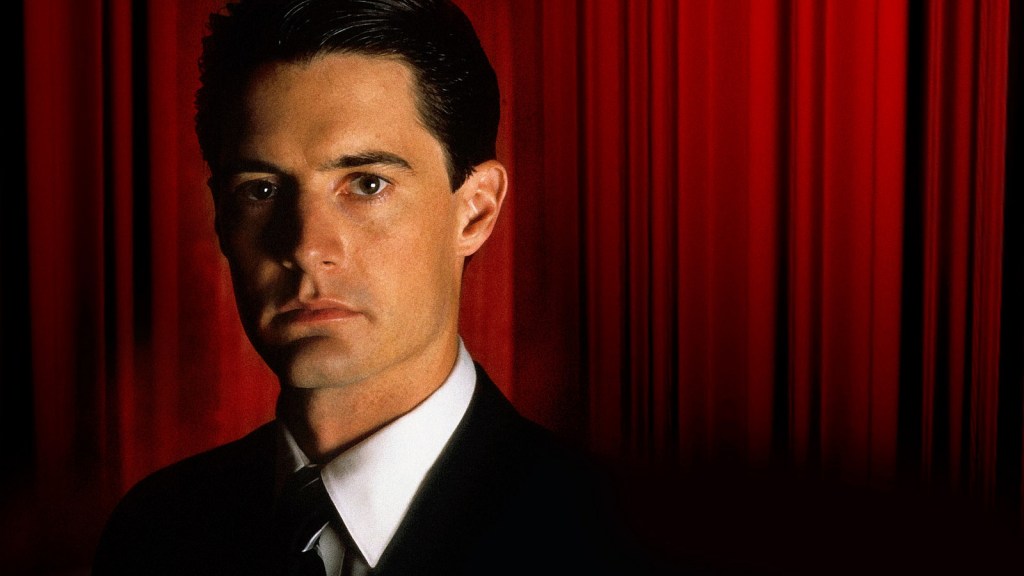
“Twin Peaks Returns to Television in 2016” by Flickr user BagoGames, CC BY 2.0.
For readers who aren’t Twin Peaks viewers, hang on: explaining the origin of Dougie Jones requires a few sentences that may read as something bordering on nonsense outside the show’s bizarre universe. Dougie is played by Kyle MacLachlan, who also plays the show’s main character, Agent Dale Cooper, as well as The Return’s Mr C, Cooper’s evil doppelganger who overcame Cooper in an extradimensional realm in the Season 2 finale and who has been living in the “real world” ever since, while Cooper is stuck in another dimension. The show implies that Mr C has only 25 years–roughly the amount of time since the show’s first run in the early 90s–before Cooper switches places with him (extradimensional bureaucracies, amiright?). As a ploy to stay in the real world, Mr C “manufactures” Dougie Jones so that when Cooper is finally released from extradimensional detention, he replaces Dougie, not Mr C. For the bulk of The Return, Mr C continues wreaking havoc across the Midwest and Western US, while Cooper, adversely affected by his transit across dimensions, is trapped in Dougie’s life, barely able to function beyond the level of a small child. Technically, then, the character called Dougie Jones is really Dale Cooper, but Cooper’s episodes-long inability to regain control of himself leads to an extended case of mistaken identity, where everyone in Dougie’s life believes Cooper to be Dougie.
Significantly, Dougie’s family and co-workers are barely phased by his ineptitude. At worst, like when he doesn’t know how to use the bathroom, people are annoyed by Dougie. But, more often than not, Dougie’s moments of silence and often erratic behavior — including befuddlement over how to feed or dress himself — are interpreted as quirky, humble, and endearing. More than that, Dougie’s boss believes him to be a courageous and principled whistle-blower whose cryptic drawings on insurance forms outs one of his co-workers for defrauding the company’s clients.

Screenshot of Twin Peaks: The Return
Dougie is beyond mediocre, yet over the course of the season, he falls into hundreds of thousands of dollars, a luxury car, a family life that seems to be fulfilling for his wife and son, and the respect and gratitude of his boss. Confidence isn’t something this mediocre white man possesses; rather, it’s a trait projected onto him by everyone around him. In riffing on the way people exist in systems of inequity, Sylvia Wynter notes in On Being Human As Praxis (2015) that we end up keeping “the reality of our own agency opaque by attributing that agency to extrahumanly mandating entities” (45). Put another way, the god who would grant us the confidence of a mediocre white man isn’t a deity but a system of patriarchal white supremacy that makes itself opaque behind the rationale that a person like, say, Dougie Jones couldn’t possibly be as successful in his life if he hadn’t earned it.
The primary marker of the mechanization of Dougie’s confidence is a sonic one: we can hear his ascendence in moments of repetition. Twin Peaks is a show comprised of overlapping aural and visual loops, recurring sounds, and doubled and tripled characters, so keying in on the sound of Dougie’s repetition fits into the series’ aesthetic. Early in Dougie’s presence in the series, when Cooper is fresh from the other dimension, his repetition is delayed, partial, and generally out of synch with regular patterns of conversation; people react to this repetition with concern. The following scene occurs in the moments just after Cooper has replaced Dougie Jones; his scene partner, Jade, was in the shower when the switch happened.
This clip is cut so that the phrase “Jade give two rides” happens back-to-back, but in the episode, there’s over a minute of a screen time between Jade saying (a grammatically correct version of) it and Dougie repeating it. Dougie’s imprecise and ill-timed repetition suggests to Jade that something may be wrong with him, and she rightly advises him to find some help. A similar interaction occurs in Episode 6, which opens with Dougie standing outside his work at night, unaware of what people do when work is over. When a police officer tries to shoo him away, Dougie is able to repeat back information he had heard several days earlier, and his delayed reaction again elicits concern from the person he’s with. A few scenes later, “Jade gives two rides” returns.
As the season progresses, however, Dougie begins to repeat back exact phrases or words that have just been spoken to him. The effect is one of understated agreement or even prescience, as if he’s repeating something he’s known for some time and has been waiting for others to realize, too. Note the way Dougie responds in the following two videos. In the first, he’s asked a question, which rises in pitch in the final syllables, and Dougie repeats the phrase with a falling pitch figure, which his conversants interpret to be confirmation. In the second, he’s given advice, and he responds by repeating the last word in uptalk, which his conversants interpret as a hilarious joke rather than the limitations of a person whose interdimensional travel has left his verbal skills lacking.
As Dougie’s repetition locks into a quicker, more immediate responsorial pattern, the people around him no longer worry about his well-being and, in fact, begin to project onto him a confidence he’s incapable of possessing. This repetition, the kind that immediately plays with or confirms what his boss or potential murderers say, suggests a couple different theoretical constructions of repetition. Butler, in describing the performativity of gender, notes that gender norms are “the stylized acts of repetition through time,” the rehearsed and rehashed ideas that we ascribe, in this case, to white men: well-timed humor on the one hand, and wise confirmation on the other (520). Sara Ahmed underscores a similar idea, noting that “compulsory heterosexuality” is “the accumulative effect of the repetition of the narrative of heterosexuality as an ideal coupling” (145). Here, Dougie’s white masculinity isn’t all that makes him the target of others’ projections of confidence and competence; his nuclear family also marks him as a productively repetitive person, a person capable of reproduction. To modify Hagi’s tweet a bit, the world projects onto Dougie the confidence of a mediocre, white, reproductive man.
Both Butler and Ahmed also gesture toward distinctly sonic phenomena present in Dougie’s repetitions. Repetition accumulating over time becomes not just distinct events happening in succession but a discrete, singular thing unto itself. When thinking in terms of systemic oppression like white supremacy or cisheteropatriarchy, the repetitive privileging of white masculinity congeals into a continuous power flow. In musical terms, we hear the accumulative, rapid retriggering of a sound as pitch rather than many distinct events. Timing matters here: if the repetition is delayed or metered just so, we can perceive instances of the same events as moving in concert either melodically or harmonically. The shift in Dougie’s repetitions over the course of The Return is the sound of institutional privilege tuning white masculinity, retriggering moments of repetition–which sounds like a rise in pitch as the repetitions move closer together, a literal ascent–until those around Dougie stop worrying about him and start believing that this mediocre white straight man must have earned the success he seemingly enjoys.
Though a perusal of Twin Peaks: The Return analyses and recaps demonstrates that viewers and critics have been far more interested in the archetypal Jekyll/Hyde duality of Dale Cooper and Mr C than they have been in the nature of Dougie Jones, Dougie’s relative lack of drive or desire offers the opportunity to hear how white male mediocrity is made. The Return checks in on Dougie regularly from his introduction in the third episode until he transforms back into Cooper, then is remanufactured and sent home to his family in the sixteenth and eighteenth episodes. What we’re privy to in that time is a different kind of manufacturing, where Dougie is constructed by his surroundings to be wise, caring, attentive, upright, and brave, though we know he’s none of those things. The slow burn of Twin Peaks: The Return means that we’re stripped of any easy excuses for Dougie’s upward momentum in the season beyond the obvious explanation that the gods of mediocre white men have gifted him with treasures out of reach for others. Dougie repeats what he hears, and what he hears is that his mediocrity is good enough.
—
Featured image: Screenshot from “‘Dougie’ Cooper – All Phrases (Twin Peaks Compilation)” by Youtube user AKA.
—
Justin Adams Burton is Assistant Professor of Music at Rider University. His research revolves around critical race and gender theory in hip hop and pop, and his book, Posthuman Rap, is available now. He is also co-editing the forthcoming (2018) Oxford Handbook of Hip Hop Music Studies. You can catch him at justindburton.com and on Twitter @j_adams_burton. His favorite rapper is one or two of the Fat Boys.
—

REWIND! . . .If you liked this post, you may also dig:
DIANE… The Personal Voice Recorder in Twin Peaks-Tom McEnaney
Malcolm Gladwell’s Bad Aesthetics–Justin Burton
Listening to Sounds in Post-Feminist Pop Music-Robin James
Share this:


Current Top Posts





April 2021

January 2020

November 2019

October 2019

August 2019

April 2014

November 2017

March 2015

December 2017

October 2015
 Sounding Out!
Recent Comments