
Pretty, Fast, and Loud: The Audible Ali


Aaaaaaaaaaaaand NOW. . .in SO!‘s corner. . .writing for this month’s “Sound and Sport,” we have the scholar. . .the poet . . .the “Wordsmith of the Web” Taaaaaaaaaara Betts! In today’s post, she shares how listening influences her creative process AND knocks us out with an analysis of the importance of Muhammad Ali’s voice to his sports career and historical legacy. For an instant replay of last month’s post, click Melissa Helquist‘s “Goalball: Sport, Silence, and Spectatorship.” Next month’s rematch will feature Josh Ottum‘s research on sound and skateparks. But now, let’s get ready to ruuuuuuuummmbbble! —J. Stoever, Editor-in-Chief
DOI: https://doi.org/10.59350/g8bjv-vzy93
Plap of glove against glove
Shush of scuffle and slide.
Rebuildin’, repeatin’, rebuildin’
All this repeatin’, getting’ up again & again
Discipline, routine and I keep
doing new things to prepare
my mind, my body, so my pretty
mouth keeps up with all my rhymes.
–Tara Betts, from “Repeatin’” (scene 8, The GREATEST!)
The recent Peggy Choy Dance Company production of “The GREATEST!: A Hip Dance Homage to Muhammad Ali” in April 2013 gave me cause to rethink the key events in Muhammad Ali’s life, particularly his burgeoning political awareness in the 1960s. As I wrote the libretto for the performance—which combined athletic dance performance with images, poems, and quotes from Ali—I kept thinking about how Ali had one of the most recognized, quoted, and distinct voices ever heard in the boxing world.
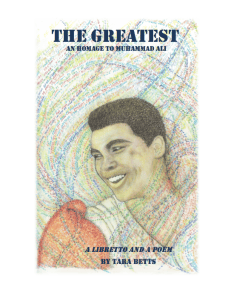
In the libretto, I tried to capture the nuances of black vernacular and the southern hallmark of Ali’s hometown, Louisville, Kentucky (he was sometimes referred to as the “Louisville Lip”), vocal sounds that signify an African American experience. Is there a southern drawl? A bass-filled bravado? There are certain words that sound fuller and cut short based on the vernacular that was spoken during the time period of Cassius Clay and well into his evolution as Muhammad Ali. While many of the materials that I visited for inspiration and historical context were books, to capture the look, feel, and speech of the 1960s and 1970s, I had to crate-dig for some vinyl.
A copy of a 1963 spoken word album I Am The Greatest!: Cassius Clay and the 1997 documentary film When We Were Kings served as two such sources. Both recordings represent an audible Ali, at once a man whose iconic voice sounded as familiar to me as people who I’ve known personally and a historical figure whose vocal grain content embodied his shifts in political consciousness. The difference between Clay’s 1964 recording and the samples woven into the When We Were Kings soundtrack is more than the changes that gradually developed over time. These recordings reveal how Ali’s confidence is constructed around creating an affirming, critical identity, rather than merely promoting his athletic prowess. At first, he merely sounds cocky; later he sounds as if he is fighting for a group of people that he wants to inform, serve, celebrate, protect, and uphold. My libretto was deeply impacted both by the sonic continuities in Ali’s voice across time and space, as well as its audible shifts.
The champ ain’t nobody but me!
Pretty, fast & loud, I’ll shake the world,
with a lion’s might.
My children will lift
their fists and fight
–Tara Betts, from “‘By Any Means necessary: If they met in Harlem’’” (transition from scene 14, The GREATEST!)
Before Cassius Clay joined the Nation of Islam and changed his name to Muhammad Ali, he recorded a spoken word album on the Sony label in 1963. I Am The Greatest! was released in 1964 before Clay’s two key fights with Sonny Liston and Ali’s eventual victory for the heavyweight crown. The album included original liner notes from modernist poet Marianne Moore and New York Post sports journalist Milton Gross, but it was telling that comedy writer Gary Belkin and Cassius Clay were the co-authors of the spoken word material—which is more comedy than poetry or interviews. Belkin was a comedy writer for well-known comedians such as Carol Burnett and Sid Caesar, and the comedy show Car 54, Where Are You? So, Belkin was clearly accustomed to writing sketch comedy, but Clay was used to being humorous outside of a recording studio with a staged audience.
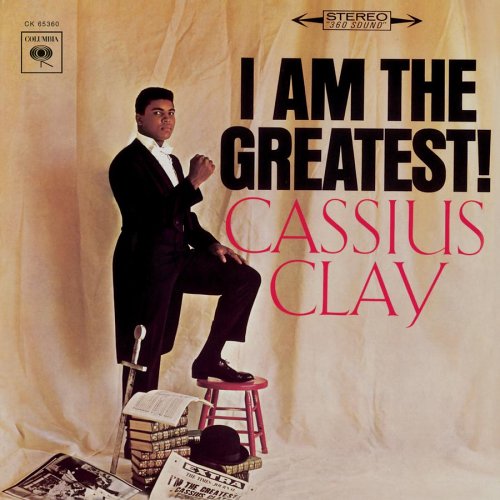
Overall, Clay’s delivery seems to be slower–both less fluid and more staged– than his impromptu recitations at boxing-related events outside the recording studio. Clay seems to anticipate that sound effects such as roaring crowds and clanging bells will be inserted into the tracks, so he over-enunciates and pauses. Each track begins with a bell ringing as if boxing round is about to begin, and there are eight “rounds,” probably because Clay insisted that any fight with Liston would be shorter than eight rounds. As I listened, I wondered if Ali was comfortable recording this album or if he considered it simply another way to promote and market one of the world’s best known boxers? To my ear, it lacked some of the speed and ease I associate with Clay’s speech in other settings. In the boxing world, his speeches mentally challenged his opponents and entertained crowds. The recording studio left less room for spontaneity, fluidity, and even the visual interplay of sound with his quick motion.
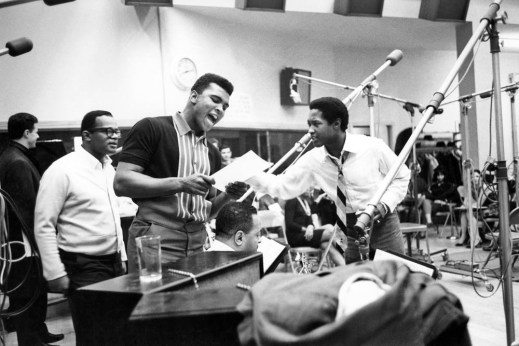
The eight rounds/comedic sketches lean heavily on Ali’s signature boisterous braggadocio in his loud, deliberate voice, using canned laughter and other voices setting up Clay to talk about his excellence. Otherwise, they are a grab bag of influences and sound effects. These other voices and sounds create an artificial environment that is not the same as being surrounded by boxers, trainers, and others in the athletic arena. In fact, these sounds and the sources sound quite different from Clay himself. “Round 1: I Am The Greatest” and “Round 2: I Am The Double Greatest” are accompanied by violins that sound more like a serenade than a classical composition. In “Round 4: ‘I Have Written A Drama,’ He Said Playfully,” a lute plays in the beginning that hints at a spoof of a Shakespearean-style drama about defeating dragons complete with affected British accents, including one actor speaking with the theatrical lisp. The knight “Cassius of Clay” enters with the audible clanking of armor.
Clay reveals a shift in tone when he sings on the last two tracks. He begins with “Stand By Me”–a cover of Ben E. King’s classic song/then recent hit–with fervor. In the last song, “The Gang’s All Here,” Clay follows some of the words of Tin Pan Alley lyricist Theodora Morse set to Sullivan’s tune from Pirates of Penzance.
Clay tries to pick up the energy lost by his less-than-enthusiastic singing. “Is Memphis with me? Is Louisville with me? Is Houston with me. Ain’t I purty?” Each question is answered with a crowd enthusiastically shouting a “Yeah!” Here Ali relies on his enthusiastic, improvised rhymes, departing from the song’s traditional lyrics to include himself in a song that does not come from an African American writer or the Black experience.
The same country that refuses to let people eat
or use the bathroom in the same places
wants ME to go and get killed?
What does THAT sound like?
—-Tara Betts, from “The Same Country” (scene 15, The GREATEST!)
Almost 35 years later, there are clear sonic differences between Cassius Clay’s debut on Sony and the soundtrack to When We Were Kings, the 1997 documentary of the 1974 heavyweight championship between George Foreman and Muhammad Ali. This retrospective record is decidedly more centered on black experiences and black voices that speak musically, politically, and spiritually, particularly about the Black presence in Islam. There are no comedic monologues, sketches or Greek choruses; it sonically represents Ali after his conversion to orthodox Islam, after his friendship with and separation from Malcolm X, and after his opposition to Vietnam. Every spoken part on this album affirms the multiplicities of a Black presence in blues, R&B, and songs recorded live on the African continent; the huffs and rhymes are cheered for by a live African audience. As I listened to When We Were Kings, I could hear Ali’s comfort and his freedom of movement, audibly in contrast with his other album.
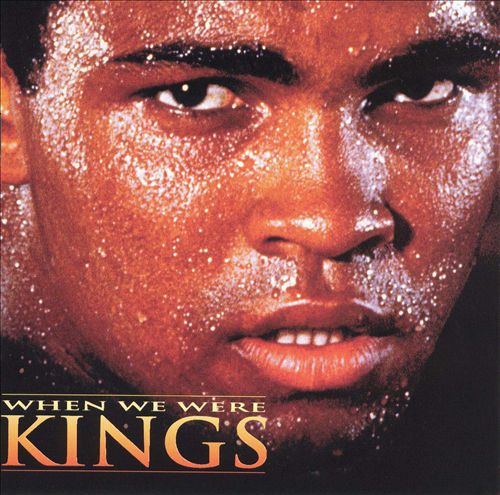
When We Were Kings records his time in Kinshasa, Zaire where he trains and eventually fights George Foreman. It does not simply focus on Ali’s voice, but is sonically rich with music, interviews with people who witnessed that fight and those who knew Ali personally; the soundtrack reflects these interconnections in its continuous uninterrupted flow. The role of these sounds endeavors to document what was heard in Zaire in 1974, but it also includes Ali in the surrounding sonic environment as one person who becomes a focal point for the musicians and speakers who also articulate black identity on the record.
The first thing I heard was Ali’s voice:
I’m gonna fight for the prestige, not for me, but to uplift my little brothers who are sleeping on concrete floors today in America, black people who are living on welfare, black people who can’t eat, black people who don’t know no knowledge of themselves, black people who don’t have no future. I want win my title and walk down the alleys and sit on the garbage cans with the wineheads…
This opening sample of Ali sets the soundtrack’s tone, and kicks off the only hip hop song on the album, a sonic shift that signals a new generation/genre in black music in 1997, more than 30 years after Ali’s spoken word album as Cassius Clay. Ali’s quote also informs listeners that the emphasis of this album has little do with comedy, especially since the soundtrack draws from nonfiction, rather than setting Clay/Ali in fictionalized sketches. The focus is on black people and their struggles.
In the first song, emcees look back and tell the story of “The Rumble in the Jungle” but the verses also hail Ali as a hero. When The Fugees, A Tribe Called Quest, and Busta Rhymes rap over a fairly standard bassline, their presence on this soundtrack is an important signal of Ali’s influence and the recurring engagement between artists and Ali during his athletic heyday such as James Brown. In Jeff Chang’s Can’t Stop, Won’t Stop (2005), Afrika Bambaataa points out repeatedly how Brown became a consistent presence in hip hop when New York radio stations simply refused to play his music, particularly in the 1970s. After decades of infusing a variety of soul singers and Brown’s stylistic turns on “the one” and messages of black pride into the genre of hip hop, the presence of “The Rumble in the Jungle” on this soundtrack completely makes sense. As more than a wellspring for samples throughout the large, growing body of hip hop music, Brown was also embodying and representing black consciousness in music with a Black voice, much in the same way that Ali utilized Black speech. In some ways, Ali’s couplets predate rap lyrics and perform in a similar manner; Bambaattaa cites him as an influence, along with Malcolm X.
James Brown and many others flow seamlessly into the event and its soundtrack in a way that reflects the immediacy and proximity of these events. The “Black Woodstock” of the Zaire 1974 music festival that accompanied Ali and Foreman’s fight set the tone and soundtrack in real life, not just in the documentary. In fact, the festival itself was documented in the 2008 release Soul Power directed by Jeff Levy-Hinte. At this point, it’s clear that there is a continuum for hearing the connections between black voices across oceans and continents.
Following “Rumble in the Jungle,” the record samples Ali and Drew “Bundini” Brown (Ali’s assistant trainer and cornerman), snippets taken directly from the documentary footage. Brown is a slower, more deliberate speaker; he uses rhyme like Ali. He talks about the fruit returning to the root and Ali claiming his crown back home. For African Americans to return to Africa post-slavery, this trip and clip sonically reinforce the cultural significance of Ali’s trip. Such pilgrimages fortify the idea that black people have a homeland, a continent, and a cultural continuum, much in the same way that this soundtrack constructs.
“Ali, Bombaye!” in a sea of faces just like mine,
my brothers, my parents, my cousins.
I want to go home and tell the people
in the streets this is what we come from,
what we could be.
—-Tara Betts, from “The Hard Road to Zaire’” (scene 21, The GREATEST!)
When African girls chant to celebrate Ali’s arrival, they reassert how this is a homecoming for Ali, a welcome and a reconnection that fuels Ali’s determination. The chants seem to encourage the first sample of Ali when he issues his threat: “When I get to Africa we gon’ get it on cause we don’t get along. I’m gonna eat him up…” This sample segues into James Brown’s “The Payback” as it was performed before the fight, then another chant performed by Mobütu, named after Zaire’s controversial leader, Mobutu Sese Seko.
When Ali concludes the soundtrack, he interrupts chants of “Ali, Bombaye!” with huffs and a brief exhortation of knocking you out, “sucker.” These last words fade into a snippet of African chant. This constructs a very different narrative that looks back at Ali’s career, long after the younger Clay established part of his image with hyperbolic bravado. Ali has cultivated a Pan African, global, political awareness that includes black people in America from his hometown in Louisville, KY to across the globe.
Hearing Clay and Ali–their continuities and their differences–gave me an insight into the familiar voices of some of my older relatives (and their blues records), and it also helped me channel that voice in poems of my own. It allowed me to imagine how hyperbole helped encourage Ali to energize and cheer himself on, so much that others began rooting for him as well. It did not matter what arena he was in, Ali would use his voice, his fists, and his will to conquer it. As I wrote the libretto, I thought about how I might unearth that determination in a way that respectfully embodied his tone, cadence, vocabulary, and ebullience. One of the definitions of greatness relates to the defeat of time and distance, and in the words that I wrote about Ali, I found that listening to him, and hearing his significance grew over time, helped him transcend both.
Every mile, every turn of the rope brings
me closer to telling him he’s nothing.
I hate every minute of training,
but I say
Don’t quit.
Suffer now
and live your life
as a champion.
I am a myth, and a man,
of my own making.
–Tara Betts, from “The Hard Road to Zaire” (scene 21, The GREATEST!)
—
Tara Betts is the author of the poetry collection Arc and Hue, a Ph.D. candidate at Binghamton University, and a Cave Canem fellow. Tara’s poetry also appeared in Essence, Bum Rush the Page, Saul Williams’ CHORUS: A Literary Mixtape, VILLANELLES, both Spoken Word Revolution anthologies, and A Face to Meet the Faces: An Anthology of Contemporary Persona Poetry. Her research interests include African American literature, poetry, creative writing pedagogy, and most recently sound studies. In the 1990s, she co-founded and co-hosted WLUW 88.7FM’s “The Hip Hop Project” at Loyola University while writing for underground hip hop magazines, Black Radio Exclusive, The Source, and XXL. She is co-editor of Bop, Strut, and Dance, an anthology of Bop poems with Afaa M. Weaver. In April 2013, she published the libretto “THE GREATEST!: An Homage to Muhammad Ali” (Winged City Press) written for the live performance directed by Peggy Choy.
—

REWIND! . . .If you liked this post, you may also dig:
They Do Not All Sound Alike: Sampling Kathleen Cleaver, Assata Shakur, and Angela Davis–Tara Betts
SO! LA: Sounding the California Story–Bridget Hoida
Freedom Back: Sounding Black Feminist History, Courtesy the Artists—Tavia Nyong’o
—
Share this:

Deejaying her Listening: Learning through Life Stories of Human Rights Violations

**Co-authored by Emmanuelle Sonntag and Bronwen Low
DOI: https://doi.org/10.59350/306p4-m0596
Are you listening?
Because sound specialist Julian Treasure argues, “We are losing our listening” due to the invention of multiple methods of recording and with the world being “so noisy . . . with this cacophony going on visually and auditorily, it’s just hard to listen, it’s tiring to listen.” In response, Treasure claims that we need to improve our conscious listening skills; he suggests teaching the skill of listening in school.
As co-directors of the “Education and Life Stories” working group of a large oral history project, we have been thinking a good deal about listening and pedagogy. The project is entitled “Life Stories of Montrealers Displaced by War, Genocide, and other Human Rights Violations,” shortened here as “Montreal Life Stories project.” From 2007 to 2012, a team of university and community-based researchers in the frame of the Canadian Community-University Research Alliances (CURA) Program recorded life story interviews with approximately 500 Montrealers who experienced mass violence and displacement. Members of the survivor communities (Tutsi, Haitian, Cambodian, and Holocaust) were key partners in both the research and the diffusion of the project, fundamentally shaping the project’s philosophy, activities and outcomes.
One of the Education Working Group’s principle accomplishments was developing an educational package called We Are Here, containing five Learning and Evaluation Situations (LES), the curricular units in the Quebec Education Program. The units are designed for “cycle two” secondary school, where the students are generally 14 to 16 years old. As of yet, these have not yet been piloted, but we plan to do so.
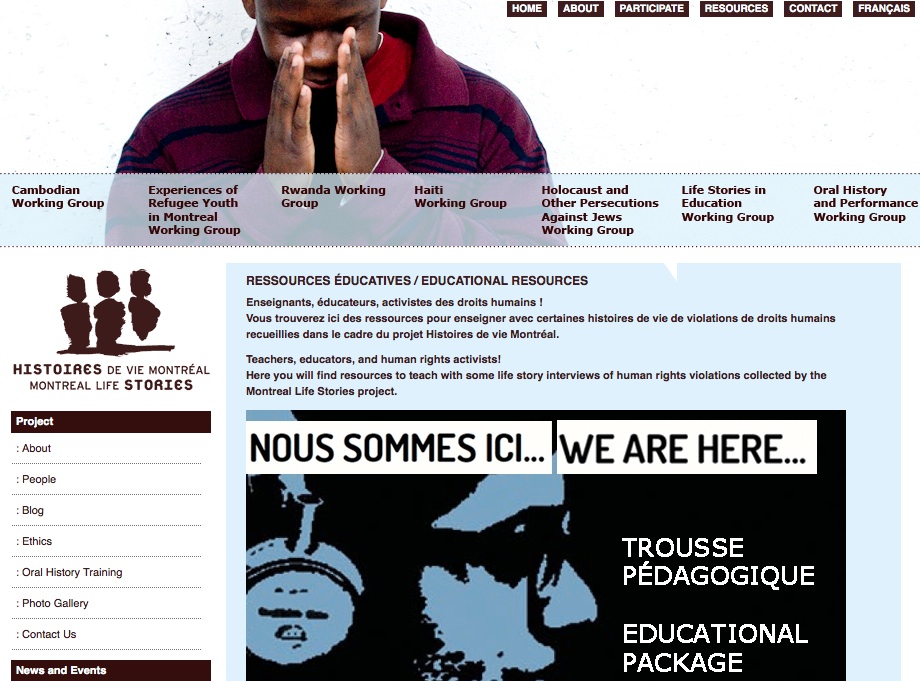
Our goal while designing “We Are Here” was to have teachers and students engage with the life stories of human rights violations, in order to foster a more inclusive cultural memory that would develop “le vivre-ensemble,” our capacity to live well together. Featuring the stories of immigrants and refugees to the province, the curriculum offers students a more complex understanding of human rights violations. First-person accounts bring world history and politics to life, helping us to understand the processes and human costs of violence and war, and expand our awareness of our fellow residents and citizens. At the same time, we recognized that the difficult stories of human rights violations make particular demands upon their listeners. We needed to consider how to ethically support students and teachers in engaging with the stories of people who have survived traumatic experience—while, importantly, respecting the interviewees themselves.
We sensed from the beginning that these goals and commitments would require us to develop our own “pedagogy of listening” to support teaching and learning from the life stories, and we foregrounded listening in all of the materials. For instance, each unit begins with the students listening to one or more project interviews, in the form of digital stories edited collaboratively by the interviewees and the editor. These digital stories tend to be under 10 minutes and bring together video, images, sound, and text (see for example, Bracha Rosenblum’s digital story). They are much more accessible than the original video interviews, which can be many hours long.
There is an irony in building a case for listening in schools. Students are commanded daily to “be quiet and listen to the teacher.” Despite the long history in educational theory of critiquing this model, the student-who-listens-in-silence versus the teacher-who-speaks-loudly is still regularly invoked in practice as an ideal relation. The demand for silence is in part a pragmatic response to the inherent noisiness of schools filled with people. At the same time, the listening imperative is also a key tool in the establishment of teacher authority and power.
We wanted to rethink the process of listening in our curricular design beyond these traditional power dynamics. Our pedagogy of listening draws on concepts of testimony, communities of memory, dialogue, and the principle of shared authority in oral history, which we describe in detail elsewhere (forthcoming in the Journal of Curriculum Studies). In this blog post, we explore our pedagogy’s indebtedness to philosopher and musicologist Peter Szendy’s work on listening and its potential in the public school classroom.
Listening begins with the desire to be signed and addressed
The address is a central notion in Peter Szendy’s Listen: A History of Our Ears. The early 2000s, as Szendy explains, saw the birth of the peer-to-peer file sharing service Napster (created by Shawn Fanning in 1999), where listeners exchanged and circulated music. Through the lens of file sharing, Szendy began reflecting on the rights of listeners and the nature of musical listening more generally. He argues that sharing shapes the listening act: while listening can be passive–I am listening to you, receiving what you are saying–we also offer up what we are listening to. Rather than envisioning listening as a two-way engagement, Szendy triangulates it, structuring listening around a listening subject, the sonorous object the subject is listening to, and the addressee (le destinataire) of the subject’s listening. In Szendy’s theory of address, as we listen to somebody or something, we also address our listening to an “other” (who might be another beside me, or in myself).
That students would address and engage with “an other” through their listening appeased, in part, our concerns about having students listen to difficult stories of mass violence. If listening is akin to a peer-to-peer sharing system, students were somehow not “alone” anymore in the experience; listening is a building of relation.
Closely related to the concept of listening as address is Szendy’s idea of signature, especially through the digitalization of sound where “listeners become authors” (136) naming, tagging, and classifying the files that they share with others. Szendy describes this process in terms of the singularity of listening:
It is more simply as a listener that I want to sign my listening: I would like to point out, to identify, and to share such-and-such sonorous event that no one besides me, I am certain of it, has ever heard as I have (3).
While all listening necessarily involves an appropriation of what has been listened to, we wanted to amplify the process of students “signing” or marking their listening, and so making it their own. We would deepen students’ engagement with the video interview and the “other” by having them actively edit, rework, even remix, and so adapt the original. We gave students the right to enter into the difficult stories from the survivors interviewed in the Montreal Life Stories project, responding as individuals and as members of a classroom community. While the dynamic of students listening to and making something in response to the life stories takes many forms in our curricular units (including timelines, maps, and audio-tours), we here share the unit which most explicitly embodies the remixing in Szendy’s notion of listening.
What a Story!
What a story!: Life stories and digital storytelling, is designed for senior students in the English Language Arts, and asks students to work in groups to create their own digital story version of a segment from one of the life story interviews.
In the preparation phase, the students listen to a 5 minute digital story of a Holocaust survivor living in Montreal that enables them to discover the multimedia elements and narrative structure of a digital story.
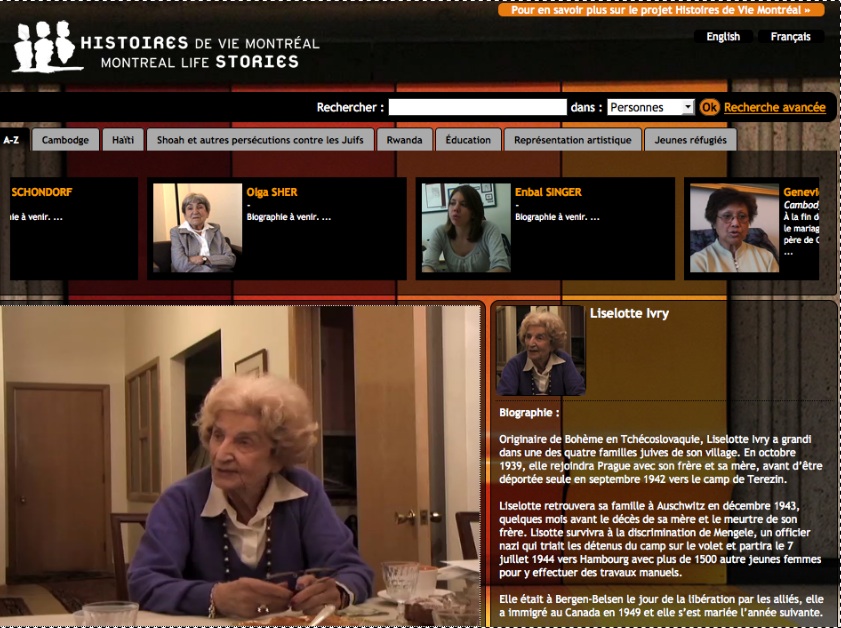
In the production phase, students approach their main task: producing a 5 minute digital story from a 34 minute life story interview with another Holocaust survivor. The phase begins with “deep listening” exercises where students work in groups to summarize the story and decide which parts of the larger interview they would like to keep in their edited versions. In doing this, they reflect on their experience as “listener“ vs. ”reader” and their responsibilities as listeners of difficult stories.
While the expression “deep listening” recalls the work of the composer Pauline Oliveros, in the Montreal Life Stories project the concept stems more directly from the notion of “shared authority,” a phrase coined by oral historian Michael Frisch (1990) to describe the process of co-creating an interview. The community-university model was collaborative at all levels, and researchers and the researched were partners in dialogue. In turn, we frequently used “deep listening” (as in the profound listening between interviewers and interviewees) as an expression during our working sessions. The concept also draws on the work of oral historian Martha Norkunas on interview techniques and deep listening exercices; her visit to the project shaped our curriculum design process, and students are encouraged to engage in dialogue and sharing, and to “Listen with close attention and deeply, in an empathetic and respectful manner.“(13). These appeared, to our eyes, to be consistent with Szendy’s notion of listening as address and signature.
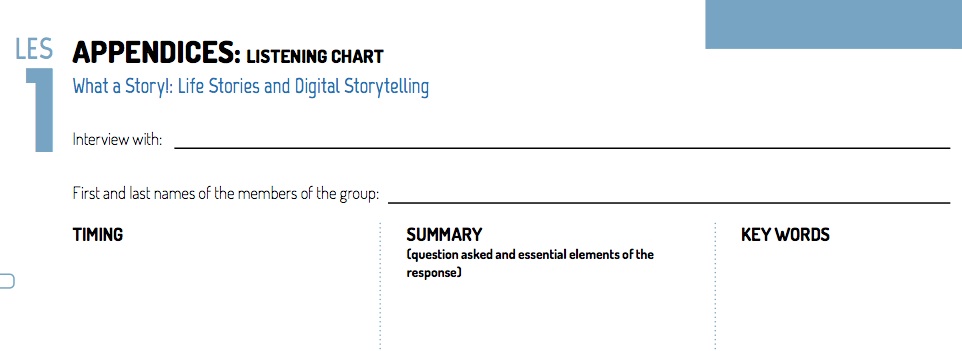
The production phase continues with the creation of the digital story, the editing and the montage. Students then reflect on the ethics of the process of cutting and reworking another’s story, exploring the way narratives can be modified, the meaning built into the digital story vs. the meaning of the interview, and the question of narrative form.
Peter Szendy chooses the deejay, or of the musical arranger, as a figure for the contemporary listener. Indeed, we imagined the students in groups, headphones on, in front of computers, slowing down the cadence, augmenting the sound, rewinding or fast-forwarding, cutting, pasting, annotating. We thought of them as highly skilled listeners, intervening in what they were listening to and interpreting their listening for the “other” ( in the manner of composition theory in which students are asked to write for real audiences for real purposes). As deejays of their listening!
Having students edit the life stories of others, especially stories of violence and war, brings with it risks of misinterpretation and manipulation. However, the unit asks students to think carefully about these risks, and unlike projects which use testimonies in the service of someone else’s argument, this editing assignment has students select from the larger interview in order to craft a narrative that respects the original. As Norkunas says, “When Michael Frisch coined his now famous phrase, “a shared authority,” he wrote of the shared responsibility of listener and narrator for creating the interview document, for interpreting it and for sharing the knowledge created.”(2) If editing and interpreting are critical to the process, adds Norkunas, “the first moment of creation takes place in the interview, in the act of listening.” Hence, the ethical issues raised by the editing assignment–and more generally by having students and teachers engage with personal stories of human rights violation–are addressed by considerable attention to the act of listening (13), and by the cultivation of trust, dialogue and sharing. In short, an attention to the “other.”
Rather than deciding that this content is too challenging for students or reproducing a passive listening dynamic in which students listen to the interviews in reverential silence, we work to support student engagement — as both an attention and response — with these stories as part of a community of listeners. And while listening to these stories can be difficult work, we hope that through our pedagogy of listening, students will gain a greater awareness of the lives of those Quebecois who are not often part of the national narrative, and grapple with some of the difficult knowledge of human pain and survival.
—
Bronwen Low is an Associate Professor in the Department of Integrated Studies in Education at McGill University. She researches the implications of popular culture for education, curriculum theory, and adolescent (multi)literacy practices. Areas of interest include hip-hop and spoken word culture; informal, arts-based and participatory education with youth; and community media and participatory video programs.
Emmanuelle Sonntag defines herself as a “knowledge organizer.” She offers consultancy services in communication, education, curriculum design, information management and knowledge mobilization while pursuing her PhD in Sociology on… Listening at Université du Québec à Montréal. She tweets on listening, sounds, stories and other noises @lvrdg.
—
REWIND! . . .If you liked this post, you may also dig:
Audio Culture Studies: Scaffolding a Sequence of Assignments–Jentery Sayers
The Sounds of Writing and Learning— Liana Silva
Listening to #Occupy in the Classroom–– Travers Scott
—
Share this:




Current Top Posts





April 2021

January 2020

November 2019

October 2019

August 2019

April 2014

November 2017

March 2015

December 2017

October 2015
 Sounding Out!
Recent Comments