
“Take ‘Em to Chuch”: OutKast and the Sounds of the Southern Black Church
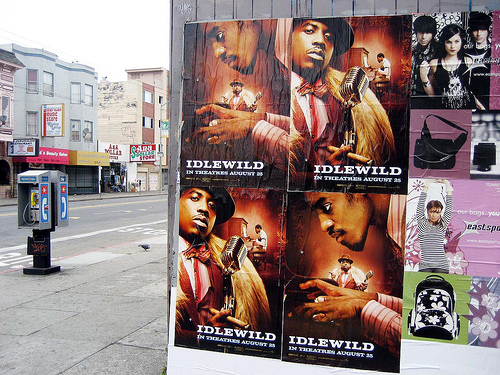
Advertising for Outkast
In 2006, I ventured into Hoosier Country. I found myself in the middle of…nowhere. And I was depressed. No, not because I decided to move to Indiana all by my lonesome on a huge leap of faith to pursue a graduate degree – I was too smooth for that – but because I found myself in a town where I couldn’t watch Outkast’s debut film Idlewild. Where they do that at? I am a Southern-bred, Southern-fed kinda girl. And Outkast was my muse. Hell, as a certified Down South Georgia Girl, all things Georgian were my muse. I planted my feet in red clay. My soundtrack was Organized Noise, the production team and heavy hitters that worked with OutKast, Goodie Mob, and a slew of other folks out of a rinky dink house basement that would later become known as the Dungeon (Family). I took pride in being from the Dungeon. And here I was, hundreds of miles away, frantically trying to find a theatre that would, if only for a brief 90 minutes, thrust me back into that familiarity of Southern life.
Of course, OutKast (comprised of members Andre Benjamin and Antwan “Big Boi” Patton) is hardly considered strictly Southern today. However, their 1994 release Southernplayalisticadillacmuzik shattered perceptions that Southern Rap was an oxymoron. In fact, OutKast’s initial sound updated tropes of southern black resistance and retaliation, fusing a lethal mastery of lyricism and flecks of a contemporary Southern culture too easily dismissed by non-Southerners. Calling upon and subverting the stereotypical traits of the Southern black voice – drawn out, slow, and heavy – OutKast sets up shop in hip hop by showcasing a rich history of Southern flair and homegrown sounds. The album made this intervention at the precise moment when hip hop became much more accessible to a mainstream white American market and the idea of being “post-Civil Rights” gained cultural traction. Combining narratives of being young, black, and frustrated with a sonic backdrop that includes an instrumental arsenal of horns, harmonicas, organs, drums, and bass, OutKast challenged and reconfigured how Southernness, Americanness, and contemporary black experience sounded at the turn of the millenium. Their initial releases seem to pick up the question of what it means to be displaced, Southern, and black after the South settled from its liberatory movements, pulling from the voices, images, and music of Southern protest like the Freedom Singers or Sweet Honey in the Rock and fusing these sounds with hip hop.

Andre Benjamin Onstage in 2003, Photo by Tulane University Public Relations
In order to discuss how they challenge and reconfigure notions of Southerness, Americanness, and contemporary black experiences, we should look at their musical nods to the black church. OutKast draws heavily on the Southern black church through sermon-esque flow, call and response, and snatches of “chuch” (lose the ‘r’) music. The black church is a staple in OutKast’s sound, reflecting what Guthrie Ramsey refers to in Race Music as community theatre, a site where “cultural, communal, and family memories associated with forms like music often become standards against which many explore and create alternative and highly personal identities for themselves” (33). The Southern black church provides such a site for communal and collective memory not only in Outkast’s music, but in African American history. Celebrated and upheld as a site of refuge from an abrasive and openly racist white supremacist environment, the black church provided a safe haven for freedom of cultural expression and social commentary unavailable in Southern white public space and discourse. OutKast challenges this older, static definition by updating its purpose to reflect the shifting social climate of the late-20th century American South. While they continue the resistance narrative tradition by bringing their marginalized experience to the forefront, they also sonically reorient mainstream views of contemporary Southern black life.
Instantly recognizable across OutKast’s recordings, their funky blend of sacred and secular musics–the blues, gospel, and hip hop–give sonic texture to something quiet-as-its-kept in black churches, how the so-called “bad” folks still come to church on Sunday, even if they were unholy on Saturday night. OutKast plays upon this unspoken understanding in songs like “Jazzybelle” from 1997’s ATLiens, “B.O.B. (Bombs Over Baghdad)” from their 2000 release Stankonia, and the straightforward “Church” from SpeakerboXXX/The Love Below (2003).
A particularly striking instance is heard on “B.O.B.,” a song which brazenly discusses issues that are often reserved for closet prayer and silent suffering. As Andre weaves a lyrical assault on the poor conditions of living in the black working class:
One-Nine-Nine-Nine, Ano Domini, anything goes, be whatchu wanna be
Long as you know consequences are given for livin – the fence is
too high to jump in jail
Too low to dig, I might just touch hell – HOT!
Get a life, now they gon’ sell
Then I might cast you a spell, look at what came in the mail
A scale and some Arm and Hammer, slow grow grid and a baby mama
Black Cadillac and a pack of pampers
Stack of question with no answers
Cure for cancer, cure for AIDS
Make a nigga wanna stay on tour for days
Get back home, things are wrong
Well not really, it was bad all along
Andre rhymes across an instrumental blend of bass and the church organ, inundating his listener’s ear with agency and anger. The church organ is as angry and explosive as his flow, with riffs and keys banged out loudly, quite different from the soft accompaniment often heard in a church setting. By heavily utilizing the organ and church choir at the end of the track, chanting “Bible music electric revival” OutKast subverts and updates the celebrated Black Church Revival, a gathering of church folk and the lost, swinging church music to give a voice to the marginalized black working class. The hybrid, urban sound of “B.O.B.” provides a space for the reclamation of a disenfranchised southern African American narrative that blends the suffering trope mandating much of African American religion with current trends in cultural expression reflected in Hip Hop. In Idlewild (which I FINALLY saw a year later, by the way), Andre and Big Boi visually annotate their secularized black church by creating an imagined community in rural Georgia that revolved around the jukejoint Church. OutKast’s audio-visual syncretism paved the way for later acts like Pastor Troy, who secularizes tropes of black masculinity and leadership in the black church, likening them to the struggles of being at war with those who don’t understand the struggles of a young black south.
The black church provides OutKast with a blueprint for reconciling displacement and authenticity by creating a sound that maneuvered a Post-Civil Rights landscape of shifting markers of social-economic identities and race. By connecting the historical context of the Southern black church with Hip Hop, OutKast’s sound reflects not only the historical residue of a pre-Civil Rights Movement South but also the constant search for a space of expression in an era where a stagnant or nonexistent “modern South” is a popularly comfortable disbelief. Perhaps this is why I was so desperate to find a theatre showing Idlewild; I found myself a geographically displaced Southern black youth searching to situate and sustain a new layer of my own post-Civil Rights narrative.


Share this:

Play it Again (and Again), Sam: The Tape Recorder in Film (Part One on Noir)
 Being a teacher, I can’t resist giving out a summer reading list. Being a researcher, I can’t help but want to share the projects that I am working on–which right now includes excavating the cultural history of the magnetic tape recorder in the United States. So, in honor of the Summer Solstice tomorrow (marking the official start of the season) I compiled a three-part summer series for Sounding Out! that does both: “Play it Again (and Again) Sam: The Tape Recorder in Film.”
My summer sound studies A-V list encourages you to fill your idle hours watching the “top 6” featured appearances of the magnetic tape recorder in film, in chronological order (2 each month, with a bonus “supporting role” nod rounding out each post). Not only will “Play it Again (And Again) Sam” help you beef up your cinema buff credentials, but it will trace a little-known history, asking you to consider how the recorder tangled its thin brown plastic tape so effectively into the warp and weft of our twentieth-century lives. You’ll find that my “top 6” list reveals much more human desire than technological determinism; the representations I examine express a complex mixture of fear and fascination, optimism and regret, change and stasis. Often a tool of the powerful, sometimes a weapon of the weak, the tape recorder was a cold war domestic product that could never truly be domesticated. As you will see in this spoiler-free three part series, interactions with the tape recorder remixed America’s workplaces, schools, homes, public spaces and private moments, ultimately shifting how the world was heard (and heard again and again).
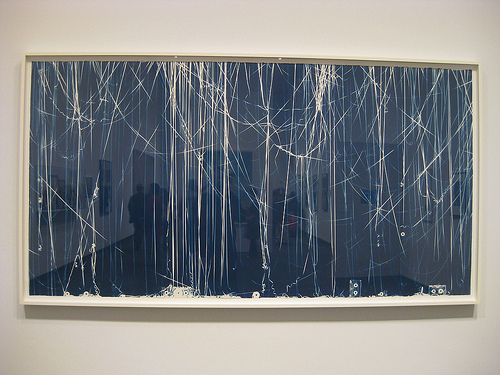
Memento (Soul II Soul) 2008 by Christian Marclay, Photo by Nathan Bowers
So, load up your Netflix queue, shake up your Jiffy Pop, and take a much-needed couch-break from the heat and humidity with these oh-so-cool black-and-whites from the 1940s and 1950s. Of course, we can’t start our films without some “Coming Attractions”: look for part two on July 18th (spotlight on Walter Murch) and part three (the 1980s) on August 15th.
1. Double Indemnity (Paramount, 1944, Directed by Billy Wilder)
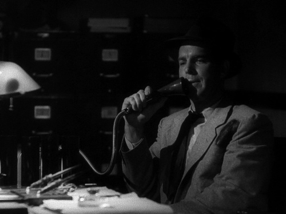
Walter Neff (Fred MacMurray) speaks his sordid tale into the dictaphone
Okay, so it is actually a dictaphone that appears in this film and the tormented insurance salesman Walter Neff (Fred MacMurry) is “putting it on wax” rather than magnetic tape, but this once ubiquitous, now long forgotten recording device has such a haunting presence and a structuring role in this grim noir confessional that, like Neff himself, I am suddenly willing to break my own rules. Outside of femme fatale Phyllis Dietrichson’s (Barbara Stanwyck) elaborately sculptured coiffure, the key image of Double Indemnity is Neff’s lips murmuring his murderous late night confessions into the dictaphone’s horn, a physical and metaphorical stand in for the ear of his hardnosed boss (and the true object of his desire) claims investigator Barton Keyes (Edward G. Robinson).
The dictaphone was Billy Wilder (director/screenwriter) and Raymond Chandler’s (screenwriter) deliberate addition to the filmscript; James M. Cain’s 1943 novella was essentially Neff’s scrawled confession to the reader of his almost-perfect plot to kill Phyllis’s husband and reap double insurance rewards. The introduction of the dictaphone transformed the standard noir flashback voiceover into an even-more intimate exchange of anxious aspiration, guilty pleasure, and homosocial desire channeled through Neff’s tense vocal grain and fierce grip on the machine’s cord. A familiar office machine made strange by Neff’s late-night admissions, the dictaphone mediates the entire film, transforming the audience into eavesdroppers, listening in to an act of recording made for Keyes’s ears only. After stumbling into his office and jamming a cylinder into the machine, Neff begins, sternly: “Office memorandum. ‘Walter Neff to Barton Keyes, Claims Manager, Los Angeles, July 16, 1938. Dear Keyes: I suppose you’ll call this a confession when you hear it. Well, I don’t like the word ‘confession.’ I just want to set you right about something you couldn’t see because it was smack up against your nose.” Sound, in the form of Neff’s heated breath pressed through the dictaphone’s curves and into our waiting ears, is the perfect device to exorcise the unseen desire in a film that tests the boundaries of darkness.
..
2. Blackboard Jungle (MGM, 1955, Directed by Richard Brooks)

Screen Capture by JSA
Most people remember Blackboard Jungle for its seductive visual representations of juvenile delinquency, stoked by the sound of Bill Haley and the Comet’s “Rock Around the Clock,” the song (written in 1952, recorded in 1954) that opened and closed the film (and became a smash hit as a result, as I discussed in a previous archival blog post here). I’d like to add an often-overlooked image to the film’s legacy, that of teacher Mr. Dadier (Glenn Ford) plunking a bulky case down on his desk and triumphantly announcing “This is a tape recorder!” A cutting edge device at the time—magnetic tape was only introduced in the states after World War II, largely through the efforts of Bing Crosby and Les Paul—Dadier’s recorder is part and parcel of the technological milieu of the 1950s, which evoked positivistic fascination with “progress” even as it was shaped by existent fears and inequalities.
At the point of almost giving up on his surly working class, ethnic, inner-city students to seek a cushy job in the segregated suburbs, Dadier brings in the reel-to-reel as a Hail Mary attempt to quell his students’ noise and remake them into good Cold War citizens once and for all. As he tells them, “We all talk, but nobody listens.” From the moment he enters the classroom, the students continue to defy the white male authority embodied in Dadier and housed in his machine—“Did you bring your cosmetics to school, Chief?” taunts one student (Gregory Miller, played by Sydney Poitier)—and they undermine his assignment by selecting the “noisiest” student in the class to make a recording: Puerto Rican Student Pete Morales. As I have discussed on this blog and in print, the concept of “noise” has a racialized edge, particularly in the 1950s, when Cold War cosmologies of colorblindness and “enemies within” ruled the day. Sound was an efficient way to separate “Us” from “them”—the noisy dissident from the quiet citizen—without making explicit reference to visual markers of race. And, let me tell you, Morales’s obscene, heavily-accented speech—peppered with “stinkin’”s, 14 of them in total—really makes Dadier’s spools spin. To hear more on the tape recorder in 1950’s American life and this film, see my essay “Reproducing U.S. Citizenship in a Blackboard Jungle: Race, Cold War Liberalism and the Tape Recorder” forthcoming in the American Quarterly special issue on sound (September 2011).
[youtube=http://www.youtube.com/watch?v=tr7n9Wxmcf4]..
And. . .in a supporting role:
Kiss Me Deadly (Parklane Pictures, 1955, Directed by Robert Aldrich)

Hammer Screens His Calls: Screen Capture by Michael Leddy
The byzantine stairwalks and gingerbread Victorians of Los Angeles’s defunct Bunker Hill neighborhood are not the only ghosts you will encounter in the noir classic Kiss Me Deadly. Our first glimpse of Mike Hammer’s (Ralph Meeker) space-age Wilshire Boulevard bachelor pad includes a shot of his wall mounted, reel-to-reel answering machine, quite a technological marvel in 1955; it would be over 15 years before Phone Mate introduced the first commercially viable home model in 1971. His recorder manages to look both ridiculously large yet streamlined–and to twenty-first century audiences, old yet futuristic. However, it also allows the hunted, haunted private detective to take just a little more control of his tailspin of a life. After the jarring ring of a telephone call, the spools spin, and a sultry female voice intones: “This is Crestview 5-4124. Mister Hammer, whom you are calling, is not available at present. If you wish to leave a record of your call, please state your message at the sound of the tone.” His back inevitably against the wall, Hammer brings a suave tension to an act that has now become mundane: call screening. Removing the small surprise of who’s on the line, Hammer uses his recorder to listen just a step ahead, pacing an increasingly mysterious world given over to the dangerous riddle of the “whatsit” that leaves so many in the morgue by the film’s end. For a more general take on sound in this film (with a brief mention of Mike Hammer’s tape recorder), see Noira-Blanchè-Rougi’s November 2009 blog post, “The Use of Sound in Kiss Me Deadly.”

Share this:


Current Top Posts





April 2021

January 2020

November 2019

October 2019

August 2019

April 2014

November 2017

March 2015

December 2017

October 2015
 Sounding Out!
Recent Comments