
Catastrophic Listening
 Welcome back to Hearing the UnHeard, Sounding Out‘s series on how the unheard world affects us, which started out with my post on the hearing ranges of animals, and now continues with this exciting piece by China Blue.
From recording the top of the Eiffel Tower to the depths of the rising waters around Venice, from building fields of robotic crickets in Tokyo to lofting 3D printed ears with binaural mics in a weather balloon, China Blue is as much an acoustic explorer as a sound artist. While she makes her works publicly accessible, shown in museums and galleries around the world, she searches for inspiration in acoustically inaccessible sources, sometimes turning sensory possibilities on their head and sonifying the visual or reformatting sounds to make the inaudible audible.
In this installment of Hearing the UnHeard, China Blue talks about cataclysmic sounds we might not survive hearing and her experiences recording simulated asteroid strikes at NASA’s Ames Vertical Gun Range.
— Guest Editor Seth Horowitz
—
Fundamentally speaking, sound is the result of something banging into something else. And since everything in the universe, from the slow recombination of chemicals to the hypervelocity impacts of asteroids smashing into planet surfaces, is ultimately the result of things banging into things, the entire universe has a sonic signature. But because of the huge difference in scale of these collisions, some things remain unheard without very specialized equipment. And others, you hope you never hear.
Unheard sounds can be hidden subtly beneath your feet like the microsounds of ants walking, or they can be unexpectedly harmonic like the seismic vibrations of a huge structure like the Eiffel Tower. These are sounds that we can explore safely, using audio editing tools to integrate them into new musical or artistic pieces.
Luckily, our experience with truly primal sounds, such as the explosive shock waves of asteroid impacts that shaped most of our solar system (including the Earth) is rarer. Those who have been near a small example of such an event, such as the residents of Chelyabinsk, Russia in 2013 were probably less interested in the sonic event and more interested in surviving the experience.
But there remains something seductive about being able to hear sounds such as the cosmic rain of fire and ice that shaped our planet billions of years ago. A few years ago, when I became fascinated with sounds “bigger” than humans normally hear, I was able to record simulations of these impacts in one of the few places on Earth where you can, at NASA Ames Vertical Gun Range.
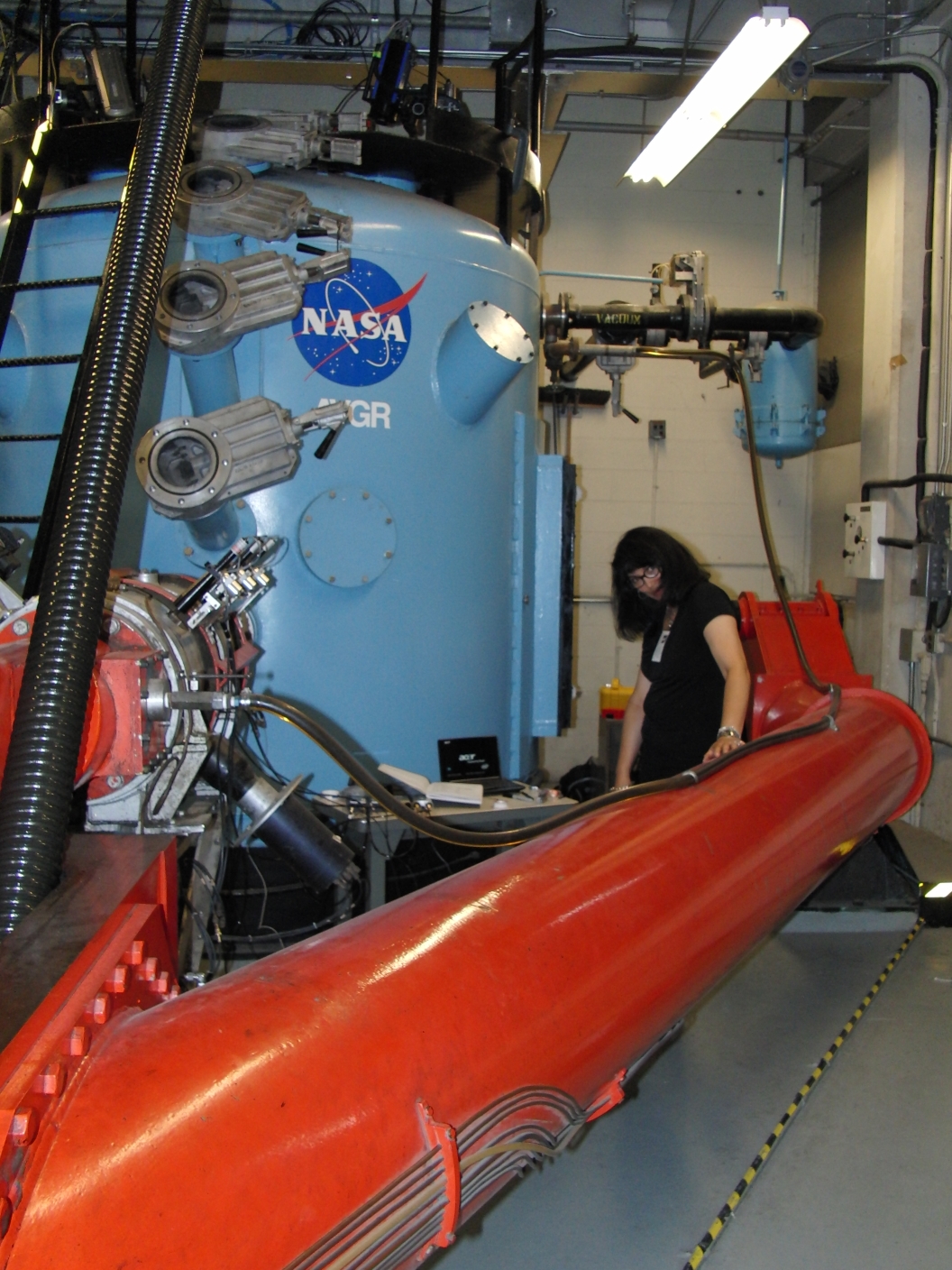
The artist at the AVGR
The Vertical Gun at Ames Research Center (AVGR) was designed to conduct scientific studies of lunar impacts. It consists of a 25 foot long gun barrel with a powder chamber at one end and a target chamber, painted bright blue, that looks like the nose of an upended submarine, about 8 feet in diameter and height at the other. The walls of the chamber are of thick steel strong enough to let its interior be pumped down to vacuum levels close to that of outer space, or back-filled with various gases to simulate different planetary atmospheres. Using hydrogen and/or up to half a pound of gun powder, the AVGR can launch projectiles at astonishing speeds of 500 to 7,000 m/s (1,100 to 16,000 mph). By varying the gun’s angle of elevation, projectiles can be shot into the target so that it simulates impacts from overhead or at skimming angles.
In other words, it’s a safe way to create cataclysmic impacts, and then analyze them using million frame-per-second video cameras without leaving the security of Earth.
My husband, Dr. Seth Horowitz who is an auditory neuroscientist and another devotee of sound, is close friends with one of the principal investigators of the Ames Vertical Gun, Professor Peter Schultz. Schultz is well known for his 2005 project to blow a hole in the comet Tempel 1 to analyze its composition, and for his involvement in the LCROSS mission that smashed into the south pole of the moon to look for evidence of water. During one conversation discussing the various analytical techniques they use to understand impacts, I asked, “I wonder what it sounds like.” As sound is the propagation of energy by matter banging into other matter, this seemed like the ultimate opportunity to record a “Big Bang” that wouldn’t actually get you killed by flying meteorite shards. Thankfully, my husband and I were invited to come to Ames to find out.
I had a feeling that the AVGR would produce fascinating new sounds that might provide us with different insights into impacts than the more common visual techniques. Because this was completely new research, we used a number of different microphones that were sensitive to different ranges and types of sound and vibrations to provide us with a selection of recording results. As an artist I found the research to be the dominant part of the work because the processes of capturing and analyzing the sounds were a feat unto themselves. As we prepared for the experiment, I thought about what I could do with these sounds. When I eventually create a work out of them, I anticipate using them in an installation that would trigger impact sounds when people enter the room, but I have not yet mounted this work since I suspect that this would be too frightening for most exhibition spaces to want.
Part of my love (and frustration) for sound work is figuring out how to best capture that fleeting moment in which the sound is just right, when the sound evokes a complex response from its listeners without having to even be explained. The sound of Mach 10 impacts and its effects on the environment had such possibilities. In pursuit of the “just right,” we wired up the gun and chamber with multiple calibrated acoustic and seismic microphones, then fed them into a single high speed multichannel recorder, pressed “record” and made for the “safe” room while the Big Red Button was pressed, launching the first impactor. We recorded throughout the day, changing the chamber’s conditions from vacuum to atmosphere.
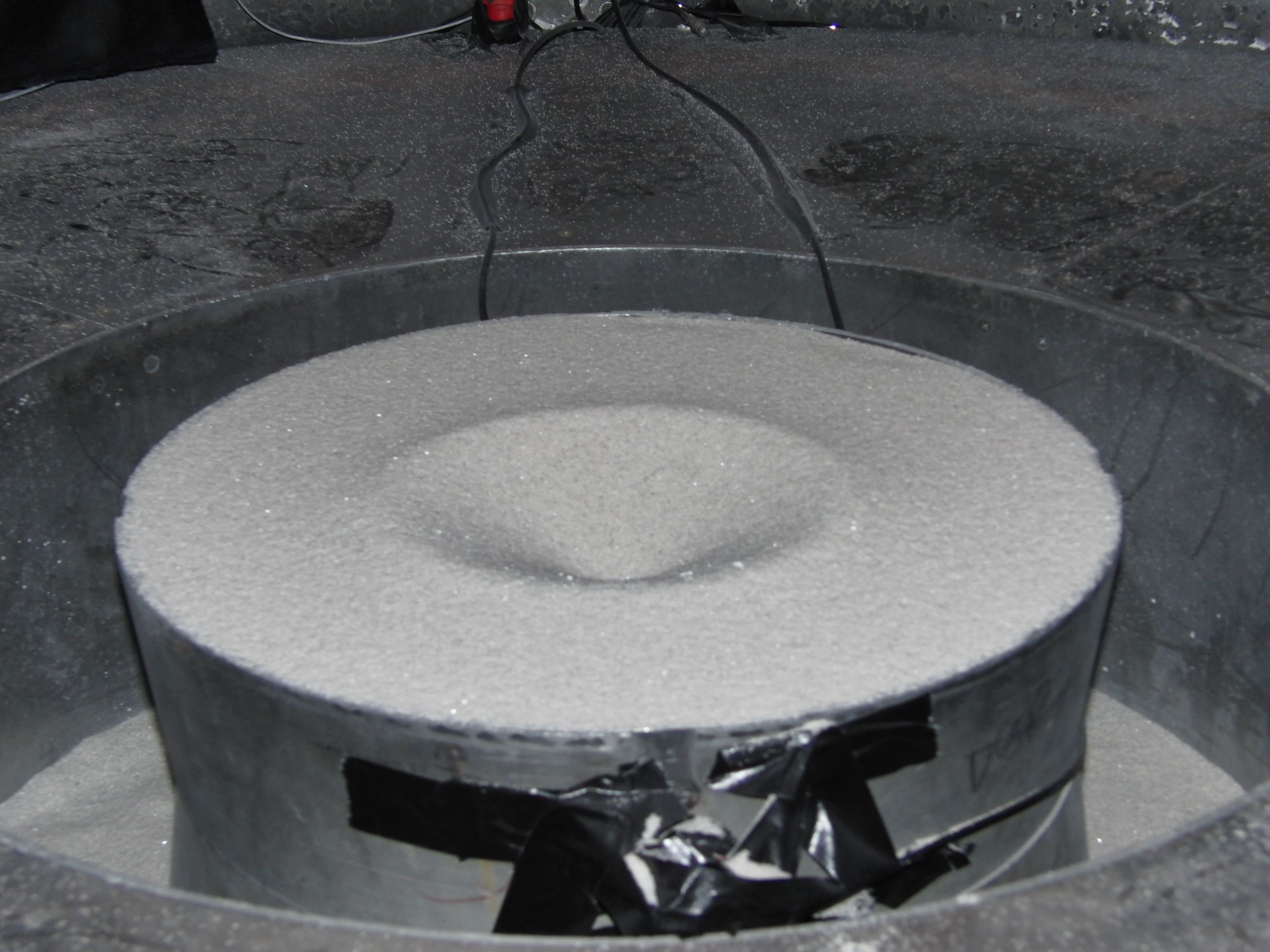
Simple impact on the AVGR sand target.
When we finally got to listen that afternoon, we heard things we never imagined. Initial shots in vacuum were surprisingly dull. The seismic microphones picked up the “thump” of the projectile hitting the sand target and a few pattering sounds as secondary particles struck the surfaces. There were of course no sounds from the boundary or ultrasonic mics due to the lack of air to propagate sound waves. While they were scientifically useful–they demonstrated that we could identify specific impact events launched from the target—they weren’t very acoustically dramatic.
When a little atmosphere was added, however, we began picking up subtle sounds, such as the impact and early spray of particles from the boundary mic and the fact that there was an air leak from the pitch shifted ultrasonic mic. But when the chamber was filled with an earthlike atmosphere and the target dish filled with tiny toothpicks to simulate trees, building the scenario for a tiny Tunguska event (a 1908 explosion of an interstellar object in Russia, the largest in recorded history), the sound was stunning:
.
After the initial explosion, there was a sandstorm as the particles of sand from the target flew about at Mach 5 (destroying one of the microphones in the process), and giving us a simulation of a major asteroid explosion.
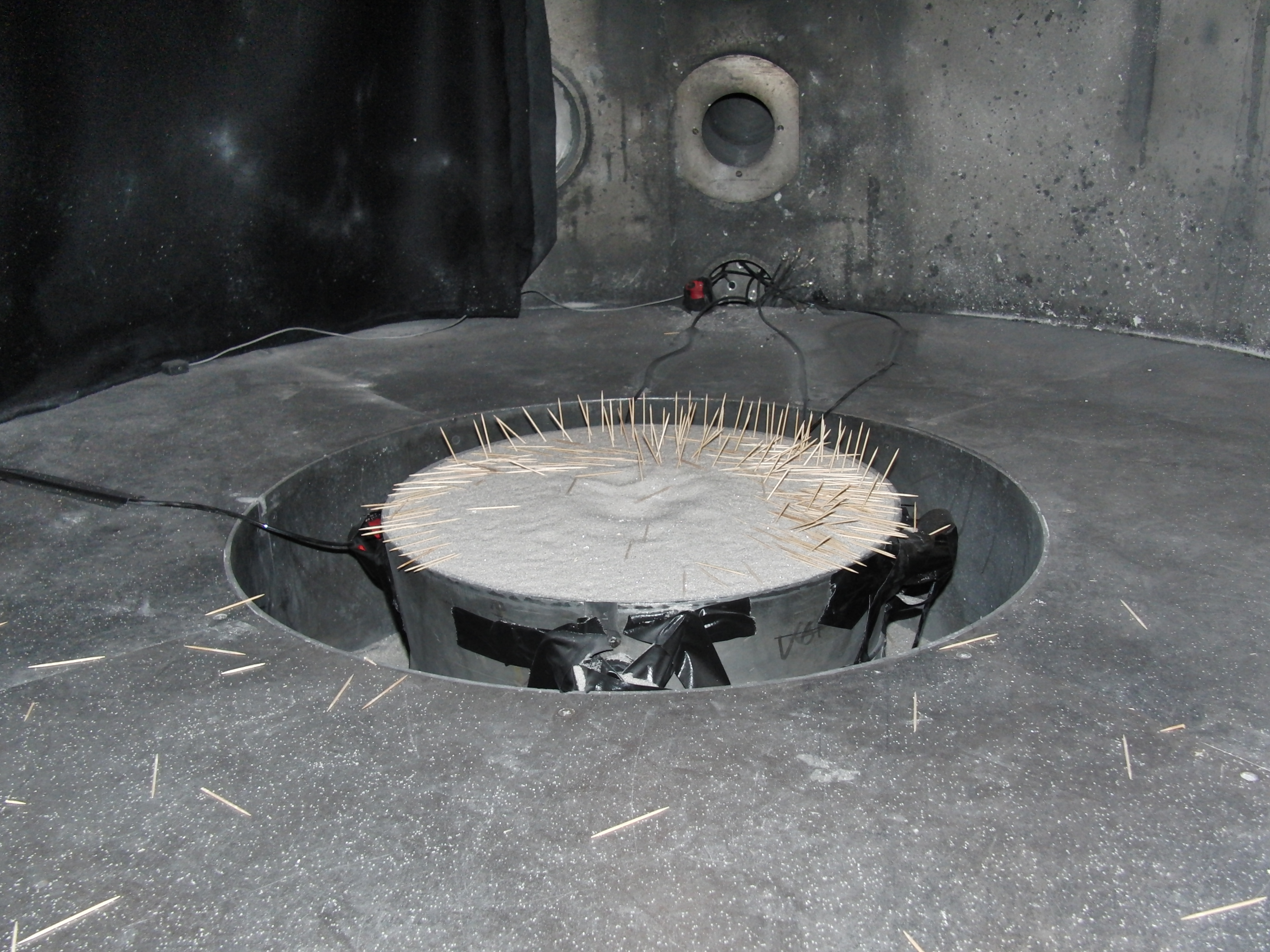
66 million years ago, in a swampy area by the Yucatan Penninsula, something like this probably occurred, when a six mile wide rock burned through the atmosphere to strike the water, ending the 135 million year reign of the dinosaurs. Perhaps it sounded a little like this simulation:
.
Any living thing that heard this – dinausaurs, birds, frogs insects – is long gone. By thinking about the event through new sounds, however, we can not only create new ways to analyze natural phenomena, but also extend the boundaries of our ability to listen across time and space and imagine what the sound of that impact might have been like, from an infrasonic rumble to a killing concussion.
It would probably terrify any listener to walk in to an art exhibition space filled with simply the sounds of simulated hypervelocity impacts, replete with loud, low frequency sounds and infrasonic vibrations. But there is something to that terror. Such sounds trigger ancient evolutionary pathways which are still with us because they were so good at helping us survive similar events by making us run, putting as much distance between us and the cataclysmic source, something that lingers even in safe reproductions, resynthesized from controlled, captured sources.
__
China Blue is a two time NASA/RI Space Grant recipient and an internationally exhibiting artist who was the first person to record the Eiffel Tower in Paris, France and NASA’s Vertical Gun. Her acoustic work has led her to be selected as the US representative at OPEN XI, Venice, Italy and at the Tokyo Experimental Art Festival in Tokyo, Japan, and was the featured artist for the 2006 annual meeting of the Acoustic Society of America. Reviews of her work have been published in the Wall Street Journal, New York Times, Art in America, Art Forum, artCritical and NY Arts, to name a few. She has been an invited speaker at Harvard, Yale, MIT, Berkelee School of Music, Reed College and Brown University. She is the Founder and Executive Director of The Engine Institute www.theengineinstitute.org.
__
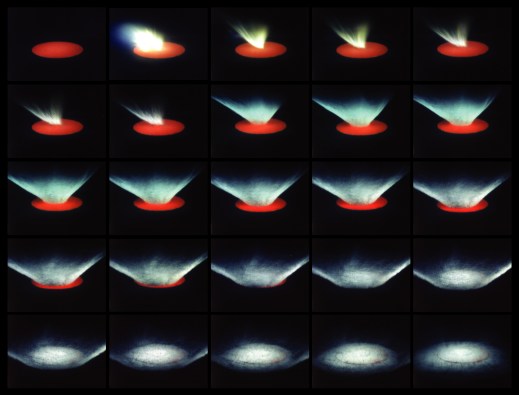
Featured Image of a high-speed impact recorded by AVGR. Image by P. H. Schultz. Via Wikimedia Commons.
__

REWIND! If you liked this post, check out …
Cauldrons of Noise: Stadium Cheers and Boos at the 2012 London Olympics— David Hendy
Learning to Listen Beyond Our Ears– Owen Marshall
Living with Noise— Osvaldo Oyola
Share this:

Radio Ambulante: A Radio that Listens

 Welcome back to the final article in our three-part series, Radio de Acción. Special thanks to you, our readers, and to editors Jennifer Stoever and Neil Verma at Sounding Out! for hosting this addition to a burgeoning field of Latin American critics and producers who are changing the way we hear radio as history, as theory, and in practice.
Over the past several weeks we have tried to bring you into the multiple worlds made possible by radio in Latin America. If you missed our previous posts, please find Alejandra Bronfman’s stunning history of radio in the Caribbean here, and Karl Swinehart’s fascinating study of Aymaran-Spanish radio here.
Both of these critical approaches set the stage for Carolina Guerrero’s extraordinary work with radio in the Americas. An executive director and co-founder of Radio Ambulante—a program that fellow co-founder and novelist Daniel Alarcón calls “This American Life, but in Spanish, and transnational”—Guerrero’s post takes us behind the scenes of her show to consider how the sounds on radio come to life for us as listeners, and the significance of hearing someone’s words in her or his own voice and language. For more Radio Ambulante after you finish reading and listening to Carolina’s post, please visit their website and download their podcasts.
–Guest editor Tom McEnaney
—
In late 2007, novelist Daniel Alarcón was hired by the BBC to produce a radio documentary about Andean migration in his native Peru. He spent 10 days traveling around the country, from the highlands to Lima, conducting interviews in both English and Spanish, talking to a wide range of people with very personal stories about migration. But when Daniel received the final mix from London, he was disappointed to find that the editor had privileged the English language voices, and left out many of the most compelling Spanish language storytellers. Daniel was left with a question: what if there was a space for those voices on the radio waves? What would it sound like?
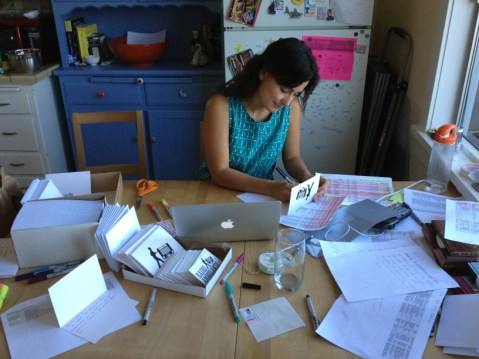
Over coffee in San Francisco in January 2011, Alarcón and I decided to create that space, inspired by US public radio shows like This American Life and Radiolab, which had no Spanish counterpart. We knew that poignant, fun, surprising, unique, sometimes sordid, sometimes romantic, absurd and incredible stories we often heard in Latin America were out there, just waiting to be reported. We knew that they would make great radio. And we knew there was an audience—in Latin America and the US—that wanted to hear it. The result became Radio Ambulante.
 .
.
FIRST STEPS
We began by asking many of our print journalist friends in Latin America to share stories with us. We sent them links to stories from some of our favorite American radio programs, and then contacted a few bilingual independent radio producers here in the US, and asked them for advice on the basics of radio production. Many directed us to Transom.org, which was an absolutely essential resource.
In March of 2012, we launched a Kickstarter campaign. All we had was an idea and a sampler with less than 45 minutes of audio—and still, we managed to raise $46,000 with the support of 600 backers. The success of this campaign was a huge confidence boost, and we knew we were on to something. We used this money to produce our pilot season.
.
Since then, we’ve worked with more than twenty different producers in more than a dozen countries. These are the characters that emerge from Radio Ambulante stories: a transgender Nicaraguan woman living with her Mexican wife in San Francisco’s Mission District; a Peruvian stowaway telling his harrowing tale of coming to New York in 1959, hidden in the hold of a tanker ship; the Chilean soccer player who dared challenge the authority of General Pinochet; a young Argentine immigrant to North Carolina, trying to find his way through the racially charged environment of an American high school. Taken together these voices create a nuanced portrait of Latino and Latin American life:
.
PERSONAL STORIES FOR ALL EARS
Now in our third season, we’ve been working hard to create a group of trusted producers and editors across Latin America; people we can turn to with an idea, people we know we can trust with our limited time and resources; reporters we can send to Cuba, send to Honduras, send to Venezuela, and be certain they’ll come back with usable tape, and a good story. We want these first time producers to become long-term contributors.
That’s the case of Camila Segura, Radio Ambulante’s current Senior Editor. She had no prior experience as a radio producer when she reported her first story for us in 2012. That piece, El otro, el mismo (The Other, The Same) is about two men, one Colombian, one Argentinian, who not only share the same name, but who look almost identical. From this coincidence, the story becomes something much stranger, funnier, more subtle, and ultimately quite moving:
.
We want the listener to be able to relate and identify with the characters, to feel what they feel. A good Radio Ambulante story should be universal and shouldn’t have an expiration date.
One story from our first season captures this universal quality. In 2011, River Plate, one of the most famous soccer clubs in South America, was relegated to the Argentine Second Division. This event shook the entire nation, and anyone who listens to this story could relate to the sadness and pain that the protagonist is feeling. Two years later, the story still has that raw power:
 .
.
HOW WE SOUND
Martina Castro, Senior Producer, has designed most of Radio Ambulante’s sound, finding the balance between music and sound effects in order to support the voice of the main characters. As she explains,
There are many kinds of pieces that make it to Radio Ambulante. Sometimes the story is focused on one person and their experience: something that happened long ago. Like with Mayer Olórtegui in Polizones (The Stowaways), and the story of how he and his friend Mario jumped aboard a ship headed to the United States. There is no substitute for a dynamic storyteller like Mayer. He not only recreates moments, sometimes even imitating the sounds of what he heard, but he remembers the emotion of what happened, and really feels deeply what he is talking about, like when his voice breaks up at the mention of saying goodbye to his friend Mario.
.
Other, more symphonic, multi-voiced pieces provide a different kind of production challenge. The script must showcase the many characters, while giving the listener enough grounding so as not to get lost. A particularly successful example is our award-winning piece “N.N.”, about Puerto Berrio, Colombia, by reporter Nadja Drost. Nadja gathered recordings of this river town, and conducted interviews with many locals, always focused on the issue of the floating, anonymous dead and the town’s strange relationship with these bodies. The music in a piece like this is only meant to support those real-life sounds and characters, and a repeated melody serves as a ghost-like echo of the dead, those voices we never hear.
We use music carefully to shift the mood, to mark the end of a section, and to alert the listener that something new is coming. The music is also meant to break up chapters of a story, give us a moment to reflect on what we just heard, or to indicate when something is about to change. There are examples in Yuri Herrera’s “Postcard from Juárez,” produced by Daniel Alarcón. It tells the story of Diana la Cazadora, or Diana the Hunter, a vigilante who set about killing bus drivers in one of the world’s most violent cities, allegedly as revenge for years of misogyny and sexism.
.
In this particular story, we were able to do something that the English version (produced for This American Life) could not: read in the original Spanish the letter that the supposed killer sent the local Ciudad Juárez newspaper explaining her actions. We had this read by Lizzy Cantú, a Mexican journalist who’d worked with us before, and then distorted her voice, to give it that dark ambience. The listener is supposed to feel the grim violence in those words: the desperation.
 THE STORY IS KEY
In three seasons producing the show, we’ve learned that the craft of radio comes from listening, and that the most challenging aspect of producing radio is not in the technical details of recording those voices or sounds, but in the story itself.
The most basic building block of a good radio story is a good interview. The technical aspects of gathering sound are less important than phrasing the questions to get vivid, almost filmic answers, full of details that set the scene.. As Executive Producer Daniel Alarcón explains,
We ask our reporters to push interviewees to describe scenes in great detail, to unpack moments. Our interviews can last two hours or more, and many are surprised that we go so in depth. We like our reporters to circle back, and then circle back again, so that we’re sure we’re getting the most vivid version possible of a given story’s crucial moments.
We ask our reporters to write colloquially, to imagine they’re telling the story to a friend at a bar. It’s important to have immediacy in the language, an expressive tone that can seem almost improvised, even when it isn’t. The emotional impact of radio is that it feels as though a secret is being shared. The script and the production should always be in service of this intimacy.
Before a script is final, it’s shared with other editors on the team around the globe (California, Colombia, Puerto Rico, Chile), mixed, edited, soundtracked, and refined through hours of collective work online.
 .
.
ONWARD
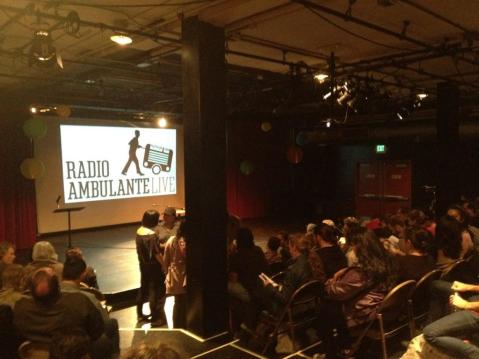
While creating our own sound and storytelling style, Radio Ambulante is constantly experiment with different formats and looking for new ways to interact with our listeners. We’ve done three live radio shows, in Los Angeles, San Francisco, and New York. In addition, we’ve produced two English Language specials, and partnered with writers and animators on hybrid multimedia storytelling. With our partners at PRI, we’re developing a new interview series, and are working with Latin American universities and media outlets to teach more journalists to use radio. Our hope is that Radio Ambulante’s success will mean more innovative radio work in Spanish, and more experiments in the possibilities of bilingual radio.
—
Carolina Guerrero is the Executive Director of Radio Ambulante. Before getting into journalism, she was a promoter for cultural and social projects, creating a bridge between organizations in three different continents. She has worked with public and private institutions in several countries, for which she has designed and overseen festivals, art exhibits, teaching workshops and fundraising events. Carolina is a John S. Knight Journalism Fellow at Stanford University 2014-15. She is the proud mother of León and Eliseo. (@nuncaduermo)
All images courtesy @radioambulante on Twitter
—
 REWIND!…If you liked this post, you may also dig:
“We wanted to tell stories about sound: Opening Ears Through the Everything Sounds Podcast”-Craig Shank
“Chicana Radio Activists and the Sounds of Chicana Feminisms”-Monica De La Torre
“Óyeme Voz: U.S. Latin@ & Immigrant Communities Re-Sound Citizenship and Belonging”-Nancy Morales
Share this:


Current Top Posts





April 2021

January 2020

November 2019

October 2019

August 2019

April 2014

November 2017

March 2015

December 2017

October 2015
 Sounding Out!
Recent Comments