
Wayback Sound Machine: Sound Through Time, Space, and Place
 This is the second post in Sounding Out!’s July forum on listening in observation of World Listening Day on July 18th, 2013. World Listening Day is a time to think about the impacts we have on our auditory environments and, in turn, its affects on us. To read last week’s post by Regina Bradley (and to read more about World Listening Day) click here.
—
When I travel to somewhere I’m unfamiliar with to create a work, I’ve become in the habit of bringing my VLF receiver, hydrophones, and underwater camera in order to explore. Whether what comes out ultimately becomes part of the work or not, my interest in these particular tools stems from a fascination with obscure events around me, real and happening, that I cannot perceive. But it also marks my wonder at events and elements in our world that have been, while changing, continuous in a time line extending much further than my own. Similar to the sense one may get when experiencing a desert, or an ocean, with time and patience, what might at first seem bleak, barren, or monotonous, begins to give hint to a rich world hidden from our day to day.
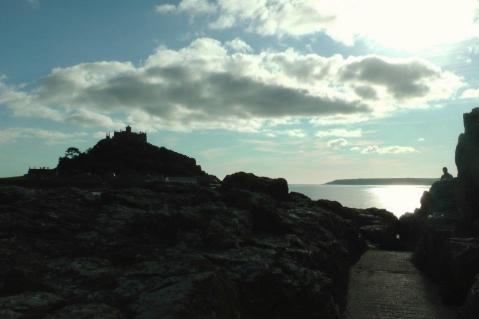
Photo by the author, Saint Michael’s Mound, Marazion, Cornwall
Two autumns ago, finding myself with a day off from a project I was working on near Penzance in Cornwall, I decided to take the day to hike the lesser known British arm of the Santiago Pilgrim Route: the St. Michael’s Way. Dating back tens of thousands of years, St. Michael’s Way enabled pilgrims and missionaries traveling from Ireland or Wales to choose to abandon their ships and walk across the peninsula, rather than navigating the treacherous waters around Land’s End. In the days of such pilgrimmages, the way was fraught with all sorts of dangers, and the path itself splits a few times, veering off towards a church near the harbor where they would get the boat to cross them. There they would meet a guide who would offer safe passage from the many thieves and pirates along the way. Still marked with the iconic scallop shell symbol of the pilgrim route, the path was nevertheless neglected, and overrun with all sorts of modern obstacles such as busy roads and farm irrigation systems.
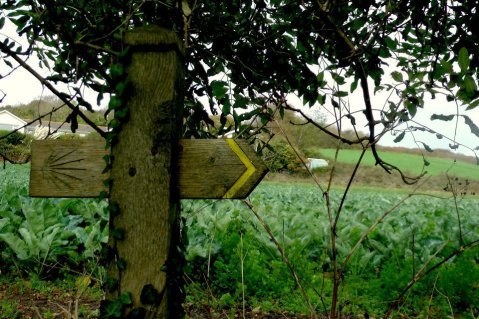
Photo by the author, Gulval, Cornwall
As I got lost time and time again making my way towards Saint Ives, I found myself marveling at all sorts of new and heretofore unknown sensations. My ears tuned from the project I was there working on, I was especially taken by the sound. Toward the middle of the path–located at the top of the hills inland of the peninsula –the wind from both sides carried over pieces of the day to day from the villages; a tractor, grazing animals, bits of conversation in Cornish, and church bells wisping by as quickly as they came, like ghosts. It is fitting that St Michael, after whom the route was named, is the patron saint of high places.
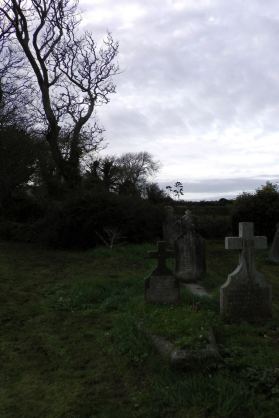
Photo by the author, Ludgvan, Cornwall
I began to wonder what this path may have sounded like back in the time of thieves and pirates, back when the occasion to use it was a shared occasion celebrated with the voices of people, priests, prayers, and the markets and fairs along the way to fuel all this activity. As I continued walking, I began to wonder how it may have sounded even before then, before the hills were blanketed with crops and cattle, before the many battles that must have been waged, and villages built and grazed. . .were there more birds then? Were there more trees? Were there more boar and foxes? What about even before these hills were hills, could there be a way to sonify these hills forming? I started to dream of a “wayback machine” for sound. What if as you walked this path, you could listen to time spinning back, listen to how it might have sounded, listen to its history? And what could you take from that experience? Could something be taken from this? In the two years since that happenstance, this idea has since stuck with me. Beginning tentative research and practice to apply these thoughts, I continue to unearth more questions than answers, so I began to seek others experimenting in a similar vein. While acoustic ecology is a growing field, I still have not found many researchers working with sound in/as time.
One person who has come close to this idea is acoustic ecologist, musician, and sound recordist Bernie Krause, whom last year I interviewed in an article on the sound of disaster about disappearing sounds as a signal of impending crises. The prelude of Krause’s book The Great Animal Orchestra: Finding the Origins of Music in the World’s Wild Places, is the beautifully written, “Echoes of the Past,” which takes a meandering listen to how the world might have sounded sixteen thousand years ago. With that trip in mind, perhaps something could come from working with people in various fields of statistical analysis to see what sounds are projected to go extinct from a soundscape with time, and what this could mean in terms of how the sound line will be extended into the future. In the section “First Notes,” Krause describes working with a graduate student, Kristin Junette, who reasoned that based on fossil records and the known sounds of insect species today, we might be able to re-create the insect ambience of about sixty-five million years ago. Then, based on acoustic physiology of the skull of a Hadrosaur, a dinosaur of the time, Krause and Junette were able to re-create a representative vocalization of its call to place in this early soundscape (for the Discovery Channel’s vision of how the hadrosaur might have sounded click here).
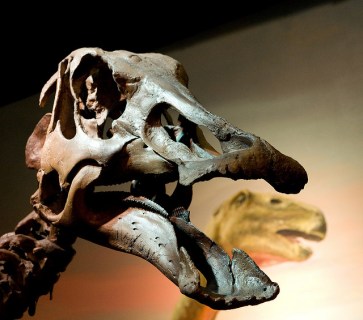
Hadrosaur skull, Image by Flickr user e_monk
I was also excited to learn of the research of Miriam Kolar, who has been working with various techniques and with people in various disciplines on a team studying and “recreating” the acoustic architecture of the Chavín de Huántar, a 3,000 year old ceremonial center, predating the Inca in the Peruvian Andes. Chavín de Huántar is a complex underground maze of rooms and twisting corridors connected by air-ducts. When they were being excavated, archeologists noticed the rooms played strange acoustic tricks on them. “This environment is not only a physical maze, but it’s a sound maze,” says Kolar. For one example, some rooms have interconnected spaces that multiply echoes and bounce them back to the ear so rapidly that the sounds appear to emanate from all directions at once, while other areas seem designed for absorption. The team has been using 3-D computer modeling and specialized recording equipment to try and recreate the auditory effect. “If you have archaeology and no acoustics, you’re deaf,” says archaeoacoustician David Lubman. “And if you have acoustics and not the other, you’re blind. You need both” to understand ancient places like Chavín.

Chavín De Huántar
Inspired in part by the research of Krause and Kolar, “Passageira em Casa/The Traveller at Home,” one of my projects from the two years since my walk in Cornwall, begins to explore the notion of the wayback machine with sound in geography. Passageira em Casa is an intermedia and interdisciplinary performance inspired by the journey to define the concept of home. The narrative is a partially fictionalized and personalized account of the Maritime history of Portugal, enacted by a dancer, vocal performer, live video, and live electronic sound composition that creates a geography through the narrative and space of the project. From a dawn chorus in Lisbon to underwater earthquakes in the Pacific, field recordings along a maritime navigation route flow throughout the performance, giving a soundscape to the narrative’s location.
.
The recent Australian version “Passageira australis” begings to explore sound in time. Recently developed at the iAir residency at RMIT, holds a focus on the debate behind whether the Portuguese were the first Europeans to arrive in Australia, based on the 16th century Dieppe maps of Jave la Grande and the myth/history of the Mahogany Ship. The soundtrack reveals a soundline based on the impact on flora, fauna, and overall soundscape on both countries.
.
A two channel composition, different then stereo, one speaker represents Europe, the other Australia. As the dancer, our sailor, moves from one end of the space to the other, the sound in each channel is changed based on her approximate location to each “country”. With this experience, my hope is the audience comes away thinking about interconnectivity of the world, and how we impact the places we touch. Although I will continue to research when I return to Australia, already the project had me working with a map historian at the Victoria State Library, as well as consulting the thesis of geologist Andrew Pickering on using GIS technology to search for the location and story behind the presumed mythological Mahogany Ship.
Based on hearing, listening (from an anthropological point of view) is the very sense of space and of time. . .By her noises, Nature shudders with meaning: at least this is how, according to Hegel, the ancient Greeks listened to her. The oaks of Dodona, by the murmur of their boughs, uttered prophecies, and in other civilizations as well. . .noises have been the immediate raw materials of a divination, cledonomancy: to listen is, in an institutional manner, to try to find out what is happening. –Roland Bathes, “Listening”
Sound has a special importance to emotion, instinct, and memory, both individual and historical.. Hitting the oldest part of our brain, sound provides immediate information telling us where we are, whether it is safe, and how we should feel about it. The wayback machine would function as a sonic database that would not only help us to remember and learn about the past, but also to create new experiences within the complexity of changing soundscapes over a period that usually defies our human comprehension. I see this tool being helpful to researchers in many disciplines as a new kind of living archive, but also having a place in libraries, museums, centers, and perhaps “in the field” along paths such as the Santiago’s Way, where one could download an audio file from the map online, then listen with wonder and unique sensation as they walk back through history.
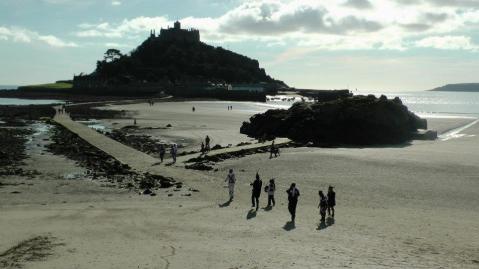
Photo by the author, Saint Michael’s Mound, Marazion, Cornwall
—
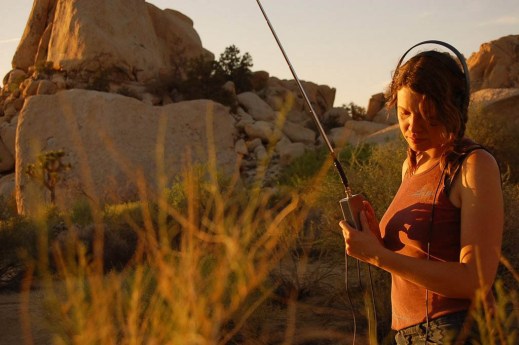
Featured Image photo credit: Vahid Sadjadi, Joshua Tree State Park, California
—
Author’s Note: A version of this post was presented at Musique et Écologies du Son/ Music and Ecologies of Sound: Theoretical and Practical Projects for the Listening of the World, Universitê Paris 8, May 2013. I slightly changed the original title of the paper to: “Sound through time, space, AND place.” Frank Vanclay said quite nicely in “Place Matters.” “‘Place” is generally conceived as being ‘space’ imbued with meaning. Thus, it refers more to the meanings that are invested in a location than to the physicality of the locality.” He goes on to state sometimes it’s the biophysical characteristics that make the foundation for those personal meanings.
—
Maile Colbert is a multi-media artist with a concentration on sound and video who relocated from Los Angeles, US to Lisbon, Portugal. She is a regular writer for Sounding Out!
—

REWIND! . . .If you liked this post, you may also dig:
“Listening to Disaster: Our Relationship to Sound in Danger”–Maile Colbert
“Within a Grain of Sand: Our Sonic Environment and Some of Its Shapers” –Maile Colbert
“Animal Renderings: The Library of Natural Sounds”--Jonathan Skinner
Share this:

Radical Listening and the People’s Microphony: A Conversation with Elana Mann
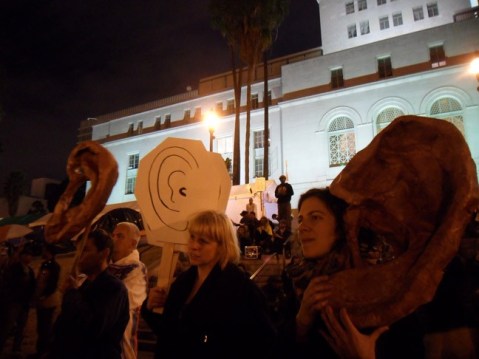
Members and collaborators of ARLA (Paula Cronan, Juliana Snapper, and Elana Mann) participating in a General Assembly at Occupy LA City Hall, November 11, 2011
Listen to everything all the time and remind yourself when you are not listening–Pauline Oliveros
“CAN YOU HEAR ME?!” “I CAN HEAR YOU!!” “IT’S A VAN GOGH PARADE!!” . . .were some of the enthusiastic replies when artist Elana Mann, musician Juliana Snapper, and other members of ARLA (Audile Receptives Los Angeles) arrived on the scene at Occupy LA with giant hand-made ears. Mann co-founded ARLA in the Spring of 2011 with Snapper, filmmaker Vera Brunner-Sung, and choreographer Kristen Smiarowski. After studying scores and techniques on listening developed by composer Pauline Oliveros, ARLA developed a workshop geared toward Occupy LA that included a listening parade in which they held up the giant ears and protest signs with ears on them. Snapper recalls, “The simple physical presence of people carrying large paper-mache ears was met with a kind of hungry recognition…recognition of what it meant that we were holding the symbols (giant ears).” They led workshops, listening sessions, and discussion groups. They performed Oliveros’ sonic meditation “Teach Yourself to Fly” and a composition written by Mann and Snapper entitled “People’s Microphony.” And a project was born. Through personal interviews and audio-visual examples, I document, contextualize, and analyze its work. 
Mp3=The People’s Microphony Camerata performing “Teach Yourself to Fly” Pauline Oliveros
I am happy that Elana Mann chose to use my Sonic Meditations for the People’s Microphony project. These pieces are meant for anyone that wants to perform them regardless of musical training.” –Pauline Oliveros
For Mann, active listening is “a process of tuning in simultaneously inward and outward. Active listening allows for an awareness of and an opening up to sounds around me and also a digestion of what is happening inside of me in relation to these sounds.” Much of the recent focus on this practice comes from the music and sound art worlds, as well as acoustic ecology, a field formed from the overlapping area between science and art that concentrates on the importance of experiencing and investigating our sonic surroundings with detailed care and respect to understand its importance on our world and our place within it. Mann’s work addresses a unique angle at the intersection of these fields: listening’s empathetic effect on those whom you are listening to, a consideration arising from a project she worked on between 2007-2010 with Iraq war veteran Captain Dylan Alexander Mack, called “Can’t Afford the Freeway.”
. “Can’t Afford the Freeway” highlights how her collaborations emerge as conversations between involved artists as well as the audience. Speaking to Mann about the project, she stated,Alex created some recordings for me and I kept listening to them over and over again trying to figure them out. I eventually produced more interviews with him and realized that he needed his story to be heard and I needed to try and understand his story. So I created a project in which I attempted to listen as best I could. Listening to his recordings made me feel close to him, but I also recognized that no matter how many times I heard his words they were still foreign to me. Still the very act of me struggling to listen was important for both of us, and I think this is true of many interpersonal/political and social situations. You can never experience what it is like to be someone else, but active listening opens up a space of empathy and connection. I also think we can see how a lack of active listening is affecting the political landscape in the United States so negatively, by producing a highly polarized and vitriolic environment.
And what about at Occupy LA?
At Occupy LA I was hopeful that there would be a place for listening to voices that had not been heard before and sometimes that happened. Other times people used the space for projecting, not receiving. I think that there needs to be strong voices making themselves heard, but I don’t want to lose the other part of that equation, which is those voices being quiet and listening to others, and themselves.

ARLA Ear Strengthening Workshop, Occupy LA site, November 11, 2011, Photo by Carol Cheh
Mann, thinking and researching about social, aesthetic, and political points of listening and voicing, felt there was something to be considered about the “radical receptivity and the core message of the OWS movement” and its global amplification of voices struggling to be heard. In the Spring of 2012, she formed The People’s Microphony Camerata with Snapper, a radical experimental choir based in Los Angeles exploring the process of the People’s Microphone. The exact history of the “People’s Microphone,” or “People’s Mic” is unclear, but its use in the Occupy Movement has already become iconic. Ted Sammons discusses the implications of the People’s Mic for communication in his October 2011 post, “‘I didn’t say look; I said listen’: The People’s Microphone, #OWS, and Beyond.” The human microphone is a way to deliver one person’s message to a large group of people in situations where amplification tools, such as bullhorns, are either not allowed or unavailable, or if the acoustics of a space distort amplification. The speaker calls, “mic check!” to alert their intentions. Those around them call back, “mic check!”, until the gathering understands something will be said. The speaker breaks their statement into short sentences, pausing to allow those around them, or the “first wave,” to repeat them in unison. They then pause for those further away, or the “second wave,” to repeat again…and so on until those in the back of the gathering have heard the statement.
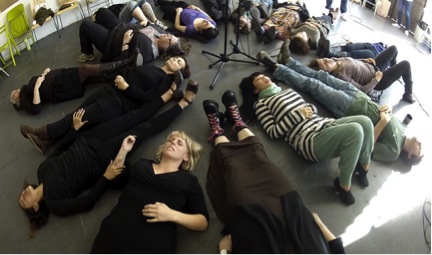
Members of People’s Microphony Camerata rehearsing in Los Angeles, April 15, 2012, Photo by Jean-Paul Leonard
The group’s trademark intensity sometimes carried over to the audience. Mann discovered such transference often had to do with prior associations with a location or context. Mann recalled a particular performance at the Occupy movement called “Chalkupy” that was formed in response to a protest running simultaneously with the LA Art Walk, in which activists had handed out chalk and told stories of police repression while chalk drawings were created on the walkways. The police shut down the art walk and a violent struggle ensued. The Occupy LA movement called for people globally to take to the street with chalk in protest, and the day was called “Chalkupy”. The audience of protestors was mixed and tense, and when the PMC began their performance of a highly emotive score called “Sob-Laugh” by Daniel Goode, people were either drawn to or repelled by the performance.
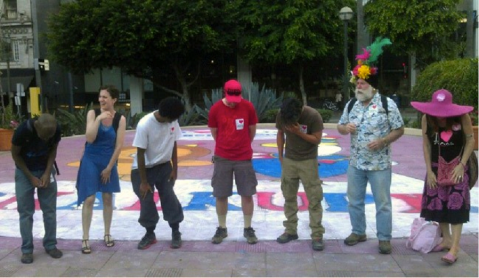
The PMC performing “Sob Laugh” at the “Chalkupy” protest in downtown Los Angeles, Image by Daniel Goode
I think there was some fear about the vulnerable revelation of emotions in the space of the protest. Many of the Occupy LA protests were so risky that everyone had to be extremely tough to exist in that activist space. I respect that. Still I think there are other things that can happen in a space of protest that bring out different feelings. Some activists wanted us to be more musically conventional, “why can’t you just sing some folk songs like normal protest choirs,” we were asked. But we really were not into that kind of thing. . .
In most protest situations, the audiences welcomed their activities. Many shared that it opened up a new space where people could meet each other as humans rather than adversaries or collaborators. Mann edited and published a monochromatic grassroots songbook with the various scores the PMC received for performance, opening up the circle for anyone and everyone to perform and feel that closeness.
Sometimes it was hard to translate a piece that worked during a group rehearsal to something for an audienceperformer situation. . .The PMC never fully developed how to deal with audience participation, but this is something I have been developing on my own in working with students on PMC materials. The scores from the People’s Microphony Songbook and the techniques Juliana and I developed when we first formed the PMC create an immediate closeness within a group, which is remarkable.

From the “People’s Microphony Songbook”: Many voices that were once silenced are now resonating through large crowds, not only of activists, but ordinary people all over the world, assisted by internet networks, and a simple technology called the People’s Microphone. The People’s Mic expressed the interrelated desires of collective and individual voices to speak and be heard, to hear one’s words spoken back through different mouths, and to digest someone else’s words through one’s own body. Beyond projecting an individual’s voice further then it can resonate on its own, the People’s Mic has implications for all of the bodies in its vicinity. It energizes listeners in ways the microphone or megaphone cannot by making listening active, vocal, and embodied. The project, like the Occupy movement, holds all the complexity, beauty, and drive of being human, whether you consider it “working” or not. When I asked Mann about how changes within and towards the Occupy Movement affected the choir, and whether they were winding down or taking a new form, she answered:
I think more than anything else, our group faced a lot of the same challenges that the Occupy Movement faced challenges in horizontality, in the push and pull between interior and exterior exploration, in the sometimes painful vulnerability of investigating the intimate personal and political space with others. I think the project is still developing. The choir still communicates, and some members are currently collaborating with composer Daniel Corral, but the PMC does not meet and rehearse like we used to I think it will continue to wax and wane. In the meantime, I am still working on ideas of active listening. I am currently creating a project called “Listening as (a) movement” within an under-served neighborhood in Pasadena, CA, exploring ideas of radical listening within a specific neighborhood.
In an age of constant bombardment of stimuli, our heads scream with thoughts, opinions, arguments, and expressions. With our current technology, our input and output can be a constant rush of snap reactions and impulses, which has a profound effect, of course, on our day-to-day lives, on our culture(s), on our politics. But these circles cannot be affectively complete without the other side. We need someone to hear us, and, more then that, we need someone to listen to us. And we, in turn, need to listen to them.
—
Maile Colbert is a multi-media artist with a concentration on sound and video who relocated from Los Angeles, US to Lisbon, Portugal. She is a regular writer for Sounding Out!
—
REWIND! . . .If you liked this post, you may also dig:
“Sensing Voice”–Nina Sun Eidsheim
“Within a Grain of Sand: Our Sonic Environment and Some of Its Shapers”–Maile Colbert
“Listening to #Occupy in the Classroom”–Travers Scott
Share this:


Current Top Posts





April 2021

January 2020

November 2019

October 2019

August 2019

April 2014

November 2017

March 2015

December 2017

October 2015
 Sounding Out!
Recent Comments