
SO! Amplifies: Cities and Memory
 SO! Amplifies. . .a highly-curated, rolling mini-post series by which we editors hip you to cultural makers and organizations doing work we really really dig. You’re welcome!
—
Inspired by how sound and memory interact, Cities and Memory is a sound program with the aim of “remixing the world, one sound at a time,” existing on the (already quite blurred) line between documentary field recording and sound art.
Its primary manifestation is an online global sound map, on which every location boasts two sounds, the “city” and the “memory.” The “city” sound is the faithful, documentary field recording capturing that place at that time, as it existed and was heard. The “memory” sound is a reimagined, remixed, reinterpreted version of that sound: everything from oral reconstructions, full-on techno tracks built around a field recording, ambient reimaginings, and all the points in between, as summarized in this roundup of creative approaches from the site. The reimagined sounds represent how sound is remembered and experienced differently by each individual, and explore what happens in that magical period between sounds being physically experienced and their being mentally processed, interpreted, and above all felt.
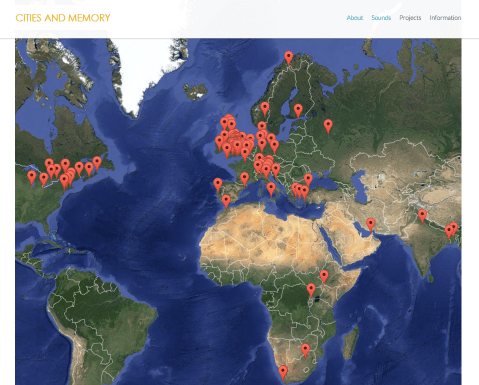
Starting from that basic premise, Cities and Memory has collected more than 600 sounds from around the world in just over a year, with more than 100 artists, musicians, field recordists and sound enthusiasts contributing anything from a field recording snatched on a mobile phone through to a complete musical reconstruction.
Over recent months, Cities and Memory has expanded with a series of projects each exploring a different avenue or window onto sound that has been opened up. For instance, last November saw #HamburgSounds, an ambitious project to sound map the vast city of Hamburg, Germany and to reimagine its sounds. A four-day recording session garnered enough recordings for forty sound artists each to give their take on a different aspect of Hamburg’s sounds and what they meant to them. The results were symbolically released over a 24-hour period, representing a day in the city’s life, and in the memories and imagination of its citizens. For more sounds from Hamburg, click here.

This year also saw a project using Brian Eno and Peter Schmidt’s Oblique Strategies cards as creative direction for reimagining field recordings. The reimagined sounds that came from more than 100 different creative strategies employed in the project were even more diverse than its locations, which covered everything from jungle in Thailand and Shanghai temples to the urban centres of Chicago, New York and London. Spectrum analysis, musical cryptograms, working simultaneously with artists in different countries, even TripAdvisor reviews(!) – every creative sonic technique in the book seems to have been used in one way or another.
The latest project, called Quiet Street, takes the form of a simultaneous digital and physical exhibition, reimagining the sounds of the city of Bath as part of its Fringe Arts Bath Festival. The physical installation presents two sides of sonic memory – first, the documentary field recording of a location in Bath, and second the reimagined, or ‘memory’ version of the sound. The audience can navigate between two sonic ‘versions’ of Bath simultaneously on different sides of the space. One side broadcasts the “city” sound from a location, the other the matching “memory” sound, a remix or reinterpretation of the field recording, time-synced so that the sets of sounds shift in and out of one another in unison. The listener chooses – by his or her own physical proximity – to experience freely the two sound worlds.
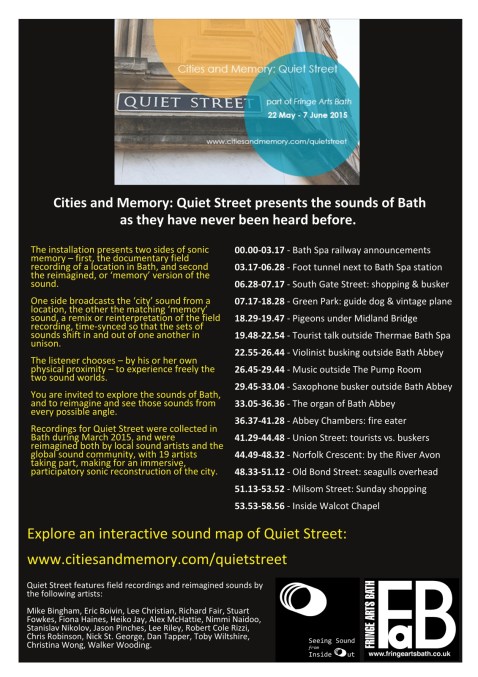
Visit the physical installation of Quiet Street at Fringe Arts Bath Festival, 22 May 2015 – 7 June 2015 at 8/9 New Bond Street Place, Bath
As the “city” and “memory” sounds are precisely time-synced in the installation, an additional creative challenge for the artists was to create reimagined version the same length as the source field recording. More importantly, they also needed consider not just how the reimagined sound stood on its own, but how it would live simultaneously in the same space as the field recording, creating a direct tension between “real” documentary sounds and the memory of those sounds in the same space.
The digital exhibition of Quiet Street allows the sounds to be explored through a map interface. It also allows listeners to simulate the installation experience with a series of installation mixes, presenting the field recording and reimagined sound on opposite sides of the stereo field. You can access playlists here and here as well as download the album documenting the event here.
As a curator, the most exciting thing to me is that the central idea behind Cities and Memory is so open; there are almost infinite possibilities for its application. A new angle on sound, place or memory can bring up a new project at any point, and every contributor brings their own experience and interpretation.
In the course of exploring hundreds of field recordings, examining them in detail and finding a creative angle from which to reinterpret them, I’ve developed a new appreciation not just of field recording as a practice, but of how to listen to whichever environment I find myself in. It’s given me a new perspective on sound and on music, and how utterly blurred the lines are between the two. I listen very differently to the world now. As Cities and Memory continues to grow, I hope many others will too.

—
Stuart Fowkes is the creator and curator of Cities and Memory, producing a large number of the source field recordings and reimagined ‘memory’ versions himself, as well as curating the project as a whole. Quiet Street runs from 22 May to 7 June at 8/9 New Bond Street Place, Bath, as part of Fringe Arts Bath, and digitally at www.citiesandmemory.com/quietstreet. Find out more about Cities and Memory and how to contribute: http://citiesandmemory.com/what-is-cities-and-memory-about/
—
 REWIND!…If you liked this post, you may also dig:
Toward A Civically Engaged Sound Studies, or ReSounding Binghamton–Jennifer Stoever
SO! Amplifies: Ian Rawes and the London Sound Survey–Ian Rawes
SO! Amplifies: Carleton Gholz and the Detroit Sound Conservancy–Carleton Gholz
Share this:

Sounding Our Utopia: An Interview With Mileece

There is no utopia without nature. Life is already a utopia–Mileece
When I heard sound artist and environmental researcher Mileece refer to utopia as she presented on her bio-sound work this past year for MOMA’s PSA1 series “Speculations: The Future Is ____” I was startled and intrigued. When I asked Mileece to delve further into her conception, Mileece explained how when faced with an environment lacking flora–such as on a recent trip to India where she spent a lot of time in a cityscape heavy with apartment blocks–she noticed that finally coming upon a garden outside a temple or other flush area felt like utopia. “I’m referring to an ecological utopian society, not a fictional one.” Mileece told me, “But either way, what we imagine as a perfect society always comes with fruit. Nature makes man right in the head. Without it, things get really rough. With it too of course, but you can see what happens to people deprived of green.” Her participatory art installations explore and communicate her sense of the lushness and sensory surprises of the natural world.
Mileece is a internationally acclaimed, multi- disciplinary sonic artist and renewable energy ambassador. Her work “promoting ecology through technology and the arts’ has brought her international critical acclaim as a composer and installation artist. Formations, her debut album, inspired by cycles and formations in nature (“beautiful, real, musical science,” BBC), was the result of her initial works in computer generated compositions, using Super Collider, an object-oriented programming language.–Decibel festival bio
.
Mileece and I recently continued our conversation via Skype–she in the city of Jaisalmer in Rajasthan performing camera and sound work on mouthharps, and me in my studio in Lisbon, Portugal–what follows is a transcript of our talk. Mileece had just finished showing in Bhutan, where she created an installation in a dome at their first international festival.
—
Maile Colbert: Was the installation [in Bhutan] related to the work you did recently in MOMA [at POPRALLY in February 2013]?
Mileece: similar in being an installation with interactive plants and sensors.
.
MC: And when you are home and in the studio, what does your day look and sound like?
M: That depends on much. The last project I did before leaving for Bhutan was a dome at a school, which had me with a shovel in garden clothes up early onsite, then home late, so I wasn’t in the studio at all. Then I worked on the plant interface for Bhutan and generally to get a public interface finished-hardware and software as pre-made wireless ‘off the shelf’ devices and learning kits that I can distribute to people and artists and do more complex projects with. So at random hours, when my colleague who is helping me with the engineering aspects had a moment, we would sit and quickly go over the builds. I did recently decide I want to do a less intensely computer based project, so completely rearranged my studio, borrowed a loop station, bought a gold guitar and started to ‘jam’. It’s something I’ve never done before. I’ve had days where it’s fourteen hours working constantly in the studio, tweaking buttons and writing code. But it all depends…
.
MC: So, does each project tend to take you into something new…new tools, new methodology…or do you think you work like that because that’s how you like it, to be an exploration as well as a process?
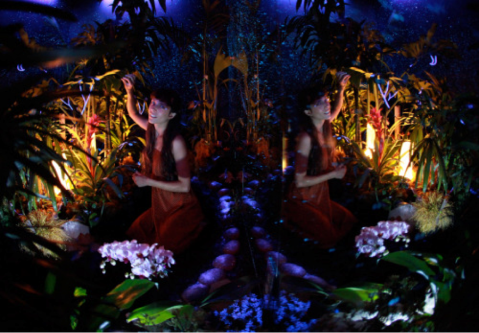
M: I’m always refining, but the software I wrote is 10 years old now and I’ve been working on the plant project for about 15 years. “Soniferous Eden” is an installation series where interior spaces are transformed into star-studded micro-ecologies, where lush groves of plants generate rich and dynamic soundscapes in response to the touch and presence of the participants, who can saunter barefoot in moist soil amongst them. I’m always working on it, whether the code, concept, or its elements.
.
M (cont. . .): Every time I do an installation it’s site specific, so never the same, and generally it’s evolved into a variety of different types with focus on various objectives. For example, the dome at the school is a bio-library and sound sanctuary, where I created a pond, dry creek, planted area, and interactive sitting ‘pods’ inside a dome so kids can read and be in a seemingly natural environment, sitting on the ground in a way that is ergonomic and triggers soundscapes when they are still. There is an array of benefits to being around plants and within a ‘high fidelity’ acoustic environment, as R. Murray Schafer would call it (from whose works some of the concepts were modeled)…from helping the parts of the brain dealing with abstract thinking, to developing memory and social skills. It’s argued that attention deficit disorder is a behavioral issue that can be traced to the decrease in natural habitat available to children.
On other projects, such as for Bhutan, more emphasis was on the interactivity with the plants themselves, so I worked on the code of the plant synths, written in SuperCollider, an object-oriented programming language.
I’m not really reinventing at this point, just tweaking and improving. Although, having said that, for these next projects there are significant advancements in the works…it’s like invention. Sometimes I make new sensors and design new sounds, but since my work has spanned quite a variety of stuff from renewables to software to gardens, each one evolves slowly.
MC: Can you tell us a bit about your background and where you are from? And what from this do you think led you to “Tree We’vr”, and working with biofeedback data of plants?
M: I’m from England and grew up in multiple cities (London, New York, Los Angeles) and the countryside equally, so I was exposed to rural and urban environments. I saw The Secret Life of Plants when I was around nineteen, and a couple of years before that Mobius 8 had shown me his work with MIDI and sensors.
M (cont. . .): I had imagined holographic plants (my mum did holography in the 80’s)…which then seemed completely uninteresting since plants THEMSELVES could iterate music.
MC: Have you always had an interest in micro-worlds? What about worlds barely perceptible to us interests you?
M: Yes, micro-worlds…love that. In Suffolk, where I grew up for some time, we had this greenhouse and I remember making this tiny micro-garden in it. I LOVED it and was just mortified when my father told me it needed to be torn down for being unsafe, which he did by getting riotously pissed with his best friend and driving the Range Rover through it.
I have great respect and love for the world and living things. I truly ache for the well being of plants and animals and most people so overall I am dedicated to helping support a healthy ecology, in the holistic sense of the word. And sometimes these ‘hidden things’ are what makes the link to show up the ‘livingness’ and connection we are lacking…the ‘magic’ we need to see and touch to remember that we are a spinning spool of intangible energy organized and perpetuated only by our own existence.
MC: Do you feel your sonification with plants as an instrument, or translation? Can you describe the connection you have with a plant when working with it…is it emotional, scientific, intellectual curiosity…a mix? Is it a dialogue?
M: Nail on the head. My work as an artist is to find the balance between the two. I call it aesthetic sonification, as what you are looking to do is relay data in a way that people understand it, which isn’t necessarily how it iterates, as there are psychoacoustics and other human factors as to how we interpret sound that need to be considered when you are translating information into the sonic realm. So you find a way to relay the information, then make it beautiful for both the human and the plant to be able to enjoy, which is key to art being successful. It’s a balance, and that is my job. That is where I see the necessity for artistry and mastery, and where I try to get it right. The rest is understanding the technicalities.
https://soundcloud.com/mileece/mileece-plusic
.
M (cont. . .): An instrument holds potential as a set of elements and offers a composer/musician that spectrum of potential to weave from. The limitations are the possible manifestations of that potential as choreographed by the degree of expertise of the musician/composer. Sonification doesn’t care about weaving potentials, it wants to be direct as possible. The degree of articulation of the information is a strictly technical matter. So I am somewhere in there, where the sonification is the limitation of the instrument, and the instrument is the plant and interface.
MC: Do you find people understand your work? How much of understanding what you do is important for you to have from your audience?
M: b A whole spectrum of folk come and make use of the installations. Though perhaps not many thoroughly understand my work, most understand the consequence. When I explain what I’m doing I don’t usually get vacant stares, most people follow. I don’t really have an audience, I have participants, so people do a thing, and a thing happens…then they wonder how, and they can find out. Their curiosity leads them on that journey of discovery, and it doesn’t really matter, the issue is plants are alive more than we thought. So long as someone walks away with that, that’s right and good. And if the music and ambience moves them, that’s best.
An instrument holds potential as a set of elements and offers a composer/musician that spectrum of potential to weave from. The limitations are the possible manifestations of that potential as choreographed by the degree of expertise of the musician/composer. Sonification doesn’t care about weaving potentials, it wants to be direct as possible. The degree of articulation of the information is a strictly technical matter. So I am somewhere in there, where the sonification is the limitation of the instrument, and the instrument is the plant and interface.
.
MC: You mentioned once plants “lacking representation”…I find this intriguing, can you tell us more about this concept?
M: There really isn’t one part of our economy that doesn’t rely on the exploitation of plants, either themselves or their habitat. We have rights for animals, rights for people, and we know we abuse them often, as there are representatives who tell us so. But we don’t often think about the plants, and the plants are also living. They support life, all life almost, so we have to start thinking about that. They are now using ‘excess’ plant energy to power devices. I find this idea of ‘excess’ interesting, like over 90% of our DNA is junk, and 94% of the Universe is ‘dark’. I wouldn’t like to be so assertive.
MC: What tends to happen with the sound from the plants when they are touched? Does it depend on the kind of touch? Does it depend on the kind of plant, or where it is touched? Do plants scream? Or is this anthropomorphizing?
M: Plants emit indicators, best known to be chemical, when they experience threats or distress. The smell of freshly cut grass for example, this is a chemical emitted by the plants to express distress. So ‘screaming’ is an anthropomorphic viewpoint on that possibly unemotional ‘response,’which is what plant biologists would commonly call it. This is because we don’t understand plant biology well. They have systems to take in a calculate information, make decisions, and produce self-regulated results, but we have a hard time figuring that out since it isn’t in the form of what we say is required of sentient beings… a nervous system and a brain. But no, it doesn’t matter where you touch a plant, that doesn’t make different sounds, at least that I can tell. I don’t have scientific instruments, I have arty ones, so they aren’t accurate enough to make precise measurements or declarations. I’m in the experience, not research department. The synths I’ve written are modulated by the current from the plant, so the sound changes in direct function of the modulation of the current, which changes with touch or presence and general livingness.
.
[. . .]
MC: You go way beyond trend or gimmick, you have been doing this a while. Where do you think your work is going? Do you have more in this vein to explore…is it leading somewhere you can share with us?
M: I’m currently working with Eden Labs and some other partners at UCSD on a project engaging custom made technology to hybridize with living systems, forging lucid and direct connections between the inner city and wild ecologies in real time.
More on Mileece and here work here: http://www.mileece.is/
—
All images courtesy of the artist
—
Maile Colbert is a multi-media artist with a concentration on sound and video who relocated from Los Angeles, US to Lisbon, Portugal. She is a regular writer for Sounding Out!
—
REWIND!…If you liked this post, you may also dig:
Sounding Out! Podcast #34: Sonia Li’s “Whale”
Sound Designing Motherhood: Irene Lusztig & Maile Colbert Open The Motherhood Archives— Maile Colbert
Playing with Bits, Pieces, and Lightning Bolts: An Interview with Sound Artist Andrea Parkins— Maile Colbert
Share this:


Current Top Posts





April 2021

January 2020

November 2019

October 2019

August 2019

April 2014

November 2017

March 2015

December 2017

October 2015
 Sounding Out!
Recent Comments