
Animal Renderings: The Library of Natural Sounds

Today we bring you the latest post in SO!’s spring series, Live from the SHC, which follows the new research from the 2011-2012 Fellows of Cornell’s Society for the Humanities, who have gathered in the A.D. White House to study “Sound: Culture, Theory, Practice, Politics.” For the full series, click here. Today poet, scholar, and ecocritic Jonathan Skinner brings us all a treat for spring, so throw open your windows and take a deep listen. –Editor in Chief, JSA
—
DOI: https://doi.org/10.59350/6grk7-v6247
This planet is singing 24/7 but are we listening to it? Take out your earbuds, turn down the music and the air conditioning, walk away from the fridge, shut off your engine, open the windows, and tell me what you hear. If you are in the humid parts of the temperate regions, chances are you’ll hear right now, amidst the myriad human sounds, and depending on the time of day, the spring peepers going, the woodcocks peenting and displaying, a grouse drumming, the whistling of cardinals and robins, chickadees countersinging, blackbirds trilling, cawing of crows, blue jays scolding, honking of geese, hooting of an owl or two, woodpeckers drumming, house sparrows chirping (in this case, to a Satie carillon), perhaps some coyotes yapping it up after midnight. Not to speak of wind in branches and leaves, water, thunder and lightning. These are just some of sounds I can pick up, with a bit of careful listening, in and around the relatively urban environment of Ithaca, New York. If you put your ear to the grass, you might hear this astonishing Treehopper communication.
Or maybe you heard these sounds in some music you were listening to, in a movie soundtrack or videogame? Just as we pervade their worlds, animals pervade our environments, and their sounds are used to “render” these environments within the relatively flat dimensions of our media—the way three dimensions of spatial information get “crunched” to the two dimensions of a video game’s display (see 4:00 – 5:20 for a demonstration of Aiden Fry’s “generative birdsong” program below, developed through the analysis and sampling of birdsong as a solution to repetitive sound effects that can diminish the immersive quality of the game). Even the most sophisticated “surround sound” audio must “render” figuratively the environed experience of hearing.
.
The next time you watch a movie, listen to some “ambient” music or play a videogame that renders an outdoors environment, imagine subtracting the animal sounds (either literal or evoked) from these media scapes and consider how incompletely rendered the experience would be. A reversal of the effect, as in Gus Van Sant’s use of Hildegard Westerkamp’s “Beneath the Forest Floor” soundscape, to track and underscore the anomie of certain characters through Elephant, his thinly veiled recreation of the Columbine High School tragedy, also proves the rule (note especially the soundtrack from 3:10 – 3:40).
.
Greg Budney and Mike Webster explain their dedication to compiling the world’s largest and best quality archive of animal recordings (now in video as well as audio), the Macaulay Library of Natural Sounds at Cornell University, as a responsibility to future acoustic biologists, who may bring tools and concepts to the data we have not remotely conceived. Their mission is first and foremost a scientific one. However, conservation is also high on their list: Budney, an expert recordist, points out how high quality recordings—as of lekking Greater Prairie-Chickens—can be played back into the environment, to promote nesting of endangered populations.

These bioacousticians agree that high quality sound recordings can be a powerful way to interest laypeople in the sounds of the robin in their backyard, and, by extension, in broader issues of conservation. Sounds in the Macaulay Library also are available to the entertainment industry, so that, indeed, myriad animal vocalizations contribute to the renderings of its various media. Licensing fees in turn contribute to the conservation mission of the Library.
Rendering is not so much a matter of reproduction—accurately representing a “real” environment—as of recreating, through a consistency that “completes” the aesthetic experience, the feelings associated with an environment. (Think of the difference in quality between the “finished” HD, surround-sound movie and the behind-the-scenes “special features” on a DVD.) In Audio-Vision: Sound on Screen, media theorist Michel Chion identifies an important feature of rendering in “materializing sound indices,” noises that help render, in sound and image, a particular “clump of sensations” (112-116).
For instance, spatial depth, in outdoor scenes, is often rendered through the presence of bird song or dogs barking, etc. Or consider the cooing of pigeons that often accompanies the opening of a garret window in a movie set in Paris. Or that ubiquitous red-tailed hawk’s cry indexing a “wild” landscape. The absence or thinness of these indices can be just as helpful to rendering, as when the landscape includes “ethereal, abstract, and fluid” entities: “out of touch” characters in Jacques Tati films or the drawn characters in Who Framed Roger Rabbit, where hollow, lightweight, plastic sounds help us believe that we are indeed seeing (or, as Chion reminds us, “hear-seeing”) cartoon characters (watch from 1:19 – 1:33 for the famous “clang” the drawn Jessica Rabbit makes as she collides with the live action Eddie Valiant).
.
Cormac McCarthy’s The Road, both the book and the film version, deploy effectively the total absence of animal sounds to convey the uncanny complex of feelings bound up in environmental apocalypse—the “silent spring” invoked by Rachel Carson a half century ago in her indictment of the toxic legacy of the chemical industry.
In his study of environmental aesthetics, Ecology Without Nature, ecocritic Timothy Morton faults rendering for perpetuating an “ecomimetic illusion of immediacy,” an “ambient” art that ultimately comes in between us and the life it is supposed to bring us close to (36). Rendering lures us into the “relaxing ambient sounds of ecomimesis,” precisely when we need to hear “the screeching of the emergency brake” (as Morton puts it: “whistling in the dark, insisting that we’re part of Gaia” 187, 196). However, Chion notes that “the disjunctive and autonomist impulse [à la Godard] that predominates in intellectual discourse on the question (‘wouldn’t it be better if sound and image were independent?’) arises entirely from a unitary illusion” that there is “a true unity existing elsewhere” (Audio-Vision 97-98). Such unity is in fact elusive: for instance, it can be difficult to identify the sources of sounds in “nature” (consider the bewildering variety of blue jay calls), while the notion that a sound can on its own invoke more abstract characteristics of its source, especially when it is produced by a nonhuman species, betrays a kind of magical thinking. (Forms of non-western magical thinking actually acknowledge the disjunctive quality of natural sounds by referring, for instance, to “voices in the forest.”) Also, sound is so context dependent, and our listening is so strongly influenced by the conventions of our media, that “sound in itself”can be a very slippery object. Chion notes that we need something like an “auditory analogy of the visual camera obscura” —i.e. the monitoring and recording of soundscapes—to help us listen to “sounds for themselves and to focus on their acoustical qualities” (108).
In a time of mass extinction, how are we to approach the rendering of animal sounds in our mediated environments? Do these sounds have agency? Does listening to and “capturing” animal sounds bring us closer to them, or only lure us, with an illusion of immersion and unity, away from realizing the dark nature of our ecology, and the urgent reforms needed, if we are actually to help animals (does our rendering and consumption of whale song—pace what Songs of the Humpback Whale has done for whale conservation—end up perpetuating the same extractive process that “renders” whale blubber)?
I would say that, so long as we approach these sounds neither as a substitute for, nor as an experience “less than,” the daily practice of listening to our environments, a resource like the Macaulay Library can add immeasurably to our awareness of the diversity, and the vulnerability, of life on Earth. (Another resource worth exploring is the British Library’s Environment & nature sounds archive, especially the collection of early wildlife recordings.) Careful attention to renderings of animal sounds in our media can make us aware of the extent to which we “render” the landscape around us, through selective habits of listening, and open us to the disjunctive, noisy, reverberant, distorted sounds such renderings obscure. (R. Murray Schafer made this point long ago, in his book The Soundscape urging us to listen to noise if we want to defeat it.) Clips posted here, of media using birdsong to render scenes of human violence, state the complexity of our pastoral aesthetics in an exaggerated way, but every day our listening has access to a range of sonic collisions.
Consider the famous recordings of nightingales in Beatrice Harrison’s backyard, to the accompaniment of her cello, as well as to RAF bombers—on Minnesota Public Radio’s Music & Nature. Part of what we will hear when we listen with open ears is our own domination of the soundscape, one that can have concrete implications for the survival of other species (Chris Clark, head of Bioacoustics Research at Cornell, has imaged the way the noise of shipping lanes impacts the acoustic habitat of endangered Right Whales.) How might the infrasonic or ultrasonic vocal communications—of blue whales, elephants, mice and bats, for instance—that operate beyond the range of the naked human ear (but not of our instruments) impact our media environments? The “materializing sound indices” of recordings can be used to return us to the embodied, imperfect natures of these other beings, whose vulnerability, philosopher Jacques Derrida suggests in The Animal That Therefore I Am, it is our own nature to follow.
The more we listen to the environment acousmatically, the better critics we become of our media environments’ often crassly commercial renderings. Many of these sounds (see also some of the recordings collected on the Earth Ear label’s Dreams of Gaia) are simply beautiful, or astonishing—conveying an aesthetic dimension alluded to in veteran nature recordist Bernie Krause’s new book, The Great Animal Orchestra: Finding the Origins of Music in the World’s Wild Places. (My concern with a focus on the exotic is that privileging “wild places” might have the effect of devaluing the “not wild,” i.e. where most people live—places nonetheless full of wild creatures—and where we might best develop our listening.) Finally, the more we find ways to render these sounds meaningfully in our own lives, outside patterns of consumption, the better chances are we’ll begin to develop (politically, ethically) meaningful relationships with these other species, species with whom we must collaborate if we want to tend the web of life that so desperately needs our care.
—
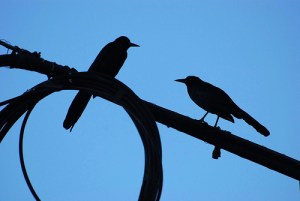
**Featured Image Credit: Digital Collage Bird Art by Flickr User Peregrine Blue
—
Jonathan Skinner founded and edits the journal ecopoetics, which features creative-critical intersections between writing and ecology. Skinner also writes ecocriticism on contemporary poetry and poetics: he has published essays on the poets Mei-mei Berssenbrugge, Ronald Johnson, Bernadette Mayer, Lorine Niedecker, and Charles Olson; on Poetries of the Third Landscape, Documentary Poetics, and Poetry Animals; and an ethnographic study of the Tohono O’odham Mockingbird Speech. Skinner’s poetry collections include Birds of Tifft (BlazeVox, 2011), Warblers (Albion Books, 2010), With Naked Foot (Little Scratch Pad Press, 2009), and Political Cactus Poems (Palm Press, 2005). Skinner’s latest creative project is a book on the urban landscape designs of Frederick Law Olmsted.
—
Share this:

Death Wish Mixtape: Sounding Trayvon Martin’s Death
“Many men wish death up on me/ blood in my eye dog and I can’t see/ I’m trying to be what I’m destined to be/ and niggas tryna take my life away” –50 Cent, “Many Men (Death Wish)”
DOI: https://doi.org/10.59350/ckh7d-h8910
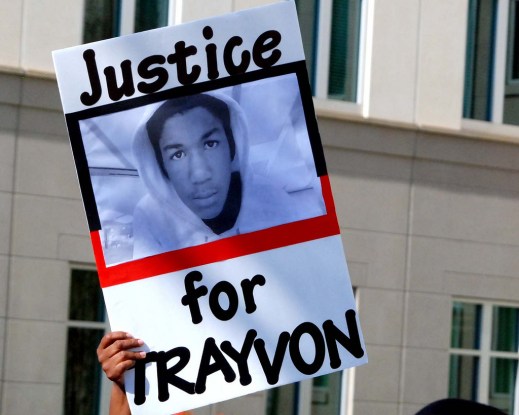
After hearing about the murder of Trayvon Martin, the unarmed teenager who was shot to death by George Zimmerman in a gated community in Sanford, Florida on February 26, 2012, I grappled with the urge to grab my godsons, nephews, cousins, brothers, and husband and never let go. I grappled with the Du Boisian question of the color-line, redressing it to consider “what does it feel like to be not only a problem but a target?” With these thoughts in my mind, I especially grappled with listening to the audio records of the 911 calls documenting the death of Trayvon Martin, just released late Friday March 16thby the Sanford police department.
I have mixed reasoning as to why I listened to the tapes. Part of me was just being nosy, but there was a deeper, far reaching curiosity stemming from my southern roots. As a Georgia girl, I was raised by Georgia men. My grandfather vividly recounted horrific stories of lynchings and beatings that happened “at the hands of persons unknown.” My mindset, like that of many, shifted to thinking about Trayvon’s death as a lynching. These tapes gave sonic urgency to a historically silent crime. In a word, Trayvon’s desperate screams gave voice to the countless men and women before him who died at the hands of white vigilantism.
As I listened to the distraught callers—and Trayvon’s final screams and pleas for his life—my mind became a mosh pit of emotions. Pissed, my mental playlist shuffled to 50 Cent’s “Many Men (Death Wish).”
.
I imagine Trayvon walking as the haunting piano and strings at the start of “Many Men” accompany his steps. He anxiously questions Zimmerman– “Why are you following me?” – in a similarly anxious way as 50 Cent can be heard asking “what’s taking homie so long, son?” and the shot rings out. As Trayvon screams and falls, the hard hitting boom fills the silent void. His lifeless body lays face down in the dirt, a lone piano softly signifying vulnerability as 50 Cent’s chorus starts: “many men wish death upon me/blood in my eye dog and I can’t see/I’m trying to be what I’m destined to be/and niggas tryna take my life away.” Situating Trayvon Martin’s final moments in a song by 50 Cent is discomforting, yet speaks to the reality and imaginative scripts of black masculinity as violent. The physical gunshot to Martin’s chest echoes the allegorical shots heard in the “Many Men” track and those in songs like Notorious B.I.G.’s “Who Shot Ya,” as another example, simultaneously blur and re-enforce black death as fantasy and normative. The 911 calls documenting Trayvon Martin’s death heard in concert with 50 Cent’s song sonically reify (gun) violence as a dominant discourse of black male identity. Indeed, Trayvon, I know who shot ya and gave you a death wish. I cannot, however, understand why.
The sonic surveillance of Trayvon Martin and George Zimmerman’s run-in—documented by the numerous accounts of neighbors who heard something but did not go outside—presents a juxtaposition of expected black male identity with the vulnerability of a horrified child forced into a criminalized space of black masculinity. In Zimmerman’s 911 call–listen via the Huffington Post here–he nonchalantly and at time heavily sighs about Martin’s blackness and its associated threat – “he’s black,” “he looks suspicious,” “he’s up to no good.” The passivity of Zimmerman’s voice reflects his bridging of (young) black masculinity as threatening. The panicked callers’ voices, however, represent reprieve and reinstate Trayvon’s humanity. The Trayvon Martin 911 recordings, then, are a mixtape of his final moments, sampling the voices of the various callers to construct Trayvon’s fatal narrative. Ultimately, the callers give voice to the vulnerabilities that Trayvon was deemed unable to evoke or possess by default as a black male.
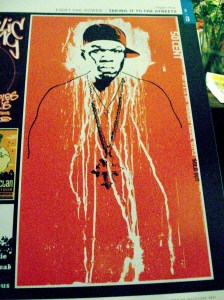
I use the word “mixtape” here to argue that the frequencies of trauma in which the (white) listener situates Trayvon Martin’s death must be heard within a larger understanding of sound as a commodified and racialized space. Ultimately, the recordings of Trayvon’s death are a sonic reflection of a long history of white America’s treatment of black bodies as capital. In negotiating the black (male) body as a commodity – which is historically and culturally significant – sounding the black male body as a commodity contextualizes this moment of expected black masculine performance for nonblack listeners. It needs to be noted how pathological black masculinity is profitable and mutually invested in by black men and white consumers alike. Briefly referring back to 50 Cent, he performs and is validated by the violence his narrative possesses. He knowingly invests in the exaggeration of his experience – he really was shot – and builds his image upon that paranoia. In In the Break, Fred Moten discusses the sonic commodification of blackness as “not what the commodity says but that the commodity says or, more properly, that commodity in its ability to say, must be made to say” (9). Situating black rappers’ narratives and, extensively, black men’s narratives as a commodity speaks to how the ambiguity of such narratives relegate blackness to a position of profitable, essentialized discourse. Moten suggests sounding blackness as a commodity is an effort to address these ambiguities, linking the privilege of speaking and constructing black (masculine) narrative, not content, as culturally and capitalistically recognizable and significant.
Trayvon’s political agency is invested in the violence placed upon his body by public scrutiny as a black man before there is any vulnerability as a child. Thrust instead into the position of ‘suspicious’ black man in a predominately white middle-class gated community, Trayvon the child bears the public scripts of expected black masculine performance, which are both visual and sonic. These expectations of popular culture and public opinion distort Trayvon’s sonic imprint, rendering him unable to vocalize and physically relay his desperate need for help.
As Mark Anthony Neal points out in a his March 19th New Black Man post “Hearing Trayvon Die” linking hearing Trayvon Martin’s death to a scene of a grieving Muddy Waters (Jeffrey Wright) from the 2008 film Cadillac Records, in which Waters’s pain is heard but not seen: “part of the reason that Jeffrey Wright’s howling had to be experienced off screen is that we have little understanding of Black males, as vulnerable, in pain, under duress, in terror and confronting death.” The impact of the lack Neal describes emphasizes the necessity for a sonic imposition of such vulnerabilities. In this case, the agency of this need is heightened by the audience being forced to listen to Trayvon’s frantic screams for help on tapes, thus humanizing him before racializing his body.
Yet it is Trayvon’s alleged screams – which I undoubtedly believe ARE his screams– that also sonically invoke his humanity. On the recording, heart-wrenching screams for help are silenced by the forceful pop of a gunshot, the silence signifying multi-layered historical and cultural indicator of Trayvon’s worth as a black boy in American society. Trayvon’s screams vocalize the agonizing silent demise of the murdered black boys before him. . .Oscar Grant. . .Amadou Diallo. . .Emmett Till. His screams are an echo of Frederick Douglass’s Aunt Hester’s screams, recorded in his 1845 Narrative, acknowledgement of the cruelty and continued viability of longstanding—even foundational—racial prejudice and violence that exists within the contemporary ‘postracial’ American agenda.
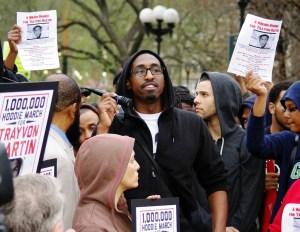
Moreover, Trayvon’s scream also concisely signifiy the ongoing “upheaval” and chaotic existence of black men that Moten suggests “pressures the assumption of the equivalence of personhood and subjectivity” (1). Trayvon’s screams amplify a tragic dimension of what I theorize as “sonic cool pose,” where black masculinity is only cool if accompanied – instrumentally, lyrically, and otherwise – with violence. In this regard, the sonic signifiers that mark death—like the gunshots and screams that introduce 50 Cent’s “Many Men,” for example—are Trayvon’s. Both built upon the traumatic condition frequently faced by men and boys of color, Trayvon and 50 Cent’s lived experiences can be heard as sonically interchangeable despite obvious differences in class position. Through sound and the American popular imagination, black manhood is virulently fluid. There is a universal, stereotypical understanding that black masculinity resorts to identical markers of lived experience. This awareness is especially heightened and dominant in sound, where 50 Cent’s shooting on the corner parallels Trayvon’s shooting in a gated townhome community.
The release of the 911 audio of Trayvon Martin’s death is a powerful intervention in maneuvering black masculinity and violence in American (popular) culture. There is a delicate and simultaneous reading of the recordings as a sonic realization of black masculine violence and a fetishizing of a violated black male body. The sounds they contain amplify a continued American investment and interest in the black pathological narrative while doubly intervening as an alternative reading of such negotiations of black manhood. Whether sounded across a courtyard in a gated suburban neighborhood in Sanford, Florida, or on the streets of South Jamaica, Queens—or in the isolation booth in a recording studio—these frantic and desperate screams are sonic imprints of his social-cultural relevance. They may bleed into one another, but they won’t fade away.

—
R.N. Bradley is a PhD candidate in African American Literature at Florida State University. She writes about African American literature, race and pop culture, Hip Hop, and her own awesomeness. She earned her BA in English from the Unsinkable Albany State University (GA) and a MA in African American and African Diaspora Studies from Indiana University Bloomington. Her dissertation project looks at negotiations of white hegemonic masculinity and race consciousness in 21st century African American literature and popular culture. You can read her work atAllHipHop, Newsone, TheLoop21, or her monthly column “The Race to Post” over atPopMatters. Scholar by day, unapologetic Down South Georgia Girl 24/7/365. Catch up with her awesomeness via twitter:@redclayscholar and her blog Red Clay Scholar (http://redclayscholar.blogspot.com).
—
Share this:




Current Top Posts





April 2021

January 2020

November 2019

October 2019

August 2019

April 2014

November 2017

March 2015

December 2017

October 2015


Recent Comments