
New Wave Saved My Life*
*The title of this piece is inspired by the short story, “Minnie Riperton Saved My Life,” by the poet & playwright, Luis Alfaro.
DOI: https://doi.org/10.59350/p857y-r1676
(Shuffle)
I watch you breathe,
I cannot sleep,
I touch your hair,
I kiss your skin,
And hope the morning sun won’t wake you too soon.
For when you wake,
and look at me,
You never know,
you just might see,
Another boy who crept in your room…
Take your time…(that’s what you told me),
Take your time…
But I fell head first, and I just don’t know what to do—“Nothing Looks the Same in the Light,” Wham!
I was a teenager in the 80’s. I grew up in South East Los Angeles, Huntington Park, to be exact, H.P. for short—home of the Huntington Park Senior High Spartans and the local after game hangout, Spartan Burgers. In those years, almost everyone in my school was Mexican and most kids were either preppy or cholos or Florentine Gardens disco-types—almost no one was “alternative.” That is, until we caught our first glimpse of Boy George on Video One with Richard Blade – that MTV style video show that came before MTV. If you remember, or have YouTubed it recently, a key scene in the video for Culture Club’s “Do You Really Want to Hurt Me?” begins with Boy George stepping out of a swimming pool, fully clothed and dry (a lo-tech effect even by 80’s standards), wearing a flowing tunic, white-boy dreadlocks, and expertly applied makeup. I remember being instantly fascinated watching him dance to a reggae beat and hearing him sing so longingly about a mysterious “you.” I had never seen anyone who looked or sounded like that before, and I went from listening to my brothers’ heavy metal records, my mom’s cumbias, and my grandpa’s Beethovens to listening to Culture Club, Eurythmics, Wham!, and Bow Wow Wow almost overnight.
Soon after, I started noticing in my neighborhood sprinklings of pink, purple and green hair, spikey egg white mohawks, brown boys in skirts and makeup, and the girls from St. Mathias High wearing black chunky combat boots with their proper, pleated, Catholic school uniforms–my personal favorite look. And when I bought my very own first pair of 8-hole lace-up Doc Marten’s, I was forever transformed. I sensed that crossing fashion lines somehow meant crossing other lines too, although, I was perhaps I bit too young to really cross anything. As a questioning adolescent, I embraced the freedom that music, fashion, and expression represented. It’s strange to think about how such a global phenomenon took shape in my little eastside town. That time of 80’s new wave, the “Second British Invasion,” told me something about who I would become. I learned fearlessness from the bold and transgressive acts of fashion and wit my favorite gender bending pop stars regularly deployed on American network TV. And I learned to “tune in” to the sexually ambiguous language of songs like “Time Clock of the Heart” or “Nothing Looks the Same in the Light.” All of those blurred lines felt “normal” to me. And it meant later on that I didn’t have to have an identity crisis when I was coming out. And I really didn’t. I didn’t really think about “identity” in this way again until much later.
(Shuffle)
I’m only sad in a natural way
And I enjoy sometimes feeling this way
The gift you gave is desire
The match that started my fire—“The Paris Match,” The Style Council
As I copy and sometimes re-purchase 25-year old lost albums for my new e-music library, I’ve started to wonder about some of my musical choices. Why did I still like what I liked? How do I trace my musical habitus? Culture Club, George Michael, The Style Council – they’re all on my iPod right now. And I ask myself, is my musical taste really so wrapped up in what I perceived to be my pop idols’ alternative sexuality so long ago? In this post-gender, post-queer, post-race (rhetorically speaking), trans-border era, is there even such a thing as “alternative” anymore?
Because when I listen to those old songs now, part of me still “hears” the skillful crossing of gender lines in every ambiguously phrased lyric, like the Pet Shop Boys’ clever line, “Which do you choose, a hard of soft option?” And I recall vivid images of Annie Lennox at once crossing and keeping those lines in the video for “Who’s That Girl?” which ends with an impossibly queer kiss. (She queered the Lacanian mirror long before Black Swan!) I still sense how all of these wildly public expressions of queer desire, with all of its spectacle and taboo, flowed into my childhood home through the sturdy Zenith television set that brought us together to “listen” to music anew. And this kind of hearing has to do with a particular way of remembering my adolescence – the memory of how felt for the first time to hear those songs and see the images of Boy George winking his long painted lashes at the video camera, seriously putting pressure on the word “Boy”; or seeing George Michael dancing with Andrew Ridgley in the macho ditty “Wham Rap”, their two beautiful and stylish female band mates conspicuously superfluous in that dance. And also remembering how the combined effect put something like the question about boys on hold for me in a really powerful way. There were options out there, is what I understood, and that was all I needed to survive – to save my queer soul.
(Shuffle)
Don’t make me feel any colder
Time is like a clock in my heart
Touch we touch, was the heat too much?
I felt I lost you from the start
In time it could have been so much more
The time is precious I know
In time it could have been so much more
The time has nothing to show because
Time won’t give me time
And time makes lovers feel like they’ve got something real
But you and me we know they’ve got nothing but time–“Time Clock of the Heart,” Culture Club
But I also detect another kind of crossing, or rather, multiple crossings in those same songs. Somewhere between the funk inspired bass line of “Nothing Looks the Same in the Light” and the soulful oohs and ahs of Helen Terry’s backup vocals in “Time Clock of the Heart,” I sense this music also crossed a race and a class line, however precariously treaded. From the perspective of a young, working class Chicana, quickly interested in all things British and gay, it seemed to me that these young white British boys took up a mic and pen and left their own working class accents behind for the promise of America. Clearly raised on a diet of soul and R&B, their eventual collaborations with Luther Vandross, Stevie Wonder, and Mary J. Blige – American musical royalty – seemed only natural on the Grammy stage. And I wondered in my youthful, pop star fantasies, how did they feel when they learned they could sing like that? What did it mean to be queer and black at the same time? Musically speaking. What was the bigger transgression? Because the 80’s were deadly years for many of us, on both sides of the Atlantic, who were confronted with the authority of the lines drawn by Reagan, Thatcher, and AIDS. Maybe the transgression is to survive. And to remember.
Listening as an adult now to George Michael’s greatest hits collection Twenty Five, it is easy to see that there is no longer any doubt about his sexual orientation. In songs like “An Easier Affair,” he celebrates that he’s “dancing with the freaks now/I’m having so much fun/I do my dance with everyone.” So I wonder, when your pop idols sex lives stop being curiosities or taboo, what still fascinates? Even their notorious falls from grace, and their celebrated “come backs” didn’t really provoke the public imagination in the same way again. But I detect there are still clues in the music. In his brilliant cover of “Feeling Good,” George Michael pays humble homage to Nina Simone saying: “It’s a new day, it’s a new dawn, it’s a new life, it’s a new low/Oh we all know it’s too much to expect a man, a white man, to do it like Nina” (my emphasis). That simple musical gesture, a crossing of many sorts, tells me something about what she means to him. And I think that it has ever been and ever will be music that will save our collective souls… I was seventeen when I left HP for a much larger Los Angeles. In some ways I was too young to leave home and sometimes I thought that I didn’t survive some things that came my way. But I always had a song to guide me and show me something new–a different way. I know I’ll never fully rebuild my archive on something like iTunes. But as I contemplate my growing digital library, I really do believe that new wave saved my life.
(Shuffle)
Wanda Alarcon
Share this:

When I Think of Home*
*title comes from a line in the song “Home” from the film The Wiz
This month I want to share with Sounding Out’s readers part of an essay that is very dear to me: an essay on home and African American urban identity in hip hop. In my longer essay I look closely at several hip hop songs and discuss the representations of urban space present in them. It is very dear to me because it is my first venture into what would eventually become my dissertation topic (dissertation in the works). As I am revising the essay for publication, I am eager to hear from our readers what they think about this excerpt and suggestions for expansion.
***

Home: it is a small word, but it opens up such a big world full of meanings. When people ask me, “where’s home for you?” I cannot help but feel confused. What home do they mean? Do they mean my home town in Puerto Rico, where my parents live? Do they mean Kansas City, where I live now, where I move around and do my grocery shopping? Or do they mean New York City, which started out as home? For me, home can be a household, a town, a family, a community; this would explain the confusion on my face when they ask me that question.
One example of the different meanings that home can have is seen in Dave Chappelle’s Block Party. The film takes the viewer to Bedford-Stuyvesant, a neighborhood in Brooklyn NY, where the comedian congregates friends, neighbors, and fans for a day of hip-hop music, food, and comedic skits. Interestingly enough, Dave Chappelle is not from Brooklyn, but from Washington DC—unlike Mos Def and Talib Kweli, both born and raised in Brooklyn, who pepper their performances with shout-outs to the borough. Dave and director Michel Gondry (according to the DVD extra for the film, titled “September in Brooklyn: The Making of Block Party“) chose Bed-Stuy for the block party because of the borough’s legacy as the birthplace of hip-hop. Their hip-hop coordinates are slightly off, since hip-hop’s roots are found in the South Bronx—even though many of hip-hop’s stars have come from Brooklyn.
However, a young man from Ohio’s Central State University’s marching band sheds some light on the question of location: “It’s wonderful, it’s great, being out here in New York for my first time. I feel kind of like I’m at home. Seeing all these people out here with locks, it’s comfortable. It’s nice though.” The young man from Ohio has never set foot in New York City before, but he claims to feel a sense of comfort from being surrounded by people who look like him. This can be read as just another iteration of the perceived sense of freedom and openness associated with urban locations, but it could also be read as a comment on the racial/ethnic composition of the city and his sense of comfort because of this. Dave Chappelle mentions earlier in the film, “5000 black people chillin’ in the rain, 19 white people peppered in the crowd…hard to find a Mexican.” New York–and Brooklyn in particular–represent a kind of home for the band member because of the historic presence of blacks in the city and its hip-hop legacy. However, the urban African American experience, at least as it is seen in the documentary, seems to equate an experience that African Americans across the country can relate to.
Of course, there is no such thing as a single contemporary African American experience; there are as varied experiences as there are towns, as there are shades of brown. However, both the marginality and community that African Americans in urban locations have historically felt resonates with many across the United States, no matter if they live in the South or the Midwest or the Northeast. Urban places have proven to be a key source of inspiration for African American musical artists, like Stevie Wonder (“Living for the City”) and Marvin Gaye (“Inner City Blues [Make Me Wanna Holler]”). But it has gained more visibility in hip-hop music, from songs like “Heart of the City” by Jay-Z to “L.A.” by Murs. Different representations of urban space abound in black cultural production, but the one that stands out for me is that of the city as home.
Even though some hip-hop artists depict the city as a center of crime and danger, there are others who talk about it as home and describe it as a locus for community, for cultural memory, and for emotional nourishment. The hip-hop artists I look at in my longer piece (Kanye West, Common, Lauryn Hill, and Mos Def) do not locate this home in a household but rather in urban locales. The representation of cities as locations for home is a way to reclaim urban space, and this act of claiming is crucial for the development of a contemporary African American urban identity. In this excerpt, I present Mos Def as an example of that reclaiming.
Mos Def’s “Habitat” was issued on his album Black on Both Sides (1999). Mos, like Common and Kanye West, uses the city as inspiration for many of his songs. (Examples of this are Common’s “Southside” and West’s aptly titled “Homecoming.”) In fact, on Black on Both Sides he not only has “Habitat” but also “Brooklyn,” in which he pays homage to his borough and to the day-to-day occurrences on the street. “Brooklyn” starts out with a few lines taken from the song “Under the Bridge” by The Red Hot Chili Peppers, but in reference to his neighborhood. The sentiments conveyed in those first few lines resonate with the theme of “Habitat”: “Sometimes I feel like I don’t have a partner, sometimes I feel like my only friend, is the city I live in, it’s beautiful Brooklyn.” This emphasizes a cross-genre trend of calling out one’s hometown (city).
“Habitat” starts with the chorus stating, “We’ve all got to have a place where we come from, this place that we come from is called home.” (I should point out that before the chorus comes in, we can hear Mos Def singing the line, “When I think of home, I think of a place,” which comes from the song “Home,” cited earlier in this post. The musical was an adaption of L.Frank Baum’s The Wonderful Wizard of Oz with an all-black cast. The film version of The Wiz was set in New York City.) Over the chorus we can hear Mos Def defining the word “home,” very much like you would find in a dictionary, although with a twist:
Home: a place where someone lives; a residence; the physical structure within which one lives, such as a house; a dwelling place with the social unit that occupies it; a household; an environment offering security and happiness; a valued place; a native habitat; a place where something is discovered, founded, developed, or promoted; a source; a headquarters; a home-base; of or relating to a team’s place of origin; on or into the point at which something is directed to the center of the heart.
After the definition, the speaker talks about their childhood in the city: sometimes nice, sometimes dangerous, sometimes sad. In juxtaposition to this is the fact that one of the motifs of the song is the motif of travel. Images of travel and mention of different cities pepper the bridge of the song; the protagonist seems to connect its neighborhood with other cities. The speaker talks from another location, he/she is not right now at home. However, the speaker repeats throughout the song, as if to insist, “it ain’t where you from, it’s where you at.”
By starting the song with a definition, the speaker seeks to identify what home is for him/her. Habitat, which connotes dwelling instead of a homespace, is put in juxtaposition with home. The song sets place against space, and the speaker correctly tries to take home outside of its stable, fixed location. Even though the subject begins by privileging place in the definition, he/she points out the emotional ties that people may have with the house—ultimately these ties are what make a house a home, like the saying goes. By displacing those ties form the household to urban space, the speaker is moving from place to space. The definition resonates with the OED entry for “home”: The Oxford English Dictionary (online) states that home is a physical residence, a place where someone lives, as well as the region from which one comes. However it also asserts that home is a “place of one’s…nurturing, with the conditions, circumstances, and feelings which naturally and properly attach to it, and are associated with it…a place, region, or state to which one properly belongs, in which one’s affections centre, or where one finds refuge, rest or satisfaction.” Here, the home embodies community, nurturing, and the cultural memory of the street.
Another reason why the subject of the song privileges place in this definition is because the rest of his song presents the listener the mean streets of the home: “I came up in the streets ‘round some real wild brothers…Got more than one enemy and more than one gun.” The violence and crime we see in the first section of the song constructs the city as a dangerous place. Later on the speaker claims them when he says, “Regardless where home is, son, home is mine.” The fact that the protagonist of the song knows his/her way around this dangerous place points to his/her dominance of this urban space, a dominance that holds cultural significance for the African American urban community.
Even though the environment the subject presents here is not a healthy or secure one, there is a sense of attachment to it because of having grown up there. In the next verse the protagonist goes over childhood memories: “When I think of home, my remembrance of my beginning, Laundromat helping ma fold the bed linen, chillin’ in front of my building with my brother.” The personal development on the streets is juxtaposed with the development within the actual household, but neither one nor the other is given predominance. The circumstances the speaker has faced and the racial politics witnessed at work in this neighborhood (“funeral homes packed with only dark bodies”) have influenced his/her outlook on life. Murray Forman, in The Hood Comes First: Race, Space, and Place in Rap and Hip-Hop argues, “members of the hip-hop culture articulate notions of subjective and collective identities, urban experience, racial consciousness, and spatially structured patterns of power” (xviii). Home is not only an empty location that one inhabits; rather, where one lives is the intersection of so many other spaces and identities, but from this location the speaker has learned how to navigate the urban space.
The protagonist of “Habitat” does not romanticize the pain and struggle taking place on the streets of Bushwick, like other hip-hop artists do. Regarding the ghetto Michael Eric Dyson argues in an interview with Meta Du Ewa Jones, “A lot of people in the ghetto are trying to get the hell up out of there. They don’t want to romanticize it. So it’s not the ghetto that’s being romanticized—its physical geography—so much as the intellectual attachment and intimacy that it breeds, a bond established with those who are fellow sufferers and fellow strugglers who long for an exit from its horrible limits” (Callaloo 29.3, 2006; 794). The speaker shows the social relationships that intersect on the city streets, and the connections that arise from those interactions. Those connections become significant, for when the protagonist travels around the world, they keep him/her grounded as seen in the last verses of the song: “we’ve traveled this big earth as we roam….it ain’t where you from, it’s were you at, it’s where you hang your hat.” No matter where the speaker may be located, home can be retrieved for comfort and solace (embodied in the phrase “it’s where you hang your hat.”)
, via Wikimedia Commons”]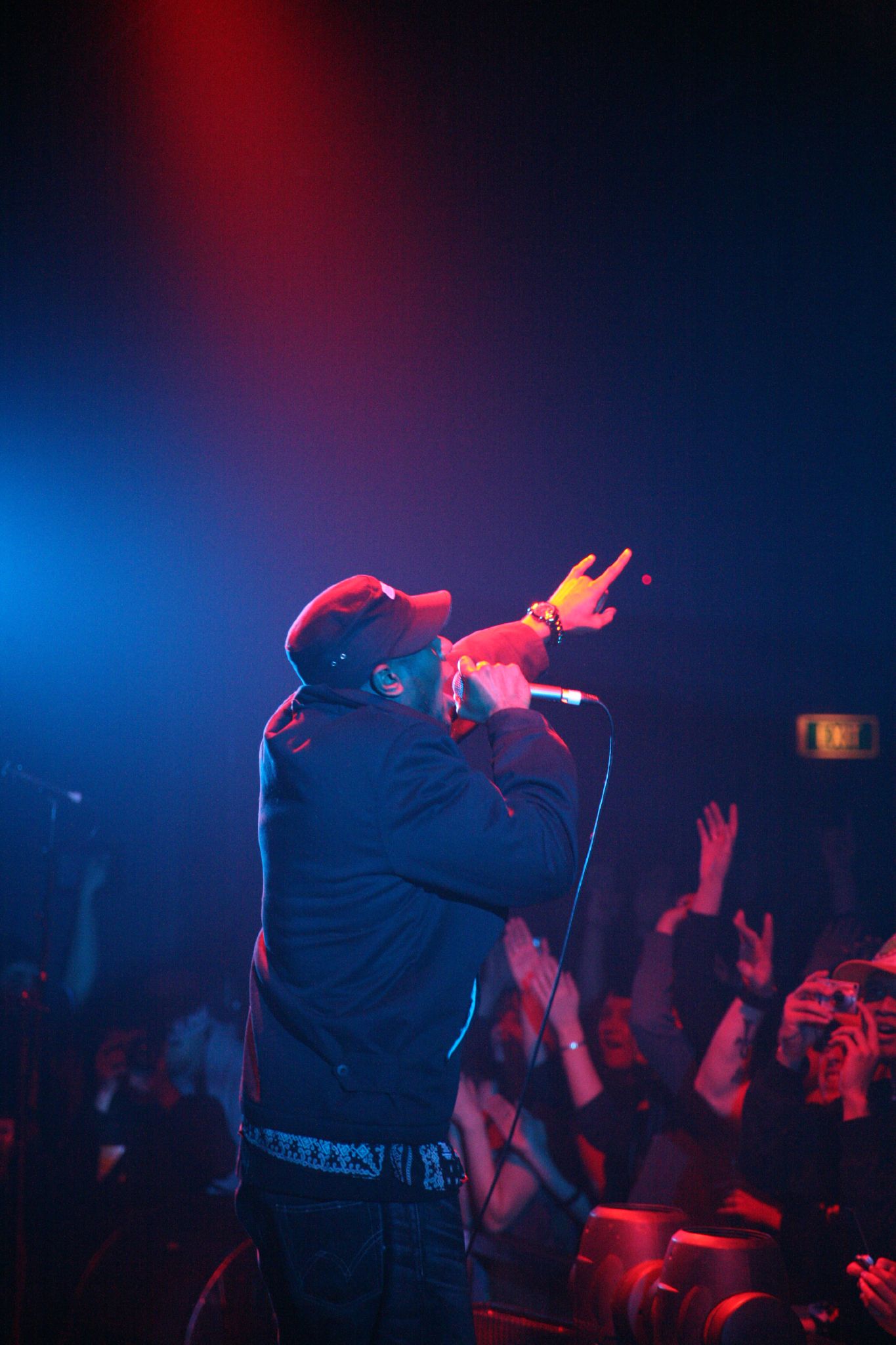 Mos Def is positing here the home and the city streets as an urban “[site] of significance.”(Forman xix). Through his experiences on the streets in Brooklyn he has constructed a new site of knowledge of oneself and one’s community for those who live in that area. He has taken the ghetto, commonly conceived as a site of extreme poverty and crime, and elevated in the song to a much more noble location: home. At the same time he has complicated the idea of home; to what point can a person hold a neighborhood in high esteem when you are not sleeping “cause the nights ain’t peace, it’s more war”? However this attempt to redefine the streets of Brooklyn as home is part of a larger attempt within hip-hop to create identity within urban space.
Part of why I am writing on representations of urban space in hip-hop (particularly representations of urban space as home) is because I believe that our listening practices are part of how we construct our identities. That’s one venue that I’d like to explore further in my paper: listening practices. I also want to talk more about how class comes to play in these representations. From what I can gather Mos Def comes from a working-class family, but Common and Kanye West do not. In fact, Common and Kanye West both had one parent with a PhD and that worked in education.
It’s not “just” music, folks.


Share this:




Current Top Posts





April 2021

January 2020

November 2019

October 2019

August 2019

April 2014

November 2017

March 2015

December 2017

October 2015


Recent Comments