
One Nation Under a Groove?: Music, Sonic Borders, and the Politics of Vibration
 Welcome to week three of our February Forum on “Sonic Borders,” a collaboration with the IASPM-US blog in connection with this year’s IASPM-US conference on Liminality and Borderlands, held in Austin, Texas from February 28 to March 3, 2013. The “Sonic Borders” forum is a Virtual Roundtable cross-blog entity that will feature six Sounding Out! writers posting on Mondays through February 25, and four writers from IASPM-US, posting on Wednesdays starting February 6th and ending February 27th. For an encore of weeks one and two of the forum, click here. And now, get up and get ready for Marcus Boon, because there’s no parking on the dance floor at Sounding Out!–JSA
—
What borders remain when it comes to thinking about sound today? The field of sound studies has exploded in so many far-flung directions in the last few years. However, I argue that what is still somewhat off limits in the field is a consideration of the ontological status of sound: in other words, what it means to understand our own being in the world as a sonic phenomenon. Out of attempts to approach this sonic ontology, comes the realization that there are prohibitions, perhaps universal ones, on thinking about sound in this way, and from that emerges what I call the politics of vibration.
For those, such as myself, who have grown up as a part of sonic subcultures, it is not difficult to ponder sonic ontologies, for the simple reason that many of the most intense and powerful experiences we have had have occurred on dance floors or at clubs, as DJs, musicians, clubbers and/or listeners. I still remember the moment of first hearing Funkadelic’s “One Nation Under a Groove” blasting through the speakers at a Pop Group gig at the Electric Ballroom in London in the late 1970s: tumbling polyrhythms, polyphony, polysexuality, polyeverything. The feeling was: “wow, the universe contains this! And it contains other people who know what it is!” And contrary to the warnings of Slavoj Zizek concerning the “autistic jouissance” to be found at the limits of language, here we all were: high; the histories of Afrodiasporic displacement and solidarity echoing off the walls; our own implication in those histories illuminated; flickering between utopia and shame.
To quote Eric Satie: “When I was young they told me: You’ll see when you’re fifty. I’m fifty. I’ve seen nothing.” Me too. But I’ve heard a lot and I still experience that same power of sound in more or less the same way. If anything, sound’s power is more intense and surprising, each time it appears. Partly because I have learned how to be a social being through sound—how to love and be loved—enabling me to be more open to its impact than I was as an awkward youth. It makes me sad the way in Canada and elsewhere in el Norte people seem to lessen their involvement in the more intense aspects of sound cultures as they hit 30 or 40. It makes me sad that my four-year-old son rarely gets to hear a real sound system. I look for music at carnivals, weddings, community centers, on the beach. . .anywhere that those age barriers are ignored. Even as a DJ, I increasingly look for new or different kinds of publicness than that of club or dancehall.
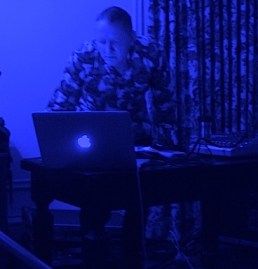
Marcus Boon DJ-ing, image by JSA
Still, I do wonder. Was the movement into sonic subcultures that my generation (and those that followed) made–especially in the UK where music (and intoxicants, and immigration) were one of the few escape routes from the brutalities of Thatcherism–a mistake, precisely because we accepted as ontological, a structure that in fact was smoothly integrated into the operations of late capitalism? From the Factory and Paradise Garage to Berghain or Ministry of Sound. . . how will history look on the era of the mega-club?
Although one could argue that the Internet put an end to the idea of subculture, since it breaks down the locality and secrecy around which particular subcultural communities grow, in fact what seems to be happening is an acceleration in the generation and dissolution of subcultural formations. Hip-hop has adapted very quickly to the internet. The cassettes or CD-Rs sold out of DJ Screw’s record store in Houston, Texas, for example, morph into the world of online mixtapes, Youtube clips and Twitter battles; the gray market availability of samples sounds a lacuna of time, appearing for a day on a hosting site rather than flying below the radar in some particular geographical location. At the same time, sonic subcultures are expanding around the world. If Jacques Attali was right that sound is prophetic, then #idlenomore was announced by Ottawa Native dubstep crew A Tribe Called Red; Tahrir Square by Chaabi and North African hip-hop.
In his book 1989, Joshua Clover describes popular music in the period of neo-liberal globalization as the sound of ideological containment. It’s true that popular music is full of ontological claims about sound, of music that celebrates setting us free. . .but which fails to actually do so. A quote from Ray Brassier just came up on my Twitter feed:

If true, this would suggest that the intensity of moments of sonic jouissance does not necessarily mean anything in terms of ontology or the truth about what’s Real. It could be entirely delusional.
All of which might be true. We might come to realize that, to put it in Heideggerian terms, we’ve been thrown into this, and that maybe there’s not much difference between being thrown and being played. But somehow I think people on dancefloors already know this. The dramas of seduction, commitment and loss are at the core of disco, and many other kinds of popular music too. To quote the disco classic “Lost in Music” by Sister Sledge (later covered by post-punks The Fall):
We’re lost in music; caught in a trap.
No turning back. We’re lost in music.
We’re lost in music. Feel so alive.
I quit my nine-to-five. We’re lost in music.
Other examples are not lacking.
Perhaps sound and music border on a vibrational ontology, rather than being truly the core of one. This is why, as Michael Taussig, Jayna Brown, and others have suggested, they can be concerned with healing. Perhaps any practice that is meaningful — and sonic subcultures are certainly a matter of practice, as Julian Henriques indicates in his book Sonic Bodies — must necessarily work at the boundary of a space that it can never entirely inhabit as a practice, but which it can push one towards, and also receive one from. The anticipation, fear, desire before one goes out, for example, but also the blinding daylight, the sensation of cool air on exposed skin when one leaves a dancehall or a party.

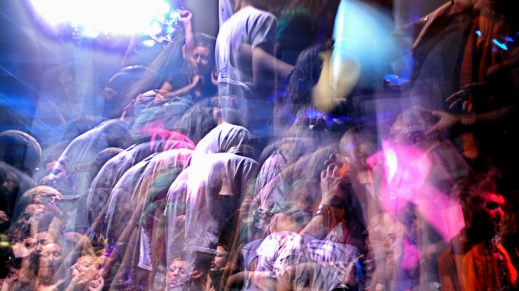
Lasers in a dance club, image by flickr user gabriel.jorby
Sound studies has not truly begin to explore these moments of exposure to and abjection from the vibrational core of sound. No doubt, Steve Goodman performed heroic work in Sonic Warfare—which sets out a proposal for a vibrational ontology in the midst of the commodification and militarization of the sonic —as have various explorations of the phenomenology of sound, such as those in Salome Voegelin‘s Listening to Noise and Silence. Yet in both cases, a full consideration of sonic ontology is in the end foreclosed. In Goodman’s case by Sonic Warfare’s emphasis on the militaristic applications of sound and vibration that are appropriated by sonic art and subcultures, which gives the violence of sound and vibration something like ontological status, while the aesthetic and cultural “uses” of the same have only a secondary, somewhat parasitic status. Conversely, in Voegelin’s work, an emphasis on the phenomenological rendering of the moment or event of sonic relationship forecloses a broader investigation of sonic ontology, because it “brackets” (to use Husserl‘s term) considerations beyond that of the subject-object relationship. In both cases, the sonic thing in itself, or indeed an ontology of vibration, risks being lost.
The recent turn to the speculative and to realism in philosophy has yet to make an impact in sound studies, despite the fact that the object of sound presents a provocative and very intimate entry point to that problematic. One of the more intriguing and improbable hypotheses emerging from the speculative realist movement is that of Quentin Meillassoux, who, in After Finitude, makes an argument that speculative knowledge of the real, unmediated by correlation with the Kantian subject, is possible through mathematics. It is roughly Alain Badiou‘s thesis in Being and Event too. As much as music is clearly about the contingency of sonic experience, there are strong arguments, going back to Pythagoras and beyond, about the relation of music to mathematics. Natural harmonics, rhythm: the elements of music express mathematical relationships. I am not interested in reducing music to a kind of vulgar scientism. But what if when we listen to music, we are exposed to a mathematical ontology and at the same time, the contingency of an unprecedented event? What if music is speculatively real? The word “speculative” here would refer not to philosophical propositions, but to the uncanny movement across subject/object individual/collective borders that the sonic matrix offers when “we” listen to “it.” Music not as the source of a speculative discourse on the real, but a speculative practice in which order and contingency meet.

A cymatic image, made by sound vibrations on a visible medium by flickr user evan grant
Genres, styles form around places of cohesion, of transport, of passage. Not an instrumental mathematics (though it can be that too), but a speculative one that seeks out locations of collective affect, of resonance between micro and macro spheres. It matters little whether a specific knowledge of mathematics is invoked here, since many traditional musics find their way to structures that, according to scholars such Alain Danielou, already express mathematical relationships. And in this way, music and musicians can be said to participate in a sonic ontology.
Reluctantly perhaps. Ready or not. The question remains: how many institutional, historical, disciplinary, intellectual, social and political barriers remain in order that a cultural artifact like “One Nation Under a Groove” can be considered to have ontological significance? That is what I mean by the politics of vibration, and in terms of borders, it’s an important set of borders for researchers in sound studies to consider.

Tyler, the Creator crowdsurfing, image by flicker user choe.brandon
Much of my current work focuses on tropes of abjection in recent hip-hop and RnB music, notably that of Odd Future members Tyler, the Creator and Frank Ocean, artists like Azealia Banks, and a new generation of queer rap MCs emerging out of New York City such as Zebra Katz, Le1f and Cakes Da Killa. All of their work is bracingly obscene, funny, violent. . .a tumbling deck of cards of performances of gender, race, sexuality, class and more. Of course, cursing to a beat is nothing particularly new, but the way in which these artists multiply and collapse identities to an ever more minimal, humming beat perhaps is.
Katz’s remarkable “Ima Read” and its equally remarkable video is a case in point. Although Katz occasionally claims dryly that the song is “pro education,” the “reading” in question mostly refers to the drag queen balls of the Harlem ballroom/voguing scene of the late 1980s/early 1990s, where to read meant to verbally trash, i.e. abject, someone at a ball. The song is rapped by male and female voices, crisply denouncing a “bitch” who they are going to “take to college.” The violence of the song is ironic, as much a marker of queer community and Eros as of sexual difference, of racial and trans-racial solidarity as much as racialized violence. It is performed over a minimal beat with a humming, in-your-face bass drum that is the only recognizable tonal element.
Why make the leap to talking about ontology in discussing this admittedly awesome Youtube clip? Both Judith Butler’s famous elaboration of the performativity of gender, one of the bases of queer theory, and Katz and friends play with taboos concerning gender, sexuality and race in contemporary hip-hop emerge from that moment of the ballroom scene.
But what if Butler’s emphasis on performance actually covered up or abjected the ontological nature of experiments at the balls? Perhaps we need to rethink why the ultimate ball anthem is Cheryl Lynn’s “Got To Be Real.” What is sonic ‘realness’? In restoring the sonic dimension to the ballroom scene, and learning, from Zebra Katz, to face that constitutive abjection that Kristeva amongst others has pointed us towards, we can begin to feel for ourselves what a vibrational ontology is.
—
My thanks to Catherine Christer Hennix, Steven Shaviro, Kevin Rogers and Ken McLeod for conversations that helped me in thinking this through, and to Jennifer Stoever-Ackerman for luminous remix skills.
—
Featured Image by Flickr User depinniped
—
Marcus Boon is associate professor of English at York University in Toronto, and was a Fellow at Cornell’s Society for the Humanities in 2011-12. He is the author of The Road of Excess: A History of Writers on Drugs (Harvard UP, 2002) and In Praise of Copying (Harvard UP, 2010). He writes about contemporary music for The Wire. He is currently co-editing a book on Buddhism and critical theory, and a new edition of William S. Burroughs and Brion Gysin’s The Third Mind. He is also working on a book entitled The Politics of Vibration.
Share this:

I Like the Way You Rhyme, Boy: Hip Hop Sensibility and Racial Trauma in Django Unchained

Welcome to week two of our February Forum on “Sonic Borders,” a collaboration with the IASPM-US blog in connection with this year’s IASPM-US conference on Liminality and Borderlands, held in Austin, Texas from February 28 to March 3, 2013. The “Sonic Borders” forum is a Virtual Roundtable cross-blog entity that will feature six Sounding Out! writers posting on Mondays through February 25, and four writers from IASPM-US, posting on Wednesdays starting February 6th and ending February 27th. For an encore of week one of the forum, click here. And now, put your hands together for Regina Bradley!–JSA
—
I’m most haunted by a scene in the film Django Unchained (2012) where a slave and former mandingo fighter is torn to bits by dogs offscreen. After seeing the dogs begin to maim the slave, the scene rapidly cuts away to former slave and bounty hunter Django’s expression (played by Jamie Foxx) while the man hollers in pain amidst the growl of dogs in the background. The scene’s grisliness was not situated within Quentin Tarantino’s signature visual violence, but in its sound. Sound better relayed the violence imposed upon the man’s body, signifying the unavailability of literal or visual discourse to speak to the racial trauma black bodies continuously face.

“Django unchained, omaggio a Quentin Tarantino alla Cineteca di Bologna” by Flickr user Il Fatto Quotidiano under a Creative Commons 2.0 Licence
Tarantino’s use of sound in this scene and the rest of the film capitalizes on an intriguing alternative to investigating racial trauma narratives in our current popular imagination. I know folks are tired of hearing about Django Unchained, but hear me out. Er, hear Quentin Tarantino out. No, I’m not talking about interviews or dribble about how he was a slave in his last life or two but rather the way he manipulates music to present a soudscape where revenge fantasies are okay. Unlike past sonic renderings of slavery like the O’Jays’ track “Ship Ahoy,” Django retraces the slave narrative in a contemporary social-cultural moment. Tarantino’s redrawing represents how postracialism provides a scapegoat for (a)historical representations of racial trauma and violence. I am most interested in the ways that the Django Unchained soundscape provides Tarantino a way to dabble in what historian and blogger Jelani Cobb calls “racial ventriloquism” by allowing him to present a sonically revisionist representation of the intersections of slave discourse, black manhood, and trauma.
If it is true that Jamie Foxx asserted that “hip hop goes hand in hand with Quentin Tarantino” then Django reflects a type of hip hop sensibility that is situated between hip hop’s commodification as the most visible form of contemporary black culture and as the most accessible form of blackness and black expression. If I had to pinpoint it, I’d suggest Tarantino’s inclusion of two rappers, Tupac Shakur and Rick Ross, within Django is no doubt a nod toward a gangsta rap sensibility that Tarantino appropriates for his slave narrative/western. Shakur’s song “Unchained” plays in the film’s trailers; Ross’s “100 Black Coffins” plays in the movie and its rolling credits. Sampling from Tupac Shakur’s music as a member of the group Outlawz reflects the vengeful, if not nihilistic, undertones of gangsta rap that run parallel to the spaghetti western aesthetic that Django is primarily framed within. Not only is Django a badass and outlaw in the sense that he is a freed slave bounty hunter roaming the South in search of his woman, but Tupac’s song contextualizes him as a gangsta badass outlaw bounty hunter who exists in the fringes of normative society. He is not the norm, but rather the exceptionally violent Negro that we as an audience root for. We want him to be violent. Violence is not only a fantasy but a privilege we want to give Django because of the violence inflicted upon him as a former slave.
“Unchained,” a mashup of James Brown’s “The Payback” and Tupac Shakur’s posthumous release “Untouchable,” sonically corresponds to these desires, using funk and the underlying association of violence in gangsta rap to provide a backdrop to cheer for Django’s violent revenge. The song utilizes sound bytes of Django and his bounty hunter partner/emancipator King Schultz (played by Christopher Waltz) interwoven with samples of “The Payback” in order to provide the context of why Django becomes unchained and displaced from the traditional impositions of violence seen in slave narratives.
A reflection of hip hop in terms of production – sampling and blending to create a unique new sound – “Unchained” also provides its listeners with a bridge between a (revisionist) slave narrative and contemporary racial violence. As the song opens, a prominent electric guitar strums to remind the listener of its western generic context but gives way to an emphatic crescendo of the horns that introduce “The Payback.” The loudness of the horns signifies the arrival of something great–Django’s arrival. The horns demand the listener’s attention. James Brown sings “sold me out, for chump change. . .told me that they, had it all arranged” sets up Django’s literal and sonic “emancipation,” correlating “sold me out” to being sold as a slave. A sound byte of King Schultz shooting Django’s overseer immediately follows Brown’s verse, bridging Brown’s verse of “time to get ready for the big payback” with Django’s freedom in the film. Django’s change in stature is sonically affirmed by an adamant and hype Shakur, rhetorically asking in loop “Am I wrong ‘cause I wanna get it on til I die?!” Shakur’s voice over the infamous horns of “Payback” and Brown’s signature scream relay the urgency of Django’s mission and past traumas, emphasizing not only black men’s capability but willingness to be violent when threatened.

“Django unchained, omaggio a Quentin Tarantino alla Cineteca di Bologna” by Flickr user Il Fatto Quotidiano under a Creative Commons 2.0 License
Another reading of this loop suggests the inherent need for black men to be violent, an essentialized (mis)conceptualization of contemporary black men within a gangsta rap aesthetic that parallels Tarantino’s (re)vengeful intentions for Django Freeman. The call and response between Shakur and the sound byte of Foxx repeating “I love the way you die boy” loosely correlates and subverts the racial trauma that often provides the foundation for slavery discourse. Foxx’s sample comes from a scene in the film where Django has just shot and killed his former overseer. The line is an inversion of when Django previously begged for mercy for his wife Broomhilda and the overseer sneered “I like the way you beg, boy.” The triumphant rendering of Brown’s horns and the loop of Shakur, when heard in conjunction with Foxx’s sound byte, signify that Django has, indeed, got the big payback. The sound bytes of Django’s voice provides a challenge to the literal slave’s voice while the music provides a backdrop for what a slave’s revenge may sound like, subverting the racial trauma inflicted on slaves.
James Brown and Tupac Shakur reflect pivotal moments of black masculinity from soul and early renderings of commodified rap, but Rick Ross reflects a more contemporary moment of black masculinity and violence within hip hop as a multicultural space. It is significant that Django includes this moment of hip hop because it similarly frames the haziness of racial politics that contextualizes the film. Ross’s “100 Black Coffins” showcases a gruff Rick Ross spitting bars about violent repercussions and avenging himself and slave women:
The track reflects a sonic representation of the American South as a site of racial trauma as seen in the American popular imagination. There is a minute and, if unaware of the film’s homage, a quickly fleeting understanding of the black coffin as representative of the original Django’s coffin that he carried around with him as a reminder of his traumatic experience and need for revenge. The sonic feel of this track is overtly masculine, consisting of Ross’s signature grunt, a lone whistle, a wailing male chorus, and hard-hitting percussion. Ross’s demands for black coffins, black pastors, and black bibles against a sonic backdrop of wails and an unsettling bell toll inflict a similarly violent Southern cultural soundscape.
Furthermore, the understanding of blackness as pathological due to the trauma blacks experience, frames Ross’s narrative as parallel to Django’s (if he were a rapper). I’m particularly struck by “100 Black Coffins” for two reasons: Rick Ross’s beat (he never picks a lame one) and Ross’ call and response with himself. Furthermore, the urgency and depth that Ross presents in his background ad libs is a haunting reflection of black (slave) men’s inability to avenge and protect their families and themselves. Ross’ solo call and response signifies a coping mechanism for the solitary existence many slaves faced when disconnected from loved ones. Ross seamlessly interchanges ahistorical images and hip hop memes against a sonic backdrop that reflects the use of sound as a usefully ahistorical space where a ‘mash-up’ of blacks’ past and present can collide. Ross talking about slinging drugs from the block extends to blacks being sold on a slave block without a question of how the two correlate. This is undoubtedly problematic but, within the context of Django as a revenge fantasy film, is acceptable because it is part of the performance of a pseudo-slave narrative.

“12.25.12 – “Django Unchained”” by Flickr user moviesinla under a Creative Commons 2.0 License
Idealistically, critically engaging Django as a sonic discourse could provide bridges to similarly violent – yet very real – representations of sonic violence in the popular imagination like Trayvon Martin’s 911 tapes and the recent murder of Jordan Davis. It is also important to point out the existence of nonmusical cues of silence and screaming presented by Kerry Washington’s character, Broomhilda, and what they suggest about the treatment of (slave) women’s narratives and agency in a sonic space, an issue that the two hip hop tracks do not broach. Overall, however, Django pushes the envelope sonically and visually in reference to sonic borders of blackness and the usefulness of the sound of racial trauma to contextualizing black masculinity, provoking a complicated question: in what ways does music blur contemporary and historical black discourses, creating a hazy representation of not only what blackness does, but what black pathology sounds like?
—
R.N. Bradley is a PhD candidate in African American Literature at Florida State University and a regular writer for Sounding Out!
Share this:


Current Top Posts





April 2021

January 2020

November 2019

October 2019

August 2019

April 2014

November 2017

March 2015

December 2017

October 2015
 Sounding Out!
Recent Comments