
SO! Reads: Alexis McGee’s From Blues To Beyoncé: A Century of Black Women’s Generational Sonic Rhetorics

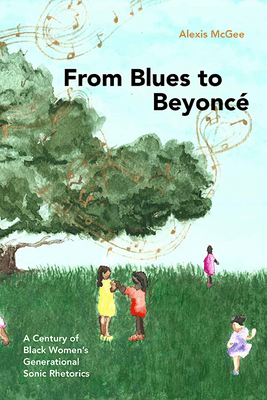
From Blues To Beyoncé: A Century of Black Women’s Generational Sonic Rhetorics (SUNY Press, 2024) by Alexis McGee explores Black women’s creative labor and cultural production. The book offers a searing critique of both record industry exploitation and sound studies’ white gaze. By focusing on quotidian engagement with sound, McGee speaks simultaneously to linguists, rhetoricians, and ethnomusicologists, demonstrating how each discipline has overlooked Black women’s fundamental contributions to our understanding of language and cultural expression. This is not merely an additive project seeking inclusion within existing frameworks, but rather a fundamental reconceptualization of how we study Black women’s sounds.
McGee, currently Associate Professor at the University of British Columbia’s School of Journalism, Writing, and Media, mobilizes her training in linguistics, rhetoric, and composition to analyze everyday communicative practices and generational knowledge systems passed down between Black women. McGee joins other recent texts such as Earl Brooks’s On Rhetoric and Black Music (2024) in critical conversations around “sonic rhetoric.” In From Blues to Beyoncé, McGee theorizes sonic rhetoric as a collection of cultural technologies for storytelling that “act as methods of communicating knowledge that can be used to persuade or inform (younger) generations about topics like survival, liberation, and care” (6). Examining artists from the 19th, 20th, and 21st centuries through personal experience, archival material, biographies, interviews, and popular media, McGee demonstrates the critical necessity of taking seriously the generational cultural knowledge embedded in Black women’s creative practices within an anti-Black and misogynist world.
At its core, the book introduces “sonic sharecropping” as a term that illuminates the lopsided relationship between Black women creatives (tenants), their sonic and musical creations (crops), and wealthier, more powerful recording industry players (landlords, music labels, copyright holders). The sharecropping metaphor reveals how the music industry extracts value from Black women’s cultural labor while denying them ownership and fair compensation. McGee further develops the concept of “audibility of advice” to name the intergenerational mentorship and fugitive pedagogy that Black women practice as they navigate this exploitative system—showing how even the transmission of survival knowledge between generations becomes entangled in the same structures designed to profit from Black women’s creative work.
The book’s chapters traverse an impressive range of cultural moments. Opening with Cardi B’s attempted trademark of “okurrr,” McGee demonstrates how legal and social structures systematically prevent Black women from securing intellectual property rights over cultural innovations that white industry executives appropriate without restriction.
This contemporary case illuminates sonic sharecropping: Black women are expected to create cultural property that record labels then own and sell back to them. McGee then traces these dynamics historically, analyzing business practices of major labels like Atlantic Records. By drawing parallels between sharecropping contracts and recording agreements, the analysis reveals how the music industry has historically relied on discretionary ethical conduct by executives rather than equitable contractual structures, perpetuating exploitative relationships reminiscent of post-Reconstruction economic arrangements.
In what is perhaps the book’s most compelling chapter, McGee examines successive performances of “Strange Fruit,” tracing how Nina Simone and later artists like Missy Elliott and Janelle Monáe have reinterpreted Billie Holiday’s haunting meditation on lynching.
McGee builds on Amiri Baraka’s concept of the “changing same”, to show that antiblackness persists throughout time though it changes form. McGee demonstrates how Black women performers resist being treated as interchangeable vessels for Black cultural expression. Rather than presenting generic renditions, each artist asserts her distinctive voice and perspective that reiterates the enduring violence perpetuated against Black bodies.
Each performance carries its own rhetorical power while participating in “sankofarration,” a neologism from artist, writer, and media studies professor John Jennings that combines “sankofa” (a West African concept symbolizing learning from the past to move forward) with “narration” to describe a rhetorical worldview premised on understanding time as cyclical rather than linear. Sankofarration positions past and future as interconnected forces that actively shape the present. Crucially, McGee connects Lawrence Beitler’s commercial sale of lynching photographs (depicting the hanged bodies of Thomas Shipp and Abram Smith) to the visual and sonic rhetorical devices in these musical works. Through this framework, Black women artists transform historical trauma into ongoing political commentary and visions for future liberation. Black women’s creative work, she argues, consistently foregrounds documented histories of racial violence alongside the willful ignorance that upholds white supremacy and patriarchy. By listening critically to Black women’s sonic rhetorics, we can access pathways toward collective liberation.
Despite the book’s title, McGee’s engagement with Beyoncé focuses narrowly on the lemon-to-lemonade metaphor in the album, Lemonade. Her analysis of other Black women artists, however, anticipated critiques later directed at Cowboy Carter, highlighting a double standard: as a Black woman, Beyoncé faces moral scrutiny for engaging with country music—positioned as both capitalist enterprise and white cultural property—while white and male artists have participated in the same commercial structures for centuries without comparable ethical condemnation.
This defense raises the book’s most provocative question, one McGee gestures toward but leaves unresolved: if the inequitable standards applied to Black women artists are symptoms of a fundamentally exploitative system, what would liberation from that system actually entail? Does it require dismantling existing structures of cultural ownership and profit, or can it be achieved through expanded access and recognition within them?
While McGee does not directly engage Matthew Morrison’s recent work Blacksound: Making Race and Popular Music in the United States, her analysis clearly converses with his examination of how Black cultural products have been reproduced for white consumption, particularly through the ongoing afterlives of blackface minstrelsy. McGee’s focus on Black women specifically adds crucial gender analysis to ongoing scholarly conversations about racial capitalism and cultural appropriation.
McGee acknowledges that capitalism itself, rather than Black women’s participation in it, constitutes the fundamental problem. However, the analysis stops short of fully theorizing alternatives to existing structures of Western sound production and commodification. Readers familiar with Sylvia Wynter’s insistence on distinguishing the map from the territory, or Audre Lorde’s warning that “the master’s tools will never dismantle the master’s house,” may desire more sustained engagement with radical alternatives and additional tool building necessary for Black liberation from existing antiblack social and political structures. What might Black women’s sonic practices look like in anticapitalist frameworks of collective ownership and exchange? How might Black femme and queer performances expand or complicate these intergenerational transmissions of knowledge? How might Black women’s intergenerational knowledge systems point toward alternative epistemologies that refuse the terms of racial capitalism altogether?
This theoretical restraint appears strategic rather than accidental. From Blues to Beyoncé navigates carefully between colleagues unfamiliar with Black feminist and womanist theory, who require accessible entry points, and specialists seeking new takes on traversing multiple disciplines at once. In threading this needle, McGee prioritizes disciplinary bridge-building before radical dismantling of capitalist structures and academic knowledge production systems.
These limitations notwithstanding, the book represents an essential contribution to multiple fields. It insists that scholars of sound studies, rhetoric, and Black feminist thought must engage one another—that these conversations can no longer proceed in isolation. Methodologically, it offers both theoretical sophistication and practical analytical tools, making it intellectually substantive for non-specialists while providing specialists a compelling model for interdisciplinary synthesis. Most importantly, McGee demonstrates that we cannot understand American culture, sound, or rhetoric without recognizing Black women’s voices as foundational rather than supplementary.
This book transforms its disciplines by interrogating their foundational assumptions, asking us not simply to include Black women in sound studies, but to recognize how their systematic exclusion has rendered the entire field epistemologically incomplete. In raising these questions, even without fully resolving them, McGee provides both rigorous foundation and invitation to continue the work.
—
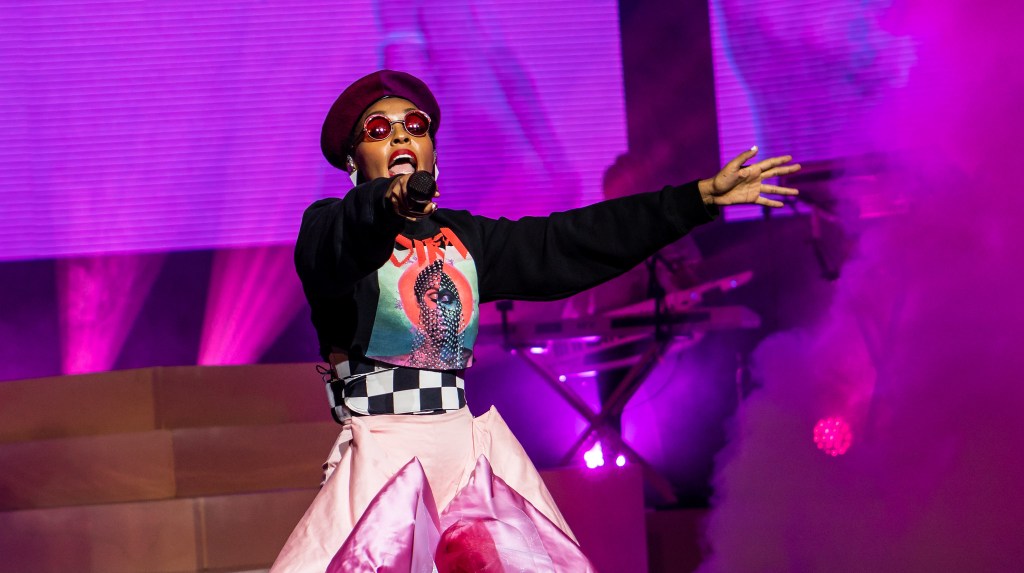
Featured Image: Janelle Monae on the Dirty Computer Tour at Madison Square Garden in 2018 by Flickr User Raph_PH. License: CC BY 2.0
—
Joe Zavaan Johnson (he/they) is a multi-instrumentalist, arts educator, and Black music researcher. Currently an Ethnomusicology Ph.D. Candidate at Indiana University-Bloomington, he examines the Black banjo renaissance through Black studies, human geography, folklore, and ethnomusicology. Johnson frequently collaborates with grassroots organizations focused on coalition building, community healing, and cultural reparations, bridging scholarship with community-engaged practice. His forthcoming dissertation, Black Banjo Bodylands: Recovering an African American Instrument, explores the relationship between Black people, lands, and banjos as ancestral technology.
—

REWIND!…If you liked this post, check out:
SO! Reads: Marisol Negrón’s Made in NuYoRico: Fania Records, Latin Music, and Salsa’s Nuyorican Meanings –Vanessa Valdés
SO! Reads: Justin Eckstein’s Sound Tactics: Auditory Power in Political Protests––Jonathan Stone
“I’m on my New York s**t”: Jean Grae’s Sonic Claims on the City--Liana Silva
Love and Hip Hop: (Re)Gendering The Debate Over Hip Hop Studies--Travis Gosa
My Music and My Message is Powerful: It Shouldn’t Be Florence Price or “Nothing”-Samantha Ege
I Been On: BaddieBey and Beyoncé’s Sonic Masculinity — Regina Bradley
Cardi B: Bringing the Cold and Sexy to Hip Hop–Ashley Luthers
Share this:

Press Play and Lean Back: Passive Listening and Platform Power on Nintendo’s Music Streaming Service

I remember long car rides as a kid in the early 2000s, headphones on, gazing out the window at the passing scenery while looping background music from The Legend of Zelda and Pokémon games on my Game Boy. After school, I’d occasionally throw the Super Smash Bros. Melee soundtrack on my Discman CD player, keeping me motivated while doing homework. Like many others, I found Nintendo’s music to be an effective accompaniment to everyday activities, a kind of functional listening long before streaming platforms like Spotify and YouTube made it trendy. Which raises the question: how has Nintendo adapted to the streaming age?
Unlike many other game publishers, Nintendo has conspicuously kept its music off streaming services—despite having some of the most recognizable soundtracks in video game history, such as Super Mario Bros., Donkey Kong, and Metroid. Instead, the company took a different direction by unveiling its own music streaming service in October 2024, aptly titled Nintendo Music. The platform, available to Nintendo Switch Online subscribers, showcases soundtracks spanning the company’s history, from 1980s NES titles to recent Nintendo Switch 2 releases.
In a listening landscape dominated by Spotify, Apple Music, and YouTube Music, Nintendo’s decision to launch its own proprietary streaming service makes it unique among video game companies. This move is idiosyncratic in a way that feels characteristically Nintendo, but it is also a bold bid to compete in the broader attention economy. By situating itself alongside, rather than within, the major music streaming services, Nintendo signals that its soundtracks are valuable cultural content worth curating and controlling directly.
Nintendo Music caters specifically to video game fans by including screenshots with each track, having a “Spoiler” filter that lets users block music from games they haven’t played, and making personalized recommendations based on each user’s play history. But perhaps most notable is its emphasis on background listening: through features like mood playlists and an “Extend” tool, video game music is explicitly framed as a companion for contexts like relaxing, working out, or doing household chores.
By repurposing game soundtracks as tools for everyday routines, Nintendo Music capitalizes on nostalgia and contemporary listening habits to deepen fan engagement and retain control over its brand—a strategic move from a company that is famously (over)protective of its intellectual property. More generally, it also reflects neoliberal logics in which music is woven into daily life to regulate mood and productivity, revealing the increasing reach of digital platforms over how we work, listen, and live.
Listening in Loops: Video Game Music in the Background
In advertisements for Nintendo Music, actors hum and sing along to famous video game tunes while carrying out their daily activities. “Whether you’re grocery shopping, straightening up at home, or getting some studying done, Nintendo Music can be the background sound to your everyday life,” the description to one video reads.
This marketing is strikingly similar to strategies by streaming services such as Spotify, which encourage listening to music in any and every context. Playlists based around specific moods or activities—like Spotify’s “Gym Hits,” “Intense Studying,” and “sad girl starter pack”—use music as a tool to manage listeners’ energy levels, focus, and emotions as they go about their lives. Anahid Kassabian’s concept of “ubiquitous listening” helps describe this phenomenon, showing how even passive, background engagement can shape listeners’ affects and experiences.
In many ways, video game music is ideal for the ubiquitous listening that streaming services promote. Game soundtracks are generally (though not always) designed for the background and are usually instrumental, setting the emotional tone of on-screen action, from serene soundscapes to intense boss battles. Unlike other multimedia soundtracks, such as film scores, much video game music is also composed to loop indefinitely, making it especially effective for sustained listening.
As Michiel Kamp demonstrates in Four Ways of Hearing Video Game Music, “background listening” is one of the main ways users experience video game soundtracks. He writes that “background music both in games and elsewhere requires us to be so attuned to it that it offers no experiential friction in need of interpreting, and through this it has the capacity to attune us to our environment, be it a mythical underworld full of dangers or a convenience store full of groceries” (2024, 175).
While Kamp primarily focuses on background listening while playing games, game music can attune listeners to moods, activities, or environments even when heard outside of gameplay. In fact, video games train us to listen in this way, using music to establish the appropriate affect for narrative events, settings, and characters. These immersive qualities have made video game music immensely popular on streaming services: soundtracks from games and franchises like Halo, Final Fantasy, The Elder Scrolls, Undertale, and Minecraft have collectively garnered over a billion streams on Spotify alone.
But Nintendo, by launching its own proprietary platform, trades streaming royalties and wider exposure for something arguably more valuable: the ability to control how and where fans experience its content.
Features in Focus: Nintendo Music’s Approach to Passive Listening
Nintendo Music’s features illustrate how the service adapts soundtracks for continuous, everyday listening. Perhaps most notable is the service’s unique Extend feature, which allows users to stretch the runtime of tracks up to 60 minutes. Described in the app as “the perfect accompaniment to studying or working,” this feature facilitates seamless background listening without the distraction of frequent track changes. So if you’ve ever wanted to loop the Wii Shop music for a full hour—and let’s be honest, who hasn’t—now you can.


Alongside complete soundtracks, Nintendo Music also foregrounds curated playlists, including those based around specific video game characters, themes, and moods. The “Powering Up” playlist features “up-tempo tracks to fill you with energy,” for example, while “Good Night” has “down-tempo tracks to help you drift into dreamland.” Screenshots for each track further immerse listeners, visually reinforcing the moods and environments the music is designed to evoke. On these playlists, Nintendo’s music is presented less as individual compositions and more as “vibes.”

Packaging music around moods or vibes is not a neutral act. In Mood Machine: The Rise of Spotify and the Costs of the Perfect Playlist, Liz Pelly asserts that “organizing music by mood is a way to transform it into a new type of media product. It is about selling users not just on moods, but on the promise of the very concept that mood stabilization is something within their control. It’s a tactic for luring users to double click and start streaming” (2025, 40). Pelly’s observation underscores that mood-based playlists do more than entertain: they are a way for platforms to influence how listeners organize their time and attention.
Furthermore, Nintendo Music’s approach positions music not only as a creative or cultural artifact, but also as a commodified resource for self-regulation. This aligns with Eric Drott’s claim that streaming services often employ music as a “technology of social reproduction,” used to structure and maintain day-to-day existence. For Drott, this is “part of a broader tendency under neoliberal capitalism that prizes music, the arts, and culture not on account of their aesthetic worth but on account of their ‘expediency’ for other social, political, and economic ends” (2024, 197).
Many users still actively listen to their favourite Nintendo soundtracks on the platform, and there’s also nothing inherently wrong with background listening—it’s how much of this music was originally designed to be heard. However, presenting music as an aid to concentration, productivity, or mood regulation also risks repurposing soundtracks as a form of “neo-Muzak,” a vehicle for continuous consumption designed to keep listeners plugged into Nintendo’s broader product ecosystem.
Background Benefits: Nintendo’s Platform Power
Beyond guiding listening habits, Nintendo Music reinforces the company’s brand image of nostalgia, innovation, and family-friendly fun while increasing engagement with its intellectual property on its own terms. As a Nintendo spokesperson said in an interview with Nippon TV News, “To increase the number of people who have access to Nintendo IP, we believe that game music is an important and valuable form of content. Nintendo Music is a service that allows us to deliver this game music in a way that is uniquely Nintendo. . . . We hope that Nintendo Music will help you recall some of your favorite gaming experiences and think that it will also encourage people to play the games again” (translation by Nicholas Anderson).
Nintendo’s efforts to centralize its music are also likely, at least in part, a response to fans unofficially circulating soundtracks online. As part of a broader trend of functional music compilations (think lofi beats to study/relax to), YouTube hosts countless user-generated Nintendo music playlists designed for activities such as studying and sleeping. Despite Nintendo’s notoriety for issuing takedown notices over copyright infringement—including shutting down the massively popular YouTube video game music channel GilvaSunner in 2022—many of these unofficial videos and reuploads continue to accrue millions of views.
By providing an official home for soundtracks and its own contextual playlists, Nintendo Music is a subtle exercise in platform power, gating access to subscribers. It redirects listeners from other platforms, letting Nintendo control its content without diluting its brand on third-party services. Although Nintendo Music’s catalogue is currently slim—as of writing it has roughly 100 soundtracks—the company continues to trickle out new music most weeks, incentivizing listeners to keep coming back.
Nintendo Music promotes ongoing background listening not only to attract users who are already accustomed to mood and activity playlists, then, but also to keep them on the platform and connected to the company’s games and services. After all, every minute a listener spends on Nintendo Music looping David Wise’s “Aquatic Ambiance” from Donkey Kong Country is a minute they aren’t spending on YouTube, Spotify, or any other entertainment platform.
* * *
Video game music is, in many respects, perfectly suited for the streaming age. From the popularity of playlists to the ascent in ambient music, streaming services’ focus on passive listening aligns with the background function of video game soundtracks. As we’ve seen, Nintendo Music takes full advantage of this, using its marketing and features to bolster branding, solidify control over IP, and encourage engagement.
For many, Nintendo Music offers an enjoyable experience and a convenient way to stream nostalgic soundtracks. But the service also exposes how proprietary platforms concentrate power and leverage passive listening for ongoing consumption, reinforcing broader patterns where work and leisure become intertwined with corporate interests. By prompting users to integrate Nintendo’s music into their activities, the platform extends the reach of its games beyond the screen and into daily life.
Whether you’re listening to famed composer Koji Kondo or everyone’s favourite troubadour dog K.K. Slider, Nintendo’s message is clear: press play and lean back.
—
Featured Image: “Mario Kart” by MIKI Yoshihito (#mikiyoshihito), CC BY 2.0
—
Ryan Blakeley is Visiting Assistant Professor at Northeastern University and holds a PhD in Musicology from the Eastman School of Music. His research investigates how digital platforms like music streaming services are shaping creative practices, listening habits, and music industry power dynamics.
—
REWIND!…If you liked this post, you may also dig:

Video Gaming and the Sonic Feedback of Surveillance: Bastion and the Stanley Parable–Aaron Trammell
Playing with the Past in the Imagined Middle Ages: Music and Soundscape in Video Games–James Cook
Beyond the Grave: The “Dies Irae” in Video Game Music–Karen Cook
Sounding Out! Podcast #29: Game Audio Notes I: Growing Sounds for Sim Cell–Leonard J. Paul
Papa Sangre and the Construction of Immersion in Audio Games— Enongo Lumumba-Kasongo
Share this:


Current Top Posts





April 2021

January 2020

November 2019

October 2019

August 2019

April 2014

November 2017

March 2015

December 2017

October 2015
 Sounding Out!
Recent Comments