
If La Llorona Was a Punk Rocker: Detonguing The Off-Key Caos and Screams of Alice Bag


Image of Alice Bag used with her permission (thank you!)
For full intro and part one of the series click here. For part two, click here. For part three click here. For part four click here.
Our Punk Sound series implicitly argues that sound studies methodologies are better suited to understanding how punk works sonically than existing journalistic and academic conversations about musical genre, chord progressions, and/or genealogies of bands. Alexandra Vasquez’s sound-oriented work on Cuban music, for example, in Listening in Detail (2014) opens up necessary conversations about the “flashes, moments, sounds” in music that bear its meanings and its colonial, raced, classed, and gendered histories in material ways people can hear and feel. While retaining the specificity of Vasquez’s argument and the specific sonic archive bringing it forth, we too insist on “an ethical and intellectual obligation to the question: what do the musicians sound like” (12) and how do folks identifying with and through these musical sounds hear them?
In this series, we invite you to amplify varied historicized “details” of punk sound–its chunk-chunk-chunk skapunk riffs, screams, growls, group chants, driving rhythms, honking saxophones–hearing/feeling/touching these sounds in richly varied locations, times, places, and perspectives: as a pulsing bead of condensation dripping down the wall of The Smell in Downtown LA (#savethesmell), a drummer making her own time on tour, a drunk sitting too near the amp at a backyard party, a queer teenager in their bedroom being yelled at to “turn it down” and “act like a lady[or a man]”. . .and on and on. In today’s essay Marlen Rios-Hernandez discusses how all the politics of punk sound, queer chicana identity, and feminism can be found in the scream.
SOUND!
–Aaron SO! (Sounding Out!) + Jenny SO! (Sounding Out!)
—
Mexican cultural theorist Carlos Monsiváis looked at various aspects of Mexican youth subcultures in the early 80s and revealed how youth relied on “caos” or chaos as a way to attain pleasure within disruption, spontaneity, and noise (68-79). How does the scream emerge through caos as a instrument of resistance? Alongside scholars like Fred Moten, I argue that the scream ruptures caos and allows us to glimpse the pleasure of resistance. In Alice Bag’s scream we find this medley of pleasure, interruption, and spontaneity. Bag explains, “once the Bags hit the stage and the music started, ego checked out and id took over, channeling my libido, my inner rage, whatever… I was free to be myself with no holds barred. It was the ultimate freedom” (221). These elements epitomize what I consider a queer Chicana feminist exorcism of tonality.
As explained in Bag’s memoir, particular to punk, there is a general reliance on informal/community-based ear training where musicians teach each other (183). European traditions of musical analysis both negate the horizontal learning central to punk while also normalizing the historical colonial presence within the Borderlands. In order to reveal how Bag’s scream exorcises these Eurocentric traditions, I consider her performance of “Violence Girl” at the Whiskey (1978), footage of “Gluttony” from The Decline of Western Civilization Part 1 (1981), and a brief clip of The Bags’ “Survive” in What We Do is Secret (2007). Because of how the scream disrupts formal analysis, there is an urgency to understand how it works against the grain.
In the face of Chicana women being politically silenced by the Chicano Movement and Women’s Movements during the late 70s and 80s, it was important for Chicanas to speak up for increased autonomy and access to space. Thus, Alice Bag’s caos is informed by an intersectional ethic of Chicana feminism. At the time queer Chicanas were largely absent from Chicano nationalist organizing. Between the Chicano Movement and unruly Chicana punks, the screaming voice became a multi-layered instrument of protest and empowerment necessary to invert normative gender and sexual politics within punk, the Chicano movement, and second wave feminism. The ability of the Chicana scream to contest oppression is not new. Such a linage can be drawn from La Llorona–– the villanized folkloric mother that drowns her children and haunts Mexico’s shores by wailing in the night.
Drawing on Latinx scholarship and a sonic reimagining of La Llorona’s wailing (as a feminist cry and public display against patriarchy), this post reimagines Alice’s scream as simultaneously resistance and pleasure. This aligns with Gloria Anzaldúa’s notion of deslengualidad. Suturing Anzaldúa’s concept of deslengualidad (detonguing)–which I define as Chicanas speaking with an orphan tongue–with caos shows how Chicanas can claim visibility through the scream. Deslengualidad and caos account for colonial interventions within the Chican@ identity, they demand the preservation and celebration of the mestiza language and help to provide visibility to Chican@ art.
Though the voice has been rendered repeatedly as a gendered instrument, usually legible via lyrics, and always harmonic, some examples tell us otherwise. For example, Alice’s scream is interrupted by her microphone malfunctioning in her performance of “Violence Girl” at the Whiskey (1978). This multi-layered recording with it’s already grainy inaudible features, helps us to understand the scream as a stand alone act of caos. Although the scream is interrupted by multiple forms of dissonance, it also persists as a public gesture of empowerment. The quality of the recording is poor and in it Alice experiences technical issues on stage. These distortions lead Alice to artfully perform a sonic delengualidad by making use of silence, inaudible screaming, and the body. She continues to move, interrupt, and most importantly still is accompanied by stable beat of the Bags despite singing without a microphone. Yet, in the absence of aurally decipherable lyrics (like the absence of a singular Chicana language) a lyrical analysis here wouldn’t serve any other purpose than to organize that which is on its own refuses order––her voice.
The seminal footage of “Gluttony” in The Decline of Western Civilization Part 1 (1981), features an aural scream. It helps us think about how the Chicana scream goes beyond mere aurality. Michelle Habell-Pallán’s notion of “el grito,”–the shout–relates to Alice’s shriek in “Gluttony.” Both punctuate emotional drama and harken back to Ranchera music. I suggest, however, that Bag’s shriek in “Gluttony” also signifies a growing concern with the homogeneity of white suburban beach punks who had infiltrated the scene. In her memoir Bag shares, “as I looked out into the audience, I could see that the once quirky men and women artists who prized originality above all else were being replaced by a belligerent, male dominated mob…playing for a belligerent group of individuals can be quite satisfying. What I didn’t like was the sameness” (308). Pushing back against the scene’s homogeneity, Bag does not end “Gluttony with a full closed cadence. Rather, she ends abruptly, leaving the listener with a sense of incompleteness.
The combination of repeated interruptions throughout “Gluttony” and the inability to conclude pushes the listener to a place of discomfort, where they are left yearning for some kind of ending. The musicologist Susan McClary argues that the absent cadences in Carmen signify how the cadence represents a return to normality and a satisfying feeling of closure. By withholding a full cadence in “Gluttony” and using her “grito” to celebrate difference, Bag enacts caos by rejecting the emerging uniformity of the scene. Much like Bag’s performance of “Violence Girl” at The Whiskey, the scream is less about being musical and ordered but instead a gesture to making do with what one has, a similar manifestation of deslengualidad.
The brief sound clip of the Bags’ “Survive” in What We Do is Secret (2007) illustrates how Alice’s scream offers a genealogy of caos via her disruption of the story of L.A. punk. The Bag’s “Survive” for the duration of a few seconds plays in the background during a scene in which fans are getting ready to watch The Germs perform at The Masque. In this clip, Alice’s voice isn’t immediate because of how it resonates within the background music. Hence, her voice refuses containment by emanating from the periphery. Alice’s voice emerges as delengualidad within the film precisely because women are written out of the story of L.A. punk. They are depicted as secondary players in the film. Fred Moten’s In The Break reminds us that the site “where shriek turns speech turns song–– remote from the impossible comfort of origin–– lies the trace of our descent.” Within the shriek also lies our resistance tactics as Chicanas. The map of our survival through loudness–though heavily stereotyped–is a testament to the unwavering and inherited conocimiento that silence has never protected us. It is the task of women of color to interrupt, archive, and preserve their roles in the L.A. scene.

Screenshot from Alice Bag Band’s video “Gluttony.” Image used for purposes of critique.
Within Bag’s screaming from the Whiskey performance, Decline, to What We Do is Secret are snapshots or sonic/visual testimonios of queer Chicana women during the early 80s. These sonic snapshots/testimonios speak to the severely gendered and racialized repression of queer Chicana youth while still reconfiguring what empowerment looked like in the aftermath of the major socio-political movements of the 60s and 70s. In a casual conversation with Alice in a panel I guest moderated, she mentioned that watching “Gluttony” today was irksome to her because she was off-key. Perhaps, being off-key is one way that Chicana feminisms audibly reject neoliberal (and gendered) state repression. When we are surrounded by noise, we must remain enveloped in its infinite shape and simply listen. In noise we can resist, interrupt, and move away from orthodoxy and order. In today’s political climate, we need this framework now more than ever.
The return to Alice’s voice in this current moment is no coincidence. In preparation for this piece, I reflected on my brother’s deployment to Iraq during George W. Bush’s term. I was in community college taking a music appreciation course and I was searching for a paper topic that would be palatable to me as both a newly politicized queer Chicana and a former regular in the South Gate punk scene. It was through an interview with Teresa Covarrubias of The Brat and Alice Bag in an issue of Los Angeles Magazine that I heard Alice’s scream for the first time. It was the description of these women’s careers that led me to look up Chicana punk and come across the Whiskey performance of “Violence Girl.” To this day, Alice’s voice reminds us that if “Alice Bag was born from chaos” (310) then the Chicana punk voice remains a testament to punk’s resilience in the face of political uncertainty.
–
Featured image “Alice Bag Performing at Club Lingerie with the Cambridge Apostles” (CC BY 2.0)
–
Marlen Ríos-Hernández is a Ph.D. Candidate in the Ethnic Studies Department at the University of California, Riverside. Her current research revolves around queer Chicana/Mexicana punks in Mexico and Los Angeles from 1977-early 2000s respectively. Her dissertation aims to theorize and argue how Alice Bag, an innovator of the 1970s Los Angeles punk scene alongside other Mexicana punks, utilized noise to correlate the systemic disenfranchisement of womxn of color with the desire for transformational change integral to the survival of Mexicanas and first generation Chicana womxn especially during the Reagan and Bush Administrations. Via Ethnic Studies as her area of study along with her humanities and arts training as a Musicologist, Marlen investigates the relationship between unruly Chicana/Mexicana performing bodies and bisexuality, swapmeets, police brutality, photography, and film as instruments of noise-making.
–
 REWIND! . . .If you liked this post, you may also dig:
G.L.O.S.S., Hardcore, and the Righteous White Voice – Chris Chien
Feeling Through the Keen and Grind: Team Dresch’s Personal Best – Gretchen Jude
Riot-Grrrl, Punk and the Tyranny of Technique – Tamra Lucid
Share this:

Surf, Sun, and Smog: Audio-Visual Imagery + Performance in Mexico City’s Neo-Surf Music Scene

Riding the Surf Wave in a City Without a Seashore
On April 24, 2005, at Zócalo square in downtown Mexico City, the Surf y Arena music festival gathered around 100,000 people and nine bands, ranging from local, barely known groups to big names in the new-wave surf music scene: Fenómeno Fuzz, Los Magníficos, Perversos Cetáceos, Espectroplasma, Los Elásticos, Yucatán A Go-Go, Sr. Bikini, Lost Acapulco, and Los Straitjackets, the latter being the only U.S. band in the festival. One year before, hardly more than a thousand people attended the event, organized in a smaller venue at Alameda del Sur, a few hundred yards south of Zócalo square. Perhaps not even the bands were prepared for the huge response in 2005. Interviewed by local newspaper La Jornada, Fenómeno Fuzz lead guitarist stated, “It’s the first time we see something like this, with so many people. Surf is an instrumental rock genre that was played in the 50s and 60s. There is no sand or sun here as in Acapulco, but we’ve brought downtown a bit of the beach vibe. In Mexico City there must be some 40 bands playing to this rhythm.” In the same interview piece, Lost Acapulco lead guitarist El Reverendo considered, “this festival is a success, for you realize this music is going up. People are on the same pitch. This is not a movement, but a style with many followers. […] It doesn’t matter if there is no beach here—you have to imagine it.”
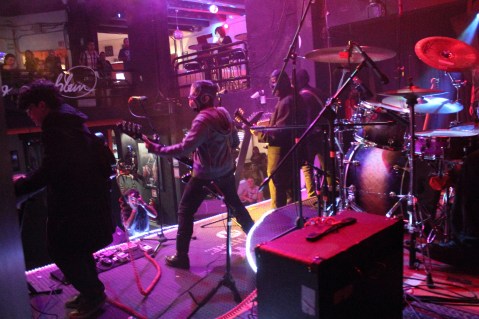
Sr. Bikini at Rock and Road on 30 de Marzo 2013, Image by Flickr User José Miguel Rosas (CC BY-SA 2.0)
The bands who played at the 2005 Surf y Arena Festival wondered whether the success was transitory or would endure. More than a decade later, some are still active, most notably Lost Acapulco, whose singles and compilations have been released in countries like Spain, Italy, and Japan; they have toured around the world, and have released a new EP, Coral Riffs (2015). Los Straitjackets lead guitarist Danny Amis has collaborated with local surf bands like Lost Acapulco and Twin Tones; after surviving a hard battle against cancer, he moved to Mexico City’s Chinatown. Los Elásticos also released a new album, Death Calavera 2.2, the Espectroplasma members formed Twin Tones and have played, toured and participated in the short film inspired by their first record, Nación Apache. In 2016, the Wild’O Fest brought together old and new surf stars, starring The Fleshtones (U.S.) and Wau y los Arrrghs! (Spain), as well as local legends Los Esquizitos and Lost Acapulco. In February 2017, the Russian band Messer Chups toured across Mexico, playing with local bands in several cities. So it seems the scene is alive and kicking.
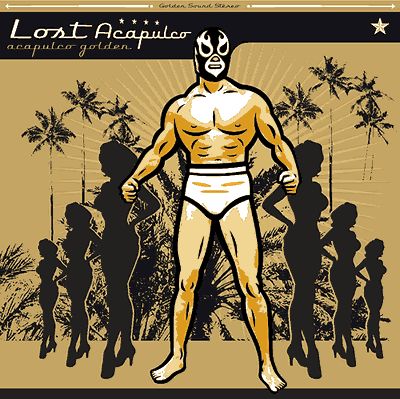
Lost Acapulco’s LP Acapulco Golden cover art by Dr. Alderete (2004). Masks became a famous trait of Mexican surf music. Danny Amys from Los Straitjackets and some Lost Acapulco members wear them on stage, as well as many other surf bands. This cover echoes films from the 50s and 60s featuring wrestlers like Santo and Blue Demon.
Today we can listen to how surf music shaped part of Mexico City’s underground music scene in the last decade of the 20th century and the early 21st. Being 235 miles away from Acapulco, one might wonder how wearing sandals, short pants, floral print shirts, plastic flower necklaces, and dark sunglasses became trendy in the country’s capital city. To this beach imagery, surf bands and fans added references to classic Mexican media icons, like wrestler Santo, comedian Mauricio Garcés, and black and white sci-fi movies. The work by visual artists like Dr. Alderete—who has designed covers and posters for many surf bands, such as Lost Acapulco, Fenómeno Fuzz, Telekrimen, The Cavernarios, Los Corona, among others—has been crucial for this imagery cross-reference process.

Lima-based visual art magazine Carboncito cover art by Dr. Alderete (2012). The cover features Kalimán, main character of an old Mexican comic strip, as well as other characters associated both with surf imagery (the Rapa Nui statue, oddly resembling a bamboo Tiki figure) and spy films like James Bond.
In this article I portray the neo-surf music scene in Mexico as a cultural-musical set of audiovisual and performative traits shared, modified, and transmitted by the scene’s partakers. It cannot be said there is a surf music “urban tribe” (a trendy concept for several years in Mexican youth studies), but rather shared “aesthetic” expressions of cultural syncretism, responding to the increase of atomization and alienation in Mexico City.
Just as in ska, punk, or hardcore rock, a number of surf concert attendees participate in typical genre-related rituals like moshing. Surf fans, however, are more “performatic” in the way Diana Taylor understands this term in The Archive and the Repertoire as “the adjectival form of the nondiscursive realm of performance” (6). Several surf concert goers wear masks, originally worn by notorious Mexican wrestlers like Santo, Blue Demon, and Rey Misterio (whose son would later become a WWE star). At the concert, when a song’s tempo suddenly stops or changes, masked dancers pose as if weightlifting, jump and crowd surf, stage fights, and mimic swimming movements. Surf music is the lyric-less soundtrack for the intertwined performance of different cultural traits, portraying a prolific tension between a hedonistic attitude associated with an invented nostalgia for West Coast surf culture, and the halo of exoticness surrounding Mexican culture in the U.S. imaginary, as portrayed by surf bands and artists (just to name a few, Herb Albert’s “Tijuana Taxi,” Link Wray’s “Tijuana,” and Los Straitjackets’ “Tijuana Boots”).
Mosh pit with masked participants. On stage, Lost Acapulco plays “Frenesick.” Multiforo Alicia, Mexico City, March 20 2009.
Tracing the Origins of Mexican Neo-Surf Music Scene
1960s Mexican rock and garage bands do not usually have instrumental songs in their repertoire, as is the case with Los Sleepers, or Los Rockin’ Devils. However, there are some examples of incursions in surf-related instrumentals, such as Los Teen Tops’ “Rock del diablo rojo,” or Los Locos del Ritmo’s  “Morelia.” It was not until Toño Quirazco (1935-2008) formed Quirazco y sus Hawaian Boys, though, that we find a Mexican instrumental song, “Surf hawaiiano,” explicitly using the noun “surf” as an identity marker, just like “Traveling Riverside Blues,” or “Jailhouse Rock”. The use of a pedal steel guitar (portrayed in their 1965 eponymous album cover photo), and its association to Hawaiian music through the slide guitar method, makes exotism an early sonic feature of Mexican surf. Born in Xalapa, Veracruz, Quirazco was not as famous as Los Teen Tops or Los Locos del Ritmo, but he is a key forerunner not only of surf music, as he is also known for having introduced ska to Mexican audiences, with songs like “Jamaica Ska” and “Ska hawaiano,” both off his album Jamaica Ska, also from 1965.
Although surf music bands suffered heavily with the arrival of the British Wave, not all of them disappeared. Bands such as The Ventures became famous for covering surf standards. Others, like The Beach Boys, eventually migrated to different music styles. Later in the 1970s and 80s, bands like The Cramps, The Stray Cats, and The Go-Go’s kept alive surf-related styles, so that by the time Pulp Fiction appeared, in 1994, there were some interesting bands we already can consider “neo-surf,” such as Man Or Astroman? and The Tantra Monsters; Los Straitjackets re-formed and Dick Dale began touring again. Quentin Tarantino’s soundtrack to Pulp Fiction (including songs by Southern California surf rockers Dale, The Tornadoes, The Revels, The Centurians, and The Lively Ones) contributed to bringing surf music back to mainstream attention, now as a vintage sound commodity (Norandi, 2002).
We might call this “the Pulp Fiction effect,” a phenomenon recognized by stakeholders in the scene, like Los Esquizitos guitar and theremin player Güili:
One day Nacho came up with the idea that we should play surf, because it was the moment in which […] in Satélite [a northern Mexico City neighborhood ] all bands wanted to play funk like Red Hot Chili Peppers or Primus. It became a virtuoso slap competition, and precisely no one was playing surf […]. Shortly afterwards, Tarantino’s Pulp Fiction was released and surf exploded impressively with the movie’s theme. But we were already riding the surf wave.
Multiforo Alicia has been an important venue for the consolidation not only of a surf scene, but also of other emerging movements at the time. Founder and owner Ignacio Pineda remembers,
When we started Multiforo Alicia [in 1995], there was a generational shift. There were a lot of new bands that didn’t fit into what had been going on in the last 10 or 11 years, and they were the punk rock, ska, hip-hop, transmetal, emo, and nu metal movements, which nowadays are quite normal. […] Luckily for us, [Alicia] was like home for all of them.
Interview with Multiforo Alicia owner Ignacio Pineda, 2011
It is a common venue for surf bands (Norandi, 2002, Caballero, 2012), and through their recording label, Grabaxiones Alicia, they have produced albums for some of the most interesting instrumental rock projects in Mexico, among them Twin Tones/Espectroplasma/Sonido Gallo Negro (three groundbreaking bands with the same members), Los Esquizitos, Los Magníficos, Telekrimen, The Cavernarios, and Austin TV. Massive festivals and concerts, like Vive Latino or Surf y Arena, have also contributed to positioning neo-surf as an ongoing trend in alternative rock.
Masking Identity, Performing Difference
While the emergence of Mexican neo-surf was contingent upon local and international music trends in the mid-90s, its permanence has been due to processes of cultural syncretism and appropriation. Wrestler masks are a good example. Worn first by Danny Amis, and later on by Los Esquizitos and Lost Acapulco, masks quickly spread out as a neo-surf visual icon. Los Esquizitos drum player, Brisa, doesn’t remember there being an aesthetic justification behind the masked man using a chainsaw portrayed in their first album cover. Nacho complains, “Argh! We created a monster unawares! Ah, I sometimes regret that. I really regret having worn masks at a concert.”
Los Esquizitos greatly contributed to blend a Mexican surf flavor through their imagery on stage, as well as with their most emblematic song, “Santo y Lunave.” One of the few songs with lyrics in the scene (and with spoken word rather than singing), it tells story of how Santo got lost in space, turning him into an important figure of Mexican neo-surf imagery. As Güili recognizes, “I think it was after the ‘Santo’ song when all the Tetris pieces fit perfectly into place—wrestling, masks, floral print shirts, surf— everything in the same box.”
Live version of “Santo y Lunave” by Los Esquizitos, Vive Latino Music Festival, Mexico City, May 17, 2009. The song was originally released in their first LP (1998)
“Performatic” moshing is another example of cultural appropriation. The apparently random movements of moshers in heavy metal concerts have been compared to the kinetics of gaseous particles (as in Silverberg, Bierbaum, Sethna & Cohen’s “Collective Motion of Moshers”) but in surf concerts their movements cannot be reduced to the categories of “self-propulsion,” “flocking” and “collision.” Here moshers interact in more complex ways, mimicking wrestling movements to the rhythm of the song in turn, enacting fights between masked and unmasked opponents, and helping other moshers to jump over the audience and crowd surf. They consciously perform the icons they associate with surf culture. They are aware of the differential traits existing between this and other rock sub-genres, and they externalize them through ritualized behaviors. In other words, Mexican surf concert goers adopt moshing to participate in simulacra about stereotyped representations of Mexican culture and subjects.
Dancing Desires
In his book Popular Music: The Key Concepts (2nd ed), Roy Shuker describes surf as “Californian good time music, with references to sun, sand and (obliquely) sex” (2005, 262). This sexual suggestiveness is still present in Mexican neo-surf, as can be noticed in songs like Fenómeno Fuzz’s “El bikini de la chica popof” [“The Snob Girl’s Bikini”]:
Ella viene caminando en su bikini de color,
ella viene caminando y a todos nos da calor,
y sus piernas bien bronceadas me hacen suspirar.
Ella viene caminando y no ve a nadie más.
[She’s walking by, wearing her colorful bikini,
she’s walking by and everyone gets hot,
and her well-tanned legs make me sigh.
She’s walking by and doesn’t look at anyone else]
Other bands seem to reinforce this fetishization. Sr. Bikini have sometimes hired women dancers wearing masks and bikinis for their shows, and Los Elásticos have a permanent member, La Chica Elástica, who dances in every live show.
[Final part of a Los Elásticos concert in 2012, featuring La Chica Elástica. All-men and all-women mosh pits can be seen at 0:40 and 3:36.]
However, even though sometimes subject to hedonistic and stereotyped representations, women participate in every level of the scene, expressing agency as band members, scenemakers, and/or fans. Women play in the most representative bands, such as Fenómeno Fuzz’s former singer and bass player, Biani, or Los Esquizitos drummer, Brisa. There are also all-woman bands, such as Las Agresivas Hawaianas (whose brief existence is scarely documented on the internet), rockabilly trio Los Leopardos, and garage-oriented Ultrasónicas, whose members have continued playing solo, most notably Jessy Bulbo.
Offstage, both genders wear masks and enter the pit. Sometimes, when there are many moshers, men and women gather in separate pits. Dancing is much more prominent in the surf scene than in punk; participants appropriate a go-go, swing, rock ‘n’ roll, and ska dancing moves, mixing them with wrestling and weightlifting positions. The attendees accomplish their middle-class expectations of leisure and entertainment by showing off their outfits, feeling desire, desired and/or admired (even if ironically) through dancing and moshing—literally by performing such expectations in situ.
The scene overall, has been critiqued for being too retro and insulated from political critique. As La Jornada‘s Mariela Norandi points out, “an element that the Mexican movement has inherited from the origins of surf is the lack of ideology. Curiously, surf is reborn in Mexico in a moment of political and social unrest [in the mid-90s], with the Zapatista uprising, the peso devaluation, Colosio’s murder, and Salinas’ escape” (2002, 6a). The fact that this scene has survived for over two decades, despite the many economic and political crises Mexico has faced ever since, suggests it works as an ideological outlet for scene partakers to elude their social reality. Just as it happened in the 60s with the Vietnam War, once again surfers stay away from social and political problems, and reclaim their right to have fun and dance. They wear their floral print shirts and dance a go-go style, remembering those wonderful 60s (6a). For Norandi, the lack of lyrics in surf music may be partly responsible for most surf bands seemingly uncritical position.
Into the Surf Sound
Although half of Mexico’s states have a seashore, surf music in the capital is related to everything but actual surfing. The imagery built around it, considered “surrealistic” by Norandi (6a), is the most visible novelty in the new scene, since melodically and rhythmically speaking surf remains fairly simple, like garage or punk. However constrained, like other genres, to the 12-bar blues progression, it is in timbre where we appreciate how surf sound has been defined by several generations of music bands and players. A triple-level approach to surf music (timbral, melodic, and stylistic) can account for the creation and development of several genres or scenes associated to the rise of Mexican neo-surf, like chili western (Twin Tones, Los Twangers, The Sonoras), space surf (Espectroplasma, Telekrimen, Megatones), garage (Ultrasónicas, Las Pipas de la Paz) and rockabilly (Los Gatos, Eddie y Los Grasosos, Los Leopardos, among many others).
Appropriation, practiced through covering standards and imitating riffs and melodies, has been always crucial for shaping the surf sound, just as it was in preceding genres that influenced rock ‘n’ roll, like blues, twist, and jazz. Although not exactly referred to as “surf standards,” there are some foundational songs that shaped the surf sound. Three pieces nowadays still debated as the first surf song—Duane Eddy’s “Rebel Rouser,”Link Wray’s “Slinky,” and Dick Dale’s “Miserlou”—influenced not only contemporary bands and their immediate successors, but also musicians in the ’90s wave.
These and other composers contributed collectively to establishing surf music’s standard traits: the 4/4 drum beat (whose earliest template may be Dale’s “Surf Beat”), the “wavy guitar” riff (perfectly illustrated in the beginning of The Chantay’s “Pipeline”), an extensive use of reverb, and the appropriation of “exotic” tunes (such as the Lebanese melody that inspired Dale’s tremolo style in “Miserlou”). Many surf songs contain, in particular, traits from “Slinky’s” guitar and “Surf Beat’s” drums. Both are simple and repetitive, but can be combined with other arrangements at will. This formula has been used in countless surf songs ever since.
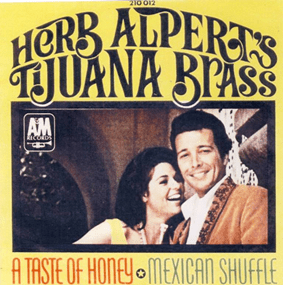 Covering is a way of making connections with specific songs, and paying homage to (or deflating) admired bands and musicians. Links between a band and certain collaboration networks are thus established. Sr. Bikini covered Alpert’s instrumental version of The Beatles’ “A Taste of Honey,” setting up a dialogue with a musician that played a lot with Mexican stereotyped imagery and sounds (like the trumpets, substituted by electric guitars in Sr. Bikini’s version).
Lost Acapulco renamed The Trashmen’s “Surfin’ Bird” as “Surfin’ Band,” participating in a long chain of covers (including The Cramps and The Ramones) of a song that in turn was the result of mixing two pieces by The Rivingtons, “Bird’s The Word” and “Papa Oom Mow Mow.” Los Esquizitos have their own covers of The Cramps’ “Human Fly” (“El moscardón”) and Rory Erickson’s “I Walked With A Zombie.”
Los Magníficos’ “Píntalo de negro,” after The Rolling Stone’s “Paint It Black,” shows that, just as in punk, any piece can be turned into a surf song.
Sometimes it is just a trait (a riff, or a beat) that is referenced. Fenómeno Fuzz’s initial riff in “Tiki Twist” resembles Chuck Berry’s “Johnny B. Goode,” whereas two chili western songs (“Transgenic Surfers” by Los Twangers and “Skawboy” by The Bich Boys) echo The Ramrods’ harmonic and timbral arrangements for “Riders In The Sky,” another song with a long cover history, including Dale, Johnny Cash, and Elvis Presley. A surf version of this song was familiar to Mexican TV viewers in the 90s, since it was a regular soundtrack of furniture store Hermanos Vázquez spots.
Surf was born at a time when stand-alone effects units were just about to change the way music was made, taking audio manipulation off the studio and bringing it to the stage. For example, The Shadows are known for having used the tape-based Watkins Copicat, “the first repeat-echo machine manufactured as one compact unit” according to Steve Russell, responsible for the guitar delay effect in their 1960 rendition of Jerry Lordan’s “Apache,” since then a surf standard. In his book Echo and Reverb, for example, Peter Doyle examines how effects like echo/delay and reverb shaped sonic spatiality in 20th century popular music recording in the U.S., from hillbilly, country, blues, and jazz to rock ‘n’ roll.
Although Doyle only dedicates a few paragraphs to Dale, Wray, and surf instrumentals, acoustic effects greatly contributed to characterize their styles as well. Some traits are intricately related to genre specific manifestations, like the double bass in rockabilly, or the twang effect in chili western. Timbre, then, is the aural counterpart to the scene’s visual aspect, “invoking the rich semiotic traditions that wove through southern and West Coast popular music recording” (Doyle, 2005, 226). It has become a way both to continually define the genre and, in the Mexical neo-surf scene in particular, to overcome melodic and harmonic limitations. Thanks to timbral play, what used to be a blind alley in rock history became in the 1990s a mirror for young generations of Mexicanos to create and feel aligned with fashionable trends, and a sonic filter enabling them to examine their social situations and, sometimes, to willfully sidestep them.
—
Featured Image: Lost Acapulco in Estadio Azteca 2009, Image by Flickr User Stephany Garcia (CC BY-ND 2.0).
—
Aurelio Meza (Mexico City, 1985) is a PhD student in Humanities at Concordia University, Montreal. Co-organizer of the PoéticaSonora research group at UNAM, Mexico City, where he is in charge of designing and developing a digital audio repository for sound art and poetry in Mexico since 1960. Author of the books of essays Shuffle: poesía sonora (2011) and Sobre Vivir Tijuana (2015). Blog: http://aureliomexa.wordpress.com/
—
REWIND! . . .If you liked this post, you may also dig:
Share this:


Current Top Posts





April 2021

January 2020

November 2019

October 2019

August 2019

April 2014

November 2017

March 2015

December 2017

October 2015
 Sounding Out!
Recent Comments