
Soundscapes of Narco Silence
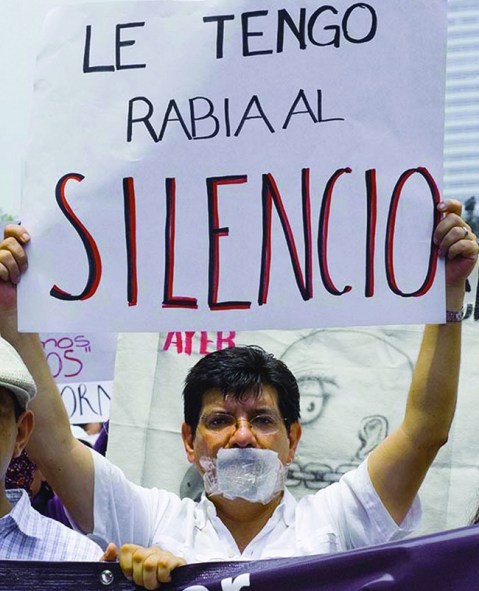
Journalists protest in silent march in Mexico City, Courtesy of the Knight Foundation
Since the drug war began, the lives of approximately 95,000 people have been claimed, with an estimated total of 26,000 disappearances (“Continued Humanitarian Crisis at the Border” June 2013 Report). At the University of Texas, Pan American – an institution located 25 miles north of Reynosa, Mexico (a Mexican city that has been hard hit by drug violence in recent years) – I teach students who have been dramatically impacted by drug war violence. Many have close relatives affected or hear horrific stories of those who have been kidnapped by the cartels; many fear traveling to Mexico to visit loved ones as a result and, in some cases, they report having relatives involved in the drug cartel business. Dinorah Guerra, psychotherapist and head of the Red Cross in Reynosa, describes the devastating psychological and physical toll: “There is a huge risk for people’s self esteem. They cannot speak about what they have seen or what they have heard. [They] lose [themselves] and lose [their] identity” (qtd. in Pehhaul 2010).
I name the space of the drug war and its resulting terror in the U.S.-Mexico border the “soundscape of narco silence.” This soundscape includes death and intimidation, from the brutal killings of news reporters by cartel members to the decapitation of citizen-activists who use online media to alert communities of narco checkpoints. It also consists of those powerful acts that call attention to silence as a tactic of terror. The Movement for Peace with Justice and Dignity, for instance, brought together tens of thousands of people in Mexico to speak out against drug violence through silent marches. Cultural productions, such as narcocorridos, or contemporary drug ballads that document the cross-border drug economy, also become part of the soundscape. The narcocorridos function as a powerful critical response to silence and fear because they enable those in Mexican society, as Jorge Castañeda, author of El Narco: La Guerra Falllida, explains, “to come to terms with the world around them, and drug violence is a big part of that world. The songs are born out of a traditional Mexican cynicism: This is our reality, we’ve gotten used to it” (Qtd. in Josh Kun 2010).
In this blog post, I focus on the role of U.S. Latina/o theater produced in the South Texas border region as it responds to the soundscape of narco silence. Building on David W. Samuels, Louis Meintjes, Ana Maria Ochoa, and Thomas Porcello’s definition of “soundscapes” in “Soundscapes: Towards a Sounded Anthropology” as “the material spaces of performance and ceremony that are used or constructed for the purpose of propagating sound” (330), I suggest that soundscapes of silence in theater function as material spaces of performance that focus the public’s attention on silence – with the intent of intervening in acts that propagate silence and fear. Soundscapes of narco silence are characterized not only by violence and terror, but by cultural productions that function as forms of critical resistance – those works that focus the publics’ attention on the economy of silence and fear that fuels the drug war, and in the process, enable communities to cope with narco violence.
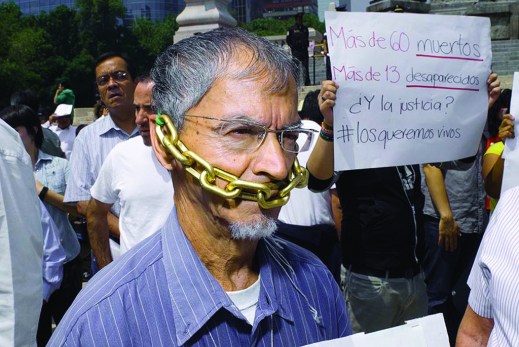
Journalists protest in silent march in Mexico City, Courtesy of the Knight Foundation
To closely listen to the soundscape of narco silence, I engage with the play script and production of Tanya Saracho’s play El Nogalar at South Texas College Theatre (STC) under the direction of Joel Jason Rodriguez in McAllen, Texas in June 2013. The play was first produced at the Goodman Theater in Chicago in April 2011, with a West Coast premiere at the Fountain Theater in Los Angeles in January 2012. I critically analyze the STC Theatre production’s incorporation of a multi-genre soundtrack that included narcocorridos, rancheras, and nortec (norteño + techno). I argue that this soundtrack focused audiences’ attention not only on the devastating effects of silence, but also the function of silence as a form of capital for those most excluded in society. I also offer a brief critical listening of the script’s rendering of silence through character dialogue and stage directions.
El Nogalar tells the story of an upper-class Mexican family comprised of three generations of women (Maité, Valeria, and Anita) whose land and home in the fictionalized estate of Los Nogales in Nuevo Leon, Mexico, and its adjacent nogalar (pecan orchard), are under threat by the maña (drug cartels) moving into the region. The play focuses on the women’s responses to the drug war economy as a result of their different relationships to home (both their estate and the space of Mexico). It also centers the experiences of Dunia, their maid, and López, a former field worker who now works for the maña.
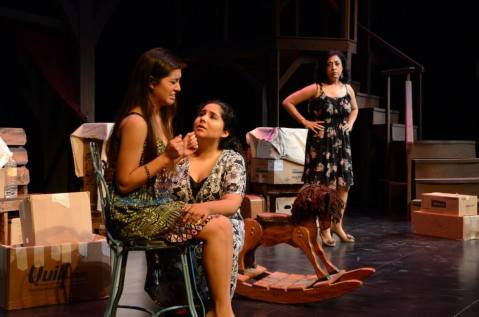
STC Theater Production of El Nogalar. Photo Credit: Miguel Salazar
Cecilia Ballí, in her article “Calderón’s War: The Gruesome Legacy of Mexico’s Antidrug Campaign,” explains the particular circumstances of marginalized men in this society: “The worst casualties of this ‘civil war’ were the estimated 7 million young men to whom society had closed all doors, leaving them the options of joining a drug gang or of enlisting in the military, both of which assured imprisonment of death” (January 2012, 48). With the characters López and Dunia, the play asks audiences then to listen to the impact of the drug war on the most vulnerable populations in Mexico and the US-Mexico border region.
The play script conveys how “narco silence” can be used by those who either seek to preserve traditional class hierarchies (the story of the matriarch Maité) or to survive and profit in the new drug economy (the story of López). “Narco silence,” a term coined by reporter Jonathan Gibler in his book To Die in Mexico, refers to “not the mere absence of talking, but rather the practice of not saying anything. You may talk as much as you like, as long as you avoid the facts. Newspaper headlines announce the daily death toll, but the articles will not tell you anything about who the dead were, who might have killed them or why. No detailed descriptions based on witness testimony. No investigation” (2011, 23). In an early exchange between López and Dunia, López defends “narco silence” as a strategy of survival:
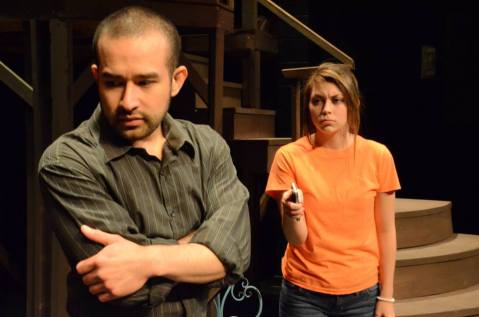
STC Theater Production of El Nogalar. Photo Credit: Miguel Salazar
DUNIA: Why are you the only one they leave alone, Memo?
LÓPEZ:….
DUNIA: All the men your age. Killed. Why Memo? (Beat).
LÓPEZ: Because I know when to keep my mouth shut which is not something I can say for you….
DUNIA: So that’s all it takes to be best of friends with the Maña? That doesn’t seem so hard to do? (American Theatre Magazine July/August 2011, 74).
Later in the play, Dunia, heeding López’s advice, offers a powerful observation of how “narco silence” enables her community to cope with death: “We all just walk around like we’re a movie on mute. You can see people’s mouths moving but all you hear is the static (my italics)” (American Theatre Magazine July/August 2011, 73-74).
The STC Theatre production enhanced the script’s soundscape of narco silence through its sound design, with a soundtrack that included rancheras, narcocorridos, norteño and nortec. This music provided audiences with a connection to the world of Los Nogales and captured each character’s process of coping with narco violence. For example, Maité’s soundtrack consists of several rancheras, such as Lola Beltran singing “Los Laureles” and Chavela Vargas’s powerful rendition of “Que te vaya Bonito.” Beltran’s “Los Laureles” – a cancion ranchera that includes Beltran’s powerful female vocals and mariachi orchestra instrumentation – invites audiences to hear Maité’s nostalgia and desire for an idealized Mexican society and her wish to preserve traditional class hierarchies.
.
Vargas’s powerful rendition of “Que te vaya Bonito” captures Maite’s pain and suffering as she loses her home to the cartels. In Vargas’s version of “Que te Vaya Bonito” – a song about love and abandonment – audiences hear Vargas’s choking and sobbing voice, accompanied by a single guitar.
.
Vargas’s voice conveys, what Lorena Alvarado powerfully argues, is “the body’s dilemma between the hysteria of sobbing and the intelligibility of words, between resignation and retribution” (2010, 4). Vargas’s powerful singing also conveys, as Alvarado further describes, “un nudo en la garganta,” a common expression in Spanish that describes “the knot in the throat, when one cannot speak because words will not come out, but the desperate, or quiet, breath of tears” (Alvarado 2010, 5).
To sonically register the drug cartel economy and lifestyle underlying the “new” Los Nogales, the soundtrack also included narcocorridos. The first sounds we hear in the play are from the narcocorrido “El Carril Número Tres” – which includes two acoustic guitars and an electric bass – by Los Cuates de Sinaloa.
.
“El Carril Número Tres” – tells the story of a secret “lane number three” that allows a Mexican drug lord to freely go back and forth between the US and Mexico because he makes a deal with the CIA and DEA. With this focus on the US government’s involvement in the drug trade, the song centers how silences north of the US-Mexico border have perpetuated drug violence.
The music also included nortec, with songs by the Mexican Institute of Sound, particularly the track “Mexico,” which is a critique of the Mexican government’s complicity with the narcos.
.
With “Mexico,” audiences hear a fusion of norteño, electronic, and hip-hop with lyrics that use the symbols of Mexican national identity and culture to focus the public’s attention on violence and terror. With the lyrics “green like weed, white like cocaine, red your blood” (referencing the Mexican flag) and “at the sound of the roar of the cannon” (alluding to the national anthem), the song powerfully invokes the visual and sonic soundscape of violence that terrorize Mexican residents. With this charged critique of government corruption, “Mexico” momentarily interrupts the soundscape of narco silence rendered in the play script and rest of the soundtrack.
Ultimately, the production’s combination of rancheras, narcocorridos, and nortec captured the class tensions in Mexican society and emphasized the play’s critique of class structures that have enabled drug war violence to persist. With this range of music, the director explains he wanted to “maneuver between the [various] aspects of [the story]: the nostalgia, the corridos, the narcocorridos, and also this fusion of saying ‘we want something more,’ and so that was the whole aspect of it; the blending of the old, the new, and what the present is” (Interview with author July 2013).
The production also deliberately incorporated the sound of silence, particularly in the final scene. By the end, López buys the Los Nogales estate, thereby increasing his class status and social power. Saracho’s stage directions in this final moment indicate “an interpretive sound of trees falling. Now don’t go cueing chainsaws because it’s not literal. Just make me feel trees are falling. Along with the upper class” (87). The play’s reference to the staging of “an interpretive sound of trees falling” brings to mind the philosophical question: “If a tree falls in a forest and no one is around to hear it, does it make a sound?” We might then interpret the final sounds of El Nogalar as inviting audiences to listen attentively to the soundscape of narco silence, implicating audiences as social actors in the politics of the drug war that continue to devastate Mexican society.
—
Featured Image: Journalists Protest against rising violence during march in Mexico, Courtesy of the Knight Foundation
—
Marci R. McMahon received her Ph.D. from the University of Southern California with affiliations in the Department of American Studies and Ethnicity. She is an assistant professor at the University of Texas, Pan American, where she teaches Chicana/o literature and cultural studies, gender studies, and theater and performance in the Departments of English and Mexican American Studies. She is the author of Domestic Negotiations: Gender, Nation, and Self-Fashioning in US Mexicana and Chicana Literature and Art published by Rutgers University Press’ Series Latinidad: Transnational Cultures in the United States (May 2013). Her essays on Chicana literature and cultural studies have been published in Aztlán: A Journal of Chicano Studies; Chicana/Latina Studies: The Journal of MALCS; and Frontiers: A Journal of Women’s Studies. Her second book project, Sounding Latina/o Studies: Staging Listening in US Latina/o Theater explores how contemporary Latina/o drama uses vocal bodies and sound to engage audiences with recurring debates about nationhood, immigration, and gender.
—

REWIND! . . .If you liked this post, you may also dig:
Listening to the Border: “’2487’: Giving Voice in Diaspora” and the Sound Art of Luz María Sánchez–D. Ines Casillas
Quebec’s #casseroles: on participation, percussion and protest–Jonathan Sterne
Deejaying her Listening: Learning through Life Stories of Human Rights Violations— Emmanuelle Sonntag and Bronwen Low
Share this:

A Listening Mind: Sound Learning in a Literature Classroom

“Listening is little short of a synonym for learning.”
–Julian Henriques, Sonic Bodies
 This is the third post in Sounding Out!’s July forum on listening in observation of World Listening Day on July 18th, 2013. World Listening Day is a time to think about the impacts we have on our auditory environments and, in turn, its affects on us. To read last week’s post by Maile Colbert click here and Regina Bradley’s discussion of listening, race, and Rachel Jeantel (and to read more about World Listening Day) click here.
—
How can listening, which I’ve come to understand as an essential way of knowing, enhance the learning experience? My pedagogical challenge over the past few years has been to develop a heightened awareness of the ways our ears are not necessarily, as Robert Frost asserts, “the only true reader and the only true writer,” but certainly an essential mode of reading and writing that is too often underdeveloped. As my high school students read works by Zora Neale Hurston, Ralph Ellison, Michael Ondaatje, Jonathan Safran Foer, James Baldwin, and Lucille Clifton, I want their ears to become increasingly attuned to the sounds, silences, vibrations, and other sonic significance embedded within printed words. I want them to experience how listening enhances their understanding of literature, that listening is learning.

“Writing” by Flickr user filipe ferreira, CC BY-NC-SA 2.0
I’ve taught A Listening Mind, a trimester course for high school juniors at Princeton Day School in New Jersey, for two years. Inspired by Toni Morrison’s 1996 National Book Award acceptance speech, “The Dancing Mind,” the course title signals my interest in challenging students to practice writing and reading in ways that are collaborative and cognitively (and otherwise) dissonant with their usual English classroom habits of mind. For my students, at least initially, writing is ruled solely by the mantra “Show. Don’t Tell.” This course, then, creates preconditions for a new kind of learning. It aims to heighten students’ aural attentiveness in general, and particularly in relation to the sonic life that inhabits the lower frequencies of the printed word. In many ways, the class resonates with Liana Silva’s discussion of sound as significant to writing and learning. In this course, we grapple with essential questions such as: How might we read and write with our ears? What happens when we take the risk to do so? As I design assessments and moderate the course, I keep in mind my own essential question as an educator: How can my scholarly interest in listening as a significant mode of cultural and social engagement translate into sound study learning opportunities for my students? The assignments students complete in A Listening Mind, a few of which I share next, are my response to these questions–a response that is in constant development.
CULTIVATING A LISTENING MIND
On the first day of class, I play Jason Moran’s “Cradle Song” from his most recent album, Artist in Residence. Moran plays the Carl Maria von Weber-composed lullaby on unaccompanied piano; the urgent scratching of a closely miked pencil on paper writes slightly ahead of the calming melody.
The song, a tribute to Moran’s mother who would stand over his shoulder taking notes as Moran practiced piano as a child, amplifies a sonic life that more often lingers within the printed word. Thus, it allows us to begin exploring the possibilities of listening as an approach to reading and writing.
In the first month of the course, students practice low stakes listening and writing: they go on short listening walks and record by hand what they hear in their sound journals. Rutger Zuydervelt’s Take a Closer Listen, an excerpt from the opening pages of Jonathan Safran Foer’s Extremely Loud and Incredibly Close, and the New York Times Magazine prose and audio essay, “Whisper in the Wind” are our inspirations for this assignment. They visit a space in which they feel most like themselves and tune into the space’s acoustics. They do the same in a space where they are less comfortable. Students also tune their attention to eco-listening – listening with intention to the natural or man-made environments in which we find ourselves. The idea is to notice the sounds our ears have become deaf to as we’ve become accustomed to a space. Their eco-listening results in their creating individual listening booklets that record the sounds we hear and our occasional reflections on them. By listening to various sounds and in various ways during the early weeks of the course, students exercise their ears and, along the way, some even realize that you need more than just ears to listen.

“Listening Devices” by Flickr user abrinsky, CC BY-NC-SA 2.0
SONIC MATERIAL CULTURE
One of the assignments of the course involves work in what I call “sonic material culture.” According to the University of Delaware’s Center for Material Culture Studies, the study of material cultural objects “promotes the learning from and the teaching about all things people make and the ways people have acted upon the physical and visible world.” But, what about the ways in which material culture impacts the audible world? Sonic material culture looks at how material cultural objects help create cultural meaning through the sounds they make and the ways in which people use those sounds. Students explored an array of “sonic objects” that included, among others, a Tibetan singing bowl, steel drum, Shofar, typewriter, stethoscope, and a boom box. They then chose one of the items – an item that either makes sound (like a steel drum) or allows for access to sound (like a stethoscope), and began their research with a specific focus on how this item holds sonic cultural significance.
To research the stethoscope, for example, one student interviewed a cardiologist and a medical historian. She learned that sounds doctors hear through the stethoscope “comprise a language, spelling out diagnoses and prognoses” and provide “gateways to our understanding of the heart.” Another student chose the Steel Drum, an instrument developed in the 20th century in Trinidad and Tobago, and ended up discussing the innovation involved in reusing oil containers to produce a new cultural sound. Another student’s research on the Tibetan Singing Bowl led him back to a moment in Jonathan Stroud’s The Bartimaeus Trilogy: Book Three, Ptolemy’s Gate when the character Kitty Jones describes the ringing of a Singing Bowl that signals her transport into the world of magical spirits. Listening to the Singing Bowl made this student more attentive to this moment that he initially skimmed. And, one student’s love of all things vintage led her to her father’s manual typewriter and an essay combining family history and larger insights about education, workplaces, and mechanical writing. In each of these cases, the students realized that the sounds cannot be extricated from the material, social, and historical conditions that produce them.
SOUNDING HISTORY
The last time I taught the course, I designed a sound history mini-project. Students read excerpts from the work of Mark A. Smith and my work on historical listening in David Bradley’s The Chaneysville Incident, and considered these question: How might sound function as a way to narrate a specific historical moment? Students needed to choose a historical moment, locate a sound, and then create a museum card that, among others, answered the following key questions: What does this sound bring to our attention that we might not otherwise consider? What questions does this sound raise? What does it leave mute? Since students had watched Django Unchained recently, we discussed sounds of slavery in that film. If you write slavery through the crack of the whip, then your focus might be on violence and torture used during that peculiar past. If you tell slavery, though, from the code-laden singing enslaved persons used to send messages to flee, then you have a different frame, a different sonic way into the historical moment.
One student used the opening sounds from The Wizard of Oz to narrate the Dust Bowl. Another examined news reports and hip hop music to listen back to the Los Angeles Uprisings. One young woman interviewed her mother about her immigration experience from Guatemala; in her project, the sound of a train whistle signaled arrival to the United States and a new life. One of the most striking projects consisted in an inventive student engineering her own sound using a teakettle in order to recreate what she imagined as the sound inside a gas chamber in a concentration camp during World War II. As she explained during her presentation, the screeching teakettle captures for her both the sound of gas and the screaming of those persons trapped within a chamber. What an empathetic choice to make as a listening scholar: to imagine the voice of one in the midst of death.
Students worked on this assignment as part of their culminating assessment for the course. I assigned this work at the end of the course because it gave students an opportunity to delve into the work of a Sound Studies scholar: students drew on their skills as listeners developed over the term; returned to questions we asked regarding listening and interpretation of written and recorded texts; framed their own questions for inquiry; and used sound technologies such as Audacity and GarageBand to amplify their historical sound.

“Turn Up the Mix” by Flickr user Travis Hightower, CC BY-NC-ND 2.0
LISTENING BACK
As I tune my ears excitedly towards another World Listening Day (this year on July 18, 2013), I find myself remembering my students’ portfolio reflections of their learning in this course. Students mentioned that their time in the course helped them pay more attention to sounds around them: “my ears have been retrofitted by my experience in this class.” Some students became more in tune with their own sound: “The world is too noisy. I need to focus in, to tune in to myself.” Yet others found themselves “slowly opening [them]selves up to others” and becoming “more engaged with others’ opinions even if they were different from” their own. Even though some students entered the class resistant to, uncertain about, or “unnerved” by the thought of a listening English course, they felt by the end that, in the words of one student, “Now I leave this class with a purpose and clearer understanding of the importance of listening to my own echo.” In short, the two groups of students who have taken this class grow more “in tune” to multiple frequencies of reading, writing, and learning.

“Verbose, sentimental foolery” by Flickr user Sarah Ross, CC BY-NC 2.0
Lastly, while I hoped students would grow as listeners, I did not anticipate that their perceptions of themselves as readers and writers would also shift. Students who previously described themselves as “just not an English student” or who began writing and reading assignments with self-defeating “I’m just not good at this” comments, delved more deeply into the writing process and produced strikingly confident, nuanced pieces by term end. They have grown in their sonic literacy. In this, my students remind me of the most essential of questions: How, to borrow Carol Dweck’s language, do we help students develop a growth, rather than a fixed, mindset where learning is concerned? In my view, listening—practiced as a dynamic, tinkering, beta-type approach to the study of literature and writing—provides interesting answers.
—
Featured image photo credit: “Listen, Understand, Act” by Flickr user Steven Shorrock, CC-BY-NC-SA-2.0
—
Nicole Brittingham Furlonge earned her PhD in English from the University of Pennsylvania. Her dissertation, “On the Lower Frequencies: Listening and African American Expressive Culture,” marks the beginnings of her investment in sound studies as the field resonates with issues of race, class, gender and education. Her work has been published in the academic journals Callaloo and Interference, and in the publication St. Andrew’s Today. She also has published a cookbook for young children, Kitchen Passports: Trinidad and Tobago. She has taught in independent high schools and colleges for 16 years, including University of Michigan, UPenn, The Lawrenceville School, Holderness School and St. Andrew’s School in Delaware. She has extensive experience in the classroom and in administrative roles dealing with curriculum development, diversity issues, faculty development and issues regarding education, equity and access.Currently, Nicole chairs the English Department at the Princeton Day School in New Jersey and blogs at the Huffington Post. She lives in the green part of New Jersey with her spouse and their three young children.
—
REWIND! . . .If you liked this post, you may also dig:
“The Sounds of Anti-Anti-Essentialism: Listening to Black Consciousness in the Classroom“–Carter Mathes
“Deejaying her Listening: Learning through Life Stories of Human Rights Violations“–Bronwen Low and Emmanuelle Sonntag
“Audio Culture Studies: Scaffolding a Sequence of Assignments“–-Jentery Sayers
—
Share this:


Current Top Posts





April 2021

January 2020

November 2019

October 2019

August 2019

April 2014

November 2017

March 2015

December 2017

October 2015
 Sounding Out!
Recent Comments