
Deaf Latin@ Performance: Listening with the Third Ear

 This is the fourth and final post in Sounding Out!’s 4th annual July forum on listening in observation of World Listening Day on July 18th, 2015. World Listening Day is a time to think about the impacts we have on our auditory environments and, in turn, their effects on us. For Sounding Out! World Listening Day necessitates discussions of the politics of listening and listening, and, as Trevor Boffone prescribes, a much wider and more corporeal understanding of the practice that goes beyond an emphasis on the ear and even on sound itself. –Editor-in-Chief JS
—
As Kent, a Deaf man, stands on stage in Tamales de Puerco, signing his story of struggling and growing up in a hearing family, the only aural sounds in the theater come from the audience: the sounds of crying. Performed in English, Spanish, and American Sign Language (ASL), Tamales offers a glimpse into the seldom seen realities of life as a single mother to a Deaf child as it intersects with Latinidad. The play presents the story of Norma, a young mother who confronts her abusive husband and challenges a country that rejects and oppresses her as an undocumented immigrant. She overcomes the hardships of being Latina, undocumented, and having a Deaf child (Mauricio) without any support from her husband, her mother, and local and state institutions. Ultimately, Norma must negotiate cultural citizenship and notions of belonging to the Deaf Latin@ community so that her son can have more opportunities. The play uses—and calls attention to—silence as an essential building block in the process of constructing, remixing, and performing the complexities of Latin@ identity.

Listening to the silences in Latin@ theatre performance offers crucial insight into how the Latin@ population and Latinidad fit into the fabric of the United States in the 21st Century, as Marci R. McMahon notes in “Soundscapes of Narco Silence.” In Tamales, the staging of Deafness creates a particular kind of silence that promotes new listening strategies. What I find most compelling is how Deafness on stage–and the particular silences Deafness can create–opens up a space for what Steph Ceraso calls “multimodal listening,” listening as a full-bodied event not solely linked to the ears, but rather connected to “bodies, affects, behaviors, design, space, and aesthetics.” Calling attention to the body as it does, the silences in the play give weight to Kent’s story and affects the viewer beyond the limits of voiced acting by encouraging spectators to concentrate on the actors’ physical emotions and how actors’ bodies work to transmit messages without verbal cues. I argue Tamales promotes multimodal listening by forcing spectators to use their “Third Ear”—a mode of listening across domains of silence, sound, and the moving body—as a device to understand a seemingly silent world.
To do this, I engage with the playscript and recordings of the 2013 production of Mercedes Floresislas’s Tamales de Puerco at CASA 0101 Theater under Edward Padilla’s direction. While Floresislas’s script raised many complex issues surrounding the Deaf Latin@ community, Padilla’s staging focused on the intersections of Deafness and Latinidad by foregrounding the use of silence in the production. [Note: I use the capitalized versions of Deaf and Deafness. A standard dictionary definition of “deaf” represents one who is partially or unable to hear (deaf and hearing impaired are essentially interchangeable). Deaf with a capital D, however, refers to the community that self-identifies as belonging to the Deaf culture. Deafness, therefore, is a sign of health and prognosis of well-being among sign language dependent hearing-impaired people. Likewise, hearing versus Hearing represents a similar biological/cultural binary.]
In Hearing Difference: The Third Ear in Experimental, Deaf, and Multicultural Theater, one of the few studies to devote critical attention to Deaf theater as it relates to multicultural experience and identity, Kanta Kochhar-Lindgren introduces the “Third Ear,” a useful term that facilitates focusing one’s attention on the performative forms of expression. Blending sensory, spatial, and visual elements generates a Third Ear that acts as a “Deaf-gain,” a hybrid mode of hearing and coming to know the world. When specific senses are lost, the mind becomes dynamic in such a way that continues to allow affected individuals to actively engage with their surroundings, with their community. Deaf people, therefore, do not lack a vital sense, but rather they gain a new sense—one typically inaccessible to hearing individuals– that enables them to successfully navigate their surroundings. Kochhar-Lindgren’s work focuses attention on the “sense” of performance and the different movements that work together to form speech sensed by the “Third Ear.” For audience members, learning to perceive the mixing of forms together as communication is fundamental to understanding the messages presented on stage; inevitably, the Third Ear promotes auditory silence yet it establishes that a lack of sound does not necessarily correspond with a lack of understanding. By removing all sound, silence gains power.

The evocation of the Third Ear separates Tamales from the majority of Latin@ theater productions grounded in aural languages such as English, Spanish, and Spanglish. Deafness is seldom represented onstage in any type of theater, aside from revivals of William Gibson’s The Miracle Worker and Mark Medoff’s Children of a Lesser God, more contemporary works such as Suzan Zeder’s Ware Trilogy and Bruce Norris’s Clybourne Park, and the work of Deaf West Theatre in Hollywood, whose most recent production, Spring Awakening received rave reviews and will move Broadway in September 2015. The work of Deaf West has been of particular interest to Sound Studies scholars for its unique contributions to the American Theatre. In Cara Cardinale’s 2012 SO! post, she discusses Deaf West’s production of Tennessee Williams’ A Streetcar Named Desire in which the roles were reversed. The production’s interpreters were for the hearing audience and, thus, sign language took center stage. Yet, all of these more well-known works focus on Anglo experiences, neglecting the specific intersectional challenges that Deaf people of color face such as limited access to state-funded resources such as counseling services, educational inequality and the achievement gap, not to mention that the majority of Deaf Latin@s do not have parents who can sign with them (re: effectively communicate).
The Third Ear, as evoked in Tamales, seems especially suited for representing Latin@ Deafness onstage and evoking a concomitant visceral understanding in audiences. Floresislas’s writing and Padilla’s direction work together to strategically allow audience members to develop a Third Ear at key moments in the play, enabling them to fill silences they might have otherwise perceived as gaps. Entering Tamales’ silent world not only compels hearing audiences to recognize their supposed privilege, but pushes toward a deeper understanding of the relativity of hearing-as-privilege. In a Deaf world, hearing is not a privilege, but rather one of many ways to come to know the world. In this regard, Tamales reiterates Liana Silva’s argument that “deafness complicates what it means to listen” by calling attention to the many non-auditory signals that are vital to the act.
 In addition, Tamales deliberately fosters moments of uncomfortable silences that are one of the production’s strengths. For example, silence plays a key role in an early scene in which Norma decides to leave her abusive husband, Reynaldo. In this violent episode–either by a deafening blow or disassociation–everything in her world goes silent. While Reynaldo yells at her and throws things around the house, his voice fades out. However, as Norma sits in silence, she becomes better able to navigate her abusive marriage. Norma hears the silence. Her hypervigilance increases her ability to identify potential threat(s) and, ultimately, she takes her son and flees from the situation. While Norma taps into her Third Ear on stage, the audience also enters a silent world in which they must seek alternative methods to actively engage with the production. By “losing” their hearing along with Norma, the audience must pay a different kind of attention to her to gain an understanding of the scene.
Along with recognizing certain hearing privileges, listening with the Third Ear both connects and separates the audience. For instance, in the scene in which Norma attends an AA meeting for Deaf people, Padilla’s direction activates the Third Ear by removing sound from the stage. In the original playscript, Floresislas wanted Kent’s monologue to include a voice-over, but during rehearsals, Padilla saw the potential to foreground the silence in this scene (and throughout the piece, as well); his direction transformed the staging from an aural scene to a silent one. Listening with the Third Ear enables the audience to blend sensory and visual hearing in order to understand the emotional depth of the action transpiring on stage. As Kent stands in silence, signing his story about the difficulties of connecting with his hearing father, many in the audience were audibly moved. During Kent’s monologue, the actor remained silent while supertitles revealed his speech:
Yesterday, my father had a heart attack and I got called to his bedside at the hospital. I had not seen him for almost 15 years! I had never had a conversation with my father; yes, he was hearing and I was his only deaf child. (…) I always believed by dad hated me; nothing I did was ever good enough. He was always watching me and looking angry for everything I ever did or asked. I actually wished he’d ignore me like the rest of the family! (15)

Particularly gripping, this scene acts as a crucial building block in the necessity of creating opportunities for her son that drives Norma’s story forward, not to mention that it calls attention to the fact that reading isn’t necessarily a silent act. Kent’s story reveals much to a hearing audience who may be unfamiliar with the Deaf Latin@ community. Kent’s experience is typical of Deaf Latin@s, only 20% of whom have parents that can sign. It compels an understanding of the reasons why Norma learns ASL and pushes for a better life for her son. She does not want him to be in the same position that Kent finds himself in. And, she does not want to have the regret of having never learned to communicate with him. Kent continues:
Yesterday, he looked frail; he was paralyzed on one side. When he saw me, he moved his hand like this (brushes his left hand up the center of his chest then points at). At first, I didn’t understand what he was doing. But when he did it again, I understood. He said, “I’m proud of you.” Then he signed “I love you.” (…) My niece told me he had been learning ASL for the last 3 months because he wanted to tell me how sorry he was for not being able to talk to me. My dad didn’t hate me; he hated himself for not being able to talk to me! (…) But yesterday, I also had my first and last conversation with my dad he signed for me! That…makes me feel very proud! (15-16)
As Kent stands in silence, his emotional journey is given life through his hands and body. Interestingly, the silences enacted onstage by Tamales actually create sound, amplifying the sobbing that emanates from the audience in both its auditory and visual manifestations. The way in which silence allows the audiences’ sonic reactions to become part of the play itself suggests that how—and why–the audience responds may actually be more important than the performance itself. How much are the sobs about the heartbreaking nature of Kent’s story and how much of it is recognizing one’s own privileges? How much of it is the audience connecting with the story? How much of it is about seeing themselves represented? And how does silence amplify “listening” to Kent’s story?
.

.
While not exhaustive, my reading of Tamales widens the conversation about the intricacies of Deaf Latin@ performance. The 2013 production of Tamales best hints at the possibilities of Latin@ performance in Boyle Heights and how community-based theater companies such as CASA 0101 can work to provide more access to Deaf people, thus forging both an inclusive community and theater company. More plays featuring Deaf characters, incorporating Deaf actors, and Deaf dramatists are needed, something Floresislas is already exploring. Still, much research remains as to how Deaf Latinidad is heard and how this identity fits into a performance framework. Through multimodal listening, Tamales urges spectators to leave the theater considering how they may or may not alter their actions to better benefit underprivileged and underrepresented communities such as the Latin@ Deaf community. Quite frankly, Tamales opens the “eyes and ears” of audiences. Now is the time to listen to Deaf Latinidad. What will we choose to hear in the silence?
—
Still Images from Tamales de Puerco, permission courtesy of CASA 0101 Theatre. Featured Image: Olin Tonatiuh and Cristal Gonzalez in “Tamales De Puerco.” Photo by Ed Krieger.
—
Trevor Boffone is a Houston-based scholar, educator, dramaturge, and producer. He is a co-founder of Amaranto Productions and a member of the Latina/o Theatre Commons Steering Committee. Trevor is a doctoral candidate in the Department of Hispanic Studies at the University of Houston where he holds a Graduate Certificate in Women’s, Gender, & Sexuality Studies. His dissertation, Performing Eastside Latinidad: Josefina López and Theater for Social Change in Boyle Heights, is a study of theater and performance in East Los Angeles, focusing primarily on Josefina López’s role as a playwright, mentor, and community leader. He has published and presented original research on Chicana Feminist Teatro, the body in performance, Deaf Latinidad, Queer Latinidad, as well as the theater of Adelina Anthony, Nilo Cruz, Virginia Grise, Josefina López, Cherríe Moraga, Monica Palacios, and Carmen Peláez. Trevor recently served as a Research Fellow at LLILAS Benson Latin American Studies and Collections at the University of Texas at Austin for his project Bridging Women in Mexican-American Theater from Villalongín to Tafolla (1848-2014).
Share this:

Sonic Connections: Listening for Indigenous Landscapes in Kent Mackenzie’s The Exiles

In April 2015, ten American Indian extras walked off the set of Adam Sandler’s new film The Ridiculous Six, a spoof on the classic Magnificent Seven (1960), in protest over the gross misrepresentation of Native cultures in general, and in particular over its insults to women and elders. Allison Young, a Navajo actress who participated in walking off, stated, “Nothing has changed. We are still just Hollywood Indians.” Young is referencing a long history of the film industries’ construction of stereotypical American Indians by non-natives created to entertain non-natives.

Still from the movie. From http://www.arthousecowboy.com
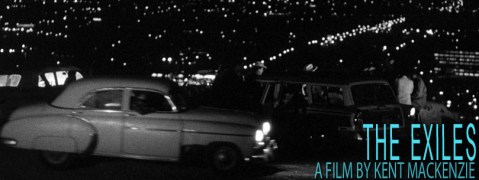
Within this long history exists a rare film, Kent Mackenzie’s 1961 The Exiles, re-restored and re-released in 2008 by Milestone Films. The Exiles is one of the few 20th century films that feature urban American Indians; it follows three main Native narrators from dusk to dawn as they experience the joys and struggles of urban life. Without an official score, this black and white docudrama places sound against haunting 35 millimeter black-and-white images of a downtown Los Angeles landscape. This mis-en-scène creates what Mackenzie (the white screenwriter, director and producer) asserts is “the authentic account of 12 hours.” The voiceovers of Homer Nish, a Hualipai from Valentine, Arizona who recently moved to Los Angeles after fighting in the Korean War; Yvonne Walker, originally from the White River Apache reservation in San Carlos, Arizona who first moved to the city to work as a domestic; and Tommy Reynolds, who is identified only as Mexican-Indian and is portrayed as a comedic playboy and the life of the party; narrate the intimate, day-to-day lives of urban American Indians.
From the website http://www.exilesfilm.com/
In this post, I consider what we can hear if we pay close attention to how the director incorporates the narrators in a kind of Indigenous soundscape. Mackenzie’s soundscape bring together voices as well as music. The collage of sounds traces the journeys of American Indians to and from Los Angeles in the mid-twentieth century. The sonic connections in The Exiles provide a cacophony of histories of forced movement, transit, and re-making spaces as Indigenous at the same time that it perpetuates important historical silences. I borrow Chickasaw scholar Jodi A. Byrd’s term from The Transit of Empire: Indigenous Critiques of Colonialism (2011), cacophony—or “discordant and competing representations” and experiences— and apply it to the sounds that inform the indigenous space represented through the film.

“Bunker Hill 1968” by Flickr user Laurie Avocado (CC BY 2.0)
The narrators are part of a large population of American Indians who moved from rural reservations to urban centers after WWII. Due to the federal government’s mismanagement of Native tribes’ land and resources, and the genocidal abandonment of treaties made with tribes, the late 1950s and 1960s were times of dire economic and social conditions on reservations. The influx of Native Americans to cities also came because of assimilation campaigns in boarding schools, military service and the Bureau of Indian Affairs’ “Termination Era” policies (1940s –1960s) that intended to terminate the state’s bureaucratic relationships with Native tribes. Relocating Native populations from reservations into cities where work was available year-round was a key aspect of the Termination Era policies. According to Norman Klein (The History of Forgetting: Los Angeles and the Erasure of Memory), areas near downtown Los Angeles, including Bunker Hill where the film is primarily shot, were multi-racial neighborhoods in economic decline and therefore became relocation sites for American Indians. Importantly, both Klein and Mackenzie are silent about the prior forced removal of Tongva on that very same location that began in the 1840s.
The audio track of The Exiles contradicts the stereotypical American Indian sounds featured in Hollywood movies. The film’s contemporary mainstream Hollywood releases included sounds such as the whooping sounds of “hostile Indians” in John Ford’s The Searchers (1956), the broken English spoken by the “Apache” in Delmer Daves’ Broken Arrow (1950), and stereotypes played out in John Sturges’ Magnificent Seven (1960). In the soft Southwestern Native lilt of Yvonne’s voice, the way that Homer and others add “you know?” to the end of almost every sentence they utter, alongside the rhythm of the casual banter and tenor of the men’s laughter, I hear a potential sonic archive of American Indians that talks back. For example, in a short clip when Tommy and his friends enter Café Ritz, an Indian bar, Thomas calls out over the loud rock and roll music as he passes people at the bar. Tommy shifts easily between English (“What’s happening there, man?”), Spanish (“Gracias amigo, ¿cómo estas?”), and Dine (“Yá’át’ééh. E la na tte?”). Careful attention to the cinematic soundscape provides access to voices of discontent and resiliency, practices of building and maintaining multilingual multi-tribal Indian spaces, and the flow of American Indians between reservations and multiple cities.
Understanding the sounds and the silences of The Exiles as a cacophony offers a way to appreciate how the film both perpetuates stereotypes but also provides insights into the urban American Indian experience. Mackenzie’s construction of Homer Nish and American Indian men continues a myth that it is individualized behavior that keeps Indians from the American Dream. (In his 1964 masters thesis, “A Description and Examination of the Production of The Exiles: A Film of the Actual Lives of a Group of Young American Indians” Mackenzie states outright that he believes they are responsible for the mess they created). The Exiles portrays American Indian men reading comic books, listening to rock and roll, hanging out at bars instead of working, and taking rent money away from their suffering women and children to gamble. These formulaic images of Native Americans are informed by a long history of visual, literary and legal representations of American Indians that compose Indian men as either savage, infantile and emasculated. But if we listen to the banter and laughter in the bar scenes and at home, we also hear the caring intimacy of camaradrie. The cacophony of sound provides a counterbalance to the visual representations.
The Voiceover and Realism
Mackenzie uses dialogue to direct the visual and sonic narrative of the docudrama’s soundscape. Ironically, this collaborative low budget project that stretched on for three and a half years has minimal original dialogue. They could not afford sound techs on site, so the most obvious sonic evocation of realism Mackenzie explores is asynchronous sound performed in a studio months later. In Mackenzie’s master’s thesis he writes that, to construct dialogues (they often voiced their lines with a group of people around), “people would joke around a lot” while “everybody was drinking beer” (76). The filmmaker did not find that dialogue on larger budget feature films at the time were “lifelike” and believable. He writes that people
seldom spoke of important matters directly; they seldom spoke clearly or coherently when they did speak and their everyday language was full of overlaps interruption and communications through looks, gestures and shrugs. Many sentences made the end understood. …What a person said seemed less important than how he said it. (73)
Here, it becomes clear that the “realism” Mackenzie pursues is more about a style of filmmaking rather than about an authentic rendering of Native American everyday life. If he found the actors performing lines too dramatically Mackenzie states he “would blow the scene apart by asking for more casual and apparently pointless lines” (73). He created a specially mediated recording of the people, downtown Los Angeles and the time period. In other words, he pursued realism: he did not seek to fully capture real experiences.
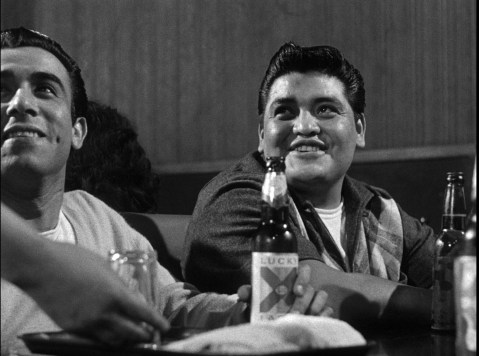
Tommy Reynolds and Homer Nish in Kent Mackenzie’s THE EXILES (1961).
Through interviews he guides the actors to talk about their everyday lives, their problems and their thoughts about life. Mackenzie used “improvised tracks” out of individual interviews in an attempt “to help preserve their point of view in the film.” He interviewed Homer, Tommy and Yvonne for several hours apiece, questioning and re-questioning them – not necessarily to document the subjects’ truths but “for emotional quality and general attitudes and feelings” (78). Despite his intentions, the voiceovers provide some context of the trials of everyday life and how the leads negotiated their belonging in a space far from home. Mackenzie’s realism builds a collage of soundscapes—voiceovers, background noise, music—to orchestrate a scene rather than simply document part of a 12-hour period of life.
Rock and Roll and Urban Indian Sounds
Mainstream “Hollywood Indians” are associated with a limited soundscape of drums and whoops, but Mackenzie’s use of contemporary rock and roll illustrates the complexity of the indigenous soundscape. Even though the film opens with the slow repetitive beating of the buckskin drums and a contextual opening monologue, after the drums stop it is the early surf music of Anthony Hilder and his five-piece band, The Revels, that drive many of the scenes. The music renders audible the many ways people tried to belong in new locations and within new cultures, juxtaposing the fast blast of the trumpet and guitar riffs of the Revels with the steady beat of the drum and shake of a turtle rattle.
Mackenzie continues this juxtaposition later in the film. Homer, alone on the street in front of a liquor store, opens a letter a bartender handed to him earlier in the evening. At the top of the letter is written “Peach Springs, Arizona” and tucked within the letter is a picture of an older man and woman. The camera focuses on the picture that dissolves and reemerges as a rural desert scene. The man from the picture sits beneath a tree with a girl and the woman, and rhythmically chants and shakes a rattle. There is no voice-over or dialogue; ceremonial singer Jacinto Valenzuela’s repeats a song multiple times without an English translation. The steady rattle of the dry seeds in the gourd are a sharp contrast to the pace of the Revels’ songs that saturates Homer’s earlier scenes.
Without guidance from a narrator, the scene is left to audience interpretation. The scene and its sounds could represent Homer’s sense of being displaced between times, or a homesick romanticized remembrance of family life: the moment quickly dissipates and Homer once again stands alone on a corner bathed in the streetlight. However, the music here could be a sonic connection that provides an alternative geography of indigenous space and place. Mackenzie’s collage of sound echoes the circuitous path of indigenous bodies and ideas of indigenous life in diasporas described in Winnebago Tribe of Nebraska scholar Renya Ramirez’s work in Native Hubs: Culture, Community, and Belonging in Silicon Valley and Beyond. The rattle and drum can instead signal a belonging to a community and people in a present that Homer carries within him. Through sound, Mackenzie connects Homer with his communities, traditions, and a sense of belonging regardless of spatial distance.
Mackenzie deepens this connection when he imbeds Homer in a place and community through the dancing and drumming on Hill X in the penultimate scene of the film sounds. When Homer talks about Hill X (formerly Chavez Ravine, then a site of the forced displacement of Mexican residents in Los Angeles in 1950-1952, now the site of Dodger Stadium) we hear his strategy for his own and his tribe’s collective survival. The shaking of the gourd in the desert and the dancing, singing and drumming of the 49 —lead by Mescalero singers Eddie Sunrise Gallerito and his twin cousins Frankie Red Elk and Chris Surefoot—shows a reclaiming of Los Angeles as indigenous land. Thus practices of sound and movement function as what Tonawanda Seneca scholar Mishuanna Goeman identifies as “remapping” of Indian space. Taken together with the beat of the drum, the bells and rock and roll compose the content of a Los Angeles indigenous soundscape.
 The Exiles registers contemporary American Indians in motion. Homer and his comrades reclaim Hill X as Indian land with song and dance over a century after the City of Los Angeles displaced the Tongva out of that same location. At the time of the filming, American Indians were also forced to move within Los Angeles- their homes on Bunker Hill soon demolished and replaced by high rises. Paying attention and critically re-listening to the sounds of The Exiles offers an alternative soundscape of Indigenous life.
−
Featured image: “chavez ravine” by Flickr user Paul Narvaez, CC BY-NC 2.0
−
Laura Sachiko Fugikawa holds a doctoral degree in American Studies and Ethnicity with a certificate in Gender Studies from the University of Southern California. Currently she is working on her book, Displacements: The Cultural Politics of Relocation, and teaches Asian American Studies at Northwestern University.
−
 REWIND! . . .If you liked this post, you may also dig:
Sounding Out! Podcast #40: Linguicide, Indigenous Community and the Search for Lost Sounds–Marcella Ernst
The “Tribal Drum” of Radio: Gathering Together the Archive of American Indian Radio–Josh Garrett Davis
Vocal Gender and the Gendered Soundscape: At the Intersection of Gender Studies and Sound Studies–Christine Ehrick
Share this:


Current Top Posts





April 2021

January 2020

November 2019

October 2019

August 2019

April 2014

November 2017

March 2015

December 2017

October 2015
 Sounding Out!
Recent Comments