
Going Hard: Bassweight, Sonic Warfare, & the “Brostep” Aesthetic


[Editor’s Note 01/24/14 10:00 am: this post has been corrected. In response to a critique from DJ Rupture, the author has apologized for an initial misquoting of an article by Julianne Escobedo Shepherd, and edited the phrase in question. Please see Comments section for discussion]
Time to ring the bell: this year, Sounding Out! is opening a brand-new stream of content to run on Thursdays. Every few weeks, we’ll be bringing in a new Guest Editor to curate a series of posts on a particular theme that opens up new ground in areas of thought and practice where sound meets media. Most of our writers and editors will be new to the site, and many will be joining us from the ranks of the Sound Studies and Radio Studies Scholarly Interest Groups at the Society for Cinema and Media Studies, as well as from the Sound Studies Caucus from the American Studies Association. I’m overjoyed to come on board as SCMS/ASA Editor to help curate this material, working with my good friends here at SO!
For our first Guest series, let me welcome Justin Burton, Assistant Professor of Music at Rider University, where he teaches in the Popular Music and Culture program. Justin also serves on the executive committee of the International Association for the Study of Popular Music-US Branch. We’re honored to have Justin help us launch this new stream.
His series? He calls it The Wobble Continuum. Let’s follow him down into the low frequencies to learn more …
Neil Verma
—
Things have gotten wobbly. The cross-rhythms of low-frequency oscillations (LFO) pulsate through dance and pop music, bubbling up and dropping low across the radio dial. At its most extreme, the wobble both rends and sutures, tearing at the rhythmic and melodic fabric of a song at the same time that it holds it together on a structural level. In this three-part series, Mike D’Errico, Christina Giacona, and Justin D Burton listen to the wobble from a number of vantage points, from the user plugged into the Virtual Studio Technology (VST) of a Digital Audio Workstation (DAW) to the sounds of the songs themselves to the listeners awash in bass tremolos. In remixing these components—musician, music, audience—we trace the unlikely material activities of sounds and sounders.
In our first post, Mike will consider the ways a producer working with a VST is not simply inputting commands but is collaborating with an entire culture of maximalism, teasing out an ethics of brostep production outside the usual urge for transcendence. In the second post, Christina will listen to the song “Braves” by a Tribe Called Red (ATCR), which, through its play with racist signifiers, remixes performer and audience, placing ATCR and its listeners in an uncanny relationship. In the final post, Justin will work with Karen Barad’s theory of posthuman performativity to consider how the kind of hypermasculinist and racist signifiers discussed in Mike’s and Christina’s pieces embed themselves in listening bodies that become sounding bodies. In each instance, we wade into the wobble listening for the flow of activity among the entanglement of producer, sound, and listener while also keeping our ears peeled for the cross-rhythms of (hyper)masculinist and racist materials that course through and around the musical phenomena.
So hold on tight. It’s about to drop.
Justin Burton
—
As an electronic dance music DJ and producer, an avid video gamer, a cage fighting connoisseur, and a die-hard Dwayne “The Rock” Johnson fan, I’m no stranger to fist pumps, headshots, and what has become a general cultural sensibility of “hardness” associated with “bro” culture. But what broader affect lies behind this culture? Speaking specifically to recent trends in popular music, Simon Reynolds describes a “digital maximalism,” in which cultural practice involves “a hell of a lot of inputs, in terms of influences and sources, and a hell of a lot of outputs, in terms of density, scale, structural convolution, and sheer majesty” (“Maximal Nation”). We could broaden this concept of maximalism, both (1) to describe a wider variety of contemporary media (from film to video games and mobile media), and (2) to theorize it as a tool for transducing affect between various media, and among various industries within global capitalism. The goal of this essay is to tease out the ways in which maximalist techniques of one kind of digital media production—dubstep—become codified as broader social and political practices. Indeed, the proliferation of maximalism suggests that hypermediation and hypermasculinity have already become dominant aesthetic forms of digital entertainment.
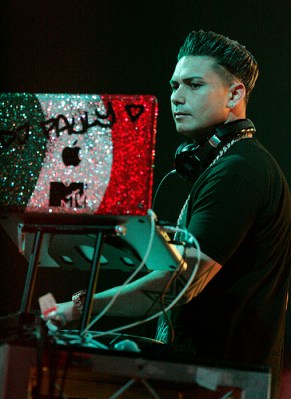
“DJ Pauly D” by Flickr user Eva Rinaldi, CC-BY-SA-2.0
More than any other electronic dance music (EDM) genre, dubstep—and the various hypermasculine cultures in which it has bound itself—has wholeheartedly embraced “digital maximalism” as its core aesthetic form. In recent years, the musical style has emerged as both the dominant idiom within EDM culture, as well as the soundtrack to various hypermasculine forms of entertainment, from sports such as football and professional wrestling to action movies and first-person shooter video games. As a result of the music’s widespread popularity within the specific cultural space of a post-Jersey Shore “bro” culture, the term “brostep” has emerged as an accepted title for the ultra-macho, adrenaline-pumping performances of masculinity that have defined contemporary forms of digital entertainment. This essay posits digital audio production practices in “brostep” as hypermediated forms of masculinity that exist as part of a broader cultural and aesthetic web of media convergence in the digital age.
CONVERGENCE CULTURES
Media theorist Henry Jenkins defines “convergence culture” as “the flow of content across multiple media platforms, the cooperation between multiple media industries, and the migratory behavior of media audiences who will go almost anywhere in search of the kinds of entertainment experiences they want” (Convergence Culture, 2). The most prominent use of “brostep” as a transmedial form comes from video game and movie trailers. From the fast-paced, neo-cyborg and alien action thrillers such as Transformers (2007-present), Cowboys & Aliens (2011), and G.I. Joe (2012), to dystopian first-person shooter video games such as Borderlands (2012), Far Cry 3 (2012), and Call of Duty: Black Ops 2 (2012), modulated oscillator wobbles and bass portamento drops consistently serve as sonic amplifiers of the male action hero at the edge.
Assault rifle barrages are echoed by quick rhythmic bass and percussion chops, while the visceral contact of pistol whips and lobbed grenades marks ruptures in time and space as slow motion frame rates mirror bass “drops” in sonic texture and rhythmic pacing. “Hardness” is the overriding affect here; compressed, gated kick and snare drum samples combine with coagulated, “overproduced” basslines made up of multiple oscillators vibrating at broad frequency ranges, colonizing the soundscape by filling every chasm of the frequency spectrum. The music—and the media forms with which it has become entwined—has served as the affective catalyst and effective backdrop for the emergence of an unabashedly assertive, physically domineering, and adrenaline-addicted “bro” culture.
Film theorist Lorrie Palmer argues for a relational link among gender, technology, and modes of production through hypermasculinity in these types of films and video games. Some definitive features of this convergence of hypermediation and hypermasculinity include an emphasis on “excess and spectacle, the centrality of surface over substance… ADHD cinema… transitory kinetic sensations that decenter spatial legibility… an impact aesthetic, [and] an ear-splitting, frenetic style” (“Cranked Masculinity,” 7). Both Robin James and Steven Shaviro have defined the overall aesthetic of these practices as “post-cinematic”: a regime “centered on computer games” and emphasizing “the logic of control and gamespace, which is the dominant logic of entertainment programming today.” On a sonic level, “brostep” aligns itself with many of these cinematic descriptions. Julianne Escobedo Shepherd describes the style of Borgore, one particular dubstep DJ and producer, as “misogy blow-job beats.” Other commenters have made more obvious semiotic connections between filmic imagery and the music, as Nitsuh Abebe describes brostep basslines as conjuring “obviously cool images like being inside the gleaming metal torso of a planet-sized robot while it punches an even bigger robot.”

“Ultra Music Festival 2013″ by Wikimedia user Vinch, CC-BY-SA-3.0
MASCULINITY AND DIGITAL AUDIO PRODUCTION
While the sound has developed gradually over at least the past decade, the ubiquity of the distinctive mid-range “brostep” wobble bass can fundamentally be attributed to a single instrument. Massive, a software synthesizer developed by the Berlin and Los Angeles-based Native Instruments, combines the precise timbral shaping capabilities of modular synthesizers with the real-time automation capabilities of digital waveform editors. As a VST (Virtual Studio Technology) plug-in, the device exemplifies the inherently transmedial nature of many digital tools, bridging studio techniques between digital audio workstations and analog synthesis, and acting as just one of many control signals within the multi-windowed world of digital audio production. In this way, Massive may be characterized as an intersonic control network in which sounds are controlled and modulated by other sounds through constantly shifting software algorithms. Through analysis of the intersubjective control network of a program such as Massive we are able to hear the convergence of hypermediation and hypermasculinity as aesthetic forms.

“Massive:Electronica” by Flickr user matt.searles, CC-BY-NC-SA-2.0
Media theorist Mara Mills details the notion of technical “scripts” embedded both within technological devices as well as user experiences. According to Mills, scripts are best defined as “the representation of users embedded within technology… Designers do not simply ‘project’ users into [technological devices]; these devices are inscribed with the competencies, tolerances, desires, and psychoacoustics of users” (“Do Signals Have Politics?” 338). In short, electroacoustic objects have politics, and in the case of Massive, the politics of the script are quite conventional and historically familiar. The rhythmic and timbral control network of the software aligns itself with what Tara Rodgers describes as a long history of violent masculinist control logics in electronic music, from DJs “battling” to producers “triggering” a sample with a “controller” or “executing” a programming “command” or typing a “bang” to send a signal” (“Towards a Feminist Historiography of Electronic Music,” 476).
In Massive, the primary control mechanism is the LFO (low frequency oscillator), an infrasonic electronic signal whose primary purpose is to modulate various parameters of a synthesizer tone. Dubstep artists most frequently apply the LFO to a low-pass filter, generating a control algorithm in which an LFO filters and masks specific frequencies at a periodic rate (thus creating a “wobbling” frequency effect), which, in turn, modulates the cutoff frequency of up to three oscillating frequencies at a time (maximizing the “wobble”). When this process is applied to multiple oscillators simultaneously—each operating at disparate levels of the frequency spectrum—the effect is akin to a spectral and spatial form of what Julian Henriques calls “sonic dominance.” Massive allows the user to record “automations” on the rhythm, tempo, and quantization level of the bass wobble, effectively turning the physical gestures initially required to create and modulate synthesizer sounds—such as knob-turning and fader-sliding—into digitally-inscribed algorithms.
SONIC WARFARE AND THE ETHICS OF VIRTUALITY
By positing the logic of digital audio production within a broader network of control mechanisms in digital culture, I am not simply presenting a hermeneutic metaphor. Convergence media has not only shaped the content of various multimedia but has redefined digital form, allowing us to witness a clear—and potentially dangerous—virtual politics of viral capitalism. The emergence of a Military Entertainment Complex (MEC) is the most recent instance of this virtual politics of convergence, as it encompasses broad phenomena including the use of music as torture, the design of video games for military training (and increasing collaboration between military personnel and video game designers in general), and drone warfare. The defining characteristic of this political and virtual space is a desire to simultaneously redefine the limits of the physical body and overcome those very limitations. The MEC, as well as broader digital convergence cultures, has molded this desire into a coherent hegemonic aesthetic form.
Following videogame theorist Jane McGonigal, virtual environments push the individual to “work at the very limits of their ability” in a state of infinite self-transition (Reality is Broken, 24). Yet, automation and modular control networks in the virtual environments of digital audio production continue to encourage the historical masculinist trope of “mastery,” thus further solidifying the connection between music and military technologies sounded in the examples above. In detailing hypermediation and hypermasculinity as dominant aesthetic forms of digital entertainment, it is not my goal to simply reiterate the Adornian nightmare of “rhythm as coercion,” or the more recent Congressional fears over the potential for video games and other media to cause violence. The fact that music and video games in the MEC are simultaneously being used to reinscribe the systemic violence of the Military Industrial Complex, as well as to create virtual and actual communities (DJ culture and the proliferation of online music and gaming communities), pinpoints precisely its hegemonic capabilities.

“Gear porn” by Flickr user Matthew Trentacoste, CC-BY-NC-ND-2.0
In the face of the perennial “mastery” trope, I propose that we must develop a relational ethics of virtuality. While it seems to offer the virtue of a limitless infinity for the autonomous (often male) individual, technological interfaces form the skin of the ethical subject, establishing the boundaries of a body both corporeal and virtual. In the context of digital audio production, then, the producer is not struggling against the technical limitations of the material interface, but rather emerging from the multiple relationships forming at the interface between one’s actual and virtual self and embracing a contingent and liminal identity; to quote philosopher Adriana Cavarero, “a fragile and unmasterable self” (Relating Narratives, 84).
—
Featured Image: Skrillex – Hovefestivalen 2012 by Flickr User NRK P3
—
Mike D’Errico is a PhD student in the UCLA Department of Musicology and a researcher at the Center for Digital Humanities. His research interests and performance activities include hip-hop, electronic dance music, and sound design for software applications. He is currently working on a dissertation that deals with digital audio production across media, from electronic dance music to video games and mobile media. Mike is the web editor and social media manager for the US branch of the International Association for the Study of Popular Music, as well as two UCLA music journals, Echo: a music-centered journal and Ethnomusicology Review.
—
 REWIND! . . .If you liked this post, you may also dig:
Toward a Practical Language for Live Electronic Performance-Primus Luta
Music Meant to Make You Move: Considering the Aural Kinesthetic-Dr. Imani Kai Johnson
Listening to Robots Sing: GarageBand on the iPad-Aaron Trammell
Share this:

Freedom Back: Sounding Black Feminist History, Courtesy the Artists
 Welcome to week four of our February Forum on “Sonic Borders,” a collaboration with the IASPM-US blog in connection with this year’s IASPM-US conference on Liminality and Borderlands, held in Austin, Texas from February 28 to March 3, 2013. The “Sonic Borders” forum is a Virtual Roundtable cross-blog entity that will feature six Sounding Out! writers posting on Mondays through February 25, and four writers from IASPM-US, posting on Wednesdays starting February 6th and ending February 27th. For an encore of weeks one through three of the forum, click here. And now, Tavia Nyong’o reviews Courtesy the Artist’s The Meeting, courtesy of Sounding Out! –JSA
—
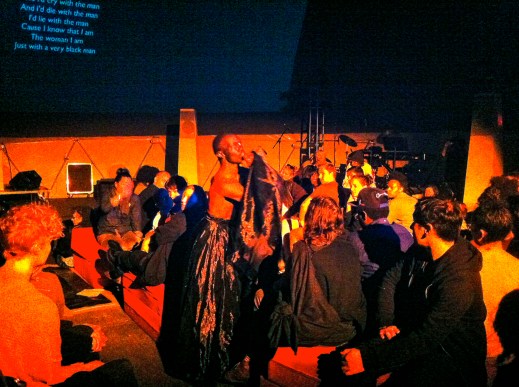
Last October 2012, in tandem with the New York launch of the retrospective art show Now Dig This! Art and Black Los Angeles 1960-1980, curated by Kellie Jones and running through March 11, 2013, MoMA PS 1 invited the sounds and images of Black Power into their courtyard Performance Dome for a Sunday afternoon collaborative arts project called The Meeting curated by Courtesy the Artists. Courtesy the Artists is the collaboration of Malik Gaines and Alexandro Segade: two-thirds of the core members of the L.A.-based performance art collective My Barbarian (the third is Jade Gordon). For The Meeting, recently transplanted New Yorkers Gaines and Seagade opted to curate a gathering of local artists, dancers and musicians they wanted to get to know better, such as LaTasha Diggs, niv Acosta, and Samita Sinha.
Curation as collaboration was the ethos behind The Meeting in PS1; Gaines and Segade were much more than masters of ceremony, but performed alongside the artists and musicians they invited. At times The Meeting felt more like a jam session than anything else, following the improvisatory and ensemblic ethos of experimental jazz. Performance piece as musician’s jam was indeed a fitting form, given that the afternoon was built around Seize the Time, a 1969 album of agit-prop cabaret recorded by activist, musician, and erstwhile Black Panther leader, Elaine Brown.
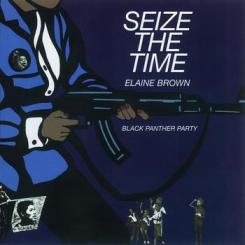
Each participant in The Meeting was invited to respond, in their chosen art form to a song from Brown’s album or another aspect of her legacy that moved them. And move them it did. If music held the event together — from Charles Gaines on the piano and drums to Matana Roberts on a haunting saxophone solo to Geo Wyeth closing down the evening with an astonishing version of “Seize the Time” intermixed with “Age of Aquarius” from the musical Hair — poetry, polemic, video, and dance sent it spinning off into a dozen scintillating tangents.
What those intersecting and diverging responses to Brown’s album shared was a concern with how the past resonates in the present, how a historical call might not always be muted over time, but sometimes amplified by its repetition across time. Given the predominance of the visual in contemporary culture — nowhere more glaring, perhaps, than in institutions devoted to visual art — what do we make of the role of the aural as a medium through which to register the reverberations of a past? The Meeting was held in a temporary structure, literally vestibular to the permanent edifice of the museum. Is the ear a similar vestibule to the institutions of culture, and, if it is, then wherein might the power of that vestibular flesh, as Hortense Spillers once named it, lie?

NYC MoMa Ps1’s Vestibular Performance Dome, image by http://momaps1.tumblr.com/
On Seize the Time, the mercurial Brown transposed the black revolutionary urgency of the 1960s into a musical idiom that sounded remarkable even in its day. It is slightly bemusing to settle into the jazzy opening of the title track “Seize the Time” with the knowledge that Marvin Gaye’s What’s Going On and Curtis Mayfield’s Super Fly were just around the corner. Certainly, despite their shared sonic defiance of American racism, Brown’s didactic sprechegesang would never be mistaken for Nina Simone’s soulful alto. Closer to the sonic mark would be singer-songwriters like Carole King, Janis Ian and Joni Mitchell, artists who broke the mold for women in pop in the late 1960s and early 1970s. Consider the rhetorical and musical twists and turns of the first verse of “The End of Silence,” a song that manages equal parts women’s liberation and black nationalism without ever teetering into blaxploitation supervixen territory:
Have you ever stood
In the darkness of night
Screaming silently you’re a man?
Have you ever hoped
That the time would come
When your voice could be heard
In the noonday sun?
Have you waited so long
Till your unheard song
Has stripped away your very soul?
Then believe it my friend
That the silence can end
We’ll just have to get guns and be men.
If The Meeting was a response to the call of that final line, it was one in which the shift from a single voice with backing band to a range of voices and positions was always audible. Some might call this postmodern fragmentation: dance choreographed to a repeating sample of Brown singing “freedom back,” a version of the album edited down to just the sequential instances of her singing the word “man,” played to projected images of every gun in the Panther arsenal she lists in her book. But these interventions arguably only expand our audition of the original album’s possibilities. More than 30 years on, The Meeting took advantage of Seize The Time’s musico-political incongruity to prise open new lines of affiliation between the past and our revanchist present. The question continuously hung in the air: How do we occupy our radical black and feminist legacies, especially given the fact that we cannot simply repeat those struggles in identical terms? How do we get freedom back?
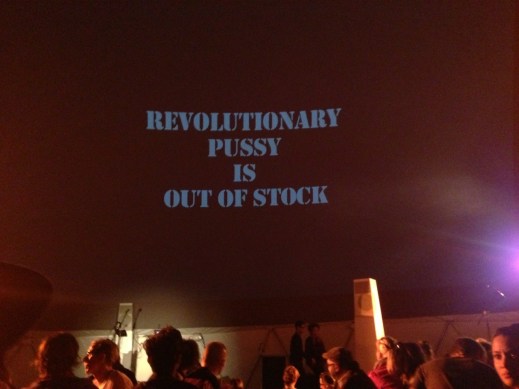
The Meeting courtesy of http://blackcontemporaryart.tumblr.com/
The declamatory cadences of black rhetoric were as central to the way The Meeting sounded as was its music. LaTasha Diggs’s barnburning performances stopped the show to inform us that revolutionary pussy was out of stock. With Charles Gaines on drums and Matana Roberts on sax, Malik Gaines scatted excerpts from President Obama’s “race speech” while excerpts from speeches Elaine Brown had given to the Panthers were read. Since the context of Obama’s speech had been his own attempt to surrogate the justified anger of the Black Power generation with a message of reconciliation, re-mixing it in this context meant it no longer had the privilege of temporal succession over Brown, but black feminist rhetoric and the improvisatory sax could invaginate his rhetoric with an eternal recurrence of radical insurgence.
It is important to note the predominantly queer and trans performance modalities through which the Meeting posed–if not fully answered–its questions regarding freedom in a contemporary context. Brown’s refrain “we’ll just have to get guns and be men” took on a new connotation when juxtaposed against the queer and trans bodies and voices in performance.
Here history revealed itself as palimpsest: images and icons were superimposed one upon the other to create dense, freighted symbols of masculinity and femininity. In a refrain originally meant to rally radical black women towards the community leadership roles tendentiously claimed by men, the gun was much more than a ‘phallic symbol.’ As Kara Keeling recounts in The Witch’s Flight (an important book containing a shrewd analysis of Seize the Time):
The appearance of the [Black Panther Party] allowed for the recognition of the black man in the Black. But this need not be understood as precluding black “females” from appearing in blacks with guns, nor does it necessarily indicate an inherent connection between “men” and “males.” What is perhaps most innovative about the BPP’s cinematic appearance is that it threw into doubt the validity of the common sense that linked “man” with “male” with “masculine” (85).
For Keeling, the innovative disruption of white supremacist racist sense — congealed in stereotypical images of black men and black women — set the stage, formed the backing track, for the historical emergence of queer and transmasculinities.
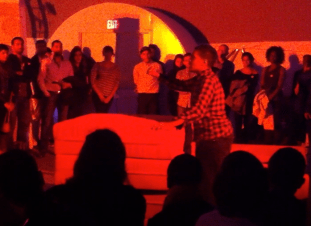
niv Acosta, image courtesy of the author
Transgender dancer and choreographer niv Acosta rhythmically ran his body against the cushioned seating of the performance dome, to the rhythmic sampling of “freedom back.” The phrase was curiously ambiguous: what actual historical freedom could Brown have possibly exhorted the panthers to claim? What imagined freedom do we think we can reclaim via our remixing of Black Power? The power of Acosta’s performance was to embody that question as a lived and livable improvisation.
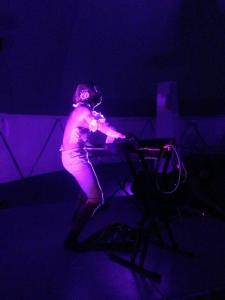
Geo Wyeth performs, image courtesy of @momaps1
The degree to which a musical legacy such as Brown’s can or should be appropriated beyond a black context was also pointedly staged that afternoon, perhaps most self-consciously by Alex Segade’s rendition of “The Meeting” — which Brown once called the Party’s anthem — in Spanish. Segade’s version captured the melodrama and romantic longing, staging the historical interconnections between black and brown power in California as a hall of mirrors and fleeting glances.
Geo Wyeth brought the house down with a funky final number that had the audience on the edge of their seats, perhaps awaiting the promised nudity a sign at the entrance warned the performance would contain. Wyeth’s onstage costume changes were anything but a striptease, however, as he instead fused the militancy of Seize the Time with the sexual revolution of Hair in an incompossible auditory portrait of the legacy of “the Sixties.” His performance left the audience with the emphatic reminder that it is less his generation’s challenge to prove adequate to the past than it is to retrieve from history’s shroud the pulsating star of their own desires.
—
[The Meeting included Simone Leigh, Samita Sinha, Matana Roberts, Charles Gaines, Malik Gaines, Adam Pendleton, niv Acosta, LaTasha Diggs, Xaviera Simmons, Jarrod Kentrell, Alex Segade, and Geo Wyeth].
—
Featured Image of Jarrod Kentrell performing to Elaine Brown’s “Very Black Man” at The Meeting, Courtesy of the author
—
Tavia Nyong’o is Associate Professor of Performance Studies at New York University, where he writes, researches and teaches critical black studies, queer studies, cultural theory, and cultural history. His first book, The Amalgamation Waltz: Race, Performance, and the Ruses of Memory (Minnesota, 2009), won the Errol Hill Award for best book in African American theatre and performance studies. Nyong’o has published articles on punk, disco, viral media, the African diaspora, film, and performance art in venues such as Radical History Review, Criticism, TDR: The Journal of Performance Studies, Women & Performance: A Journal of Feminist Theory, Women Studies Quarterly, The Nation, and n+1. He is co-editor of the journal Social Text.
Share this:


Current Top Posts





April 2021

January 2020

November 2019

October 2019

August 2019

April 2014

November 2017

March 2015

December 2017

October 2015
 Sounding Out!
Recent Comments