
Kawa: Rediscovering Indigeneity in China via Reggae
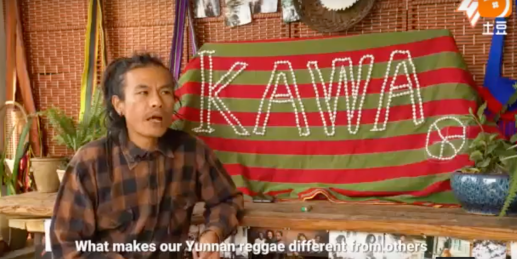
Kawa is a reggae group from Yunnan’s Ximeng, an autonomous county for the Wa people in the southwest of China, bordering Myanmar. When I learned about Kawa’s story in 2016, I was first intrigued by the geographical similarities between Yunnan and Jamaica: both regions are characterized by tropical climates, lush vegetations, and perhaps most prominently, proximities to marijuana plantations. Outsiders often associate the musical style of reggae with a stereotypical “laidback” lifestyle projected onto these locales. Known as “Yunnan Reggae,” Kawa’s music indeed exhibits some of the most characteristic elements of reggae music—slower tempos, remixed vocals, and repetitive chords falling on the offbeat.
“Yunnan Reggae”–Kawa
Recently I realized this climate connection was simplistic and reductive, and what I failed to grasp in Kawa’s music was far more important—a notion of indigeneity manifested through reggae’s generic elements. In Steven Feld’s “From Schizophonia to Schismogenesis: The Discourses and Practices of World Music and World Beat” in 1995, he noted the affinity of many indigenous cultures for reggae music. “Its [reggae] perception by indigenous peoples outside the Caribbean as an oppositional roots ethnopop form has led to its local adoption by migrants and indigenes in places as diverse as Europe, Hawaii, Native North America, Aboriginal Australia, Papua New Guinea, South Africa, and Southeast Asia” (110). In the 1970s, “roots” reggae translated the everyday lives of Jamaicans as well as their Rastafarian spirituality into a stark resistance to racial oppression, economic inequality, and colonial capitalism that they had experienced in history. The music was deeply embedded in the Jamaican culture. Around the same time, however, engineers and producers in Jamaica–many of them Chinese and Chinese-Jamaican–began to experiment with remixing reggae songs, contributing to an adaptive style of pop music as well as its international popularity. Therefore, against the global market force for “a world music,” reggae was quickly adopted to preserve indigenous cultures, remixing a wide range of ethnomusical elements.
But note that Feld’s list did not include East Asia. In fact, indigeneity as a discourse has been largely absent in this region. Taiwan is perhaps the only exception, where the Austronesian peoples have claimed their indigenous status and political rights. Japan and the Koreas are often considered as the most ethnically homogeneous countries in the world. And China, while officially acknowledging its ethnic diversity, never thought its internal migration of the Han majority as a potential threat to its ethnic minorities and indigenous cultures. I grew up in the southwest of China in the 1990s, when the internal migration of ethnic groups was already a norm. I could not remember if “indigeneity” meant anything even remotely political. I could not remember if the cultural traditions of ethnic minorities were meant to be tied up to the land on which they are/were practiced. What I do remember is that there are regions where the ethnic minorities concentrate and in which they integrate.
This post examines how the Chinese reggae group Kawa introduces an indigenous discourse through the sonic elements of reggae. In their performances, Lao Han often opens with a statement about being an indigenous ethnic minority. Most members of the group have non-Han Chinese backgrounds—Wa, Hani, Aini, and Hui. And even the name Kawa refers to the Wa people in their own language.
Kawa always find the most innovative ways to incorporate ethnic elements into their interpretations of the genre. In “Yunnan Reggae,” for example, sampled vocals from Wa people, lyrics written in Wa language, and traditional Wa instrumentation all work together to portray living cultural traditions closely associated with the Wa ethnic identity. However, it is the intimacy with the land Kawa expresses in their music that foregrounds their indigenous sentiments.
Although the entirety of the lyrics consists of two lines, the song “Red Hair Tree” reveals an indigenous life dwelling on the land—in its neighborhood, locality, and proximity.
Such a huge red hair tree
Hitting the wooden drum sounding dong dong
“Red Hair Tree” resembles a labor song narrating the mundane activities of logging and drum crafting. The first line describes the tree’s size, invoking a reverence for its sublimity. The glistening red color contributes to the plant’s vibrant animacies. As Ai Yong explains, “If you have chatted with the elders on the A Wa Mountains about this land, you will see an extraordinary beam of light glistening in their eyes, carrying endless assurance and reverence” (translated by Meng Ren). The second line translates that reverence into a more intimate whispering. Due to the Wa people’s animist beliefs, the red hair tree’s spirit is reincarnated in the wooden drum. The “dong dong” sound then embodies an invocation of the natural spirits. “The Wa ancestors believe, where there is the red hair tree, there is god’s blessing. In the past, the tall and robust red hair trees surrounded all Wa villages.” As Ai Yong continues to explain, the natural spirits are called for protection in exchange for the people’s worship.
“Red Hair Tree” is not the first time when reggae prompted the Han Chinese to confront questions about migration and indigeneity, however. It is often forgotten that the Chinese diaspora in Jamaica contributed to the development of reggae. Stephen Cheng’s “Always Together (A Chinese Love Song)” in 1967 is a rare yet symptomatic example of how the Chinese imagined indigeneity through remixing reggae.
Despite its obvious rocksteady overtone, the song combines a wide range of Chinese elements. It opens with a pronounced bass line coupled by the guitar and then the accented drum beat. Although this rhythmic beat is reminiscent of typical reggae songs, the music flow is somehow disrupted by the sudden appearance of the male vocal. Stephen Cheng sings in Mandarin. His chest voice meanders across a wide range, registering a sonority that is more often heard in Chinese opera than in reggae songs (or pop music in general). His delivery accentuates on the extended vowels, exaggerating the dramatic ups and downs of the tonal language—Mandarin Chinese. In fact, the music is adapted from a well-known Taiwanese folk song “Green is the Mountain (Gao Shan Qing).” On the surface, it is a romantic love story. It depicts the scenic landscape of the mountains and waters of Alishan, which the Taiwanese indigenous Tsou people traditionally inhabit. Through a metaphorical parallel, the romantic love between a young Tsou couple is embodied in the companionship between the mountain and the water, which resonates with its English title “Always Together.”
Indeed, “Green is the Mountain” was written by the Han Chinese who fled to Taiwan during the Chinese Civil War, and it is often criticized for romanticizing the experience of the indigenous peoples who were forced to move into the mountain. When the song is rendered into reggae by Cheng, however, it re-contextualizes this imagined indigeneity as a diasporic yearning to restore the lost connections between land and culture. “Always Together” was produced by Byron Lee, a Chinese-Jamaican who founded the renowned ska band Byron Lee and the Dragonaires. As record producers, sound system owners, or band managers, numerous Chinese-Jamaicans like Lee contributed “Chinese elements” to reggae during its formative years. In return, reggae carries on the tradition of cultural remix, always opening itself up to local adaptions.
Reggae has always been an eclectic music form. As we have seen, both examples combine a wide range of musical elements from different cultures—from ethnic minorities in China to Chinese and African diaspora in Jamaica. Despite almost a half century apart, the two reggae songs foreground a discourse on indigeneity that is shaped by the migration of people and the mixing of culture. Despite the most generic “pop” elements, the local adoption of reggae reveals an attempt to comprehend the relationship between ethnic identity, cultural practice, and the land. Understood in this way, Kawa’s reggae music becomes an important voice in understanding ethnic differences and indigeneity in today’s China.
—
Featured Image: Screen Shot from “Kawa: Chinese Yunnan Reggae Band”
—
Junting Huang is a Ph.D. Candidate in the Department of Comparative Literature at Cornell University. His research areas include literary studies, film/media studies, and sound studies. His dissertation project “The Noise Decade: Intermedial Impulse in Chinese Sound Recording” examines the figure of noise in contemporary Chinese literature and new media art. It analyzes how noise is conceptualized through the recorded sound as a materializing force that indexes the shifting social relations in the 1990s.
—
 REWIND! . . .If you liked this post, you may also dig:
Decolonizing the Radio: Africa Abroad in the Age of Independence– Samantha Pinto
“Everyone I listen to, fake patois…”– Osvaldo Oyola
Radio de Acción: Violent Circuits, Contentious Voices: Caribbean Radio Histories–Alejandra Bronfman
Share this:

SO! Reads: Nicole Brittingham Furlonge’s Race Sounds: The Art of Listening in African American Literature

 Is literature truly a primarily visual entity? Do we only read books or are we actually actively “listening in print”(1)? These are the main questions that Nicole Brittingham Furlonge explores in Race Sounds: The Art of Listening in African American Literature (2018). As Black literature is often considered in terms of its attention to music, listening has therefore been limited to the musicality of stories, and many voices are left unheard. What Furlonge does in Race Sounds is go back to these unheard voices and focus our attention on them to see what we have been missing.
Furlonge wants to demonstrate how to “uncover the different ways of knowing that emerge from aural engagement” (3) such as exposed in Invisible Man, Their Eyes Were Watching God, and Sterling Brown’s “Ma Rainey.” She urges us to learn to “decode print differently” (4) by attuning the reader to the practice of listening, as well as to (black) sound(s) studies in more general terms, by referring to the essential scholars of the field: Tsitsi Jaji, Fred Moten, Kevin Quashie, Jennifer Stoever, and Alexander Weheliye – to name a few. Furlonge further “joins a collective effort to shift from a heavy emphasis on sounding to an attention to listening practices” (9). By redirecting the reader to listening practices, Furlonge leads us to reconsider our own “coexistence among humans.” (9)
 Furlonge, previously chair of the English Department at the Princeston Day School, and new Director of Teacher’s College’s Klingenstein for Independent School Leadership is not only an experienced scholar, but a teacher experiencing first hand what it means to listen: in a classroom and in society. Race Sounds is a five chapter book, moving from a consideration of “Literary Audiences” (chapter one), to the “Silence of Sound” (chapter two), to various forms of Listening (chapters three-five). Her fifth chapter, as well as her epilogue, have an especially interesting approach to Sound Studies through her lens as an educator. Not only does Furlonge have extensive classroom experience and administrative expertise in curriculum development, diversity issues, faculty development and issues regarding equity and access, but she is in a good position, as an independent scholar, to reflect on listening practices in and out of academia. It is quite exceptional to consider pedagogy in a critical text, as it observes education in the classroom and citizenship, in addition to her critical analysis.
By guiding her reader to listening in new modes throughout the book, Furlonge demonstrates how to “read in a multimodal way” (109) in order to learn to listen. This multimodal method includes an attention drawn beyond the book to “sonic literacy,” “aural pedagogies,” as well as the full sensory process of listening (from hearing, to vibrations, to sensory immersion of many kinds, and so on). She insists that, “while hearing is a physiological form of reception, listening is interpretive, situated, and reflective” (83), and this is ultimately what she presents in Race Sounds.
Furlonge aims at an audience of readers and listeners ready to deepen their understanding of the importance of sounds through the multisensory experiences that she proposes, especially as she describes her experience of “Aural Listening in the English Classroom.” She “aim[s] to amplify listening as a creative, aesthetic, and interpretative practice in ways that provoke robust motivations to develop our capacities to listen” (15) and manages to do just that by guiding her readers to consider sounds, voices, vibrations, silences, and historical listening, such as (re)reading Zora Neale Hurston’s Their Eyes Were Watching God in a new light, pointing to protagonist Phoebe’s listening throughout the novel.
Image by Flickr User Adrian Sampson, from a series of three art pieces engaged with Ralph Ellison’s Invisible Man (CC BY 2.0)
By close reading, or listening, to many canonic texts such as Their Eyes Were Watching God, The Chaneysville Incident, and Invisible Man, Furlonge performs an in-depth understanding of sound and what it means to “unmute words in print” (109). She renews the ways to interpret the texts by teaching her readers how to hear sonic literature. After situating the texts in the literature, she depicts what sounds and silences in the narratives tell the reader. For instance, in the first chapter, “Our Literary Audience,” Furlonge distances herself from the often-times asked question of “whether or not Janie realizes her voice over the course of [Their Eyes Were Watching God]” and thinks about “Phoebe’s hungry listening” (25) and what it adds to the conversation. Rather than analysing the story’s narrator yet again, Furlonge turns the reader’s attention towards her friend, the listener. The reader is presented with the importance of listening with an analysis of the “storyhearer” (60) and the work that they accomplish by listening in proper ways, which allows the speaker to develop a voice they know is heard. In this sense, “storyhearers” are used to critique and bring the listening back into stories. As Furlonge considers the body a “living archive” (63), the intake of sounds and its use and reiterations transport the stories and transform the listener into an archive that will allow the story to live on and be transported.
Race Sounds, therefore, brings to the discussion ideas of what it means to listen and one’s responsibility of listening properly and carrying the story within one’s self. “Historical listening” (82) further defines the importance of the audiences in engaging with sounds. As one’s listening, in becoming knowledge, develops this importance, as well as a civic responsibility, to bring the story where it needs to be. Furlonge wonders about the same question Peter Szendy asks, “Can one make a listening listened to? Can I transmit my listening, as unique as it is?” (102). Through reading of The Chaneysville Incident, she demonstrates the carrying of such stories through sound, “a sound that contains memories” (117), and its historical as well as civic importance.
Furlonge also brings new insight to Ralph Ellison’s Invisible Man, a novel often studied in African American Sound Studies, such as in Weheliye’s Phonographies, because of its use of the phonographand its attention to the use of music. However, Furlonge diverges from the usual exploration of Ellison’s narrator with his phonograph and insists on vibrations and the experience of “tactile listening” (55), or the materiality that comes with the listening experience. In shifting the conversation, Furlonge presents the physicality of sound and voices, and does so throughout Race Sounds. Redirecting the reader’s attention to how listening practices affects the novel’s narration, Furlonge aims for the reader to rethink their own listening practices in turn.

Teagle F. Bourge in Oren Jacoby’s adaptation of Ralph Ellison’s INVISIBLE MAN. At the Huntington Theatre Company Jan. 4 – Feb. 3, 2013. Photo: Michael Brosilow (Court Theatre production), (CC BY 2.0)
By directly addressing our way of being in the world, Furlonge creates a text that speaks to the reader, and cannot leave one indifferent. In her last chapter, a walkthrough of her class on listening, Furlonge plunges with the reader into a sense of meaning; everything that one has just read comes together into her classroom. The result of Furlonge’s observations guide the reader into finding a new listener within themselves. Before concluding her book, she describes:
While I hoped students would grow as listeners, I did not anticipate that their perceptions of themselves as readers and writers would also shift. […] Helping students learn to listen, to be attentive to others, and to be discerning of all the talk that comes their way can lead to enduring understandings about themselves and the ways in which they want to engage with and change their world. (118)
As optimistic and ambitious as this statement is, I believe Furlonge manages to teach exactly this to the reader of Race Sounds. By concretely applying in her classroom what she presents in this book, not only does she prove how her work furthers the conversation of Sound Studies, she demonstrates how it belongs in larger conversations about our society’s listening practices and the role of every person in it.

“Students travel around the world with books” image by Flickr User Garrison Casey, (CC BY 2.0)
Furlonge’s book intends to speak to anyone interested in their own listening practices. By being conscious of one’s own body as a “living archive,” it may allow a story to live on by listening properly to it. Finally, “we are unaware of the conversations we miss when we speak” (120) concludes the book on a reflection unto the self to be a better listener, in order to allow our surroundings to teach us to listen differently, and maybe hear things we have not heard before.
—
Featured Image: Quinn Dombrowski,(CC BY-SA 2.0)
—
Alexandrine Lacelle is mainly interested in Modernist literature, women’s writing, and Sound Studies (especially silences). She is pursuing her Master’s degree in English Literature at Queen’s University, where she will be starting her PhD in the fall of 2019, with a focus on the use of wordlessness and sounds in early 20th century literature by women. Originally from Montreal, she completed her BA in English Literature at Concordia University, where she was able to practice her background in French, English, and German.
—
REWIND!…If you liked this post, you may also dig:
SO! Reads: Dolores Inés Casillas’s ¡Sounds of Belonging!–Monica De La Torre
SO! Reads: Roshanak Khesti’s Modernity’s Ear–Shayna Silverstein
SO! Reads: Kirstie Dorr’s On Site, In Sound: Performance Geographies in América Latina–Benjamin Bean
Share this:




Current Top Posts





April 2021

January 2020

November 2019

October 2019

August 2019

April 2014

November 2017

March 2015

December 2017

October 2015


Recent Comments