
LMGM’s “Lost: Choirboy” & El Jefe’s “Muñoz & La Mission: A Sermon. . .” (in memoriam José Esteban Muñoz)

 Come, let us sing of great men. Well, just one man, not men—and masculine gender is not essential for our purposes. Come to think of it, his greatness isn’t nearly as important as his fierceness, his queer significance, his brown sensibility. But we’re still committed to singing—or at least to music—well, to sound and noise, in any case. José Esteban Muñoz often wrote about queer scenes where music and sound were central to participants’ world-making activities. His archives buzzed with the sounds of West Coast punk, vogue-ball house, cruisy toilets, genderqueer burlesque, and salsa echoing down the barrio streets. And so, for this Round Circle of Resonance, we at La Mission are here to make some noise about a badass thinker who deeply impacted the way we dance/sing/talk/write/sweat about dance music, identity, and politics.
And this is just the beginning of our cacophonous, four-part response to Muñoz’s intellectual holler. The first installment, written by La Mission’s resident essayist / deranged propagandist LMGM (Luis-Manuel Garcia) provides a brief introduction to our collective, some reflections on Muñoz’s relevance to our activities, and a frame for the next three missives from our fellow cultists. It is backed with a rousing sermon-cum-manifesto from our charismatic cult-leader/prophet, El Jefe (Pablo Roman-Alcalá). In the coming weeks, our Naked Mennonite/randy dramaturge (Mandie O’Connell) will prepare and film a urinary performance piece; and our saucy Choir Boy/Linguist (Johannes Brandis) will compose a dirge to our dearly departed José (August 9, 1967- December, 4, 2013).
LMGM a.k.a. Luis-Manuel Garcia
—
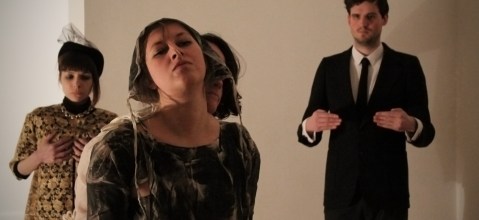
La Mission’s “(p/A)001: A non-Aristotelian Drama in Five Acts,” 2013, Image by Julien Barret
Lost: Choirboy (in memoriam José Esteban Muñoz)
La Mission
Named after San Francisco’s Latino barrio, La Mission is a satirical utopian doomsday cult, a music label, a queer situationist art-gang, a magazine, and a group of dancers with a very dirty sense of humor. We release music on vinyl, publish DIY ‘zines, and make performance art, aiming to re-politicize genres of dance music that have been important to queer people of color. La Mission’s identity is perhaps best summed up by cult-leader El Jefe’s manifesto-sermon, “The Sermon for the Steps of the Ziggurat in our Hearts,” published in our first La Mission magazine:
La Mission is a Community. La Mission is a Collective. La Mission is a Cult. La Mission is a Situationist Art Gang. La Mission is a Anarcho-Syndicalist terror cell. La Mission is a Family. La Mission is You. La Mission is Us. La Mission is gonna strip you butt nekkid, gonna check all your body cavities, gonna give you a shower, gonna give you a goodie bag, gonna give you a clean sheet and a towel. You at home with us now children, you understand me? You home with us now.

Founders Luis-Manuel, Pablo, and Mandie, caught on film at the performance for LM002, ‘a slow mutiny.'”
La Mission was first formed in 2012, in a small café in the Neukölln district of Berlin. The collective initially began with just three of us—Pablo Roman-Alcalá, Mandie O’Connell and Luis-Manuel Garcia—but like any good charismatic doomsday cult, it quickly expanded to include a broad network of lovers and collaborators, led by a core of four instigators (Johannes Brandis joined us later in the year). After a fundraising run in the fall of 2012 (witness our surrealist fundraising video here), we held our first two performances in the winter and spring of 2013, which involved experimental performance art pieces held in unusual spaces. The performances incorporated music and text from our vinyl EPs and their corresponding ‘zines, which were released at around the same time. These multi-channel productions were also conceptually coherent, with (kunst/WORK)001 introducing La Mission’s “mission” and (kunst/WORK)002 focusing on the relevance of utopianism to dance music. After a “quiet spell” where we released an out-of-series vinyl record of “lost remixes,” 2014 has been dedicated to preparing the next volume in the series (due in February 2015), which examines the depredations of capitalism, forced austerity, and false scarcity on music.
Hearing José
La Mission has no idols, but we do have influences—and José Esteban Muñoz is foremost among them. We share with Muñoz a focus on queer nightlife-worlds, a non-classical take on utopianism, a commitment to intellectual interventions outside of academic channels, and a certain brassy tone of voice. His revival of Ernst Bloch’s notion of a utopia based in real-life struggles was crucial in helping us reconcile revolutionary politics with dancefloor utopianism; or, put differently, Muñoz helped us find the critical politics latent in the queer, brown, sweaty gatherings that form the core of our scene of commitment. As “EDM” continues to blow up into a primarily white, hetero, cis, mainstream phenomenon, his insights have helped us maintain clarity and critical focus.
From the outset, we have also been profoundly influenced by Muñoz’s lifelong theorizations of brownness, affect, and (dis)identification. Since three of our four core members are Latina/os in varying states of stripped identity, we have been especially interested in Muñoz’s notion of the “brown commons,” as he was developing the concept in the last years of his life. In promotional texts that circulated ahead of his speaking engagements on the topic, he described brownness as “an expansive sense of the world, a feeling and being in common that surpasses the limits of the individual and the subject.” Notably, he understands brownness and the brown commons as being shaped not only by suffering and struggle, but also by thriving, providing a pool of resources for a better, more vibrant kind of life.
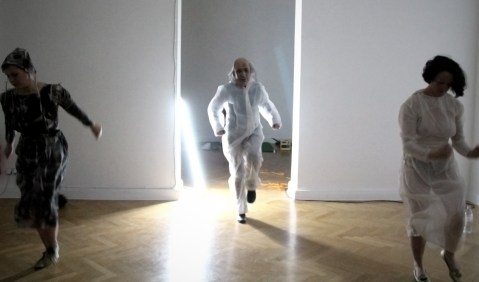
La Mission, (p/A)001: A non-Aristotelian Drama in Five Acts, 2013, Image by Julien Barret
The significance for La Mission’s project in dance music culture should be clear already, but we also take great inspiration in how Muñoz developed an expansive view of brownness and the brown commons, using Latina/o experience as an entry-point for “a vaster consideration of the ways in which people and things suffer and experience harm under the duress of local and global forces that attempt to diminish their vitality and degrade their value.” We here at La Mission are committed to exploring brownness for its potentials for lateral solidarities among people of color, who may have diverse cultural backgrounds but nonetheless share post-migrant experiences of struggle, devaluation, displacement, and inauthenticity. In fact, Muñoz’s work was a direct inspiration for the “Brown Corner” in our La Mission ‘zine (a parody of the “ladies’ corner” and “kid’s corner” of American mid-century lifestyle magazines). Published bilingually and featuring post-migrant authors, the Brown Corner reflects on aspects of brownness, as both specific to their contexts and generalizable to a wider “commons” of brown experience. In the process, we hope to highlight shared feelings, narratives, and resources for brown survival in a world of white supremacy.

A hand-drawn re-working of Frieda Kahlo’s own self-portrait, part of the Brown Corner for issue 001 of the La Mission ‘zine.
Singing into the Horizon
Brother Muñoz, what are we supposed to do with the vinyl records, the zines, the performance videos we had been accumulating for you? We’re trying to sing our way into a queer utopian horizon, and we had been counting on your voice. We know you’re not coming back. As a radical lefty utopian doomsday cult, we’re not so invested in the afterlife, anyway. But it still sucks for us and everyone else you left behind, left in the “here and now” that we struggle to turn into something less suffocating. The party was just getting started, dammit. Besides, we had such a kickass choirboy outfit picked out for you.
—
LUIS-MANUEL GARCIA aka “LMGM”: LMGM/Luis-ManuelLMGM/Luis-Manuel is a Canadian of Peruvian-Colombian origins, currently an Assistant Professor in Popular Music at the University of Groningen (NL), after migrating between Toronto, Berlin, Chicago, and Paris. He has managed to turn his love of electronic dance music into a PhD in Ethnomusicology at the University of Chicago, and into post-doctoral fellowships at the Max Planck Institute for Human Development and the Freie Universität Berlin. On the side, he writes about food and dances every chance he gets.
—

“Portrait of La Mission” by Ben Hammond, who has not seen any of its members naked
Muñoz & La Mission: A Sermon for the Imagined Sanctuary We Built Together
Welcome. La Mission is a family. A family of chosen comrades, chosen brethren, chosen hermanos, chosen сестры, chosen lovers, chosen students, chosen teachers, and chosen arms. Arms, linked and brandished through common thought, common feeling, common goals. It is with a heavy heart that we find ourselves here, remembering one of our family who (though never officially an acolyte or collaborator) was one who contributed to the ecstasy that we have felt and will feel for many years. José Esteban Muñoz was said to be a believer. Ernst Bloch and the New Revolutionary Epoch. Our utopias were described and imagined and realized and experienced. Rise up, my brown brethren, and let us celebrate Brother Muñoz’s legacy!

La Mission’s “(p/A)001: A non-Aristotelian Drama in Five Acts,” 2013, Image by Julien Barnet
The words and deeds of this fellow freedom-fighter, who infiltrated the bourgeois güero academy and infected it with a polylateral program for de- and reprogramming, has been our parallel and our inspiration. Colleague and comrade. A representative of our struggle. Not quite a patron saint—that honor we’ve reserved for communarde Louise Michel—but no less a visionary. As queers, as minorities stripped of identity, as angry and happy children in revolt for something better, we must all learn from each other as equals.
Brother Muñoz made utopia political again and located that utopianism in performance. La Mission’s performances bring forth utopias from our queer future through fleeting mindfuck happenings in the present. Through the work of Sister O’Connell and her band of terrorizing miscreants, we present a non-narrative and non-paternalistic path towards redemption, one of our own making. Can I get a “Fuck, yeah!”?

La Mission at Import Projects, 2013
Brother Muñoz loved music and dancing and life-worlds connected by the beat and said, “Take Ecstasy with Me.” He revealed to us the connections between collective dancing and feeling utopian. In his spirit, La Mission’s music strives to bring forth utopia through that ever-lasting beat. Through disassociation and reassociation, through transcendental repetition, and through getting the fuck down! Can I get a “Fuck, yeah!”?
Brother Muñoz believed in learning and critical thinking. Analysis and the great revolutionary trek through the jungle of our critically thinking minds. La Mission’s tracts enact utopia through a constant vomiting out of our recently digested learnings into the baby-bird mouths of those who read them. The brother was also a hilarious motherfucker, and from this we realize that it is not through the shrill screams of egoism disguised as activism that we will prevail. It is through the joy of laughter combined with thought that we will win our bread. Can I get a “Fuck, yeah!”?
Brother Muñoz loved fucking. La Mission’s fucking creates utopias through the ecstatic act in and of itself. If you aint fucking to make yourself a Temporary Autonomous Zone of happiness, then you aint doing it right. Can I get a copulatory “Fuck, yeah!”?
It is not all loss, though. The ideas live on. Caminamos juntos. On the dancefloor. In the reclaimed Torre David skyscraper and the Taller Tupac Amaru collective; in the informal classrooms and the sweaty bedrooms. Our hearts must burst after sagging, our heads must fill after hanging low, and our linked arms will raise! Oh honey, please don’t give your heart to a world system based on exploitation of the luckless, give your heart to US!
—

La Mission at Import Projects, Common Revilings Project, 2013, Image by Julien Barrat
—
All images courtesy of La Mission
—
PABLO ROMAN-ALCALA: Yo. I am Pablo aka “Beaner” aka “Skirtchaser” aka “El Frijolero” etc. I am an internationally working musician and dj who has enjoyed a modicum of success, but who doesn’t like what has happened to the musical landscape vis-a-vis “conservatism” in respect to both Money and Art. I mean the relationship of the two, okay? It sucks. And I want to change it.
—
 REWIND!…If you liked this post, check out:
Karaoke and Ventriloquism: Echoes and Divergences–Karen Tongson and Sarah Kessler
Freedom Back: Sounding Black Feminist History, Courtesy the Artists– Tavia Nyong’o
“New Wave Saved My Life*”-Wanda Alarcon
Share this:

Brasil Ao Vivo!: The Sonic Pleasures of Liveness in Brazilian Popular Culture

 After a rockin’ (and seriously informative) series of podcasts from Leonard J. Paul, a Drrty South banger dropped by SO! Regular Regina Bradley, a screamtastic meditation from Yvon Bonenfant, and a heaping plate of food sounds from Steph Ceraso, our summer Sound and Pleasure series gets even louder with Kaleb Goldschmidt‘s work on live events in Brazil. Brasil Ao Vivo! –-JS, Editor-in-Chief
—
Brazilians pray, cheer and celebrate in public and often in close physical proximity to each other. From the nearly 3 million people that flocked to Copacabana Beach to hear Pope Francis lead a mass in 2013 to the huge crowds that regularly turn out for concerts at Maracanã stadium, Brazilians earn their global reputation for large-scale public events. Of course there is Carnival in Rio de Janeiro and Salvador; the largest LGBT Pride Parade in the world held in São Paulo; and then there is football.
The relationship between large-scale public events and sound hit home as the country reacted to the national team’s humiliating loss to Germany in the semi-final round of the 2014 FIFA World Cup. The world witnessed a different kind of public outpouring as the Brazilian public mourned. Within hours of the initial shock at the lopsided score, images of Brazilian football fans weeping and screaming in the stadium and on the street became a humorous meme with music and sound playing a prominent role. By the next day, most Brazilian football observers were taking pleasure in the public spectacle of weeping fans. With the abundance of images featuring hysteria, videos mocking the intensity of the crying went viral with dramatic musical scores. One observer proclaimed : “essa capacidade de rir de nós mesmos é uma das melhores qualidades”; the capacity to laugh at ourselves is one of our best qualities. That Brazilians express all varieties of emotions and annual passages together in public for everyone to witness, even when they border on campy excess, allow for everyone to feel the pleasures of community and the power of public performance.

“Abschlussfeier Maracana Fifa WM 2014” by Flickr user Marco Verch, CC BY 2.0
All of this led me to believe that such a public culture has an effect on the aesthetics of what performance studies scholar Philip Auslander calls “liveness” in recorded music and related viral media. Auslander argues that the appeal of liveness for television broadcasts, concerts, and other stage performances allows audiences to feel the immediacy of the moment even if the presence of mediation, such as screens and on-air censorship, is obvious. The international spectacle of Brazilians emoting en masse, then, has a direct relationship with Brazilian sonic aesthetics. Nowhere, I argue, is this more prominent than in the (sometimes viral) popularity of live recordings.
That immediacy Auslander speaks of spreads to many aspects of Brazilian popular culture, including the popularity of concert DVDs and albums which are regularly listed among the most popular domestic recordings. In fact, concert records tend to be more popular than the studio albums that inspire the tour. These live albums often carry the designations Ao Vivo, live or MTV Acústico (the equivalent of the Unplugged albums popular in the United States), and they are often recorded in such a way so as to feature the interaction of the crowds. In place of the draw for authenticity (a value that permeates the MTV Unplugged recordings) is the love for community, and for experiencing big emotions together no matter how obviously they are mediated through cameras, microphones and other technology. Through the example of the continued popularity of live albums in Brazil, there is an opening for a different theorization for sounding liveness; in place of celebrating canonic performances and virtuosity, the valorization of liveness in Brazil reinforces the importance of crowds and the so-called “popular classes” at the root of the politicized singer-songwriter genre MPB or Música Popular Brasileira.
The pleasure and preference for live recordings also extends to social media. For meme chasers, a good example of this is Michel Teló’s 2011 hit “Ai Se Eu Te Pego.” The song and video were recorded ao vivo before a crowd dominated by young women. A close listen reveals that sounds of Teló’s female audience members are just as important as his voice even if his voice is only slightly louder in the mix. There is barely a moment in the recording when the audience stops making itself heard; the engineering revels in their presence. This is especially obvious during the opening seconds of the track when Teló and his audience sing “Nossa, nossa / assim você me mata / Ai, se eu te pego / Ai, ai, se eu te pego” [Wow, wow / you kill me like that / Ah, if I could get you / ah, ah, if I could get you] in unison at nearly the same volume in the mix. When the accordion and electric bass (crucial instruments for the song’s forró style) finally enter over the screaming audience, there is a noticeable break in the tension set up by the audience and Teló singing together. Their cries, like those in other live recordings, illustrate Teló’s appeal to the crowd in that moment while also allowing other listeners to imagine themselves there.
Teló’s song went viral (as of this writing, the official version currently has nearly 580 million views on YouTube and over 72 million plays on Spotify), with alternate video versions teaching the song’s dance steps and others highlighting global football stars dancing and singing along to the song. At one point Neymar, the national team’s biggest hope for World Cup victory, sang with Teló in front of a crowd. In general, Teló’s live songs easily outpace his studio recordings in terms of virality, and, I would argue, that a major part of the appeal of “Ai Se Eu Te Pego” is its provenance in a concert setting. It is just as important that the screaming throngs of women are audible as it is for those dance steps to be easy and recognizable. The liveness of the recording is so important, in fact, that the screaming audience appears as sampled snippets in the Pitbull remix. In its viral form, Teló’s song united the popularity of live spectacle with Brazil’s enthusiasm for other live events, merging concert goers with football fans.
The popularity of Teló’s live song is not an isolated incident. Look, for example, at record sales figures for all time. Two are live albums by artists who do not appear elsewhere on the list. Other albums that have sold more than 2 million copies in Brazil alone are by Roberto Carlos (Acústico MTV) and the teen pop/rock duo Sandy and Júnior (As Quatro Estações ao Vivo and Era Uma Vez… Ao Vivo). In 2011, five of the top ten albums in Brazil fit the ao vivo mode with little regard to genre: MPB stars Caetano Veloso and Maria Gadú are there alongside sertanejo artists Paula Fernandes and Luan Santana. In 2012, three of the top 20 best-sellers were live albums. Meanwhile, DVDs of concerts in Brazil continue to be strong sellers. Thus, the communal pleasure palpable on-screen translates to that experienced in the home.

“Eric Clapton – Unplugged” by Flickr user Ian Alexander Martin, CC BY-NC-ND 2.0
Compare this with the status of live records in the United States in the last few years where they have rarely seen any chart success. If anything, liveness continues in YouTube clips and Spotify Sessions but not in physical sales and downloads. This is probably because live albums for U.S. based artists are embedded with different values having to do with the rock authenticity rather than communal pleasure. These performances demonstrate the chops of the musician and valorize the concerts (and tours) as events. The double live albums from the 1970s such as as Frampton Comes Alive, Lynyrd Skynyrd’s One More From The Road, and Kiss Alive! hold a prized place in the classic rock canon, often as much for extended guitar solos rather as the screaming throngs of fans. In the late ‘80s and early ’90s live albums, especially MTV Unplugged, re-inscribed a love of liveness through acoustic instruments and songs that reached back into the roots of American popular music. Eric Clapton’s Unplugged (1992) even topped the Billboard album charts and won 6 Grammy awards including Album of the Year while other records such as Nirvana’s MTV Unplugged in New York and U2’s Rattle and Hum were multi-platinum hits. While there is the occasional top-40 live single, these songs are the exception to a genre of that has has moved liveness to YouTube rather than streaming and MP3 markets.
SO! contributor Osvaldo Oyola has noted there is a tension between the efforts recording engineers often go through to make studio recordings sound as immediate as possible, and those that call attention to the recording process. Live records replace the need to sound polished with the need to sound spontaneous, often reveling in mistakes and banter. That immediacy is something I enjoy when listening to live recordings and it has a parallel for many people who participate in the reception of major events in real time through social media.
In Brazil, audiences enjoy the immense power of participation in live events. As part of a larger work in progress I’m particularly fascinated by how this power and pleasure is mediated through the sonic experience of recordings and viral social media. Whether they are sharing tears over an international football loss or singing along to “Ai Se Eu Te Pego” Brazilians extend Auslander’s liveness by prolonging and replaying the immediacy of the crowds to experience that shared sonic moment, again and again.
—
Kaleb Goldschmitt is a Visiting Lecturer in the Faculty of Music at University of Cambridge. Her scholarly work focuses on Brazilian music, modes of listening, and sonic branding in the global cultural industries. She has published in the Oxford Handbook of Mobile Music Studies, Popular Music and Society, American Music, Yearbook for Traditional Music, and Luso-Brazilian Review and contributes to the South American cultural magazine, Sounds and Colours.
—
Featured image: Adapted from “Gloria” by Flickr user Lourenço Fabrino, CC BY-NC-SA 2.0
—
 REWIND! . . .If you liked this post, you may also dig:
Sound-politics in São Paulo, Brazil— Leonardo Cardoso
Calling Out To (Anti)Liveness: Recording and the Question of Presence–Osvaldo Oyola
Hello, Americans: Orson Welles, Latin America, and the Sounds of the “Good Neighbor“– Tom McEnaney
Share this:


Current Top Posts





April 2021

January 2020

November 2019

October 2019

August 2019

April 2014

November 2017

March 2015

December 2017

October 2015
 Sounding Out!
Recent Comments