
The Cyborg’s Prosody, or Speech AI and the Displacement of Feeling
In summer 2021, sound artist, engineer, musician, and educator Johann Diedrick convened a panel at the intersection of racial bias, listening, and AI technology at Pioneerworks in Brooklyn, NY. Diedrick, 2021 Mozilla Creative Media award recipient and creator of such works as Dark Matters, is currently working on identifying the origins of racial bias in voice interface systems. Dark Matters, according to Squeaky Wheel, “exposes the absence of Black speech in the datasets used to train voice interface systems in consumer artificial intelligence products such as Alexa and Siri. Utilizing 3D modeling, sound, and storytelling, the project challenges our communities to grapple with racism and inequity through speech and the spoken word, and how AI systems underserve Black communities.” And now, he’s working with SO! as guest editor for this series (along with ed-in-chief JS!). It kicked off with Amina Abbas-Nazari’s post, helping us to understand how Speech AI systems operate from a very limiting set of assumptions about the human voice. Then, Golden Owens took a deep historical dive into the racialized sound of servitude in America and how this impacts Intelligent Virtual Assistants. Last week, Michelle Pfeifer explored how some nations are attempting to draw sonic borders, despite the fact that voices are not passports. Today, Dorothy R. Santos wraps up the series with a meditation on what we lose due to the intensified surveilling, tracking, and modulation of our voices. [To read the full series, click here] –JS
—
In 2010, science fiction writer Charles Yu wrote a story titled “Standard Loneliness Package,” where emotions are outsourced to another human being. While Yu’s story is a literal depiction, albeit fictitious, of what might be entailed and the considerations that need to be made of emotional labor, it was published a year prior to Apple introducing Siri as its official voice assistant for the iPhone. Humans are not meant to be viewed as a type of technology, yet capitalist and neoliberal logics continue to turn to technology as a solution to erase or filter what is least desirable even if that means the literal modification of voice, accent, and language. What do these actions do to the body at risk of severe fragmentation and compartmentalization?
I weep.
I wail.
I gnash my teeth.
Underneath it all, I am smiling. I am giggling.
I am at a funeral. My client’s heart aches, and inside of it is my heart, not aching, the opposite of aching—doing that, whatever it is.
Charles Yu, “Standard Loneliness Package,” Lightspeed: Science Fiction & Fantasy, November 2010
Yu sets the scene by providing specific examples of feelings of pain and loss that might be handed off to an agent who absorbs the feelings. He shows us, in one way, what a world might look and feel like if we were to go to the extreme of eradicating and off loading our most vulnerable moments to an agent or technician meant to take on this labor. Although written well over a decade ago, its prescient take on the future of feelings wasn’t too far off from where we find ourselves in 2023. How does the voice play into these connections between Yu’s story and what we’re facing in the technological age of voice recognition, speech synthesis, and assistive technologies? How might we re-imagine having the choice to displace our burdens onto another being or entity? Taking a cue from Yu’s story, technologies are being created that pull at the heartstrings of our memories and nostalgia. Yet what happens when we are thrust into a perpetual state of grieving and loss?
Humans are made to forget. Unlike a computer, we are fed information required for our survival. When it comes to language and expression, it is often a stochastic process of figuring out for whom we speak and who is on the receiving end of our communication and speech. Artist and scholar Fabiola Hanna believes polyvocality necessitates an active and engaged listener, which then produces our memories. Machines have become the listeners to our sonic landscapes as well as capturers, surveyors, and documents of our utterances.
The past few years may have been a remarkable advancement in voice tech with companies such as Amazon and Sanas AI, a voice recognition platform that allows a user to apply a vocal filter onto any human voice, with a discernible accent, that transforms the speech into Standard American English. Yet their hopes for accent elimination and voice mimicry foreshadow a future of design without justice and software development sans cultural and societal considerations, something I work through in my artwork in progress, The Cyborg’s Prosody (2022-present).
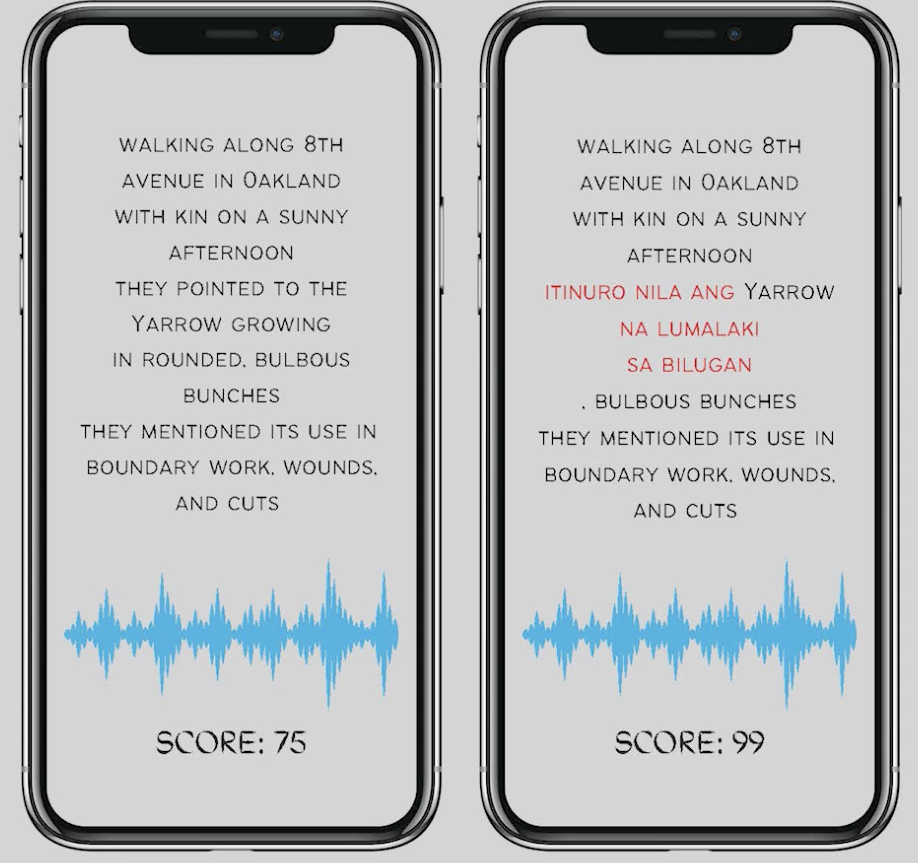
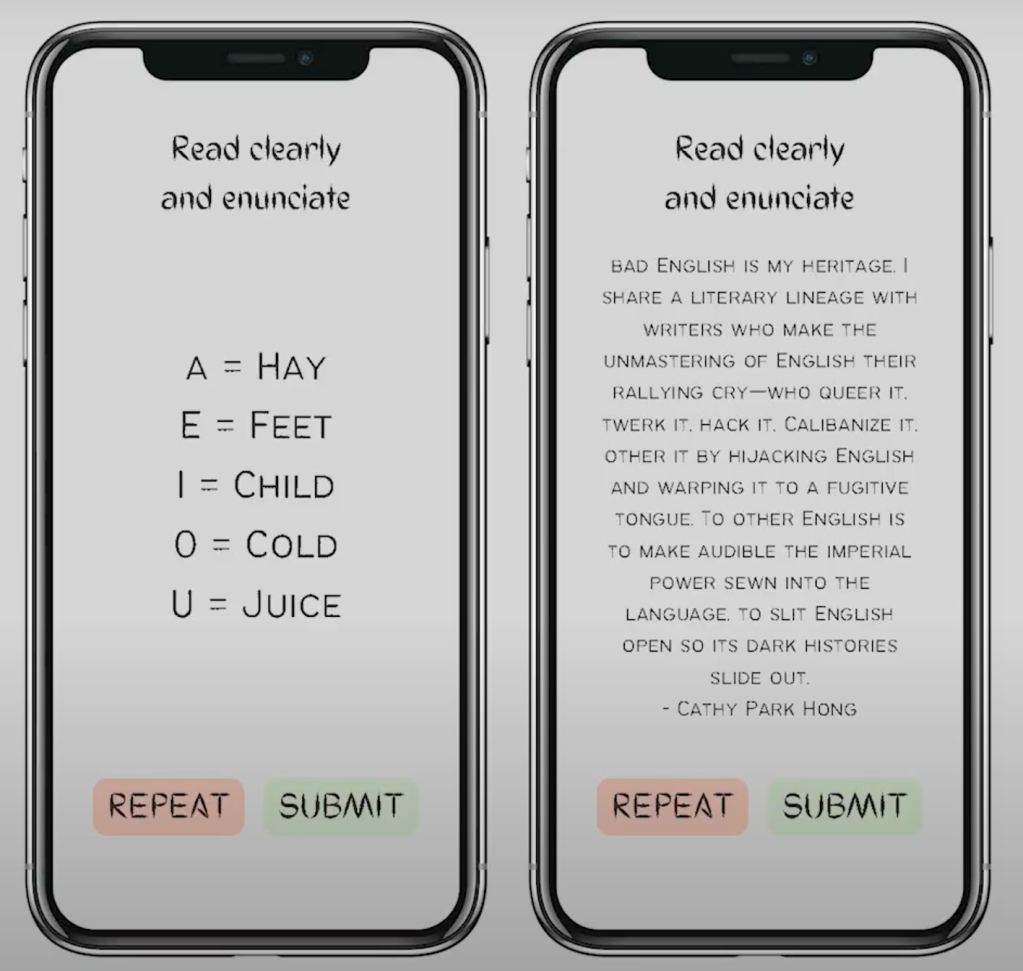
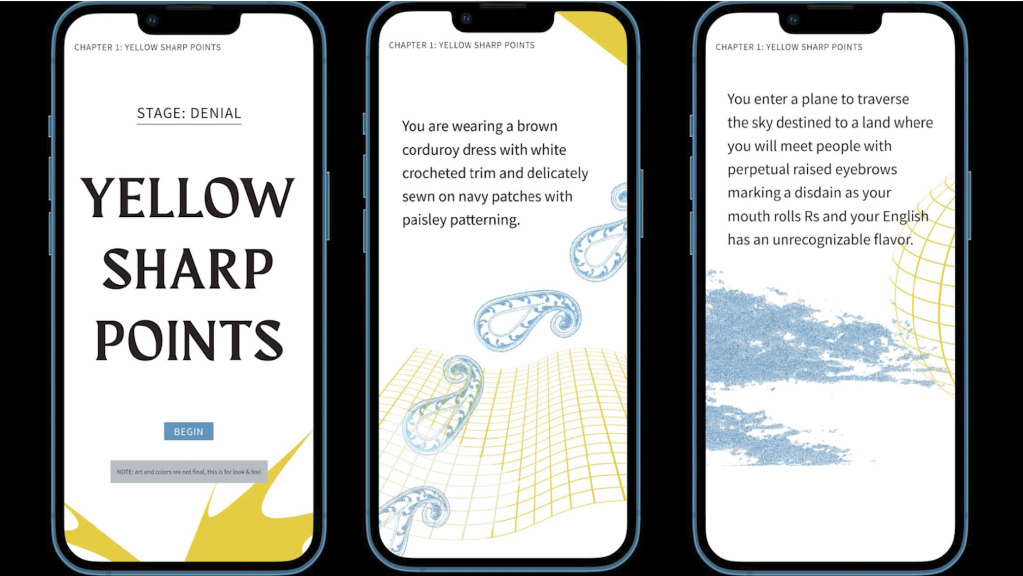
The Cyborg’s Prosody is an interactive web-based artwork (optimized for mobile) that requires participants to read five vignettes that increasingly incorporate Tagalog words and phrases that must be repeated by the player. The work serves as a type of parody, as an “accent induction school” — providing a decolonial method of exploring how language and accents are learned and preserved. The work is a response to the creation of accent reduction schools and coaches in the Philippines. Originally, the work was meant to be a satire and parody of these types of services, but shifted into a docu-poetic work of my mother’s immigration story and learning and becoming fluent in American English.
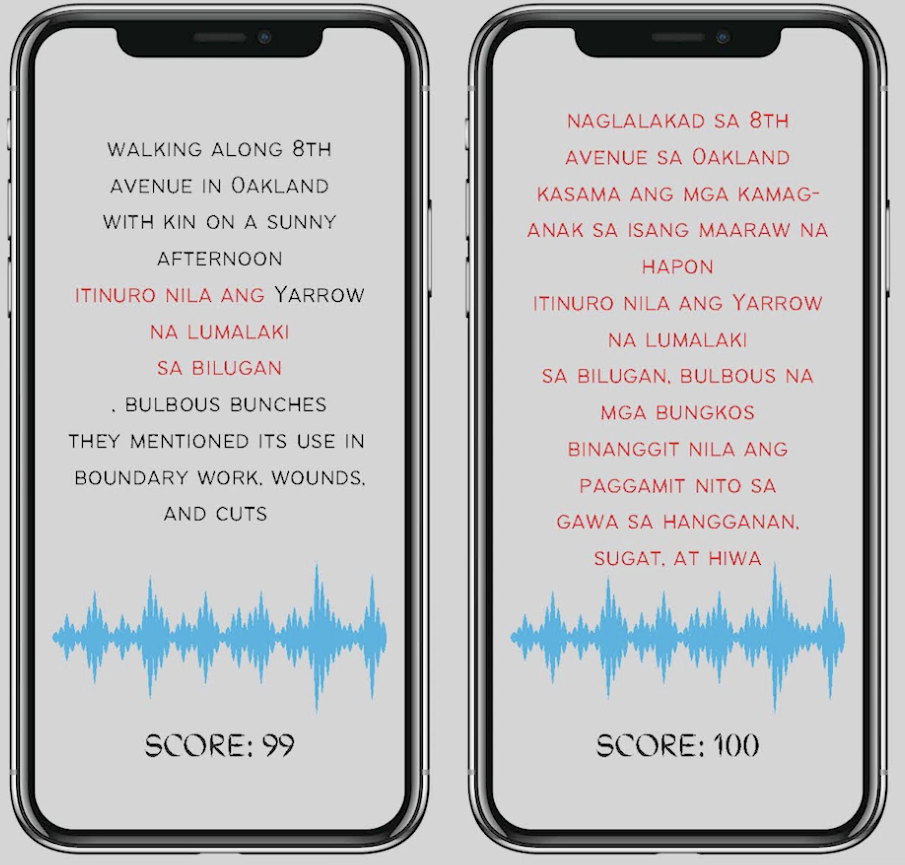
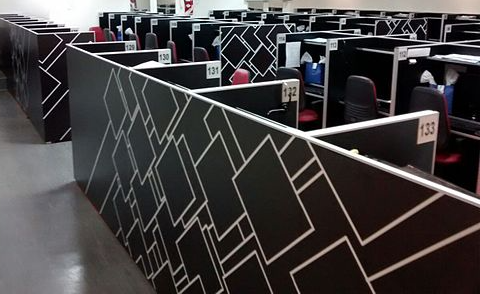
Even though English is a compulsory language in the Philippines, it is a language learned within the parameters of an educational institution and not common speech outside of schools and businesses. From the call center agents hired at Vox Elite, a BPO company based in the Philippines, to a Filipino immigrant navigating her way through a new environment, the embodiment of language became apparent throughout the stages of research and the creative interventions of the past few years.
In Fall 2022, I gave an artist talk about The Cyborg’s Prosody to a room of predominantly older, white, cisgender male engineers and computer scientists. Apparently, my work caused a stir in one of the conversations between a small group of attendees. A couple of the engineers chose to not address me directly, but I overheard a debate between guests with one of the engineers asking, “What is her project supposed to teach me about prosody? What does mimicking her mom teach me?” He became offended by the prospect of a work that de-centered his language, accent, and what was most familiar to him.The Cyborg’s Prosody is a reversal of what is perceived as a foreign accented voice in the United States into a performance for both the cyborg and the player. I introduce the term western vocal drag to convey the caricature of gender through drag performance, which is apropos and akin to the vocal affect many non-western speakers effectuate in their speech.
The concept of western vocal drag became a way for me to understand and contemplate the ways that language becomes performative through its embodiment. Whether it is learning American vernacular to the complex tenses that give meaning to speech acts, there is always a failure or queering of language when a particular affect and accent is emphasized in one’s speech. The delivery of speech acts is contingent upon setting, cultural context, and whether or not there is a type of transaction occurring between the speaker and listener. In terms of enhancement of speech and accent to conform to a dominant language in the workplace and in relation to global linguistic capitalism, scholar Vijay A. Ramjattan states in that there is no such thing as accent elimination or even reduction. Rather, an accent is modified. The stakes are high when taking into consideration the marketing and branding of software such as Sanas AI that proposes an erasure of non-dominant foreign accented voices.
The biggest fear related to the use of artificial intelligence within voice recognition and speech technologies is the return to a Standard American English (and accent) preferred by a general public that ceases to address, acknowledge, and care about linguistic diversity and inclusion. The technology itself has been marketed as a way for corporations and the BPO companies they hire to mind the mental health of the call center agents subjected to racism and xenophobia just by the mere sound of their voice and accent. The challenge, moving forward, is reversing the need to serve the western world.
A transorality or vocality presents itself when thinking about scholar April Baker-Bell’s work Black Linguistic Consciousness. When Black youth are taught and required to speak with what is considered Standard American English, this presents a type of disciplining that perpetuates raciolinguistic ideologies of what is acceptable speech. Baker-Bell focuses on an antiracist linguistic pedagogy where Black youth are encouraged to express themselves as a shift towards understanding linguistic bias. Deeply inspired by her scholarship, I started to wonder about the process for working on how to begin framing language learning in terms of a multi-consciousness that includes cultural context and affect as a way to bridge gaps in understanding.
Or, let’s re-think this concept or idea that a bad version of English exists. As Cathy Park Hong brilliantly states, “Bad English is my heritage…To other English is to make audible the imperial power sewn into the language, to slit English open so its dark histories slide out.” It is necessary for us all to reconfigure our perceptions of how we listen and communicate that perpetuates seeking familiarity and agreement, but encourages respecting and honoring our differences.
—
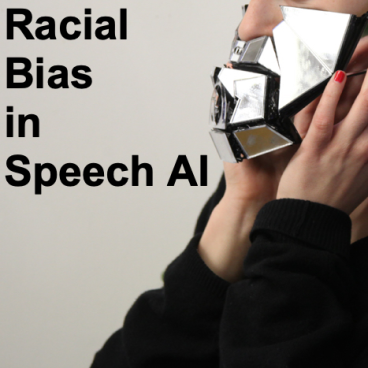
Featured Image: Still from artist’s mock-up of The Cyborg’s Prosody(2022-present), copyright Dorothy R. Santos
—
Dorothy R. Santos, Ph.D. (she/they) is a Filipino American storyteller, poet, artist, and scholar whose academic and research interests include feminist media histories, critical medical anthropology, computational media, technology, race, and ethics. She has her Ph.D. in Film and Digital Media with a designated emphasis in Computational Media from the University of California, Santa Cruz and was a Eugene V. Cota-Robles fellow. She received her Master’s degree in Visual and Critical Studies at the California College of the Arts and holds Bachelor’s degrees in Philosophy and Psychology from the University of San Francisco. Her work has been exhibited at Ars Electronica, Rewire Festival, Fort Mason Center for Arts & Culture, Yerba Buena Center for the Arts, and the GLBT Historical Society.
Her writing appears in art21, Art in America, Ars Technica, Hyperallergic, Rhizome, Slate, and Vice Motherboard. Her essay “Materiality to Machines: Manufacturing the Organic and Hypotheses for Future Imaginings,” was published in The Routledge Companion to Biology in Art and Architecture. She is a co-founder of REFRESH, a politically-engaged art and curatorial collective and serves as a member of the Board of Directors for the Processing Foundation. In 2022, she received the Mozilla Creative Media Award for her interactive, docu-poetics work The Cyborg’s Prosody (2022). She serves as an advisory board member for POWRPLNT, slash arts, and House of Alegria.
—

REWIND! . . .If you liked this post, you may also dig:
Your Voice is (Not) Your Passport—Michelle Pfeifer
“Hey Google, Talk Like Issa”: Black Voiced Digital Assistants and the Reshaping of Racial Labor–Golden Owens
Beyond the Every Day: Vocal Potential in AI Mediated Communication –Amina Abbas-Nazari
Voice as Ecology: Voice Donation, Materiality, Identity–Steph Ceraso
The Sound of What Becomes Possible: Language Politics and Jesse Chun’s 술래 SULLAE (2020)—Casey Mecija
Look Who’s Talking, Y’all: Dr. Phil, Vocal Accent and the Politics of Sounding White–Christie Zwahlen
Listening to Modern Family’s Accent–Inés Casillas and Sebastian Ferrada
Share this:

“Hey Google, Talk Like Issa”: Black Voiced Digital Assistants and the Reshaping of Racial Labor
.
In summer 2021, sound artist, engineer, musician, and educator Johann Diedrick convened a panel at the intersection of racial bias, listening, and AI technology at Pioneerworks in Brooklyn, NY. Diedrick, 2021 Mozilla Creative Media award recipient and creator of such works as Dark Matters, is currently working on identifying the origins of racial bias in voice interface systems. Dark Matters, according to Squeaky Wheel, “exposes the absence of Black speech in the datasets used to train voice interface systems in consumer artificial intelligence products such as Alexa and Siri. Utilizing 3D modeling, sound, and storytelling, the project challenges our communities to grapple with racism and inequity through speech and the spoken word, and how AI systems underserve Black communities.” And now, he’s working with SO! as guest editor for this series (along with ed-in-chief JS!). It kicked off with Amina Abbas-Nazari’s post, helping us to understand how Speech AI systems operate from a very limiting set of assumptions about the human voice. Today Golden Owens explored what happens when companies sell Black voices along with their Intelligent Virtual Assistants. Tune in for a deep historical dive into the racialized sound of servitude in America. Even though corporations aren’t trying to hear this absolutely critical information–or Black users in general–they better listen up. –JS
—
In October 2019, Google released an ad for their Google Assistant (GA), an intelligent virtual assistant (IVA) that initially debuted in 2016. As revealed by onscreen text and the video’s caption, the ad’s announced that the GA would soon have a new celebrity voice. The ten-second promotion includes a soundbite from this unseen celebrity—who states: “You can still call me your Google Assistant. Now I just sound extra fly”— followed by audio of the speaker’s laughter, a white screen, the GA logo, and a written question: “Can you guess who it is?”
Consumers quickly speculated about the person behind the voice, with many posting their guesses on Reddit. The earliest comments named Tiffany Haddish, Lizzo, and Issa Rae as prospects, with other users affirming these guesses. These women were considered the most popular contenders: two articles written about the new GA voice cited the Reddit post, with one calling these women Redditors’ most popular guesses and the other naming only them as users’ desired choices. Those who guessed Rae were proven correct. One day after the ad, Google released a longer promo revealing her as the GA’s new voice, including footage of Rae recording responses for the assistant. The ad ends with Rae repeating the “extra fly” line from the initial promo, smiling into the camera.
Google’s addition of Rae as an IVA voice option is one of several recent examples of Black people’s voices employed in this manner. Importantly, this trend toward Black-voiced IVAs deviates from the pre-established standard of these digital aides. While there are many voice options available, the default voices for IVAs are white female voices with flat dialects. This shift toward Black American voices is notable not only because of conversations about inclusion—with some Black users saying they feel more represented by these new voices—but because this influx of Black voices marks a spiritual return to the historical employment of Black people as service-providing, labor-performing entities in the United States, thus subliminally reinforcing historical biases about Black people as uniquely suited for performing this type of work.
Marketed as labor-saving devices, IVAs are programmed to assist with cooking and grocery shopping, transmit messages and reminders, and provide entertainment, among other tasks. Since the late 2010s they have also been able to operate other technologies within users’ homes: Alexa, for example, can control Roomba robotic vacuums; IVA-compatible smart plugs or smart home devices enable IVAs to control lights, locks, thermostats, and other such apparatuses. Behaviorally, IVAs are designed and expected to be on-call at all times, but not to speak or act out of turn—with programmers often directed to ensure these aides are relatable, reliable, trustworthy, and unobtrusive.
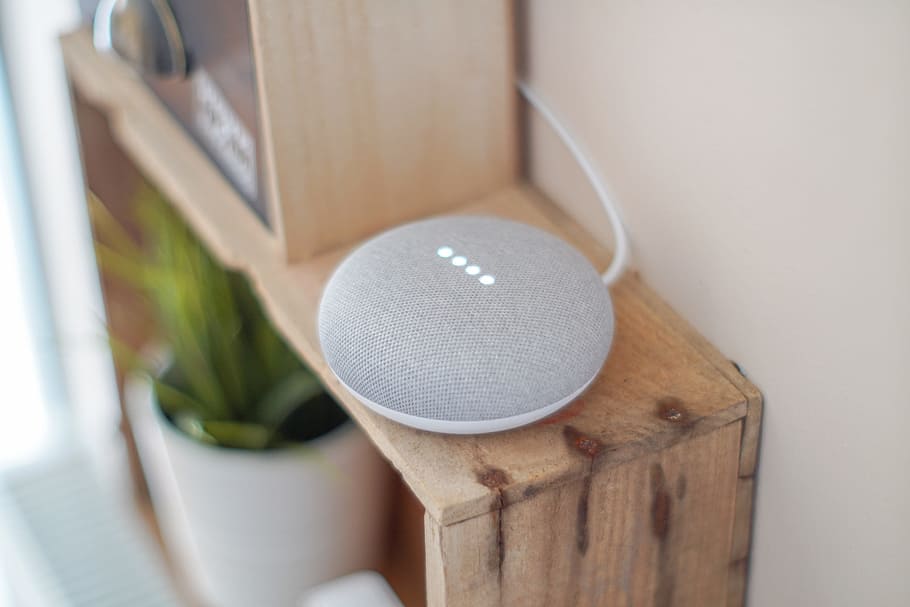
Far from operating in a vacuum, IVAs eerily evoke the presence of and parameters set for enslaved workers and domestic servants in the U.S.—many of whom have historically been Black American women. Like IVAs, Black women servants cooked, cleaned, entertained children, and otherwise served their (predominantly white) employers, themselves operating as labor-saving devices through their performance of these labors. Employers similarly expected these women to be ever-available, occupy specific areas of the home, and obey all requests and demands—and were unsettled if not infuriated when maids did not behave according to their expectations.
White women being the default voices of IVAs has somewhat obfuscated the degree to which these aides have re-embodied and replaced the Black servants who once predominantly executed this work, but incorporating Black voices into these roles removes this veil, symbolically re-implementing Black people as labor-performing entities by having them operate as the virtual assistants who now perform much of the labor Black workers historically performed. Enabling Black people to be used as IVAs thus re-aligns Black beings with the performance of service and labor.

While Black women were far from the only demographic conscripted into domestic labor, by the 1920s they comprised a “permanent pool of servants” throughout the country, due largely to the egress of white American and immigrant women from domestic service into fields that excluded Black women (183). Black women’s prominence in domestic service was heavily reflected in early U.S. media, which overwhelmingly portrayed domestic servants not just as Black women, but as Black Mammies—domestic servant archetypes originally created to promote the myth that Black women “were contented, even happy as slaves.” Characters like Gone with the Wind’s “Mammy” pulled both from then-current associations of Black women with domestic labor and from white nostalgia for the Antebellum era, and specifically for the archetypal Mammy—marking Black women as idealized labor-performing domestics operating in service of white employers. These on-screen servants were “always around when the boss needed them…[and] always ready to lend a helping hand when times were tough” (36). Historian Donald Bogle dubbed this era of Hollywood the “Age of the Negro Servant,” referenced in this reel from the New York Times.
—-
.
Cinema and television merely built from years of audible racism on the radio—America’s most prominent form of in-home entertainment in the first half of the 20th century—where Black actors also played largely servant and maid roles that demanded they speak in “distorted dialect, exaggerated intonation, rhythmic speech cadences, and particular musical instruments” in order to appear at all (143). This white-contrived portrayal of Black people is known as “Blackvoice,” and essentially functions as “the minstrel show boiled down to pure aurality” (14). These performances allowed familiar ideals of and narratives about Blackness to be communicated and recirculated on a national scale, even without the presence of Black bodies. Labor-performing Black characters like Beulah, Molasses and January, Aunt Jemima, and Amos and Andy were prominent in the Golden Age of Radio, all initially voiced by white actors. In fact, Aunt Jemima’s print advertising was just as dependent on stereotypical representations of her voice as it was on visual “Mammy” imagery.

When Black actors broke through white exclusion on the airwaves, many took over roles once voiced by white men and/or were forced by white radio producers and scriptwriters to “‘talk as white people believed Negroes talked’” so that white audiences could discern them as Black (371). This continuous realignment undoubtedly informs contemporary ideas of labor, labor performance, and laboring bodies, further promoted by the sudden influx of Black voice assistants in 2019.
Specifically, these similarities demonstrate that contemporary IVAs are intrinsically haunted by Black women slaves and servants: built in accordance with and thus inevitably evoking these laborers in their positioning, programming, and task performance. Further facilitating this alignment is the fact that advertisements for Black-voiced IVAs purposefully link well-known Black bodies in conjunction with their Black voices. Excepting Apple’s Black-sounding voice options for Siri, all of the Black IVA voice options since 2019 have belonged to prominent Black American celebrities. Prior to Issa Rae, GA users could employ John Legend as their digital aide (April 2019 until March 2020). Samuel L. Jackson became the first celebrity voice option for Amazon’s Alexa in December 2019, followed by Shaquille O’Neal in July 2021.
The ads for Black-voiced IVAs thus link these disembodied aides not just to Black bodies, but to specific Black bodies as a sales tactic—bodies which signify particular images and embodiments of Blackness. The Samuel L. Jackson Alexa ad utilizes close-ups of Jackson recording lines for the IVA and of Echo speakers with Jackson’s voice emitting from them in response to users. John Legend is physically absent from the ad announcing him as the GA; however, his celebrity wife directs the GA to sing for her instead, after which she states that it is “just like the real John”—thus linking Legend’s body to the GA even without his onscreen presence. Amazon has even explicitly explored the connection between the Black-voiced IVA and the Black body, releasing a 2021 commercial called “Alexa’s Body” that saw Alexa voiced and physically embodied by Michael B. Jordan—with the main character in the commercial insinuating that he is the ideal vessel for Alexa.
By aligning these bodies with, and having them act as, labor-performing devices in service of consumers, these advertisements both re-align Blackness with labor and illuminate how these devices were always already haunted by laboring Black bodies—and especially, given the demographics of the bodies who most performed the types of labors IVAs now execute, laboring Black women’s bodies. That the majority of the Black celebrities employed as Black IVA voices are men suggests some awareness of and attempt to distance from this history and implicit haunting—an effort which itself exposes and illuminates the degree to which this haunting exists.
In some cases, the Black people lending their voices to these IVAs also speak in a way that sonically suggests Blackness: Issa Rae’s “Now I’m just extra fly,” for example, incorporates Black American slang through the use of the word “fly. As part of African American Vernacular English (AAVE), the term “fly” dates back to the 1970s and denotes coolness, attractiveness, and fashionableness. Because of its inclusion in Hip Hop, which has become the dominant music genre in the United States, the term, its meaning, and its racial origins are widely known amongst consumers. By using the word “fly,” Rae nods not only at these qualities but also at her own Blackness in a manner that is recognizable to a mainstream American audience. Due in part to Hip Hop’s popularity, U.S.-based media outlets, corporations, and individuals of varying races and ethnicities regularly appropriate AAVE and Black slang terms, often without regard for the culture that created them or the vernacular they stem from. The ad preceding Issa Rae’s revelation as the GA specifically invited users to align the voice with a celebrity body, and users’ predominant claims that the voice was a Black woman’s suggest that something about the voice conjured Blackness and the Black female body.

This racial marking was also likely facilitated by how people naturally listen and respond to voices. As Nina Sun Eidsheim notes in The Race of Sound, “voices heard are ultimately identified, recognized, and named by listeners at large. In hearing a voice, one also brings forth a series of assumptions about the nature of voice” (12). This series of assumptions, Eidsheim asserts in “The Voice as Action,” is inflected by the “multisensory context” surrounding a given voice, i.e., “a composite of visual, textural, discursive, and other kinds of information” (9). While we imagine our impressions of voices as uniquely meaningful, “we cannot but perceive [them] through filters generated by our own preconceptions” (10). As a result, listening is never a neutral or truly objective practice.
For many consumers, these filters are informed by what Jennifer Lynn Stoever terms the sonic color line, “a socially constructed boundary that racially codes sonic phenomena such as vocal timbre, accents, and musical tones” (11). Where the racial color line allows white people to separate themselves from Black people on the basis of visual and behavioral differences, the sonic color line allows people “to construct and discern racial identities based on voices, sounds, and particular soundscapes” and to assign nonwhite voices with “differential cultural, social, and political value” (11). In the U.S., the sonic color line operates in tandem with the American listening ear, which “normalizes the aural tastes and standards of white elite masculinity as the singular way to interpret sonic information” (13) and therefore marks-as-Other not only the voices and bodies of Black people, but also those of non-males and the non-elite.

Ironically, the very listening practices which make consumers register particular voices and vocal qualities as Black also make Black voices inaccessible to Alexa and other IVAs. Scholarship on Automated Speech Recognition (ASR) systems and Speech AI observes that many Black users find it necessary to code-switch when speaking to IVAs, as the devices fail to comprehend their linguistic specificities. A study by Christina N. Harrington et al. in which Black elders used the Google Home to seek health information discovered that “participants felt that Google Home struggles to understand their communication style (e.g., diction or accent) and language (e.g., dialect) specifically due to the device being based on Standard English” (15). To address these struggles, participants switched to Standard American English (SAE), eliminating informal contractions and changing their tone and verbiage so that the GA would understand them. As one of the study’s participants states,
You do have to change your words. Yes. You do have to change your diction and yes, you have to use… It cannot be an exotic name or a name that’s out of the Caucasian round. …You have to be very clear with the English language. No ebonic (15).
This incomprehension extends to Black Americans of all ages, and to other IVAs. A study by Allison Koenecke et al. on ASR systems produced by Amazon, Google, IBM, Microsoft and Apple discovered that these entities had a harder time accurately transcribing Black speech than white speech, producing “an average word error rate (WER) of 0.35 for black speakers compared with 0.19 for white speakers.” (7684). A study by Zion Mengesha et al. on the impact of these errors on Black Americans—which included participants from different regions with a range of ages, genders, socioeconomic backgrounds and education-levels—discovered that many felt frustrated and othered by these mistakes, and felt further pressure to code-switch so that they would not be misunderstood. Koenecke et al. concluded that ASR systems could not understand the “phonological, phonetic, or prosodic characteristics of” AAVE (7687), and that this ignorance would make the use of these technologies more difficult for Black users—a sentiment that was echoed by participants in the study conducted by Mengesha et al., most of whom marked the technology as working better for white and/or SAE speakers (5).
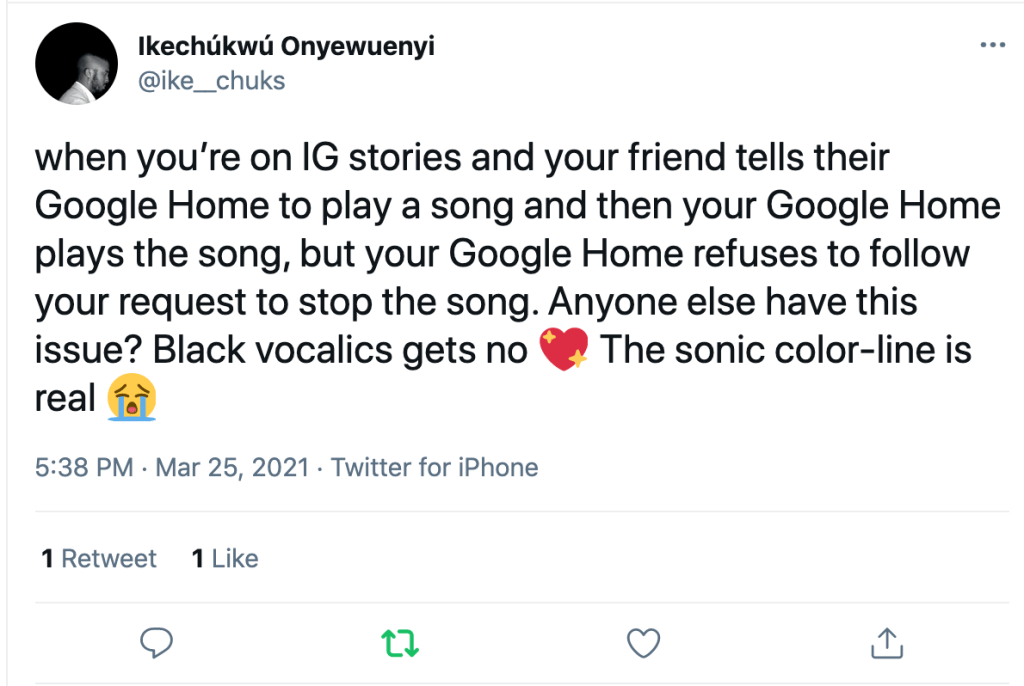
The speech recognition errors these technologies demonstrate—which also extend to speakers in other racial and ethnic groups—illuminate the reality that despite including Black voices as IVAs, these assistant technologies are not truly built for Black people, or for any person that does not speak Standard American English. And where AAVE is largely associated with Blackness, SAE is predominantly associated with whiteness: as a dialect widely perceived to be “lacking any distinctly regional, ethnic, or socioeconomic characteristics,” it is recognized as being “spoken by the majority group or the socially advantaged group” in the United States—both groups which are solely or primarily composed of white people. SAE is so identified with whiteness that Black people who only speak Standard English are often told that they sound and/or “talk” white, and Black people who deliberately invoke SAE in professional and/or interracial settings (i.e., code switching) are described as “talking white” or using their “white voice” when doing so. That IVAs and other ASR systems have such trouble understanding AAVE and other non-standard English dialects suggests that these technologies were not designed to understand any dialect other than SAE—and thus, given SAE’s strong identification with whiteness, were designed specifically to assist, understand, and speak to white users.
Writing on this phenomena as a woman with a non-standard accent, Sinduja Rangarajan highlights in “Hey Siri—Why Don’t You Understand More People Like Me?” that none of the IVAs currently on the market offer any American dialect that is not SAE. And while users can change their IVA’s accents, they are limited to Standard American, British, Irish, Australian, Indian, and South African—which Rangarajan rightly highlights as revealing who the IVAs think they are talking to, rather than who their user actually is. That most of these accents belong to Western, predominantly white countries (or to countries once colonized by white imperialists) strongly suggests that these devices are programmed to speak to—and perform labor for—white consumers specifically.
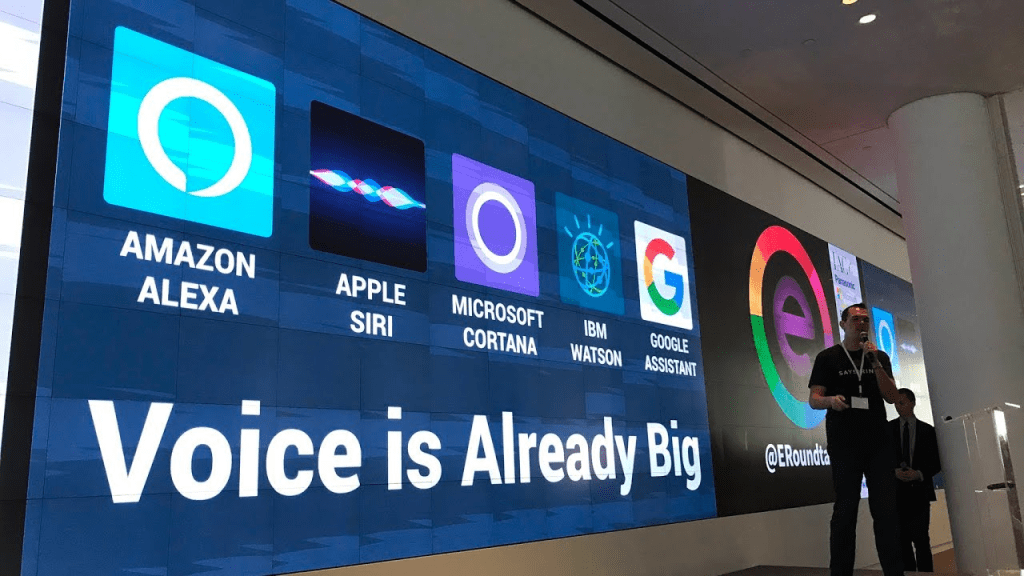
When considering the primary imagined and target users of IVAs, the sudden influx of Black-voiced IVAs becomes particularly insidious. Though they may indeed make some Black users feel more represented, cultivating this representation is merely a byproduct of their actual purpose. Because these technologies are not built for Black consumers, Black-voiced IVAs are meant to appeal not to Black users, but to white ones. Rae, Jackson, and the other Black celebrity voices may provide a much-needed variety in the types of voices applied to IVAs, but they primarily operate as “further examples of technology companies using Black voices to entertain white consumers while ignoring Black consumers.” Black-voiced assistants, after all, no better understand Black vernacular English than any of the other voice options for IVAs, a reality marking Black speech patterns as enjoyable but not legitimate.
By excluding Black consumers, the companies behind these IVAs insinuate that Blackness is only acceptable and worthy of consideration when operating in service of whiteness. Where Black people as consumers have been delegitimized and disregarded, Black voices as labor-saving assistants have been welcomed and deemed profitable—a reality which further emphasizes how historical constructions of Black people as labor-performing devices haunts these contemporary technologies. Tech companies reinforce historical positionings of white people as ideal consumers and Black people as consumable products—repeating historical demarcations of Blackness and whiteness in the present.
In imagining the futures of IVAs, the companies behind them would need to reconsider how they interact—or fail to interact—with Black users. Both Samuel L. Jackson and Shaquille O’Neal, the last of the Black-celebrity-voiced IVAs still currently available to users, will be removed as Alexa voice options by September 2023, presenting an opportunity for these companies to divest. Whether or not the brands behind these IVAs take this initiative, consumers themselves can be critical of how AI technologies continue to reestablish hierarchical systems, of their own interactions with these devices, and of who these technologies are truly made for. In being critical, we can perhaps begin to envision alternative, reparative modes of AI technology—modes that serve and support more than one kind of user.
—
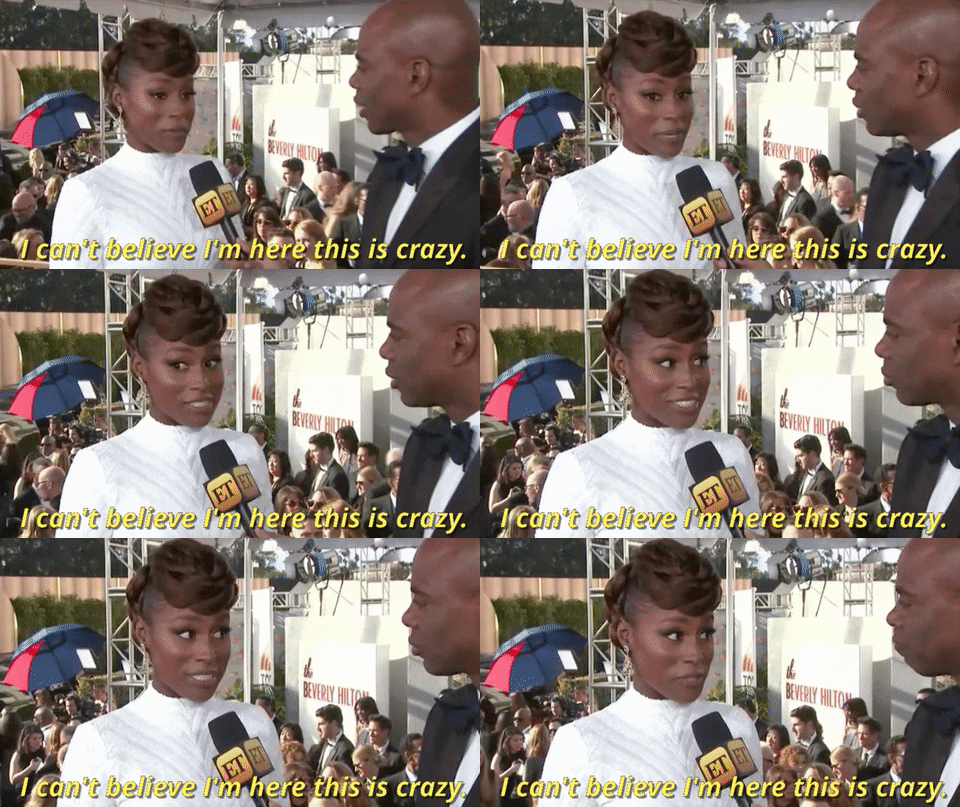
Featured Image: Issa Rae gif from the 2017 Golden Globes
—
Golden Marie Owens is a PhD candidate in the Screen Cultures program at Northwestern University. Her research interests include representations of race and gender in American media and popular culture, artificial intelligence, and racialized sounds. Her doctoral dissertation, “Mechanical Maids: Digital Assistants, Domestic Spaces, and the Spectre(s) of Black Women’s
Labor,” examines how intelligent virtual assistants such as Apple’s Siri and Amazon’s Alexa evoke and are haunted by Black women slaves, servants, and houseworkers in the United States. In her time at Northwestern, she has had internal fellowships through the Office of Fellowships and the Alice Kaplan Institute for the Humanities. She currently holds an MMUF Dissertation Grant through the Institute for Citizens and Scholars and Ford Dissertation Fellowship through the National Academy for Sciences, Engineering, and Medicine.
—
REWIND! . . .If you liked this post, you may also dig:
Beyond the Every Day: Vocal Potential in AI Mediated Communication –Amina Abbas-Nazari
Voice as Ecology: Voice Donation, Materiality, Identity–Steph Ceraso
Mr. and Mrs. Talking Machine: The Euphonia, the Phonograph, and the Gendering of Nineteenth Century Mechanical Speech – J. Martin Vest
Echo and the Chorus of Female Machines—AO Roberts
Black Excellence on the Airwaves: Nora Holt and the American Negro Artist Program —Chelsea Daniel and Samantha Ege
Spaces of Sounds: The Peoples of the African Diaspora and Protest in the United States–Vanessa Valdes
On Whiteness and Sound Studies–Gus Stadler
Share this:


Current Top Posts





April 2021

January 2020

November 2019

October 2019

August 2019

April 2014

November 2017

March 2015

December 2017

October 2015
 Sounding Out!
Recent Comments