
The Noises of Finance
DOI: https://doi.org/10.59350/5v3ds-zzw51
What does finance sound like? Is it the clanging of the opening and closing bells at the New York Stock Exchange? The shouting of offers to buy or sell? The beeps made by cash registers as a credit card is swiped? The whirring of fans working overtime to cool computers? What is this noise?
Noise, however, is not purely a sonic phenomenon. Since the late 1940s, noise has been intimately linked with theories of communication and information, as Aaron Trammell discusses in Sounding Out! posts such as “What Mixtapes Can Teach Us About Noise.” My research attempts to bring these two aspects of noise—the sonic and informatic—into conversation. I trace the interferences noise makes within a set of disparate disciplines: I listen to the history of the impact of information theory on experimental and electronic music; investigate the interferences of “fearless speech,” artistic robotics, and the public; and examine how noises digital and sonic have impacted the development of finance. Rather than creating my own definition of noise, I follow how other disciplines deal with their encounters with noise as both a material phenomenon—something that interferes with a signal, or a sound that is deemed unwanted—and as something to be theorized, asking questions such as what are the meanings of these noises? or should we be controlling noise at all?
In this post, I discuss three vignettes that outline the different ways in which noise (sonic and informatic) interferes with different aspects of finance: the shouts of open-outcry pits and the information they may or may not convey; new forms of electronic trading and the noises of server farms and trading behavior; and the Flash Crash of May 6th, 2010 that provoked noises from both traders and artists. Each reflects a particular conjunction of the sonic and informatic aspects of noise. When we attend to both components simultaneously, we discover that financial noises are complex entities that are not inherently revolutionary nor regressive, but are rather an elusive combination of both.
Noisy Trading: The Pits
My interest in the noises of finance comes in part from listening to open-outcry trading, following the work of Caitlin Zaloom’s Out of the Pits: Traders And Technology from Chicago to London and the documentary Floored (2008). An open-outcry pit, such as that found on the floor of the Chicago Board of Trade (CBOT), pairs buyers and sellers through a bodily practice of trading involving the extremities of behavior. Shouting, pushing, and shoving occur on the steps of the pit as buyers and sellers work to match their orders through nearly whatever means necessary.
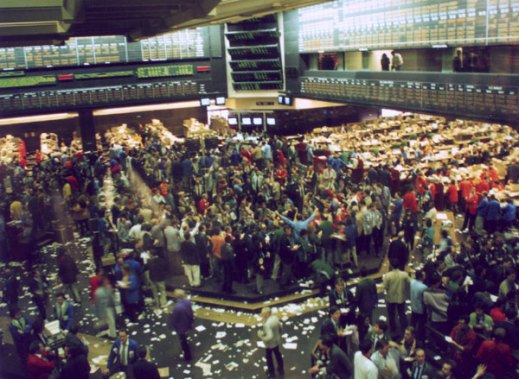
In the wonderfully titled article “Is Sound Just Noise?”, the business school professors Joshua Coval and Tyler Shumway ask, in one of the few academic articles related to the sounds of the pits, whether or not the shouting might convey information that is not necessarily available on the computer screens that were then coming to dominate trading:
we ask whether there exists information that is regularly communicated across an open outcry pit but cannot be easily transmitted over a computer network. Any signals that convey information regarding the emotion of market participants—fear, excitement, uncertainty, eagerness, and so forth—are likely to be difficult to transmit across an electronic network (1890).
Coval and Shumway found that the ambient sound level of the pits did have predictive impact regarding various aspects of the market: in short, the louder the pits got, the higher the volatility in the prices of securities and the decrease in the likelihood of conducting a trade.
Noisy Trading, Redux: Datacenters
Yet changes in the structure of the market have not only shifted the location of activity to people behind computer screens and away from these types of sounds, it has also shifted the actual location of the exchanges themselves. No longer do most trades take place in the physical location of, for example, the NYSE; rather, they take place in buildings like this one, at 1700 MacArthur Boulevard in Mahwah, NJ.
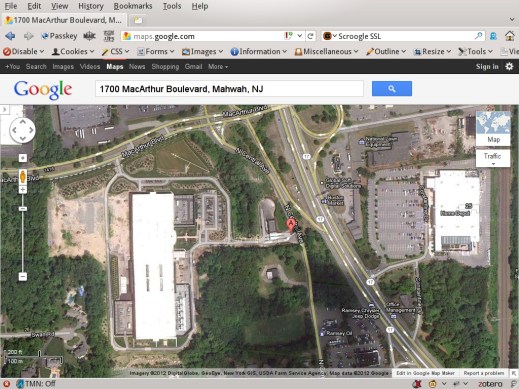
This is the location of the NYSE’s new datacenter, a 400,000 square foot facility. (In the linked video, note the whirring of the fans, a new noise of finance beyond that of the pits.) The servers in these datacenters—run by highly-capitalized financial firms large and small alike—are able to respond much quicker to market information the closer they are to the computers that run the exchange. And what can be closer than being co-located in the same datacenter as the exchange? This need for speed has lead to all sorts of interesting situations, such as new fibre-optic lines being laid to shave off a millisecond or two in travel between New Jersey and Chicago, or the taking into account of special relativity effects in the location of future datacenters. The new High-Frequency Trading (HFT) algorithms run on these servers in these datacenters.
Noisy Trades, Sonified: May 6th 2010
The voice on this recording, made on May 6th, 2010, belongs to Ben Lichenstein, an employee of a firm called Trader’s Audio. Now, Trader’s Audio provides live coverage of market movements from a person on the floor of an exchange in order for day traders and others to get an idea of the “sentiment” of a market. It’s kind of like a play-by-play of market activity, a running commentary of major market movements that can’t be discerned soley by the watching of numbers on a screen. What, then, could have been going on for Ben Lichenstein to be in such a frenzy, for his voice to be inflected in such a way? What are we to make of this noise?
Well, May 6th, 2010 was the day of what has infamously become known as the Flash Crash. The full details of this day are beyond the scope of this post, so I will outline it schematically, following the findings of the official US report produced by the Commodity Futures Trading Commission (CFTC) and the Securities and Exchange Commission (SEC). (For a different take on this, see the sociologist of finance Donald MacKenzie’s “How to Make Money in Microseconds”.) In short, between the hours of 2 and 3PM Eastern Time the New York Stock Exchange (NYSE) had both its largest single day loss as well as its largest single day gain, a swing of over 600 points. A series of trades made by algorithms that failed to take into account their impact on the market caused the prices of securities to swing to extremes, excerbated by the activity of High-Frequency Trading (HFT) algorithms. While the market eventually recovered—in part due to the activity of the same algorithms that caused the problem in the first place—the event indicated the precariousness of the stock market, the potential for things to spiral quickly out of control, and the difficulty in forecasting the behavior of an ecosystem of opaque algorithms.
How do the HFT algorithms relate to the Flash Crash that took place on May 6th, 2010? While the report of the CFTC and the SEC regarding the Flash Crash does not lay blame on HFT in particular, it did indicate how these algorithms contributed to the large price swings, the immense number of shares traded, and the drying up of liquidity (that is, the ability to find buyers and sellers in the market). One of the reasons why the market swings were so severe on May 6th, 2010 was due to the fact that HFT algorithms react immediately to small fluctuations of price, a quality of markets that financial economists call microstructure noise, a fascinating topic that is unfortunately beyond the scope of this particular post. In general, HFT and these datacenters go hand-in-hand, as it is a truism that it will take longer for data to travel between a machine in New Jersey and one in Chicago, than it will to travel between two machines in the same data center in New Jersey. HFT works to take advantage of this shorter latency in order to exploit market movements on the timescale of milliseconds, accelerating trading far beyond the open-outcry pit.
Noisy Finance: The Sonic and the Informatic
.
Let’s conclude with a sonic artifact of the Flash Crash from the French collective rybn. Their work has explored the concept of “antidatamining,” that is, the use of the “data mining” techniques of computational capitalism in order to shed light on the intersection of data and society. Consider their piece FLASHCRASH SONIFICATION (one of the few artistic responses to the Flash Crash), where rybn took trading data from nine different exchanges on the afternoon of the Flash Crash and created an austere, digitally-sharp yet undulating soundscape that recalls the work of artists Ryoji Ikeda or Carsten Nicolai without the rhythmic precision. If you can, listen to their online-available, two-channel mix on headphones in order to appreciate the details of the piece.
The building towards the end of “FLASHCRASH SONIFICATION” was meant to “emphasize the moment of the crash, [by] adding an effect of resonance, which propagates slowly, making it more tense, as the krach goes on” (all quotes in this paragraph from author’s personal interview with rybn). Thus instead of merely transparently translating the data into sound, rybn constructed the sonification in order to bring out this resonance: “resonance is pointed [to] as one of the major risk[s] of HFT by many economists and the feedback phenomenon was in the center of our discussions when we were preparing the piece.” Isolating the Flash Crash was important for rybn as it was perhaps the “moment when people started to understand financ[ial] orientations more clearly” thereby highlighting the symptomatic nature of the “speculative short-term loop finance seems to be stuck in.”
In FLASHCRASH SONIFICATION, sonic noise becomes a translation of the data from the market—abstract yet eminently material—into a different abstract form that does not immediately signify. FLASHCRASH SONIFICATION suggests rather than indicates; listening to it cannot provide us with rational information regarding the dynamics of the Flash Crash. Instead it produces a dark foreboding of the mechanisms at work, the high-frequency pulses first recalling heartbeats that soon speed up beyond any ability for distinction. In FLASHCRASH SONIFICATION, rybn comments on the inability for computation—and by extension, the market—to be the perfectly rational, ordered space it is ideally understood to be.
In Noise We Cannot Trust
If there is one thing clear about the examples of noises heard and encountered in this post—the shouting in the pits, the fluctuations of prices, the whirring of air conditioning, the sonification of the Flash Crash—it is that noise cannot be counted upon for positive or negative disruption. Noise cannot be counted upon as a political exploit in the market, as it can signify the potential of a trade, or be recuperated into profit through the activity of HFT algorithms. Yet noise can also provide an alternative experience of the Flash Crash beyond that of bureaucratic reports and figures. It is thus through the interferences noise causes within the dynamics of finance that we come into contact with the equivocality of noise as a phenomenon, and thus become attuned to a particular need to not confine noise to preconceived notions of positivity or negativity.
—
Adriana Knouf (she/her/hers, sie/hir/hirs) is an Assistant Professor of Art + Design in the College of Arts, Media, and Design at Northeastern University. She is a media artist and scholar researching noise, interferences, boundaries, and limits in media technologies and communication.
Her current research project, tentatively entitled The Xenology Notebooks, is a transmedia, transdisciplinary corpus expansively considering the “xeno”. Her first book, How Noise Matters to Finance (University of Minnesota Press, 2016), traced how the concept of “noise” in the sonic and informatic domains of finance mutated throughout the late 20th century into the 21st.
Her current artistic research explores queer and trans futurities on earth and in the cosmos. Projects include Enredos Sónicos/Sonic Plots, a collaborative sonic exchange between the US and Cuba; they transmitted continuously / but our times rarely aligned / and their signals dissipated in the æther (2018-present), a 20 channel sound art installation with speakers made from handmade abaca paper and piezo electric elements, with sounds collected by custom antennas from satellite transmissions; and PIECES FOR PERFORMER(S) AND EXTRATERRESTRIAL ENTITIES (2017-present), event scores laser etched into handmade translucent abaca paper.
—

REWIND! . . .If you liked this post, you may also dig:
Experiments in Agent-based Sonic Composition–Andreas Pape
Listening to Disaster: Our Relationship to Sound in Danger–Maile Colbert
SO! Reads: Jonathan Sterne’s MP3: The Meaning of a Format–Aaron Trammell
—
Share this:

Deejaying her Listening: Learning through Life Stories of Human Rights Violations


**Co-authored by Emmanuelle Sonntag and Bronwen Low
DOI: https://doi.org/10.59350/306p4-m0596
Are you listening?
Because sound specialist Julian Treasure argues, “We are losing our listening” due to the invention of multiple methods of recording and with the world being “so noisy . . . with this cacophony going on visually and auditorily, it’s just hard to listen, it’s tiring to listen.” In response, Treasure claims that we need to improve our conscious listening skills; he suggests teaching the skill of listening in school.
As co-directors of the “Education and Life Stories” working group of a large oral history project, we have been thinking a good deal about listening and pedagogy. The project is entitled “Life Stories of Montrealers Displaced by War, Genocide, and other Human Rights Violations,” shortened here as “Montreal Life Stories project.” From 2007 to 2012, a team of university and community-based researchers in the frame of the Canadian Community-University Research Alliances (CURA) Program recorded life story interviews with approximately 500 Montrealers who experienced mass violence and displacement. Members of the survivor communities (Tutsi, Haitian, Cambodian, and Holocaust) were key partners in both the research and the diffusion of the project, fundamentally shaping the project’s philosophy, activities and outcomes.
One of the Education Working Group’s principle accomplishments was developing an educational package called We Are Here, containing five Learning and Evaluation Situations (LES), the curricular units in the Quebec Education Program. The units are designed for “cycle two” secondary school, where the students are generally 14 to 16 years old. As of yet, these have not yet been piloted, but we plan to do so.
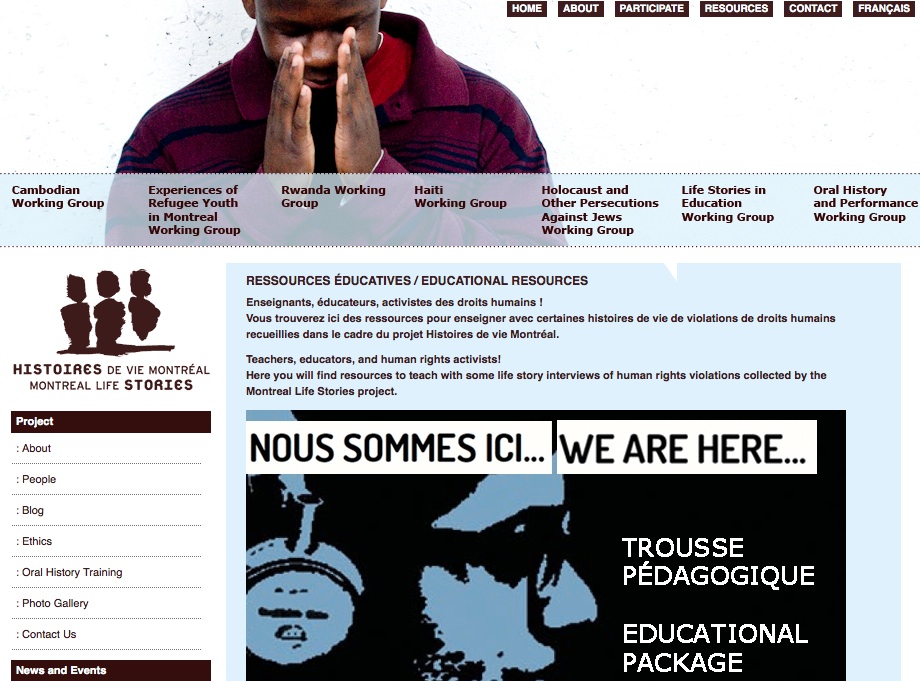
Our goal while designing “We Are Here” was to have teachers and students engage with the life stories of human rights violations, in order to foster a more inclusive cultural memory that would develop “le vivre-ensemble,” our capacity to live well together. Featuring the stories of immigrants and refugees to the province, the curriculum offers students a more complex understanding of human rights violations. First-person accounts bring world history and politics to life, helping us to understand the processes and human costs of violence and war, and expand our awareness of our fellow residents and citizens. At the same time, we recognized that the difficult stories of human rights violations make particular demands upon their listeners. We needed to consider how to ethically support students and teachers in engaging with the stories of people who have survived traumatic experience—while, importantly, respecting the interviewees themselves.
We sensed from the beginning that these goals and commitments would require us to develop our own “pedagogy of listening” to support teaching and learning from the life stories, and we foregrounded listening in all of the materials. For instance, each unit begins with the students listening to one or more project interviews, in the form of digital stories edited collaboratively by the interviewees and the editor. These digital stories tend to be under 10 minutes and bring together video, images, sound, and text (see for example, Bracha Rosenblum’s digital story). They are much more accessible than the original video interviews, which can be many hours long.
There is an irony in building a case for listening in schools. Students are commanded daily to “be quiet and listen to the teacher.” Despite the long history in educational theory of critiquing this model, the student-who-listens-in-silence versus the teacher-who-speaks-loudly is still regularly invoked in practice as an ideal relation. The demand for silence is in part a pragmatic response to the inherent noisiness of schools filled with people. At the same time, the listening imperative is also a key tool in the establishment of teacher authority and power.
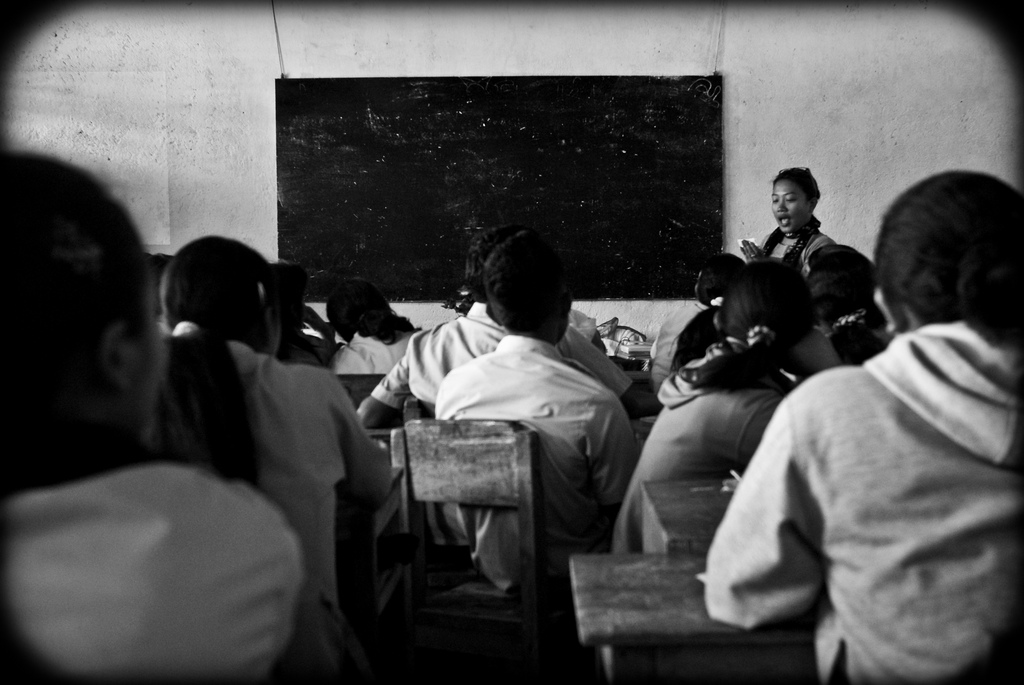
We wanted to rethink the process of listening in our curricular design beyond these traditional power dynamics. Our pedagogy of listening draws on concepts of testimony, communities of memory, dialogue, and the principle of shared authority in oral history, which we describe in detail elsewhere (forthcoming in the Journal of Curriculum Studies). In this blog post, we explore our pedagogy’s indebtedness to philosopher and musicologist Peter Szendy’s work on listening and its potential in the public school classroom.
Listening begins with the desire to be signed and addressed
The address is a central notion in Peter Szendy’s Listen: A History of Our Ears. The early 2000s, as Szendy explains, saw the birth of the peer-to-peer file sharing service Napster (created by Shawn Fanning in 1999), where listeners exchanged and circulated music. Through the lens of file sharing, Szendy began reflecting on the rights of listeners and the nature of musical listening more generally. He argues that sharing shapes the listening act: while listening can be passive–I am listening to you, receiving what you are saying–we also offer up what we are listening to. Rather than envisioning listening as a two-way engagement, Szendy triangulates it, structuring listening around a listening subject, the sonorous object the subject is listening to, and the addressee (le destinataire) of the subject’s listening. In Szendy’s theory of address, as we listen to somebody or something, we also address our listening to an “other” (who might be another beside me, or in myself).
That students would address and engage with “an other” through their listening appeased, in part, our concerns about having students listen to difficult stories of mass violence. If listening is akin to a peer-to-peer sharing system, students were somehow not “alone” anymore in the experience; listening is a building of relation.
Closely related to the concept of listening as address is Szendy’s idea of signature, especially through the digitalization of sound where “listeners become authors” (136) naming, tagging, and classifying the files that they share with others. Szendy describes this process in terms of the singularity of listening:
It is more simply as a listener that I want to sign my listening: I would like to point out, to identify, and to share such-and-such sonorous event that no one besides me, I am certain of it, has ever heard as I have (3).
While all listening necessarily involves an appropriation of what has been listened to, we wanted to amplify the process of students “signing” or marking their listening, and so making it their own. We would deepen students’ engagement with the video interview and the “other” by having them actively edit, rework, even remix, and so adapt the original. We gave students the right to enter into the difficult stories from the survivors interviewed in the Montreal Life Stories project, responding as individuals and as members of a classroom community. While the dynamic of students listening to and making something in response to the life stories takes many forms in our curricular units (including timelines, maps, and audio-tours), we here share the unit which most explicitly embodies the remixing in Szendy’s notion of listening.
What a Story!
What a story!: Life stories and digital storytelling, is designed for senior students in the English Language Arts, and asks students to work in groups to create their own digital story version of a segment from one of the life story interviews.
In the preparation phase, the students listen to a 5 minute digital story of a Holocaust survivor living in Montreal that enables them to discover the multimedia elements and narrative structure of a digital story.
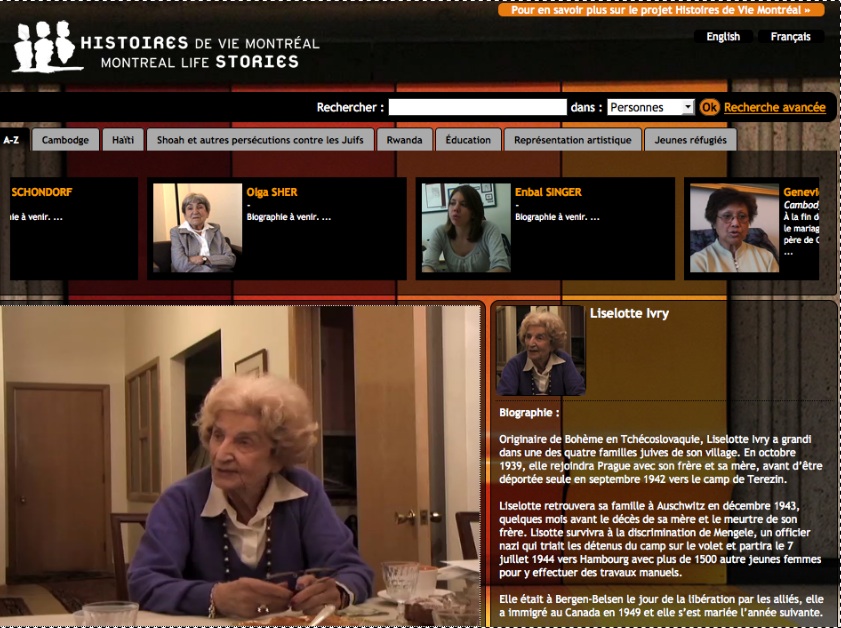
In the production phase, students approach their main task: producing a 5 minute digital story from a 34 minute life story interview with another Holocaust survivor. The phase begins with “deep listening” exercises where students work in groups to summarize the story and decide which parts of the larger interview they would like to keep in their edited versions. In doing this, they reflect on their experience as “listener“ vs. ”reader” and their responsibilities as listeners of difficult stories.
While the expression “deep listening” recalls the work of the composer Pauline Oliveros, in the Montreal Life Stories project the concept stems more directly from the notion of “shared authority,” a phrase coined by oral historian Michael Frisch (1990) to describe the process of co-creating an interview. The community-university model was collaborative at all levels, and researchers and the researched were partners in dialogue. In turn, we frequently used “deep listening” (as in the profound listening between interviewers and interviewees) as an expression during our working sessions. The concept also draws on the work of oral historian Martha Norkunas on interview techniques and deep listening exercices; her visit to the project shaped our curriculum design process, and students are encouraged to engage in dialogue and sharing, and to “Listen with close attention and deeply, in an empathetic and respectful manner.“(13). These appeared, to our eyes, to be consistent with Szendy’s notion of listening as address and signature.
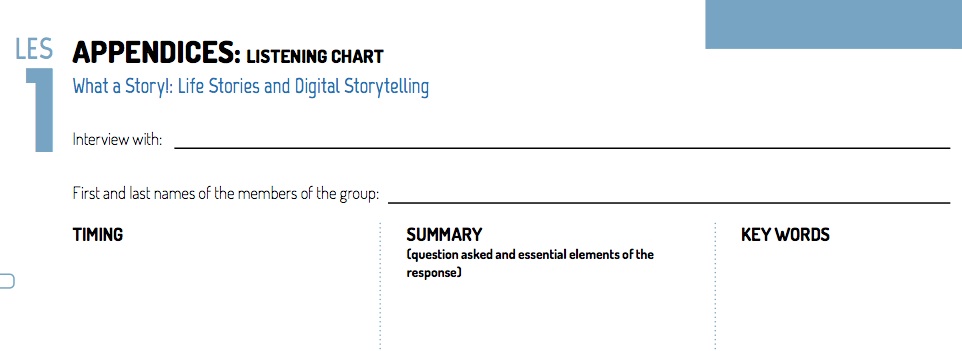
The production phase continues with the creation of the digital story, the editing and the montage. Students then reflect on the ethics of the process of cutting and reworking another’s story, exploring the way narratives can be modified, the meaning built into the digital story vs. the meaning of the interview, and the question of narrative form.
Peter Szendy chooses the deejay, or of the musical arranger, as a figure for the contemporary listener. Indeed, we imagined the students in groups, headphones on, in front of computers, slowing down the cadence, augmenting the sound, rewinding or fast-forwarding, cutting, pasting, annotating. We thought of them as highly skilled listeners, intervening in what they were listening to and interpreting their listening for the “other” ( in the manner of composition theory in which students are asked to write for real audiences for real purposes). As deejays of their listening!
Having students edit the life stories of others, especially stories of violence and war, brings with it risks of misinterpretation and manipulation. However, the unit asks students to think carefully about these risks, and unlike projects which use testimonies in the service of someone else’s argument, this editing assignment has students select from the larger interview in order to craft a narrative that respects the original. As Norkunas says, “When Michael Frisch coined his now famous phrase, “a shared authority,” he wrote of the shared responsibility of listener and narrator for creating the interview document, for interpreting it and for sharing the knowledge created.”(2) If editing and interpreting are critical to the process, adds Norkunas, “the first moment of creation takes place in the interview, in the act of listening.” Hence, the ethical issues raised by the editing assignment–and more generally by having students and teachers engage with personal stories of human rights violation–are addressed by considerable attention to the act of listening (13), and by the cultivation of trust, dialogue and sharing. In short, an attention to the “other.”
Rather than deciding that this content is too challenging for students or reproducing a passive listening dynamic in which students listen to the interviews in reverential silence, we work to support student engagement — as both an attention and response — with these stories as part of a community of listeners. And while listening to these stories can be difficult work, we hope that through our pedagogy of listening, students will gain a greater awareness of the lives of those Quebecois who are not often part of the national narrative, and grapple with some of the difficult knowledge of human pain and survival.
—
Bronwen Low is an Associate Professor in the Department of Integrated Studies in Education at McGill University. She researches the implications of popular culture for education, curriculum theory, and adolescent (multi)literacy practices. Areas of interest include hip-hop and spoken word culture; informal, arts-based and participatory education with youth; and community media and participatory video programs.
Emmanuelle Sonntag defines herself as a “knowledge organizer.” She offers consultancy services in communication, education, curriculum design, information management and knowledge mobilization while pursuing her PhD in Sociology on… Listening at Université du Québec à Montréal. She tweets on listening, sounds, stories and other noises @lvrdg.
—
REWIND! . . .If you liked this post, you may also dig:
Audio Culture Studies: Scaffolding a Sequence of Assignments–Jentery Sayers
The Sounds of Writing and Learning— Liana Silva
Listening to #Occupy in the Classroom–– Travers Scott
—
Share this:




Current Top Posts





April 2021

January 2020

November 2019

October 2019

August 2019

April 2014

November 2017

March 2015

December 2017

October 2015
 Sounding Out!
Recent Comments