
Listening to Whisperers: Performance, ASMR Community and Fetish on YouTube
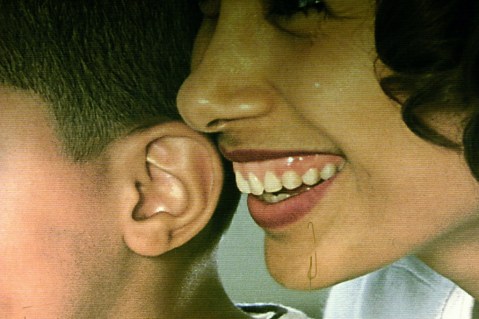
Imagine this, only virtual. Image borrowed from Genista @Flickr.
PercussiveThoughts is giving me a facial. The voice tells me about the “little scrubbies” in the exfoliant, and I begin to hear their delicate sibilance on my temples. If I’m lucky, a pleasurable, tingling sensation might begin somewhere on the back of my head and travel down my spine, turning my facial into something closer to a massage. The sole caveat is that I’m not really being touched at all.
This is ASMR, “Autonomous Sensory Meridian Response,” a pseudo-medical designation whose native soil is YouTube. The term pulls together a range of physiological and affective states: goosebumps, chills, relaxation, melting, tingles, and so forth. PercussiveThoughts and her fellow vloggers (I call them “Whisperers” here and explain why below) aim to trigger these frissons through a cornucopia of techniques. Sound is paramount; Whisperers scratch rough surfaces with their fingernails and percuss everyday objects with fingertip drum-rolls. And, of course, they whisper, sometimes using lozenges or gum to increase the opportunities for swallowing and lip-smacking.
What’s interesting about these videos is how they manage to traverse the gap between the sonic and the haptic. There is, of course, something familiar about this leap. Like the magician’s hat that produces rabbits and endless handkerchiefs, an audio speaker produces a volume and variety of sound out of proportion with its small, blank visage. In the case of Whispering, however, sound is transduced into touch, and the taut membranes of the listener’s headphones become coterminous with his own skin.
Apart from Steven Novella’s suggestion that ASMR might be a mild form of seizure, it does not yet appear to be a subject of scientific research. So Whisperers have taken on the role of amateur scientists themselves, with YouTube serving as a public petri dish. For this very reason, Novella has also cautioned against the assumption that ASMR is a real physiological phenomenon at all, since feedback loops of suggestion on the Internet might create “the cultural equivalent of pareidolia.”
Whisperers, however, have no doubts. And while the ASMR acronym is a recent development, many Whisperers say their first encounters with the phenomenon occurred sometime before their first exposure to the Internet and often before adulthood: during make-believe tea parties, while watching their classmates draw or braid each other’s hair, and, perhaps most commonly, while watching The Joy of Painting with Bob Ross.
The audience for Whispering is anyone who can have this experience, which apparently isn’t everyone. Contrary to the soporific themes of their videos, Whisperers and their fans identify themselves as having awakened to a special form of pleasure. Some have even made videos recounting their first experiences. The downside of this ability is the anxiety about its social acceptance. Whisperers sometimes opt for anonymity in their videos, revealing their faces only after much encouragement from fans. Rarely do they they let their family and friends in on the secret.
That this familiar, tingly feeling has assumed a pseudo-medical acronym is hardly coincidental. ASMR isn’t just pleasurable, it’s therapeutic. Hundreds of YouTube comments attest to the power of ASMR to help relieve them of insomnia, anxiety, and panic attacks. Nor has this dimension been overlooked by Whisperers themselves, who regularly perform as doctors or therapists in their roleplay videos. This is particularly interesting in light of recent scholarship on human/machine interactions. In Addiction By Design, Natasha Schüll shows how therapy for video-poker addiction can take the same format as the gambling itself, namely, “ongoing technological self-modulation to maintain equilibrium” (250).
Homemade Whisper videos, while habit-forming, are clearly not the sort of intricately-engineered machines that Schüll writes about. Nor do they wreack the same sort of havoc (depletion of one’s life-savings, deterioration of one’s physical health, etc.). And yet, both are arranged in problematic feedback loops of self-medication. The slow-paced, low-volume respite that Whisper videos offer is made all the more necessary by the fact that viewers must go online to watch them. This paradox is amplified by YouTube’s advertisements, which will sound especially abrasive because viewers tend to turn the volume up while listening to Whisper videos. That some of the more popular Whisperers earn money from their videos only complicates things further.
*
“No, we don’t get as many men here as women,” PercussiveThoughts says, as though responding to a question from me. Of course, I wouldn’t be so rude as to contradict her – I know better. To judge from the comments below, she gets plenty of male visitors. And her colleague ASMR Velous confided during an interview that around 70 percent of her viewers are men. For this reason, some Whisperers have made gender–neutral or male-oriented videos.

A man getting a facial. Borrowed from FoundryParkInn @Flickr.
Gender is a major, and sometimes contentious, topic of discussion in the Whisper Community. In the YouWhisper web forum, the discussion topic “Gender Preference?,” has the greatest number of views (more than 170,000). In general, female Whisperers are more popular than their male counterparts. The three most popular male Whisperers that I could find–WhisperMister1, MaleSoothe, and TheLyricalWhispers–each have fewer than 5,000 subscribers and their per-video view-counts tend to peak around ten or twenty thousand.
Not long ago, GentleWhispering, one of the better-known names in the Whisper community, set off a series of heated back-and-forths with her ~FeminineGrace & Charmforsleep~ video. In it, she discusses universal traits of femininity while brushing her hair absent-mindedly. Whatever one might think of her opinions, the fact that GentleWhispering’s viewership dwarfs all other Whisperers to date suggests that something in her technique is working. My guess is that it has a great deal to do with her hands.
While giving Russian language lessons on a chalkboard, she points to a word with her middle, ring, and pinkie fingers while keeping the chalk poised delicately between her thumb and index finger. When she is about to touch the fabric of an armchair, her fingers arch back–rather than claw forward–as though to ensure that the contact is as light as possible. And, like so many other Whisperers, she takes any opportunity to tap hard objects with her well-kept fingernails.
The “femininity” of GentleWhispering’s hands is the performance of a soothing, caring touch, and her whispering voice is the transubstantiation of this touch through sound. Sometimes, she even short-circuits the analogy by massaging the microphone directly.
*
But even the performance of gendered touching does not quite explain how these sounds and images manage to reach through the speaker and screen. After a second glance at these videos, we might wonder if the preponderance of partial objects has something to do with it.
I’m talking about all of those disembodied hands stroking opposite hands or displaying objects detached from their collections. Often, for the sake of anonymity, the Whisperer’s eyes are kept out of frame, leaving only an expressive mouth, like CalmingEscape’s, with its signature tics and swallows. If even the mouth is too revealing, the camera gazes down at covered breasts, ”objects,” in a Freudian panoply of sexual cathexis (is it a coincidence that some Whisperers even roleplay as the viewer’s doting mother?). One has to wonder what effect is achieved by this strange summation of partials.
In spite of widespread insistence that these videos are not sexual, the comparison with sexual fetish is too obvious not to make. Sticking with Freud for a moment, the hyper-presence of the Whisperer would seem to disavow the separation implicit in internet communication. Her mouth speaks individually into each of the listener’s ears while also hovering on screen. Her hands animate dead objects through rappings and close-ups. In her omnipotence, she can even tell us what to do.
Fetish or not, the word “whisper” is a perfect synecdoche for this fragmentary whole, and that’s why I’ve used it instead of ASMR. A whisper is, by definition, “unvoiced.” The cheeks, mouth, teeth, and tongue accomplish the acoustic filtering that gives words their shapes, but the larynx produces noise rather than tones. Lacking pitch, a whisper might be called only a “part of speech.” And yet it speaks volumes by shifting the register of communication. Whatever is said in a whisper gains the aura of genuineness, honesty, and intimacy.
Of course, in a YouTube video, these qualities are suspect from the moment one clicks the play button. But perhaps this is what makes Whispering work. One hears in these videos, above all, the effort of performance. It is the performance of gender, as discussed above, but more generally the performance of interaction, intimacy, and proximity. What every Whisper video whispers is “Let’s pretend!” And nothing proves this better than the fact
that some popular Whisper videos contain rather unpleasant sounds. Consider TheWhiteRabbitASMR’s dentist appointment video. If one is willing to grit one’s teeth through the long sections of abrasive drilling, it’s because she so adeptly crafts the intimate space of fantasy in which it takes places.
The pleasure of pretending was made clear to me when ASMR Velous recounted her childhood tactic for inducing ASMR. “I would constantly trick people into pretending to do things. I had this little play kitchen set, and I would cook up imaginary food for people and make them pretend-eat it really slowly and make those eating sounds like [chewing sounds], and I would just sit there and be all tingly. And I just loved it….I made up this game with my friends, where we would basically mime a profession and the other person would have to guess the profession you were miming. That was another way for me to trick my friends into pretending to do stuff.”
*
PercussiveThoughts is wrapping things up. “That completes your facial… So you can sit up. Well, thank you. Thank you so much. I’m really glad you enjoyed it.”
I did enjoy it! But thank goodness it’s not really over; I can just hit the reload button. No matter how many times I do, I know that my pores won’t be any cleaner when I look in the mirror. But that’s not the point. Rather, Whisper fans take pleasure in the intimacy and complicity of pretending. That complicity applies even to the skin of the listener, a surface as vibrant as the skin of the speaker.
—
Share this:

Sound as Art as Anti-environment

When I performed at the 2012 Computers and Writing Conference in Raleigh, North Carolina, I looked around during my fairly abstract 10-minute long improvisation featuring feedback loops, glitches, silences, and circuit-bent instruments, and I noticed the audience’s sometimes visible restlessness, discomfort, and even anxiety. This is a fairly common occurrence when I perform experimental sound art, particularly in contexts in which audiences expect “music” (you can hear my work at 38:30 in the video below). However, for an experimental sound artist to take offense to such reactions is, in my estimation, missing the point of the exercise. That sound art disrupts, agitates, and even offends is a powerfully reaffirming reminder that sound art transcends music and sound; it is a method of revelation, an act that surpasses logical communication, instead challenging the very nature of sound and perception.
.
As an artist, scholar, and fan, I am drawn toward sound and music that lures me into a new world, an unfamiliar way of being and knowing. Like Lewis Carroll’s Alice, I learn that the rules of my world no longer apply. This happened when I heard J Dilla’s Donuts album, and when I heard Madlib’s Medicine Show #3: Beat Konducta in Africa, when I heard Miles Davis’ Bitches Brew. An artist that continually draws me down the rabbit hole is Walter Gross, an experimental sound/beat artist out of Los Angeles. His work changes the way I usually interact with sonic art, both in terms of his sound and in his approach to physical collage and handcrafted cassette packaging, Gross departs from the comfortable and familiar listening imparted by polished hi-fi 3-minute tracks with definitive beginnings and ends and discernible melodies. Gross instead propels listeners into very unusual (and pleasantly discomforting) soundscapes that demand attention. Almost counter-intuitively, Gross’s visual representations of his work intensify that experience. Consider his 2010 work, Dopamine:
Dopamine is likely a challenging piece for audiences, at least in terms of violating the dominant structures of music. The piece opens with disorienting use of panning, deliberately obscuring degraded audio, largely indiscernible movements and patterns, and so on. His video work likewise presents a fitting yet relatively unusual juxtaposition of youth and destruction, celebration and danger. In terms of both sound and sight, Gross’ work disrupts dominant musical sensibilities, challenging the very patterns and structures within which we can express ideas. He violates tradition, shakes off the canonical baggage carried by prevailing paradigms of Art and Music, and plunges audiences into unfamiliar sensory experiences that require metacognition, reflection, and examination of what sonic art is, and more importantly, what sonic art can be. Gross, in other words, seems to transcend the musician moniker and reach something else entirely. In what follows, I’d like to explore a (very brief) history of such artists, and begin to think about how to frame sonic art as immersion in what Marshall McLuhan called anti-environments: the unconscious environment as raised to conscious attention.
Sound as Art
There exists a strong tradition of experimental noise and sound art, particularly in 20th-century Western avant-garde movements. Futurists were arguably the first to consider noise as music in the European tradition, and were certainly influential in asking artists and audiences to become more aware of the changing social and sonic surroundings . In his 1913 manifesto-of-sorts titled “The Art of Noises,” Italian Futurist Luigi Russolo proposed an orchestral configuration that more aptly represented the range of sounds available to contemporary listeners, namely those sounds that accompanied industrialization and urbanization. The sounds of the Futurist orchestra would include “rumbles, roars, explosions, and crashes.” Russolo built devices called intonarumori to mechanically achieve and manipulate these sounds. His brother, Antonio Russolo, also enacted this new philosophy of modern found sound and composed Corale and Serenata.

Luigi Russolo and Ugo Piatti with the Intonarumori, 1913
Any inquiry of art as anti-environment would be incomplete without a discussion of the great anti-art movement, Dada. Like the Futurists before them, Dadaists used found sound and technology-as-art to violently disrupt conventions of art, beauty, and authorship within the white avant-garde community. Marcel Duchamp’s famous work, “Fountain,” is likely the most familiar Dadaist artifact to contemporary readers, yet the sound poetry of Kurt Schwitters and other Dadaist and Dada-inspired sound pieces such as Erwin Schulhoff’s 1922 work In Futurum (the middle movement of which contains only a rest and the notation “with feeling,” an undoubtable precursor to John Cage’s 4’33”, written 30 years later) created sonic spaces of innovation and strangeness that changed the way audiences listened to both voices and silences. The Russian Cubo-Futurists, especially zaumniks such as Alexei Kruchenykh, made similar ventures into anti-environments. Kruchenykh developed the sound art zaum, which he understood as a transrational language that undercut existing language systems in which the “word [had] been shackled…by its subordination to rational thought” (70). Zaum was a sort of linguistic anti-environment, one rooted in the notion that meaning resided first and foremost in the sound of a word rather than the denotative symbol system that emerged alongside the proliferation of print/visual culture. One could also not underemphasize the work of John Cage, from his prepared piano to his work with organic instruments.

John Cage and His “Prepared Piano,” Image courtesy of Flickr User William Cromar
The list of artists, genres, and movements engaged to some extent in the enterprise of anti-environment architecture could go on and be debated indefinitely: Free Jazz, Turntablism/Nu Jazz, Experimental Hip-Hop,Fluxus, Circuit Bending, Prepared Guitar, ProtoPunk, Punk, Post-Punk, New Wave, No Wave. . . in all of these diverse movements, the sonic artists share the tendency to create strange new worlds via sound; worlds that reveal social and technological environments that most people seem unaware of in the moment. This is why media theorist Marshall McLuhan called the artist “indispensible,” because the artist can tell us something about ourselves that we cannot know via ordinary means of perception. Sonic artists expose audiences to auditory phenomena, structures, juxtapositions, etc. that are to various extents hidden, obscured, or ignored as “noise.” The sonic artist is more than just a clever selector and (re)arranger of sound; s/he is a revelatory agent, exposing what is inaudible.
Art as Anti-environment
Anti-environments, however we might define and classify them, are vital not only to artistic communities themselves, but they are also vital to a society of fish in water. In his 1968 text, War and Peace in the Global Village, McLuhan asserts (among other things) that humans remain largely unaware of their new environments, likening them to fish in water: “one thing about which fish know exactly nothing is water, since they have no anti-environment which would enable them to perceive the element they live in” (175). In other words, humans seldom possess or practice a sense of awareness regarding their surroundings because there’s nothing against which surroundings may be contrasted. The “water” to McLuhan represented the various environments (physical, psychological, cultural) shaped by technological innovation, but we can—and should—extend the water metaphor to a range of hegemonic frameworks: constructions of gender, race, ability, and so on.
This essay is certainly not an attempt to generate some sort of evaluative rubric by which to judge artistic or sonic expression objectively. Rather, we might use the concept of anti-environments as a way to frame our subjective experiences and encounters with all sound, and begin listening to unfamiliar sounds as psychedelic (from Greek psyche- “mind” + deloun “reveal”) keys to illuminate the patterns and structures in which listeners exist. We must work to understand our environments and our place in them; if we are to engage critically with our culture, we must first understand existing (yet invisible) patterns and structures that surround us. And we are aided in this effort, in great part, by humanity’s great seekers of pattern recognition, the sonic-psychonautical messengers: the sonic artists.

Sound Artist Performing at Circuit Bending Workshop in Dayton, Ohio in 2009, Image Courtesy of Flickr User Vistavision
To return to the sound that inspired this meditation, Walter Gross (among others) is in many ways participating in and propelling the discourse of Leary and McLuhan, Schwitters and Schulhoff, Kruchenykh and Cage,Davis and Sun Ra, Madlib and J Dilla. Gross performs the sonic anti-environment, enacts the revelation of obscured sonic paradigms. For me, Gross can act as a sort of lens through which ordinary sonic patterns and structures become visible. I hear Flying Lotus, Bob Dylan, and The Minutemen differently after Gross. I hear my office, my home, my family’s voices differently after Gross. I hear patterns that weren’t audible before. After Gross, I become aware of how I am continuously trained to expect certain things from the sonic world: compartmentalized units of meaning, clearly stated origins of utterances, linear narratives, repeated/repeatable melodies, and so on.
Likewise, my own sonic art/scholarship approaches the use of sound to reveal the inaudible assumptions present in Western frameworks surrounding sonic production. I will conclude with an illustration of my own work and why sonic anti-environments are so central to my philosophy and method. One of my sonic works, “Toward an Object-Oriented Sonic Phenomenology,” was recently part of an exhibition titled Not For Human Consumption, curated by Julian Weaver of CRISAP in London. I recorded the sounds of a high mast lighting pole using contact microphones. Contact microphones do not “hear” like humans typically hear. Typical (dominant) notions of human hearing (and therefore of sound itself) involve the reception and interpretation of vibrations present in air. Contact microphones instead only interpret the vibrations in solid objects.
By listening through an object–through alien “ears,” so to speak– we can begin to critique the ways that we privilege listening via air, a listening that places humans at the center of the universe. We can consider the ways that sound has very real effects on humans with atypical hearing abilities and nonhuman objects. It is difficult to have such conversations if we never explore sonic anti-environments, if we never break through dominant epistemological models, if we never expose the limits of our own environments.
—
Featured Image: Beatrix*JAR in Dayton, Ohio, September 9, 2009, by Flickr User Vista Vision
—
Steven Hammer is a Ph.D. candidate in Rhetoric, Writing, and Culture at North Dakota State University in Fargo, ND, USA. His research deals with various aspects of sonic art, from exploring glitch and proto-glitch practices and theories (e.g., circuit bending), to understanding and producing sound from an object-oriented ontology (e.g., contact microphones). He also researches and facilitates trans-Atlantic translation collaborations between American, European, and African universities. He has multimedia publications with Enculturation, Sensory Studies, as well as forthcoming book chapters with Wiley/IEEE press, and IGI Global Publishing, and has performed creative and academic work at several conferences across North America, including the national Computers and Writing Conference and the Council for Programs in Technical and Scientific Communication. He performs experimental circuit-bent and sampler-based music under the moniker “patchbaydoor,” and has constructed and documented a number of hardware modification projects for his own artistic projects and for other artists in the upper Midwest United States. You can read/hear more atstevenrhammer.com
Share this:


Current Top Posts





April 2021

January 2020

November 2019

October 2019

August 2019

April 2014

November 2017

March 2015

December 2017

October 2015
 Sounding Out!

Recent Comments