*Dedicated to the love we hear in our mothers’ accents. This post is co-authored by Sara V. Hinojos and Dolores Inés Casillas
The Cinco de Mayo season showcases troubling instances of Spanish being mocked. Corporate ‘merica profits from Drinko de Mayo when menus advertise “el happy hour”; words like “fiesta” and “amigo” are overused; and Spanish hyperanglicized for laughs (one of the worst: “COM-PREN-DAY”). These acts of linguistic privilege, according to Jane Hill, elevate whiteness in public spaces. What is heard as playful for the dominant ear is simply an acoustic representation of the racist appropriation of mustaches, sombreros, and sarapes.
CinKO de Mayo(naise)
Fiesta like there’s no mañana
Said no Juan ever
That said, bilennials have struck back.
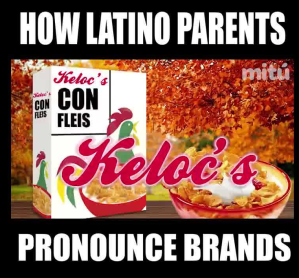
Last year, the Latino digital platform, we are mitú, published a list that resonated with its young, bicultural readers, those long accustomed to hearing Spanish Accented English (SAE) as part of their everyday speech: 17 Popular Brand Logos If They Looked The Way Your Parents Pronounce Them. This humorous phonetic play in the face of complaints about foreign accents being unintelligible or moral indignation over immigrants who do not learn English with native-like proficiency re-directs our attention to digital, engaged Spanish-English bilingual communities. Like Chicana/o listening practices, these digital memes, gifs, and lists embrace how these accents invoke sounds of survival, solidarity and place making.
Con Fleis (Corn Flakes)
Gualmar (Wal-Mart)
Feisbu (Facebook)
Cosco (Costco)
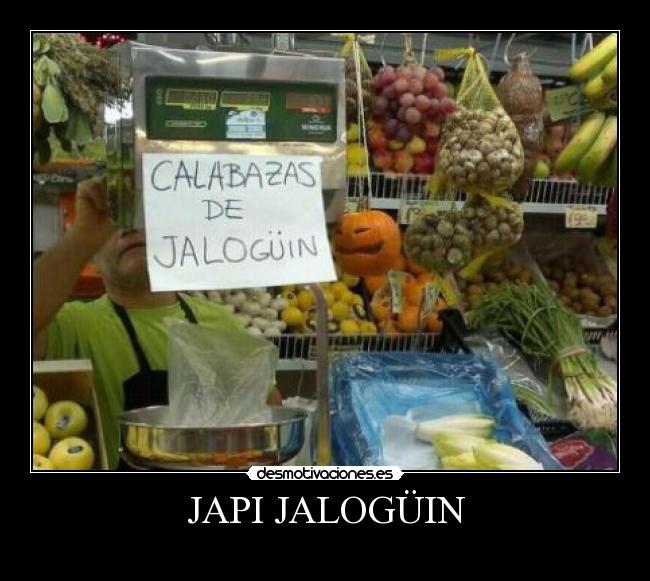
The witty Buzzfeed-ish list re-spelled English-language global logos in Mexican, immigrant styled phonetics to reflect how said stores, brands, and social media sites are heard within Spanish-dominant or bilingual speaking communities. The absence of letters (Cosco) and/or the substitution of letters (Gualmar) induce an “accented” non-English dominant speech, dislodging standard rules about English-language spelling and pronunciation. Readers chuckled at seeing immigrant, ESL (English as a Second Language), phonetic speech in print – a tactic Sara V. Hinojos refers to in her media writings as a visual accent, or a visual vocabulary based on sound.
In order to “get” the humor behind the wave of memes and gifs that use Spanish Accented English (SAE), Chicana/o readers rely much more on their listening ears than their eyes to understand how these accents are voiced in print. Here, listening to accents operates as a popular form of literacy, one that registers the audible, racialized experiences of Spanish-speaking immigrants. Of course, the use of creative, rasquache forms of humor have long been a hallmark aspect of Chicana/o humor. Yet listening to these digital literacies, especially within the contemporary “build the wall yet eat the taco” era, help make these accents legible.
Estop (Stop)
Eschool (School)
Espray (Sprite)
Certainly, some vocal accents are audibly more patent to select ears than others. Accents work to socially and geographically locate speakers; for instance, often racially indexing Spanish Accented English speakers as Mexican (regardless of nationality), immigrant (regardless of citizenship), and/or poor (regardless of occupation). Sociocultural linguists remind us that accents, word choice, vocal tone and other sound qualities of language are a part of a larger Bourdieu-ian rubric of linguistic capital. Social psychologists consistently demonstrate that listeners make “moral, intellectual, and aesthetic judgments of others based on language use and accent alone.” For scholars of race and sound, accents comprise part of a sonic color line; a socially constructed aural boundary that aligns accented English speech as non-white and non-accented (or Midwestern) English as white. Vocal neutrality, like whiteness itself, operates invisibly as privilege usually does.
Jess (Yes)
Brefas (Breakfast)
Effectively “reading” a visual accent does not privilege a bilingual speaker but rather an accented listener, one raised or surrounded by immigrant speakers. The humorous phonetic play of a visual accent symbolically challenges the capitalist logic that a “neutral accent” or non-accent in English holds immense Western value. For those of us with accented speakers in our families and communities, accents function as emotional markers; vocal or vernacular archives that trace an individual or family’s migration, travels and/or histories. As Denice Forham shares poetically about her Puerto Rican mother’s accent, “even when her lips can barely stress themselves around English, her accent is a stubborn compass, always pointing her towards home.” For our families, accents evince the affective labor entailed in retraining tongues, in learning new idioms, and general struggles to converse in Inglish.
(when your grandmother wants to motivate you)
Using the name of a popular Mexican sweet bread (conchas) as a substitute for “conscious” upsets Western, phonetic understandings of “scious” in favor of a phonetic, Mexican stand-in. Concha, a sea shelled shaped sweet bread, associated with female genitalia and used in digital Latino communities has become a symbol for body positive inclusion; an insistence to not feel “self conchas” when eating (see Nalgona Positivity and SOMAR ATX). These memes privilege an accented listener, a feminist sensibility, as well as a panadería connoisseur.
The mega-for-profit-English-teaching-colonial organization, known as Teaching English as a Foreign Language (TEFL), explains that the lack of distinction in the Spanish language between a short and long vowel – for instance ship/sheep – causes miscomprehension for assumed-yet-never-named native English listeners. Those learning English as a Second Language are encouraged to first reorient their own ears to listen to the subtlety between pull/pool before grasping the complexities of yacht/jot. The communicative burden lies on the accented speaker rather than the non-accented listener. The visual accent places the onus on the English-dominant listener, effectively excluding them.
Gail Shuck found that white, native English-speaking college students construct an ideological distinction between Us and Them; gesturing to a sonic color line. Compellingly, she reported how American tourists in Mexico would describe native Spanish speakers as “heavily accented.” Yes. The communicative proficiency of Spanish by Mexicans in Mexico continued to be scrutinized by native English-language listeners.
Cinco de Mayo has versed us too well on the visual markers of racism like oversized sombreros, felt mustaches, and cheap beer pursuits, all a part of the commercial exploitation of Mexican communities in the U.S. But then phrases such as “Grassy Ass” or “No Problem-o” are heard bitterly as recurrent reminders that our language and accents are policed with the same fervor as our bodies. The inventive use of the visual accent archives how we listen, privileging the accented ear. The loving jest that enwraps these digital literacies reminds us to never lose our accents.
—
Sara Veronica Hinojosis currently a Visiting Assistant Professor and Scholar with the Center for Mexican American Studies and Jack J. Valenti School of Communication at the University of Houston (2016-2018). She received her Ph.D. from the University of California, Santa Barbara in Chicana and Chicano Studies. Her research focuses on Chicana/o and Latina/o Media, the Politics of Language, and Humor.
.
Dolores Inés Casillas is associate professor in the Department of Chicana and Chicano Studies and a faculty affiliate of Film & Media Studies at the University of California, Santa Barbara. She writes and teaches courses on Latina/o sound practices, popular culture, and the politics of language. Her book, Sounds of Belonging: U.S. Spanish-language Radio and Public Advocacy(2014) was published by New York University Press as part of their Critical Cultural Communication series.
—
REWIND! . . .If you liked this post, you may also dig:
For full intro and part one of the series click here. For part two, click here. For part three click here. For part four click here.
Our Punk Sound series implicitly argues that sound studies methodologies are better suited to understanding how punk works sonically than existing journalistic and academic conversations about musical genre, chord progressions, and/or genealogies of bands. Alexandra Vasquez’s sound-oriented work on Cuban music, for example, in Listening in Detail (2014) opens up necessary conversations about the “flashes, moments, sounds” in music that bear its meanings and its colonial, raced, classed, and gendered histories in material ways people can hear and feel. While retaining the specificity of Vasquez’s argument and the specific sonic archive bringing it forth, we too insist on “an ethical and intellectual obligation to the question: what do the musicians sound like” (12) and how do folks identifying with and through these musical sounds hear them?
In this series, we invite you to amplify varied historicized “details” of punk sound–its chunk-chunk-chunk skapunk riffs, screams, growls, group chants, driving rhythms, honking saxophones–hearing/feeling/touching these sounds in richly varied locations, times, places, and perspectives: as a pulsing bead of condensation dripping down the wall of The Smell in Downtown LA (#savethesmell), a drummer making her own time on tour, a drunk sitting too near the amp at a backyard party, a queer teenager in their bedroom being yelled at to “turn it down” and “act like a lady[or a man]”. . .and on and on. In today’s essay Marlen Rios-Hernandez discusses how all the politics of punk sound, queer chicana identity, and feminism can be found in the scream.
Mexican cultural theorist Carlos Monsiváis looked at various aspects of Mexican youth subcultures in the early 80s and revealed how youth relied on “caos” or chaos as a way to attain pleasure within disruption, spontaneity, and noise (68-79). How does the scream emerge through caos as a instrument of resistance? Alongside scholars like Fred Moten, I argue that the scream ruptures caos and allows us to glimpse the pleasure of resistance. In Alice Bag’s scream we find this medley of pleasure, interruption, and spontaneity. Bag explains, “once the Bags hit the stage and the music started, ego checked out and id took over, channeling my libido, my inner rage, whatever… I was free to be myself with no holds barred. It was the ultimate freedom” (221). These elements epitomize what I consider a queer Chicana feminist exorcism of tonality.
As explained in Bag’s memoir, particular to punk, there is a general reliance on informal/community-based ear training where musicians teach each other (183). European traditions of musical analysis both negate the horizontal learning central to punk while also normalizing the historical colonial presence within the Borderlands. In order to reveal how Bag’s scream exorcises these Eurocentric traditions, I consider her performance of “Violence Girl” at the Whiskey (1978), footage of “Gluttony” from The Decline of Western Civilization Part 1 (1981), and a brief clip of The Bags’ “Survive” in What We Do is Secret (2007). Because of how the scream disrupts formal analysis, there is an urgency to understand how it works against the grain.
In the face of Chicana women being politically silenced by the Chicano Movement and Women’s Movements during the late 70s and 80s, it was important for Chicanas to speak up for increased autonomy and access to space. Thus, Alice Bag’s caos is informed by an intersectional ethic of Chicana feminism. At the time queer Chicanas were largely absent from Chicano nationalist organizing. Between the Chicano Movement and unruly Chicana punks, the screaming voice became a multi-layered instrument of protest and empowerment necessary to invert normative gender and sexual politics within punk, the Chicano movement, and second wave feminism. The ability of the Chicana scream to contest oppression is not new. Such a linage can be drawn from La Llorona–– the villanized folkloric mother that drowns her children and haunts Mexico’s shores by wailing in the night.
Drawing on Latinx scholarship and a sonic reimagining of La Llorona’s wailing (as a feminist cry and public display against patriarchy), this post reimagines Alice’s scream as simultaneously resistance and pleasure. This aligns with Gloria Anzaldúa’s notion of deslengualidad. Suturing Anzaldúa’s concept of deslengualidad (detonguing)–which I define as Chicanas speaking with an orphan tongue–with caos shows how Chicanas can claim visibility through the scream. Deslengualidad and caos account for colonial interventions within the Chican@ identity, they demand the preservation and celebration of the mestiza language and help to provide visibility to Chican@ art.
Though the voice has been rendered repeatedly as a gendered instrument, usually legible via lyrics, and always harmonic, some examples tell us otherwise. For example, Alice’s scream is interrupted by her microphone malfunctioning in her performance of “Violence Girl” at the Whiskey (1978). This multi-layered recording with it’s already grainy inaudible features, helps us to understand the scream as a stand alone act of caos. Although the scream is interrupted by multiple forms of dissonance, it also persists as a public gesture of empowerment. The quality of the recording is poor and in it Alice experiences technical issues on stage. These distortions lead Alice to artfully perform a sonic delengualidad by making use of silence, inaudible screaming, and the body. She continues to move, interrupt, and most importantly still is accompanied by stable beat of the Bags despite singing without a microphone. Yet, in the absence of aurally decipherable lyrics (like the absence of a singular Chicana language) a lyrical analysis here wouldn’t serve any other purpose than to organize that which is on its own refuses order––her voice.
The seminal footage of “Gluttony” in The Decline of Western Civilization Part 1 (1981), features an aural scream. It helps us think about how the Chicana scream goes beyond mere aurality. Michelle Habell-Pallán’s notion of “el grito,”–the shout–relates to Alice’s shriek in “Gluttony.” Both punctuate emotional drama and harken back to Ranchera music. I suggest, however, that Bag’s shriek in “Gluttony” also signifies a growing concern with the homogeneity of white suburban beach punks who had infiltrated the scene. In her memoir Bag shares, “as I looked out into the audience, I could see that the once quirky men and women artists who prized originality above all else were being replaced by a belligerent, male dominated mob…playing for a belligerent group of individuals can be quite satisfying. What I didn’t like was the sameness” (308). Pushing back against the scene’s homogeneity, Bag does not end “Gluttony with a full closed cadence. Rather, she ends abruptly, leaving the listener with a sense of incompleteness.
The combination of repeated interruptions throughout “Gluttony” and the inability to conclude pushes the listener to a place of discomfort, where they are left yearning for some kind of ending. The musicologist Susan McClary argues that the absent cadences in Carmen signify how the cadence represents a return to normality and a satisfying feeling of closure. By withholding a full cadence in “Gluttony” and using her “grito” to celebrate difference, Bag enacts caos by rejecting the emerging uniformity of the scene. Much like Bag’s performance of “Violence Girl” at The Whiskey, the scream is less about being musical and ordered but instead a gesture to making do with what one has, a similar manifestation of deslengualidad.
The brief sound clip of the Bags’ “Survive” in What We Do is Secret (2007) illustrates how Alice’s screamoffers a genealogy of caos via her disruption of the story of L.A. punk. The Bag’s “Survive” for the duration of a few seconds plays in the background during a scene in which fans are getting ready to watch The Germs perform at The Masque. In this clip, Alice’s voice isn’t immediate because of how it resonates within the background music. Hence, her voice refuses containment by emanating from the periphery. Alice’s voice emerges as delengualidad within the film precisely because women are written out of the story of L.A. punk. They are depicted as secondary players in the film. Fred Moten’s In The Break reminds us that the site “where shriek turns speech turns song–– remote from the impossible comfort of origin–– lies the trace of our descent.” Within the shriek also lies our resistance tactics as Chicanas. The map of our survival through loudness–though heavily stereotyped–is a testament to the unwavering and inherited conocimiento that silence has never protected us. It is the task of women of color to interrupt, archive, and preserve their roles in the L.A. scene.
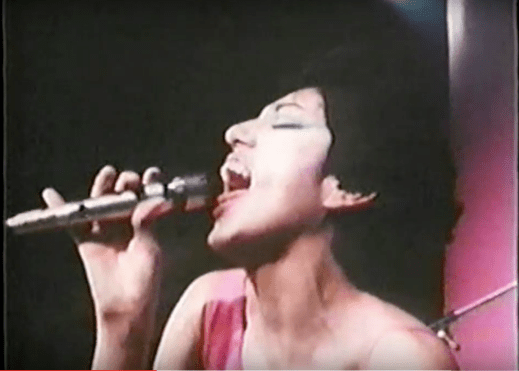
Screenshot from Alice Bag Band’s video “Gluttony.” Image used for purposes of critique.
Within Bag’s screaming from the Whiskey performance, Decline, to What We Do is Secret are snapshots or sonic/visual testimonios of queer Chicana women during the early 80s. These sonic snapshots/testimonios speak to the severely gendered and racialized repression of queer Chicana youth while still reconfiguring what empowerment looked like in the aftermath of the major socio-political movements of the 60s and 70s. In a casual conversation with Alice in a panel I guest moderated, she mentioned that watching “Gluttony” today was irksome to her because she was off-key. Perhaps, being off-key is one way that Chicana feminisms audibly reject neoliberal (and gendered) state repression. When we are surrounded by noise, we must remain enveloped in its infinite shape and simply listen. In noise we can resist, interrupt, and move away from orthodoxy and order. In today’s political climate, we need this framework now more than ever.
The return to Alice’s voice in this current moment is no coincidence. In preparation for this piece, I reflected on my brother’s deployment to Iraq during George W. Bush’s term. I was in community college taking a music appreciation course and I was searching for a paper topic that would be palatable to me as both a newly politicized queer Chicana and a former regular in the South Gate punk scene. It was through an interview with Teresa Covarrubias of The Brat and Alice Bag in an issue of Los Angeles Magazine that I heard Alice’s scream for the first time. It was the description of these women’s careers that led me to look up Chicana punk and come across the Whiskey performance of “Violence Girl.” To this day, Alice’s voice reminds us that if “Alice Bag was born from chaos” (310) then the Chicana punk voice remains a testament to punk’s resilience in the face of political uncertainty.
–
Featured image “Alice Bag Performing at Club Lingerie with the Cambridge Apostles” (CC BY 2.0)
–
Marlen Ríos-Hernández is a Ph.D. Candidate in the Ethnic Studies Department at the University of California, Riverside. Her current research revolves around queer Chicana/Mexicana punks in Mexico and Los Angeles from 1977-early 2000s respectively. Her dissertation aims to theorize and argue how Alice Bag, an innovator of the 1970s Los Angeles punk scene alongside other Mexicana punks, utilized noise to correlate the systemic disenfranchisement of womxn of color with the desire for transformational change integral to the survival of Mexicanas and first generation Chicana womxn especially during the Reagan and Bush Administrations. Via Ethnic Studies as her area of study along with her humanities and arts training as a Musicologist, Marlen investigates the relationship between unruly Chicana/Mexicana performing bodies and bisexuality, swapmeets, police brutality, photography, and film as instruments of noise-making.
–
REWIND! . . .If you liked this post, you may also dig:
























Recent Comments