
Sound at MLA 2014


DOI: https://doi.org/10.59350/fq036-jye23
Happy new year, dear Sounding Out! readers! Early January brings about New Year’s resolutions, specials on bins for holiday ornaments, Three Kings’ Day, and our yearly MLA sound studies panel round-up. This year, MLA 2014 attendees will get another blast of cold temperatures because this year’s convention is in Chicago—not much of a difference weather-wise from Boston but just as exciting! If you’re undecided about what panels to check out or if you’re not sure about where to start with the MLA Program, you’re in the right place: I combed the MLA Program page by page and condensed it just for our sound studies aficionados. If you’re sitting this MLA out or if you’re just curious about what the following panels are all about, it’s easy to follow the conference from home if you have access to Twitter. MLA is one of the most active academic conferences on social media: there’s the lively twitter hashtag #MLA14, the individual hashtags for each session (#s–followed by the session number), and an attentive twitter account (@MLAConvention), so even if you’re not in Chi-town you can still see what’s going on at your favorite panels this week.
Whereas last year some of the sound-oriented panels had a particular digital angle, this year there are several panels look at the intersection of sound and literary studies. The titles may not suggest sound, but the presentations do. For example, panel #s384 Literary Crossroads: African American Literature and Christianity includes presentations on representations of gospel and spirituality in different African American books. Another panel of interest is #s414, Literature and Media in the Nineteenth-Century United States arranged by the Division on Nineteenth-Century American Literature. (This panel resonates nicely with Sounding Out!’s Sound in the Nineteenth Century forum which just ended last Monday.) The focus on literature may come from the fact that the MLA brings many literary scholars together, but it is encouraging that the study of sound is also overlapping with the study of literature.

Despite that the convention brings literature scholars from across the United States together, some of the more intriguing sound-oriented panels are not focused on literature at all. In fact, several panels address sound from the angle of music. Panel #s131, The Musics of Chicago brings together High Fidelity and Lupe Fiasco, and panel #s162 on the HBO series Girls includes Chloe H. Johnson’s paper “Dancing on My Own: Popular Music and Issues of Identity in Girls.“ Although the fields of literary studies and cultural studies are sometimes in tension with each other, some MLA presenters are approaching popular culture particularly from an aural angle.
Music is not the only presence of sound in the MLA Program. Several panels bring up sound in conjunction with pedagogy. Some of our readers may remember the forum Sounding Out! hosted last year on sound and pedagogy—a forum of which I was a part. I’m glad to see other language, composition, and literature teachers are thinking about sound too. Panel #s114, Dialects of English Worldwide: Issues in English Language Studies includes several papers that think about spoken English nowadays. For those who are interested in how the sound of students’ speech are intersected by structural racism and public policy will find lots to think about with this panel. If you’re looking for concrete suggestions on using sound as a pedagogical approach, panel #s213 has some answers. Twenty-First-Century Pedagogies, arranged by the Discussion Group on the Two-Year College includes a presentation on sound essays by Kathryn O’Donoghue from the Graduate Center at City Univ. of New York.
Where will Team SO! be at MLA 2014? Editor-in-Chief Jennifer Stoever-Ackerman can be found at the DH Commons pre-conference workshop on Thursday, January 9, 2014; she will be presenting Friday, January 10 at 8:30 am on her research on Lead belly and Richard Wright as part of panel #s221, Singing Out in the American Literary Experience. Regular writer Regina Bradley will be presenting Friday at 5:15 pm on panel #s403 Words, Works, and New Archives: Studying African American Literature in the Twenty-First Century. Guest blogger Scott Poulson-Bryant will be at panel #s447, The Seventies in Black and White: A Soundtrack on Saturday at 8:30 am. I will be presenting on Friday morning at panel #s218, a roundtable on the graduate seminar paper and will be leading panel #s788, Back Up Your Work: Conceptualizing Writing Support for Graduate Students on Sunday at 1:45 pm. You can catch us on Twitter: @lianamsilvaford and @soundingoutblog where we’ll be live-tweeting panels and keeping followers up to date on convention chatter. Who knows, maybe there’ll be an impromptu SO! tweet-up? Stay tuned to our social media feeds!
Before I go, a shameless plug: As of this month I am the new editor of the newsletter Women in Higher Education, so if you want to meet up and talk about the newsletter please let me know!
Did I miss something? Maybe I somehow missed you or your panel in this round up? Please let me know either via email, via tweet, or post on the Sounding Out! Facebook page.
–
Liana Silva-Ford is co-founder and Managing Editor of Sounding Out!.
–
Featured image: “Mississippi North” by Flickr user John W. Iwanski, CC-BY-NC-2.0
–
Jump to THURSDAY, JANUARY 9, 2014
Jump to FRIDAY, JANUARY 10, 2014
Jump to SATURDAY, JANUARY 11, 2014
Jump to SUNDAY, JANUARY 12, 2014

THURSDAY, JANUARY 9, 2014
8:30 am-11:30 am
3. Get Started in the Digital Humanities with Help from DHCommons
Chicago A–B, Chicago Marriott
PRESIDING: Ryan Cordell, Northeastern Univ.; Josh Honn, Northwestern Univ.; Katherine A. Rowe, Bryn Mawr Coll.
The workshop welcomes language and literature scholars who wish to learn about, pursue, or join digital humanities (DH) projects but do not have the institutional infrastructure to support them. Representatives of DH projects and initiatives will share their expertise on project design, outline available resources and opportunities, and lead small-group training sessions on DH technologies and skills. Preregistration required.
12:00 pm-1:15 pm
31. Radical Curators, Vulnerable Genres: Lost Histories of Collecting, Editing, Bibliography
Michigan–Michigan State, Chicago Marriott
PRESIDING: Meredith L. McGill, Rutgers Univ., New Brunswick
SPEAKERS:
Jessica J. Beard, Univ. of California, Santa Cruz;
Alex Black, Cornell Univ.;
Jane Greenway Carr, New York Univ.;
Ellen Gruber Garvey, New Jersey City Univ.
Laura Helton, Univ. of Virginia
Courtney Thorsson, Univ. of Oregon
33. Sir Walter Scott and Music
Sheffield, Chicago Marriott
Program arranged by the Lyrica Society for Word-Music Relations
PRESIDING: Jeff Dailey, Five Towns Coll.
1. “Cutting Out the Castle Quicksand: Scott’s Bride, Donizetti’s Lucia, and the ‘Personally Furious’ Ayn Rand,” Shoshana Milgram Knapp, Virginia Polytechnic Inst. and State Univ.
2. “‘Drifting through the Intellectual Atmosphere’ from Scott’s Old Morality to Liszt’s Hexameron,” Catherine Ludlow, Western Illinois Univ.
3. “Walter Scott, British Identity, and International Grand Opera: Isidore de Lara’s Amy Robsart(1893),” Tommaso Sabbatini, Univ. of Chicago
For abstracts, visit lyricasociety.org.
1:45-3:00 pm
75. Voice and Silence
Mississippi, Sheraton Chicago
Program arranged by the Division on French Medieval Language and Literature
PRESIDING: Matilda Tomaryn Bruckner, Boston Coll.
1. “Gut Feelings,” Jason D. Jacobs, Roger Williams Univ.
2. “Tomboy Silence,” Wan-Chuan Kao, Washington and Lee Univ.
3. “Giving Voice to the Word of God; or, Bernard of Clairvaux Sings the Song of Songs,” Kris Trujillo, Univ. of California, Berkeley
3:30-4:45
114. Dialects of English Worldwide: Issues in English Language Studies
Illinois, Chicago Marriott
Program arranged by the Discussion Group on Present-Day English Language
PRESIDING: Elizabeth Bell Canon, Emory Univ.
1. “‘Speak the Language of Your Flag’: American Policy Responses to Nonanglophone Immigrants,” Dennis E. Baron, Univ. of Illinois, Urbana
2. “The Sounds of Silence: Standard and Nonstandard Englishes in Contemporary Ethnic American Writing,” Melissa Dennihy, Queensborough Community Coll., City Univ. of New York
3. “Star Spanglish Banter: Harnessing Students’ Linguistic Expertise,” Jill Hallett, Northeastern Illinois Univ.
4. “Emerging Attitudes toward New Media within the Discourses of Poetics and Literature,” April Pierce, Univ. of Oxford
5:15-6:30
131. The Musics of Chicago
Chicago H, Chicago Marriott
PRESIDING: Shawn Higgins, Univ. of Connecticut, Storrs
1. “Sweet Home Chicago? (Dis)Locating the American ‘Race Record’ in High Fidelity,” Jürgen E. Grandt, Univ. of North Georgia
2. “Experiment and Exodus in the Music of Chicago,” Toshiyuki Ohwada, Keio Univ.
3. “Fly Girls or Blackface? The Racial and Gender Politics of Lupe Fiasco,” Jorge Santos, Univ. of Connecticut, Storrs
141. Enduring Noise: Sound and Sexual Difference
Illinois, Chicago Marriott
PRESIDING: Rizvana Bradley, Emory Univ.
1. “Listening to Gertrude Stein’s Repeating: Sonorous Temporality in The Making of Americans,” Erin McNellis, Univ. of California, Irvine
2. “Queer Extensities: Pauline Oliveros and Disco,” Amalle Dublon, Duke Univ.
3. “Metal, Reproduction, and the Politics of Doom,” Aliza Shvarts, New York Univ.
RESPONDING: Rizvana Bradley
7:00-8:15 pm
162. Girls and the F Word: Twenty-First-Century Representations of Women’s Lives
Los Angeles–Miami, Chicago Marriott
PRESIDING : Tahneer Oksman, Marymount Manhattan Coll.
1. “‘My Shoes Match My Dress . . . Kind Of!’: The Politics of Dressing and Nakedness in Girls,” Laura Scroggs, Univ. of Minnesota, Twin Cities
2. “She’s Just Not That into You: Girls, Dating, and Damage,” Jennifer Mitchell, Weber State Univ.
3. “Dancing on My Own: Popular Music and Issues of Identity in Girls,” Chloe H. Johnson, York Univ., Keele
RESPONDING: Nancy K. Miller, Graduate Center, City Univ. of New York

FRIDAY, JANUARY 10, 2014
8:30 am-9:45 am
207. Diversifying the Victorian Verse Archives
Chicago A–B, Chicago Marriott
PRESIDING : Meredith Martin, Princeton Univ.
1. “Recovering Tennyson’s ‘Melody in Poetry’: Salon Recitations and Musical Settings,” Phyllis Weliver, Saint Louis Univ.
2. “Morris Metrics: The Work of Meter in the Age of Mechanical Reproduction,” Yopie Prins, Univ. of Michigan, Ann Arbor
3. “Digital Archives and the Music of Victorian Poetry,” Joanna Swafford, Univ. of Virginia
For abstracts, visit https://sites.google.com/a/slu.edu/diversifying-the-victorian-verse-archives/
213. Twenty-First-Century Pedagogies
Michigan–Michigan State, Chicago Marriott
Program arranged by the Discussion Group on the Two-Year College
PRESIDING: Stacey Lee Donohue, Central Oregon Community Coll.
1. “Not on Wikipedia: Making the Local Visible,” Laurel Harris, Queensborough Community Coll., City Univ. of New York
2. “Survival Spanish Online: Designing a Community College Course That Bridges Culture and Authentic Connections,” Cecilia McGinniss Kennedy, Clark State Community Coll., OH
3. “Sound Essays: A Cure for the Common Core,” Kathryn O’Donoghue, Graduate Center, City Univ. of New York
4. “Leveling Up! Gamifying the Literature Classroom,” Jessica Lewis-Turner, Temple Univ., Philadelphia
For abstracts, visit commons.mla.org/groups/the-two-year-college/announcements/ after 15 Dec.
217. Cuba on Stage
Arkansas, Sheraton Chicago
Program arranged by the Discussion Group on Cuban and Cuban Diaspora Cultural Production
PRESIDING: Vicky Unruh, Univ. of Kansas
1. “José Triana, Virgilio Piñera, and the Racial Erotics of Cuban Tragedy,” Armando Garcia, Univ. of Pittsburgh
2. “Estorino’s Gray Ghosts,” David Lisenby, Univ. at Albany, State Univ. of New York
3. “Musical Trangressions on the Cuban Stage: Rap, Rock, and Reggaeton,” Elena Valdez, Swarthmore Coll.
4. “Locating the Malecón,” Bretton White, Colby Coll.
221. Singing Out in the American Literary Experience
Old Town, Chicago Marriott
Program arranged by the Discussion Group on Folklore and Literature
PRESIDING: Mark Allan Jackson, Middle Tennessee State Univ.
1. “Re-sounding Folk Voice, Remaking the Ballad: Alan Lomax, Margaret Walker, and the New Criticism,” Derek Furr, Bard Coll.
2. “‘A Voice to Match All That’: Lead Belly, Richard Wright, and Lynching’s Sound Track,” Jennifer Stoever-Ackerman, Binghamton Univ., State Univ. of New York
3. “Stunting Gualinto: The Limits of Corrido Heroism in Americo Paredes’s George Washington Gomez,” Melanie Hernandez, Univ. of Washington, Seattle
For abstracts, write to majackso@mtsu.edu.
10:15-11:30
261. Applying Linguistics to the Learning of Middle Eastern Languages
Huron, Sheraton Chicago
Program arranged by the Discussion Group on General Linguistics
PRESIDING: Terrence Potter, Georgetown Univ.
1. “How Strategic Can They Be? Differences between Student and Instructor Attitudes toward Language Learning Strategies,” Gregory Ebner, United States Military Acad.
2. “Needs-Analysis Informed Task Design in Arabic Foreign Language Programs in the United States: Insights from Learner Perceptions and Production,” Maimoonah Al Khalil, King Saud Univ., Riyadh
3. “Linguistic Advantages and Constraints in the Classroom: Judeo-Spanish as an L2,” Bryan Kirschen, Univ. of California, Los Angeles
For abstracts, write to tmp28@georgetown.edu.
263. John Clare: The Voices of Nature
Chicago C, Chicago Marriott
Program arranged by the John Clare Society of North America
PRESIDING: Rochelle Johnson, Coll. of Idaho
1. “Speaking for the Trees: Margaret Cavendish, John Clare, and Voicing Nature,” Bridget Mary Keegan, Creighton Univ.
2. “Clare’s Air: Sound in Motion,” Paul Chirico, Univ. of Cambridge, Fitzwilliam Coll.
3. “John Clare: The Unusual and Challenging Natural Historian,” Eric H. Robinson, Univ. of Massachusetts, Boston
12:00 pm-1:15 pm
269A. Chicago Latina/o Writing: A Creative Conversation
Sheraton I, Sheraton Chicago
Program arranged by the Office of the Executive Director
PRESIDING: Ariana Ruiz, Univ. of Illinois, Urbana
SPEAKERS: Rey Andújar, Centro de Estudios Avanzados de Puerto Rico y el Caribe
Brenda Cárdenas, Univ. of Wisconsin, Milwaukee
Paul Martínez Pompa, Triton Coll.
Achy Obejas, Chicago, IL
270. Women’s Education in Third World Countries
Parlor G, Sheraton Chicago
Program arranged by the Discussion Group on Interdisciplinary Approaches to Culture and Society
PRESIDING : Shirin E. Edwin, Sam Houston State Univ.
1. “Narrative Approaches to Transmitting Regional Oral and Instrumental Literary Traditions in the Works of Aminata Sow Fall,” Julie Ann Huntington, Marymount Manhattan Coll.
2. “Gender, Class, and Education: Intersections in South Asian Literature,” Maryse Jayasuriya, Univ. of Texas, El Paso
3. “Women’s Schooling in Clarice Lispector’s Narrative: A Brazilian Education,” Alejandro E. Latinez, Sam Houston State Univ.
279. Dadaphone: Indeterminacy in Words and Music
Huron, Chicago Marriott
Program arranged by the Lyrica Society for Word-Music Relations and the Association for the Study of Dada and Surrealism
PRESIDING : Jeff Dailey, Five Towns Coll.
1. “Black Dada,” Kathy Lou Schultz, Univ. of Memphis
2. “Aleatory Adaptation and Indeterminate Interpretation: Radiohead’s In Rainbows as Faustian Rock Opera,” Meg Tarquinio Roche, Northeastern Univ.
3. “Game Changer: Cage’s Word-Music Combination in ‘Renunion’ and ‘Solo 23,'” Sydney Boyd, Rice Univ.
4. “Graphic Notation in Contemporary Music and Its Debt to Dada,” Laura Prichard, Univ. of Massachusetts, Lowell
For abstracts, visit lyricasociety.org.
5:15 pm-6:30 pm
384. Literary Crossroads: African American Literature and Christianity
Addison, Chicago Marriott
Program arranged by the Conference on Christianity and Literature and the Division on Literature and Religion
PRESIDING: Katherine Clay Bassard, Virginia Commonwealth Univ.
1. “God’s Trombones, the Social Gospel, and the Harlem Renaissance,” Jonathan Fedors, Univ. of Pennsylvania
2. “When the Gospel Sings the Blues in Ralph Ellison’s Invisible Man,” Claudia Rosemary May, Univ. of California, Berkeley
3. “Faith Moves: Belief and the Body in Bill T. Jones’s Chapel/Chapter and Toni Morrison’sParadise,” Leslie Elizabeth Wingard, Coll. of Wooster
For abstracts, write to kcbassar@vcu.edu.
403. Words, Works, and New Archives: Studying African American Literature in the Twenty-First Century
Michigan–Michigan State, Chicago Marriott
Program arranged by the College Language Association
PRESIDING : Warren Carson, Univ. of South Carolina, Spartanburg
1. “The Field and Function of African American Literary Scholarship: A Memorial and a Challenge,” Dana A. Williams, Howard Univ.
2. “The Black Book: Creating an Interactive Research Environment,” Kenton Rambsy, Univ. of Kansas
3. “Keepin’ It Interactive: Hip-Hop in the Age of Digital Reproduction,” Regina Bradley, Kennesaw State Univ.; Jeremy Dean, Rap Genius, Inc.
414. Literature and Media in the Nineteenth-Century United States
Chicago A–B, Chicago Marriott
Program arranged by the Division on Nineteenth-Century American Literature
PRESIDING : Meredith L. McGill, Rutgers Univ., New Brunswick
SPEAKERS: Jonathan Elmer, Indiana Univ., Bloomington
Teresa Alice Goddu, Vanderbilt Univ.
Naomi Greyser, Univ. of Iowa
Brian Hochman, Georgetown Univ.
Christopher J. Lukasik, Purdue Univ., West Lafayette
Lauren A. Neefe, Stony Brook Univ., State Univ. of New York
For project statements, panelist biographies, and description of roundtable format, visit19thcamlitdiv.wordpress.com after 1 Dec.

SATURDAY, JANUARY 11, 2014
8:30 am-9:45 am
441. Socialist Senses
Ohio, Sheraton Chicago
Program arranged by the Discussion Group on Slavic Literatures and Cultures
PRESIDING : Nancy Condee, Univ. of Pittsburgh
1. “The Materiality of Sound: Esfir Shub’s Haptic Cinema,” Lilya Kaganovsky, Univ. of Illinois, Urbana
2. “From the Cinema of Attractions to the Cinema of Affect in Early Socialist Realism,” R. J. D. Bird, Univ. of Chicago
3. “Ineluctable Modality of the Visible: Gorky’s Return and the Onset of Clarity,” Petre M. Petrov, Princeton Univ.
For abstracts, visit mlaslavic.blogspot.com/ after 30 Dec.
447. The Seventies in Black and White: A Soundtrack
Purdue-Wisconsin, Chicago Marriott
PRESIDING : Jack Hamilton, Harvard Univ.
1. “Mutts of the Planet: Joni Mitchell Channels Charles Mingus,” David Yaffe, Syracuse Univ.
2. “Righteous Minstrels: Race, Writing, and the Clash,” Jack Hamilton
3. “Broken Masculinities: Black Sound, White Men, and New York City,” Scott Poulson-Bryant, Harvard Univ.
10:15 am-11:30 am
474. African American Voices from the Civil War
Michigan–Michigan State, Chicago Marriott
PRESIDING : Timothy Sweet, West Virginia Univ., Morgantown
1. “The Color of Quaintness: Thomas Wentworth Higginson, Black Song, and American Union,”Jeremy Wells, Indiana Univ. Southeast
2. “‘If We Ever Expect to Be a Pepple’: The Literary Culture of African American Soldiers,” Christopher A. Hager, Trinity Coll., CT
3. “‘And Terrors Broke from Hill to Hill’: The Civil War Poems of George Moses Horton,” Faith Barrett, Duquesne Univ.
4. “The Negro in the American Rebellion: William Wells Brown and the Design of African American History,” John Ernest, Univ. of Delaware, Newark
485. Digital Practice: Social Networks across Borders
Missouri, Sheraton Chicago
Program arranged by the Division on Twentieth-Century German Literature
PRESIDING : Stefanie Harris, Texas A&M Univ., College Station
1. “Kafka and the Kafkaesques: Close Reading Online Fan Fiction,” Bonnie Ruberg, Univ. of California, Berkeley
2. “Network Politics, Wireless Protocols, and Public Space,” Erik Born, Univ. of California, Berkeley
3. “Intersections of Music, Politics, and Digital Media: Bandista,” Ela Gezen, Univ. of Massachusetts, Amherst
Responding: Yasemin Yildiz, Univ. of Illinois, Urbana
For abstracts, visit german.berkeley.edu/transit.
12:00 pm-1:15 pm
508. Performing Blackness in the Nineteenth Century
Chicago A–B, Chicago Marriott
Program arranged by the Division on Nineteenth-Century American Literature
PRESIDING : Harvey Young, Northwestern Univ.
1. “Being Touched: Sojourner Truth’s ‘Spiritual Theatre’ and the Genealogy of Radical Black Activism,” Jayna Brown, Univ. of California, Riverside
2. “Frederick Douglass and the ‘Claims’ of Democratic Individuality in Antebellum Political Theory,” Douglas Jones, Princeton Univ.
3. “’Dey Make Me Say Dat All De Time: Performance Art, Objecthood, and Joice Heth’s Sonic of Dissent,” Uri McMillan, Univ. of California, Los Angeles
509. Becoming Chroniclers: Latin American Women Writers and the Press, 1920–73
Parlor F, Sheraton Chicago
PRESIDING : Vicky Unruh, Univ. of Kansas
1. “The Opportunities of Technology: Cube Bonifant’s Radiophonic Chronicles in El universal ilustrado,” Viviane A. Mahieux, Univ. of California, Irvine
2. “Key Moments in the Subversion of a Genre: Alfonsina Storni and Clarice Lispector Redefine Womanhood,” Mariela Méndez, Univ. of Richmond
3. “Issues of Gender and Genre: Isabel Allende and Clarice Lispector Writing Chronicles, 1968–73,” Claudia Mariana Darrigrandi, Universidad Adolfo Ibáñez
1:45 pm-3:00pm
572. Illness and Disability Memoir as Embodied Knowledge
Los Angeles–Miami, Chicago Marriott
Program arranged by the MLA Committee on Disability Issues in the Profession
PRESIDING : Rachel Adams, Columbia Univ.
1. “Recoding Silence: Teresa de Cartagena, Medieval Sign Lexicons, and Deaf Life Writing,” Jonathan H. Hsy, George Washington Univ.
2. “‘Twisted and Deformed’: Virginia Woolf, Alison Bechdel, and Crip-Feminist Autobiography,” Cynthia Barounis, Washington Univ. in St. Louis
3. “‘My Worry Now Accumulates’: Sensorial and Emotional Contagion in Autistic Life Writing,” Ralph James Savarese, Grinnell Coll.
For papers or abstracts, write to rea15@columbia.edu after 1 Jan.
3:30 pm-4:45 pm
586. Early Modern Media Ecologies
Great America, Chicago Marriott
PRESIDING: Jen Boyle, Coastal Carolina Univ.
1. “Needlework Networks: Paper, Prints, and Female Authorship,” Whitney Trettien, Duke Univ.
2. “Sidney Circularities: Music and Script in the Contrafactum Lyric,” Scott A. Trudell, Univ. of Maryland, College Park
3. “Stage, Stall, Street, Sheet: Multimedia Shakespeare,” Adam G. Hooks, Univ. of Iowa
For abstracts, visit www.scotttrudell.com.
591. Multilingualism in Native American and Aboriginal Texts
Kane, Chicago Marriott
Program arranged by the Division on American Indian Literatures
PRESIDING : Beth H. Piatote, Univ. of California, Berkeley
1. “Reading Resistance and Resisting Readings in a Bilingual Text,” Laura J. Beard, Univ. of Alberta
2. “Narrative and Orthography in Cree Oral Histories,” Stephanie J. Fitzgerald, Univ. of Kansas
3. “Ongwe Onwe Languages in the Fourth Epoch of Iroquois History,” Penelope M. Kelsey, Univ. of Colorado, Boulder
4. “Poetics of ka ‘āina and na ‘ōiwi: Language(s) of Land, Earth, and the Hawaiian People in Haunani-Kay Trask’s Night Is a Sharkskin Drum,” Nicole Tabor, Moravian Coll.
5:15 pm-6:30 pm
624. Boethius’s Consolation of Philosophy in Medieval and Early Modern England: Form and History
Old Town, Chicago Marriott
PRESIDING : Ian Cornelius, Yale Univ.
1. “Singing and Speaking Boethius in Anglo-Saxon England,” Anne Schindel, Yale Univ.
2. “Sensible Prose and the Sense of Meter: Ethics and the Mixed Form in Boethius and After,” Eleanor Johnson, Columbia Univ.
3. “Boethius’s Consolation of Philosophy and an Expansive Theology in the Late Sixteenth Century: Queen Elizabeth’s Translation in Context,” Linda Suzanne Shenk, Iowa State Univ.
For abstracts, write to ian.cornelius@yale.edu.
625. Verbal and Visual Satire in the Nineteenth Century
Chicago F, Chicago Marriott
PRESIDING : Joseph Litvak, Tufts Univ.
1. “Organizing Anarchy: Class, Intellectual Property, and Graphic Satire,” Jason Kolkey, Loyola Univ., Chicago
2. “The Reemergence of Radical Satire in the Late Nineteenth Century,” Frank A. Palmeri, Univ. of Miami
3. “Turn-of-the-Century Satirical Plots of Fenian and Anarchist Terrorism,” Jennifer Malia, Norfolk State Univ
645. Current Issues in Romance Linguistics
Parlor F, Sheraton Chicago
Program arranged by the Discussion Group on Comparative Romance Linguistics
PRESIDING : Andrea Perez Mukdsi, Univ. at Buffalo, State Univ. of New York
1. “Attribution in Romance: Reconstructing the Oral and Written Tradition,” Martin Hummel, Karl-Franzens-Universität Graz
2. “Pronouns and the Author-Reader Relationship in Academic Portuguese,” Karina Veronica Molsing, Pontifícia Universidade Católica do Rio Grande do Sul; Cristina Perna, Pontifícia Universidade Católica do Rio Grande do Sul
3. “The Semantic Feature [+INFLUENCE] and the Spanish Subjunctive,” M. Emma Ticio Quesada, Syracuse Univ.
4. “Palatalization in Chilean Spanish and Proto-romance,” Carolina Gonzalez, Florida State Univ.
For abstracts, write to perezmukdsi@gmail.com.

SUNDAY, JANUARY 12, 2014
12:00 pm-1:15 pm
742. Socialist Culture in the Age of Disco: East European Popular Pleasures
Parlor F, Sheraton Chicago
Program arranged by the American Association of Teachers of Slavic and East European Languages
PRESIDING: Jessie M. Labov, Ohio State Univ., Columbus
1. “Imperial Disco: Czeslaw Milosz and Science Fiction,” Mikolaj Golubiewski, Free Univ.
2. “The ‘Movement of Writing Workers’ and State Stability in the 1970s German Democratic Republic,” William Waltz, Univ. of Wisconsin, Madison
3. “Flaming Socialist Creatures: Hippies as Auteurs in Soviet Latvia,” Mark Svede, Ohio State Univ., Columbus
For abstracts, visit mlaslavic.blogspot.com/.
744. Mass versus Coterie: The Audiobook
Missouri, Sheraton Chicago
Program arranged by the Division on Prose Fiction
PRESIDING : Rebecca L. Walkowitz, Rutgers Univ., New Brunswick
1. “‘Fully Fleshed Out and Filled with Emotion’: Accent, Region, and Identification in the Reception of The Help,” Sydney Bufkin, Univ. of Texas, Austin
2. “Joyce, LibriVox, and the Recording Coterie,” Brandon Walsh, Univ. of Virginia
3. “Alien Stereo: China Mieville’s Embassytown,” Christopher Pizzino, Univ. of Georgia
1:45 pm-3:00 pm
788. Back Up Your Work: Conceptualizing Writing Support for Graduate Students
Grace, Chicago Marriott
PRESIDING : Liana Silva-Ford, Houston, TX
SPEAKERS:
Tara Betts, Binghamton Univ., State Univ. of New York;
Lee Ann Glowzenski, Duquesne Univ.;
Annemarie Pérez, Loyola Marymount Univ.
Abigail Scheg, Elizabeth City State Univ.
792. Old Materials, New Materialisms
Missouri, Sheraton Chicago
Program arranged by the Division on Methods of Literary Research
1. “Objects, Authors, and Other Matter(s) in the Gloria Anzaldúa Archive,” Suzanne M. Bost, Loyola Univ., Chicago
2. “Writing Histories of Listening: Acoustemology as Literary Practice,” Ely Rosenblum, Univ. of Cambridge
3. “Even the Stones Cry Out: Archival Research and the Inhuman Turn,” Andrew Ferguson, Univ. of Virginia
4. “A Life of Its Own: A Vital Materialist Look at the Medieval Manuscript as an Agentic Assemblage,” Angela Bennett Segler, New York Univ.

—
Share this:

“I’m on my New York s**t”: Jean Grae’s Sonic Claims on the City

Hellooooooo, Cyberspace! Are you ready to rock??? Welcome to our February Forum on “Sonic Borders,” a collaboration with the IASPM-US blog in connection with this year’s IASPM-US conference on Liminality and Borderlands, held in Austin, Texas from February 28 to March 3, 2013. Expertly organized by Sounding Out!’s Managing Editor Liana Silva and IASPM’s Web Editor/Webmaster Justin Burton (and curated for SO! by yours truly), the “Sonic Borders” forum is a Virtual Roundtable cross-blog entity that will feature six Sounding Out! writers posting on Mondays beginning today and running through February 25, and four writers from IASPM-US, posting on Wednesdays starting February 6th and ending February 27th. We envision plenty of excitement and cross blog commenting from authors, audiences, and IASPM-US conference attendees. Consider this your ticket to the show, so please come on in and mix it up!
And what will we be talking about across our platforms? The “sonic borders” between sound studies and popular music studies. . .where their methods, objects of study, and approaches overlap, where they rub raw, where they challenge the people on either side to do do better, and where they meet to generate some of the finest scholarship in the contemporary humanities.
And who will you be hearing from over here at Sounding Out!?: Liana Silva, SO! regular Regina Bradley, Marcus Boon (York University, The Wire), Daphne Brooks (Princeton), Tavia Nyong’o (NYU), and Art Jones (film-maker, photographer, artist, mixer, raconteur, School of the Museum of Fine Arts, Boston).
And what topics do you have a front row ticket for? Some real New York shit. Django. Body-regenerating vibrations on the dance floor. Cabaret, jazz, and funk/soul, plus musical memory, dance, performance art, race, gender, sexuality, and politics. Sound gatherings in Pakistan.
Feel free to camp out and shine your cell phone lights at each day of our Forum, because we’re turning it up to 11 over here at Sounding Out! and IASPM-US!—Jennifer Stoever, Editor-in-Chief
***
DOI: https://doi.org/10.59350/7z2y0-zz956
If you had to guess whether the singers of the following lyrics were male or female, how would you fare? Click on the lyrics to hear the song and find out who’s the rap artist.
“We gon’ hold it down for Illadel for life
Came through made a name, nigga nailed it tight
An’ now we shine, been knew, shit, it was about time
Switched from streets, the beats, platinum lines
Used to struggle in the hood just to brodie the mic
Took the fame ’cause they ain’t give it us, now we excite
The biggest crowds an’ they screamin’ loud, “Philly the shit”
“They hear Brooklyn, and we up to no good
Well, here we come, so there goes your neighborhood
Timbos scuffed up, sess bein’ puffed up
Mess with the wrong one, kid, you get ruffed up”
“My city do it best, whether it’s East or West
We feelin’ good fine, love it when it’s summertime
Detroit in summertime, summer time in Detroit,
Detroit in summertime, summertime in Detroit”
Although it is somewhat unfair to judge the gender of a rapper by the lyrics of a song, it is commonly thought that if a rapper is talking about the city, they are more than likely a man. Are there borders in hip hop around the content that men or women can address?
Case in point: several years ago I wrote a paper on representations of the city in hip hop songs. It gave me the opportunity to look closely and write extensively about some of my favorite hip hop artists and songs. However, most of the songs I tackled in the paper, actually most of the songs that occurred to me, were written and sung by male rappers. When I realized this, I couldn’t believe my oversight. Surely there had to be female rappers invoking the city in their songs. Men couldn’t be the only ones claiming the city. So, over the years I have been on the hunt for songs by female emcees that talk about the city. (I recently started a Spotify playlist, but several of the songs I have come across are on mix tapes that don’t show up on Spotify. If you have any suggestions you’d like to add to this collaborative playlist, please add them or mention them in the comments!)
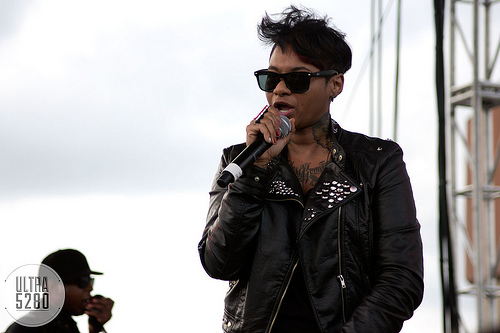
One of the female emcees that stands out most is Brooklyn-based Jean Grae. Born in South Africa in 1976, she moved to the United States with her parents shortly after she was born and grew up in New York City. In a 2006 interview with Robert Walsh for the academic journal Callaloo, Jean Grae reminisces about how hip hop culture was inescapable for a teen in New York City in the early nineties:
It was a thing when kids finally realized that you could put out your music yourself and you didn’t have to wait around and get signed. It was possible to learn for yourself and be able to put out music on your own or on an underground level. It was kind of unavoidable to be a part of it, I guess. (216)
After a brief stint as a DJ, she opted for rapping, as she was already writing (even if not necessarily rhyming). She took a hiatus from the hip hop scene in 2008 but later that year returned to performing and finally released a new mixtape named Cookies or Comas in 2011.
In hip hop, cities are often represented as masculine–what with the number of male rappers dropping stories about how things go down on the street–and Jean Grae complicates that representation. In Jean Grae’s version of Busta Rhymes’ “New York Shit,” she opens a door to thinking about female rappers and urban space, and her sonic intervention into Busta Rhymes’ narrative in his version of “New York Shit” illustrates how female rappers claim the city as well. I read her track as an act of urban homemaking: rapping about the city (and subverting the male voice that initially sung on the track, Busta) becomes a practice to claim the city as her home. In fact, it is not just through her lyrics but also through her voice that Jean Grae makes her presence felt.
Jean Grae’s version of “New York Shit,” a collaboration with rapper Talib Kweli, is an alternate version of Busta Rhymes’ hit track “New York Shit” from his 2006 album The Big Bang, although both songs use the same sampled loop and constantly repeat the phrase “New York Shit.”
The track that “New York Shit” samples is from the opening of a 1976 song titled “Faded Lady” from The Soul Sensation Orchestra (featuring Douglas Lucas and The Sugar Sisters, who sing together throughout the whole song). The song itself tells the story of a “faded lady” who seems to have lost her hopes, dreams, and connection to the world around her. “New York Shit,” both the Busta Rhymes and the Jean Grae/Talib Kweli version, samples approximately the first 13 seconds of the song, so that in their version the voices are erased; all that is left is the even thump thump of a drum, a bass, and a guitar, with the clash of a top hat and the bass in between, finally rising up to a climax with what sounds like a flute or clarinet until it drops back into the thump thump. The loop invokes the soundtracks of blaxploitation films, several of which were set in urban locations. The sample choice then places “New York Shit” in an urban soundscape.
Busta’s original song weaves images of New York as the birthplace of hip hop, as the location of great sports teams, and expensive taste around this soulful, smooth loop. The chorus of the song (“If you’re from New York, stand up right now, If you’re from New York, hands up right now”) calling forth New Yorkers. In the song, Busta also pays homage to some of the big names in hip hop who come from New York: Ol’ Dirty Bastard, Notorious BIG, Big Pun, Jam Master Jay, while the video includes cameos from people like Q-Tip, RZA, Slick Rick, and Big Daddy Kane. In this way, the song celebrates their contributions to hip hop, but also recreates a narrow, gendered view of who is part of that musical history.
However, the sonic picture Busta Rhymes paints is one that is devoid of women. Before the loop starts, Busta Rhymes’ voice emerges from the quiet: “DJ Scratch you’re sick for this one,” which acts as the signal for a chorus of male voices. Some of them whoop, some of them whistle, and some of them sing. Eventually they make way for Busta Rhymes to serenade listeners with his tales of New York life. His voice sounds gruff and aggressive, a contrast with the smooth vibe of “Faded Lady.” In fact, it seems as if the “faded lady” of the title is not just faded but erased–the women in the city become the faded ladies whose erasure makes possible for this problematic representation of urban space.
Enter Jean Grae.
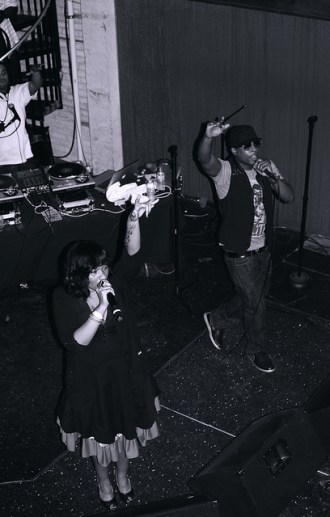
In 2006, she and Talib Kweli released their version of “New York Shit” in a mixtape titled Hip Hop Docktrine: The Official Boondocks Mixtape which responds to Busta Rhymes’ sonic tribute to New York. (It also appeared on the mixtape Talib Kweli Presents Blacksmith the Movement.) Busta Rhymes’ song comes immediately to mind when listening to Jean Grae’s sixteen bars, especially when she starts with “Some of y’all forgot what New York is,” and in that vein it is hard not to hear Jean Grae’s track as a response to Busta Rhymes’.
Whereas Busta Rhymes’ song is ushered in by a chorus of disparate men’s voices, Talib Kweli and Jean Grae’s version starts with Talib Kweli’s introduction, followed by Jean Grae’s rapping. Talib Kweli’s introduction tricks the listener into thinking this version is just an echo of the original by Busta Rhymes (especially since the loop is virtually unchanged) until Jean Grae pops up by responding to Talib Kweli’s “I went for mine” with her “Go for yours, man.” The back-and-forth of the male and female voices, laid upon the same loop, acts as a subversion of Busta Rhymes’ male New York chorus.
But Jean Grae’s rapping is the most subversive element of the song. Jean Grae’s first line, “I’m on my New York shit,” calls forth Busta Rhymes’ song, even in her tempo. However, her verses take a swift turn from what Busta Rhymes puts forth in his song; at first listen, Busta Rhymes’ snappy, aggressive repetition of the phrase “New York [plus noun]” at the end of each verse is absent from Jean Grae’s rapping. Her voice seems to float on top of The S.S.O. loop, picking up speed when the loop reaches a climax, and dropping an octave or two (and slowing down a tad, too) when the climax of the track drops and loops back to the beginning. The resulting effect is that Jean Grae’s voice merges with the soulful flow of the song whereas Busta Rhymes’s voice is at war with it. Through her voice, Jean Grae disrupts Busta Rhymes’ sonic portrayal of a men’s-only New York. In fact, by subverting the vocal pattern Busta Rhymes sets up in the original version, Jean Grae creates a space in this New York hip hop narrative for female rappers to claim New York City as their own.
In her verses, Jean Grae depicts a New York that is not glamorous or glitzy, like the one in Busta Rhymes’ song. Instead she talks about a “cement jungle,” and men who “struggle to their feet”; she also invokes the perils of gentrification when she talks about the Starbucks that pop up around the block (an indication of the white middle class coming to the neighborhood). But what catches my ear from this song is that Jean Grae mentions toward the end of her bars, “I just want to write and give back to the city that I’m a factor of.” Writing and rapping become a way for Jean Grae to practice her New York citizenship, an act of urban homemaking.
Even though Jean Grae busts her way into this narrative of urban masculinity, she is still a lonely female voice in the “New York Shit” repertoire. According to Wikipedia, there are several versions of the song, but Jean Grae is one of only two women to take on “New York Shit.” (Brooke Valentine has a version titled “H-Town Shit,” but I am limiting myself to the versions that look at New York City.) In that sense, Jean Grae’s female voice doesn’t necessarily fill a void in hip hop but rather points to it. On the other hand, her voice can be read/heard as highlighting a tradition of women rapping about the city. Whereas many rap songs invoke cities and urban locations, oftentimes these are portrayed as the sites of male dominance, normalizing a sonic cityscape that consists solely of men However, Jean Grae’s vocal track resists to that sonic cityscape, and that resistance too is an act of urban homemaking by virtue of claiming her space.
I continue to look for more tracks by female rappers and MCs that talk about U.S. cities, and this post has brought to mind more questions that I need to address. For example, what does it mean for a woman to rap about the city? Are there certain themes that echo throughout the songs (or throughout certain periods or subgenres)? Are there certain samples that are repeated? Do the sounds vary from city to city? These are questions that can be addressed by looking at a broader sample, but a close reading of one track can go a long way into thinking through these issues. Female rap artists like Jean Grae remind listeners that, to signify on Jay-Z, there is love in the heart of the city.
—
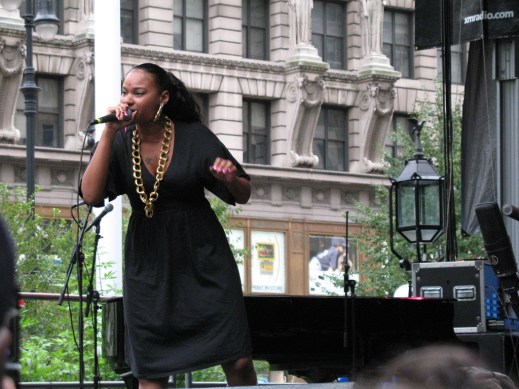
Featured Image of Jean Grae performing in New York City on August 26, 2006, Courtesy of Flickr User MrMoneda
—
Liana M. Silva is co-founder and Managing Editor of Sounding Out!
—
Share this:




Current Top Posts





April 2021

January 2020

November 2019

October 2019

August 2019

April 2014

November 2017

March 2015

December 2017

October 2015


Recent Comments