
SO! Reads: Shana Redmond’s Anthem: Social Movements and the Sound of Solidarity in the African Diaspora

DOI: https://doi.org/10.59350/h0g6f-m3e21
To follow a song, to trace its roots and genealogy, to consider the context of its emergence as well as its lineage. To consider how sound and song propels political movement. To trace histories and concepts through the enunciative force of sound, of song. This is the work of Shana L. Redmond’s Anthem: Social Movements and the Sound of Solidarity in the African Diaspora (NYU Press, 2014). Redmond is Associate Professor of American Studies and Ethnicity at University of Southern California and the 2014-2015 Ella Baker Visiting Associate Professo of Black Studies at UC Santa Barbara, with research interests in music and popular culture, history and social movements, labor and working-class studies and critical ethnic studies. And this is to say nothing of her interests inAfrican Diaspora and Black political and social life. All these interests are made explicit within Anthem, a book that compels readers and listeners not only to ask questions about bygone eras, but to consider the soundscapes and beat drops of their own milieus. Redmond’s work, in other words, causes readers to consider the efficacy of sound and song making as the vibratory force that inheres in any social mood and movement. Anthem‘s power lies in the attention Redmond gives the circulation of sound and song: how each emerges from specific contexts as well as how songs end up being contested sonic sites wherein an intellectual practice of justice organizing can be articulated and Black sociality and personhood asserted and contended.
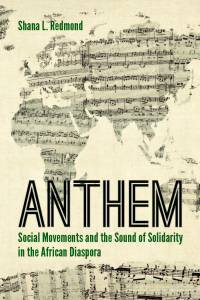
In particular, Redmond utilizes the concept of the Black anthem as a theoretical tool in order to consider the efficacy of organizing and fighting against practices of racism, sexism and imperialism. Redmond documents Black anthems as “sonic productions” that “were not ancillary, background noise” but “were absolutely central to the unfolding politics because they held within them the doctrines and beliefs of the people who participated in their performance” (8). That sounds, that songs, have so much potential to enunciate otherwise modes of living; that sounds, that songs, have within them the capacity to announce otherwise worlds, is something well known to those violently excluded from modernity and its epistemologies of the human, the citizen, the subject. We know this otherwise mode of living, this otherwise modality of world, affectively. And this affectivity is born out in aesthetic practice. Thus, to attend to the organizing of sound – as song – and how such musics made their way from, for example, Harlem to Cuba in the case of the Universal Negro Improvement Association’s “Ethiopia” or from women’s singing in Charleston to international stages, is all within the analysis and the archives offered by Redmond. What pleases is how her historical archival work is inflected by sonic analyses of songs; Redmond discusses the musicality of songs, how chord changes, harmonies, and melodies offer fresh insight into ways to think sonically about the movement of sound and song.
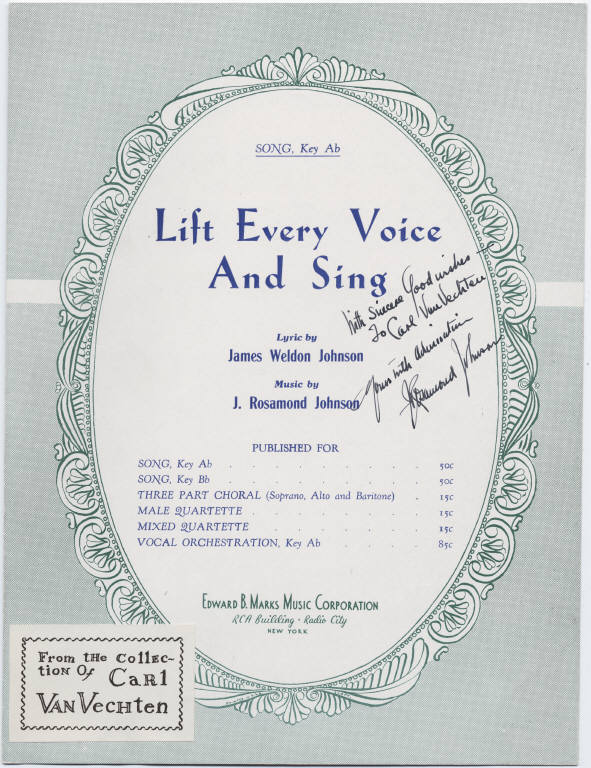
Anthem appeals to those interested in Black social movements of the twentieth-century, to be sure. But the book also makes musicological argumentation central to its thesis. So, for example, readers not only learn about lyrical content and history of brothers James Weldon and John Rosamond Johnsons’ “Lift Ev’ry Voice and Sing,” but they are also compelled to think about the song in its sonic registers, with its musicological features. For example,
The first measure of the vocal line is a half measure and offers a running start to the A-flat major key signature, with the text ‘lift ev’-ry’ notated by three eight notes in the 6/8 time signature. While the song was written in 6/8, its performance follows a 12/8 phrasing, placing it alongside the Black gospel tradition, which…was growing in dynamic ways at this very moment. The quick introduction leads the vocalist to a strong tonic chord on the downbeat of measure 2. The melodic emphasis lands on the word ‘voice’ with ‘and sing’ (measures 10 and 11) following as long notes (72-3).
This so say that Redmond takes seriously the ways songs are constructed as part of the argument she wants to put forward about the efficacy of the Black anthem. Her work models how to attend to the musicological as a fundamental feature of sound and song-making in Black sociality.
In considering the context of emergence for sounds and songs, Redmond produces a text that fits squarely within Black performance theory, since she is less concerned with the rightness or wrongness and much more with the efficacy of performance. The concern and the question of efficacy displaces the necessity for results-driven analyses in Black performance theory, placing emphases on how the production of sound and song proliferates, how it finds life, how it creates – while also being created by – worlds. Impressively, Redmond’s thorough sonic-historical approach to her archive gives her method resonance beyond even its richness. Anthem can be radicalized through generalizing its treatment of to songs as objects that are both part of and propel movements, enabling us to consider the context of emergence for any song and performance. Generalizing Anthem means that readers would take seriously the attempt to move from the specific sonic moment to the general, from various, plural moments of emergence to considering how sounds and songs move, how they create otherwise temporalities and spatial zones. Anthem produces a new theory of thinking relation between specific performances and their history and social movements, both in local and in global diasporic contexts.
In addition, Redmond analyzes how songs–and sounds within such songs–can at times be utilized to further racialist, sexist, imperialist impulses and practices. For example, Redmond analyzes “Ol’ Man River” in multiple forms and contexts, including the performance changes produced by Paul Robeson. Here Redmond begins the tension in the dialect as written by Oscar Hammerstein II and Robeson’s deployment of the song in performance.
The dialect demonstrates a particular version of blackness out of sync with the ‘fine intelligence’ of Robeson, a Phi Beta Kappa scholar at Rutgers University and Columbia Law School graduate. Hammerstein’s dialect not only distinguishes Black from white in the musical but also serves to contain the Black characters in their natural state as uneducated and simple laborers and confidants (105).
Thus, sound and song can also be deployed otherwise, can be used in order to critique, to produce an intervention into such normative conceptions of blackness. And from Redmond’s text, readers learn something of Robeson’s radicalizing, of his deep engagement with thinking global blackness, through the way he changed the lyrical content, and thus the dialect and mood, of “Ol’ Man River.”
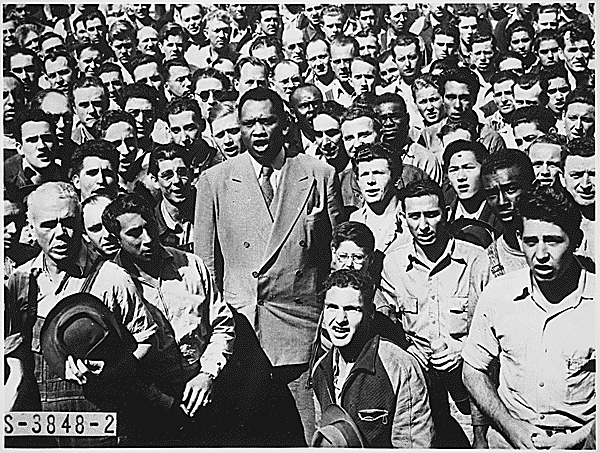
Oakland, CA, September 1942, Image courtesy of the National Archives and Records Administration
Still Picture Branch, Record Group 208, National Archives Identifier: 535874
Ultimately, Anthem produced for me the occasion to wonder if we can think the very concept of diaspora otherwise, as a following of vibrational moods and movements, as antiphonal participation in an ongoing call. And as an ongoing call that is resistive in its enunciation, that is ongoing and open-ended. If we did so, perhaps we would also come to understand Black sociality otherwise. In other words, perhaps we can think of it as making a claim on us, a ceaseless and performative ceaseless pulse that beckons and convokes. We are then forced to consider what our response will be to this ongoing call, what reply and resolve we give. In such a response, reply and resolve will have been irreducible, will have had no grounds, will have been constant. Sound and song are resistant to any desire for capture because of the internal disruptive capacities of vibration. Whatever the sound, whatever the song, it has within it vibration, vibration as the materiality that makes anything audible, that gives anything over to its possibly being heard. And if vibration is the grounds from which sound and song emerge, if thoughts of diaspora and blackness and sociality were inflected through such vibration, what we are called to consider is the ongoing sound, the ongoing echo, the ongoing verve and materiality of otherwise modes of living into the world.
As vibrational, Anthem forces readers to think of possibilities for sociality not grounded in categorical distinction as pure or as possibly maintained. “Through anthems,” Redmond argues, “the delineation between art and politics as well as listener and actor is blurred” (2). This blurring can be radicalized as a generalized feature of Black performance as theory and critical intervention into the normative world that depends upon invented–and distinct–categories in order to produce ongoing violence. In their accounting, the sounds, songs, and sonicity of blackness, Black sociality and Black antiphonal force demand a radical rethinking of categorical distinctions of racial classifications, gender binaries, and nation-states. And their vibrations resonate outward. On and on and on and on.
—
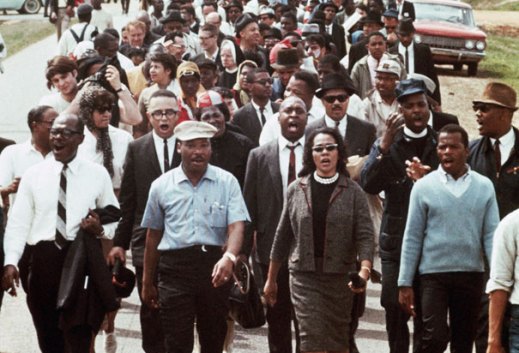
Featured Image: American Civil Rights Movement leaders singing on the 1965 March from Selma to Montgomery, Alabama, Photo Credit: Bettman/Corbis
—
Ashon Crawley is Assistant Professor of African American Studies in the Ethnic Studies Department of University of California, Riverside. He earned his doctoral degree from Duke University in the English Department with a certificate in African and African American Studies. Before Duke, he attended the Candler School of Theology at Emory University, earning a Master of Theological Studies degree with a concentration in feminist thought and queer theology. His research and teaching experiences are in the areas of Black Studies, Performance Theory and Sound Studies, Philosophy and Theology, Black Feminist and Queer theories. He has published work in Current Musicology; Souls: A Critical Journal of Black Politics, Culture and Society; The Journal of Theology and Sexuality; Black Theology: An International Journal and in Pneuma: The Journal of the Society for Pentecostal Studies. He is completing my first manuscript, titled Blackpentecostal Breath: The Aesthetics of Possibility, which investigates the relationship of aesthetic productions to modes of collective intellectual practice. this work contributes to interdisciplinary scholarship by engaging queer theory, sound studies, literary theory, theological studies, continental philosophy and visual studies.
—

REWIND! . . .If you liked this post, you may also dig:
SO! Reads: Deborah R. Vargas’s Dissonant Divas in Chicana Music: The Limits of La Onda– Wanda Alarcon
Pentecostal Song, Sound, and Authentic Voices– Ashon Crawley
Quebec’s #casseroles: on participation, percussion and protest– Jonathan Sterne
—
Share this:

Pleasure Beats: Using Sound for Experience Enhancement

DOI: https://doi.org/10.59350/dz4wp-q9e33
After a rockin’ (and seriously informative) series of podcasts from Leonard J. Paul, a Drrty South banger dropped by SO! Regular Regina Bradley, a screamtastic meditation from Yvon Bonenfant, a heaping plate of food sounds from Steph Ceraso, and crowd chants courtesy of Kariann Goldschmidt‘s work on live events in Brazil, our summer Sound and Pleasure comes to a stirring (and more intimate) conclusion. Tune into Justyna Stasiowska‘s frequency below. And thanks for engaging the pleasure principle this summer!--JS, Editor-in-Chief
—
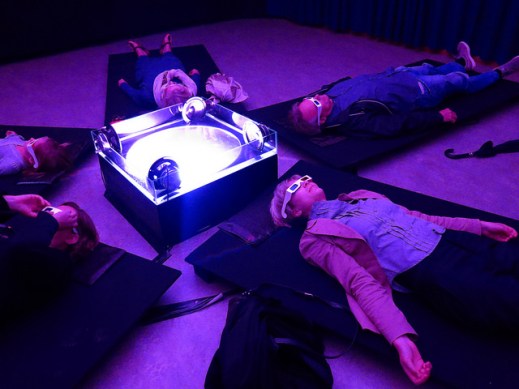
One of my greatest pleasures is lying in bed, eyes closed and headphones on. I attune to a single stimuli while being enveloped in sound. Using sensory deprivation techniques like blindfolding and isolating headphones is a simple recipe for relaxation, but the website Digital Drugs offers you more. A user can play their mp3 files and surround themselves with an acoustical downpour that increases and then develops into gradient waves. The user feels as if in a hailstorm, surrounded by this constant gritty aural movement. Transfixed by the feeling of noise, the outside seems indistinguishable from inside.

Sold by the i-Doser company, Digital Drugs use mp3 files to deliver binaural beats in order to “simulate a desired experience.” The user manual advises lying in a dark and silent room with headphones on when listening to the recording. Simply purchase the mp3, and fill the prescription by listening. Depending on user needs, the experience can be preprogrammed with a specific scenario. This way users can condition themselves using Digital Drugs in order to feel a certain way. The user can control the experience by choosing the “student” or “confidence” dose suggestive of whether you’d like your high like a mild dose of marijuana or an intense dose of cocaine. The receiver is able to perceive every reaction of their body as a drug experience, which they themselves produced. The “dosing” of these aural drugs is restricted by a medical warning and “dose advisors” are available for consultation.

Thus, the overall presentation of Digital Drugs resembles a crisscross of medicine and narcotic clichés with the slogan “Binaural Brainwave doses for every imaginable mood.” While researching the phenomena of Digital Drugs, I have tried not to dismiss them as another gimmick or a new age meditation prop. Rather, I argue the I-Doser company offers a simulation of a drug experience by using the discourse of psychoactive substances to describe sounds: the user becomes an actor taking part in a performance.
By tracing these strategies on a macro and micro scale I show a body emerging from a new paradigm of health. I argue that we have become a psychosomatic creature called the inFORMational body: a body that is formed by information, which shapes practices of health undertaken to feel good and form us. This body is networked, much like a fractal, and connects different agencies operating both in macro (society) and micro (individual) scales.
Macroscale Epidemy: The Power of Drug Representation
Heinrich Wilhelm Dove described binaural beats in 1839 as a specific brain stimuli resulting in low-frequency pulsations perceivable when two tones at slightly different frequencies are presented separately through stereo headphones to each of the subject’s ears. The difference between tones must be relatively small, only up to 30 Hz, and the tones themselves must not exceed 1000 Hz. Subsequently, scientific authorities presented the phenomena as a tool in stimulating the brain in neurological affliction therapy. Gerard Oster described the applications in 1968 and the Monroe Institute later continued this research in order to use binaural beats in meditation and “expanding consciousness” as a crucial part of self-improvement programs.
I-Doser then molded this foundational research into a narrative presenting binaural beats as a brain stimulation for a desired experience. The binaural beats can be simply understood as an acoustic phenomena with application in practices like meditation or medical therapy.
I-Doser also employs the unverified claims about binaural beats into a narration that consists of the scattered information about research; it connects these authorities with YouTube recordings of human reactions to Digital Drugs. Video testimonies of Digital Drugs users caused a considerable stir among both parents and teachers in American schools two years ago. An American school even banned mp3 players as a precautionary measure. In the You Tube video one can see a person lying with headphones on. After a while we see an involuntary body movement that in some videos might resemble a seizure. Losing control over one’s body becomes the highlight of the footage alongside a subjective account also present in the video. The body movements are framed as a drug experience both for the viewer who is a vicarious witness and the participant who has an active experience.
This type of footage as evidence was popularized as early as the 1960s when military footage showed reactions to psychoactive substances such as LSD.
In the same manner as the Digital Drugs video, the army footage highlights the process of losing control over one’s body, complete with subjective testimonies as evidence of the psychoactive substance’s power.
This kind of visualization is usually fueled by paranoia, akin to Cold War fears, depicting daily attacks by an invisible enemy upon unaware subjects. The information of the authority agencies about binaural beats created a reference base that fueled the concern framing the You Tube videos as evidence of drug experience. It shows that the angst isn’t triggered by technology, in this case Digital Drugs, but by the form in which the “invisible attack” is presented: through sound waves. The manner of framing is more important than the hypothetical action itself. Context then changes recognition.
Microscale Paradigm Shift: Health as Feeling
On an individual level, did feeling better always mean being healthy? In Histoire des pratiques de santé. Le sain et le malsain depuis le MoyenAge, Georges Vigarello, continuator of the Foucault School of Biopolitics, explains that well-being became a medicalized condition in the 20th century with growing attention to mental health. Being healthy was no longer only about the good condition of the body but became a state of mind; feeling was important as an overall recognition of oneself. In the biopolitical perspective, Vigarello points out, health became more than just the government’s concern for individual well-being but was maintained by medical techniques and technologies.
In the case of Digital Drugs the well-being of children was safely governed by parents and media coverage creating prevention in schools from the “sound drugs.” Similarly, the UAE called for a ban on “hypnotic music” citing it as an illegal drug like cannabis or ecstasy. Using this perspective, I would add that feeling better, then, becomes a never-ending warfare; well-being becomes understood as a state (as in condition and as in governed territory).
Well-being is also an obligation to society, carried out by specific practices. What does a healthy lifestyle actually mean? Its meaning includes self-governance: controlling yourself, keeping fit, discipline (embodying the rules). In order to do it you need guidance: the need for authorities (health experts and trainers) and common knowledge (the “google it” modus operandi). All of these agencies create a strategy to make you feel good every day and have a high performance rate. Digital Drugs, then, become products that promise to boost up your energy, make you more endurable, and extend your mind capabilities. High performance is redefined as a state that enables instant access to happiness, pleasure, relaxation.
inFORMational Body
Vigarello reflects that understanding health in terms of low/high performance—itself based on the logic of consumption—created the concept of a limitless enhancement. Here, he refers to the information model, connecting past assumptions about health with a technique of self-governing. It is based on senses and an awareness of oneself using “intellectual” practices like relaxation and “probing oneself” (or knowing what vitamins you should take). The medical apparatus’s priority, moreover, shifted from keeping someone in good health to maintaining well-being. The subjective account became the crucial element of a diagnosis, supporting itself on information from different sources in order to imply the feeling of a limitless “better.” This strategy relies strongly on the use of technologies, the consideration of a sensual aspect and self-recognition—precisely the methodology used for Digital Drugs’ focus on enhancing wellbeing.
Still, this inFORMational body needs a regulatory system. How do we know that we really feel better? Apart from the media well-being campaign (and the amount of surveillance it involves), we are constantly asked about our health status in the common greeting phrase, but its unheimlich-ness only becomes apparent for non-anglo-saxon speakers. These checkpoint techniques become an everyday instrument of discipline and rely on an obligation to express oneself in social interactions.
So how do we feel? As for now, everything seems “OK.”
—
Featured image: “Biophonic Garden” by Flickr user Rene Passet, CC BY-NC-ND 2.0
—
Justyna Stasiowska is a PhD student in the Performance Studies Department at Jagiellonian University. She is preparing a dissertation under the working title: “Noise. Performativity of Sound Perception” in which she argue that frequencies don’t have a strictly programmed effect on the receiver and the way of experiencing sounds is determined by the frames or modes of perception, established by the situation and cognitive context. Justyna earned her M.A in Drama and Theater Studies. Her thesis was devoted to the notion of liveness in the context of the strategies used by contemporary playwrights to manipulate the recipients’ cognitive apparatus using the DJ figure. You can find her on Twitter and academia.edu.
—

REWIND!…If you liked this post, check out:
Papa Sangre and the Construction of Immersion in Audio Games–Enongo Lumumba-Kasongo
On Sound and Pleasure: Meditations on the Human Voice—Yvon Bonenfant
This is Your Body on the Velvet Underground–Jacob Smith
—
Share this:




Current Top Posts





April 2021

January 2020

November 2019

October 2019

August 2019

April 2014

November 2017

March 2015

December 2017

October 2015


Recent Comments