
Listening to Whisperers: Performance, ASMR Community and Fetish on YouTube

DOI: https://doi.org/10.59350/76yd5-w8273
PercussiveThoughts is giving me a facial. The voice tells me about the “little scrubbies” in the exfoliant, and I begin to hear their delicate sibilance on my temples. If I’m lucky, a pleasurable, tingling sensation might begin somewhere on the back of my head and travel down my spine, turning my facial into something closer to a massage. The sole caveat is that I’m not really being touched at all.
This is ASMR, “Autonomous Sensory Meridian Response,” a pseudo-medical designation whose native soil is YouTube. The term pulls together a range of physiological and affective states: goosebumps, chills, relaxation, melting, tingles, and so forth. PercussiveThoughts and her fellow vloggers (I call them “Whisperers” here and explain why below) aim to trigger these frissons through a cornucopia of techniques. Sound is paramount; Whisperers scratch rough surfaces with their fingernails and percuss everyday objects with fingertip drum-rolls. And, of course, they whisper, sometimes using lozenges or gum to increase the opportunities for swallowing and lip-smacking.
What’s interesting about these videos is how they manage to traverse the gap between the sonic and the haptic. There is, of course, something familiar about this leap. Like the magician’s hat that produces rabbits and endless handkerchiefs, an audio speaker produces a volume and variety of sound out of proportion with its small, blank visage. In the case of Whispering, however, sound is transduced into touch, and the taut membranes of the listener’s headphones become coterminous with his own skin.
Apart from Steven Novella’s suggestion that ASMR might be a mild form of seizure, it does not yet appear to be a subject of scientific research. So Whisperers have taken on the role of amateur scientists themselves, with YouTube serving as a public petri dish. For this very reason, Novella has also cautioned against the assumption that ASMR is a real physiological phenomenon at all, since feedback loops of suggestion on the Internet might create “the cultural equivalent of pareidolia.”
Whisperers, however, have no doubts. And while the ASMR acronym is a recent development, many Whisperers say their first encounters with the phenomenon occurred sometime before their first exposure to the Internet and often before adulthood: during make-believe tea parties, while watching their classmates draw or braid each other’s hair, and, perhaps most commonly, while watching The Joy of Painting with Bob Ross.
The audience for Whispering is anyone who can have this experience, which apparently isn’t everyone. Contrary to the soporific themes of their videos, Whisperers and their fans identify themselves as having awakened to a special form of pleasure. Some have even made videos recounting their first experiences. The downside of this ability is the anxiety about its social acceptance. Whisperers sometimes opt for anonymity in their videos, revealing their faces only after much encouragement from fans. Rarely do they they let their family and friends in on the secret.
That this familiar, tingly feeling has assumed a pseudo-medical acronym is hardly coincidental. ASMR isn’t just pleasurable, it’s therapeutic. Hundreds of YouTube comments attest to the power of ASMR to help relieve them of insomnia, anxiety, and panic attacks. Nor has this dimension been overlooked by Whisperers themselves, who regularly perform as doctors or therapists in their roleplay videos. This is particularly interesting in light of recent scholarship on human/machine interactions. In Addiction By Design, Natasha Schüll shows how therapy for video-poker addiction can take the same format as the gambling itself, namely, “ongoing technological self-modulation to maintain equilibrium” (250).
Homemade Whisper videos, while habit-forming, are clearly not the sort of intricately-engineered machines that Schüll writes about. Nor do they wreack the same sort of havoc (depletion of one’s life-savings, deterioration of one’s physical health, etc.). And yet, both are arranged in problematic feedback loops of self-medication. The slow-paced, low-volume respite that Whisper videos offer is made all the more necessary by the fact that viewers must go online to watch them. This paradox is amplified by YouTube’s advertisements, which will sound especially abrasive because viewers tend to turn the volume up while listening to Whisper videos. That some of the more popular Whisperers earn money from their videos only complicates things further.
*
“No, we don’t get as many men here as women,” PercussiveThoughts says, as though responding to a question from me. Of course, I wouldn’t be so rude as to contradict her – I know better. To judge from the comments below, she gets plenty of male visitors. And her colleague ASMR Velous confided during an interview that around 70 percent of her viewers are men. For this reason, some Whisperers have made gender–neutral or male-oriented videos.

Gender is a major, and sometimes contentious, topic of discussion in the Whisper Community. In the YouWhisper web forum, the discussion topic “Gender Preference?,” has the greatest number of views (more than 170,000). In general, female Whisperers are more popular than their male counterparts. The three most popular male Whisperers that I could find–WhisperMister1, MaleSoothe, and TheLyricalWhispers–each have fewer than 5,000 subscribers and their per-video view-counts tend to peak around ten or twenty thousand.
Not long ago, GentleWhispering, one of the better-known names in the Whisper community, set off a series of heated back-and-forths with her ~FeminineGrace & Charmforsleep~ video. In it, she discusses universal traits of femininity while brushing her hair absent-mindedly. Whatever one might think of her opinions, the fact that GentleWhispering’s viewership dwarfs all other Whisperers to date suggests that something in her technique is working. My guess is that it has a great deal to do with her hands.
While giving Russian language lessons on a chalkboard, she points to a word with her middle, ring, and pinkie fingers while keeping the chalk poised delicately between her thumb and index finger. When she is about to touch the fabric of an armchair, her fingers arch back–rather than claw forward–as though to ensure that the contact is as light as possible. And, like so many other Whisperers, she takes any opportunity to tap hard objects with her well-kept fingernails.
The “femininity” of GentleWhispering’s hands is the performance of a soothing, caring touch, and her whispering voice is the transubstantiation of this touch through sound. Sometimes, she even short-circuits the analogy by massaging the microphone directly.
*
But even the performance of gendered touching does not quite explain how these sounds and images manage to reach through the speaker and screen. After a second glance at these videos, we might wonder if the preponderance of partial objects has something to do with it.
I’m talking about all of those disembodied hands stroking opposite hands or displaying objects detached from their collections. Often, for the sake of anonymity, the Whisperer’s eyes are kept out of frame, leaving only an expressive mouth, like CalmingEscape’s, with its signature tics and swallows. If even the mouth is too revealing, the camera gazes down at covered breasts, ”objects,” in a Freudian panoply of sexual cathexis (is it a coincidence that some Whisperers even roleplay as the viewer’s doting mother?). One has to wonder what effect is achieved by this strange summation of partials.
In spite of widespread insistence that these videos are not sexual, the comparison with sexual fetish is too obvious not to make. Sticking with Freud for a moment, the hyper-presence of the Whisperer would seem to disavow the separation implicit in internet communication. Her mouth speaks individually into each of the listener’s ears while also hovering on screen. Her hands animate dead objects through rappings and close-ups. In her omnipotence, she can even tell us what to do.
Fetish or not, the word “whisper” is a perfect synecdoche for this fragmentary whole, and that’s why I’ve used it instead of ASMR. A whisper is, by definition, “unvoiced.” The cheeks, mouth, teeth, and tongue accomplish the acoustic filtering that gives words their shapes, but the larynx produces noise rather than tones. Lacking pitch, a whisper might be called only a “part of speech.” And yet it speaks volumes by shifting the register of communication. Whatever is said in a whisper gains the aura of genuineness, honesty, and intimacy.
Of course, in a YouTube video, these qualities are suspect from the moment one clicks the play button. But perhaps this is what makes Whispering work. One hears in these videos, above all, the effort of performance. It is the performance of gender, as discussed above, but more generally the performance of interaction, intimacy, and proximity. What every Whisper video whispers is “Let’s pretend!” And nothing proves this better than the fact
that some popular Whisper videos contain rather unpleasant sounds. Consider TheWhiteRabbitASMR’s dentist appointment video. If one is willing to grit one’s teeth through the long sections of abrasive drilling, it’s because she so adeptly crafts the intimate space of fantasy in which it takes places.
The pleasure of pretending was made clear to me when ASMR Velous recounted her childhood tactic for inducing ASMR. “I would constantly trick people into pretending to do things. I had this little play kitchen set, and I would cook up imaginary food for people and make them pretend-eat it really slowly and make those eating sounds like [chewing sounds], and I would just sit there and be all tingly. And I just loved it….I made up this game with my friends, where we would basically mime a profession and the other person would have to guess the profession you were miming. That was another way for me to trick my friends into pretending to do stuff.”
*
PercussiveThoughts is wrapping things up. “That completes your facial… So you can sit up. Well, thank you. Thank you so much. I’m really glad you enjoyed it.”
I did enjoy it! But thank goodness it’s not really over; I can just hit the reload button. No matter how many times I do, I know that my pores won’t be any cleaner when I look in the mirror. But that’s not the point. Rather, Whisper fans take pleasure in the intimacy and complicity of pretending. That complicity applies even to the skin of the listener, a surface as vibrant as the skin of the speaker.
—
—
Share this:

Listening to #Occupy in the Classroom

Yes, it’s that time again, readers. You are going to have to stop pretending the “Back to School” aisles haven’t been appearing in stores for the past few weeks. We at SO! are here to ease your transition from summer work schedules to the business of teaching and student-ing with our fall forum on “Sound and Pedagogy.” Developed to explore the relationship between sound and learning, this forum blends the thinking of our editors (Liana Silva), recruited guests (D. Travers Scott), and one of the winners of our recent Call For Posts (Jentery Sayers) to explore how listening impacts the writing process, the teachable moment, and the syllabus (and vice versa). We hope to inspire your fall planning–whether or not you teach a course on “sound studies”–and encourage teachers and students of any subjects to reconsider the classroom as a sensory space. We also encourage you to share your feedback, tips, and experiences in comments to these posts and on our Twitter, Facebook, and Reddit sites. As I said in the Call for Posts for this Forum: “because teaching is so crucial—yet so frequently ignored at conferences and on campus—Sounding Out! wants to wants to provide a virtual space for this vital discussion.” This conversation will be ongoing: we will also bring you a “Spring Break Brush-Up” edition in 2013 featuring several more excellent posts by writers selected from our open call. Right now, the bell’s about to ring–so take a seat, open those ears, and enjoy this shiny auditory apple of an offering from D. Travers Scott in which he discusses how the sounds of #Occupy invigorated his classroom. And, yes, it will be on the test. —JS, Editor-in-Chief
—

DOI: https://doi.org/10.59350/g5wbz-4bz75
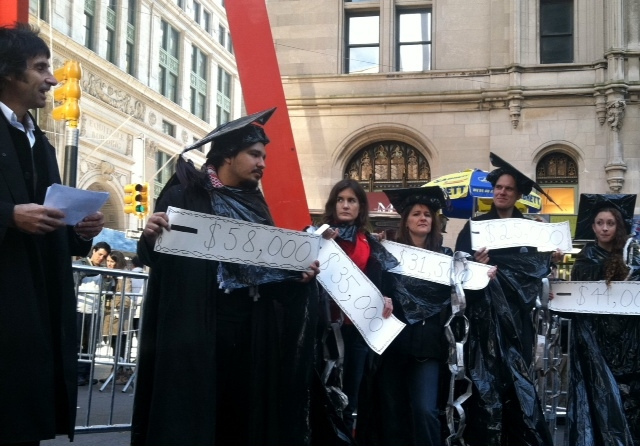
In the late fall of 2011, I was teaching a class on cultural studies of advertising. I presented the Occupy Student Debt campaign, a subcategory or spinoff of the larger Occupy movement, while we were examining ways people challenged consumer culture. We discussed education as a commodity and students as consumers. Unsurprisingly, my seniors were dissatisfied consumers. They expressed that what had been advertised to them was a product that guaranteed or at least would strongly increase their chances for quality employment (of course, it was also a product they had worked for years in creating, and one they couldn’t return.) If higher education really did land you the lucrative job it had been advertised as guaranteeing, in theory, then, you would be able to more easily pay off student loan debt. To address this dissatisfaction, I showed them two artifacts: a video from the launch in New York City on November 12, 2011, and the OSD debtors’ pledge*.
In the video, OSD founder Pamela Brown reads the pledge one line at a time, with each line chanted back by others. I played the video in a dark classroom. I also projected it on the room’s main screen, but I didn’t use the room’s amplification system because it sounds too much like an authoritarian public address and disperses the audio in a dominating way. External speakers connected to my laptop made the sound feel, to me, more localized and objectified, something we could focus on rather than an institutional part of the room. The students’ first reaction was, not to the words, but the sound: the verbal relay used at the public demonstration. Brows furrowed and heads cocked quizzically, they asked, “Why are they all repeating the speaker like that?” I explained how this provides additional amplification, but the students’ listening experience was instructive to me. Their unfamiliarity with a sonic practice of vocalization indicated their unfamiliarity with larger practices of collective, public social action.
Listening to OSD, and paying attention to how my students listened to it, informed me of larger contexts they needed to understand and discuss it, in ways that the object of the text did not suggest to me. It made me think about the experience and process of my students’ encountering OSD. I immediately noticed its ambient sounds of city life, which I no longer hear. These sounds of traffic, the acoustics of being surrounded by buildings, etc. gave several urban dimensions to the movement the pledge text did not. From the perspective of Upstate South Carolina, “urban” is not a simple thing, an identity or geography category, but intersectional: our largest city, Greenville, has a population under 60,000. City noises feel not merely urban, but un-Southern, and thereby alien. (I say un-Southern rather than Northern or Yankee because another thing I’ve learned here is the inadequacy of that binary: Los Angeles, for example, is not a Northern city but most certainly is as un-Southern as New York. Cities also carry a class dimension.) Even though my school is one of the elite institutions in this area, this region is still worse off economically than the rest of the country and has a generally lower cost of living. Cities require money to live in. In spatial, class, and urban dimensions, OSD felt alien.
The experience of listening to the ODS rally illustrates how a sound studies perspective foregrounds experiential processes over exclusive categories of things and ideas. For example, when I read the OSD Debtors’ Pledge aloud to my students—vocalizing the text and sounds and listening to them— it brought the text into my body, making it an action. It also made students uncomfortable. Even just a round-robin reading of theory seems to make then anxious and fidgety. While I try to understand and accommodate anxieties around public speaking, I think the way sound makes a text enter the body can be a powerful affective experience. And no one ever said the classroom always had to be comfortable. For me, reading the text aloud personalized the OSD pledge. It evoked sensory memories: “Pledge of” evoked saying the pledge of allegiance in public school; saying “We believe” took me to attending Lutheran church services with my husband at the time where they collectively recite the Apostles’ Creed. These associations evoked emotional disidentifications from organized religion and mandatory collective professions of patriotism. It also temporalized and spatialized OSD for me, positioning it in relations to Dallas, Texas in the 1970s and Greenville, SC today.
Overall, the reading aloud of the pledge staged a tension or dialectic of identification and disidentifications. Although I agreed and identified with the sentiments of the movement, several alienating and unsettling aspects of the pledge came through as I read aloud: the blithe collapsings of “we” and “as members of the most indebted generations” made me wary (collectives always do, but so do easy historical assertions. Really? Are we more indebted than indentured servants who came to America, or people born into slavery?), and the sudden shift to first person singular at the very end seemed jarring: (After saying “we” six times, suddenly it’s ‘I’ now – what happened?). Lastly, the numerous alliterations also had an alienating effect, making the text seem sophistic and manipulative, artificial, composed.
The auditory experience of OSD can also provide insight into how we create texts. A video of Andrew Ross shows him presenting the first, “very rough draft” weeks earlier at an OWS event. Listening to him read this different, earlier version underscores the text as process. The pledge is something that developed. While his flat tone and straight male voice do not appeal to me, they do complexify and dimensionalize Brown’s reading, giving it depth. They also show that some things that bothered me in the final version – the collectivity and alliterations – were not there. This intertextual, diachronic listening does not erase troublesome aspects of the ‘final’ text, but it mediates them. I am moved closer to it by listening to its different origin.
Arguably, any of these points could have been arrived at by good ole’ textual analysis. My point is not that listening always should supplant visual modes; sound studies tries to break that false dichotomy by not denigrating or replacing the visual but by elevating the sonic to complementary – not superseding – status. I argue that reading aloud should be a fundamental, basic component of sound studies methodology, as it allows anyone to hear, voice, embody, and experience a text. I not only noticed these aspects sooner through listening – my first time speaking it aloud, despite having read it at least a dozen times before. Moreover, I didn’t just notice them: I felt them on a personal, emotional, level, which spurs thinking and analysis that is, if not completely new and unique, definitely qualitatively different in its potency and urgency.
Listening to OWS, and the OSD in particular, brings insights affective and personal. Yes, I can read a statistic from a survey stating that a certain percentage of participants in OWS feel angry or betrayed. That doesn’t mean anything to me in a specific, personal, and empathetic way – and empathy is crucial for a social movement to garner support. Listening to both Ross and Brown, I am reflective and conflicted over my professional role – no longer a grad student, but certainly not an established scholar like Ross. I feel connected to OSD in ways beyond the literal facts of my debt. Listening draws me into a contemplative, reflexive space beyond a sticky note on my office desk saying “OWS: teachable moment.” I can see a map with big, red OWS circles over Washington D.C. and New York, but I don’t feel the distance from myself and my students in the same way—and this is crucial for my teaching and engaging them in dialogue about what could be the most significant social movements of their lifetimes.
—
Share this:




Current Top Posts





April 2021

January 2020

November 2019

October 2019

August 2019

April 2014

November 2017

March 2015

December 2017

October 2015


Recent Comments