
Video Gaming and the Sonic Feedback of Surveillance: Bastion and The Stanley Parable

The world of Bastion is beautifully illustrated and affectively evocative. Image borrowed from darkzabimaru @DeviantArt.
As the practice of sound design becomes ever more refined as a key factor in the immersive aspects of gameplay, it is essential to develop a conceptual vocabulary of the ways that sound is implemented as a cultural facet. In particular, it is important to recognize the power relations at stake within the implementation of the human voice as an interactive narrative trope. And, while I’ve already discussed the ways in which the voice of GLaDOS in Portal invites players to reflect on how they internalize a set of mediated perspectives about how their body ought to be, it is equally important to consider the other ways that a narrator’s voice invites players to reconsider the intersection of agency and surveillance.
This post compares the use of narration in Bastion and The Stanley Parable in an effort to understand how the voice is used as what Karen Collins would refer to as an “interactive non-diagetic sound,” or, in other words, a sound that is triggered by player actions, but not experienced by the character in the game. Specifically, I argue that the voice in these examples is an essential point in the feedback loop between player and game. And, as part of the cybernetics of gameplay, it produces a dispositif of surveillance, akin to Bentham’s panopticon, which lets the player know their actions are constantly being monitored, calculated, and considered by the game’s algorithms. But, while the original panopticon produced the effect of surveillance through the clever use of light, these games use sound to effect surveillance.
Bastion, was developed by the small indie game company Supergiant Games, but was distributed and released by Warner Bros. Interactive Entertainment, first through Microsoft’s distribution service, XBOX Live Arcade, but has since been released more broadly after receiving much critical acclaim. In Bastion, players take the role of a young boy, referred to only as “The Kid,” and adventure around gradually rebuilding a world that has fallen apart since a cataclysmic sundering referred to only as “the Calamity.” Although the world of Bastion is beautiful and visually stimulating, it is the game’s sound design that has earned it much critical acclaim. The game is narrated by a character named “Rucks,” who speaks in a deep weathered voice, with somewhat of a western twang. And, even though The Kid eventually encounters and is able to interact with Rucks within the game, Rucks still relays dialogue in the third-person.
When The Kid and Rucks meet, Rucks evinces with trademark grit, “Sure enough, he finds another. He finds me.” And, while that is a scripted plot point within the game, at other points Rucks’ narration modulates to best reflect the player’s actions. A player who begins the game slowly, exploring nooks and crannies, might hear “The kid walks slowly down the path, checking everything,” while a player who runs straight ahead could hear, “The kid barrels forward, not looking once behind him.” These quotes force the player to recognize that the game is watching, and actively staging narrative commentary about their in-game decisions. This commentary unfolds in aural space, through narration, discrete from the old text (and controller) triggers of “look” and “examine” which used to prompt text-box commentary about the environment of the game. In short, Bastion’s sound design succeeds because it is balanced in such a precise way: players are being constantly engaged with a narration which confirms that they are, in fact, properly interacting within the game world and story.

Games used to use text boxes to interrupt gameplay with narrative elements. Image borrowed from ultrapublications.com
The Stanley Parable, on the other hand, works deliberately to turn the paradigm of narration on its head. Where Rucks, in Bastion, frequently alluded to how many secrets he was yet to reveal about himself and the game-world, his character ultimately plays a supportive role, helping The Kid to understand the chaotic environment of the game. The narrator in The Stanley Parable, however, plays the antagonist in many ways, attempting to foreshadow and predetermine the actions of the player, or “Stanley.” On the game’s website, a short sentence contextualizes the endeavor, “The Stanley Parable is a Half Life 2 mod about video games.” The game itself is a mod of the “Source engine,” which runs both Half-Life 2, and Portal, was developed by the very small development team of Davey Wreden and William Pugh, and released for free. It is meta-fiction that stages a critique of the context of narrative within interactive games and fiction. Specifically, the game questions the idea of narrative itself by showcasing the ways that players are able to undermine the scripted plots and spaces of a videogame by exploring and experimenting with exploits and bugs in the game’s code and narrative.
Although the narrator in The Stanley Parable will prescribe several decisions to the player over the course of the game, the player is given the agency to contest the story as told by the narrator, and, therefore, to experiment with the plot. As the player reaches a set of two open doors on the way to the employee lounge the narrator reads, “When Stanley came to a set of two open doors, he entered the door on his left.” If the player chooses to travel through the door on the right instead, the narrator will attempt to steer the player back to the main plot tree by saying, “This was not the correct way to the employee lounge, and Stanley knew it perfectly well.” And, then as an open door is revealed, “So he turned left at the first open door, and walked back in the right direction.” If the player continues to ignore the narrator’s advice, he comes to somewhat of a dead end and the narrator reads, “Stanley was so bad at following directions, it’s incredible that he wasn’t fired years ago. Maybe this was why everyone left. No one wanted to be around someone as bad at listening as him.” The player is given several other opportunities to make decisions and lead the story to completion in achieving one of seven endings; each based the decisions the player has made when interacting with the narrator’s dialogue.
The Stanley Parable allows players the agency to see the limitations of linear storytelling where Bastion does not. Where some paths in The Stanley Parable will lead the player into direct conflict with the narrator, other paths do not. There is never a point where the narrator ceases to comment on the player’s actions and activities. Because the sonic feedback of surveillance remains a constant in both games the player remains engaged, in both cases, with the logic of the game-system. In other words, no matter how many times the player defies the narrator in The Stanley Parable, it never seems like the game is breaking. The game world remains constant because the motif of surveillance holds; players know the game still works because the narrator continues to stage commentary – even if it is commentary about the player’s failure to keep to the plot.
For Marc Andrejevic, author of iSpy (2007)—who has written extensively about the abundance of surveillance techniques implemented in digital spaces–the danger of surveillance lies in the production of an asymmetrical power relationship between media producer and media consumer. And, while this is certainly best argued about instances of dataveillance–how companies like Amazon, for example, track customer clicks on and off their website via web cookies in order to better produce exploitable (and in some cases saleable) consumer profiles–it is important to also consider the ways that the implementation of sound also functions as a technique of control.

Paradigms of surveillance have changed a lot in the past 30 years. Image borrowed from cobalt123 @Flickr.
At its most positive, the sonic panopticism of Bastion and The Stanley Parable offer players a sense of comfort in knowing that the game is operating properly, and not glitching out. Further, players are invited into a more immersive game, which leverages both visual and audio interactivity to lull players into an environment of almost trancelike feedback and play. Clearly, this is the promise of good sound design; it gently alerts players to the presence of a tightly designed and well-implemented game, and produces affects of brand loyalty and trust within a game’s player contingent.
But, while there are clearly aesthetic and market benefits to the implementation of narration in both games, one cannot help but wonder, in the context of post-feminism and self-surveillance, what implications there are in the implementation of the male voice as surveil-er in both games. Just as it was curious in Portal 2 how GLaDOS acted as a critical female voice constantly judging the player’s body image and intelligence, it is curious how much authority is given to the voice of Rucks in Bastion. And while several good critiques have already been written about how the game features only one (somewhat silent, and certainly helpless) female character, and how the game’s villain is portrayed, concretely, as the racially exotic other, it is sadly fitting that the most comforting and well-acclaimed aspects of the game come from the interactivity produced by the voice of its distinctively white male narrator.
The sound design in The Stanley Parable, of course, is more cutting in the ways it stages a commentary about how the voice of the narrator (this time distinctively British), exacts a form of social coercion through techniques of surveillance, and how these techniques serve, namely, to hamper player agency. But, even its own narrative of resistance fails to compel; in fact, it is the uneasy ending of compliance and conformity that is, perhaps, the happiest. This, ironically, reveals one of the key cultural problems of our era: the reciprocal aspects of surveillance and interactivity. If affective resonances of trust, knowledge, and comfort come bundled with the male voice, is it in the vested economic interests of sound design communities to leverage these to make profit? Even though both games have earned critical praise, it is only Bastion that has won awards for sound design. In other words, are we caught in our own feedback loop of comfort, industry, and design?
–
Aaron Trammell is co-founder and Multimedia Editor of Sounding Out! He is also a Media Studies PhD candidate at Rutgers University. His dissertation explores the fanzines and politics of underground wargame communities in Cold War America. You can learn more about his work at aarontrammell.com.
—
 REWIND! . . .If you liked this post, you may also dig:
DIANE… The Personal Voice Recorder in Twin Peaks— Tom McEnaney
The Role of Sound in Video Games: Pong, Limbo, and Interactivity— Aaron Trammell
Orality and Cybernetics in Battleship— Aaron Trammell
Share this:

They Do Not All Sound Alike: Sampling Kathleen Cleaver, Assata Shakur, and Angela Davis

Assata Shakur, Image with quote courtesy of Flickr user Jacob Anikulapo
 Welcome to week four of our February Forum on “Sonic Borders,” a collaboration with the IASPM-US blog in connection with this year’s IASPM-US conference on Liminality and Borderlands, held in Austin, Texas from February 28 to March 3, 2013. The “Sonic Borders” forum is a Virtual Roundtable cross-blog entity that will feature six Sounding Out! writers posting on Mondays through February 25, and four writers from IASPM-US, posting on Wednesdays starting February 6th and ending February 27th. For an encore of weeks one through three of the forum, click here. And now, Tara Betts drops some science, Sounding Out! style. –JSA
—
When underground hip-hop artist P. Blackk released Blackk Friday (2011), several reviewers insisted that he sampled political activist Angela Davis. Oddly enough, one of the reviews from The Meara Blog, featured the video for “Brainz,” the song in question–and the video clearly showed that the sampled track was in fact not Davis but activist and lawyer Kathleen Cleaver. Why the automatic assumption that any black woman sampled from the 1960s is Davis? Why the collapsing and erasure of so many distinct and powerful voices?
Davis, Cleaver, and Assata Shakur are arguably the three most iconic women of the Black Power Movement, but they largely go unrecognized in mainstream history. Erasure by omission represents how many historical sources are resistant to identifying their specific contributions to grassroots organizing, intellectual life, and politics, while the male leadership of the Black Power Movement is often mentioned by name. So, the inclusion of Davis, Cleaver, and Shakur in songs by hip hop artists P. Blackk, John Forté, and Common simultaneously amplifies the distinctiveness of their voices while signaling conscious choices by younger male artists to align themselves with the political thinking espoused by these radical women in politically-rooted, layered tracks–even as these samples inadvertently reveal the mainstream public’s tendency to treat black female activists as interchangeable. Both in their moment and in its sampled echoes, these women resist being grouped into an amorphous group of misconstrued black people, and these tracks highlight that.
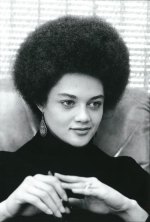
Kathleen Cleaver, 1960s
In “Brainz,” P. Blackk samples a 1968 speech by Cleaver. In the track, the basic bassline reverbs beneath the emcee’s repeated hook. He begins the song with the “huh” sound that many emcees use to amplify enthusiasm, start rhyming, and alert whomever is listening that the words are about to arrive. Blackk repeats certain phrases and utilizes internal rhyme as he makes observations about the choices people should make to care for themselves, their children, and their communities. The most original slant rhyme emerges in the second of two verses, replicated here:
It’s funny how we love chains and whips
when we were bound by em.
and we hate rock’n’roll and it was found by us.
You can’t hate what’s beautiful. I’m black and I’m proud,
but that ain’t got nothing to do with my pants sagging down.
Society is pimping you.
I’m just a man who’s a little more sensible.
I used to be invisible, now I’m invincible.
Not the stereotypical,
and I’m doing my thing in a game with no principles.
Knowledge and power, all I need, yeah, that’ll do.
The difference between me and my peers is gratitude.
Younguns is dumb too and too cool,
but it’s uncool living in a city that’s gun-ruled.
Here, P. Blackk most closely echoes how Cleaver expresses a sense of embracing and affirming black beauty while still acknowledging flawed educational systems, materialism, the origin of rock music, intergenerational disconnects, and gun violence. As a member of the Black Panther Party, wife of Eldridge Cleaver, attorney and professor, Cleaver has been a spokesperson for African American struggles. When the chorus simply repeats “real n-gga wit a brain,” P. Blackk is claiming the term that is still an affront to middle class people reaching for the civility of assimilation. He is insisting that some people are afraid of their intelligence and growing awareness as marginalized people and what actions that might entail. This fear of a nascent threat was at the root of resistance towards the slogan “Black is Beautiful” in the 1960s.
The Cleaver sample comes at the end of “Brainz,” and in the music video appears in its entirety on a projection screen and against P. Blackk himself, decked in a white shirt and bow tie, as he “lectures” students in a darkened classroom. As different black historical figures, including the likes of Marcus Garvey, Rosa Parks, Angela Davis, Ralph Abernathy, George Jackson, and James Baldwin, are projected on the screen behind Blackk, the instrumental audibly drops much lower so the only voice heard is Cleaver’s.
[Cue to 3:05 for Kathleen Cleaver]
The footage from which her sample is taken has background sound such as others talking and a chant with cadences that were often heard at black political protests; these can be faintly heard along with the audible buzz of varied speaking voices in the crowd that surrounding Cleaver. She was not onstage nor the main focal point of the larger event, but P. Blackk’s re-framing places her at its center. When one considers the position of Davis and Cleaver as esteemed and radical activists and professors, it’s not surprising that P. Blackk video positions him as an educator, like these women, to further reinforce the point of Cleaver’s words.

Image of Assata Shakur on Community Mural of Revolutionary Heroes, Image by Flickr User Gary Stevens
In “A Song for Assata,” from Like Water for Chocolate (2000), Common retells some of the events detailed in Assata: An Autobiography, but his sample reinforces why her activism was so important to Common and others like him. Her looped voice concludes his song, incredulously repeating the question, “You askin’ me about freedom?” In the sample Shakur explains how she knows more about what freedom is not, which is similar to a comment that Shakur made in Gloria Rolando’s documentary Eye of the Rainbow: Assata Shakur and Oya. Shakur then defines how freedom allows one to be one’s self, and the definition is faded down and the last of the soaring music rises slightly. When this fade occurs, we have a few examples of what Shakur imagines what freedom could potentially be, but it also leaves a sonic pause where listeners might contemplate how they define freedom for themselves.
The choice to fade out a sample says so much about not just the message that it (and Common) hopes to convey, but also reveals narratives that have been enforced consistently through institutions and time. I read the fade out as sonically emphasizing “the struggle,” rather than the intellectual present of an activist speaking; it limits her to the role of an representing the past. In dream hampton’s documentary Black August, Malcolm X Grassroots Movement organizer Meron Haile Selassie elucidates how women like Shakur are idolized:
Historically, the black liberation movement and actually all movements, let’s be honest, have fallen short of trying to incorporate the role of women, what women need, and how we incorporate anti-sexist theory and anti-sexist work in our general liberation movement. And when the woman that we put on the poster every single year, Assata Shakur, is someone that these artists revere and talk about yet but they’re somehow unable to see an Assata Shakur in the woman they’re dating that’s a painful realization.
In other words, even in black history and social movements, some women are canonized and celebrated and others are disregarded, which is not a far cry from the well-worn debate of using the word “b-tch” or “ho” and insisting that this namecalling does not address all women. Such overlooking and fading out is a subtler silencing of women.

Angela Davis speaking in Oakland, 1969
John Forte’s “Drift On” works against the narrative of the fade-out in “A Song for Assata.” In “Drift On,” from his album The Water Suite (2012), Forte lyrically articulates the feeling of being distant from someone; however, it is the brief sample of a few seconds from Angela Davis that reinforces the possibility of redemption during and after confinement. Forté begins singing the hook over a guitar-like loop that functions almost like a chord, and his soft singing of the chorus contrasts with his solemn rhyming lines and the firm solemnity of Davis’ brief sample midway through the song. A little more than a minute before “Drift On” ends, Davis speaks:
many people recognize that they can refashion themselves. They can rehabilitate themselves. They can live a life of the mind.
Davis stresses the words “they,” “refashion” and the third, final “can” spoken in this sample. Her tendency to stretch and soften particular nouns and verbs in speaking is a consistent pattern in Davis’ public speech, achieved by rhetorical devices such as metanoia– the immediate restatement of a phrase–and amplification. When Davis speaks in this manner, she makes listeners pay attention to the “they” whom she refers to as intellectually capable, but it also stresses “possibility” and redemption of the self.
It is important to note that the artists sampling these iconic Black women are men. Although women such as Me’shell Ndegeocello, and Terri Lyne Carrington and Diane Reeves have sampled Angela Davis on successful records, these records were not necessarily considered hip hop, which has consistently relied on men’s voices to create a radical impression in music, like Public Enemy’s “Fight the Power.” Public Enemy long relied on voices like Malcolm X and Martin Luther King, Jr., but happens to (and with) women’s voices? Including these voices in hip hop shows that women do exist as thinkers, activists, and speakers, even if the exposure is being exercised by artists who are men.
However, each song extends the narrative of each woman in a different manner than they constructed for themselves. P. Blackk stops admonishing, advising, and insisting on pragmatic Afrocentrism so he can to listen to Cleaver explain why black beauty was finally being embraced in the 1960s. Cleaver, in her 1968 speech, eschews white standards of beauty to embrace herself, which P. Blackk uses to connect self-hatred in the past and self-destructive behavior in the present. Common ends “A Song for Assata” with Shakur so she can share some of her thoughts on freedom after the song relates major events from her life based on details and paraphrased lines from poems in Assata: An Autobiography. Forté uses the sample of Angela Davis to further a narrative that reveals how the prison industrial complex diminishes perceptions of the humanity and the intellectual capacity of prisoners in “Drift On.”
These three hip hop songs align with a continuum of specific radical women during a time when there are few women getting consistent recognition in the genre of hip hop music, so it marks a curious point of departure where women can be part of conversations in a musical genre where they are not frequently prominent as vocalists. This sampling practice also places men and women in conversation–activists, artists, and listeners–in a manner that reflects strength, certainty, and a sense of coming together with specific political ideas in a manner that, importantly, does not erase intellectual, or sonic, difference.
—
Tara Betts is the author of the poetry collection Arc and Hue, a Ph.D. candidate at Binghamton University, and a Cave Canem fellow. Tara’s poetry also appeared in Essence, Bum Rush the Page, Saul Williams’ CHORUS: A Literary Mixtape, VILLANELLES, both Spoken Word Revolution anthologies, and A Face to Meet the Faces: An Anthology of Contemporary Persona Poetry. Her research interests include African American literature, poetry, creative writing pedagogy, and most recently sound studies. In the 1990s, she co-founded and co-hosted WLUW 88.7FM’s “The Hip Hop Project” at Loyola University while writing for underground hip hop magazines, Black Radio Exclusive, The Source, and XXL. She is co-editor of Bop, Strut, and Dance, an anthology of Bop poems with Afaa M. Weaver.
Share this:


Current Top Posts





April 2021

January 2020

November 2019

October 2019

August 2019

April 2014

November 2017

March 2015

December 2017

October 2015
 Sounding Out!
Recent Comments