
“I Love to Praise His Name”: Shouting as Feminine Disruption, Public Ecstasy, and Audio-Visual Pleasure
Well, if you don’t believe in shouting,
That’s alright with me
Some folk don’t believe in shouting,
That’s alright with me…
Doubt and ignore it,
But I belong to the Lord’s crew.
David said rejoice in the Lord,
And that’s the way we Christians do.
If you don’t believe in shouting,
That’s alright with me.
–Dorothy Love Coates & the Gospel Harmonettes, “That’s Alright with Me”
A handy catch-all term, “shouting” is actually a euphemism encompassing a range of ecstatic worship behaviors. These can include clapping, dancing, pacing, running, rocking, fainting, as well as using the voice in speaking, singing, laughing, weeping, yelling, and moaning. Certainly, there were men who shouted in the days of my childhood in church; there are men who shout today. The only shouts I can recall and even imitate to this day, however, are those of the women.
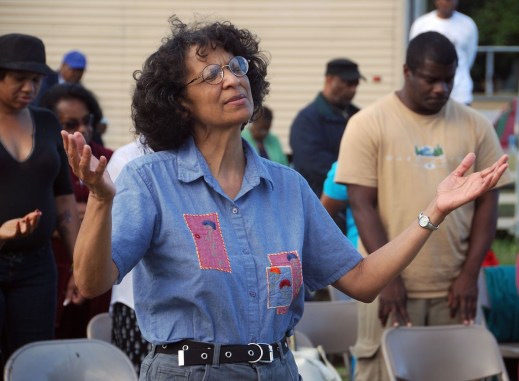
There is, in fact, a longstanding association between women and shouting. Perhaps because of the pronounced emotionality involved in the practice, the shouting sphere tends to be prefigured as feminine and in this bears great relevance to women. I am interested in the significances of shouting among black Christian women of struggling populations. In my view, shouting is not only a religious practice for these women, but is also a binary-breaking performance which confounds—if only fleetingly—the divisions which have so often oppressed, menaced, and harmed them. I argue that shouting has worked to codify the disruption of male-dominated services by women who have so often faced sharp sanctions by black church patriarchy. I also contend that shouting places its female practitioners and their observers within a sphere of public ecstasy and visual and auditory pleasure, which makes mischief for notions of what is proper for Christian women and for the entire church community.
.
The Shout, the Sound, and the Shriek: Black Feminine Disruption
In a 2011 post for Sounding Out! entitled “Pentecostal Song, Sound, and Authentic Voices,” Ashon Crawley posits the existence of a black church “public zone,” which serves as the conceptual, holy ground upon which “sound, song, and subject [function] as conduits for the exchange of ecstasy and ecstatics.” I’d like to track Crawley’s public zone into the shouting sphere, the very heart of ecstasy within the black worship experience.
Although culturally codified—even expected and welcomed—within the church community, the shout functions primarily as a disruption. The faces, bodies, and voices of shouting black women disrupt the flow of the service. A shout takes time and has the power to alter the program. Regarding such moments, worshippers—most often women and gay men—often proclaim in retrospect, “Baby, there was no more order!” This disruption of order through the use of the body and the voice has a distinct place within the Christian black feminine tradition of resistance to oppression.

Image by Flickr User Steve Schwartz
In the essay, “The Restorative Power of Sound,” womanist Roxanne Reed has examined the function of gendered sound within black Christianity. For Reed, the feminine “wordless cry, holler, moan, or wail” achieves “primacy over the written text,” “suggests a historical time with relying on a defined chronology,” and is legitimated by an African “ancestral heritage” which presages black musical forms (2). This distinctly feminine worship sound claims space from “patriarchal privilege,” which has often extended to black folk preaching, a tradition which excluded most black women for decades after slavery.
The sound of the black feminine in worship is thus a symbol for black women’s triumph over historically masculine arenas of writing, history, and form. The shout and the gendered worship sound can be placed in critical triangulation with Fred Moten’s “shriek,” as theorized in In the Break (2003) An expression of the distinct suffering of the black female, the shriek is a primal “phono-photo-porno-graphic disruption” of spirit and matter, and other binaries (14). The shout, the feminine worship sound, and the shriek all take center stage as black female performances which disrupt oppressive categories and assert the black woman’s voice as triumphant.
Shouting as Public Ecstasy, Scopophilia, and Sonophilia
Many observers have noted the shout’s resemblance to sexual ecstasy. The shout is often expressed through the sounds, movements, and facial expressions commonly associated with sex. Some shouters close their eyes and moan. Some hug themselves around the waist or bend over the pew in front of them, rubbing their own shoulders, bellies, or thighs. Some roll about the floor, hollering or speaking in tongues. Some whisper His Name, as in closest intimacy to a lover. Some dance with abandon before the altar or in the aisles before collapsing, spent and panting. Some quiver quietly in deepest distraction.
Shouters in the throes of their ecstasy are closely observed by all within the church community. Members of church communities often mark shared remembrances by who shouted, when, and how. Even young children can be called upon to reproduce the shouts of various church members. The conspicuousness of the shout provides reason to consider it as spectacle containing pleasure for both the shouter and those who gaze upon her.
.
Laura Mulvey’s “Visual Pleasure and Narrative Cinema” discusses “scopophilia” as a phenomenon occurring in “circumstances in which looking itself is a source of pleasure, just as, in the reverse formation, there is pleasure in being looked at” (587). In the moment in which a shout goes forth, those shouters who are aware of being watched—not all are—and their gazers may be said to enter into mutual pleasure from being watched and from watching. For the observer, the pleasure arising from the sight-based stimulation is often compounded by the narcissism of the ego which seeks to identify with its source. This may explain why in highly charged church moments, shouts become highly communicable—“thriving in concert,” as Zora Neale Hurston once phrased it. Looking upon another in worship ecstasy can be understood to reinforce one’s own relation to the Holy and to stir desire to engage that relation through shouting.
There is sufficient cause to assign what I call a “sonophilic”aspect to shouting as well, as shouting never fails to take place but within a context of sound. This sonophilic component should be understood as the means by which the sounds of ecstasy coming from a shouter provide stimulation and identification in the listener, who may in turn become a shouter. It must be noted, however, that the sonophilia can emanate from sources other than the shouter. Shouts are often roused by a complex network of sounds. Within a service, preaching and verbal exhortations, prayers, congregational chants and songs, and instrumental music designed to buoy sermonic delivery or to capitalize on swells of emotion often work in tandem to provide the sound-based pleasure essential to shouting.

Image by Flickr User Steve Schwartz
A Final Shout-Out to Shouting
From West Africa to North America, from slavery to emancipation, from the eighteenth century into the present day, the black ecstatic in the form of shouting has served several important purposes for black women. Black women’s general and persistent preoccupation with the relationship between the spiritual and the sensual, the cornerstone of black female intellectualism in my view, was first and foremost expressed in the practice of shouting. The shout can be understood as the primary site upon which black women made the spiritual physical and rendered the sensual holy.
.
Furthermore, in eras in which black women were customarily denied the right to preach and were granted but limited authority within church communities, the shout communicated a woman’s ability to engage the Holy. This proven ability undoubtedly helped to open doors for the thousands of black women who now preach and pastor all over the country. Shouting has also provided much needed relief for the unique pressures of the black female in North America, absorbing and transforming her hurts and frustrations and replacing them, down through the centuries, with the hope and strength vital to her survival.
—
Featured Image Credit: Flickr User Steve Schwartz
—
Shakira Holt is a thirteen-year classroom veteran and currently teaches high school English in Los Angeles County. She earned a doctorate degree in English from the University of Southern California, and works primarily in the area of black women’s literature and culture. She is deeply concerned about the intersections of race, religion, gender, sexuality, class, and politics in the public sphere. She is a lazy poet, a latent novelist, an intermittent blogger, a retired songwriter, and a reluctant karaoke singer. A licensed Baptist minister, she is but slowly working her way back to the pulpit. “I Love to Praise His Name” is her first published piece.
Share this:

Sound + Vision: Andy’s Mick

Andy Warhol – Mick Jagger 1975, Image by Flickr User Oddsock
 Hello Internet! It’s great to be here in cyberspace! Are you ready to rock? Today’s dispatch from our Spring Series, Live from the SHC, finds Cornell’s Society for the Humanities Fellow Eric Lott jamming it out on the relationship between the early 70s sound and vision of one Sir Mick Jagger. If you happen to be thinking that Monday morning at 9:00 a.m. is the least rock and roll time slot possible, just remember that’s when Jimi Hendrix gave “The Star Spangled Banner” the business at Woodstock. To give earlier installments by Damien Keane, Tom McEnaney, and Jonathan Skinner a listen, click here. As May comes to a close and the “Sound: Culture, Theory, Practice, Politics” fellows reluctantly break up the A.D. White House house band, look for our final two dispatches from Jeanette Jouili and Society Director Tim Murray. Until then, we’ll keep turning it up to 11 here at Sounding Out! –JSA, Editor in Chief (and 2011-2012 SHC Fellow)
—
After we left the Carlyle I told Jerry I thought Mick had ruined the Love You Live cover I did for them by writing all over it—it’s his handwriting, and he wrote so big. The kids who buy the album would have a good piece of art if he hadn’t spoiled it. –Andy Warhol
Andy Warhol’s complaint in his Diaries captures the almost cartoonish play for artistic control between himself and Jagger in the 1970s—between painter and singer, portrait artist and subject (Jagger and the other Stones biting each other), the visual and the verbal (“he wrote so big”!): between sight and sound in the realm of popular music. Warhol was no stranger to sound artistry, of course, from his work with the Velvet Underground to the everyday taping he did with his portable cassette recorder, the machine he called his “wife.” But Warhol as visual conceptualist returns us to a moment when, through album art and other commercial iconography, the visual domain shaped our sonic experiences perhaps more immediately than it does in these digital days. At the recent EMP conference in New York, I raised the question of the visual/conceptual from the perspective of sound, looking and listening to how the modalities were conjoined during an excellent and rather brief (and nowadays mostly scorned) passage of Jagger time in the middle 1970s: Jagger in his thirties.

Andy Warhol designed cover for Sticky Fingers (1971)
A funny thing happened after Exile on Main St. in the early 1970s: the Rolling Stones became a New York band instead of a London and L.A.-based one, and their frontman Mick Jagger, always an outlandish presence, became a swishier one. The manner in which this happened owes a lot to their encounter with Andy Warhol. From his cover designs for Sticky Fingers (1971) and Love You Live (1977) to the Stones’ renting of his Montauk house to rehearse for their 1975 tour to conspicuous late-70s hanging out together at Studio 54 and New York dinner parties of the rich and not so fabulous, it’s clear the Stones, or at least Jagger (and for sure his wives, Bianca and Jerry Hall), steered ever closer to Warhol’s orbit.
Good writing about the Stones’ New York phase has recently begun to appear, including Cyrus Patel’s 33 1/3 book on Some Girls (2011) and Anthony DeCurtis’s liner notes to that record’s 2011 deluxe re-release; Ron Wood’s Ronnie: The Autobiography (2008) opens with the band’s famous promo stunt playing on the back of a flatbed truck rolling down lower Fifth Avenue on 1 May 1975 to advertise their upcoming tour.
.
But the influence on them of the Andy aesthetic has gotten far less attention, at least in pop music criticism (the Warhol Museum mounted a show, Starfucker: Andy Warhol and the Rolling Stones, in 2005, full of great stuff). In particular, Warhol’s 1975 Ladies and Gentlemen black drag queen series, and the draggy portrait series of Jagger done at the same time and in the same way, attest to their mutual influence on each other. The gain for the Stones was exponential: a new persona for a new decade and indeed a new town.
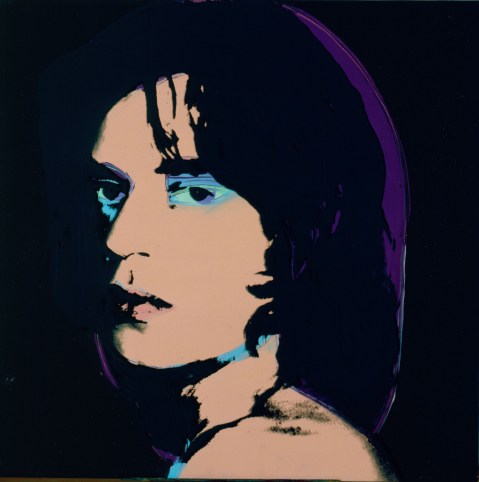
Andy’s Mick, Image by Flickr User Shreveport Bossier
The persona as influenced by Warhol arrives at the nexus of drag, hustling, and stardom, and Jagger in the 70s can be seen to be addressing and/or capitalizing on all three. Warhol’s Ladies and Gentlemen was originally referred to as simply the Drag Queen series. As Bob Colacello tells the story in Holy Terror: Andy Warhol Close Up, some Factory workers were sent to the Times Square gay bar The Gilded Grape to hire several hustlers there to sit for some Warhol Polaroids for fifty dollars a pop. (They later quipped that they were used to doing a lot more than that for fifty bucks.) As was his practice at the time, Warhol transferred these images to silkscreen for mechanical reproduction, over (or under) which he painted in unusually expressive fashion, at times applying collages of torn paper as well. Geometries of color in these pictures war with the photographic image; they signify on race as well as the drag queen’s everyday glamour and its defensive-aggressive thrust-and-parry. In any case, Times Square hustlers of color became stars in Andy’s hands. At this point the title was changed to Ladies and Gentlemen—perfect, since his subjects in the works can be thought of as both—and it may be that the title was taken from the 1974 Stones film of their celebrated 1972 tour, Ladies and Gentlemen, the Rolling Stones (it’s worth recalling lest we be tempted to discount such a film that almost everyone in a broad swath of the New York milieu saw it—in Just Kids (2010), for example, Patti Smith writes of seeing the film with Lenny Kaye and then going off to CBGB to catch a set by Television). What is certain is that Warhol at this same moment was giving Polaroids he had taken of Jagger in Montauk the exact treatment he gives the drag queens in Ladies and Gentlemen.
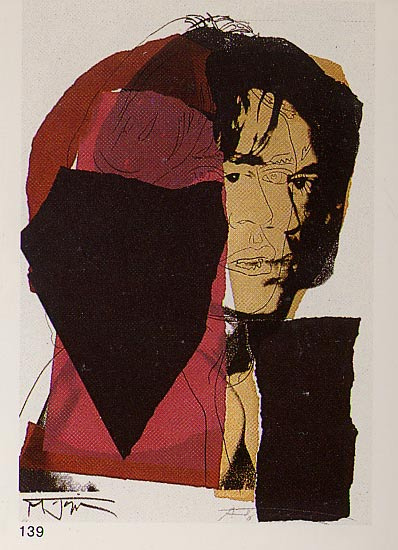
Andy Warhol’s Mick, 1975, Image by Flickr User Thomas Duchnicki
Being a drag queen is really hard work, Warhol famously wrote in The Philosophy of Andy Warhol (1975), and it is in part the connections between hard work, its celebrity remuneration, drag, and prostitution that link the Ladies and Gentlemen series with the portraits—paintings and then prints—of Jagger. These connections link this output with Warhol himself, making the portraits a sort of displaced self-portraiture. Their mechanics, if you will, seem homologous with drag, in fact. Starting with the Warhol-snapped Polaroid—not, say, with newspaper photos or commercial iconography as in Warhol’s 60s silkscreens—the works depend on Warhol’s presence, which then puts the images through the silkscreening process, after which (or before it) an uncharacteristically painterly (or collagist) procedure is applied, the latter akin to make-up itself. Where in some of the series the paint obscures the face, acting as a kind of negation or comment on the negation behind black queer hustling, in most of it the faces rise to a new form of presence or fabulousness, as if by repeating the act of drag the portraits affirm its “success.” Warhol’s make-over of Jagger, meanwhile, both drags the singer and makes him Warhol’s: Andy’s Mick.
According to a scheme worked out by Warhol and Jagger, the latter signed the portraits so that they could promote both artists. Which, if it doesn’t exactly make Jagger a co-author of the works, does signal his endorsement of Warhol’s vision of him. (Indeed the Warhol Museum has a facsimile of a 1983 letter from Jagger to Warhol asking for his assistance with Mick’s autobiography—a collaboration that boggles the mind.) As John Ashbery had it in Self-Portrait In a Convex Mirror, his multiple-prize-winning long poem of 1975:
Your [the artist Parmigianino’s] eyes proclaim
That everything is surface. The surface is what’s there
And nothing can exist except what’s there;
It [the surface] is not
Superficial but a visible core. . .
Your [Parmigianino’s] gesture . . . is neither embrace nor warning
But . . . holds something of both in pure
Affirmation that doesn’t affirm anything.
Not a bad definition of the Warholian image, this, and in the 1970s, as the Rolling Stones entered their second decade of performance and stardom, Jagger took the lesson and ran with it. A new self-consciousness about his own stardom enters Jagger’s (underrated) lyrics in the 70s; while self-reference is not unknown in the band’s 60s work (cf. 1968’s “Street Fighting Man”), and while one of their first hits takes on the culture industry itself (“Satisfaction”), in the 70s a new kind of meditation on rock-star celebrity enters the picture—I have seen the culture industry, and it is me: Jagger begins to write about himself as the culture industry. And this under the sign of Warhol, I think, which is to say, with a queerly knowing intimacy informed by a sense of the artist-star as a hustler for money in what we might call image-drag. Everything is surface, the surface is what’s there and nothing can exist except what’s there, and it’s not superficial but a visible core.
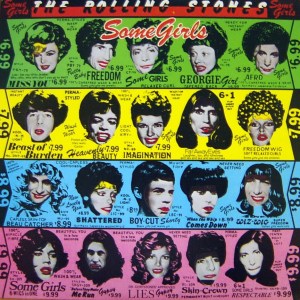
From 1973 forward, in the music from Goat’s Head Soup to Tattoo You (with It’s Only Rock n Roll, Black and Blue, Some Girls, and Emotional Rescue in between), and even more on the covers of these albums, culminating in the one for Some Girls with the Stones in drag—Andy in the Warhol Diaries: “[Mick] showed me their new album and the cover looked good, pull-out, die-cut, but they were back in drag again! Isn’t that something?”; the Some Girls cover, though Warhol didn’t do it, really does recall his drag queens, right down to the double drag of the inner-sleeve pull-out—to say nothing of the made-up glam of the 1975 and 1978 tour performances: in all this one sees a flouncier, queerer Mick, one that Jagger nodded to in various lyrics (for that demonstration you’ll have to wait for the longer version of this piece!). What this means in part is that the cliche we have of Jagger strutting like a neo-blackface soul man is due for revision: it’s much more precise to think of his aura as proximate to black femininity (icons like Tina Turner, say, who of course opened for the Stones), which he (re-)crafted through the adoption of a persona right out of Warhol’s colored drag queen sensibility.
.
So why the now-canonical assumption of the Stones’ decline at just this moment? Is their 70s sound discounted because of the queer reinvigoration of their visual/conceptual appeal? (One counter to this hegemony is Ellen Willis’s fine 1974 review of It’s Only Rock n Roll, included in her Out of the Vinyl Deeps.) Did the Stones’ sound change all that much, beyond new acquisitions of this reggae vibe or that funk riff or the other disco groove, or does the insistence on their fall come from a sense of their queening around? Is it this—not only this, I know, I know, Mick’s such an asshole, but still—that lies in part behind the (particularly post-Life) cult of Keith?
—
Eric Lott teaches American Studies at the University of Virginia. He has written and lectured widely on the politics of U.S. cultural history, and his work has appeared in a range of periodicals including The Village Voice, The Nation, New York Newsday, The Chronicle of Higher Ed, Transition, Social Text, African American Review, PMLA, Representations, American Literary History, and American Quarterly. He is the author of the award-winning Love and Theft: Blackface Minstrelsy and the American Working Class (Oxford UP, 1993), from which Bob Dylan took the title for his 2001 album “Love and Theft.” Lott is also the author of The Disappearing Liberal Intellectual (Basic Books, 2006). He is currently finishing a study of race and culture in the twentieth century entitled Tangled Up in Blue: The Cultural Contradictions of American Racism. This post is adapted from a talk Eric gave at the 2012 EMP POP Conference in New York City entitled “Andy’s Mick: Warhol Builds a Better Jagger.”
Share this:


Current Top Posts





April 2021

January 2020

November 2019

October 2019

August 2019

April 2014

November 2017

March 2015

December 2017

October 2015
 Sounding Out!
Recent Comments