
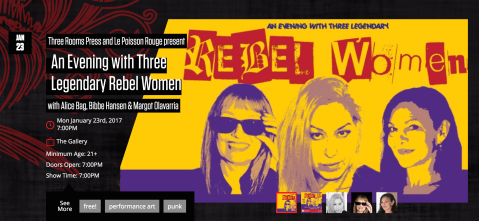
An Evening with Three Legendary Rebel Women at Le Poisson Rouge, January 27, 2017: Margot Olavarria, Bibbe Hansen, and Alice Bag


Image of Alice Bag used with her permission (thank you!)
For full intro and part one of the series click here. For part two, click here. For part three click here.
Our Punk Sound series implicitly argues that sound studies methodologies are better suited to understanding how punk works sonically than existing journalistic and academic conversations about musical genre, chord progressions, and/or genealogies of bands. Alexandra Vasquez’s sound-oriented work on Cuban music, for example, in Listening in Detail (2014) opens up necessary conversations about the “flashes, moments, sounds” in music that bear its meanings and its colonial, raced, classed, and gendered histories in material ways people can hear and feel. While retaining the specificity of Vasquez’s argument and the specific sonic archive bringing it forth, we too insist on “an ethical and intellectual obligation to the question: what do the musicians sound like” (12) and how do folks identifying with and through these musical sounds hear them?
In this series, we invite you to amplify varied historicized “details” of punk sound–its chunk-chunk-chunk skapunk riffs, screams, growls, group chants, driving rhythms, honking saxophones–hearing/feeling/touching these sounds in richly varied locations, times, places, and perspectives: as a pulsing bead of condensation dripping down the wall of The Smell in Downtown LA (#savethesmell), a drummer making her own time on tour, a drunk sitting too near the amp at a backyard party, a queer teenager in their bedroom being yelled at to “turn it down” and “act like a lady[or a man]”. . .and on and on. Today we feature Elizabeth Keenan, documenting an evening with three of punk’s legendary Rebel Women at a time of political crisis.
SOUND!
–Aaron SO! (Sounding Out!) + Jenny SO! (Sounding Out!)
This is not normal/let’s not pretend.
–Alice Bag, “Reign of Fear”
Since November 8, nothing has felt normal in the United States. Instead, every day brings new concerns about what the Trump administration might dismantle, destroy, or defund. The first two months have brought two attempts at an executive order barring immigrants to the US from predominantly Muslim countries and re-introduced the nation to the following cast of characters: a billionaire with no public education experience placed in charge of the Department of Education seeking to push a religious agenda; a man who once vowed to abolish the Department of Energy nominated to helm it; a white supremacist, Breitbart-editor consigliere; and a conspiracy-theorist National Security Advisor with suspicious ties to Russia.
This is not normal.
Let’s not pretend.
But in her song, “Reign of Fear,” Bag counters with defiance: “We’ll resist you/We won’t stand by.”
“Reign of Fear,” which Bag performed last at “Rebel Woman,” an event at (le) Poisson Rouge in New York City, encapsulated the evening’s message of resistance. Hosted by Three Rooms Press, “Rebel Women” featured readings from Margot Olavarria, Bibbe Hansen, and Alice Bag, all of whom have crafted careers that blend music and literary performance. Olavarria is the founding bass player for the Go-Go’s; she later played bass for post-punk experimental band Brian Brain, and holds a PhD in political science. Hansen, an actress, artist and musician, grew up in New York City’s art world. As a teen, she worked with Andy Warhol and played music with Jan Kerouac. Later, she co-founded the ironic Black Flag tribute band, Black Fag, with “terrorist drag artist” Vaginal Creme Davis (who also played with Alice Bag in Cholita). As lead singer and co-founder of the Bags, Alice Bag emerged as one of the most influential Chicana voices in the punk rock scene in Los Angeles in the 1970s (She later documented the women of this scene on her website). Since then, her musical career has included groundbreaking bands Castration Squad, Cholita, and Las Tres, as well as her self-titled solo debut in 2016. Her memoirs Violence Girl (2011) and Pipe Bomb for the Soul (2015) document her music and activism, from L.A. to Nicaragua.
“Rebel Women,” held just two days after the Women’s March on Washington, D.C.—and the satellite marches across the country and internationally—offered an opportunity to reflect on approaches to resistance, whether through music, words, or direct action. Although the Women’s March came under criticism for an initial lack of diversity, it became a protest led by activist women of color, with speakers and performers pushing back against the normalizing of misogyny from a pussy-grabbing president. Both Bag and Olavarria had attended the march in Washington, D.C.; many in the audience had marched there or in the crowd of 500,000 in New York City, which gave “Rebel Woman” a particularly urgent charge.

Image from Flickr user astoller (CC BY-NC-ND 2.0)
And our present moment calls for such urgency; among many other necessary actions, we need popular music scholars to rethink how resistance continues to be a productive idea for musicians and protesters, especially those with marginalized identities. In the past few months, “resistance” has experienced a resurgence in political circles. Many of the most popular posters at the Women’s march picked up on the idea of resistance, including one featuring Star Wars’ Princess Leia and the slogan, “A Woman’s Place Is in the Resistance.” #Resist has become a buzzword for organizing against the Trump administration, whether for women’s rights or against the administration’s racism, for health care or against various cabinet nominations. As a hashtag, #resist is remarkably open, allowing social media users to make connections between causes. This is what the performances of “Rebel Women” did so well for the audience at Le Poisson Rouge.
Calling an event “rebel women” positions Bag, Hansen, and Olavarria as “resistance” fighters. The title “Rebel Women” conjures Bikini Kill’s “Rebel Girl” and the punk-rock feminism of Riot Grrrl, a generation of feminism after Bag and Olivarria participated in the L.A. punk scene and nearly two decades after Hansen starred in a Warhol film based on her own life. Bag and Olavarria, first active as musicians during the 1980s, connected the present moment to the time when punk rock positioned itself against the policies of the Reagan administration. Situating their resistance in their Latina identities (Bag is Chicana, Olavarria is Chilean, both are Angelenos), they conveyed to the mostly white, mostly middle-class New York audience an urgent, intersectional politics. Hansen, who said she wasn’t “given the memo” to connect her reading to politics, read what she called a “time capsule.”

Alice Bag performing at the International Women’s March, January 21, 2017
The stark contrast between these performances brought up questions of power and privilege around what types of memoir are available to different types of women. Bag and Olivarria performed the intersectional oppressions that shaped their lives and connected them to politics, while Bibbe got to be “herself” (that is, unmarked, apolitical, and white). Was this a sign of a tacit understanding white women aren’t going to be as affected by Trump’s policies? (after all, white women elected Trump). Are women of color always expected to perform the emotional labor of connecting their oppressions to political policy, while white women can merely tell stories? Because it is exhausting for women of color to perform this emotional labor–and it can often be exploitative–its all the more important to recognize that Bag and Olivarria chose to do so at Le Poisson Rouge, as I am certain they constructed their performances to speak to this audience (to think otherwise would deny some incredibly smart women their agency).
With those differences in mind, “Rebel Women” underscored for me that intersectional feminism has much to offer in terms of reframing studies of resistance within popular music and is key to ensuring the field’s continued viability in the face of multiple, destructive Trump policies. The concept of intersectionality, developed by Kimberlé Crenshaw to describe the ways that multiple axes of identity—for example, gender, race, ethnicity, religion, or class—affect people in multi-dimensional ways. Crenshaw’s work stresses the importance of seeing intersectionality as an expression of structural power, not just an individual’s conception of their personal identity. Drawing on these intersections can help add complexity to how we understand “resistance” (or even #resistance).
While the study of resistance used to be common in popular music studies—especially in the 1990s—the framework rightly came under criticism as too binary, a position of counterculture vs. mainstream that worked well for glossing 1960s antiwar protests and punk rock, but too simplistic for exploring the nuances of the late-capitalist marketplace. As a theory that emerged from Marxist scholars and examined mostly close-knit, male-dominated subcultures (with formative texts such as Resistance Through Rituals and Subculture: the Meaning of Style), “resistance” was never ideal for grappling with networks organized from a diverse population. An intersectional view, however, understands that the “resistance” group is not evenly or equally affected by the policies of the dominant group; that multiple oppressions shape the forms of resistance available to individual actors; that people facing multiple oppressions also face heightened stakes when they engage in political protest; and that responding to the dominant group requires a commitment to others whose oppressions you may not share.

Archival Photo courtesy of Alice Bag, (from l-r) Margot Olavarria, Alice Bag, Jane Wiedlin, and Shannon Wilhelm
Olavarria’s performance, which opened the evening, illustrated intersectional resistance by interweaving work from the past and present. Instead of feeling piecemeal, each fragment signaled how structural power and resistance intersected in her life. In the first vignette, she described how, shortly after Trump received the Republican nomination, she ducked into a bar in Florida to escape the rain. A man next to her began to praise Trump. So did another. Finally, one turned to her, to ask what she thought of Trump’s policies. She responded: “’No habla Inglés. Yo soy Mexicana.’ I’m not really Mexican. I’m from Chile, known for poetry and protest. But today we are all Mexican, all Muslims, all immigrants.” Of course, we aren’t all Mexican, Muslims, or immigrants—but we can show thoughtful solidarity. Olavarria’s act of resistance worked because she effectively deployed her Latina identity to make a powerful intersectional point.
Intersectionality offers an important understanding, that not all moments are prime for resistance from every body in the same way. Women of color, for example, face different stakes and consequences than white women at the airport and at border crossings. In an excerpt from her entry in the musician’s guide Tour Smart, Olavarria recalled her band Brian Brain being pulled over by the US border patrol in the late 1980s. Dressed head-to-toe in thrift-store plaid in honor of their record label, Plaid Records, Olavarria didn’t look the part of a stowaway. But that didn’t stop the border guards from questioning her although she had a valid driver’s license, and her English bandmate’s visa had expired: “I was quizzed on civics. Then it was where did you go to high school? Who was your kindergarten teacher?” As the questioning grew more in depth, Olavarria “started to imagine working in Juarez in plaid attire.”
Olavarria’s story cannot be separated from Latinx identity, nor can they be separated from the politics of race, borders, and national identity in the United States. Instead, she illustrates that proposals such as Trump’s proposed “wall” have deep roots in anti-Mexican, anti-immigrant policies, and they show dark possibilities about the eagerness with which ICE embraced Trump’s “Muslim Ban.” Her story also emphasizes that, although our current moment is certainly an intensification of such harassment, deportation, and incarceration, women of color have faced these dangers in the U.S. for a very long time. What’s new, beyond Trump’s policies, is increased white feminist attention to these issues, an opportunity for both increased resistance and wary skepticism. Olavarria ended her segment with six suggestions for resistance reminding the audience that in these dark times, “walking around thinking we’re totally fucked will not change anything.” She certainly spoke to my struggle in that moment; the response in the room suggested I wasn’t alone.
Margot Olivarria’s Tips for Resistance:
- Wear your safety pin. It is appropriate that a punk fashion accessory has become the symbol of political dissidents. It may also come in handy when militarized police tear your clothes.
- Enjoy yourself. Walking around thinking we’re totally fucked will not change anything.
- If you have numb yourself, go ahead, as long as you don’t become addicted.
- Spread love. The only thing that will counter Trump’s hate is love.
- It may be that the only way we can say, “You’re fired!” to Trump is through the vote. Register as many progressive minded people as you can. Midterms will be crucial.
- If you see something, do something. Protest against all injustices we witness. Art mightier than the sword. Surround yourself with like-minded people and express outrage. As love Trumps hate, expression beats depression.
Hansen’s “time capsule” from 1964 described events leading to her starring in Andy Warhol’s film, Prison, based on her experiences in reform school. Hansen’s performance, told from behind her dark “reading sunglasses,” took on the tenor of a world-weary teenager.
She had run away from her parents—her father was Fluxus painter Al Hansen and her mother was poet and New York bon vivant Audrey Ostlin Hansen (who died at age 37 in 1968)—and was feeling stir-crazy at her friend Jeff’s apartment, because he only had “the same 40 books every hipster has.” So when her pal Janet Kerouac called with an invite of learning to cook spaghetti and taking acid for the first time, she jumped at the chance, even though she wasn’t sure about the acid part, because it was “too earnest.”
By ten that night, we’re rolling around, and spaghetti is everywhere. We’re dipping it in sauce, hurling it everywhere. We slither and roll across the floor like the first reptiles emerging from the primordial ooze. All the guys have hard-ons. I’m not really into orgies. They’re more like work, you know?
Hansen’s skill as an actor was on full display in her reading, as she vanished into her narration, capturing a unique combination of jadedness and enthusiasm. But every once in a while, a line like, “I may be a kid, but I’m also a freak,” would jump out. It was only toward the end of her reading, when Bibbe describes herself, still high, playing hopscotch with kids in the neighborhood that she reminds us: this is a child of twelve. The kids’ mom takes Bibbe in and gives her some cake, and she is astonished that this what normal parents do for kids.

Still from Bibbe Hansen’s screen test for Andy Warhol, 1964
The moment reveals the vulnerability of Bibbe, the runaway. She might have some agency in choosing to spend time with hipster boys and Jan Kerouac, but those come along with expectations of orgies and acid. It doesn’t leave much room for childhood, hopscotch, and cake. After this realization, Bibbe decides to call her father, who tells her, “I ain’t going to jail, so I guess you are.” In this powerlessness, Hansen found an upside: the day her father got her out of juvenile detention, he took her to lunch with Andy Warhol. Finding that upside does not mean that Hansen lacks self-awareness; instead, the moment read as one of acceptance. She cannot create a new girlhood for herself, just as she couldn’t escape her family by hiding with hipsters. “In the end,” she said, “you get what you get.”
Although Hansen’s reading felt disconnected from current politics, I heard her contribution to the evening as a moment of personal resistance. Hansen has often been defined by the men surrounding her: daughter Al Hansen, youngest of Andy Warhol’s Factory stars, mother of musician Beck. Instead of giving us Bibbe through her connections to her father, or to Warhol, she reframed her adolescent experiences so that they became side characters, opening up space for her unique, clear, adolescent voice, recast through a woman’s perspective.
 Alice Bag, singer of The Bags, finished out the night with combined spoken word and live musical performance. After playing in many bands since, Bag released her first solo album in 2016 on the independent punk label Don Giovanni Records. In the intervening years, she worked as an activist and teacher, both in the United States and in Central America. Her combination of readings from her memoirs and musical performance with Tanya Pearson evoked a lifetime of resistance. As the only performer to combine spoken word and live musical performance, Bag situated her songs in the readings she selected from her memoirs. Although the songs are relatively new, they drew on her rich experience with Latinx activism and education.
Her first excerpt, from Violence Girl, described the march for the National Chicano Moratorium on March 29, 1970, the largest anti-Vietnam protest by a minority group. Bag went to the march with her father. Until that moment, she said, “I had never realized I was part of a minority. Our enemies were not afraid to throw bottles at us, or shoot us.” The moment inspired a song that Bag performed, “White Justice.” Framed from a child’s perspective, “White Justice” explores the dawning realization that a march is not a parade, and that it may have dangerous consequences, even violence. At first filled with vivid colors of “blue skies/brown berets,” “green lawns,” and “yellow corn,” the mood turns when the police arrive, with “black gloves/blue collars/blood red/silver dollars,” a moment she connected to the present day: “Our struggle then was here at home/And it’s still going on.”
Bag encouraged the audience to sing along at the chorus of “White Justice”—and many members of the mostly white audience did. This eager participation stood in stark contrast to an incident I witnessed at the Women’s March in New York City, when a man tried to get a “Black Lives Matter” chant going during the New York City march and it was slow going.
 Bag’s next story, from Pipe Bomb for the Soul, illustrated that, while she was a member of an oppressed minority in the United States, she brought privilege with her as a teacher in Nicaragua. In her words, “I discovered a lot of things, mostly my own ignorance.” She returned to the United States and taught for over 20 years. Her next song, “Programmed,” expressed her frustration at the post-Leave No Child Behind state of education. At a certain point, she said, “The kids were asked to bubble in Scantrons. We need to teach kids to think for themselves, to value their heritage and experience.”
Finally, Bag ended with the song that began this blog post: “Reign of
Fear.” Inspired by the election, the song acknowledges both fear and
resistance. It is fear that elected Trump; it’s fear that now
motivates some of thethe resistance against him is a stance against
that fear. The fears that elected Trump are fears that treat rights as
a zero-sum game—that if women, or people of color, or queer people, or
Muslims, or Mexicans, or anyone else should gain rights or power, then
white men will lose theirs. In rejecting this view, Bag offers an
intersectional resistance in a punk song, noting “the future comes in
all colors and creeds.” Women of color have been leaders of the
resistance since Trump was elected, but they have also laid a
groundwork for intersectional feminist activism over decades of work.
This is not normal. Let’s not pretend.
But, in resistance lies hope.
In the small space below Le Poisson Rouge, Bag’s voice and Pearson’s guitar swelled to fill the room with that hope:
We reject your/Reign of fear. The future is female/the future is queer. Look out, man/’Cause the future is here.
—
Featured Image of Margot Olavarria, Bibbe Hansen, and Alice Bag by Christine Tottenham, Used here with permission of the Women of Rock Oral History Project.
—
Elizabeth K. Keenan completed her doctorate in ethnomusicology at Columbia University in 2008.She is currently reworking her academic work on popular music and feminism since 1990 into a book for normal humans. She has published in Women and Music, Journal of Popular Music Studies, Archivaria, and Current Musicology, as well as two chapters in Women Make Noise: Girl Bands from Motown to the Modern (2012). Her proudest moment is finally getting to interview Carrie Brownstein, for NYLON, more than ten years after she tried to interview Brownstein for her dissertation. She sometimes writes for the Chronicle of Higher Education’s Vitae website, and her occasional blogging can be found at badcoverversion.wordpress.com.
—

REWIND! . . .If you liked this post, you may also dig:
G.L.O.S.S., Hardcore, and the Righteous White Voice – Chris Chien
If La Llorona Was a Punk Rocker: Detonguing The Off-Key Caos and Screams of Alice Bag– Marlen Ríos-Hernández
Riot-Grrrl, Punk and the Tyranny of Technique – Tamra Lucid
SO! Amplifies: The Women in L.A. Punk Archive
Share this:

(Dis)orienting the Bell: Aural Assault from A Game of Thrones to Richard Coer de Lyon


series co-editors Dorothy Kim and Christopher Roman
Hear YE! Below is the introduction to the latest installment of Medieval Sound, Aural Ecology, by series co-editors Dorothy Kim and Christopher Roman. To read their previous introduction, click here. To read the first run of the series in 2016, click here.
Aural Ecology
What is considered music, noise, or harmony is historically and culturally contingent. For example, some medieval musical theory, or musica speculative, such as Jan Herlinger’s “Music Theory of the Fourteenth and Early Fifteenth Centuries” in Music as Concept and Practice in the Late Middle Ages, defined music as “contemplation that serves the moral edification of the mind” (293). Influenced by the work of Boethius’s De Musica, music is not just everyday music but “connotes harmony conceived broadly enough to encompass the relationships obtaining in the human body and psyche and governing the motions of planets” (293). This kind of ecological harmony is explored in the work of Boethius, especially in his discussion of abstract qualities in the prelude to the De Musica, The Book of Arithmetic (as translated by Calvin Martin Bower) “Indeed these things themselves are incorporeal in nature and thrive by reason of their immutable substance, but they suffer radical change through participation in the corporeal, and through contact with variable things they change in veritable consistency” (24). For Boethius these “essences” are concordant with mathematical properties expressed in music. Thus, music was both speculative and moral, and these intertwining purposes derived from music’s phenomenological pleasures derived in the environment, “for nothing is more consistent with human nature than to be soothed by sweet modes and disturbed by their opposites” (Bower 32).
Boethius also comments on the psychological effects experienced in hearing music as they “affect and remold the mind into their own character” (Bower 34). Boethius gives examples of how certain groups of peoples, such as the Thracians or Lacedaemonians, delight in different kinds of music that harmonizes with their natures. For Boethius, music is transcendent in that it exists as a kind of eternal sound, but also an immanent sound, in that it appeals to various peoples depending on their nature and environment. Boethius’ speculations lead him to think about harmony and sound as available to reason and sensory perception. Thus the notion of harmony itself is “the faculty of considering the difference between high and low sounds using the reason and senses. For the senses and reasons are considered instruments of this faculty of harmony” (Bower 295). Harmony (and disharmony in the form of noise) became a marker of the aural ecology for an individual or group.
The essays in “Aural Ecologies” also address the issue of unharmonious sounds, sounds that often mark dissonant critical identities—related to race, religion, material—that reverberate across different soundscapes/landscapes. In this way, this group of essays begins to open up the stakes of Medieval Sound in relation to what contemporary sound studies has begun to address in relation to cultural studies, architectural and environmental soundscapes, and the marking of race through the vibrations of the body. —Dorothy Kim and Christopher Roman
In the neo-medieval A Game of Thrones (2011), the medieval Saracen-inspired and violent Dothraki utilize bells as a symbol of victories in battle. Each time a leader or khal defeats a foe, he incorporates the bells from his foe’s shorn black braid into his own braid. Khal Drogo, khal of the most powerful khalasar in Essos, sports an uncut braid sensuously described by George R. R. Martin as “black as midnight . . . hung with tiny bells that rang softly as he moved. It swung well past his belt, below even his buttocks” (37).
Dothraki bells serve both a hypermasculine and deterritorializing function: esteem and prowess for Eastern men comes from the symbolic castration of their enemies and the eradication of civilizations. For the Dothraki, sexualized and territorial conquest is centralized around amplitude of noise made by an aggregate of bells adorning a phallic braid. Drogo is frightening because of his noise: he wears “[b]ells so his enemies w[ill] hear him coming and grow weak with fear” (802). In the pilot episode of Season 1 of HBO’s Game of Thrones, writers David Benioff and D. B. Weiss and director Tim Van Patten emphasized the contrast in noise between the copper-skinned Dothraki and the white Valyrians of the Free Cities:
East disrupts West in this scene through a racialized auditory disruption of white silence.
The association of the Middle East with noise pervades Western culture. One need only recall juxtapositions of quietly carefully groomed news anchors in sterile American news sets conversing with correspondents struggling to be heard in earsplitting raucous streets embroiled in Middle Eastern crises in countries like Iraq and Syria. See Aron Brown of CNN announcing the U.S. War on Iraq in 2003, for example:
However, this association of the Arab world with noise is not a new one. In medieval literature, noise played a crucial role in distinguishing Saracen East from Christian West. Bells and particularly the cacophonous noise they cumulatively make came to be associated with a violent imagining of the East in literature of the medieval period. The late medieval crusading romance Richard Coer de Lyon, centered on the exploits of the twelfth-century crusading king, Richard the Lionheart, situates the pealing bell as its central object. [Note: Richard Coer de Lyon is cited by line number. All quotations come from the widely-used complete modern version, Richard Löwenherz, ed. Karl Brunner, Wiener Beiträge zur Englischen Philologie (Vienna and Leipzig, 1913)].
As in Dothraki warrior culture in A Game of Thrones, bells gain symbolic power in the romance through replication and accumulation. Richard Coer de Lyon features pealing bells in two crucial episodes concerned with the East and a maternal rather than phallic male body: 1) the exorcism of Richard’s demonic Eastern mother at Mass with a sacring bell (l.221-34); and 2) the appearance of Saladin’s demonic mare arrayed in clamorous bells attached to her crupper at the climactic battle of Acre (l.5532-49, 5753-8). Drawing on both medieval treatises on the function of bells and Gilles Deleuze and Felix Guattari’s theory of the refrain, I argue that the bell—initially a symbol of Christian order, the West, and patriarchy—becomes a disorienting aural force associated with chaos, the East, and maternity.
Early on in the romance, the king’s men try the piety of Richard’s mother, Cassodorien of Antioch, a bewitching foreigner whose only apparent fault is that she cannot remain in church to hear Mass, by physically restraining her during a service. To the shock of the English parishioners, at the ringing of the sacring bell, Cassodorien breaks free of her male captors, seizes two of her children, and flies through the church roof never to be seen again:
And whene þe belle began to ryng,
And when the bell began to ring,
The preest scholde make þe sakeryng,
And the priest was about to do the sacring,
Out off þe kyrke sche wolde away…
Out of the church she tried to go away…
Out of the rofe she gan her dyght,
Out of the roof she began to make her way/transform,
Openly before all theyr syght…
Openly before all of their sight…
— Richard Coer de Lyon, 221-5.
At this striking moment of contact between queen and masculine material object, the bell is forever altered, (re)oriented on a trajectory that transmogrifies it from a symbol of priestly power to a chaotic symbol of maternity and the East.

Sacring Bells in Aberdeen, Scotland. Image by Flickr User rethought (CC BY-NC 2.0)
Medieval thinkers conceptualized the church bell as an agent for revealing both foreign and demonic threats from within the community. In The Rationale Divinorum Officiarum of William Durand of Mende thirteenth-century French liturgical writer and bishop, William Durand,xplains the significance of the pealing of bells– “when the bell rings . . . the people are unified with the unity of faith and charity” (51) –but also expounds on this exorcising function of the church bell:
[T]he bells are rung in processions so that the demons who fear them will flee . . . They are so fearful when they hear the trumpets of the Church militant, that is the bells, that they are like some tyrant who is fearful when he hears in his own country the trumpets of some powerful king who is his enemy (51).
Durand conflates the demonic with the East, both qualities embodied by Cassodorien who hails from Antioch (near the border of Syria and Turkey). He also imbues the bell with an emasculating quality; it renders even a tyrant fearful. The measured sounding of the church bells forms a tonal refrain, an aural sequence to familiarize Christian space.
The purpose of the aural refrain, for Gilles Deleuze and Felix Guattari, is to deterritorialize and then reterritorialize unfamiliar space. In A Thousand Plateaus, they explain the refrain/‘ritournelle’ as a threefold place of disorientation, the familiar, and escape:
They are three aspects of a single thing, the Refrain (ritournelle)…. Sometimes chaos is an immense black hole in which one endeavors to fix a fragile point as a center. Sometimes one organizes around that point a calm and stable “pace” (rather than a form): the black hole has become a home. Sometimes one grafts onto that pace a breakaway from the black hole (312).
The bell was arguably the most important and pervasive aural symbol in medieval Europe, one whose refrain regularly demarcated Christian spaces in times of chaos. Sound theorist R. Murray Schafer has called the medieval church bell “the most salient sound signal in the Christian community” in The Tuning of the World (53), and a unifying force “acoustically demarking the civilization of the parish from the wilderness beyond its earshot” (55). Yet, as the bell multiplies through contact with Cassodorien and Richard wanders into the wilderness or black hole of the East, its sound is layered and its signification coopted by the East and transformed into a disorienting force that decenters Saladin’s enemies.

Richard battles Saladin, Luttrell Psalter, BL42130, 4v
The bell resurfaces once more as Richard prepares for his epic battle against Saladin at the gates of Babylon. In this climactic battle with a second pairing of mother and son, reimagined in the form of a demonic belled “mere” and her “colt” summoned by Saladin’s necromancer, bells occupy a central place of prominence on the mare’s accoutrements. In 1192, Saladin reportedly sent two new horses to Richard after his horse was slain in battle (For an overview of this event, see page 73 of Sir Steven Runciman’s A History of the Crusades, Vol.3: The Kingdom of Acre and the Later Crusades). The mare, as one of only two mothers in the romance, uses the same aural symbol to assault the English Christians that they had used to exorcise Cassodorien. As Saladin’s mare proudly strides onto the battlefield, the poet emphasizes the deterritorializing effect of her cacophonous bells:
þerffore, as þe book vs telles,
Therefore, as the book tells,
Hys crouper heeng al ful off belles,
The mare’s crupper hung all full of bells;
And hys peytrel, and his arsoun.
From the armor, too, and the saddlebow,
þree myle men my3ten here þe soun.
For three miles men could hear the sound.
Þe mere gan ny3e, here belles to ryng,
His mare began to neigh, her bells she rang
Ffor gret pryde, wiþouten lesyng.
With great pride, it is no lie.
–Richard Coer de Lyon, 5753-8.
Fascinatingly, Brunner again diverges in this passage from Caius 175, and changes “þe mere” to “his mere,” further stripping the demonic mare of her agency.
Whereas the church bell is a singular symbol of order, symmetrical and “acoustically demarking” space with its meted refrain, the bells of the mare are multiple, discordant, chaotic, and cacophonous, designed to disorient rather than to unify (see Schafer 55). The medieval illuminator of the Luttrell Psalter (c.1325-1335) similarly emphasizes the clamorous quality of the belled mare, and distinguishes Saladin’s mount from Richard’s by the vast array of bells attached to its crupper and the noise these bells suggest.
The noise, suggested in the Luttrell Psalter by the movement and detail given to the crupper bells, can be heard on a smaller scale in the following video clip of a horse merely walking noisily with a smaller bell-laden crupper:
One can easily infer the discordant sound a running mare might make with a crupper “hung all full of bells.” The poet suggests that the noise encompassed an aural disturbance of three-miles and disrupted the Christian crusaders. The bells also serve an insidious maternal purpose: they serve as a trap to lure her colt to abandon Richard and “knele adoun, and souke hys dame” (kneel down and suck his dame)” (Richard Coer de Lyon, 5547). In A Thousand Plateaus, Deleuze and Guattari suggest the layering of sounds, particularly maternal sounds, can disrupt and deterritorialize space. In their discussion of the reterritorializing effects of layered song, Deleuze and Guattari provide the strikingly maternal example of Debussy’s Sirens, which, they posit, integrates voice with orchestra to make the voices of child and woman inextricable from “the sea and the water molecule” (340). In much the same way in Richard Coer de Lyon, the mare’s imbrication of voice over bells seeks to make the dichotomies of the romance—mother and son, east and west, chaos and order, demonic and angelic—implode as the demarcated boundaries between them are dissolved in her cacophonous demonic lullaby.

Daenerys, Created in ArtRage Studio by Flickr User Happy Snapper 80 (CC BY-NC 2.0)
While A Game of Thrones and its HBO counterpart pick up on the resonances of medieval noise to differentiate between East and West, noise is gendered differently. In RCL the threat signaled by the sound of bells is that Richard will be emasculated by his inability to cut ties with the specter of his mother’s influence and disambiguate himself from the Eastern Saracens she represents. However, in Martin’s series, the Dothraki bells, like much of Dothraki culture, exist only to be subsumed under Daenerys’ imperial ambitions for an Iron Throne the Dothraki neither care about nor want. Daenerys’ bell, affixed to her hair after the death of Drogo and the dissolution of his khalasar, becomes a symbol of cultural and racial appropriation Martin stages under the guise of (white) feminism. That is, the issues noise signals have changed from the challenge of excising Christian West from Islamic East (a fear literalized in Richard’s cannibalistic consumption of Saracen flesh) to cultural appropriation (the devouring of Dothraki culture for the benefit of white colonialism).
—
Featured Image: Proceso Khal Drogo by Flickr User Orgita Sucubita, (CC BY-NC-ND 2.0)
—
Thomas Blake is Assistant Professor of English at Austin College.
—
REWIND!…If you liked this post, you may also dig:
Sounding Out! Podcast #54: The Sound of Magic-K.A. Laity
Mouthing the Passion: Richard Rolle’s Soundscapes–Christopher Roman
Playing with the Past in the Imagined Middle Ages: Music and Soundscape in Video Game–James Cook
Share this:


Current Top Posts





April 2021

January 2020

November 2019

October 2019

August 2019

April 2014

November 2017

March 2015

December 2017

October 2015
 Sounding Out!
Recent Comments