
Shoo bop shoo bop, my baby, ooooo: W.E.B. Du Bois, Sigmund Freud & Barry Jenkins’ Moonlight
 Inspired by the recent Black Perspectives “W.E.B. Du Bois @ 150” Online Forum, SO!’s “W.E.B. Du Bois at 150” amplifies the commemoration of the occasion of the 150th anniversary of Du Bois’s birth in 2018 by examining his all-too-often and all-too-long unacknowledged role in developing, furthering, challenging, and shaping what we now know as “sound studies.”
It has been an abundant decade-plus (!!!) since Alexander Weheliye’s Phonographies “link[ed] the formal structure of W.E.B. Du Bois’s The Souls of Black Folk to the contemporary mixing practices of DJs” (13) and we want to know how folks have thought about and listened with Du Bois in their work in the intervening years. How does Du Bois as DJ remix both the historiography and the contemporary praxis of sound studies? How does attention to Du Bois’s theories of race and sound encourage us to challenge the ways in which white supremacy has historically shaped American institutions, sensory orientations, and fields of study? What new futures emerge when we listen to Du Bois as a thinker and agent of sound?
Over the next two months, we will be sharing work that reimagines sound studies with Du Bois at the center. Pieces by Phillip Luke Sinitiere, Kristin Moriah, Aaron Carter-Ényì, Austin Richey, Julie Beth Napolin, and Vanessa Valdés, move us toward a decolonized understanding and history of sound studies, showing us how has Du Bois been urging us to attune ourselves to it. To start the series from the beginning, click here.
Readers, today’s post by Julie Beth Napolin brings her trilogy to a close, exploring the echoes of black maternal sounding and listening she has amplified in Du Bois in Barry Jenkins’s Oscar-winning film Moonlight (2016).
Essay One: Listening to and as Contemporaries: W.E.B. Du Bois & Sigmund Freud
Essay Two: (T)racing Mother Listening: W.E.B. Du Bois & Sigmund Freud
–Jennifer Lynn Stoever and Liana Silva, Eds.
The theory of the acousmatic—the idea of a sound whose source is unseen, as it comes to us from Barthes, Chion, and Dolar—rests upon the mother tongue and the Oedipal scene, the dyad of mother and father. There is in “Do ba – na co – ba”–his great- great- grandmother’s song Du Bois remembers hearing passed down through his family–a transmission from the mother, but what kind of transmission? “There is no one extant autobiographical narrative of a female captive who survived the Middle Passage,” Hartman writes in “Venus in Two Acts” (3). History becomes, she continues, a project of “listening for the unsaid, translating misconstrued words” (3-4). The word-sounds “Do ba-na co-ba” are not the translation of a misconstrued word and they bolster a song of survival, of living on. But there is a silence there. “Do ba-na co-ba,” in a manner of speaking, survives the Middle Passage, and re-opens it as a primary channel of listening and receiving.
The Bantu woman was Du Bois’ grandfather’s grandmother, so many generations removed.
Returning to the vestiges of black motherhood in recent black cinema (including Jordan Peele’s Get Out and Barry Jenkin’s Moonlight), Rizvana Bradley argues that the loss of the mother “in black life more generally, as it repeats through cycles of material loss, … encapsulates racial slavery’s gendered social afterlife” (51). Bradley’s essay is crucial in retrieving the figure of the lost mother even in moments when the mother is absolutely elided as a character, not to appear visually. Horror more generally owes its immersive quality to the womb (enclosed spaces), but Bradley turns to black film form in particular to find in its mise-en-scène (such as in the gravitational field of the “sunken place”) maternal flesh and form.
In the compositional and formal strategies of The Souls of Black Folk, in the punctuated silences that open each chapter, there is a trace of the elided black maternal. The Bantu woman is lost not because Du Bois did not know her (he could not have), but because something of her song transmits a loss and theft that were not symbolic, but literal—a stolen and kidnapped maternal, rather than simply destroyed, as in the Oedipal mandate. It is crucial that the song that is at the core of Du Bois’ memory is transmitted along the maternal line. This maternal voicing is the unspoken wound of Du Bois’ text.

Spillers begins “Mama’s Baby, Papa’s Maybe” from the premise of non-Oedipal psycho-biographies, and these include not only the single mother, but the kidnapped mother. The quotation marks that surround the figure of the “black woman” for Spillers are “so loaded with mythical prepossession” that the agents it conceals cannot be clarified. Spillers takes particular aim at the infamous conclusions of the Moynihan report of 1965 that trace the roots of African American poverty to the figure of the single mother, the underachievement of lower class black males being linked in the report to black women.
In this way, black culture is thought to operate in a matriarchal pattern essentially out of step with a majority culture where a child’s identity and name, by definition, cannot be determined by the maternal line (66). As Lacan insists, it is the Father who gives a child both the Name and the symbolic Law (language). According to this configuration, Spillers argues, the child of the black mother can only be left in a haunting dis-identity. The implications for psychoanalysis are radical: Spillers begins the essay with a “stunning reversal of the castration thematic,” one that displaces its structure “to the territory of the Mother and Daughter, [and] becomes an aspect of the African-American female’s misnaming” (66). Among these misnamings is that black women are often not seen as “women,” omitted from the category and its political inflections. She is left castrated, politically impotent. For in this displacement, the subject positions of “male” and “female” lose—or fail to adhere to—their traditionally conceived symbolic integrity, and this loss begins with the historical experience aboard ship.

“waves and shadows,” image by Flickr User Albatrail
For Spillers, then, it is essential to trace this misnaming and undifferentiation of black women to the physical and psychic conditions of the Middle Passage. When Freud begins Civilization and Its Discontents, he notes an “oceanic feeling” engendered by religion. The oceanic is the longing for return to a pre-subjective state where one is united with all that is, before the cut that is birth and then language (indeed, the oceanic feeling is often attributed to song). Spillers’ move is to read the oceanic literally and structurally at once: there is the Atlantic Ocean and its Middle Passage. The oceanic, in this way, is de-subjectivating; it casts the subject out of itself in a terror of undifferentiation that does not cease with landfall.
But Spillers also implies that, in that (sexual) undifferentiation, a radical political potential can be retrieved. It is not that black feminism retrieves for her a sexual differentiation after becoming an ambiguous thing. It would not be “woman” in any traditional sense, for that New World category rests upon the violence Spillers seeks to describe. Above all, it would not be easy to name.
Du Bois certainly takes up the Father in his poetic epigraphs. But in ending with the Bantu woman’s song—as it seems to anatomize all of the other songs he describes—Du Bois upholds himself as being named by the maternal line. He is unable or perhaps unwilling to make a clarified place for a black female political agent. If we listen with ear’s pricked, we find that she is the submerged, oceanic condition for his speech.

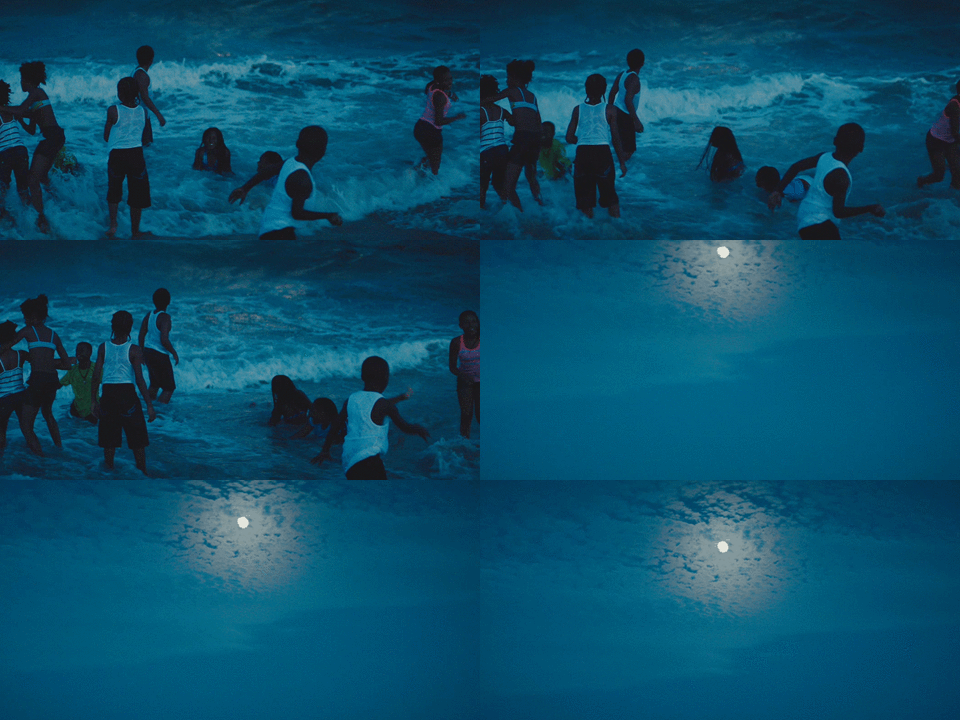
By way of an open-ended conclusion, we can recall the sound of the ocean that punctuates Jenkin’s stunningly lyrical and psychologically complex coming-of-age film, Moonlight. The ocean provides the anchoring location for the psychological action, but also its aesthetic locus, the beginnings of its cinematic language. The sound of the ocean continually marks a desire for “return” to maternal undifferentiation and oneness, and yet, it provides the space for two embodied memories that cannot be compassed by traumatic separation. In the first, a father-like figure, Juan, embraces a young boy, Little, to allow him to float in a nearly baptismal scene of second birth, and in a second scene at the shore, Little experiences with his friend, Kevin, sexual gratification, a coming into his body as a site of pleasure.
The conclusion of the film posits these moments as being in the past. We had experienced them as contemporary, but only later realize they are a well of memory for a now-adult subject who does not know himself. I want to focus, then, on the film’s conclusion, after Kevin and Little (now named Black, his adult re-renaming), meet again after many years. Kevin calls Little/Black on the phone, a defining gesture of reaching out erotically and acousmatically with voices. We later learn that he calls because Kevin has heard an old song that reminded of him of his lost friend. By this voice or call, Black is brought somewhere back to his moment of break to become Little again, as if something in the past must be recuperated for the present. As he drives down the open road to find Kevin, the music of Caetano Veloso soars.
We can’t be sure if this is extra-diegetic or diegetic music. To be sure, Black would never listen to such a song on his stereo. And yet, the song seems to emanate directly from its affective space. In the language of literature, it is a “free-indirect style,” part character and part author; the film is hearing Black/Little feel. He’s in a space of haunting melody, drenched in personal memory, whose principle scene had been the Florida shore, the ocean lapping providing a (maternal) containing motif for the film, now transmuted into song.
The oceanic, Spillers might remind us, is violent, echoing the passages that made it possible for these two black boys to be there. But the sound is also amniotic, a space of maternal longing, particularly for a character who, in Bradley’s estimation, is positioned as pathological, injured by the missing mother who is, in turn, indicted by the film’s imaginary. To some extent, Moonlight participates in the mother’s misnaming: it cannot see the structures that ensure her lostness. But the film does also push towards some mode of melancholia that, as Michael B. Gillespie argues of Jenkins’ earlier work, would cease to be depressive. Jenkins’ aesthetic practice is transformative, Gillespie suggesting that we use Flatley’s term, “antidepressive melancholia,” as it’s with a stake in the personal past but turned towards the collective future (106).

When the two boys, now men, meet again, several sounds punctuate the scene. They are not words or even phonemes, yet “speak” to provide a sonic geography of feeling that includes or “holds” the viewer, as Ashon Crawley might suggest. Among them is the sound of the bell on the door, which marks hello and goodbye, entry and exit, coming and going (or “fort-da” in Freud’s lexicon). When Black enters the diner, he is still “Black.” It is only when remembering what happened at the shore, then to say that no man has touched him since, that he becomes Little. He discloses this truth on behalf of a potential in present and a still-nascent future. Kevin cooks for Black, and Jenkins’ is careful to amplify the sound of the spoon stirring. He provides for Black, the film locating Kevin, a male, within the coordinates of maternal care. The sonic crux of the scene—no longer primal, no longer traumatic—is when Kevin plays the song on the jukebox that had drawn him to call to Little/Black in the first place. “Hello, stranger,” Barbara Lewis croons, “it seems like a mighty long time. Shoo bop shoo bop, my baby, ooooo.”
In listening to a song that is from our past, Newtonian time collapses, a shock running from past to present. The film never discloses whether these two had once heard this song together before. It is more likely that its affective map impacts Kevin, that he hears in its melancholic sound a nascence, and with it, a longing to retrieve his own past and repair. Lewis herself, singing in the sixties, is a recalling an already eclipsed fifties doo-wop. The phonemes circle back to their beginnings in “Do ba- na co-ba.” Such sounds are to be opposed to the shot of Little’s mother yelling at him (presumably a slur). There, the sound had cut out of the scene, which recurs for Little in a traumatic nightmare.
In contrast to that violent naming, the boys’ intimacy was defined by, to use Kevin Quashie’s term, “quiet,” a sense of interiority Michael Gillespie explores in his analysis of Jenkins’ first feature film, Medicine for Melancholy. Shakira Holt and Chris Chien called this dynamic in Chiron and Juan’s relationship “silence as a form of intimate conversance” in their 2017 post about Moonlight. There is a queer intimacy revived apart from trauma, triangulated by a black woman’s voice, paired with male harmonies, that resonate acousmatically from the jukebox to hold and contain the scene. For psychoanalytic theories of voice, containment is the essential maternal gesture of song.
We begin to wonder what might be possible for the feminine were it to be separated from the maternal dimension, a potential that Jenkins does not explore in this particular film in his oeuvre (as he does in Medicine for Melancholy, for example); each of the women in Moonlight “mother” to some extent. Nonetheless, he disperses the maternal function across male and female subjects, particularly in moments when the film resists depression. In listening with ears pricked, as with Du Bois’ epigraphs, the voices cease to belong to an individual, to be male voices or female voices, but become plural and pluralistic. It becomes possible to ground a politics of listening to the past for remaking in the present in that sound.

—
I would like to thank Michael B. Gillespie, Amanda Holmes, and Jennifer Stoever for their incredible scholarly assistance and comments in writing this essay trilogy.
—
Julie Beth Napolin is Assistant Professor of Literary Studies at The New School, a musician, and radio producer. She received a PhD in Rhetoric from the University of California, Berkeley. Her work participates in the fields of sound studies, literary modernism and aesthetic philosophy, asking what practices and philosophies of listening can tell us about the novel as form. She served as Associate Editor of Digital Yoknapatawpha and is writing a book manuscript on listening, race, and memory in the works of Conrad, Du Bois, and Faulkner titled The Fact of Resonance. Her work has appeared in qui parle, Fifty Years After Faulkner (ed. Jay Watson and Ann Abadie), and Vibratory Modernism (ed. Shelley Trower and Anthony Enns).
—
 REWIND! . . .If you liked this post, you may also dig:
Moonlight’s Orchestral Manoeuvers: A duet by Shakira Holt and Christopher Chien
“A Sinister Resonance”: Joseph Conrad’s Malay Ear and Auditory Cultural Studies–Julie Beth Napolin
“Scenes of Subjection: Women’s Voices Narrating Black Death“–Julie Beth Napolin
Share this:

“Music More Ancient than Words”: W.E.B. Du Bois’s Theories on Africana Aurality

 Inspired by the recent Black Perspectives “W.E.B. Du Bois @ 150” Online Forum, SO!’s “W.E.B. Du Bois at 150” amplifies the commemoration of the occasion of the 150th anniversary of Du Bois’s birth in 2018 by examining his all-too-often and all-too-long unacknowledged role in developing, furthering, challenging, and shaping what we now know as “sound studies.”
It has been an abundant decade-plus (!!!) since Alexander Weheliye’s Phonographies “link[ed] the formal structure of W.E.B. Du Bois’s The Souls of Black Folk to the contemporary mixing practices of DJs” (13) and we want to know how folks have thought about and listened with Du Bois in their work in the intervening years. How does Du Bois as DJ remix both the historiography and the contemporary praxis of sound studies? How does attention to Du Bois’s theories of race and sound encourage us to challenge the ways in which white supremacy has historically shaped American institutions, sensory orientations, and fields of study? What new futures emerge when we listen to Du Bois as a thinker and agent of sound?
Over the next two months, we will be sharing work that reimagines sound studies with Du Bois at the center. Pieces by Phillip Luke Sinitiere, Kristin Moriah, Aaron Carter-Ényì, Austin Richey, Julie Beth Napolin, and Vanessa Valdés, move us toward a decolonized understanding and history of sound studies, showing us how has Du Bois been urging us to attune ourselves to it. To start the series from the beginning, click here.
Readers, today’s post by Aaron Carter-Ényì delineates two central strands in Du Bois’s work that have proven key to what we now call sound studies–the historical and affective meanings that sound carries as well as its ability to travel great distances through time and space.
–Jennifer Lynn Stoever and Liana Silva, Eds.
I know little of music and can say nothing in technical phrase, but I know something of men, and knowing them, I know that these songs are the articulate message of the slave to the world. – W. E. B. Du Bois, The Souls of Black Folk (1903, p. 253)
W. E. B. Du Bois claimed to “know little of music,” yet his writings offer profound insights into aurality, foreshadowing the transdisciplinary of sound studies, by connecting language, music, sonic environments and aural communication. Du Bois published the souls of The Souls of Black Folk in 1903, less than a decade after becoming the first African American to receive a PhD from Harvard in 1895. In it, he addresses the color line, reflected in the policy of “separate but equal,” forming arguments that continue in Black Reconstruction in America. He also introduces themes that reappear in his later works including The World and Africa (1947), which formed the seeds of Afropolitanism and many modes of enquiry of Sound Studies. This short essay explores two concepts in Du Bois’s writings: that melodies may last longer than lyrics as cultural retentions; and, that drummed language may travel further than spoken language as communication.
By the time Du Bois published The Souls of Black Folk, what he termed the “Sorrow Songs” (alternatively Slave Songs or Spirituals) had entered the popular canon of American song. As incipits (or epigraphs) for each essay in the book, he entered the songs into a new literary and scholarly canon, ultimately changing the concept of what a book could be by fusing language and music in a new way. Even in a divided society following the U.S. government’s disinvestment in Reconstruction and the sharp uptick in lynching and other forms of racial terror, the “Negro folk-song” could not help but have a profound impact “as the most beautiful expression of human experience born this side the seas” (Souls XIV), particularly due to the efforts of Fisk’s Jubilee Singers. Du Bois’s choice to include musical transcriptions without lyrics at the opening of each essay in Souls reflects a view of melodies as having a life–and a value– of their own.

Du Bois paired a quote from “Childe Harold’s Pilgrimage ” by Lord Byron with a musical citation from the African American spiritual “The Great Camp Meeting” to open Chapter III, “Of Mr. Booker T. Washington and Others.”
Although Du Bois’s work quite clearly accounts for the development of what has usually been called the African American oral tradition, the concept of an oral tradition is credited to Harvard comparative literature scholars Milman Parry and Albert Lord, who popularized the term in American scholarship by establishing a binary theory of orality and literacy, that not only pitted the two against each other, but implied that they were hierarchical, evolutionary phases of “culture” (1960). This divide both widened and became more nuanced with Walter Ong’s recognition of “secondary orality” (1982), acknowledging that aspects of orality persist in literate societies.
But much earlier than these texts, Du Bois offers an alternate theory of how orality and literacy work, and even concepts similar to secondary orality, in the last essay of Souls, “XIV On the Sorrow Songs.” Notably, he describes his earliest experience with African music via a song that “travelled down” from his “grandfather’s grandmother”:
The songs are indeed the siftings of centuries; the music is far more ancient than the words, and in it we can trace here and there signs of development. My grandfather’s grand-mother was seized by an evil Dutch trader two centuries ago; and coming to the valleys of the Hudson and Housatonic, black, little, and lithe, she shivered and shrank in the harsh north winds, looked longingly at the hills, and often crooned a heathen melody to the child between her knees, thus:
The child sang it to his children and they to their children’s children, and so two hundred years it has travelled down to us and we sing it to our children, knowing as little as our fathers what its words may mean, but knowing well the meaning of its music (254).

Du Bois makes no mention of a spoken oral tradition throughout Souls. In fact, quite the contrary. In this passage, he implicitly argues it is not the meaning of the words, but the meaning of the music that survived the Trans-Atlantic Slave Trade. Instead of an “oral tradition”, Du Bois identifies four steps in the development of American Sorrow Songs: (1) African; (2) “Afro-American”; (3) blending of “Negro and Caucasian” (a creolization); and (4) songs of white America influenced by the Sorrow Songs (256). The search for continuity between African and American culture has been a quest for many, including African-born scholars such as Lazarus Ekwueme. It is clear that melody (both pitch and rhythm) is the most idiosyncratic element of a piece, more so than lyrics, and is the most durable when a people and their culture experience extreme duress. As language (and certainly the meaning of the language) can fade (or be violently submerged) in diaspora, melodies can often hold fast, and be held on to.
At an early date (1903), Du Bois already arrives at a point that is now a consensus: the Gullah-Geechee communities of the Sea Islands of South Carolina and Georgia have closely retained African practices, such as the ring shout.
Gullah-Geechee ring shout performed by McIntosh County Shouters (Carter-Ényì, Hood, Johnson, Jordan and Miller 2018)
Du Bois states that the Sea Island people are “touched and moulded less by the world about them than any others outside the Black Belt” (251–2). The Language You Cry In (1988), traces a Gullah song passed down back to its origins in Sierra Leone. Though separated by 200 years and 5000 miles, the melody was immediately recognizable to Baindu Jabati, a woman of the village, Senehum Ngola, even the lyrics were “strikingly similar.”

Sheet Music, “Old Folks At Home,” A project of the Digital Scriptorium Rare Book, Manuscript, and Special Collections Library, Duke University
The Gullah-Geechee are exceptional because of their linguistic retentions, documented by Lorenzo Dow Turner in his 1949 book. The preservation of linguistic features was possible because of relative isolation, but as Du Bois notes, this source of African music is fundamental to American music in steps (2), (3) and (4), of which he offers famous examples of each. It is the recognition of the crossing of the African and African-American influence across the racial divide into the music of white America, in songs such as Stephen Foster’s “Old Folks at Home” (more popularly known as “Swanee River”) that was the most controversial. Du Bois approaches this matter cautiously: “One might go further and find a fourth step in this development…” (256), but then goes full force: “a mass of music in which the novice may easily lose himself and never find the real Negro melodies” (257).
Racist musicologist George Pullen Jackson (1874-1953) fought hard against the position that white hymnody had been influenced by black spirituals for much of his career. In “White and Negro spirituals, their life span and kinship” (1944), he argued just the opposite, that black spirituals were derivative of white hymnody and conducted an early corpus study to prove it. William H. Tallmadge, in “The Black in Jackson’s White Spirituals” (1981), summarizes Jackson’s findings:
Jackson, after examining 562 white items and 892 black items, found only 116 pairs which he thought demonstrated tune similarities, and of these 116, only 70 pairs actually prove to have had a valid melodic relationship… These seventy items represent slightly less than eight percent of the 892 black spirituals (150).
Jackson could not find the empirical support for his claim to of primacy (perhaps supremacy) of white spirituals, even with some ample confirmation bias. In fact, his findings fit well into Du Bois’s account, particularly his identification of step 3 in the development of the Sorrow Songs: “blending of Negro music with the music heard in the foster land” (256). Essentially, it took a nearly a century for musicology to recognize what Du Bois laid out in 1903.
The aural tradition Du Bois describes, which includes various versions of songs and the steps of sorrow song development, is more sympathetic to Ngugi wa Thiong’o’s concept of “orature” than the Parry/Lord dichotomy. In “Notes towards a Performance Theory of Orature” (2007), Thiong’o points out that:
What is often arrested in writing is a particular version, a particular rendering, … as performed by a particular performers at a particular moment. Nature, then, in orature manifests itself as a web of connections of mutual dependence … in active communications within themselves and with others (5).
For example, the black and white spirituals with similar tunes in Jackson’s corpus both are and are not the same, which challenges the very notion of intellectual property (IP), and the flawed IP debate over spirituals that Jackson pursued. Even in a segregated society, under which racist laws separated the performers, a mutual dependence developed between black and white spirituals. Despite the affinity of the melodies and common heritage in the aural culture (and perhaps even common sources in either Africa or Europe), divisions were articulated in writing, through different hymnbooks and different words, once again supporting the veracity of Du Bois’s claim that the “music is far more ancient than the words.”

Waves on the Ghanaian Shore, Image by Flickr User Yenkassa (CC BY 2.0)
Later in his life, Du Bois’s attention turned more and more toward Africa. In The World and Africa (1947), he confronts colonialism and Eurocentric history, foreshadowing Afrocentrism and to some extent Afropolitanism. He also, very briefly, reprises his discussion of aurality, citing German musicologist and father of organology, Erich von Hornbostel, as affirmation of the virtues of both African and African American music from the 1928 article “African Negro Music”:
The African Negroes are uncommonly gifted for music-probably, on an average, more so, than the white race. This is clear not only from the high development of African music, especially as regards polyphony and rhythm, but a very curious fact, unparalleled, perhaps, in history, makes it even more evident; namely, the fact that the negro slaves in America and their descendants, abandoning their original musical style, have adapted themselves to that of their white masters and produced a new kind of folk-music in that style. Presumably no other people would have accomplished this. (In fact the plantation songs and spirituals, and also the blues and rag-times which have launched or helped to launch our modern dance-music, are the only remarkable kinds of music brought forth in America by immigrants (60).
Du Bois studied in Germany from 1892–94 before attending Harvard. According to Kenneth Barkin (2005), Du Bois’s “affection” for Imperial Germany has “remained a puzzle to historians” (285). Hornbostel too had a complicated relationship to Germany: though celebrated in his home country for much of his life, in 1933 he was forced into exile because his mother was Jewish; he died in 1935. The passage Du Bois cites from Hornbostel echoes some aspects of Souls XIV Sorrow Songs, particularly the centrality of the spirituals in American culture, but not all. In particular, “abandoning their original musical style … to that of their white masters” is incongruent with Du Bois’s earlier perspective. Though Hornbostel is clearly impressed with the musicality of black people(s), Hornbostel’s summary conclusions stated at the beginning of the same article do not mesh with Du Bois’s own (more insightful) work in Souls: “African and (modern) European music are constructed on entirely different principles, and therefore they cannot be fused into one, but only the one or the other can be used without compromise” (30).
Unfortunately, Du Bois does not contest Hornbostel with his narrative of continuity and “steps” of development from Souls. Du Bois recognized both the happenings and possibilities of creolization and syncretism in black culture of which Hornbostel only captures glimpses. Ultimately, despite a generally positive perspective on black music, Hornbostel’s position is one of not only continental, but racial, division, promoting segregation of musical practice as the only way. It is disconcerting that Du Bois cites this article and Hornbostel as a musical expert with its main argument when Du Bois identified the color line as the singular issue of the twentieth century.
In The World and Africa, Du Bois goal is a bit different: in the pursuit of repositioning Africa and moving towards both a corrected history and post-colonial future, there were stranger bedfellows than Hornbostel. A more pristine vision of recasting Africa and Africana aurality is found on the same page (99), in Du Bois’s mention of an astonishing form of music as communication, the talking drum: “The development of the drum language by intricate rhythms enabled the natives not only to lead in dance and ceremony, but to telegraph all over the continent with a swiftness and precision hardly rivaled by the electric telegraph” (99).
The recent intellectual current within African studies, Afropolitanism, is embodied in Du Bois’s juxtaposition of African tradition with modernity. A recent book on West African talking drums by Amanda Villepastour, Ancient Text Messages of the Yorùbá bàtá drum also draws an analogy to telecommunication. While Du Bois’s brief 1947 account is only a single sentence, Villepastour’s lengthy 2010 account confirms Du Bois conjecture was not a metaphor or empty comparison, the talking drum and telegraph share the same utility, and while we are keeping track, the talking drum came first and is a lot more efficient in terms of infrastructure.
Yorùbá talking drummers in Ọ̀yọ́, Nigeria (Carter-Ényì 2013)
For those unfamiliar with them, here are some rough calculations regarding how talking drums work. Singing or shouting is about 80 decibels (dB) at one meter. Drumming is over 100 dB at one meter. This 20 dB differential means that a speech surrogate (like a talking drum) could travel up to 10 times the distance under the same environmental conditions. With those intensities at the source, a loud voice could travel one kilometer before becoming inaudible (at around 20 dB), while a drum could reach 10 km, easily communicating with the next village.

Hausa Talking Drum, Image by African Studies Library BU (CC BY-NC 2.0)
Within a regional network of drummers that “speak” the same language—such as in the Yorùbá-speaking region of southwest Nigeria—long distance communication was possible, and much earlier than the telegraph. A recent study (2018) by Frank Seifert and his colleagues on Amazonian Bora drumming, “Reducing language to rhythm,” finds minute timing variations represent the placement of consonants suggesting there is detail in speech surrogacy, beyond the representation of lexical tone previously documented. Seifert’s findings suggest that the “precision” Du Bois described is exactly what talking drummers have (throughout the Global South). Now the “swiftness” part may have been a bit exaggerated (electric signals travel much faster than sound waves).
Du Bois’s practiced a transdisciplinary study of sound and understood Africa as Afropolitan long before most of the West. In addition to foreshadowing the interdisciplinary moves of sound studies—which also connects sound to speech to music and examines their coexistence—Du Bois’s thinking also prefigures the current intellectual (and urban-cultural) vogue of Afropolitanism, which has to some extent displaced the Pan-African movement that drew Du Bois to Ghana.In a 2016 interview, Achille Mbembe positions Afropolitanism as a way “in which Africans, or people of African origin, understand themselves as being part of the world rather than being apart.” Much like the African cultures he first encountered in melody in the nineteenth century and then heard firsthand as a contemporary when he moved to Ghana in 1961, Du Bois heard beyond Eurocentric disciplinary divides of music and language that served to portray African cultures as somehow always already outside of modernity, yet not the right color of “ancient.” Du Bois wholeheartedly believed music could change the narrative of Black life, history and culture, a message first crooned to him as a child between his grandmother’s knees, to which he never stopped listening.

Housatonic River, Great Barrington Massachusetts, W.E.B. Du Bois’s Home Town. Image by Flickr User Criana, (CC BY-NC-ND 2.0)
—
Featured Image: Brooklyn African Festival Drum, 2010, Image by Flickr User Serge de Gracia (CC BY-NC 2.0)
—
Aaron Carter-Ényì teaches music theory, class piano, and music appreciation in Morehouse’s Department of Music. He holds a PhD from Ohio State University (2016), was a Fulbright Scholar to Nigeria in 2013, and is a 2017 fellow of the American Council of Learned Societies (ACLS). Recent scholarship appears in Africa (Journal of the International African Institute), Ethnomusicology, Music Theory Online, Oxford Handbook of Singing and Tonal Aspects of Languages; or is forthcoming in Performance Research and Sounding Out! He is the director of the interdisciplinary Africana Digital Ethnography Project (ADEPt) and is currently developing the Video-EASE Toolbox and ATAVizM. During the summer, he is a STEAM instructor for federally-sponsored student enrichment programs including MSEIPand iSTEM for which he provides workshops and courses in the Morehouse Makerspace.
—
 REWIND! . . .If you liked this post, you may also dig:
Music Meant to Make You Move: Considering the Aural Kinesthetic–Imani Kai Johnson
Black Mourning, Black Movement(s): Savion Glover’s Dance for Amiri Baraka –Kristin Moriah
Share this:


Current Top Posts





April 2021

January 2020

November 2019

October 2019

August 2019

April 2014

November 2017

March 2015

December 2017

October 2015
 Sounding Out!
Recent Comments