
What Feels Good to Me: Extra-Verbal Vocal Sounds and Sonic Pleasure in Black Femme Pop Music

The lyrics to Beyoncé’s 2008 song “Radio” treats listening pleasure as a thinly-veiled metaphor for sexual pleasure. For example, they describe how turning up a car stereo transforms it into a sex toy: “And the bassline be rattlin’ through my see-eat, ee-eats/Then that crazy feeling starts happeni-ing- i-ing OH!” Earlier in the song, the lyrics suggest that this is a way for the narrator to get off without arousing any attempts to police her sexuality: “You’re the only one that Papa allowed to hang out in my room/…And mama never freaked out when she heard it go boom.” Because her parents wouldn’t let her be alone in her bedroom with anyone or anything that they recognized as sexual, “Radio”’s narrator finds sexual pleasure in a practice that isn’t usually legible as sex. In her iconic essay “On A Lesbian Relationship With Music,” musicologist Suzanne Cusick argues that if we “suppose that sexuality isn’t necessarily linked to genital pleasure” and instead “a way of expressing and/or enacting relationships of intimacy through physical pleasure shared, accepted, or given” (70), we can understand the physical pleasures of listening to music, music making, and music performance as kinds of sexual pleasure.
Though Cusick’s piece overlooks the fact that sexual deviance has been, since the invention of the idea of sexuality in the late 19th century, thoroughly racialized, her argument can be a good jumping-off point for thinking about black women’s negotiations of post-feminist ideas of sexual respectability; it focuses our attention on musical sound as a technique for producing queer pleasures that bend the circuits connecting whiteness, cispatriarchal gender, and hetero/homonormative sexuality. In an earlier SO! Piece on post-feminism and post-feminist pop, I defined post-feminism as the view that “the problems liberal feminism identified are things in…our past.” Such problems include silencing, passivity, poor body image, and sexual objectification. I also argued that post-feminist pop used sonic markers of black sexuality as representations of the “past” that (mostly) white post-feminists and their allies have overcome. It does this, for example, by “tak[ing] a “ratchet” sound and translat[ing] it into very respectable, traditional R&B rhythmic terms.” In this two-part post, I want to approach this issue from another angle. I argue that black femme musicians use sounds to negotiate post-feminist norms about sexual respectability, norms that consistently present black sexuality as regressive and pre-feminist.
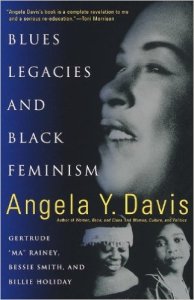 Black women musicians’ use of sound to negotiate gender norms and respectability politics is a centuries-old tradition. Angela Davis discusses the negotiations of Blues women in Blues Legacies & Black Feminism (1998), and Shana Redmond’s recent article “This Safer Space: Janelle Monae’s ‘Cold War’” reviews these traditions as they are relevant for black women pop musicians in the US. While there are many black femme musicians doing this work in queer subcultures and subgenres, I want to focus here on how this work appears within the Top 40, right alongside all these white post-feminist pop songs I talked about in my earlier post because such musical performances illustrate how black women negotiate hegemonic femininities in mainstream spaces.
As America’s post-identity white supremacist patriarchy conditionally and instrumentally includes people of color in privileged spaces, it demands “normal” gender and sexuality performances for the most legibly feminine women of color as the price of admission. As long as black women don’t express or evoke any ratchetness–any potential for blackness to destabilize cisbinary gender and hetero/homonormativity, to make gender and sexuality transitional–their expressions of sexuality and sexual agency fit with multi-racial white supremacist patriarchy.
It is in this complicated context that I situate Nicki Minaj’s (and in my next post Beyoncé’s and Missy Elliott’s) recent uses of sound and their bodies as instruments to generate sounds. If, as I argued in my previous post, the verbal and visual content of post-feminist pop songs and videos is thought to “politically” (i.e., formally, before the law) emancipate women while the sounds perform the ongoing work of white supremacist patriarchy, the songs I will discuss use sounds to perform alternative practices of emancipation. I’m arguing that white bourgeois post-feminism presents black women musicians with new variations on well-worn ideas and practices designed to oppress black women by placing them in racialized, gendered double-binds.
 For example, post-feminism transforms the well-worn virgin/whore dichotomy, which traditionally frames sexual respectability as a matter of chastity and purity (which, as Richard Dyer and others have argued, connotes racial whiteness), into a subject/object dichotomy. This dichotomy frames sexual respectability as a matter of agency and self-ownership (“good” women have agency over their sexuality; “bad” women are mere objects for others). As Cheryl Harris argues, ownership both discursively connotes and legally denotes racial whiteness. Combine the whiteness of self-ownership with well-established stereotypes about black women’s hypersexuality, and the post-feminist demand for sexual self-ownership puts black women in a catch-22: meeting the new post-feminist gender norm for femininity also means embodying old derogatory stereotypes.
I think of the three songs (“Anaconda,” “WTF,” and “Drunk in Love”) as adapting performance traditions to contemporary contexts. First, they are part of what both Ashton Crawley and Shakira Holt identify as the shouting tradition, which, as Holt explains, is a worship practice that “can include clapping, dancing, pacing, running, rocking, fainting, as well as using the voice in speaking, singing, laughing, weeping, yelling, and moaning.” She continues, arguing that “shouting…is also a binary-breaking performance which confounds—if only fleetingly—the divisions which have so often oppressed, menaced, and harmed them.” These vocal performances apply the shouting tradition’s combination of the choreographic and the sonic and binary-confounding tactics to queer listening and vocal performance strategies.
Francesca Royster identifies such strategies in both Michael Jackson’s work and her audition of it. According to Royster, Jackson’s use of non-verbal sounds produces an erotics that exceeds the cisheteronormative bounds of his songs’ lyrics. They were what allowed her, as a queer teenager, to identify with a love song that otherwise excluded her:
in the moments when he didn’t use words, ‘ch ch huhs,’ the ‘oohs,’ and the ‘hee hee hee hee hees’…I ignored the romantic stories of the lyrics and focused on the sounds, the timbre of his voice and the pauses in between. listening to those nonverbal moments–the murmured opening of “Don’t Stop Till You Get Enough,” or his sobbed breakdown at the end of “She’s Out of My Life,’ I discovered the erotic (117).
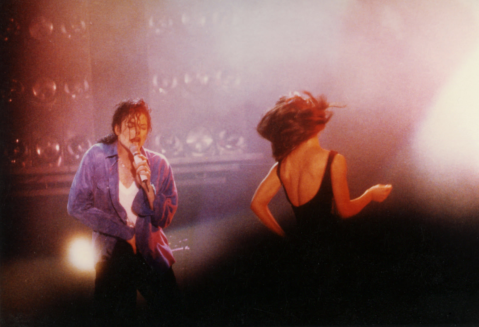
“Michael Jackson” by Flickr user Daniele Dalledonne, CC BY-SA 2.0
Royster references a black sexual politics in line with Audre Lorde’s notion of the erotic in “The Uses of the Erotic,” which is bodily pleasure informed by the implicit and explicit knowledges learned through lived experience on the margins of the “European-American male tradition” (54), and best expressed in the phrase “it feels right to me” (54). Lorde’s erotic is a script for knowing and feeling that doesn’t require us to adopt white supremacist gender and sexual identities to play along. Royster calls on this idea when she argues that Jackson’s non-verbal sounds–his use of timbre, rhythm, articulation, pitch–impart erotic experiences and gendered performances that can veer off the trite boy-meets-girl-boy-loses-girl stories in his lyrics. “Through his cries, whispers, groans, whines, and grunts, Jackson occupies a third space of gender, one that often undercuts his audience’s expectations of erotic identification” (119). Like shouting, “erotic” self-listening confounds several binaries designed specifically to oppress black women, including subject/object binaries and binary cisheterogender categories.
Nicki Minaj uses extra-verbal sounds as opportunities to feel her singing, rapping, vocalizing body as a source of what Holt calls “sonophilic” pleasure, pleasure that “provide[s] stimulation and identification in the listener” and invites the listener to sing (or shout) along. Minaj is praised for her self-possession when it comes to business or artistry, but such self-possession is condemned or erased entirely when discussing her performances of sexuality. As Treva B. Lindsey argues, “the frequency that Nicki works on is not the easiest frequency for us to wrestle with, because it’s about…whether we can actually tell the difference between self-objectification and self-gratification.’’ Though this frequency may be difficult to parse for ears tempered to rationalize post-feminist assumptions about subjectivity and gender, Minaj uses her signature wide sonic pallette to shift the conversation about subjectivity and gender to frequencies that rationalize alternative assumptions.
In her 2014 hit “Anaconda,” she makes a lot of noises: she laughs, snorts, trills her tongue, inhales with a low creaky sound in the back of her throat, percussively “chyeah”s from her diaphragm,among other sounds. The song’s coda finds her making most of the extraverbal sounds. This segment kicks off with her quasi-sarcastic cackle, which goes from her throat and chest up to resonate in her nasal and sinus cavities. She then ends her verse with a trademark “chyeah,” followed by another cackle. Then Minaj gives a gristly, creaky exhale and inhale, trilling her tongue and then finishing with a few more “chyeah”s. While these sounds do percussive and musical work within the song, we can’t discount the fact that they’re also, well…fun to make. They feel good, freeing even. And given the prominent role the enjoyment of one’s own and other women’s bodies plays in “Anaconda” and throughout Minaj’s ouevre, it makes sense that these sounds are, well, ways that she can go about feelin herself.
Listening to and feeling sonophilic pleasure in sounds she performs, Minaj both complicates post-feminism’s subject/object binaries and rescripts cishetero narratives about sexual pleasure. “Anaconda” flips the script on the misogyny of Sir Mix-a-Lot’s hit “Baby Got Back” by sampling the track and rearticulating cishertero male desire as Nicki’s own erotic. First, instead of accompanying a video about the male gaze, that bass hook now accompanies a video of Nicki’s pleasure in her femme body and the bodies of other black femmes, playing as she touches and admires other women working out with her. Second, Nicki re-scripts the bass line as a syllabification: “dun-da-da-dun-da-dun-da-dun-dun,” which keeps the pattern of accents on 1 and 4, while altering the melody’s pitch and rhythm.
Just as “Anaconda”’s lyrics re-script Mix-A-Lot’s male gaze, so do her sounds. If the original hook sonically orients listeners as cishetero “men” and “women,” Nicki’s vocal performance reorients listeners to create and experience bodily pleasure beyond the “legible” and the scripted. Though the lyrics are clearly about sexual pleasure, the sonic expression or representation of that pleasure–i.e., the performer’s pleasure in hearing/feeling herself make all these extraverbal sounds–makes it physically manifest in ways that aren’t conventionally understood as sexual or gendered. Because it veers off white ciseterogendered scripts about both gender and agency, Minaj’s performance of sonophilia is an instance of what L.H. Stallings calls hip hop’s “ratchet imagination.” This imagination is ignited by black women’s dance aesthetics, wherein “black women with various gender performances and sexual identities within the club, on stage and off, whose bodies and actions elicit new performances of black masculinity” renders both gender and subject/object binaries “transitional” (138).
Nicki isn’t the only black woman rapper to use extra-verbal vocal sounds to re-script gendered bodily pleasure. In my next post, I’ll look at Beyoncé and Missy Elliot’s use of extra-vocal sounds to stretch beyond post-feminism pop’s boundaries.
—
Featured image: screenshot from “Anaconda” music video
—
Robin James is Associate Professor of Philosophy at UNC Charlotte. She is author of two books: Resilience & Melancholy: pop music, feminism, and neoliberalism, published by Zer0 books last year, and The Conjectural Body: gender, race and the philosophy of music was published by Lexington Books in 2010. Her work on feminism, race, contemporary continental philosophy, pop music, and sound studies has appeared in The New Inquiry, Hypatia, differences, Contemporary Aesthetics, and the Journal of Popular Music Studies. She is also a digital sound artist and musician. She blogs at its-her-factory.com and is a regular contributor to Cyborgology.
—
 REWIND! . . .If you liked this post, you may also dig:
“I Love to Praise His Name”: Shouting as Feminine Disruption, Public Ecstasy, and Audio-Visual Pleasure–Shakira Holt
Music Meant to Make You Move: Considering the Aural Kinesthetic–Imani Kai Johnson
Something’s Got a Hold on Me: ‘Lingering Whispers’ of the Atlantic Slave Trade in Ghana–Sionne Neely
Share this:

Unlearning Black Sound in Black Artistry: Examining the Quiet in Solange’s A Seat At the Table

Editors’ note: As an interdisciplinary field, sound studies is unique in its scope—under its purview we find the science of acoustics, cultural representation through the auditory, and, to perhaps mis-paraphrase Donna Haraway, emergent ontologies. Not only are we able to see how sound impacts the physical world, but how that impact plays out in bodies and cultural tropes. Most importantly, we are able to imagine new ways of describing, adapting, and revising the aural into aspirant, liberatory ontologies. The essays in this series all aim to push what we know a bit, to question our own knowledges and see where we might be headed. In this series, co-edited by Airek Beauchamp and Jennifer Stoever you will find new takes on sound and embodiment, cultural expression, and what it means to hear. –AB
—
DOI: https://doi.org/10.59350/1m8hp-chf19
On May 18th, 2017, Solange Knowles took viewers on an expedition as she glided, danced and “agonized” in a “joyful praise break” on the floor of New York City’s Guggenheim museum. Drawing from the museum’s narrative of introspection and multi-sensory connection, Solange’s performance of “An Ode To. . .” prompted viewers to relearn and reorient the melodies of A Seat at the Table (2016). Solange’s performance in this setting hearkened listeners to new concepts and emotions in the record they didn’t catch before as they consumed it. This begs the question– what other sonic elements have we neglected to identify in A Seat at the Table? And why?
A Seat at the Table integrates topics like race, depression, and empowerment. Although the younger sister of powerhouse Beyoncé Knowles, Solange has managed to carve out her own legion of dedicated listeners from her infusion of Minnie Ripperton-esque vocals, hip-hop production and Gil Scott-Heron storytelling. Thematically, the album incorporates issues of Black Lives Matter and cultural self-preservation. However, Solange weaves personal elements such as vulnerability, futurism and paternity throughout the record as well, which buoy the album to praise but are hardly discussed in the album’s many reviews. Instead, writers and listeners have largely focused on resistance, anger and reactionary concepts.

Because Solange is a black women, historical signifiers of black embodiment influence both the listeners’ senses and consumption of her album. Solange’s intimate moments and reveals are shrouded by the limitation of black sound to the disruptive, angry or depressive. Such masking demands a listening praxis akin to what sound artist Christine Sun Kim describes as “unlearning.” “I’m trying to unlearn what I’ve been taught by others,” she said in an interview about her work, “and trying to find my own definition of both sound and silence.” This unlearning and re-imagination of sound is a difficult transformation considering how sound is influenced by our racialized, gendered, and religious histories.
Consider the contemporary rhetoric of black sound. Black outcry and screaming is a banal American, banal soundscape. Blackness is grieving. Blackness tiptoes near death. Captivity is a breath away. Black Lives Matter leans on the Civil Rights Movement often sonically. Dr. J Marion Sims, both his medical torture of enslaved women and the widespread belief that black people are inured to pain, still haunts our research methodologies, medical practice and our daily lives. This ushering of strife consumes black life into a sound that bleeds—an aural transfer both material and metaphoric—black sound is never personal, individualized or singular, and such historical misperceptions influences black sound studies. The Western artistic critique of black sound and black artistry overwhelmingly focuses on the reaction of whiteness, black resistance, and little else—because supposedly—there is nothing notable about blackness in and of itself.
For example, revisit the 1968 Olympic photo of Tommie Smith, John Carlos and Peter Norman as they stand on the platform with their medals. What do you see in this photo? Perhaps nationalism, masculinity, aggression, or anger from their bodily gesture to the Black Panther Party Movement? What do you hear in the photo—what is its decibel? An outcry? A rebellious yell? desperate scream?

But what other nuances are in the photo? What other critiques are masked by this proscribed sound? In The Sovereignty of Quiet (2012), Kevin Quashie invites us to:
Look again, closely, at the pictures from that day and you can see something more than the certainty of public assertiveness. See, for example, how the severity of Smith’s salute is balanced by the yielding of Carlos’s raised arm. And then notice how the sharpness of their gesture is complemented by one telling detail: that their heads are bowed as if in prayer, that Smith, in fact, has his eyes closed. The effect of their bowed heads is to suggest intimacy…How is it that they are largely icons of resistance, and that vulnerability and interiority are not among all things we are encouraged to read on their image? (Quashie 2-3).
Because of racialized history, we have limited our conceptualization of blackness in literature, film and other mediums. We only hear blackness as it pertains to resistance, grief, and anger—the reaction to whiteness. Black people are verbs instead of nouns. The ’68 Olympic photo is particularly special as it captures the steadfast Western influence that infects our synesthesia because of political and social histories. Moreover, such defects are even internalized in the black artist. As an identity, Quashie argues that “blackness is always supposed to tell us something about race or racism, or about America, or violence, struggle and triumph or poverty and hopefulness (4). Sonically this means blackness in contemporary discourse is critiqued by its decibel of resistance. We cannot read or hear blackness without integrating white pain.
Much like typical readings of the ’68 olympic photo, Solange’s album cover might elicit themes of self-esteem, black-nationalism or even aggression. However, Solange quietly sounds her life transition and personal vulnerability, via her photo, if we would hear it.

But confining view of blackness as pain and resistance prevents us—including those who are black-identifying—from noticing and celebrating vulnerability, grace, and the interiority. Quashie describes interiority as the “inner reservoir of thoughts, feelings, desires, fears, ambitions that shape a human self. . .[it is] expansive, voluptuous, creative; impulsive…more akin to hunger, memory forgetting, the edges of all the humanness one has” (20-21). It’s the tender part of identity shown through subtlety—the desires and dreams spoken through prayer. It’s Martin Luther King Jr. tapping his feet to Coltrane or Tupac Shakur watching dancers to perfect his plié—it’s the soft falsetto Solange uses in her album that bolsters emotional healing and draws avian imagery.
Asking what quiet can bring to our personal, cultural, historical and political understandings of blackness does not signal the imposition of respectability politics or desire for post-racialism. Rather, Quashie’s theory considers how whiteness has constructed and limited our senses as it relates to blackness. Blackness will remain in resistance because of systemic oppression but there is so more to black life. The element of analysis and the sensorium itself needs expansion.
Subsequently, Solange Knowles’ recent album innovatively captures resistance but centers other aspects of black sonic experience: individualization—the nuances of interiority regarding mental health, paternity and forgiveness.
The first track of the song, “Rise,” flutters an anthem of well-being:
Fall in your ways so you can crumble.
Fall in your ways so you can sleep at night.
Fall in your ways so you can wake up and rise
Her tone and pitch is sweet, light and matter-of-fact. The repetition and delivery is similar to a lullaby —reminiscent of Langston Hughes’s poem “Mother to Son”—a soft plea to rest, welcome weariness and any conflict with authenticity but to also travel with a straight back and head looking forward. Fall in your ways… At the 1.11 mark, there is a break of silence in the song; thereafter, the synthesizer yawns into melody with a futuristic twang. This Afrofuturistic moment—the study of blackness as it relates to space, technology, art and futurism— continues later with the production and lyrical content with “Borderline (An Ode To Self Care).” Notably, “Rise” introduces the sonic atmosphere of the record through Solange’s honeyed tonal drops and leaps when she sings “So you can sleep at night.” Her delivery mimics a bird within a thermal lift—her voice calling the plight of the Flying African—the myth that Igbo people escaped slavery by flying back to Africa at night. “Fall in your ways” whispers the discovery and preservation of one’s interiority. Rise emphasizes inner, restorative practice.
Solange also highlights interiority through her album interludes, mostly narrated by Master P, rapper and owner of No Limit Records. This also relates to her inclusion of paternity alongside maternity—a bright distinction considering her identification with black womanhood and the historical racist exclusion of black fathers in the home (e.g. the Moynihan Report and welfare polices). Solange notes the importance of her father and Master P’s presence with an interview with her sister:
I remember reading or hearing things about Master P that reminded me so much of Dad growing up. And I wanted a voice throughout the record that represented empowerment and independence, the voice of someone who never gave in, even when it was easy to lose sight of everything that he built.
Thus the precursor to each song draws from Master P’s embodiment of kinship, lineage and esteem, traits the teenaged-Solange admired and later internalizes into her interiority.
Through these interludes, Solange redresses Master P’s sonic history, particularly his famous rap catch phrase. As he explains in the interlude “Pedestals“:
I never cried or nothing, and that’s where the, ‘Make ’em say uhh uhh,’ that’s like my pain…that’s my battle cry.
Solange spotlights Master P’s quiet–and accompanying tonal signature—while showing its relation to “louder” elements of masculinization and coping. P’s insoluble moan is a staple throughout his songs and a signature in other No Limit artists’s songs as well.
No longer limited to its “loudness” or flattened to party anthem accompaniment—as this song and sound has all too often been characterized—P’s “battle cry” calls out, sounding a communal harkening of empathy and relation.
. . .uhh uhh. . .
In tracks such as Don’t Touch My Hair, Solange makes Black Lives Matter a key sonic element in her album, but as with her rendering of Master P, in a way that “unlearns” previous assumptions and limitations and reveals how the Black Lives Matter Movement and network is pigeon-holed by American racial ideology and its accompanying sonic constriction. While the catalyst for the movement was white supremacy and police brutality, the movement’s guiding principles also highlight interiority-infused concepts of loving engagement, empathy, and restorative justice. Patrisse Cullors, co-founder of the network, has been vocal about the movement’s integration of the arts and the reimagination of blackness. The focus on black outcry and white sirens muffles the movement’s quiet. The consequences of ignoring the interiority dismisses the whole, black self.
Belying a similar dynamic, many listeners have pinned “Don’t Touch My Hair” as a declaration to whiteness, but considering Solange’s point of view, lyrics and gentle sonic value, makes the meaning of the stretch far wider.
As Solange divulges through the sound of the Mardi Gras trumpet that blares throughout the chorus and changes in volume and texture after the quiet interlude ends at 3:34, black hair is spiritual. As the trumpets blasts in hosannas in gospel celebration, the track also sounds honor, adoration, tribute and preservation in the thick of American, racialized fixation.
The unlearning of confined sensory orientation that Solange’s A Seat at The Table and “An Ode To. . .” demands unveils a progression to time travel, what Michelle Commander’s recent book calls Afro-Atlantic Flight. Solange further incorporates such spiritual, diasporic flight with her homage to Parliament-Funkadelic artist Junie Morrison–who passed just a few months after the record came out–in her futuristic track, “Junie,” punctuated with the light, avian melisma, one of her sonic signatures on the record:
Let’s go to moonlight, then they will never find
Let’s go to home, free from the mother mind.Come on along, along, along, along, along, along, along
—
Featured Image of Solange by Flickr User Greg Chow (CC BY-NC-ND 2.0)
—
Kimberly Williams oversees a Black Cultural Center at Virginia Tech where her work includes advocacy, policy, programming and bloodletting. She received her M.F.A. in poetry at Cornell University where she also became a Callaloo Oxford University fellow. Her thesis studied the sonic flight from the Stono Rebellion into contemporary dance and household rhythm. You can find her work in Gulf Coast, Callaloo, Drunken Boat and more. At night, you can catch her watching 90s live performances of Michael Jackson or Nine Inch Nails.
—

REWIND! . . .If you liked this post, you may also dig:
The Listening Body in Death –Denise Gill
Black Mourning, Black Movement(s): Savion Glover’s Dance for Amiri Baraka –Kristin Moriah
Moonlight’s Orchestral Manoeuvers: A duet by Shakira Holt and Christopher Chien
How not to listen to Lemonade: music criticism and epistemic violence–Robin James
Share this:




Current Top Posts





April 2021

January 2020

November 2019

October 2019

August 2019

April 2014

November 2017

March 2015

December 2017

October 2015
 Sounding Out!
Recent Comments