
Sounding Out! Podcast #40: Linguicide, Indigenous Community and the Search for Lost Sounds

CLICK HERE TO DOWNLOAD: Linguicide, Indigenous Communities and the Search for Lost Sounds
SUBSCRIBE TO THE SERIES VIA ITUNES
ADD OUR PODCASTS TO YOUR STITCHER FAVORITES PLAYLIST
This podcast is an effort to understand the cultural practices which surround the recovery of “lost sounds.” These are early linguistic sounds that have been forgotten after years of cultural and martial violence toward indigenous communities in America.
From the very beginning of the invasion of the Americas that began in 1492, Eurocentric ideologies overwhelmingly failed to recognize the strengths of American Indian cultures. Evaluating Native people as “savage,” efforts to westernize the tribes alternated between genocide and acts of removal. Government supported education, amongst other things, became the primary means to accomplish the forced eradication of Indian language. The loss of language as a component of ongoing colonization is what Hawaiian scholar Noenoe K. Silva has called “linguicide.” The results of “linguicide,” as the suppression of indigenous languages and cultures in the United States, has been catastrophic for American Indian and Alaska Native peoples.
For Indigenous people, the spoken language is a cherished intellectual treasure. Each sound captures how we see the world. Native American languages are oral, but some of them have been written in the last three centuries. There are over two hundred different North American languages still spoken by peoples of the United States and Canada. That is, of the over three hundred pre-contact languages originally spoken, only two hundred languages still remain. Fortunately, Native communities are fighting hard to keep these languages alive through sustainability efforts and revitalization projects.
I wonder about the relationship between “lost sounds,” indigenous language, and personal experience. How did we come to lose the language in our own homes? How does this loss continue today? What is being done to “find lost sounds”? How are we, as Native people, searching for the sounds, and what does that process mean to us? The conversation in this podcast is not about the science of linguists, it is not about history or the methods of linguistic preservation. Instead, it is a conversation about the experience of listening and trying to hear how we once were.
–
Marcella Ernest is a Native American (Ojibwe) interdisciplinary video artist and scholar. Her work combines electronic media with sound design with film and photography in a variety of formats; using multi-media installations incorporating large-scale projections and experimental film aesthetics. Currently living in California, Marcella is completing an interdisciplinary Ph.D. in American Studies at the University of New Mexico. Drawing upon a Critical Indigenous Studies framework to explore how “Indianness” and Indigenity are represented in studies of American and Indigenous visual and popular culture, her primary research is an engagement with contemporary Native art to understand how members of colonized groups use a re-mix of experimental video and sound design as a means for cultural and political expressions of resistance.
—
 REWIND! . . .If you liked this post, you may also dig:
Sounds of Science: The Mystique of Sonification – Margaret Anne Schedel
Radio and the Voice of the Aymara People – Karl Swinehart
The “Tribal Drum” of Radio: Gathering Together the Archive of American indian Radio – Josh Garrett-Davis
Share this:

SO! Amplifies: Mega Ran and Sammus, The Rappers With Arm Cannons Tour

 SO! Amplifies. . .a highly-curated, rolling mini-post series by which we editors hip you to cultural makers and organizations doing work we really really dig. You’re welcome!
—
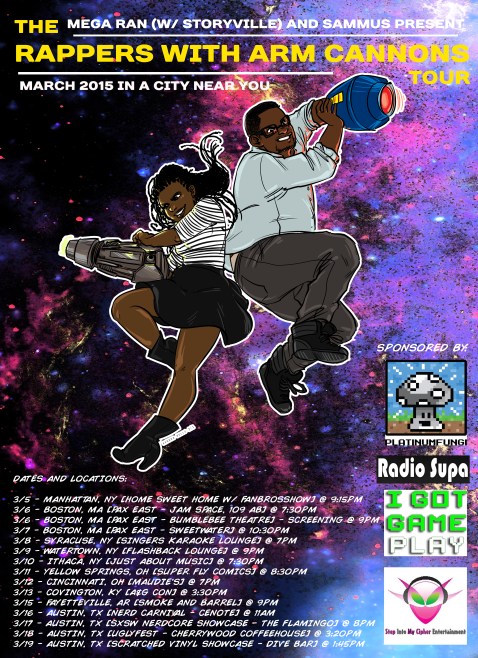
Throughout the month of March, nerdcore MCs Mega Ran (Raheem Jarbo) and Sammus (Enongo Lumumba-Kasongo) will be embarking on the “Rappers with Arm Cannons” Tour. Both artists independently based their monikers on two of the most notable video game characters to possess arm cannons, (Mega Man and Samus respectively), but they have since collaborated on several songs and a SoundScan charting Castlevania project, as well as sharing the stage at numerous concert venues and conventions, and releasing individual albums and videos that have received international attention and critical acclaim. Now three years later the two teachers-turned-rappers have decided to take their show on the road alongside rapper and sound engineer Storyville (Matthew Weisse), who has recently joined forces with Mega Ran to release their February 2015 album “Soul Veggies.”
 .
.
While at first glance the name of the tour appears a bit tongue-in-cheek, it calls necessary attention to the growing presence of Black nerdcore artists like Mega Ran and Sammus who cast their experiences as people of color against the backdrop of nerd and geek culture. In Mega Ran’s case, this has meant writing verses about his struggle to make sense of his Black nerd identity while growing up amongst a very rough crowd in Philadelphia. For Sammus, being a rapper with an arm cannon has largely meant reconciling her ideas about the lack of diverse representations of Black women in notable movies, games, and cartoons among other media forms.
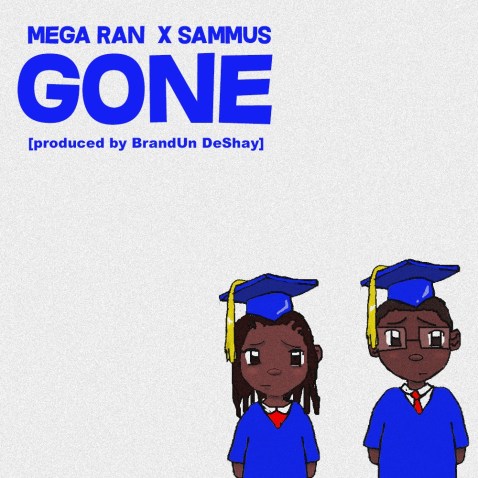
Click to “pay what you want” to download the new Sammus X Mega Ran track “Gone” in support of “The Rappers With Arm Cannons” Tour: https://sammusmusic.bandcamp.com/track/gone
Both Mega Ran and Sammus began making beats on the Playstation game MTV Music Generator. Since that time Sammus has brought together the production styles of Kanye West, Daft Punk, Björk and various video game composers to produce beats that are rich with video game synths and uniquely chopped samples. Mega Ran has similarly drawn on his love of hip hop artists, such as Redman, Nas, and Busta Rhymes as well as music from video games such as Mega Man, Final Fantasy VII, and River City Ransom.
On Tuesday, March 10th, the tour stopped at Cornell University’s Just About Music center where SO! Editors J. Stoever And Aaron Trammell sat down with the trio for a very frank and open discussion on how to survive and thrive as independent artists in the new music economy. Here’s a choice sample of that conversation:
The tour began on March 5th in NYC and will continue through March 19th with final stops in Austin, TX at this year’s South-by-South-West (SXSW). For full details on tall of the dates visit http://sammusmusic.com/shows-tour-dates/
Mega Ran on Twitter, Soundcloud, Bandcamp, Facebook, and Megaranmusic.com
Sammus on Soundcloud, Bandcamp, Facebook, and sammusmusic.com.
Storyville on Soundcloud, Bandcamp, and Facebook.
—
Enongo Lumumba-Kasongo is a PhD student in the Department of Science and Technology Studies at Cornell University. Since completing a senior thesis on digital music software, tacit knowledge, and gender under the guidance of Trevor Pinch, she has become interested in pursuing research in the emergent field of sound studies. She hopes to combine her passion for music with her academic interests in technological systems, bodies, politics and practices that construct and are constructed by sound. More specifically she would like to examine the politics surrounding low-income community studios, as well as the uses of sound in (or as) electronic games. In her free time she produces hip hop beats and raps under the moniker Sammus (based on the video game character, Samus Aran, from the popular Metroid franchise).
—
 REWIND!…If you liked this post, you may also dig:
Making Music at Studio X: The Identity Politics of Community Studios-Enongo Lumumba-Kasongo
SO! Amplifies: Regina Bradley’s Outkasted Conversations-Regina Bradley
Love and Hip Hop: (Re)Gendering The Debate Over Hip Hop Studies— Travis Gosa
Share this:




Current Top Posts





April 2021

January 2020

November 2019

October 2019

August 2019

April 2014

November 2017

March 2015

December 2017

October 2015


Recent Comments