
Music Video as Process: “Revitalize” by T-Rhyme

What is a music video, anyway? Historically dismissed by film theorists as cinematically flawed or by the public as mere promotional snippets, music videos didn’t used to get the credit they deserve as a serious artistic medium. In the 1990s, Carol Vernallis challenged both notions, suggesting that they are actually a unique genre where music and visuals aren’t just paired—they communicate deeply with each other. Since then, scholars have taken diverse approaches to try to make sense of how film theory is applicable to these delicious nuggets of musical storytelling. For example, Phoebe Macrossan argues that Beyoncé’s Lemonade is a signal example of “film worlding,” indicating how the artist uses video to create her own intimate and all-encompassing environment. Additionally, Olu Jenzen and colleagues have found that political remix videos use recombinations of existing sounds and images to make rhetorical points that can challenge mainstream media reporting in real time. According to Stan Hawkins and Tore Størvold, from the perspectives of musicology or music theory, perhaps it is the video that amplifies the song’s harmonic structure or musical form, as suggested by their analysis of Justin Timberlake’s “Man of the Woods.”
Through skillful harmonic analysis or rhetorical analysis or cataloging of film techniques, scholars and critics now take music videos seriously. Yet, across interdisciplinary research approaches to music videos, what is largely taken for granted is that the music video is an object, a work to which various theories can be applied. What if we extend these approaches further and consider the music video not just as an object of analysis to be dissected, but as a representation of a creative process that entwines sound and vision in innovative ways to connect people and forge relationships? Such an analysis is especially possible when listening to independent creators who take an active role in conceptualizing, shooting, and editing their videos. By shifting our perspective to view the music video as documenting an ongoing creative and relational journey rather than solely as an object for analysis, we open up new possibilities for understanding the deeper significance of these works. Music videos can serve not just as vehicles for artistic expression, but as catalysts for strengthening bonds, preserving cultural knowledge, and fostering a sense of pride and resilience within communities.
Music Video as Process
In 2023, I co-organized a series of performances for Native Jam Night at UC Riverside, an annual music showcase featuring Indigenous artists from California and across Turtle Island. One way my colleagues and I honed in on guest artists was by asking students to listen to several playlists and recommend the music that spoke to them. The song “Revitalize” by T-Rhyme came up as a favorite. T-Rhyme has released music that tells personal stories and responds to contemporary social realities. At times, this music responds to her lived experience as a woman with Nehiyaw and Denesuline roots.
The music video for “Revitalize” is not only a popular extension of the song’s appeal, but an audiovisual series of connections and interactions. Paying attention to it in this way shows what can emerge from one kind of nontraditional listening posture, this one inspired by my conversations with T-Rhyme and also grounded in the way I have been opening my ears to her music. I first got to know T-Rhyme in-person when I invited her and MC Eekwol to perform as part of the Show & Prove hip hop event in 2018. We stayed in touch over the next several years.

As part of T-Rhyme’s return visit to California in 2023, we got to drive around and talk music business, have dinner with Native directors and actors as part of an Indigenous Storytelling event, go shopping, and get tacos at one of my favorite hole-in-the-wall spots. When it came time to make plans around the release for my book Sonic Sovereignty: Hip Hop, Indigeneity, and Shifting Popular Music Mainstreams, I knew it made sense to keep building on dialogues with musicians. Instead of just talking about myself, or even ideas that were already published, I wanted to keep the conversation going, continue listening, and find ways to share what I was hearing with more audiences. When I talked with T-Rhyme in the winter and spring of this year, then, it was to hear more about her creative process beyond any single project, to talk about what I was hearing and how I was listening, and to make space for that meaning making that almost approaches a musical flow that can bubble up out of a good dialogue.
Revitalization
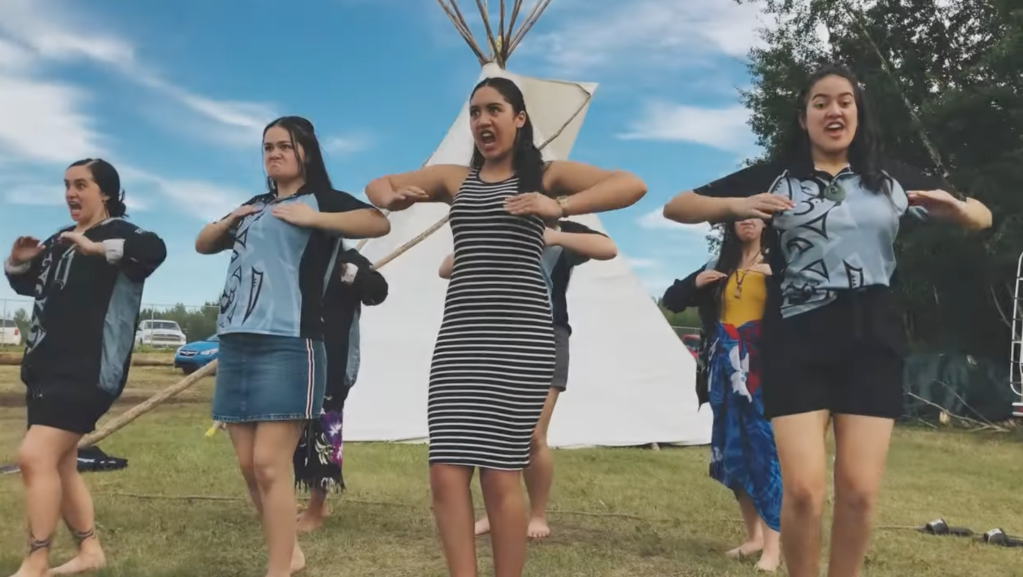
A years-long process led up to “Revitalize,” T-Rhyme told me, and there are goals for the song that stretch beyond the moment of recording. To make the video, T-Rhyme went out to ceremonial grounds with her family and her photographer cousin Tennille Campbell’s family, spending time out with buffalo so Campbell could record. Looking back, she went through over a year and a half of her recordings of family and friends to select moments of daily life to interweave with special moments of celebration.
To convey the importance of land with viewers, the rapper worked with her brother, who shared his drone landscape footage that he recorded where he lives in northern Saskatchewan. She filmed other pieces at a powwow in Treaty Six territory in Alberta, finding inspiration from old friends she reconnected with for the occasion, as well as other Indigenous musicians and dancers she met while looking to connect there. T-Rhyme delivers the chorus and rapped verses over a beat by Doc Blaze, while collaborators in the music video mouth key words, notably “revitalize,” to her audio. Each aspect of the video was made with family or friends, and together they encompass years of work and hopes for the future.

From her past work, T-Rhyme recalled that shooting a music video can be stressful and involve intense time pressure. Instead, she told me, “I wanted none of those vibes to be involved with this project. I wanted the whole entire thing to be good vibes. And positive because part of our healing is through laughter and joking and being together as family.”
So, what is “revitalization” in the context of making music with family and friends? For T-Rhyme, “These are people I trust, I grew with, I evolved with, I changed with. All these people make me feel good and that I’m proud of, that I want to show off.” Paying attention to how musicians choose to tell their stories and further relationships with others is part of recognizing their sovereignty through sound. Sonic sovereignty is an active process.
The notion of “sonic sovereignty” builds from Jolene Rickard’s determination in “Diversifying Sovereignty and the Reception of Indigenous Art,” that “the idea of our art serving Indigenous communities reinforced my understanding that sovereignty is more than a legal concept”(82), and Tewa and Dine scholar-filmmaker Beverly Singer’s working through what she refers to as “cultural sovereignty,” in Wiping the War Paint off the Lens: Native American Film and Video, “which involves trusting in the older ways and adapting them to our lives in the present”(2). It’s meaningful to move into celebration together, as T-Rhyme explains: “Part of revitalization, especially when it comes to our healing as Native people, is we need to remember love. We don’t need to be in survival mode all the time.”
Intergenerational Teaching
Generations of T-Rhyme’s family stretch throughout the video for “Revitalize”. In the first verse, the musician’s mother stands in a bright red ribbon skirt at the edge of the river, near a photo frame.Then this photo of the rapper’s grandparents smiles out from the rocky shores of a river. A kid in sneakers runs nimbly over these same rocks, generations converging at the water. When T-Rhyme raps in the chorus, “raise your fists high in the air right now,” viewers see her mother raising her fist, the river greenery behind her, then proudly holding the picture of her own parents.

Music videos are often associated with youth culture, especially in a North American context. Yet in process and in content, this music video showcases intergenerational teaching and learning, with the involvement of elders, parents, children, and friends, connecting embodied knowledge across generations. Men and boys teaching intergenerationally feature onscreen, notably a father and son in regalia and an entrepreneur who runs Cree Coffee Company. Community leaders and scholars across Turtle Island share stories of diverse Indigenous masculinities, highlighting the kinds of teaching, leadership, and care that men, boys, and masculine people share from the present into the future. T-Rhyme reflected, “we have men out here who are trying to be warriors still, in their own way, whether they’re dancing powwow, whether they’re running their own business, and just being present fathers.”

T-Rhyme described that over the years, her relationship with her mother has changed. And yet, they have an ongoing push and pull between being serious and being playful together. With her mom, she says, “laughter and joking is our medicine.” She laughed as she recalled that for filming, “we’d be trying to have a serious moment and I’d say ‘okay mom, stand in the water’ and she’d say, ‘okay, like this.’ ‘Yeah, that looks good. Rest your face. You look real Kookum right now.’ Just cracking jokes at her.” T-Rhyme uses a word for grandmother to kid with her mom.
The process of writing the lyrics, too, involved reflecting on the relationship she has had with her mom across the past, present, and future. T-Rhyme raps, “My mother is sacred, she’s a survivor for real, though it’s taken her and I so many decades to heal.” This comes from what the rapper describes as a way to highlight how her mom is a “survivor and somebody that I respect and ultimately, enabled and motivated me to do my own healing too.”
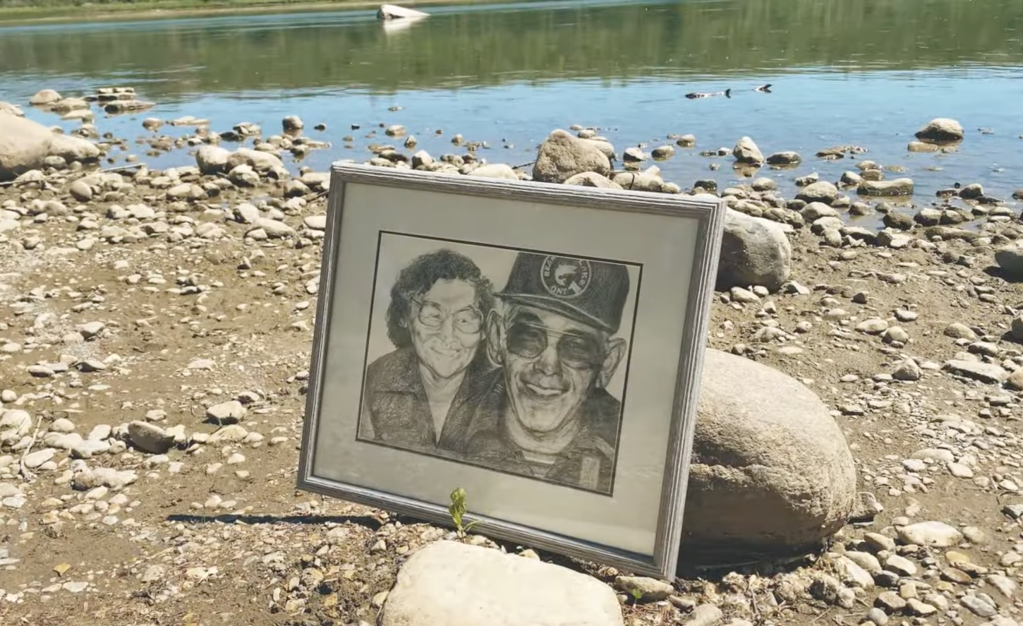
In the context of intergenerational healing, T-Rhyme’s music video, which involves multiple generations of her family, embodies Indigenous survivance –the active transition from mere survival to resilience—in the face of historical and ongoing colonial violence. T-Rhyme brought her grandparents into the filming through their photograph, and their living memory. She explained, “Without them, I wouldn’t be here, my kids wouldn’t be here and my mom wouldn’t be here. Speaking of revitalization, they were the ones that were the front lines of maintaining our culture through a literal, cultural genocide in our communities.” Since “they really had to do their part in maintaining our culture enough to survive through residential school,” she recalls, “It was important to me to acknowledge them as survivors.”
T-Rhyme included her daughter in ‘Revitalize,” as well as in other music videos, notably the title track on “For Women By Women.” She explains, “I always want to feature her because she’s such a powerhouse.” T-Rhyme’s visual narrative brings in a photo of her daughter dancing at one of her shows, and the rapper has made music videos with her son as well.
When they were all getting stir-crazy from COVID shutdowns, T-Rhyme and her kids made the video “Trap’d,” for which the rapper helped then-12-year-old Joaquem act as videographer. Teaching her son and daughter and giving them space to make their own art, she calls her kids her “heroes,” explaining, “I just love including them where I can.”
The Story Beyond the Video
Watching and listening to the work of independent artists, such as T-Rhyme, complements existing writing on music video that comments on mainstream names like Madonna and Beyoncé. Furthermore, approaching music videos as processes through which relationships are built and furthered rather than solely as objects for analysis invites other forms of listening, especially modes that acknowledge the network of people whose interactions create the sounds that vibrate audience members’ eardrums.

The people who click play on the finished music video make up what is traditionally understood as its audience. By witnessing relationships behind musical choices, we can recognize that there is another group, too, that the video is for: media professionals, family members, and community participants who work together to create it. Making a piece as complicated as a music video can become an occasion for all of these actors to further and strengthen relationships: filming may offer the excuse everyone needed to visit an important location together, or storyboarding brings people in the room together who hadn’t been able to find the time, or the song provides a vehicle for talking about a topic that would otherwise be repeatedly put on the shelf for another day. Listening for process in this way can encourage audience members who view the video, too, to use this communally crafted artistic labor as an invitation for connection.
“Revitalize” particularly serves as an example of how making a music video can involve collaboration with family and friends over an extended period, encompassing years of documentation and strengthening relationships. In addition to sharing a past and inspiring interaction for the making of the video, the song carries hopes for a future. As T-Rhyme says, “I want “Revitalize” to be a catalyst for healing and pride.” Paying attention to how musicians tell their stories and build relationships through music videos is part of recognizing their sovereignty and cultural continuity through sound and visuals.
—
Featured Image: Still from music video for “Revitalize” by T-Rhyme (2021)
—
Dr. Liz Przybylski (pronunciation) is an ethnomusicologist and pop music scholar working in hip hop and electronic music in the US and Canada. Dr. Przybylski is an Associate Professor of Ethnomusicology at the University of California, Riverside. A graduate of Bard College (BA) and Northwestern University (MA, PhD), Liz’s research appears in Ethnomusicology, Journal of Borderlands Studies, and IASPM Journal, among others. Dr. Przybylski has presented research nationally and internationally, including at the Society for Ethnomusicology, Native American and Indigenous Studies Association, Feminist Theory and Music, International Association for the Study of Popular Music, and International Council for Traditional Music World Conferences. Recent and forthcoming publications analyze how the sampling of heritage music in Indigenous hip hop contributes to dialogues about cultural change in urban areas. Dr. Przybylski has also published on popular music pedagogy. Liz was awarded a National Endowment for the Humanities Faculty Fellowship and a Fulbright Fellowship. Liz’s most recent book Sonic Sovereignty: Hip Hop, Indigeneity, and Shifting Popular Music Mainstreams was published in July 2023 (NYU Press). This follows Liz’s first book, Hybrid Ethnography: Online, Offline, and In Between (SAGE Publications, 2020) which develops an innovative model of hybrid on- and off-line ethnography for the analysis of expressive culture. In addition to university teaching, Liz has taught adult and pre-college learners at the American Indian Center in Chicago and the Concordia Language Villages program of Concordia College in Bemidji. On the radio, Liz hosted the world music show “Continental Drift” on WNUR in Chicago and has conducted interviews with musicians for programs including “At The Edge of Canada: Indigenous Research” on CJUM in Winnipeg. Dr. Przybylski served as the Media Reviews Editor for the journal American Music, the President of the Society for Ethnomusicology, Southern California and Hawaii Chapter, and on the Society for Ethnomusicology Council.
—

—
REWIND! . . .If you liked this post, you may also dig:
Sounding Out! Podcast #40: Linguicide, Indigenous Community and the Search for Lost Sounds–Marcella Ernest
The “Tribal Drum” of Radio: Gathering Together the Archive of American Indian Radio–Josh Garrett Davis
Sonic Connections: Listening for Indigenous Landscapes in Kent Mackenzie’s The Exiles–Laura Sachiko Fugikawa
Unsettling the World Soundscape Project: Soundscapes of Canada and the Politics of Self-Recognition–Mitchell Akiyama
Becoming Sound: Tubitsinakukuru from Mt. Scott to Standing Rock–Dustin Tahmahkera
EPISODE 60: Standing Rock, Protest, Sound and Power–Marcella Ernest
A Tribe Called Red Remixes Sonic Stereotypes–Christina Giancona
I’m on my New York s**t”: Jean Grae’s Sonic Claims on the City––Liana Silva
How not to listen to Lemonade: music criticism and epistemic violence–Robin James
Share this:

“In My Life”: Loving Queerly and Singing Across Generations
December 1975.
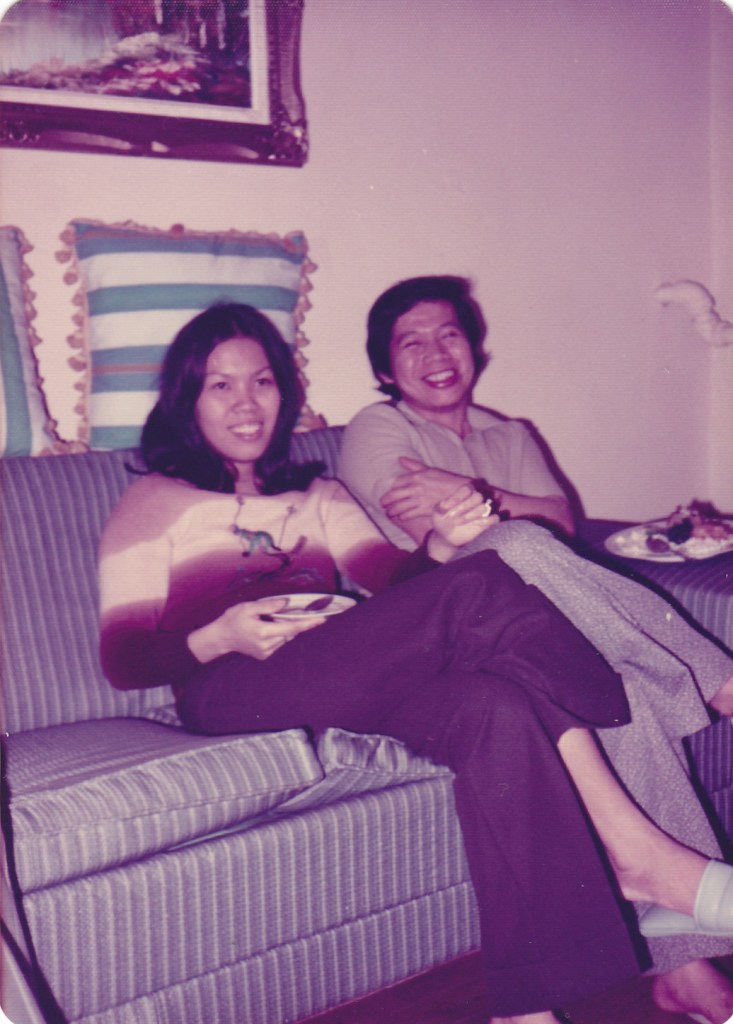
The cold winds staked their claim over Toronto, where my parents had recently arrived from the Philippines. They were underdressed and making their way down Parliament Street. Despite being warned of a shift in temperature, they were not expecting the brutal intensities of Canadian winter. I’m not sure how anyone anticipates the sharp sting of negative temperatures when they are arrivants used to tropical climates. Undeterred, my mother and father headed to a small Filipino grocer, hoping to encounter a semblance of domestic familiarity. Pressed against the biting winds, my mother abruptly stopped, looked at my father and said, “Tumutolo ang sipon” – you have a runny nose. To which my father replied, “Ikaw din” – you do too! They both started laughing and laughed again when they retold me this story 48 years later. When faced with the challenges of migrating to a new and very cold country, they managed to mine humour from a deep well of difficult circumstances. We had been listening to the song “In My Life” by the Beatles (Lennon & McCartney 1965). Something in its expression, melody, and feeling caused my parents to be transported to this small but important moment.
In her conversation with Christine Bacareza Balance, “‘Revolutions in Sound’: Keynote Duet” (2022) Alexandra T. Vazquez writes: “The popular…leaves so much room for engagement with sound artists (musicians without the gallery). None of them need theorists to argue for them, to argue for their mattering because to so many, they already do. How do they instead invite theorists to take part in something alongside them?” (12). I was never a big fan of the Beatles, but regardless of my opinions, they were popular. As a relentlessly oppositional teenager, I was put off by their mass popularity. As Vazquez suggests, despite one’s musical taste, songs are invitations, not scholarly conquests. The memory re-opened by my parents’ connection to “In My Life” was an invitation for me to take stock of the song’s affective and, for them, diasporic trajectories. As Balance (2022) suggests songs request us to “listen long so we hear where another is coming from” (15). For her, “long” describes temporality and commitment. To “listen long” implies that duration and attention are the pretext for empathic relations.
“In My Life” was released in 1965. My mother was fifteen years old when she first heard the song on the radio in a boarding house in Marbel, Philippines. One year later, on July 16, 1966 the Philippine Free Press would announce, “The Beatles Are Coming” (de Manila as cited by Robert Nery in “The Hero Takes a Walk” 2018). At that time, Ferdinand Marcos was the newly elected president of the Philippines, and Imelda Marcos was his First Lady. The Marcoses would later unleash an era of violent dictatorial power and impose Martial Law in 1972, escalating political suppression (Burns 2013). My mother recalls that the band’s first and only appearance in the Philippines was remembered by many less for their two scheduled concerts and more for their “snub” of Imelda. The Beatles were noticeably absent at a lunch reception they were expected to attend with the First Lady at the Presidential Palace. Their absence, attributed to a communication error between the concert promoter and the band’s manager, incited public disapproval and resulted in the sudden disappearance of their security escort and hotel and porter service. Unlike in other cities, the band was refused room service and was forced to carry their own luggage (Nery 2018).
What is striking about this moment is that it breaks from preoccupations with Filipinx desires for assimilation and mimicry of Western imperial projects. In Video Night in Kathmandu and Other Reports from the Not-So-Far East, British travel writer Pico Iyer (1988) famously stated that Filipinx people are the “[m]aster of every American gesture, conversant with every western song…the Filipino plays minstrel to the entire continent (153)” Turning against imperial scripts and the band’s documented disdain of “Mosquito City” and even worse, John Lennon’s comment that a return to the Philippines would require “an H-bomb,” the soured residues of their visit marks a queer rupture in Beatlemania. The public decried that Filipinx people deserved better from the band, capturing what Balance describes in Tropical Renditions: Making Musical Scenes in Filipino America (2016), as “disobedience” in that “disavows a belief in the promises of assimilation” (5). For me, Filipinx non-compliance textures the sonic substance of “In My Life.” While the shadow of the Marcoses cronyism and corruption is an inescapable footnote, it is the defiant voices of hotel employees, dismayed fans, and airport workers that insisted on the “ordinariness” (Wofner & Smeaton, 2003) of the Beatles that holds the song’s queer decibels.
There are places I’ll remember all my life, though some have changed. Some forever, not for better. Some have gone, and some remain.
“In My Life” (Lennon & McCartney 1965).
January 2018.
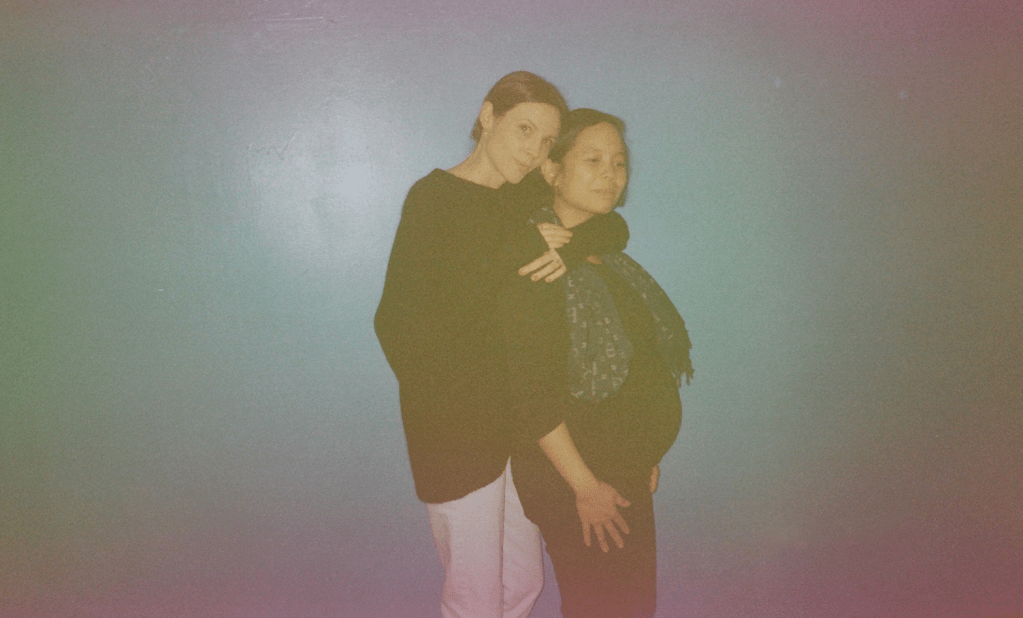
I am sitting on my couch watching a Toronto Raptors game. The television emits light that flickers through a large window that frames a bright winter moon. I am 41 weeks pregnant at this point (feeling similarly shaped and sized as the moon outside). My stubborn queer resistance to the Beatles somehow dissipated during my pregnancy, and the song “In My Life” made its way to me. I would quietly sing the song to my pregnant belly. Then, that January night, I felt a snap inside my body and a rush of water down my legs. I won’t go into much gratuitous detail other than to say that at 12:49 pm the next day, Asa Cy Dyer-Mecija was born at home.
And these memories lose their meaning when I think of love as something new.
“In My Life” (Lennon & McCartney 1965)
Sometimes, I needed to couch the queerness of pregnancy in words that were not mine. The distance between these words and the ones I had yet to find would help to structure my unfolding love for Asa. Here, queerness presented a modality of encounter with uncensored desires. Queerness is often theorized as a utopian impulse; the queerness of my pregnancy jostled both the hopes and fears brought up by the unknown terrain of parenting amidst heteronormativity. For me, “In My Life” is riven by sentimentality and nostalgia, but it also gave melody to a tender relationship with myself and my new role in the world. This was the sonic throughline to my parents, a queer inheritance of tension made from the hopes for kinder contexts amidst the limitations of harsh realities.
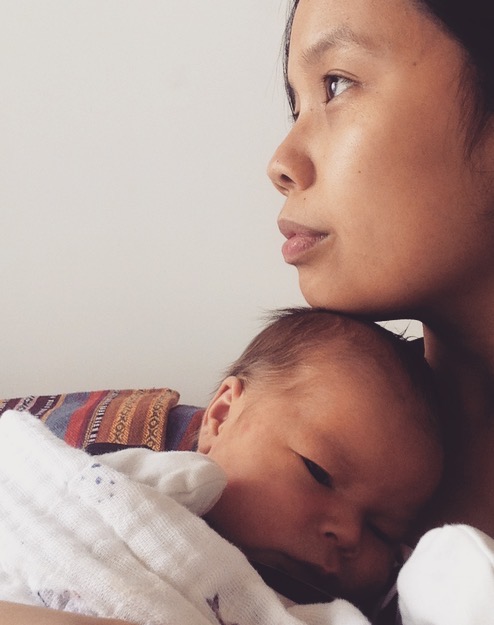
December 2022.
I was invited to perform as part of the Queer Songbook Orchestra’s holiday fundraiser. The Queer Songbook Orchestra is a chamber pop ensemble that hosts an annual concert focused on songs and stories about “chosen family and queer joy” (Queer Songbook n.d.). At that time, Asa was four years old. He is a child of the pandemic. He’s a kid with two moms, a present and kind donor, and is dearly loved by his Lolo and Lola, his grandparents, aunts, titas, uncles, cousins, kuya, ate, and his beautiful chosen family. My partner, Hannah, and I sometimes worry about how his world will be affected by reactions to the makeup of our family, but mostly, we know he’ll be sure he’s loved by many.
To me, the song “In My Life” offers a useful sonic response to homophobia. As a baby, after Asa’s baths, I would often wrap him in a towel, and while rocking him back and forth, I would sing these lyrics from the song: “Though I know I’ll never lose affection for people and things that went before, I know I’ll often stop and think about them. In my life, I love you more” (Lennon & McCartney 1965). To me, this statement is a queer ethos. We know that 2SLGBTQ+ people have necessarily and creatively reworked and reimagined the organization and expression of kinship. When family is so often bounded by what Julianne Pidduck calls “constraints of relationality” in “Queer Kinship and Ambivalence”(2008: 441), the lyrics “In my life, I love you more” are a call to action. More is a word used comparatively to insist that there is something greater, something more exists, something more is possible. I embrace the challenge to love more. My queerness urges me to love more, and parenting Asa does, too. On the evening of the performance, indexed by my parents’ struggles and our shared disdain for the chill of winter, Asa and I performed “In My Life” together. The video of our performance will remain a treasured sonic archive that I will return to often, and as Asa gets older, I hope it reminds him of how beautiful he’s always been.
—
Casey Mecija is an Assistant Professor in the Department of Communication & Media Studies at York University. Her current research examines sound as a mode of affective, psychic, and social representation, specifically in relation to diasporic experience. Drawing on sound studies, queer diaspora studies and Filipinx Studies, her research considers how sensorial encounters are enmeshed and disciplined by social and psychic conditions. In this work, she theorizes sounds made in and beyond Filipinx diaspora to make an argument about a “queer sound” that permeates diasporic sensibilities. She is also a musician and filmmaker whose work has received several accolades and has been presented internationally.
—

REWIND!…If you liked this post, you may also dig:
Blank Space and “Asymmetries of Childhood Innocence” –Casey Mecija
The Sound of What Becomes Possible: Language Politics and Jesse Chun’s 술래 SULLAE (2020) –Casey Mecija
The Cyborg’s Prosody, or Speech AI and the Displacement of Feeling–Dorothy Santos
Tape Hiss, Compression, and the Stubborn Materiality of Sonic Diaspora–Chris Chien
Xicanacimiento, Life-giving Sonics of Critical Consciousness—Esther Díaz Martín and Kristian E. Vasquez
Moonlight’s Orchestral Manoeuvers: A duet by Shakira Holt and Christopher Chien
Enacting Queer Listening, or When Anzaldúa Laughs–Maria Chaves Daza
Echoes in Transit: Loudly Waiting at the Paso del Norte Border Region—José Manuel Flores & Dolores Inés Casillas
The Queerness of Wham’s “Last Christmas”–Justin Burton
Could I Be Chicana Without Carlos Santana?–Wanda Alarcón
Share this:


Current Top Posts





April 2021

January 2020

November 2019

October 2019

August 2019

April 2014

November 2017

March 2015

December 2017

October 2015
 Sounding Out!
Recent Comments