
On the Lower Frequencies: Norman Corwin, Colorblindness, and the “Golden Age” of U.S. Radio
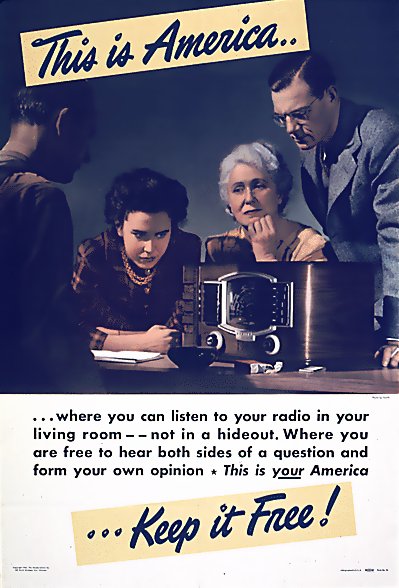
Editor’s Note: This is Liana, Managing Editor for Sounding Out!, introducing you to this special fall installment of our series “Tune Into the Past,” penned by our very own Editor-in-Chief and Guest Posts Editor, Jennifer Stoever-Ackerman. We at SO! have been waiting for months for Jennifer to share with us a brand-spanking new blog post! She’s back in action this month with a post that asks readers to listen to the cultural landscape that foregrounded Norman Corwin’s success as a radio writer and producer, inspired by her research on her book manuscript on the sonic color-line. In particular, Jennifer addresses the notion of colorblindness and its very real repercussions on radio artists and producers of color in the 1940s. Want to catch up on our series on Norman Corwin? Check out this summer’s posts by radio scholars Neil Verma, Shawn VanCour, and Alex Russo. If you’re all caught up, open your ears and your eyes then (to paraphrase Kurt Cobain). —LMS
—
Almost every day, I hear someone on the radio hailing America as the home of democracy. Yet almost every network is guilty of discrimination against the Negro performer. There are a few isolated cases of Negroes in broadcasting, but the lily-white policy is seldom violated.—Lena Horne, Chicago Defender 1940
The fine pieces in the “Tune in to the Past” series have thoughtfully considered the audible legacies of Norman Corwin: the “kaleidosonic” aesthetics that Neil Verma called the “Corwinesque,” the virtually seamless melding of artistic and commercial concerns that Shawn VanCour analyzed, and the echoes of Corwin remixed into WNYC’s Radiolab that Alexander Russo amplified. But the research I performed for my book manuscript, The Sonic Color-line: Race and the Cultural Politics of Listening, about the fraught relationship between race and 1940s radio, left me pondering the gaps and silences of Corwin’s soundscape. Radio’s “Golden Age” was also its most racially segregated: was the philosophy of “colorblindness” that Norman Corwin publicly espoused key to keeping it that way?
It’s not my goal to undermine Corwin’s work, but rather to enhance our understanding of it by embedding his broadcasts in the wider political, historical and sonic fields in which he was enmeshed. Just as Corwin’s sounded legacy left long-lasting traces in our media, so too have the silences and omissions fostered by the media executives, casting directors, union bosses, radio critics, and sonic auteurs of the “Golden Age.” If Corwin’s work is difficult to access save for far-flung archives and spotty collector’s catalogues, the exclusions of African-American producers, performers, and listeners are even harder to hear, in part because of his very insistence that radio’s microphones were colorblind. As the epigraph from Lena Horne testifies, the discourse of democracy is not mutually exclusive with segregation. In what follows, I discuss the intensely segregated history of the “Golden Age of Radio,” arguing that one of Corwin’s most far-reaching legacies may not have been set in motion by his virtuostic broadcasting, but rather by the World War II-era liberalism that shaped it.
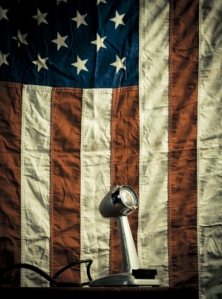 The apex of Corwin’s radio career coincided with a profound shift in America’s dominant racial formation, the beginnings of “colorblindness.” By colorblindness, I mean the belief that if individuals and institutions ignored skin color as a signifier and eliminating race as an official category of identity—particularly within governmental institutions—it would cease to matter in American life and all groups would have equitable access to the privileges, opportunities, and freedoms afforded by citizenship. The shift toward colorblindness—what Michele Hilmes calls America’s “wartime racial realignment” in Radio Voices—was predicated on creating a sense of unity that would inspire men across the color-line to sign up to fight what was dubbed a war to end racism and fascism, even as it raged on in their segregated hometowns. The Pittsburgh Courier’s Double V Campaign—Victory against fascism abroad and Victory against racism at home—addressed these ironies. Barbara Dianne Savage’s Broadcasting Freedom: Radio, War, and the Politics of Race details the suppression of many black newspapers on military bases due to the Double V Campaign, as well as the pressure it put on government radio programs to address race. However, she notes:
if black people had been forced to rely on radio as their primary means of communication about the failings of the federal government, they would have been on an impossible mission, since they were admitted to radio only as entertainers or as briefly invited guests expected to be on their best behavior (94).
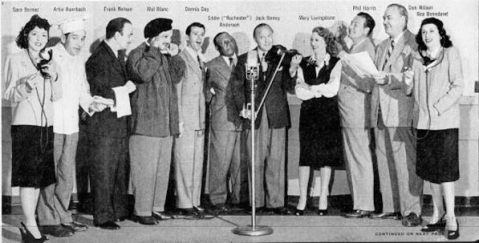
Cast Photo of the Jack Benny Program. Eddie Anderson, who played Benny’s valet, was one of only a handful of steadily working black radio actors in the 1940s
Despite high-profile protests in the black press, mainstream broadcasters constructed radio as an unmediated purveyor of equality and truth with increasing frequency during World War II—its “lofty aerials, symbols of freedom” according to New York Times radio critic Orrin Dunlap. In the case of Norman Corwin, he wrote a symptomatic (and nervy) editorial for Negro Digest in 1945 that depicted U.S. radio as a direct material and technological representation of colorblindness itself.
In “A Microphone. . . is. . . Color Blind”–what revealing ellipses!–Corwin assures black readers that “my feeling about Negroes in radio is that they belong as surely as the microphone.” This strange opening gambit compares black participation in radio to the mute technological presence of the microphone that, while absolutely central to broadcasting, is an object with no inherent agency. Unlike the proprietary, agenda-setting presence of whites in radio, a microphone amplifies the voices of others, while speaking not a word of its own. From his privileged vantage point, Corwin doesn’t quite realize how colorblindness enables him to use black people as tools.
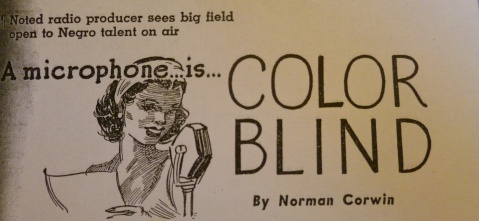
Norman Corwin’s “A Microphone is Color Blind” from Negro Digest (1945), Image by the author
And, while Corwin’s title insists on the microphone’s colorblindness, his article suggests otherwise. Much of his description of what America is missing without black people’s radio presence has to do with aural racial difference: “I have found the same thing that makes Negroes supremely great artists in song makes them great in speech. The color and warmth conveyed in the performance of a Negro artist is directly communicable by air. The microphone is a faithful reporter and says exactly what it hears.” In addition to perpetuating the old stereotype of black people as natural performers, Corwin’s realist depiction of the microphone as a “faithful reporter” that “says exactly what it hears” covers up exactly how much black voices were sculpted for white consumption during this period in radio; as actor Johnny Lee (“Algonquin C. Calhoun” on Amos ‘n’ Andy) told UCLA graduate student researcher Estelle Edmerson in 1954: “I had to learn how to talk as white people believed Negroes talked. Most of the directors take it for granted that if you’re a Negro actor, you’ll do the part of a Negro automatically.”

Johnny Lee as “Algonquin C. Calhoun” on Amos ‘n’ Andy
Whereas radio listeners were able to hear a wide range of white voices in a spectrum of roles—major and minor, comedic, dramatic, musical, informational—the sound and the content of black speech was circumscribed by the sonic color-line that marked it as “automatic,” essential, comedic, and potentially dangerous. Corwin’s use of the word “communicable” rather than “communicated,” for example, is a revealing flourish giving black sound a tinge of contagion and infectiousness. While ostensibly celebrating black voices, this passage simultaneously assures white listeners that they will still be able to unequivocally identify the race of any speaker over the “colorblind” airwaves and that this experience will be a pleasurable one for them. While the microphone may be color blind, it clearly is not color deaf.
That Corwin assumes a white audience becomes more obvious with his assertion a few lines later that “I have found too few Negroes who have taken an interest in radio. I suspect it’s because they don’t know about it.” This statement is fairly incredible, considering that the Research Company of America published a study in the radio industry magazine Sponsor that placed African American radio ownership at 87%, just shy of the national figure of 90% (October 1949, 25). Sponsor dubbed black audiences “The Forgotten 15,000,000.”
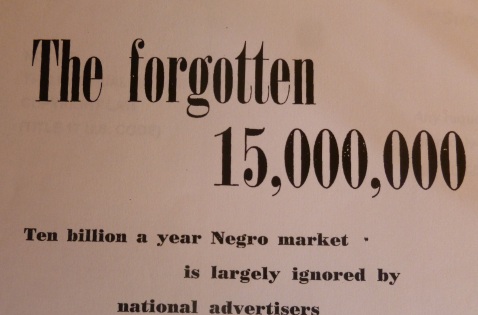
Sponsor, October 1949, Image by author
In addition to being inaccurate, Corwin’s suggestion that African Americans had limited knowledge of radio performs one of the signature moves of colorblindness; it makes institutional barriers to access—lack of training, networks, and mentorship, as well as straight up discriminatory hiring practices—invisible by asserting that black people only need to work harder to succeed in the American media industry. Under colorblindness, the failure to achieve success equitable to white citizens falls squarely on the shoulders of those oppressed. It also willfully mutes the protest of many black actors—such as Butterfly McQueen—who refused to participate in the segregated industry and the agency of all the black listeners who turned the dial on shows distasteful to them, allowing the fantasy of a unified (white) America to remain a powerful referent.
By and large, Corwin’s article paints colorblindness as already achieved. In his estimation, it is up to black people themselves to take advantages of the opportunities he suggests already await them via the colorblind microphone: “My attitude is not unique among radio directors—at least not in the main centers of radio[. . . ],“Corwin insists, “there is less prejudice in this field than in any other. It exists unfortunately, but you can get a hearing.” For someone whose bread and butter was rhetorical flourish, Corwin’s use of passive sentence construction to discuss racial prejudice is significant—he naturalizes it as something that merely “exists,” tooling along without any specific historical agent performing the discriminatory and oppressive actions. Such omission lets the white gatekeepers of the 1940s radio industry off the hook for both the institutional and individual forms of discrimination that kept the industry largely, as Lena Horne phrased it, “lily-white.”
Radio’s profound whiteness was aural as well as visual. In Corwin’s colorblind America, a radio “hearing” comes at a heavy price for African Americans. Without commenting on educational segregation, Corwin proclaimed: “Negro schools should have in their curriculum courses in public speaking, radio, theater. There is no reason why there should not be Negro announcers. It is important to study diction so that distinction in speech cannot be noted.” While Corwin begins “A Microphone. . . is. . .Color blind” by arguing that black voices should continue to retain the racial markings that are legible (and pleasurable) to white listeners, he then suggests they must also simultaneously sound enough like the white voices surrounding them in order to be heard and accepted as fellow American citizens. Radio didn’t just passively reflect the sounds of American citizenship during this period–it actively constructed them on a foundation of exclusion and silencing.
 There remains, then, a profound disconnect between the full exercise of American citizenship, the idealized discourse of colorblind equality forwarded by government officials, media critics, and prominent broadcasters exemplified here by Corwin, and the actual representation of African Americans as radio producers, performers, and listeners during and after this period. At the same time as state-sponsored colorblind ideology rose to prominence during the war years, the U.S.’s airwaves became almost exclusively white. There were no black writers regularly employed by any national radio station during the 1940s and there was not a single black member of the Los Angeles Writer’s Guild. While black authors Langston Hughes and Carlton Moss wrote occasional scripts on one-shot contracts, they were about topics deemed of black interest by the networks. Black radio critic Joe Bostic—who would later become one of the nation’s first black radio sportscasters—described the limited openings for black radio performers:
publication last week of the most authoritative and comprehensive of the radio polls showed not a single Negro entertainer placing in the first ten of any branch of radio entertainment. Such a compilation outlines, in bold relief the disturbing fact that the Negro, long a leader in every phase of entertainment, is being excluded in this newest and most lucrative branch (People’s Voice, 1942).
Regular on-site broadcasts from nightspots that featured black performers all but vanished after 1940, meaning that the vast majority of black musical performances broadcast over the American radio networks were conditioned and mediated by white announcers and sponsors as well as the sounds of white-oriented programming that introduced and followed them.
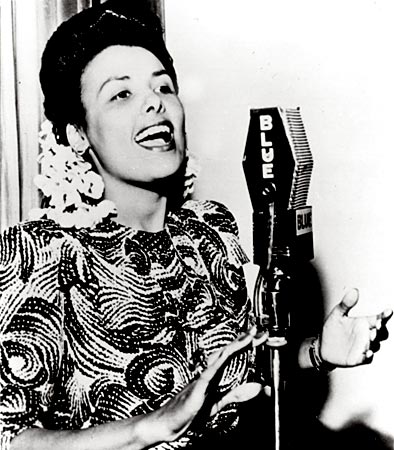
Lena Horne guesting for NBC’s Blue Network
To be clear, I don’t blame Corwin individually for the ideology of colorblindness and the world it has wrought, but I do think it is important to consider his role as a cultural producer in the “Golden Age” of segregated radio, and as a power broker who helped shape the media landscape with which we now contend. While we commemorate his labors as a sonic artist with high journalistic standards who undoubtedly worked to “glorify the ‘common man,'” we also have to consider the institutionalized privilege that enabled him to claim this role as his own, as well as the many people silenced by him doing so, inadvertently or not. Tuning in to the past demands a vigilant ear attentive to the profound silences of exclusion: the traces of words muted, mangled, disciplined and unsaid, as well as the subterranean reverberations ghosting the triumphant tones of the “Golden Age,” a shadow broadcast, on the lower frequencies, of all the sounds that might have been.
—
Jennifer Stoever-Ackerman is co-founder, Editor-in-Chief and Guest Posts Editor for Sounding Out! She is also Assistant Professor of English at Binghamton University and a former Fellow at the Society for the Humanities at Cornell University (2011-2012).
Share this:

SO! L.A.: Sounding the California Story
 Editor’s Note: Welcome to the second installment in our month-long exploration of listening in observation of World Listening Day on July 18, 2012. For the full introduction to the series click here. To peep the previous post, click here. Otherwise, whip out your most oversized sunglasses, kick back, and listen to Bridget Hoida’s California. –JSA
—-
STOP.
Do not read along with me “in your book.”
Resist the temptation to follow along with your eyes.
Click play. Listen.

Sunset in the San Joaquin Valley
If I had things my way, I would whisper these stories to you as we sat in mesh folding chairs on the poured concrete porch of my Central Valley childhood home. If I had things my way, I would refill your glass with lemons and gin, and we would breathe in the sweet, summer smell of rotting blackberry brambles. If I had things my way, we would wait until the sun set against a Tokay harvest, taking with it the harsh triple digit temperature and leaving us nothing but the quiet of a delta breeze and moonlight. If I had it my way, I would ask you to lean in close as I whisper with canonical voices:
“This is a story about love and death in the golden land, …”
“I remember that moment exactly, those exact words registering in my mind like the notes of a solo…”
“Bobby Gene was a tattletale he told everything he heard…”
“You must not tell anyone what I am about to tell you…”
“My history is murky, and I wanted it [ …] that way so I could be free to tell whatever I wanted. ”
“I’ll tell you what I suppose from your silences and few words and you can tell me if I’m mistaken. You’ll have to speak up with the real stories if I’ve got you wrong…”
“And so they talked and told tales of their region, and I listened. Long into the night I listened until I dropped off to sleep and my father would pick me up onto his lap as he continued to talk about the Revolution…. And every camp was different, none existing for more than six or seven weeks, then off we would go to the next harvest, where new people would gather and there would be new tales to be told and heard. I knew when I was six years old that the one thing I most wanted from life was to be a storyteller.
The storied sound of California
-All Voices
Shush…. Listen.
Linger with me on the drawn-out drawl of the stories I was raised on. Of the stories I was raised upon. For this is the sound of the California story: A myriad of voices sounding out narratives onto the page. Conflicting, concurring, spoken-over and rewrote…no one lasts longer than the next harvest, the next filmic “Action!” This is the sound of the storied terrain of interwoven melodies spoken upon the California soil that I call home.
1.
In or around 1995, I fell madly in love with Joan Didion. It’s not so much Didion the woman but rather the sound of Didion’s words that have me so hung up. My obsession began in the stacks of the Bancroft Library at UC Berkeley. I was assistant to the assistant librarian there and during my lunch hour I would take the dumb waiter up to the roof, eat a Kaiser roll with apricot jam, and read dime store copies of classic novels. I chose the roof because I like to read aloud, and in libraries at the time, reading aloud, especially to yourself, was expressly forbidden.

So there I was on the roof of Bancroft, with my roll, my jam, and my dime store copy of Play It As It Lays. I opened the page and read something about snakes and Iago. A mother died, the town of Silver Wells was won, and then lost, in much the same way a marriage slips into divorce. And then it happened. I stumbled across a line that changed the way I thought about words. Page 7, the first full sentence of the top paragraph, on the right: I might as well lay it on the line, I have trouble with as it was.
And after that line a whole lot of white space.
Beautiful, brilliant, blank white space.
As though in the silence of the rooftop, of the view, Didion was screaming to the reader, to me, something louder than words. In that white space there was sound and it was deafening.

2.
Later, when I decided to get a Ph.D. in creative writing, and although I couldn’t say as much on paper, examine, among other things, the commonality of language in California writers and the sonic devices of oral storytelling, I came across a quote from Didion, in interview, that said:
I had the technical intention to write a novel so elliptical and fast […] it would scarcely exist on the page at all…white space. Empty space. […] A white book to which the reader would have to bring his or her own bad dreams…
And although I adore everything about her I almost wished she hadn’t said it. Or that I hadn’t read it, because the thing about Didion is that statement… the part about the blank space… and the nightmare… it was already there. On the roof of the Bancroft library with my Kaiser roll and apricot jam, when the air tasted like September, I brought my own bad dreams because in that brilliant bit of white space I heard the scream.
3.
I like the white page. I prefer stories to plots. Plot for me is how the narrative moves from one space in time (from one line on the page) to the next. Story is how the narrative sounds. Story is voice. Plots are where girls meet boys and girls lose boys and girls get boys back. Stories are the shuffle and stop of scuffed shoes walking railroad levees, old men clearing phlegm, the surprise of an elastic bikini band as it snaps against the freshly burnt back of a burgeoning starlet. And the sounds of words as they smack unbridled against the page.

a traditional page by John Steinbeck

a white page by Joan Didion
4.
When I read Didion we are on my porch and I hear her voice. When we think of writing, when we imagine reading, we think of quiet moments that exist alone with fixed type on a printed page. But as a reader, and more importantly as a writer, I have never felt this way.
5.
Voice, to paraphrase Emily Dickinson, is the “slant” you bring to your version of “the truth.” Plots are recyclable. Hell, you can buy one on eBay, to be sure. But a writer’s voice is different. I don’t read a book to figure out what happens next. I read to hear the whisper of the author’s voice. If they whisper well, I turn the page.
6.
From John Steinbeck to Gertrude Stein, John Fante to Susan Straight, Larry Levis and Mary Hunter Austin to William Saroyan and Shawna Yang Ryan, there is commonality of sound and language that I’m willing to claim composes an aural palimpsest of sorts. A voicing over, both literally and figuratively of native daughters and native sons held up on the tongue of the golden state.
The cadence, the rhythm, the obsession with things past. The aching nostalgic longing. The reflection. The fear. The reclamation. The imagination. The witness of an agrarian undoing. Sleepy Hollow moments reborn—again and again on western soil. The feeling of home. The feeling of home slipping away. The feeling of self, self-made in the image of home, slipping away alongside it. There’s a certain Californianess to it.
7.
What if we found a way to consider the sound these “fixed texts” emote? What if we broke with conventional narrative structure and embraced a written technique that more adeptly mirrored the sound and cadence of spoken story telling? Then might it be possible that the very aurality that is “written over” on the read palimpsest is in fact the sound that also remains?
As a writer, a writer who believes in voice, who rejoices in sounds as the strike-like syllables against a now forgotten Olivetti key, my pursuit in writing not only a novel, but in writing a novel about California was how I could possibly enter into this conversation. How I might be able to raise my voice loud enough to embrace the crowd of such a respectable page. How I could construct my text in such a way that it would not only read, but also sound Californian.

a “docu-page” by Raymond Barrio
8.
In my struggle to voice not only my novel, So L.A., but also my protagonist Magdalena de la Cruz, I relied heavily on the patterns, soundscapes and literary devices of the collective California canon comprised of authors such as the ones I spoke of above. In So L.A. I was looking for a way to tell the story out loud while still operating within the conventional structure of a “type and text” book.
 9.
9.
My novel opens with Magdalena falling off a boat and then moves both forward and backward in time. This is how most people tell stories orally. They begin in the middle and then jump around, forgetting, amending, and calling attention to the most important parts, while the listener rarely ever exclusively listens but instead interjects and provides his or her own connections, observations and experiences. Eliminating quotations allowed me to access some of this interplay. It allowed me to question the reliability of spoken language. Spoken utterance does NOT always translate to precise hearing of the said words uttered. There is always interference—be it emotional (memory-sound triggers), psychological (felt meaning as opposed to said meaning), physical (honking cars, loud birds, eye rolls and sneezing) or linguistic (signifiers and unspoken gestures). Just because words are utter does not mean they are the same words that are heard. And not only did I want this, but I needed it on my page. Although I considered the docunovel (in the vein of Raymond Barrio), autho-interview collage (like Anna Deavere Smith) and autofictive exploration (ala Salvador Plascencia) I ultimately decided to abandon quotation marks.


a “sounded” page from The People of Paper
10.
This (“) says open. It says start.
This (”) says closed. It says stop.
But (“) and (”) also sound.
For me they sound like a particularly rough clearing of the throat. They sound like standing on a library rooftop, trying to confess your love with the passion of a librarian “with hiccups.”
“They” interrupt the eye. “They” provide visual cues for accessing character and I didn’t want Magdalena “to be seen.” I wanted her to sound.
Her voice required a fluidity and unreliability not attainable “in quotes.” Without conventional quotes I was free to wander inside the head and voice of my protagonist as I pushed the blur between what she was saying, what the listener perceived she was saying, and what other characters were voicing without visual interruption.
11.
Also important in my authorial access to sound (and the absence of sound) on the fixed and written page was the use of filmic microchapters (some only as long as a single sentence). A sentence that reads as a chapter, surrounded by all that stark and lovely white space, not only looks different from a classical bookish chapter, but it also sounds different. Read out loud, or quietly inside the reader’s head, it sounds out a particular meaning and resonated differently within the mind’s eye and ear.
12.
With so much of the present world turning virtual, author and storyteller Barry Sanders concludes, “We demand less from the historical accuracy of our stories. We even demand less of a truth. We are content with images and feelings. If it feels closer to the truth then it might as well be.” However I’d like to extend Sander’s assessment beyond image and feeling to include sound. In this newly constructed world of virtual storytelling we are again experiencing a shift (not unlike the shift from oral to written storytelling) that is also sound dependent and sonically informed. From the staccato sounds of Twitter as compared to the unconstricted and leisurely expanse of Tumblr, it is important to acknowledge that the twenty-second sound bite can be (and historically has been) used (and utilized) in fiction to make noise and call attention to lasting moments of profound revelation. Although Didion’s Maria may “have trouble with how it was” I find a certain sense of comfort in how it is provided we are all able to lean in close and listen. Listen past the interference of type, text and YouTube to the sound of words both on and upon the page as,
“These are tales told in darkness in the quiet at the end of the day’s heat…”
—
Opening Image Credit: “L.A. Sky at Sunset” by Flickr User David Vienna
Audio note: Voices used, with the exception of Bridget Hoida, are not the actual voices of the authors listed, nor are they meant to be representative of said authors.
—
Bridget Hoida is the author of So L.A. (2012). In a past life she was a librarian, a DJ, a high school teacher, and a barista. In this life she experiments with words and has taught writing at UC Irvine, the University of Southern California and is currently a professor at Saddleback College. Hoida is the recipient of an Anna Bing Arnold Fellowship and the Edward Moses prize for fiction. She was a finalist in the Joseph Henry Jackson/San Francisco Intersection for the Arts Award for a first novel and the William Faulkner Pirate’s Alley first novel contest. Her short stories have appeared in the Berkeley Fiction Review, Mary, and Faultline Journal, among others, and she was a finalist in the Iowa Review Fiction Prize and the Glimmer Train New Writer’s Short Story Contest. Her poetry has been recognized as an Academy of American Poets Prize finalist and she was a Future Professoriate Scholar at USC.
She has a BA from UC Berkeley, a MA in fiction from San Francisco State University, and a Ph.D. in Literature and Creative Writing from the University of Southern California. So L.A. is her first novel.
Share this:


Current Top Posts





April 2021

January 2020

November 2019

October 2019

August 2019

April 2014

November 2017

March 2015

December 2017

October 2015
 Sounding Out!
Recent Comments