
Pleasure Beats: Using Sound for Experience Enhancement
 After a rockin’ (and seriously informative) series of podcasts from Leonard J. Paul, a Drrty South banger dropped by SO! Regular Regina Bradley, a screamtastic meditation from Yvon Bonenfant, a heaping plate of food sounds from Steph Ceraso, and crowd chants courtesy of Kariann Goldschmidt‘s work on live events in Brazil, our summer Sound and Pleasure comes to a stirring (and more intimate) conclusion. Tune into Justyna Stasiowska‘s frequency below. And thanks for engaging the pleasure principle this summer!--JS, Editor-in-Chief
—
One of my greatest pleasures is lying in bed, eyes closed and headphones on. I attune to a single stimuli while being enveloped in sound. Using sensory deprivation techniques like blindfolding and isolating headphones is a simple recipe for relaxation, but the website Digital Drugs offers you more. A user can play their mp3 files and surround themselves with an acoustical downpour that increases and then develops into gradient waves. The user feels as if in a hailstorm, surrounded by this constant gritty aural movement. Transfixed by the feeling of noise, the outside seems indistinguishable from inside.

Screenshot courtesy of the author
Sold by the i-Doser company, Digital Drugs use mp3 files to deliver binaural beats in order to “simulate a desired experience.” The user manual advises lying in a dark and silent room with headphones on when listening to the recording. Simply purchase the mp3, and fill the prescription by listening. Depending on user needs, the experience can be preprogrammed with a specific scenario. This way users can condition themselves using Digital Drugs in order to feel a certain way. The user can control the experience by choosing the “student” or “confidence” dose suggestive of whether you’d like your high like a mild dose of marijuana or an intense dose of cocaine. The receiver is able to perceive every reaction of their body as a drug experience, which they themselves produced. The “dosing” of these aural drugs is restricted by a medical warning and “dose advisors” are available for consultation.

Screenshot courtesy of the author
Thus, the overall presentation of Digital Drugs resembles a crisscross of medicine and narcotic clichés with the slogan “Binaural Brainwave doses for every imaginable mood.” While researching the phenomena of Digital Drugs, I have tried not to dismiss them as another gimmick or a new age meditation prop. Rather, I argue the I-Doser company offers a simulation of a drug experience by using the discourse of psychoactive substances to describe sounds: the user becomes an actor taking part in a performance.
By tracing these strategies on a macro and micro scale I show a body emerging from a new paradigm of health. I argue that we have become a psychosomatic creature called the inFORMational body: a body that is formed by information, which shapes practices of health undertaken to feel good and form us. This body is networked, much like a fractal, and connects different agencies operating both in macro (society) and micro (individual) scales.
Macroscale Epidemy: The Power of Drug Representation
Heinrich Wilhelm Dove described binaural beats in 1839 as a specific brain stimuli resulting in low-frequency pulsations perceivable when two tones at slightly different frequencies are presented separately through stereo headphones to each of the subject’s ears. The difference between tones must be relatively small, only up to 30 Hz, and the tones themselves must not exceed 1000 Hz. Subsequently, scientific authorities presented the phenomena as a tool in stimulating the brain in neurological affliction therapy. Gerard Oster described the applications in 1968 and the Monroe Institute later continued this research in order to use binaural beats in meditation and “expanding consciousness” as a crucial part of self-improvement programs.
I-Doser then molded this foundational research into a narrative presenting binaural beats as a brain stimulation for a desired experience. The binaural beats can be simply understood as an acoustic phenomena with application in practices like meditation or medical therapy.
I-Doser also employs the unverified claims about binaural beats into a narration that consists of the scattered information about research; it connects these authorities with YouTube recordings of human reactions to Digital Drugs. Video testimonies of Digital Drugs users caused a considerable stir among both parents and teachers in American schools two years ago. An American school even banned mp3 players as a precautionary measure. In the You Tube video one can see a person lying with headphones on. After a while we see an involuntary body movement that in some videos might resemble a seizure. Losing control over one’s body becomes the highlight of the footage alongside a subjective account also present in the video. The body movements are framed as a drug experience both for the viewer who is a vicarious witness and the participant who has an active experience.
This type of footage as evidence was popularized as early as the 1960s when military footage showed reactions to psychoactive substances such as LSD.
In the same manner as the Digital Drugs video, the army footage highlights the process of losing control over one’s body, complete with subjective testimonies as evidence of the psychoactive substance’s power.
This kind of visualization is usually fueled by paranoia, akin to Cold War fears, depicting daily attacks by an invisible enemy upon unaware subjects. The information of the authority agencies about binaural beats created a reference base that fueled the concern framing the You Tube videos as evidence of drug experience. It shows that the angst isn’t triggered by technology, in this case Digital Drugs, but by the form in which the “invisible attack” is presented: through sound waves. The manner of framing is more important than the hypothetical action itself. Context then changes recognition.
Microscale Paradigm Shift: Health as Feeling
On an individual level, did feeling better always mean being healthy? In Histoire des pratiques de santé. Le sain et le malsain depuis le MoyenAge, Georges Vigarello, continuator of the Foucault School of Biopolitics, explains that well-being became a medicalized condition in the 20th century with growing attention to mental health. Being healthy was no longer only about the good condition of the body but became a state of mind; feeling was important as an overall recognition of oneself. In the biopolitical perspective, Vigarello points out, health became more than just the government’s concern for individual well-being but was maintained by medical techniques and technologies.
In the case of Digital Drugs the well-being of children was safely governed by parents and media coverage creating prevention in schools from the “sound drugs.” Similarly, the UAE called for a ban on “hypnotic music” citing it as an illegal drug like cannabis or ecstasy. Using this perspective, I would add that feeling better, then, becomes a never-ending warfare; well-being becomes understood as a state (as in condition and as in governed territory).
Well-being is also an obligation to society, carried out by specific practices. What does a healthy lifestyle actually mean? Its meaning includes self-governance: controlling yourself, keeping fit, discipline (embodying the rules). In order to do it you need guidance: the need for authorities (health experts and trainers) and common knowledge (the “google it” modus operandi). All of these agencies create a strategy to make you feel good every day and have a high performance rate. Digital Drugs, then, become products that promise to boost up your energy, make you more endurable, and extend your mind capabilities. High performance is redefined as a state that enables instant access to happiness, pleasure, relaxation.

“Submerged” by Flickr user Rene Passet, CC BY-NC-ND 2.0
inFORMational Body
Vigarello reflects that understanding health in terms of low/high performance—itself based on the logic of consumption—created the concept of a limitless enhancement. Here, he refers to the information model, connecting past assumptions about health with a technique of self-governing. It is based on senses and an awareness of oneself using “intellectual” practices like relaxation and “probing oneself” (or knowing what vitamins you should take). The medical apparatus’s priority, moreover, shifted from keeping someone in good health to maintaining well-being. The subjective account became the crucial element of a diagnosis, supporting itself on information from different sources in order to imply the feeling of a limitless “better.” This strategy relies strongly on the use of technologies, the consideration of a sensual aspect and self-recognition—precisely the methodology used for Digital Drugs’ focus on enhancing wellbeing.
Still, this inFORMational body needs a regulatory system. How do we know that we really feel better? Apart from the media well-being campaign (and the amount of surveillance it involves), we are constantly asked about our health status in the common greeting phrase, but its unheimlich-ness only becomes apparent for non-anglo-saxon speakers. These checkpoint techniques become an everyday instrument of discipline and rely on an obligation to express oneself in social interactions.
So how do we feel? As for now, everything seems “OK.”
—
Featured image: “Biophonic Garden” by Flickr user Rene Passet, CC BY-NC-ND 2.0
—
Justyna Stasiowska is a PhD student in the Performance Studies Department at Jagiellonian University. She is preparing a dissertation under the working title: “Noise. Performativity of Sound Perception” in which she argue that frequencies don’t have a strictly programmed effect on the receiver and the way of experiencing sounds is determined by the frames or modes of perception, established by the situation and cognitive context. Justyna earned her M.A in Drama and Theater Studies. Her thesis was devoted to the notion of liveness in the context of the strategies used by contemporary playwrights to manipulate the recipients’ cognitive apparatus using the DJ figure. You can find her on Twitter and academia.edu.
—
 REWIND!…If you liked this post, check out:
Papa Sangre and the Construction of Immersion in Audio Games–Enongo Lumumba-Kasongo
On Sound and Pleasure: Meditations on the Human Voice—Yvon Bonenfant
This is Your Body on the Velvet Underground–Jacob Smith
Share this:

Radio Ambulante: A Radio that Listens

 Welcome back to the final article in our three-part series, Radio de Acción. Special thanks to you, our readers, and to editors Jennifer Stoever and Neil Verma at Sounding Out! for hosting this addition to a burgeoning field of Latin American critics and producers who are changing the way we hear radio as history, as theory, and in practice.
Over the past several weeks we have tried to bring you into the multiple worlds made possible by radio in Latin America. If you missed our previous posts, please find Alejandra Bronfman’s stunning history of radio in the Caribbean here, and Karl Swinehart’s fascinating study of Aymaran-Spanish radio here.
Both of these critical approaches set the stage for Carolina Guerrero’s extraordinary work with radio in the Americas. An executive director and co-founder of Radio Ambulante—a program that fellow co-founder and novelist Daniel Alarcón calls “This American Life, but in Spanish, and transnational”—Guerrero’s post takes us behind the scenes of her show to consider how the sounds on radio come to life for us as listeners, and the significance of hearing someone’s words in her or his own voice and language. For more Radio Ambulante after you finish reading and listening to Carolina’s post, please visit their website and download their podcasts.
–Guest editor Tom McEnaney
—
In late 2007, novelist Daniel Alarcón was hired by the BBC to produce a radio documentary about Andean migration in his native Peru. He spent 10 days traveling around the country, from the highlands to Lima, conducting interviews in both English and Spanish, talking to a wide range of people with very personal stories about migration. But when Daniel received the final mix from London, he was disappointed to find that the editor had privileged the English language voices, and left out many of the most compelling Spanish language storytellers. Daniel was left with a question: what if there was a space for those voices on the radio waves? What would it sound like?
Over coffee in San Francisco in January 2011, Alarcón and I decided to create that space, inspired by US public radio shows like This American Life and Radiolab, which had no Spanish counterpart. We knew that poignant, fun, surprising, unique, sometimes sordid, sometimes romantic, absurd and incredible stories we often heard in Latin America were out there, just waiting to be reported. We knew that they would make great radio. And we knew there was an audience—in Latin America and the US—that wanted to hear it. The result became Radio Ambulante.
 .
.
FIRST STEPS
We began by asking many of our print journalist friends in Latin America to share stories with us. We sent them links to stories from some of our favorite American radio programs, and then contacted a few bilingual independent radio producers here in the US, and asked them for advice on the basics of radio production. Many directed us to Transom.org, which was an absolutely essential resource.
In March of 2012, we launched a Kickstarter campaign. All we had was an idea and a sampler with less than 45 minutes of audio—and still, we managed to raise $46,000 with the support of 600 backers. The success of this campaign was a huge confidence boost, and we knew we were on to something. We used this money to produce our pilot season.
.
Since then, we’ve worked with more than twenty different producers in more than a dozen countries. These are the characters that emerge from Radio Ambulante stories: a transgender Nicaraguan woman living with her Mexican wife in San Francisco’s Mission District; a Peruvian stowaway telling his harrowing tale of coming to New York in 1959, hidden in the hold of a tanker ship; the Chilean soccer player who dared challenge the authority of General Pinochet; a young Argentine immigrant to North Carolina, trying to find his way through the racially charged environment of an American high school. Taken together these voices create a nuanced portrait of Latino and Latin American life:
.
PERSONAL STORIES FOR ALL EARS
Now in our third season, we’ve been working hard to create a group of trusted producers and editors across Latin America; people we can turn to with an idea, people we know we can trust with our limited time and resources; reporters we can send to Cuba, send to Honduras, send to Venezuela, and be certain they’ll come back with usable tape, and a good story. We want these first time producers to become long-term contributors.
That’s the case of Camila Segura, Radio Ambulante’s current Senior Editor. She had no prior experience as a radio producer when she reported her first story for us in 2012. That piece, El otro, el mismo (The Other, The Same) is about two men, one Colombian, one Argentinian, who not only share the same name, but who look almost identical. From this coincidence, the story becomes something much stranger, funnier, more subtle, and ultimately quite moving:
.
We want the listener to be able to relate and identify with the characters, to feel what they feel. A good Radio Ambulante story should be universal and shouldn’t have an expiration date.
One story from our first season captures this universal quality. In 2011, River Plate, one of the most famous soccer clubs in South America, was relegated to the Argentine Second Division. This event shook the entire nation, and anyone who listens to this story could relate to the sadness and pain that the protagonist is feeling. Two years later, the story still has that raw power:
 .
.
HOW WE SOUND
Martina Castro, Senior Producer, has designed most of Radio Ambulante’s sound, finding the balance between music and sound effects in order to support the voice of the main characters. As she explains,
There are many kinds of pieces that make it to Radio Ambulante. Sometimes the story is focused on one person and their experience: something that happened long ago. Like with Mayer Olórtegui in Polizones (The Stowaways), and the story of how he and his friend Mario jumped aboard a ship headed to the United States. There is no substitute for a dynamic storyteller like Mayer. He not only recreates moments, sometimes even imitating the sounds of what he heard, but he remembers the emotion of what happened, and really feels deeply what he is talking about, like when his voice breaks up at the mention of saying goodbye to his friend Mario.
.
Other, more symphonic, multi-voiced pieces provide a different kind of production challenge. The script must showcase the many characters, while giving the listener enough grounding so as not to get lost. A particularly successful example is our award-winning piece “N.N.”, about Puerto Berrio, Colombia, by reporter Nadja Drost. Nadja gathered recordings of this river town, and conducted interviews with many locals, always focused on the issue of the floating, anonymous dead and the town’s strange relationship with these bodies. The music in a piece like this is only meant to support those real-life sounds and characters, and a repeated melody serves as a ghost-like echo of the dead, those voices we never hear.
We use music carefully to shift the mood, to mark the end of a section, and to alert the listener that something new is coming. The music is also meant to break up chapters of a story, give us a moment to reflect on what we just heard, or to indicate when something is about to change. There are examples in Yuri Herrera’s “Postcard from Juárez,” produced by Daniel Alarcón. It tells the story of Diana la Cazadora, or Diana the Hunter, a vigilante who set about killing bus drivers in one of the world’s most violent cities, allegedly as revenge for years of misogyny and sexism.
.
In this particular story, we were able to do something that the English version (produced for This American Life) could not: read in the original Spanish the letter that the supposed killer sent the local Ciudad Juárez newspaper explaining her actions. We had this read by Lizzy Cantú, a Mexican journalist who’d worked with us before, and then distorted her voice, to give it that dark ambience. The listener is supposed to feel the grim violence in those words: the desperation.
 THE STORY IS KEY
In three seasons producing the show, we’ve learned that the craft of radio comes from listening, and that the most challenging aspect of producing radio is not in the technical details of recording those voices or sounds, but in the story itself.
The most basic building block of a good radio story is a good interview. The technical aspects of gathering sound are less important than phrasing the questions to get vivid, almost filmic answers, full of details that set the scene.. As Executive Producer Daniel Alarcón explains,
We ask our reporters to push interviewees to describe scenes in great detail, to unpack moments. Our interviews can last two hours or more, and many are surprised that we go so in depth. We like our reporters to circle back, and then circle back again, so that we’re sure we’re getting the most vivid version possible of a given story’s crucial moments.
We ask our reporters to write colloquially, to imagine they’re telling the story to a friend at a bar. It’s important to have immediacy in the language, an expressive tone that can seem almost improvised, even when it isn’t. The emotional impact of radio is that it feels as though a secret is being shared. The script and the production should always be in service of this intimacy.
Before a script is final, it’s shared with other editors on the team around the globe (California, Colombia, Puerto Rico, Chile), mixed, edited, soundtracked, and refined through hours of collective work online.
 .
.
ONWARD
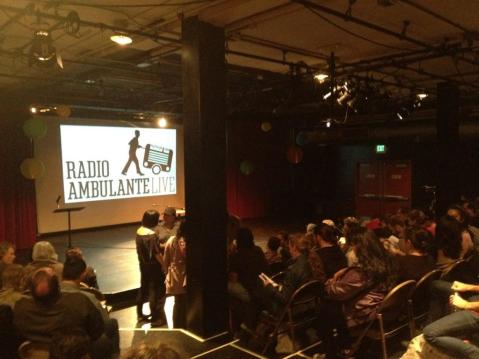
While creating our own sound and storytelling style, Radio Ambulante is constantly experiment with different formats and looking for new ways to interact with our listeners. We’ve done three live radio shows, in Los Angeles, San Francisco, and New York. In addition, we’ve produced two English Language specials, and partnered with writers and animators on hybrid multimedia storytelling. With our partners at PRI, we’re developing a new interview series, and are working with Latin American universities and media outlets to teach more journalists to use radio. Our hope is that Radio Ambulante’s success will mean more innovative radio work in Spanish, and more experiments in the possibilities of bilingual radio.
—
Carolina Guerrero is the Executive Director of Radio Ambulante. Before getting into journalism, she was a promoter for cultural and social projects, creating a bridge between organizations in three different continents. She has worked with public and private institutions in several countries, for which she has designed and overseen festivals, art exhibits, teaching workshops and fundraising events. Carolina is a John S. Knight Journalism Fellow at Stanford University 2014-15. She is the proud mother of León and Eliseo. (@nuncaduermo)
All images courtesy @radioambulante on Twitter
—
REWIND!…If you liked this post, you may also dig:
“We wanted to tell stories about sound: Opening Ears Through the Everything Sounds Podcast”-Craig Shank
“Chicana Radio Activists and the Sounds of Chicana Feminisms”-Monica De La Torre
“Óyeme Voz: U.S. Latin@ & Immigrant Communities Re-Sound Citizenship and Belonging”-Nancy Morales
Share this:


Current Top Posts





April 2021

January 2020

November 2019

October 2019

August 2019

April 2014

November 2017

March 2015

December 2017

October 2015
 Sounding Out!
Recent Comments