
Live Through This: Sonic Affect, Queerness, and the Trembling Body


Marginalized bodies produce marginalized sounds to communicate things that escape language. The queer body is the site of sounds that engage pleasure, repression, rage, isolation, always somehow outside of dominant language. Sound Studies tells us that we should trust our ears as much as our eyes, justifying our trust in sound, and of the resonating body. Affect Theory goes further, saying that all senses play into a body that processes input through levels of response, experience, and anticipation. Affect is the vibrational space that is both bodily memory and anticipation. So where do sound and affect meet in queer bodies? How do marginalized peoples use sound and the body to express liberation, objectification, joy, and struggle?
Our writers in Sound and Affect tackle these questions across a spectrum of the marginalized experience. Next week, Kemi Adeyemi, sloooooooows thingggggggggs doooooooooownnnnn so that we can hear the capitalist connections between the work expected of black bodies and the struggle for escape from this reality through the sonic affects, temporal shifts, and corporeal elsewhere of purple drank. Then, Maria Chaves explores the connection between voice, listening, and queer Chicana community formation: through space, across time, and with laughter. The series finishes with Justyna Stasiowska bringing the noise in a discussion of the trans body and the performance work of Tara Transitory. Today, I open by offering the concept of the tremble, a sonic form of affect that is necessarily queer in its affective reach. Live through this. Get life from this. —Guest Editor Airek Beauchamp
—
I first became interested in the intersections of sound studies and affect theory when, in graduate school, I began to research alternative rhetorics of the AIDS Crisis. ACT UP!, the noisiest and most politically effective of the AIDS advocacy groups from 1987 through 1995, posited noise as presence and silence as loss throughout their campaigns. ACT UP! was notorious for their actions in which they invaded public spaces, from the FDA to the White House and used militaristic chants to create a disruptive cacophony that ran counter to the official silence of government policy. The organization harnessed noise as powerful weapon to shake the status quo.
The ACT UP! equation led me to a critique of AIDS-era politics in which sound and affect became the predominant modes of inquiry, allowing me to investigate how the situated body and the senses experience and invoke rhetorics of marginialization. This maneuver proved to be intellectually difficult, particularly because my post-structuralist training stubbornly insisted on a discursively constructed universe in which only language constructed reality. Instead, what sound and affective rhetoric allow for is exactly that which is beyond the text, that which communicates without strictly-defined language. Theorizing the AIDS crisis as a social event might be necessary in terms of understanding how our culture processes or catalogues such an event, but as I engaged with its archive, I felt bereft when facing the limits of such an approach. It offered nothing to soothe the pain or express the terror of those whose bodies disintegrated in the cruel grasp of the disease.
Rather than relying on abstracted theory to force the affect of the plague into a logical form, I needed something like Antonin Artaud’s work on the plague to explore the cultural but embodied affect of the disease. When Artaud was invited to speak about his essay “The Theater and the Plague” at the Sorbonne, he decided to actually incorporate his ideas about ‘liquefying boundaries” into his speech. Artaud began with a standard oratory but slowly devolved into a theatrical performance of the plague, eventually ending in shrieks of physical pain. By the end of his speech, the only people left in the lecture hall were a minor contingent of his close friends, including Anais Nin, who recounted the tale (Eshleman, 12). Artaud’s shrieks and howls engaged the whole body in the process of making sound, while also erasing semantic and syntactical codes. Here is a video compilation of Artaud performances, to provide the smallest hint of his vocal performances:
To continue my research, I realized, I needed to understand bodies as instruments for processing, producing, and receiving sonic stimuli, while, at the same time, rethink how feeling, quite literally, moves bodies. Artaud led me to connect the sound and affect of AIDS in the 1980s through the unspeakable and the pre-semantic language of the body, deeply embedding these sound/feelings in a network of past experience, present and anticipatory states of being. His work gave me a different way to theorize, to grasp, to listen, to scream—to tremble and tremble in return.
I continued to connect the sinews between sound and affect in my February 2013 post for Sounding Out!, “Queer Timbres, Queered Elegy: Diamanda Galás’s The Plague Mass and the First Wave of the AIDS Crisis.” Through Galás’s visceral interactions with the unendurable pain embedded in history, I keenly felt the presence of the material body so lacking from post-structuralist critique of lived experience, alongside an urgent sense of agency. Galás’s performances made fascinating use of the “tactile effect of layered sound that is felt with the skin, in the bones, as well as with the ears, communicating a palpable experience that lies beyond the barely-nuanced music it is seductively easy to grow accustomed to.” The experience of listening to Galás helps us to realize that the body is a series of machines of input and output—processor and producer—systems that often forego semantic language and instead listen and speak in tremblings.
In what follows, I flesh out the notion of sonic tremblings: how it links what we call sound studies and affect studies, of course, but more importantly, how it speaks past the post-structuralist insistence on a world confined to text, and how we might build upon this notion in future theory and research. Our bodies’ materiality, a site of constant unfolding, engages with the world via a series of shimmers and impulses—such as the synesthetic vibration I am calling sonic tremblings—rather than with concrete events or objects in and of themselves. These tremblings, always intersectional, encompass past lived experiences, social and cultural constructions that restrict interpretation, and interpretations falling outside social or cultural codes. I understand the trembling body as both processor and producer of sound, a connection of trembling nodes eschewing the patriarchal structures of language. And, though I write through and about the particular tremblings of my own white, queer, cis male body, that experience is by no means universal or at the center of my theorizations. Instead, I hope that the way I experience and understand sound studies and affect theory will open up new ways of hearing the world, especially for people whose experiences are not mine and who can add depth, nuance, and texture to the conversation. It is in fact through their variety and unique resonances that tremblings speak simultaneously to and against the limitations placed on queer bodies.
My articulation of affect with sound studies is necessarily queer, as it rejects binaries and speaks without definitive vocabulary, syntax, or grammar. Marta Figlerowicz, in “Affect Theory Dossier: An Introduction,” offers a good primer on the widely divergent ways in which scholars use the idea of affect. In Figlerowitz’s explanation, affect is always a self in motion, be it “the self running ahead of itself,” “the self catching up with itself,” “the self as self-discursive and always constantly mutating and adapting to ambient stimuli,” and/or “celebrations of Proustian moments when the self and the sensory world, or the conscious and the unconscious self, or the self and another person, fall in step with each other… to make a sliver of experience more vivid and more richly patterned than willful analysis could ever have” (4). In all of these cases, the body’s perception and the discourse of the self remain in motion, trembling with identifications that are at best fleeting, though richly communicative and expressive. Sound, as an always-present stimulus, works affectively in such a form of communication.

Image by Flickr User Graham Campbell, “Goosebumps”
Queer bodies are inherently intertwined in theorizing sound and affect. The actual concept of affect itself is queer, implicating the unknowable, but concretely felt phenomena of the body. But rather than forming a linear narrative, affect is produced, and received, in a web of physical and neural processes that rejects the linear concept of time and instead are never static but self-referential and constantly evolving in response to our environment. To navigate this space I adopt the term “affective field,” used by Marie Thompson and Ian Biddle in their introductory essay to Sound, Music, Affect. An affective field describes a textural field of play between stimulus, meaning, and response; it relies on reproduction and broadcast, a field of listening/emitting/processing machines all working in a sort of continuous flow, always already present. The affective field model encourages the removal of emphasis on subject/object but instead focuses on interfacial relationships as a point of contact. Eradicating =the subject/object dualism is vital to exchange, as Yvon Bonenfant says in “Queer Listening to Queer Vocal Timbres“: “We cannot exchange with an object, only other subjects” (76).

Image From Flickr User Alvaro Sasaki, From Brasília Queer Fest!, 31 March 2013
Finding a theory that worked with the body and with subject/subject communication allowed me to make more sense of the ways in which ACT UP! used noise and silence as a way to build community, and allowed me to dig deeper into the idea of queer communication. The silent scream of the slogan Silence = Death succinctly articulated ACT UP!’s most definitive tactic: manipulation of the affective field. Their chants initially filled the streets, of New York, but by 1990 their actions had united them with Europe, creating world-wide noise in protest of the now-global epidemic, creating a distinct disjuncture to the silent death falling over gay communities. Noise offered the queer community both a form of protest and community, becoming an affective mechanism of agency. ACT UP!’s use of noise not only speaks to the dire need of queer bodies to exercise agency and demonstrate social worth, but it also helps break down the essential binary between encoded language and un-encoded sound. Rather than syntactical sound, noise communicates in trembles, resonating in both the psyche and in the actual body. Noise worked to unify disparate parts of identity–and disparate identities–a coalescing rather than normalizing process, a trembling vital to queer identity.
However, while ACT UP! worked to create noise—and to develop community through the trembling of their rage—they also communicated affectively with silence. Staging their now infamous die-ins, ACT UP! manipulated the affective field through the deafening buzz that accompanies silence, a somber quiet that refused to go ignored. These actions were not done to—but instead with—people, a disruption of the subject/object, or perhaps the subject/abject. But, it is the unexpected noise of the die-ins that I find most interesting. Not just the ambient noise of occupying bodies in space—people moving, coughing, breathing—but the loud silence created by the protest itself: a hushed roar that trembles through the room, the microphones, and the bodies of the listeners, a disruptive noise crafted from intentional silence. This silence itself resonates in the body, enabling them to erupt in tremblings of loss, of mourning, and of rage, the painfully loud silence of marginalized bodies at war with an epidemic about which no one in power seemed to care.
ACT-UP’s die-ins reclaimed agency within silence’s palpable materiality, using its noise to disrupt the affective field and reclaim space within it. Using the material body as both receptor and transmitter of the affective field, their noise created tremblings and spoke in associations both somatic and psychic. In the case of the die-ins, the silence mediated the noise of the voices of the dead, all talking at once through the trembling bodies of the living.
Adapting silence and the noise it brings, one of ACT UP!’s historical legacies, offers contemporary listeners agency over our marginalized bodies. We must make some noise, and then “listen out” for particular affects of noise and silence in turn, as Bonenfant suggests, seeking the tremblings that touch our skins and resonate in our brains, bone, and flesh. The affective field permeates queer communication and offers to the marginalized an opportunity, through sound, to make noise, establish self, and establish communities.
At once subversive and coalescent, noise resists the codification of what our culture might traditionally consider to be “music” or other codified sounds, making it a necessarily affective communication. The discordant, unruly strains of Throbbing Gristle’s “Discipline,” for example, jarred, shaken, and trembled me into a powerful feeling of community amid dissonance and difference, of community through difference at key moments in my life.
At other moments, the shriek, fuzz, and wail of riot grrrrl punk act Bikini Kill, in particular, Kathleen Hanna’s growl in “Suck My Left One,” has awakened in me a strain of tremblings that move freely associative in their rage against the marginalization of women and the ways in which socially constructed gender roles also marginalize and demonize queer folks. While post-structuralism maintains that the self is necessarily disunified and can only be defined by its difference to others, I have to disagree. While academic methodologies make it difficult to form an argument based on my lived experience, when I feel the tremblings connecting me to Genesis Breyer P-Orridge or Kathleen Hanna and to their audiences, I am hard pressed to feel them as anything but real.
In fact, it might just be in endurance that I can best articulate tremblings as a sonic, somatic, affective phenomenon. Born of present stimuli, always connected to past experiences and anticipatory of the future, tremblings are unruly, unable to be pinpointed. They do not just express the order or pleasure that we find in traditional music, though they can encompass this as well. Instead, tremblings are communicative, they move through the I, the subject, while unifying other subjects through their rich and unnamable identifications. It speaks simultaneously to and against the limitations placed on queer bodies, expressing joy, pain, pleasure.
—
Featured Image: Genesis P-Orridge by Flicker User Jessica Chappell
—
Airek Beauchamp is a Visiting Assistant Professor at Arkansas State University and a Ph.D. candidate at SUNY Binghamton, where he specializes in Writing Studies. Airek is currently working on his dissertation, which details ways that universities can offer social and academic writing support to graduate students to better help them professionalize in their fields. His other areas of research include queer theory, affect theory, and trauma in the LGBTQ community.
—
 REWIND!…If you liked this post, check out:
“Music to Grieve and Music to Celebrate: A Dirge for Muñoz”-Johannes Brandis
“Music Meant to Make You Move: Considering the Aural Kinesthetic”-Imani Kai Johnson
“Hearing Queerly: NBC’s ‘The Voice’”-Karen Tongson
“One Nation Under a Groove?: Music, Sonic Borders, and the Politics of Vibration“–Marcus Boon
Share this:

Black Mourning, Black Movement(s): Savion Glover’s Dance for Amiri Baraka
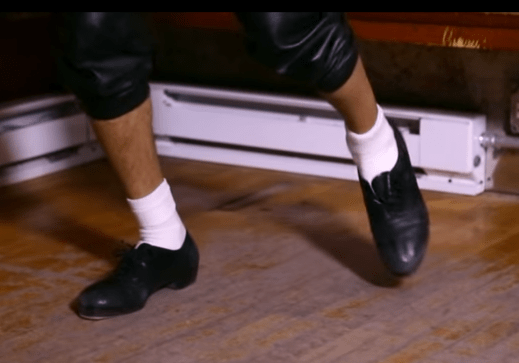
I don’t worry about the look of it so much. Choreography comes later, when I’m putting together a piece. I’m into the sound; for me, when I’m hittin’, layin’ it down, it’s all about the sound. –Savion Glover, My Life in Tap
It has been a little over a year since Amiri Baraka passed, and still I hear the echoes of his presence. I am especially attentive to the ways his work has been carried on by those involved in recent black uprisings in Ferguson, New York City, and Baltimore. Powerful political poetics that have emerged from these events include work by Danez Smith, Claudia Rankine and the many contributors to blackpoetsspeakouttumblr.com.
And yet, part of what I’ve witnessed in the streets, actual physical spaces of public protest against police violence and systemic racial oppression, is an example of what Thomas DeFrantz has termed “corporeal orature,” or the ability of bodies to resonate throughout public space and shift political discourse. In these moments, the body talk of protesters is not simply the sound of clattering feet through city streets, but a commitment to the ways in which physical gestures can speak truth to power. I am especially interested in connecting Baraka’s legacy to the larger conversation about the aural kinesthetic that Imani Kai Johnson has proposed, and in teasing out the various dimensions and potentials embedded in that category.
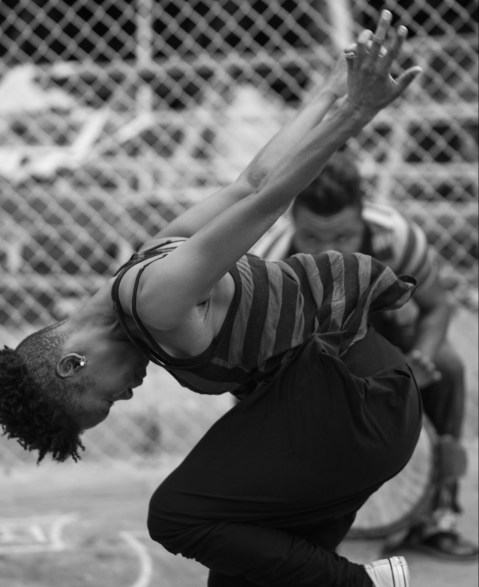
Dance at Ferguson Protests, 2014, Image by Shawn Semmler
For me, Savion Glover exemplified the lingering sound of Baraka’s spirit in his tap dance at his memorial service. Whenever I listen to the recording—which still brings tears to my eyes—I am reminded of the abundant sense of joy, sadness, and love that characterized Baraka’s service. Listening to Glover’s dance is an aural kinesthetic experience, like watching a comet pass across the night’s sky. I am reminded, too, of the way I clamored to record that moment, to keep a piece of the poet alive on my iPhone even after his public passing. And indeed, that performative sound of feet tapping, that measured excess of the body produced through movement, has kept Baraka alive for me; like his groundbreaking work, it is powerfully resistant to the proper rubrics of any one discipline except, perhaps for the study of sound itself.
So, this post then, is about tap dance and its ability to sound out Baraka’s name and life. But in a larger context, the intricate vibrations of Glover’s performance facilitate a deeper understanding of the relationship between sound and mourning, and a kind of mourning that is particularly African American, that is to say, American. It is a mourning that exists beyond the word, written text, or image and a sound practice that enables the bereaved to make a joyful noise and a mournful one at the very same time. So I ask, how do you write a eulogy with the body? How do you perform an embodied love? What does Black love and a reverence for Black life sound like? Sometimes, the answer is tap.
Audio Clip of Savion Glover’s Dance at Amiri Baraka’s Funeral, 18 Jan 2014
The dance explodes on stage like a burst of light. It begins with something approximating a drum roll – and then hard slow taps, hammering away like someone at a typewriter, I imagine, or a train gaining steam.
It is coming.
Slow, insistent and strong, with a little riff now and then, a little picking up of speed here and there. It is coming on louder now, that explosive thing, the tension you are noticing. He is doing the thing. And then there is that skillful, smooth, strong tap. Glover is at work, y’all.

Savion Glover at Work, Image by Flickr Users Raquel and Soren
As a tribute to Baraka, Glover’s dance bears numerous stylistic implications. Among them, I understand the rhythm of Glover’s tap as the rhythm of writing, an aesthetic that complicates the way his dance can be understood as a manifestation of the black vernacular. Sketching out the early connections between her son’s artistry and the percussive taps of the keyboard, Yvette Glover says. “‘I was working for a judge, as an assistant, when I was pregnant with Savion…And when I would type, and the carriage would automatically return, he’d walk, he’d follow it, in my stomach. You could see him move” (39). He does it still. In the audio clip, Glover’s footwork evokes the dexterity of Baraka’s language, all the while telling a story of its own.
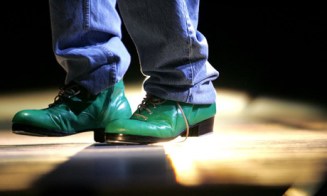
Savion Glover’s Shoes, Sadler’s Wells, 2007, Image by Tristram Kenton
But what about the intensity of the dance, its crescendo toward the end of the service, a flurry of percussive steps beside Baraka’s coffin? Baraka himself reminds us this particular musicality is so necessary here. In his discussion of “Afro-Christian Music and Religion” in Blues People, Baraka notes that in Black diasporic religious services, “the spirit will not descend without a song” (41). Glover’s dance takes place at a moment in the service when emotion exceeds the power of language, but not sound. He uses his body as an instrument of sound in its fullest sense. His performance is a choreography of embodied sound: full-on and at-once body poetry, mourning and tribute.
Elucidating the use of his body as an instrument of sound, Glover declares:
It’s like my feet are the drums and my shoes are the sticks[…]My left heel is stronger, for some reason, than my right; it’s my bass drum. My right heel is like the floor tom-tom. I can get a snare out of my right toe, a whip sound, not putting it down on the floor hard, but kind of whipping the floor with it. It get the sounds of a top tom-tom from the balls of my feet. The hi-hat is a sneaky one. I do it with a slight toe lift, either foot, so like a drummer, I can slip it in there anytime. And if I want cymbals, crash crash, that’s landing flat, both feet, full strength on the floor, full weight on both feet. That’s the cymbals. So I’ve got a whole drum set down there (19).
Combining his body’s drumbeat with the tic of Baraka’s keystrokes, Glover embeds the pattern of Baraka’s life in this tap dance, communicating it with the kind of deep and reverential love you are taught to have for your elders when you are young, appropriate and deep.
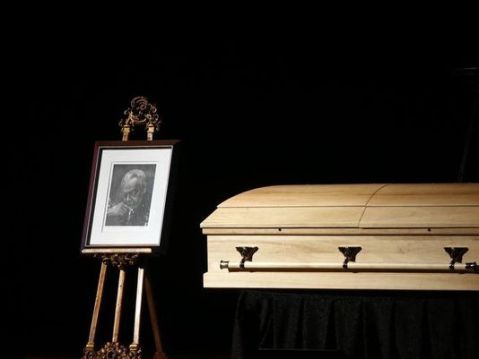 But as powerful as his body-poetry is, Glover’s silences are also key. In those inaudible spaces, Glover spreads out his arms, offering up the dance in a gesture of expansive love; the immensity of the silent gestures mirroring the immensity of Baraka’s life. He holds it out as a gift towards the audience, bows his head, too.
In moments of sound and silence, the audience calls out to Glover the way they would a preacher. At these moments, the dance becomes a call and response akin to the way Baraka’s life’s work was a call and response. A call to respond. A call to take what was given to you and make it mean. Listeners to the dance are called up out of themselves. We are changed by the dance and by the listening.
Tap tap tap.
Glover’s performance shows us how his specific blend of African and European dance traditions exists in a spiritual and artistic dimension. There is a religious explanation for this, too. In African Dance, Kariamu Welsh-Asante explains the function of the African funeral dance in definite terms:
All African dances can be used for transcendence and transformational purposes. Transcendence is the term usually associated with possession and trance. Dance is the conduit for transcendent activities. Dance enables an initiate or practitioner to progress or travel through several altered states, thereby achieving communication with an ancestor to deity and receiving valuable information that he/she can relate back to the community. Repetition is key to this process as it guides the initiates, or dancers, through the process of the ceremony. The more a movement is repeated, the greater the level of intensity and the closer a dancer gets to the designated deity or ancestor. Transformation means to change from one state, or phase, to another (16).
Glover certainly brought us close to Baraka. And yet, I would go a step further to suggest that this is, above all, blues dance. As such, it reveals continuing relevance of social dance and movement to Baraka’s political legacy. Baraka and Glover work directs us towards the propulsive nature of black social/percussive dance forms. These sonic gestures clarify the ways black life matters, impacts the public sphere and policy. The politicized nature of Black Arts Movement performances and the performative elements of contemporary Black protest are still linked through sound. Politicized Black aesthetics continue to offer us multiple opportunities to witness the convergence of sound and movement. Ras Baraka, affirms this in his own eulogy for his father:
Have you seen black fire it burns deep it never goes out you can try and extinguish it but it never goes out it never goes out it never goes out only up or out as in broad as in multiply as in blues black base of the fire dancing flickering at times but never all the way gone dancing flickering at times but never all the way gone…
The power of the dance, of the Black Movement to move is still with us.

Protestors dance to a community band, Baltimore, MD, 28 April 2015, Photo by Adrees Latif/Reuters
—
Featured Image, Screen Capture of Savion Glover dancing by JS
—
Kristin Moriah is the editor of Black Writers and the Left (Cambridge Scholars Press, 2013) and the co-editor of Adrienne Rich: Teaching at CUNY, 1968-1974 (Lost & Found: The CUNY Poetics Document Initiative, 2014). Her critical work can be found in Callaloo, Theater Journal, TDR and Understanding Blackness Through Performance (Palgrave Macmillan, 2013). Moriah is completing a dissertation on African American literature and performance in transnational contexts at the CUNY Graduate Center. Her research has been funded through grants from the Social Science and Humanities Council of Canada, the Freie Universität Berlin and the Graduate Center’s Advanced Research Collaborative. She is a 2014-15 @IRADAC_GC Archival Dissertation Fellow and spring 2015 Scholar-in-Residence at the NYPL Schomburg Center for Research in Black Culture. Sometimes she tweets via @moriahgirl.
—
REWIND! . . .If you liked this post, you may also dig:
“HOW YOU SOUND??”: The Poet’s Voice, Aura, and the Challenge of Listening to Poetry-John Hyland
Pretty, Fast, and Loud: The Audible Ali–Tara Betts
The Sounds of Anti-Anti-Essentialism: Listening to Black Consciousness in the Classroom-Carter Mathes
Share this:


Current Top Posts





April 2021

January 2020

November 2019

October 2019

August 2019

April 2014

November 2017

March 2015

December 2017

October 2015
 Sounding Out!
Recent Comments