
I Hear You, I See You
(The title of this post comes from an episode from Season Two of NBC’s Parenthood; Zeke, the patriarch, learns in marriage counseling that he must listen to his wife and let her know he is listening.)
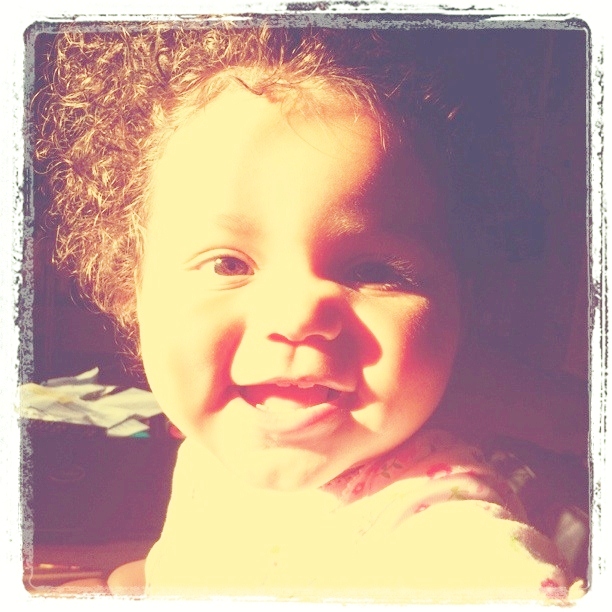 Since she was in the womb I’ve recorded Miss E’s sounds. I’ve posted before about my experience listening to her heartbeat at every obstetrician appointment. Late in my pregnancy I managed to record her heartbeat. I still play it and replay it in amazement; those beats were a sign of the life growing inside of me. I felt like I was eavesdropping on her every time we tuned in. It was sonic peeking. After she was born, I wanted to continue recording the sounds she made because I wanted to have recordings as well as pictures for her when she grew up.
For the past eleven months I’ve recorded my daughter’s sounds at different stages with my iPhone (as I’ve mentioned in my latest KC post, my iPhone is my preferred recording device if only because it is always within reach). I record when I remember, or when she adds a new sound to her repertoire. However, I try to record her once a month. The same way that she has gone from not moving at all to crawling all over our apartment, she has gone from not making any sounds to babbling, squeeling, and laughing. The sounds she makes are an indication of development, but they are also a sign of her awareness of the world around her.
As a first-time mom, I expected a lot of things early on. I didn’t understand why she held her fists closed for the first few weeks or why she didn’t follow me around the room. It almost felt like she was ignoring me. The same thing happened with her sounds. The fact that she didn’t respond to my words with sounds worried me. I always wondered if she was sad! And it’s no wonder: all she would do was cry. Of course, I realized soon after that her crying was her only way of communicating with the world. One of my first recordings of Miss E is of her shrill crying, and it still makes my chest tighten up when I hear it.
My second recording is of her at three months. By this point the cries have morphed into more of a grunt. As I typed this post I listened to my recordings, and it’s remarkable how inarticulate she sounds compared to what she sounds like now. But back then, I was excited that she was making more sounds other than crying. Indeed, the fact that she wasn’t always crying was a relief. These new sounds, to me, were her attempt at trying to communicate, or rather discovering ways to communicate. It’s almost as if she had discovered that she had a voice. The silences talked as much as the sounds, for at this stage she spends more time awake (and more time awake without crying).
As Miss E has grown throughout this first year, her sounds have started to vary. Very much like a language, she has different registers, different sounds depending on what she wants to say. Whereas before she would only give me a smile when she woke up, now she provides me with a running commentary on her dreams and her giraffe while I change her diaper. Even her giggles developed different registers. She had different kinds of giggles! Now she makes sounds on her own, not as a response to something I had done but because there is something she wants to respond to. I read in her babbles the beginning of her path to independence. it’s a long way until she moves out of our household, but the fact that she wants to talk to other people or talk about what she wants, and not in response to what I am saying or doing is amazing. It’s also a little sad, for it’s also an indication of her willingness to move on to other things.
We tend to forget that during that first year babies have little interest in interacting with people outside of their nuclear family. They stare at strangers or shy away. But the moment they start talking to themselves or their toys, you are no longer the center of their world. And it’s a bone-chilling thought.
Recording her sounds is important to me just as much as taking pictures. (I don’t take video of her mostly because we didn’t have any way to do that until recently when I updated my phone to an iPhone 4). I wanted her to have visuals as well as audio, and even though video recordings could do just as well, the effect of just listening to sounds and being able to focus on that is an interesting (if jarring) experience. Those sound recordings trigger memories just as vividly as pictures do, or even more so than pictures. I hope to keep these recordings until she is older so that she can see herself as well as hear herself when she was just a little girl. I want to know that “I hear you, I see you,” that hearing is just as relevant as seeing.
Bonus tracks: Here’s Miss E at several stages in the last year.
Miss E at 3 months (trying to get Mommy’s attention)
Miss E at 10 months (banging and making music)


Share this:

From Illegitimate to Illmatic: On Tiger Mothers, Ethnoburbs, and Playing the Violin While Dreaming of Nas
“Don’t tell me you’re still listening to that shit.”
“I told you, I like it.”
“This is why we have so much trouble with you.”
“You don’t know anything about it.”
“Listen to that cursing…it’s nothing but garbage!”
“What are you doing?”
“All of these CDs are going in the basement. No more rap until you start listening to your parents! Now, go practice your violin!”
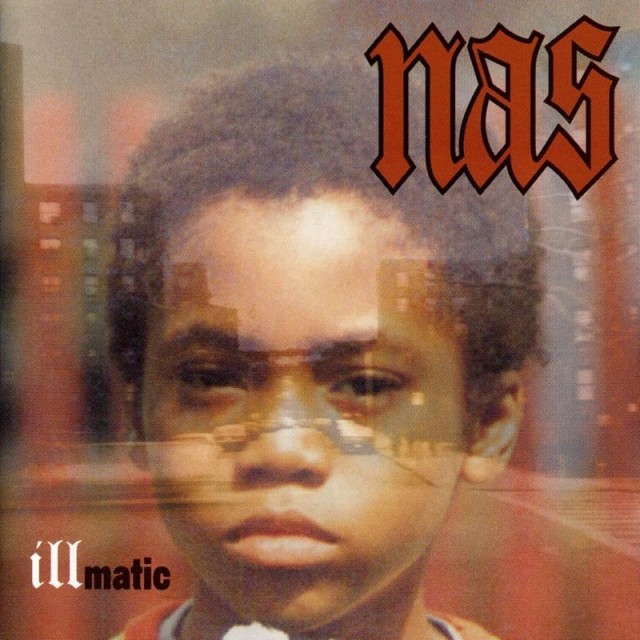
Growing up, exchanges like these were common between my Korean American mother and me—a multiracial Korean Euro-American. In her eyes, there was no such thing as enough violin practice. Rap—the vulgarity! The noise! It was turning me into a juvenile delinquent! She was convinced I had it in me to be the next Korean-American classical music virtuoso, the next Sarah Chang—if only I would practice more scales and stop trying to imitate “black men shouting.” (However “conversational” the rap world considered Nas’s flow, my mother still heard yelling.)
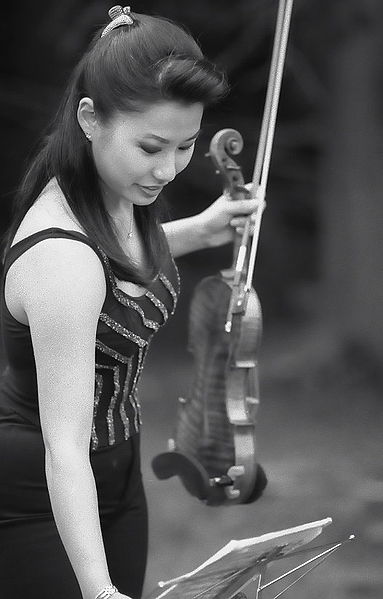
Violinist, Sarah Chang
It’s not that I didn’t like classical music—I watched Amadeus on loop until the VHS squealed—but my mother, like the mothers of most all my Asian friends, insisted on it consuming a fairly large chunk of my life. While immensely diverse in its makeup, most of the Asian population where I lived was either Korean or Chinese, and were forced by their parents to learn violin, piano or cello. Not only was it criminal to play an instrument other than one of these; but, whichever one (or two) you chose, you had better be the best at it.
Author and Yale Law Professor, Amy Chua, recently incited an online firestorm when the Wall Street Journal published an excerpt from hercontroversial new memoir, Battle Hymn of the Tiger Mother, in which she recounts calling her daughters “worthless” and “garbage” if they couldn’t perform a piece of classical music up to her exacting standards. University of Hawai’i at Manoa Professor, Mari Yoshihara’s study, Musicians from a Different Shore: Asians and Asian Americans in Classical Music(2008) describes similar instances of “tiger mothering,” such as virtuoso violinist, Midori Goto’s, mother, Setsu Goto, who (it was rumored) was so strict that it forced Midori into a mental breakdown and an eating disorder. Many would likely agree that “Tiger Mothering” such as this is morally questionable (and in some cases abusive), but I should note that instances like these are only part of a much bigger picture. Scores of students and performers would no doubt concur with Dr. O’C’s recent SO! account of the potential for classical music praxis to have ameliorative effects. Despite this, however, classical music training seems to have become a central tenet of “Tiger Mother” methodology. In all the kerfluffle over Chua’s book, no one has been asking the most foundational question: Why is it so important to Asians and Asian Americans that their children play classical music?
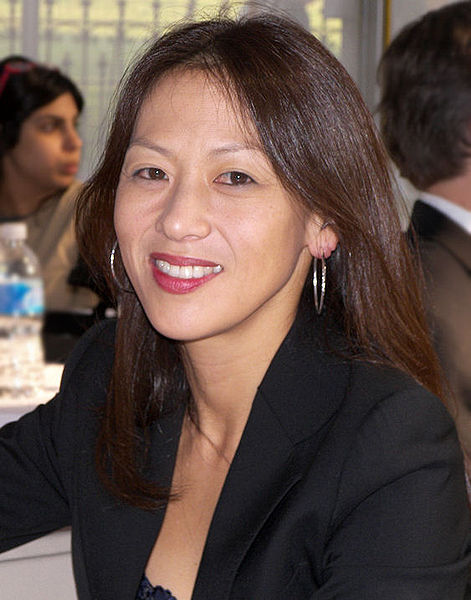
Amy Chua, (CC) Larry D. Moore
In a recent interview on why she chose classical violin and piano for her children, Chua fancifully suggests that classical music is the antidote to materialism. She says that “classical music all about depth” and calls the violin and piano “very respectable instruments.” Indicative of more than just a love of classical music, Chua’s statements imply that other forms of music lack comparable artistic value and require less cultivation to perform and enjoy. In a similar vein, the Asian-descent classical musicians interviewed in Yoshihara’s Musicians From a Different Shore divulge their belief that playing classical music anchors one to a high social stratum. Acknowledging the contradiction between classical music’s high cultural status and its mostly poor compensation, the musicians identified social factors such as educational attainment and musical taste and ability as more important determining factors of class standing than income. Yoshihara thus links the importance Asians and Asian Americans place on classical music praxis to class consciousness and the production of cultural capital.
Class consciousness no doubt accounts for some of the zealousness exhibited by Tiger Mothers with regard to their children’s classical music training, but it’s not the only thing that keeps them roaring. Chua’s Battle Hymn illustrates that, in addition to class consciousness, the pressure to study classical music stems from an intra-racial expectation to perform Asianness adequately. Chapter 5 of Chua’s memoir, titled, “On Generational Decline,” is her cut-and-dried summarization of how subsequent generations of Chinese Americans become lazier as they’re allowed to revel in the comforts of middle class life. Chua chooses classical music for her children because it is “the opposite of decline, the opposite of laziness, vulgarity, and spoiledness.” Constructed as an appeal to Chinese Americans, Chua essentially argues that classical music training is key to an Asian person’s cultural and racial legitimacy. Unwilling to relinquish “the high cultural tradition of [her] ancient ancestors,” she expects her children to uphold a racially and culturally endorsed standard of melody-making that reinforces Asian gender norms and encourages other Asian parents to do the same.

One of Ellicott City’s Korean Shopping Plazas, photo by Barbara Fisher
In Ellicott City, Maryland, the wealthy, culturally diverse “Ethnoburb” of Baltimore where I grew up, Asian American classical musicians abound and Asian American rappers are few. Here, (where the community-wide motto is “Choose Civility”) Asian youth gained a sort of “cred” for mastering the violin or piano, and this pressure to “prove” oneself along racial lines was something I always felt—particularly as a teen of mixed race. It was probably the biggest reason why I didn’t quit the violin until I graduated from high school. I hated it, but resentfully continued attending orchestra and private lessons in the fear that I would lose the meager amount of “cred” I’d built up. It hardly mattered, though. There was no chance of me getting into an Ivy League school or playing Carnegie Hall—I listened to rap and sometimes didn’t do my homework. In short, I would never be a “Super Asian” (a term coined by my Indian music stand partner and me), and as any Asian kid knows, if you’re not the best, you needn’t bother trying. None of the “Super Asians” had any interest in rap, and one even joked that I was a “chocolate-filled twinkie” for wearing a Pelle Pelle jacket to practice one week.
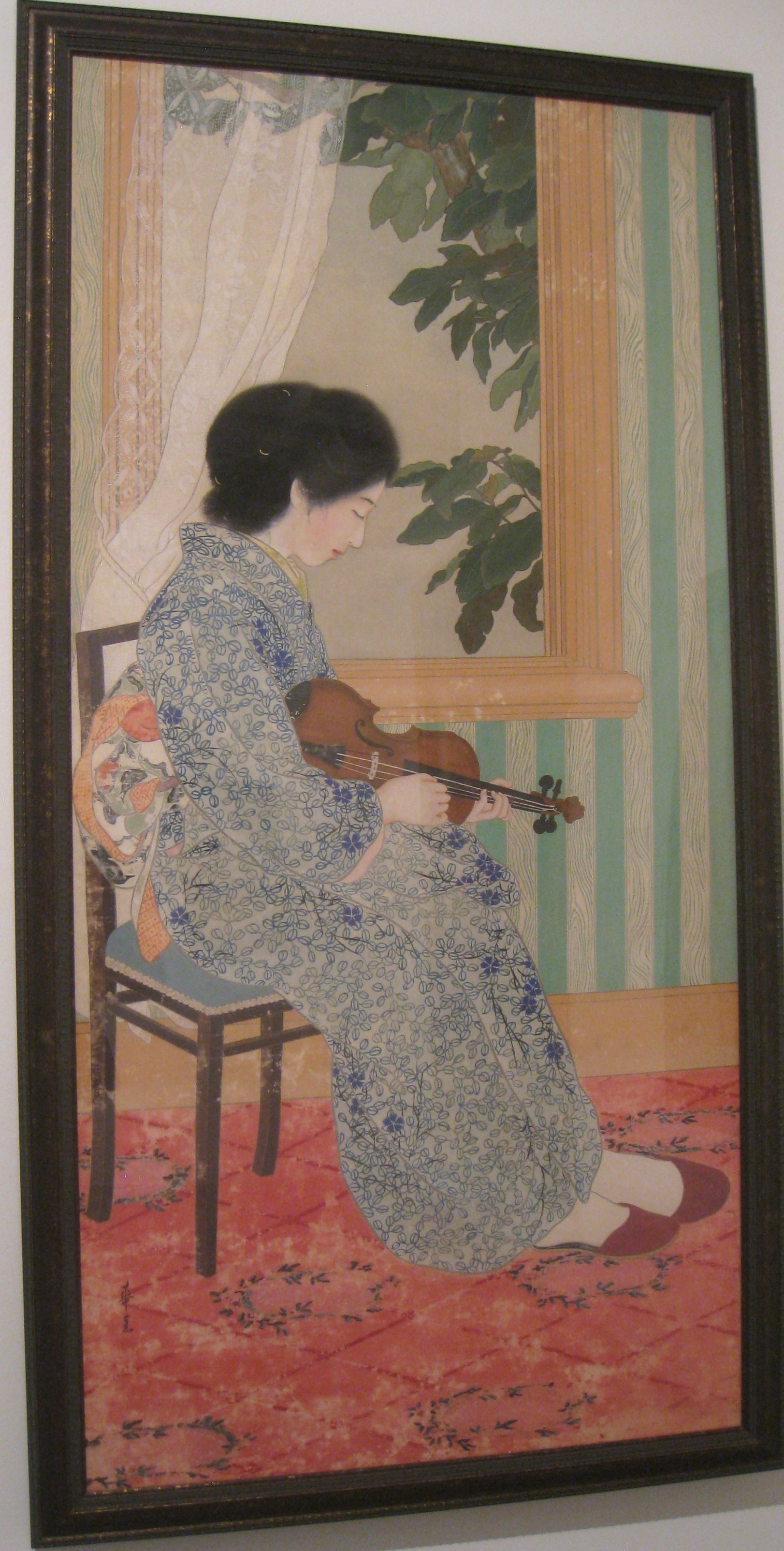
Wolfosonian Museum, Unknown Artist
People who looked like Sarah Chang were supposed to be in the business of making melodies, not rhymes. Chang performing a violin concerto is a comforting scene, a sonic image that reaffirms a familiar cultural narrative of femininity and class stature associated with Asianness in the US. A result of the gradual process of East Asian modernization (instigated by Western Imperialism), classical music was initially adopted by the people at the behest of the state, eventually becoming a integral part of middle class life in East Asia and a social marker of bourgeois womanhood that functioned to situate women vis à vis the domicile. Uncomfortable defining myself in this way (and feeling, also, that I never truly could), I gravitated towards something more “disruptive” that would allow me to show a different face to the world.
Rap became a vehicle for me to explain myself in more hybrid terms. On drives into Baltimore City, I heard it bellowing from the windows of the West Side’s crumbling row homes. The loud, curt, interjections! The spontaneity and candor! This loudness was initially what drew me in, but eventually I realized that rap had just as much profundity as anything classical you could throw at it. Listening to rap, I was finally on offense. It was a medium that spoke to me, because it made me feel capable of speaking back. And there was an entire legion of disaffected youth who seemed to feel the same way.
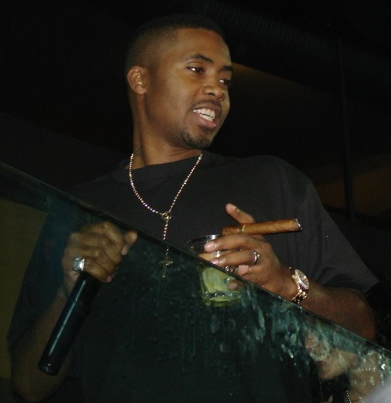
Nas performing in 2007
Despite this popularity, however, critics of rap maintain that the sounds that (predominately African American) rappers produce are nothing more than “noise.” In Black Noise, Tricia Rose observes that despite (and perhaps because of) rap’s widespread popularity and cultural relevance, it is often pitted as classical music’s polar-opposite—“unintelligible yet aggressive sound that disrupt[s the] familial domain” (63). Against charges that rap lacks “depth,” purveyors of hip hop (despite their hefty salaries) often accrue little to no widespread artistic acclaim. Evidence of what Jennifer Stoever-Ackerman terms the “sonic color-line,” this demotion and “Othering” of non-white sounds into “noise” (discussed further in her recent SO! post) has historically functioned to both generate and underwrite public attitudes about race, class and gender and to create dominant ideas about listening that she dubs “the listening ear.”
It seems that dominant modes of listening have everything figured out. If you look like this, you sound like that. But, what about people who look like me? What are we supposed to sound like? With which sonic cultural productions am I supposed to ally myself, and do I have a choice in the matter? How does “the listening ear” interpret a biracial Korean Euro-American or any person of mixed race heritage? Was there a distinction to be heard? I was sure there was, but didn’t quite know how to voice it.
For most of my life I have lived on the precipice of Asianness and something else, leaving me to feel—at times—confused, demoralized and illegitimate. As Michael Omi and Howard Winant famously note in their seminal work, Racial Formation, “Without a racial identity [in America], one is in danger of having no identity.” Acutely aware of my difference, I searched for ways of being heard as a multiracial subject in a fiercely stratified, race-conscious society. In the Introduction to The Sum of Our Parts: Mixed-Heritage Asian Americans, Michael Omi notes that within the historical and political context of the United States, (the “one-drop rule,” eugenic fears of racial intermixing, anti-miscegenation laws, etc.) multiracial identities have consistently been “contained, disregarded, [and] denied.” Disruptive to fixed notions about race, it is often a challenge for multiracial subjects to be recognized or understood by the state or the ear.
Rap assisted me in my effort to be heard as a multiracial person. While my Asian friends in All-State Orchestra were polishing their four-octave chromatic scales for the judging panel at Julliard, I was conscientiously studying Rakim’s flow and the RZA’s beats, hoping that one day it might make sense for me to show my face at a rap battle, if only as an observer. After the realization that Nas wasn’t the reason I could never be a “Super Asian,” my mom returned my copy of his masterpiece debut, Illmatic. As previously, I spent the hours before bedtime reciting the lyrics to Nasty classics like “It Ain’t Hard to Tell,” moved by every skillful turn of phrase: “Nas is like the Afrocentric Asian/half man-half amazin,” I would repeat over and over until I got the cadences just right. Whatever the hell he was talking about, I was sure it applied to me.


Share this:


Current Top Posts





April 2021

January 2020

November 2019

October 2019

August 2019

April 2014

November 2017

March 2015

December 2017

October 2015
 Sounding Out!
Recent Comments