
Pretty, Fast, and Loud: The Audible Ali

 Aaaaaaaaaaaaand NOW. . .in SO!‘s corner. . .writing for this month’s “Sound and Sport,” we have the scholar. . .the poet . . .the “Wordsmith of the Web” Taaaaaaaaaara Betts! In today’s post, she shares how listening influences her creative process AND knocks us out with an analysis of the importance of Muhammad Ali’s voice to his sports career and historical legacy. For an instant replay of last month’s post, click Melissa Helquist‘s “Goalball: Sport, Silence, and Spectatorship.” Next month’s rematch will feature Josh Ottum‘s research on sound and skateparks. But now, let’s get ready to ruuuuuuuummmbbble! —J. Stoever-Ackerman, Editor-in-Chief
Plap of glove against glove
Shush of scuffle and slide.
Rebuildin’, repeatin’, rebuildin’
All this repeatin’, getting’ up again & again
Discipline, routine and I keep
doing new things to prepare
my mind, my body, so my pretty
mouth keeps up with all my rhymes.
–Tara Betts, from “Repeatin’” (scene 8, The GREATEST!)
The recent Peggy Choy Dance Company production of “The GREATEST!: A Hip Dance Homage to Muhammad Ali” in April 2013 gave me cause to rethink the key events in Muhammad Ali’s life, particularly his burgeoning political awareness in the 1960s. As I wrote the libretto for the performance—which combined athletic dance performance with images, poems, and quotes from Ali—I kept thinking about how Ali had one of the most recognized, quoted, and distinct voices ever heard in the boxing world.
 In the libretto, I tried to capture the nuances of black vernacular and the southern hallmark of Ali’s hometown, Louisville, Kentucky (he was sometimes referred to as the “Louisville Lip”), vocal sounds that signify an African American experience. Is there a southern drawl? A bass-filled bravado? There are certain words that sound fuller and cut short based on the vernacular that was spoken during the time period of Cassius Clay and well into his evolution as Muhammad Ali. While many of the materials that I visited for inspiration and historical context were books, to capture the look, feel, and speech of the 1960s and 1970s, I had to crate-dig for some vinyl.
A copy of a 1963 spoken word album I Am The Greatest!: Cassius Clay and the 1997 documentary film When We Were Kings served as two such sources. Both recordings represent an audible Ali, at once a man whose iconic voice sounded as familiar to me as people who I’ve known personally and a historical figure whose vocal grain content embodied his shifts in political consciousness. The difference between Clay’s 1964 recording and the samples woven into the When We Were Kings soundtrack is more than the changes that gradually developed over time. These recordings reveal how Ali’s confidence is constructed around creating an affirming, critical identity, rather than merely promoting his athletic prowess. At first, he merely sounds cocky; later he sounds as if he is fighting for a group of people that he wants to inform, serve, celebrate, protect, and uphold. My libretto was deeply impacted both by the sonic continuities in Ali’s voice across time and space, as well as its audible shifts.
The champ ain’t nobody but me!
Pretty, fast & loud, I’ll shake the world,
with a lion’s might.
My children will lift
their fists and fight
–Tara Betts, from “‘By Any Means necessary: If they met in Harlem’’” (transition from scene 14, The GREATEST!)
Before Cassius Clay joined the Nation of Islam and changed his name to Muhammad Ali, he recorded a spoken word album on the Sony label in 1963. I Am The Greatest! was released in 1964 before Clay’s two key fights with Sonny Liston and Ali’s eventual victory for the heavyweight crown. The album included original liner notes from modernist poet Marianne Moore and New York Post sports journalist Milton Gross, but it was telling that comedy writer Gary Belkin and Cassius Clay were the co-authors of the spoken word material—which is more comedy than poetry or interviews. Belkin was a comedy writer for well-known comedians such as Carol Burnett and Sid Caesar, and the comedy show Car 54, Where Are You? So, Belkin was clearly accustomed to writing sketch comedy, but Clay was used to being humorous outside of a recording studio with a staged audience.

Overall, Clay’s delivery seems to be slower–both less fluid and more staged– than his impromptu recitations at boxing-related events outside the recording studio. Clay seems to anticipate that sound effects such as roaring crowds and clanging bells will be inserted into the tracks, so he over-enunciates and pauses. Each track begins with a bell ringing as if boxing round is about to begin, and there are eight “rounds,” probably because Clay insisted that any fight with Liston would be shorter than eight rounds. As I listened, I wondered if Ali was comfortable recording this album or if he considered it simply another way to promote and market one of the world’s best known boxers? To my ear, it lacked some of the speed and ease I associate with Clay’s speech in other settings. In the boxing world, his speeches mentally challenged his opponents and entertained crowds. The recording studio left less room for spontaneity, fluidity, and even the visual interplay of sound with his quick motion.

Cassius Clay in the studio recording I Am the Greatest! with Sam Cooke, Image from newblackman.blogspot, courtesy of Michael Ochs Archives/Getty Images
The eight rounds/comedic sketches lean heavily on Ali’s signature boisterous braggadocio in his loud, deliberate voice, using canned laughter and other voices setting up Clay to talk about his excellence. Otherwise, they are a grab bag of influences and sound effects. These other voices and sounds create an artificial environment that is not the same as being surrounded by boxers, trainers, and others in the athletic arena. In fact, these sounds and the sources sound quite different from Clay himself. “Round 1: I Am The Greatest” and “Round 2: I Am The Double Greatest” are accompanied by violins that sound more like a serenade than a classical composition. In “Round 4: ‘I Have Written A Drama,’ He Said Playfully,” a lute plays in the beginning that hints at a spoof of a Shakespearean-style drama about defeating dragons complete with affected British accents, including one actor speaking with the theatrical lisp. The knight “Cassius of Clay” enters with the audible clanking of armor.
Clay reveals a shift in tone when he sings on the last two tracks. He begins with “Stand By Me”–a cover of Ben E. King’s classic song/then recent hit–with fervor. In the last song, “The Gang’s All Here,” Clay follows some of the words of Tin Pan Alley lyricist Theodora Morse set to Sullivan’s tune from Pirates of Penzance.
Clay tries to pick up the energy lost by his less-than-enthusiastic singing. “Is Memphis with me? Is Louisville with me? Is Houston with me. Ain’t I purty?” Each question is answered with a crowd enthusiastically shouting a “Yeah!” Here Ali relies on his enthusiastic, improvised rhymes, departing from the song’s traditional lyrics to include himself in a song that does not come from an African American writer or the Black experience.
The same country that refuses to let people eat
or use the bathroom in the same places
wants ME to go and get killed?
What does THAT sound like?
—-Tara Betts, from “The Same Country” (scene 15, The GREATEST!)
Almost 35 years later, there are clear sonic differences between Cassius Clay’s debut on Sony and the soundtrack to When We Were Kings, the 1997 documentary of the 1974 heavyweight championship between George Foreman and Muhammad Ali. This retrospective record is decidedly more centered on black experiences and black voices that speak musically, politically, and spiritually, particularly about the Black presence in Islam. There are no comedic monologues, sketches or Greek choruses; it sonically represents Ali after his conversion to orthodox Islam, after his friendship with and separation from Malcolm X, and after his opposition to Vietnam. Every spoken part on this album affirms the multiplicities of a Black presence in blues, R&B, and songs recorded live on the African continent; the huffs and rhymes are cheered for by a live African audience. As I listened to When We Were Kings, I could hear Ali’s comfort and his freedom of movement, audibly in contrast with his other album.

When We Were Kings records his time in Kinshasa, Zaire where he trains and eventually fights George Foreman. It does not simply focus on Ali’s voice, but is sonically rich with music, interviews with people who witnessed that fight and those who knew Ali personally; the soundtrack reflects these interconnections in its continuous uninterrupted flow. The role of these sounds endeavors to document what was heard in Zaire in 1974, but it also includes Ali in the surrounding sonic environment as one person who becomes a focal point for the musicians and speakers who also articulate black identity on the record.
The first thing I heard was Ali’s voice:
I’m gonna fight for the prestige, not for me, but to uplift my little brothers who are sleeping on concrete floors today in America, black people who are living on welfare, black people who can’t eat, black people who don’t know no knowledge of themselves, black people who don’t have no future. I want win my title and walk down the alleys and sit on the garbage cans with the wineheads…
This opening sample of Ali sets the soundtrack’s tone, and kicks off the only hip hop song on the album, a sonic shift that signals a new generation/genre in black music in 1997, more than 30 years after Ali’s spoken word album as Cassius Clay. Ali’s quote also informs listeners that the emphasis of this album has little do with comedy, especially since the soundtrack draws from nonfiction, rather than setting Clay/Ali in fictionalized sketches. The focus is on black people and their struggles.
In the first song, emcees look back and tell the story of “The Rumble in the Jungle” but the verses also hail Ali as a hero. When The Fugees, A Tribe Called Quest, and Busta Rhymes rap over a fairly standard bassline, their presence on this soundtrack is an important signal of Ali’s influence and the recurring engagement between artists and Ali during his athletic heyday such as James Brown. In Jeff Chang’s Can’t Stop, Won’t Stop (2005), Afrika Bambaataa points out repeatedly how Brown became a consistent presence in hip hop when New York radio stations simply refused to play his music, particularly in the 1970s. After decades of infusing a variety of soul singers and Brown’s stylistic turns on “the one” and messages of black pride into the genre of hip hop, the presence of “The Rumble in the Jungle” on this soundtrack completely makes sense. As more than a wellspring for samples throughout the large, growing body of hip hop music, Brown was also embodying and representing black consciousness in music with a Black voice, much in the same way that Ali utilized Black speech. In some ways, Ali’s couplets predate rap lyrics and perform in a similar manner; Bambaattaa cites him as an influence, along with Malcolm X.
James Brown and many others flow seamlessly into the event and its soundtrack in a way that reflects the immediacy and proximity of these events. The “Black Woodstock” of the Zaire 1974 music festival that accompanied Ali and Foreman’s fight set the tone and soundtrack in real life, not just in the documentary. In fact, the festival itself was documented in the 2008 release Soul Power directed by Jeff Levy-Hinte. At this point, it’s clear that there is a continuum for hearing the connections between black voices across oceans and continents.
Following “Rumble in the Jungle,” the record samples Ali and Drew “Bundini” Brown (Ali’s assistant trainer and cornerman), snippets taken directly from the documentary footage. Brown is a slower, more deliberate speaker; he uses rhyme like Ali. He talks about the fruit returning to the root and Ali claiming his crown back home. For African Americans to return to Africa post-slavery, this trip and clip sonically reinforce the cultural significance of Ali’s trip. Such pilgrimages fortify the idea that black people have a homeland, a continent, and a cultural continuum, much in the same way that this soundtrack constructs.
“Ali, Bombaye!” in a sea of faces just like mine,
my brothers, my parents, my cousins.
I want to go home and tell the people
in the streets this is what we come from,
what we could be.
—-Tara Betts, from “The Hard Road to Zaire’” (scene 21, The GREATEST!)
When African girls chant to celebrate Ali’s arrival, they reassert how this is a homecoming for Ali, a welcome and a reconnection that fuels Ali’s determination. The chants seem to encourage the first sample of Ali when he issues his threat: “When I get to Africa we gon’ get it on cause we don’t get along. I’m gonna eat him up…” This sample segues into James Brown’s “The Payback” as it was performed before the fight, then another chant performed by Mobütu, named after Zaire’s controversial leader, Mobutu Sese Seko.
When Ali concludes the soundtrack, he interrupts chants of “Ali, Bombaye!” with huffs and a brief exhortation of knocking you out, “sucker.” These last words fade into a snippet of African chant. This constructs a very different narrative that looks back at Ali’s career, long after the younger Clay established part of his image with hyperbolic bravado. Ali has cultivated a Pan African, global, political awareness that includes black people in America from his hometown in Louisville, KY to across the globe.
Hearing Clay and Ali–their continuities and their differences–gave me an insight into the familiar voices of some of my older relatives (and their blues records), and it also helped me channel that voice in poems of my own. It allowed me to imagine how hyperbole helped encourage Ali to energize and cheer himself on, so much that others began rooting for him as well. It did not matter what arena he was in, Ali would use his voice, his fists, and his will to conquer it. As I wrote the libretto, I thought about how I might unearth that determination in a way that respectfully embodied his tone, cadence, vocabulary, and ebullience. One of the definitions of greatness relates to the defeat of time and distance, and in the words that I wrote about Ali, I found that listening to him, and hearing his significance grew over time, helped him transcend both.
Every mile, every turn of the rope brings
me closer to telling him he’s nothing.
I hate every minute of training,
but I say
Don’t quit.
Suffer now
and live your life
as a champion.
I am a myth, and a man,
of my own making.
–Tara Betts, from “The Hard Road to Zaire” (scene 21, The GREATEST!)
—
Tara Betts is the author of the poetry collection Arc and Hue, a Ph.D. candidate at Binghamton University, and a Cave Canem fellow. Tara’s poetry also appeared in Essence, Bum Rush the Page, Saul Williams’ CHORUS: A Literary Mixtape, VILLANELLES, both Spoken Word Revolution anthologies, and A Face to Meet the Faces: An Anthology of Contemporary Persona Poetry. Her research interests include African American literature, poetry, creative writing pedagogy, and most recently sound studies. In the 1990s, she co-founded and co-hosted WLUW 88.7FM’s “The Hip Hop Project” at Loyola University while writing for underground hip hop magazines, Black Radio Exclusive, The Source, and XXL. She is co-editor of Bop, Strut, and Dance, an anthology of Bop poems with Afaa M. Weaver. In April 2013, she published the libretto “THE GREATEST!: An Homage to Muhammad Ali” (Winged City Press) written for the live performance directed by Peggy Choy.
—
 REWIND! . . .If you liked this post, you may also dig:
They Do Not All Sound Alike: Sampling Kathleen Cleaver, Assata Shakur, and Angela Davis–Tara Betts
SO! LA: Sounding the California Story–Bridget Hoida
Freedom Back: Sounding Black Feminist History, Courtesy the Artists—Tavia Nyong’o
Share this:

Radical Listening and the People’s Microphony: A Conversation with Elana Mann
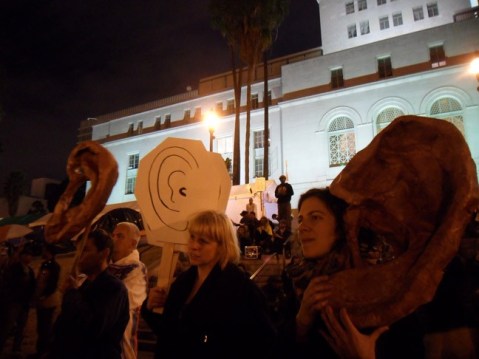
Members and collaborators of ARLA (Paula Cronan, Juliana Snapper, and Elana Mann) participating in a General Assembly at Occupy LA City Hall, November 11, 2011
Listen to everything all the time and remind yourself when you are not listening–Pauline Oliveros
“CAN YOU HEAR ME?!” “I CAN HEAR YOU!!” “IT’S A VAN GOGH PARADE!!” . . .were some of the enthusiastic replies when artist Elana Mann, musician Juliana Snapper, and other members of ARLA (Audile Receptives Los Angeles) arrived on the scene at Occupy LA with giant hand-made ears. Mann co-founded ARLA in the Spring of 2011 with Snapper, filmmaker Vera Brunner-Sung, and choreographer Kristen Smiarowski. After studying scores and techniques on listening developed by composer Pauline Oliveros, ARLA developed a workshop geared toward Occupy LA that included a listening parade in which they held up the giant ears and protest signs with ears on them. Snapper recalls, “The simple physical presence of people carrying large paper-mache ears was met with a kind of hungry recognition…recognition of what it meant that we were holding the symbols (giant ears).” They led workshops, listening sessions, and discussion groups. They performed Oliveros’ sonic meditation “Teach Yourself to Fly” and a composition written by Mann and Snapper entitled “People’s Microphony.” And a project was born. Through personal interviews and audio-visual examples, I document, contextualize, and analyze its work. 
Mp3=The People’s Microphony Camerata performing “Teach Yourself to Fly” Pauline Oliveros
I am happy that Elana Mann chose to use my Sonic Meditations for the People’s Microphony project. These pieces are meant for anyone that wants to perform them regardless of musical training.” –Pauline Oliveros
For Mann, active listening is “a process of tuning in simultaneously inward and outward. Active listening allows for an awareness of and an opening up to sounds around me and also a digestion of what is happening inside of me in relation to these sounds.” Much of the recent focus on this practice comes from the music and sound art worlds, as well as acoustic ecology, a field formed from the overlapping area between science and art that concentrates on the importance of experiencing and investigating our sonic surroundings with detailed care and respect to understand its importance on our world and our place within it. Mann’s work addresses a unique angle at the intersection of these fields: listening’s empathetic effect on those whom you are listening to, a consideration arising from a project she worked on between 2007-2010 with Iraq war veteran Captain Dylan Alexander Mack, called “Can’t Afford the Freeway.”
. “Can’t Afford the Freeway” highlights how her collaborations emerge as conversations between involved artists as well as the audience. Speaking to Mann about the project, she stated,Alex created some recordings for me and I kept listening to them over and over again trying to figure them out. I eventually produced more interviews with him and realized that he needed his story to be heard and I needed to try and understand his story. So I created a project in which I attempted to listen as best I could. Listening to his recordings made me feel close to him, but I also recognized that no matter how many times I heard his words they were still foreign to me. Still the very act of me struggling to listen was important for both of us, and I think this is true of many interpersonal/political and social situations. You can never experience what it is like to be someone else, but active listening opens up a space of empathy and connection. I also think we can see how a lack of active listening is affecting the political landscape in the United States so negatively, by producing a highly polarized and vitriolic environment.
And what about at Occupy LA?
At Occupy LA I was hopeful that there would be a place for listening to voices that had not been heard before and sometimes that happened. Other times people used the space for projecting, not receiving. I think that there needs to be strong voices making themselves heard, but I don’t want to lose the other part of that equation, which is those voices being quiet and listening to others, and themselves.

ARLA Ear Strengthening Workshop, Occupy LA site, November 11, 2011, Photo by Carol Cheh
Mann, thinking and researching about social, aesthetic, and political points of listening and voicing, felt there was something to be considered about the “radical receptivity and the core message of the OWS movement” and its global amplification of voices struggling to be heard. In the Spring of 2012, she formed The People’s Microphony Camerata with Snapper, a radical experimental choir based in Los Angeles exploring the process of the People’s Microphone. The exact history of the “People’s Microphone,” or “People’s Mic” is unclear, but its use in the Occupy Movement has already become iconic. Ted Sammons discusses the implications of the People’s Mic for communication in his October 2011 post, “‘I didn’t say look; I said listen’: The People’s Microphone, #OWS, and Beyond.” The human microphone is a way to deliver one person’s message to a large group of people in situations where amplification tools, such as bullhorns, are either not allowed or unavailable, or if the acoustics of a space distort amplification. The speaker calls, “mic check!” to alert their intentions. Those around them call back, “mic check!”, until the gathering understands something will be said. The speaker breaks their statement into short sentences, pausing to allow those around them, or the “first wave,” to repeat them in unison. They then pause for those further away, or the “second wave,” to repeat again…and so on until those in the back of the gathering have heard the statement.
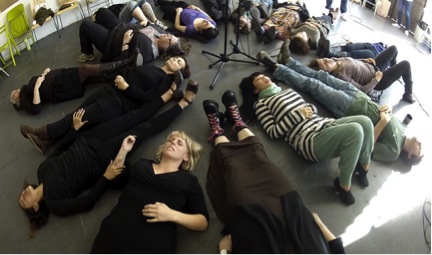
Members of People’s Microphony Camerata rehearsing in Los Angeles, April 15, 2012, Photo by Jean-Paul Leonard
The group’s trademark intensity sometimes carried over to the audience. Mann discovered such transference often had to do with prior associations with a location or context. Mann recalled a particular performance at the Occupy movement called “Chalkupy” that was formed in response to a protest running simultaneously with the LA Art Walk, in which activists had handed out chalk and told stories of police repression while chalk drawings were created on the walkways. The police shut down the art walk and a violent struggle ensued. The Occupy LA movement called for people globally to take to the street with chalk in protest, and the day was called “Chalkupy”. The audience of protestors was mixed and tense, and when the PMC began their performance of a highly emotive score called “Sob-Laugh” by Daniel Goode, people were either drawn to or repelled by the performance.
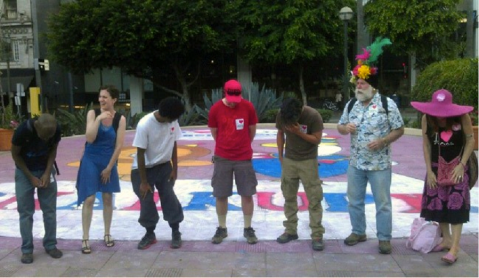
The PMC performing “Sob Laugh” at the “Chalkupy” protest in downtown Los Angeles, Image by Daniel Goode
I think there was some fear about the vulnerable revelation of emotions in the space of the protest. Many of the Occupy LA protests were so risky that everyone had to be extremely tough to exist in that activist space. I respect that. Still I think there are other things that can happen in a space of protest that bring out different feelings. Some activists wanted us to be more musically conventional, “why can’t you just sing some folk songs like normal protest choirs,” we were asked. But we really were not into that kind of thing. . .
In most protest situations, the audiences welcomed their activities. Many shared that it opened up a new space where people could meet each other as humans rather than adversaries or collaborators. Mann edited and published a monochromatic grassroots songbook with the various scores the PMC received for performance, opening up the circle for anyone and everyone to perform and feel that closeness.
Sometimes it was hard to translate a piece that worked during a group rehearsal to something for an audienceperformer situation. . .The PMC never fully developed how to deal with audience participation, but this is something I have been developing on my own in working with students on PMC materials. The scores from the People’s Microphony Songbook and the techniques Juliana and I developed when we first formed the PMC create an immediate closeness within a group, which is remarkable.

From the “People’s Microphony Songbook”: Many voices that were once silenced are now resonating through large crowds, not only of activists, but ordinary people all over the world, assisted by internet networks, and a simple technology called the People’s Microphone. The People’s Mic expressed the interrelated desires of collective and individual voices to speak and be heard, to hear one’s words spoken back through different mouths, and to digest someone else’s words through one’s own body. Beyond projecting an individual’s voice further then it can resonate on its own, the People’s Mic has implications for all of the bodies in its vicinity. It energizes listeners in ways the microphone or megaphone cannot by making listening active, vocal, and embodied. The project, like the Occupy movement, holds all the complexity, beauty, and drive of being human, whether you consider it “working” or not. When I asked Mann about how changes within and towards the Occupy Movement affected the choir, and whether they were winding down or taking a new form, she answered:
I think more than anything else, our group faced a lot of the same challenges that the Occupy Movement faced challenges in horizontality, in the push and pull between interior and exterior exploration, in the sometimes painful vulnerability of investigating the intimate personal and political space with others. I think the project is still developing. The choir still communicates, and some members are currently collaborating with composer Daniel Corral, but the PMC does not meet and rehearse like we used to I think it will continue to wax and wane. In the meantime, I am still working on ideas of active listening. I am currently creating a project called “Listening as (a) movement” within an under-served neighborhood in Pasadena, CA, exploring ideas of radical listening within a specific neighborhood.
In an age of constant bombardment of stimuli, our heads scream with thoughts, opinions, arguments, and expressions. With our current technology, our input and output can be a constant rush of snap reactions and impulses, which has a profound effect, of course, on our day-to-day lives, on our culture(s), on our politics. But these circles cannot be affectively complete without the other side. We need someone to hear us, and, more then that, we need someone to listen to us. And we, in turn, need to listen to them.
—
Maile Colbert is a multi-media artist with a concentration on sound and video who relocated from Los Angeles, US to Lisbon, Portugal. She is a regular writer for Sounding Out!
—
REWIND! . . .If you liked this post, you may also dig:
“Sensing Voice”–Nina Sun Eidsheim
“Within a Grain of Sand: Our Sonic Environment and Some of Its Shapers”–Maile Colbert
“Listening to #Occupy in the Classroom”–Travers Scott
Share this:


Current Top Posts





April 2021

January 2020

November 2019

October 2019

August 2019

April 2014

November 2017

March 2015

December 2017

October 2015
 Sounding Out!
Recent Comments