
Archivism and Activism: Radio Haiti and the Accountability of Educational Institutions


Radyo Ayisyen
Learning from other scholars’ work on Haitian radio was, and still is, one of the greatest pleasures in the process of writing Isles of Noise: Sonic Media in the Caribbean (UNC 2016). People living in or from Haiti widely acknowledged and almost took for granted radio’s outsized role in public and political life. Edwidge Danticat and Jonathan Demme also understood this and paid tribute in Claire of the Sea Light and The Agronomist respectively, but historians remained largely fixated, understandably, on pivotal moments in Haiti’s rich history. Radio is different. Not pivotal, but witnessing the pivotal. Less dramatic and more long lasting and adhering to the same format for days, years, decades. It speaks to people who wouldn’t read newspapers or books. It floods private and public space with the sounds of music, talking, ruling, dissenting, explaining, satirizing, creating, crying, testifying, lying. But it leaves few archival traces. This is why the work of the five scholars in this series is so important. They allow us to hear a little and honor the listeners who make the medium what it is.
To start the series, Ian Coss gave a finely tuned account of a “day in the life” of a radio station in Cap Haïtien that follows the programming rhythm of days and nights. Last week, Jennifer Garcon shows how the long marriage between Haitian politics and Haitian radio has endured, despite multiple and conflicting alliances, high drama, and attacks from all sides. The powerful and the powerless have even in their enmity presumed that if they could harness radio’s power they would ascend to political power. Her story recounts one of the pivotal points in the relationship—its near breakdown and ultimate survival—also a turning point for a 19-year-old Jean Claude Duvalier, newly proclaimed President for life.
The sweeping stories of Radio Haïti-Inter and its archive (now at Duke University), its more than 5300 recordings fully digitized and described in English, French and Haitian Creole) come together in this all too brief account. Laura Wagner, who listened to each recording and wrote the descriptors, writes of the work itself, the emotional, financial and intellectual challenges involved, and the reason this archive is essential to anyone interested in Haiti, or radio, or racial justice.
Guest Editor– Alejandra Bronfman
Click here for the full series!
—-
For four years, I spent forty hours a week in a cubicle in a converted tobacco warehouse with noise-cancelling headphones over my ears, listening to and describing the entire audio archive of Haiti’s first independent radio station, Radio Haïti-Inter. Though my title was “project archivist,” I am not an archivist by training. But I am compelled to compile, assemble, and preserve stories from lost people and lost worlds. Sound is more intimate than printed words or video. With sound, voices are inside your head, as close as another person can be. As I processed the Radio Haiti collection, I would forget that many of the voices I heard every day belonged to people I never knew in life. Sometimes in my dreams I would see the station’s director, Jean Dominique, alive and laughing.
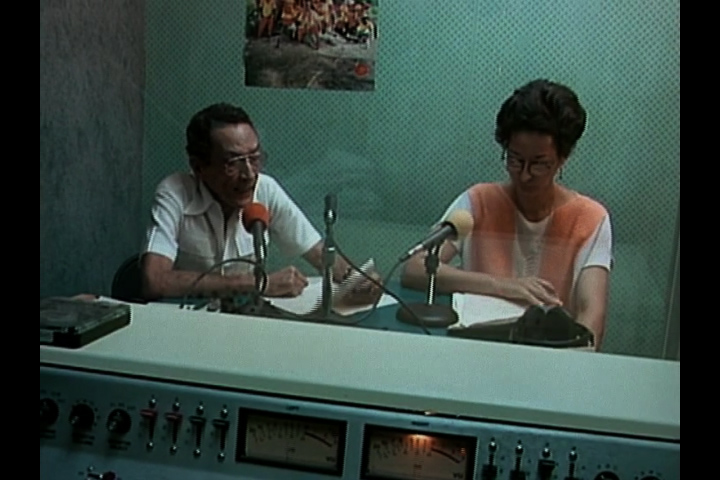
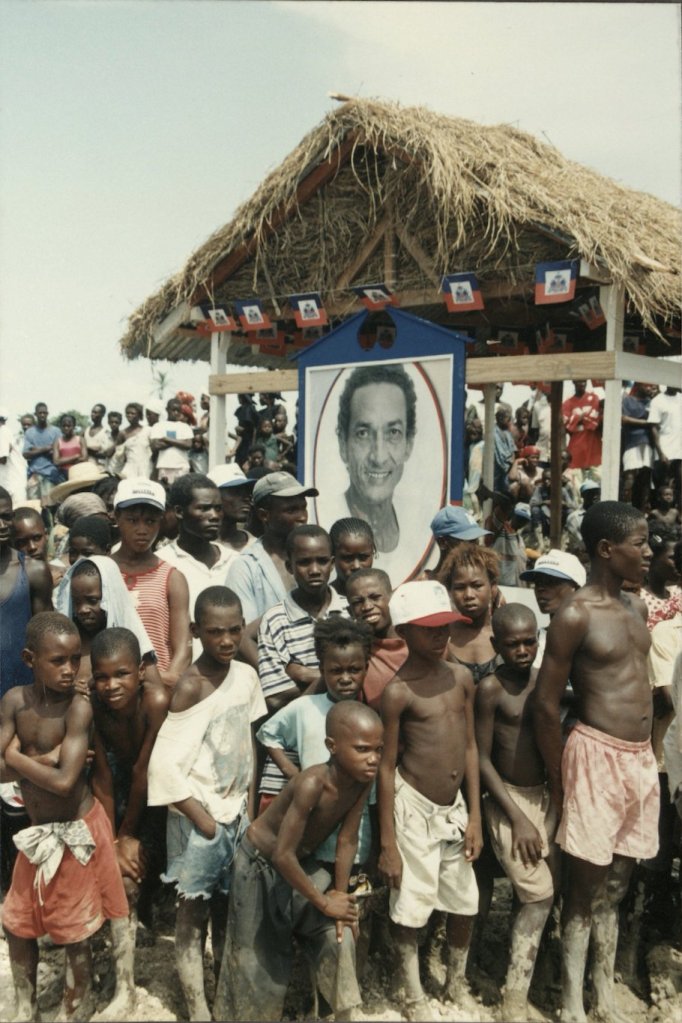
Radio Haïti-Inter was inaugurated in the early 1970s. Dominique, an agronomist by training, quickly became the most recognized journalist in Haiti. His professional partner and wife, Michèle Montas, Radio Haiti’s news editor, was a Columbia Journalism School graduate who trained several generations of Haitian journalists. Dominique was part Ida B. Wells, part Edward R. Murrow, part Sy Hersh, part Studs Terkel, part Hunter S. Thompson. He was an investigative journalist who uncovered human rights abuses, government corruption, and corporate malfeasance. He was an activist who possessed the charisma of a theater star, the crackling wit of a satirist, and the public intellectual’s gift for insight and analysis. After Dominique was assassinated on April 3, 2000, more than fifteen thousand mourners attended his funeral.
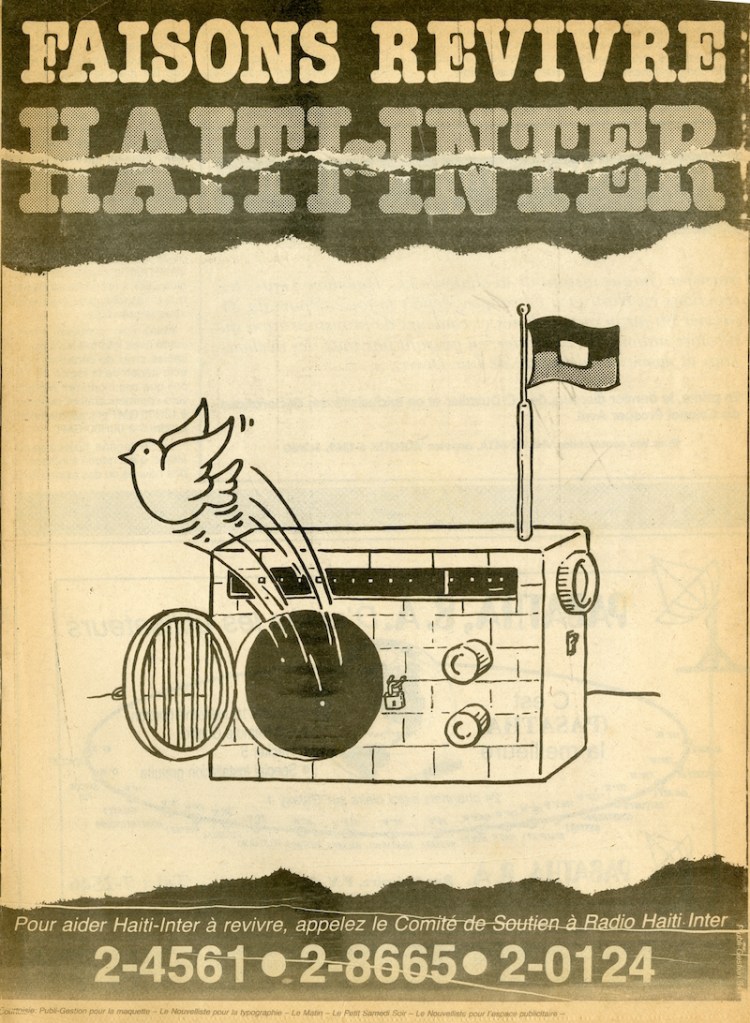
In 2013, Montas donated the archive of Radio Haïti-Inter — more than 1600 open-reel tapes, more than 2000 audio cassettes, and approximately 100 linear feet of paper records — to Duke University’s Rubenstein Rare Book & Manuscript Library, under the condition that it be digitized and made available to the widest possible public in Haiti. Thanks to support from the National Endowment for the Humanities and the Council on Library and Information Resources, today the Radio Haiti Archive is a free, publicly accessible, trilingual digital collection. Its over 5300 audio recordings represent the most comprehensive archive of late 20th-century Haitian history. Radio Haiti still speaks, despite government repression, multiple exiles, the assassination of Dominique, the attempted assassination of Montas in December 2002, the closure of the station in 2003, and the 2010 earthquake. That the archive exists is a miracle.
According to its mission statement, the Rubenstein Library “builds distinctive collections of original materials and preserves them for use on campus and around the world. In support of Duke University’s mission of ‘knowledge in service to society,’ we collect a diversity of voices in a wide range of formats… We invite students, scholars, and the general public to explore the world through our unique collections.” the library seeks to preserve the voices of marginalized people, and make various kinds of materials (including sonic media) available to audiences beyond Duke, beyond the United States, and beyond academia.
In Radio Haiti’s broadcasts, rural farmers, activists from poor urban neighborhoods, sex workers, marketwomen, Vodou patriarchs, and refugees narrate vivid stories of their lives and worlds. The aurality of radio allowed speakers and listeners who were not traditionally literate to participate in the political life of Haiti. Likewise, the aurality of the Radio Haiti collection makes it a trove of information that appears nowhere else. It is invaluable for academic researchers and ordinary audiences alike. It is a people’s history of Haiti, told through voices that are silenced in the written record.
Most libraries in poor countries like Haiti lack the resources to restore, digitize, and process audiovisual materials, but wealthy institutions in wealthy countries tend to neglect sonic archives. Unlike written records, audio is difficult to skim, and therefore harder for researchers to use. The rights considerations are often fraught. Audiovisual archives are expensive and difficult to preserve, digitize, and process; as a result, many projects, including Radio Haiti, depend on highly competitive external grants. While these days many universities prize Black archival collections (sometimes to the point of commodification, as Steven G. Fullwood argues), it’s another matter when those collections are audio, especially non-English language audio. In Radio Haiti’s case, the audio is in Haitian Creole and French. All of these factors made Radio Haiti a complex project. But I believe the complexity of a project like Radio Haiti could be mitigated if institutions were to truly make custodianship of marginalized collections a priority. In other words, some of the complexity isn’t inherent to the collection, but rather to the system that was not built to accommodate it.
As I processed Radio Haiti, I ached for the cane-cutters that the Duvalier dictatorship effectively sold to the Dominican Republic, former political prisoners describing horrific torture, and migrants risking their life at sea. But it was not my trauma. In some ways, this project was challenging because I am not Haitian, but it was also easier because the anguish was not my own. I understood the archive’s importance, but I did not feel the pain in my bones.
So, yes, the material in the archive could be heavy, but the project was difficult mainly because the current practices of US academic libraries are incompatible with a project like Radio Haiti. For the last year and a half of the project, there was no remaining grant money or internal funding for an intern fluent in Haitian Creole or French to earn a living wage. When I proposed seeking additional funding to support an intern to help describe the audio, I was told it would be unfair to other staff who are likewise underpaid. In order to finish before my own grant-funded salary ran out, I listened to and created multilingual narrative description for an average of ten recordings a day. Every day was a race against time. I was reprimanded for “overdescribing” the audio, and told, “Don’t do the researcher’s job for them.” Library leadership and I did not share the same objectives. Despite their stated commitment to digitize Radio Haiti and make it available to the Haitian public, they still considered traditional academic researchers the target audience, while I was thinking of ordinary people in Haiti, trying to access the audio on a secondhand smartphone with a limited data plan.
Michelle Caswell and Marika Cifor ask, “what happens when we scratch beneath the surface of the veneer of detached professionalism and start to think of recordkeepers and archivists less as sentinels of accountability… and more as caregivers, bound to records creators, subjects, users, and communities through a web of mutual responsibility?” They call for empathy between the archivist and the creators, subjects, users, and audience of the archive. I believed that “slow processing” — providing detailed, trilingual description of each Radio Haiti recording — was a necessary act of empathy, and the only way to honor the voices in the archive and make the collection truly available to Haitian audiences. If I provided only “minimal description,” Radio Haiti’s audio would remain lost.
The work was exhausting. I began to have panic attacks. One administrator encouraged me to develop “strategies for self-care.” “Self-care,” which places the responsibility onto the individual worker, is not a solution to burnout. What I needed were more resources.
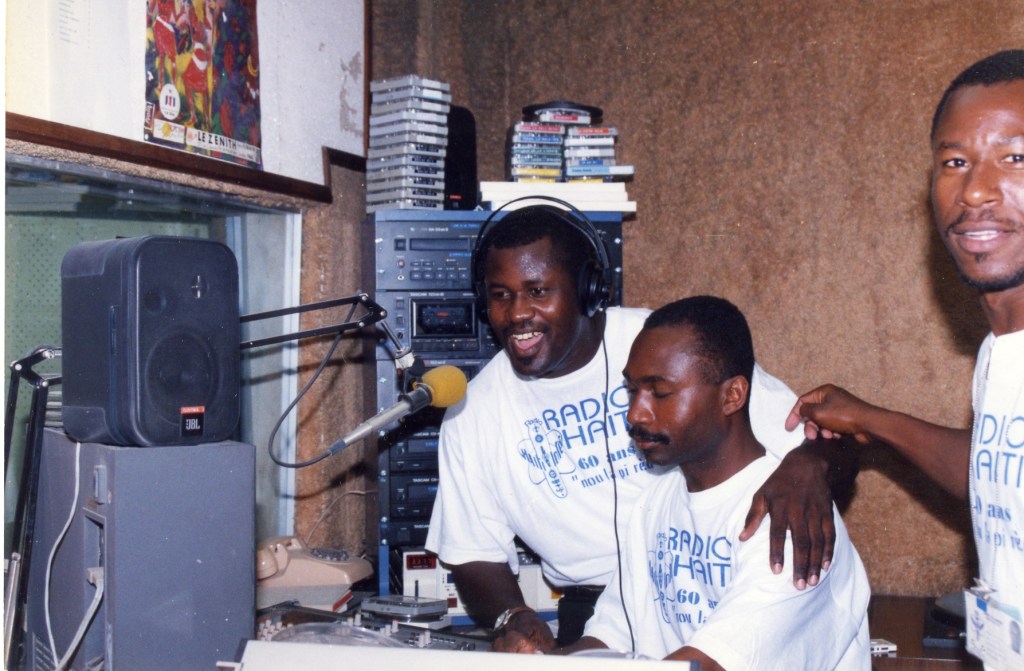
Like everyone else in the neoliberal US university, archivists are bound by concrete considerations of political economy. They are being asked to do more with less: they must eliminate backlogs and process more collections more quickly, without improvements in salary, staffing, or workspace. Library work remains a feminized profession, one that downplays and erases the intellectual labor of those workers who “merely” process collections. The archivist is the invisible technician, while researchers discover. And so my intent is not to impugn any individual. Rather, I point to the structural factors and cultural attitudes — including institutional white supremacy — that make traditional archives inhospitable to collections like Radio Haiti.
Former archivist Jarrett Drake contends that “the purpose of the archival profession is to curate the past, not confront it; to entrench inequality, not eradicate it; to erase black lives, not ennoble them.” As a white American woman, my personal experiences were obviously not comparable to those of archivists and scholars of color who endure racism regularly, but my time as the Radio Haiti project archivist revealed to me how Black archival collections are subjected to structural racism. The Radio Haiti collection was created by and for Black people. It centers the voices, perspectives, and experiences of Black people. It is a sonic archive, in a field that prioritizes traditional paper collections. It is largely in Haitian Creole, a disparaged language spoken mostly by Black people. It is from a country that has been colonized, exploited, invaded, occupied, vilified, pitied, embargoed, evangelized, and intervened upon for centuries. And finally, its primary audience is not anglophone academics, but Haitian people.

Many library workers at predominantly white institutions make extraordinary efforts to combat systemic white supremacy, but low-level staff cannot create change when the larger institution remains hidebound. Bringing Radio Haiti back to Haiti required intellectual work, passion, and love. To represent diverse voices and make a collection like Radio Haiti truly accessible to a worldwide public, traditional archival institutions must undergo a radical transformation. They must confront assumptions about what makes a collection “difficult to process,” commit resources to collections that foreground the voices of marginalized people, and support the work of staff who give those collections the care they deserve.
Editor’s Note: Minor changes have been made since publication for clarity and to add links to sources. Nothing substantive has been changed. 12:48 PM EST, 5/3/2021
—
Featured Image: Picture of a painting of Radio Haiti tied to a cross with the inscription (in translation): “The proverb goes: each firefly lights the way for itself [every man for himself]. We say: unity makes strength. Let’s help Radio Haiti-Inter lay its cross down so that it is not crucified.” Radio Haiti Collection, David M. Rubenstein Rare Book & Manuscript Library, Duke University CC BY-NC-SA 4.0
—
From 2015 to 2019, Laura Wagner was the project archivist for the Radio Haiti Archive at the David M. Rubenstein Rare Book & Manuscript Library at Duke University. She holds a PhD in cultural anthropology from UNC Chapel Hill, where her research focused on displacement, humanitarian aid, and everyday life in the aftermath of the 2010 earthquake in Haiti. Her writings on the earthquake and the Radio Haiti project have appeared in Slate, Salon, sx archipelagos, PRI’s The World, and other venues. She is also the author of Hold Tight, Don’t Let Go, a young adult novel about the earthquake and its aftermath, which was published by Abrams/Amulet in 2015. She is currently working on a book about Radio Haïti-Inter and its archive.
—

REWIND! . . .If you liked this post, you may also dig:
Radio de Acción: Violent Circuits, Contentious Voices: Caribbean Radio Histories–Alejandra Bronfman
Black Excellence on the Airwaves: Nora Holt and the American Negro Artist Program–Chelsea M. Daniel and Samantha Ege
SO! Amplifies: Marginalized Sound—Radio for All–J Diaz
Share this:

SO! Podcast #78: Ethical Storytelling in Podcasting

CLICK HERE TO DOWNLOAD: SO! Podcast #78: Ethical Storytelling in Podcasting
SUBSCRIBE TO THE SERIES VIA ITUNES
ADD OUR PODCASTS TO YOUR STITCHER FAVORITES PLAYLIST
FOR TRANSCRIPT: AFRI0550 ethical considerations panel transcript final or ACCESS EPISODE THROUGH APPLE PODCASTS , locate the episode and click on the three dots to the far right. Click on “view transcript.”
Here at Sounding Out! we think that it’s best to learn from the experts. That’s why we sat in as a fly on a wall for a panel on ethics in podcasting put together by Laura Garbes at Brown University. Please join Laura as she discusses the politics of sound, podcasts, and more with SO! Editor-in-Chief Jennifer Lynn Stoever, storyteller Alex Hanesworth, and radio producer Babette Thomas (Now Hear This).
Laura Garbes was awarded a 2019 Engaged Scholarship award by the Swearer Center for Public Service. She’s recently published an academic essay entitled “Sound Archive Access: Revealing Emergent Cultures.” for the Journal of Radio and Audio Media. In addition to this, check out Laura’s more public facing scholarship: Both the excellent “How a CPB task force advanced a prescient vision for diversity in public radio” for Current and “Excellence, Reflexivity, and Racism: On Sociology’s Nuclear Contradiction and Its Abiding Crisis,” with Michael D. Kennedy and Prabhdeep S. Kehal for Critical Historical Sociology.
If you want to learn more about Laura’s excellent work, check out the page “A Pedagogical Approach to Storytelling and Technology” that details her collaboration with Dr. Nic John Ramos (now of Drexel University) in Spring 2019
for a course taught within the Department of Africana Studies at Brown University called African American Health Activism from Colonialism to AIDS. We have crafted this page to provide guidance and help to educators interested in experimenting with podcasting as a pedagogical tool, particularly in courses where sound or radio is not the primary object of study.
This panel, “Ethical Audio Stories: Teaching in the Age of the Sonic Color Line” was convened in conjunction with this course on April 18th, 2019 at the John Nicholas Brown Center for Public Humanities. The panel discussed questions such as:
If we are to be coming at the practice through a racial justice lens, does the code of ethics differ from journalistic professional ethics? Does it change the questions we ask? The way we interact with stories? How does this affect our notions of objectivity? How to make the audio storytelling more accessible: When we say audio storytelling has a “low barrier to entry,” what aren’t we considering in terms of resources and in terms of more complex cultural barriers?
and also offered general tips to audio storytelling and a Q and A with the audience. For a full transcript of the podcast, click here: AFRI0550 ethical considerations panel transcript final
Featured image is “Podcast” by Aristocrat @Flickr CC BY-NC-ND.
Alex Hanesworth is the managing editor for Now Hear This. She grew up listening to audiobooks in a nook somewhere on Fidalgo Island, WA and now spends her days studying, teaching, and making radio for Now Here This and the RISD Museum. She mostly makes stories about art, history, intimacies, and the intersection of the three.
Babette Thomas is a Black radio producer originally from Oakland, California and is also one of the current managing editors of Now Hear This. Her work is largely concerned with using sound and narrative to bring Black history in conversation with the present.
Jennifer Lynn Stoever is Associate Professor at SUNY Binghamton where she teaches courses on African American literature and race and gender representation in popular music. She has published in Social Text, Social Identities, Sound Effects, Modernist Cultures, American Quarterly and Radical History Review among others; her most recent research, “Crate Digging Begins at Home: Black and Latinx Women Collecting and Selecting Records in the 1960s and 1970s Bronx” was published in The Oxford Handbook of Hip Hop Studies (and is FREE to download as of September 2019). In 2016, she published her first book, The Sonic Color Line: Race and the Cultural Politics of Listening (NYU Press).
 REWIND! . . .If you liked this post, you may also dig:
DIY Histories: Podcasting the Past – Andrew Salvati
A Manifesto, or Sounding Out!’s 51st Podcast!!! – Aaron Trammell
Share this:


Current Top Posts





April 2021

January 2020

November 2019

October 2019

August 2019

April 2014

November 2017

March 2015

December 2017

October 2015
 Sounding Out!
Recent Comments