
What Feels Good to Me: Extra-Verbal Vocal Sounds and Sonic Pleasure in Black Femme Pop Music

The lyrics to Beyoncé’s 2008 song “Radio” treats listening pleasure as a thinly-veiled metaphor for sexual pleasure. For example, they describe how turning up a car stereo transforms it into a sex toy: “And the bassline be rattlin’ through my see-eat, ee-eats/Then that crazy feeling starts happeni-ing- i-ing OH!” Earlier in the song, the lyrics suggest that this is a way for the narrator to get off without arousing any attempts to police her sexuality: “You’re the only one that Papa allowed to hang out in my room/…And mama never freaked out when she heard it go boom.” Because her parents wouldn’t let her be alone in her bedroom with anyone or anything that they recognized as sexual, “Radio”’s narrator finds sexual pleasure in a practice that isn’t usually legible as sex. In her iconic essay “On A Lesbian Relationship With Music,” musicologist Suzanne Cusick argues that if we “suppose that sexuality isn’t necessarily linked to genital pleasure” and instead “a way of expressing and/or enacting relationships of intimacy through physical pleasure shared, accepted, or given” (70), we can understand the physical pleasures of listening to music, music making, and music performance as kinds of sexual pleasure.
Though Cusick’s piece overlooks the fact that sexual deviance has been, since the invention of the idea of sexuality in the late 19th century, thoroughly racialized, her argument can be a good jumping-off point for thinking about black women’s negotiations of post-feminist ideas of sexual respectability; it focuses our attention on musical sound as a technique for producing queer pleasures that bend the circuits connecting whiteness, cispatriarchal gender, and hetero/homonormative sexuality. In an earlier SO! Piece on post-feminism and post-feminist pop, I defined post-feminism as the view that “the problems liberal feminism identified are things in…our past.” Such problems include silencing, passivity, poor body image, and sexual objectification. I also argued that post-feminist pop used sonic markers of black sexuality as representations of the “past” that (mostly) white post-feminists and their allies have overcome. It does this, for example, by “tak[ing] a “ratchet” sound and translat[ing] it into very respectable, traditional R&B rhythmic terms.” In this two-part post, I want to approach this issue from another angle. I argue that black femme musicians use sounds to negotiate post-feminist norms about sexual respectability, norms that consistently present black sexuality as regressive and pre-feminist.
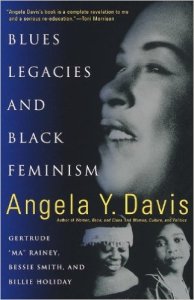 Black women musicians’ use of sound to negotiate gender norms and respectability politics is a centuries-old tradition. Angela Davis discusses the negotiations of Blues women in Blues Legacies & Black Feminism (1998), and Shana Redmond’s recent article “This Safer Space: Janelle Monae’s ‘Cold War’” reviews these traditions as they are relevant for black women pop musicians in the US. While there are many black femme musicians doing this work in queer subcultures and subgenres, I want to focus here on how this work appears within the Top 40, right alongside all these white post-feminist pop songs I talked about in my earlier post because such musical performances illustrate how black women negotiate hegemonic femininities in mainstream spaces.
As America’s post-identity white supremacist patriarchy conditionally and instrumentally includes people of color in privileged spaces, it demands “normal” gender and sexuality performances for the most legibly feminine women of color as the price of admission. As long as black women don’t express or evoke any ratchetness–any potential for blackness to destabilize cisbinary gender and hetero/homonormativity, to make gender and sexuality transitional–their expressions of sexuality and sexual agency fit with multi-racial white supremacist patriarchy.
It is in this complicated context that I situate Nicki Minaj’s (and in my next post Beyoncé’s and Missy Elliott’s) recent uses of sound and their bodies as instruments to generate sounds. If, as I argued in my previous post, the verbal and visual content of post-feminist pop songs and videos is thought to “politically” (i.e., formally, before the law) emancipate women while the sounds perform the ongoing work of white supremacist patriarchy, the songs I will discuss use sounds to perform alternative practices of emancipation. I’m arguing that white bourgeois post-feminism presents black women musicians with new variations on well-worn ideas and practices designed to oppress black women by placing them in racialized, gendered double-binds.
 For example, post-feminism transforms the well-worn virgin/whore dichotomy, which traditionally frames sexual respectability as a matter of chastity and purity (which, as Richard Dyer and others have argued, connotes racial whiteness), into a subject/object dichotomy. This dichotomy frames sexual respectability as a matter of agency and self-ownership (“good” women have agency over their sexuality; “bad” women are mere objects for others). As Cheryl Harris argues, ownership both discursively connotes and legally denotes racial whiteness. Combine the whiteness of self-ownership with well-established stereotypes about black women’s hypersexuality, and the post-feminist demand for sexual self-ownership puts black women in a catch-22: meeting the new post-feminist gender norm for femininity also means embodying old derogatory stereotypes.
I think of the three songs (“Anaconda,” “WTF,” and “Drunk in Love”) as adapting performance traditions to contemporary contexts. First, they are part of what both Ashton Crawley and Shakira Holt identify as the shouting tradition, which, as Holt explains, is a worship practice that “can include clapping, dancing, pacing, running, rocking, fainting, as well as using the voice in speaking, singing, laughing, weeping, yelling, and moaning.” She continues, arguing that “shouting…is also a binary-breaking performance which confounds—if only fleetingly—the divisions which have so often oppressed, menaced, and harmed them.” These vocal performances apply the shouting tradition’s combination of the choreographic and the sonic and binary-confounding tactics to queer listening and vocal performance strategies.
Francesca Royster identifies such strategies in both Michael Jackson’s work and her audition of it. According to Royster, Jackson’s use of non-verbal sounds produces an erotics that exceeds the cisheteronormative bounds of his songs’ lyrics. They were what allowed her, as a queer teenager, to identify with a love song that otherwise excluded her:
in the moments when he didn’t use words, ‘ch ch huhs,’ the ‘oohs,’ and the ‘hee hee hee hee hees’…I ignored the romantic stories of the lyrics and focused on the sounds, the timbre of his voice and the pauses in between. listening to those nonverbal moments–the murmured opening of “Don’t Stop Till You Get Enough,” or his sobbed breakdown at the end of “She’s Out of My Life,’ I discovered the erotic (117).
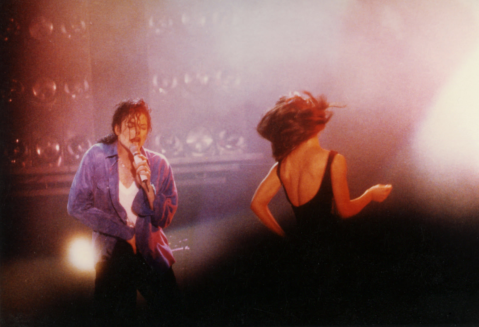
“Michael Jackson” by Flickr user Daniele Dalledonne, CC BY-SA 2.0
Royster references a black sexual politics in line with Audre Lorde’s notion of the erotic in “The Uses of the Erotic,” which is bodily pleasure informed by the implicit and explicit knowledges learned through lived experience on the margins of the “European-American male tradition” (54), and best expressed in the phrase “it feels right to me” (54). Lorde’s erotic is a script for knowing and feeling that doesn’t require us to adopt white supremacist gender and sexual identities to play along. Royster calls on this idea when she argues that Jackson’s non-verbal sounds–his use of timbre, rhythm, articulation, pitch–impart erotic experiences and gendered performances that can veer off the trite boy-meets-girl-boy-loses-girl stories in his lyrics. “Through his cries, whispers, groans, whines, and grunts, Jackson occupies a third space of gender, one that often undercuts his audience’s expectations of erotic identification” (119). Like shouting, “erotic” self-listening confounds several binaries designed specifically to oppress black women, including subject/object binaries and binary cisheterogender categories.
Nicki Minaj uses extra-verbal sounds as opportunities to feel her singing, rapping, vocalizing body as a source of what Holt calls “sonophilic” pleasure, pleasure that “provide[s] stimulation and identification in the listener” and invites the listener to sing (or shout) along. Minaj is praised for her self-possession when it comes to business or artistry, but such self-possession is condemned or erased entirely when discussing her performances of sexuality. As Treva B. Lindsey argues, “the frequency that Nicki works on is not the easiest frequency for us to wrestle with, because it’s about…whether we can actually tell the difference between self-objectification and self-gratification.’’ Though this frequency may be difficult to parse for ears tempered to rationalize post-feminist assumptions about subjectivity and gender, Minaj uses her signature wide sonic pallette to shift the conversation about subjectivity and gender to frequencies that rationalize alternative assumptions.
In her 2014 hit “Anaconda,” she makes a lot of noises: she laughs, snorts, trills her tongue, inhales with a low creaky sound in the back of her throat, percussively “chyeah”s from her diaphragm,among other sounds. The song’s coda finds her making most of the extraverbal sounds. This segment kicks off with her quasi-sarcastic cackle, which goes from her throat and chest up to resonate in her nasal and sinus cavities. She then ends her verse with a trademark “chyeah,” followed by another cackle. Then Minaj gives a gristly, creaky exhale and inhale, trilling her tongue and then finishing with a few more “chyeah”s. While these sounds do percussive and musical work within the song, we can’t discount the fact that they’re also, well…fun to make. They feel good, freeing even. And given the prominent role the enjoyment of one’s own and other women’s bodies plays in “Anaconda” and throughout Minaj’s ouevre, it makes sense that these sounds are, well, ways that she can go about feelin herself.
Listening to and feeling sonophilic pleasure in sounds she performs, Minaj both complicates post-feminism’s subject/object binaries and rescripts cishetero narratives about sexual pleasure. “Anaconda” flips the script on the misogyny of Sir Mix-a-Lot’s hit “Baby Got Back” by sampling the track and rearticulating cishertero male desire as Nicki’s own erotic. First, instead of accompanying a video about the male gaze, that bass hook now accompanies a video of Nicki’s pleasure in her femme body and the bodies of other black femmes, playing as she touches and admires other women working out with her. Second, Nicki re-scripts the bass line as a syllabification: “dun-da-da-dun-da-dun-da-dun-dun,” which keeps the pattern of accents on 1 and 4, while altering the melody’s pitch and rhythm.
Just as “Anaconda”’s lyrics re-script Mix-A-Lot’s male gaze, so do her sounds. If the original hook sonically orients listeners as cishetero “men” and “women,” Nicki’s vocal performance reorients listeners to create and experience bodily pleasure beyond the “legible” and the scripted. Though the lyrics are clearly about sexual pleasure, the sonic expression or representation of that pleasure–i.e., the performer’s pleasure in hearing/feeling herself make all these extraverbal sounds–makes it physically manifest in ways that aren’t conventionally understood as sexual or gendered. Because it veers off white ciseterogendered scripts about both gender and agency, Minaj’s performance of sonophilia is an instance of what L.H. Stallings calls hip hop’s “ratchet imagination.” This imagination is ignited by black women’s dance aesthetics, wherein “black women with various gender performances and sexual identities within the club, on stage and off, whose bodies and actions elicit new performances of black masculinity” renders both gender and subject/object binaries “transitional” (138).
Nicki isn’t the only black woman rapper to use extra-verbal vocal sounds to re-script gendered bodily pleasure. In my next post, I’ll look at Beyoncé and Missy Elliot’s use of extra-vocal sounds to stretch beyond post-feminism pop’s boundaries.
—
Featured image: screenshot from “Anaconda” music video
—
Robin James is Associate Professor of Philosophy at UNC Charlotte. She is author of two books: Resilience & Melancholy: pop music, feminism, and neoliberalism, published by Zer0 books last year, and The Conjectural Body: gender, race and the philosophy of music was published by Lexington Books in 2010. Her work on feminism, race, contemporary continental philosophy, pop music, and sound studies has appeared in The New Inquiry, Hypatia, differences, Contemporary Aesthetics, and the Journal of Popular Music Studies. She is also a digital sound artist and musician. She blogs at its-her-factory.com and is a regular contributor to Cyborgology.
—
 REWIND! . . .If you liked this post, you may also dig:
“I Love to Praise His Name”: Shouting as Feminine Disruption, Public Ecstasy, and Audio-Visual Pleasure–Shakira Holt
Music Meant to Make You Move: Considering the Aural Kinesthetic–Imani Kai Johnson
Something’s Got a Hold on Me: ‘Lingering Whispers’ of the Atlantic Slave Trade in Ghana–Sionne Neely
Share this:

You Got Me Feelin’ Emotions: Singing Like Mariah

Mariah Carey’s New Year’s Eve 2016 didn’t go so well. The pop diva graced a stage in the middle of Times Square as the clock ticked down to 2017 on Dick Clark’s Rockin New Year’s Eve, hosted by Ryan Seacrest. After Carey’s melismatic rendition of “Auld Lang Syne,” the instrumental for “Emotions” kicked in and Carey, instead of singing, informed viewers that she couldn’t hear anything. What followed was five minutes of heartburn. Carey strutted across the stage, hitting all her marks along with her dancers but barely singing. She took a stab at a phrase here and there, mostly on pitch, unable to be sure. And she narrated the whole thing, clearly perturbed to be hung out to dry on such a cold night with millions watching. I imagine if we asked Carey about her producer after the show, we’d get a “I don’t know her.”
These things happen. Ashlee Simpson’s singing career, such as it was, screeched to a halt in 2004 on the stage of Saturday Night Live when the wrong backing track cued. Even Queen Bey herself had to deal with lip syncing outrage after using a backing track at former President Barack Obama’s second inauguration. So the reaction to Carey, replete with schadenfreude and metaphorical pearl-clutching, was unsurprising, if also entirely inane. (The New York Times suggested that Carey forgot the lyrics to “Emotions,” an occurrence that would be slightly more outlandish than if she forgot how to breathe, considering it’s one of her most popular tracks). But yeah, this happens: singers—especially singers in the cold—use backing tracks. I’m not filming a “leave Mariah alone!!” video, but there’s really nothing salacious in this performance. The reason I’m circling around Mariah Carey’s frosty New Year’s Eve performance is because it highlights an idea I’m thinking about—what I’m calling the “produced voice” —as well as some of the details that are a subset of that idea; namely, all voices are produced.
I mean “produced” in a couple of ways. One is the Judith Butler way: voices, like gender (and, importantly, in tandem with gender), are performed and constructed. What does my natural voice sound like? I dunno. AO Roberts underlines this in a 2015 Sounding Out! post: “we’ll never really know how we sound,” but we’ll know that social constructions of gender helped shape that sound. Race, too. And class. Cultural norms make physical impacts on us, perhaps in the particular curve of our spines as we learn to show raced or gendered deference or dominance, perhaps in the texture of our hands as we perform classed labor, or perhaps in the stress we apply to our vocal cords as we learn to sound in appropriately gendered frequency ranges or at appropriately raced volumes. That cultural norms literally shape our bodies is an important assumption that informs my approach to the “produced voice.” In this sense, the passive construction of my statement “all voices are produced” matters; we may play an active role in vibrating our vocal cords, but there are social and cultural forces that we don’t control acting on the sounds from those vocal cords at the same moment.
Another way I mean that all voices are produced is that all recorded singing voices are shaped by studio production. This can take a few different forms, ranging from obvious to subtle. In the Migos song “T-Shirt,” Quavo’s voice is run through pitch-correction software so that the last word of each line of his verse (ie, the rhyming words: “five,” “five,” “eyes,” “alive”) takes on an obvious robotic quality colloquially known as the AutoTune effect. Quavo (and T-Pain and Kanye and Future and all the other rappers and crooners who have employed this effect over the years) isn’t trying to hide the production of his voice; it’s a behind-the-glass technique, but that glass is transparent. Less obvious is the way a voice like Adele’s is processed. Because Adele’s entire persona is built around the natural power of her voice, any studio production applied to it—like, say, the cavernous reverb and delay on “Hello” —must land in a sweet spot that enhances the perceived naturalness of her voice.
Vocal production can also hinge on how other instruments in a mix are processed. Take Remy Ma’s recent diss of Nicki Minaj, “ShETHER.” “ShETHER”’s instrumental, which is a re-performance of Nas’s “Ether,” draws attention to the lower end of Remy’s voice. “Ether” and “ShETHER” are pitched in identical keys and Nas’s vocals fall in the same range as Remy’s. But the synth that bangs out the looping chord progression in “ShETHER” is slightly brighter than the one on “Ether,” with a metallic, digital high end the original lacks. At the same time, the bass that marks the downbeat of each measure is quieter in “ShETHER” than it is in “Ether.” The overall effect, with less instrumental occupying “ShETHER”’s low frequency range and more digital overtones hanging in the high frequency range, causes Remy Ma’s voice to seem lower, manlier, than Nas’s voice because of the space cleared for her vocals in the mix. The perceived depth of Remy’s produced voice toys with the hypermasculine nature of hip hop beefs, and queers perhaps the most famous diss track in the genre. While engineers apply production effects directly to the vocal tracks of Quavo and Adele to make them sound like a robot or a power diva, the Remy Ma example demonstrates how gender play can be produced through a voice by processing what happens around the vocals.
Let’s return to Times Square last New Year’s Eve to consider the produced voice in a hybrid live/recorded setting. Carey’s first and third songs “Auld Lang Syne” and “We Belong Together”) were entirely back-tracked—meaning the audience could hear a recorded Mariah Carey even if the Mariah Carey moving around on our screen wasn’t producing any (sung) vocals. The second, “Emotions,” had only some background vocals and the ridiculously high notes that young Mariah Carey was known for. So, had the show gone to plan, the audience would’ve heard on-stage Mariah Carey singing along with pre-recorded studio Mariah Carey on the first and third songs, while on-stage Mariah Carey would’ve sung the second song entirely, only passing the mic to a much younger studio version of herself when she needed to hit some notes that her body can’t always, well, produce anymore. And had the show gone to plan, most members of the audience wouldn’t have known the difference between on-stage and pre-recorded Mariah Carey. It would’ve been a seamless production. Since nothing really went to plan (unless, you know, you’re into some level of conspiracy theory that involves self-sabotage for the purpose of trending on Twitter for a while), we were all privy to a component of vocal production—the backing track that aids a live singer—that is often meant to go undetected.

The produced-ness of Mariah Carey’s voice is compelling precisely because of her tremendous singing talent, and this is where we circle back around to Butler. If I were to start in a different place–if I were, in fact, to write something like, “Y’all, you’ll never believe this, but Britney Spears’s singing voice is the result of a good deal of studio intervention”–well, we wouldn’t be dealing with many blown minds from that one, would we? Spears’s career isn’t built around vocal prowess, and she often explores robotic effects that, as with Quavo and other rappers, make the technological intervention on her voice easy to hear. But Mariah Carey belongs to a class of singers—along with Adele, Christina Aguilera, Beyoncé, Ariana Grande—who are perceived to have naturally impressive voices, voices that aren’t produced so much as just sung. The Butler comparison would be to a person who seems to fit quite naturally into a gender category, the constructed nature of that gender performance passing nearly undetected. By focusing on Mariah Carey, I want to highlight that even the most impressive sung voices are produced, and that means that we can not only ask questions about the social and cultural impact of gender, race, class, ability, sexuality, and other norms may have on those voices, but also how any sung voice (from Mariah Carey’s to Quavo’s) is collaboratively produced—by singer, technician, producer, listener—in relation to those same norms.
Being able to ask those questions can get us to some pretty intriguing details. At the end of the third song, “We Belong Together,” she commented “It just don’t get any better” before abandoning the giant white feathers that were framing her onstage. After an awkward pause (during which I imagine Chris Tucker’s “Don’t cut to me!” face), the unflappable Ryan Seacrest noted, “No matter what Mariah does, the crowd absolutely loves it. You can’t go wrong with Ms. Carey, and those hits, those songs, everybody knows.” Everybody knows. We didn’t need to hear Mariah Carey sing “Emotions” that night because we could fill it all in–everybody knows that song. Wayne Marshall has written about listeners’ ability to fill in the low frequencies of songs even when we’re listening on lousy systems—like earbuds or cell phone speakers—that can’t really carry it to our ears. In the moment of technological failure, whether because a listener’s speakers are terrible or a performer’s monitors are, listeners become performers. We heard what was supposed to be there, and we supplied the missing content.

Sound is intimate, a meeting of bodies vibrating in time with one another. Yvon Bonenfant, citing Stephen Connor’s idea of the “vocalic body,” notes this physicality of sound as a “vibratory field” that leaves a vocalizer and “voyages through space. Other people hear it. Other people feel it.” But in the case of “Emotions” on New Year’s Eve, I heard a voice that wasn’t there. It was Mariah Carey’s, her vocalic body sympathetically vibrated into being. The question that catches me here is this: what happens in these moments when a listener takes over as performer? In my case, I played the role of Mariah Carey for a moment. I was on my couch, surrounded by my family, but I felt a little colder, like I was maybe wearing a swimsuit in the middle of Times Square in December, and my heart rate ticked up a bit, like maybe I was kinda panicked about something going wrong, and I heard Mariah Carey’s voice—not, crucially, my voice singing Mariah Carey’s lyrics—singing in my head. I could feel my vocal cords compressing and stretching along with Carey’s voice in my head, as if her voice were coming from my body. Which, in fact it was—just not my throat—as this was a collaborative and intimate production, my body saying, “Hey, Mariah, I got this,” and performing “Emotions” when her body wasn’t.
By stressing the collaborative nature of the produced voice, I don’t intend to arrive at some “I am Mariah” moment that I could poignantly underline by changing my profile picture on Facebook. Rather, I’m thinking of ways someone else’s voice is could lodge itself in other bodies, turning listeners into collaborators too. The produced voice, ultimately, is a way to theorize unlikely combinations of voices and bodies.
—
Featured image: By all-systems-go at Flickr, CC BY-SA 2.0, via Wikimedia Commons
—
Justin Adams Burton is Assistant Professor of Music at Rider University, and a regular writer at Sounding Out! You can catch him at justindburton.com.
—
REWIND! . . .If you liked this post, you may also dig:
Gendered Sonic Violence, from the Waiting Room to the Locker Room-Rebecca Lentjes
I Can’t Hear You Now, I’m Too Busy Listening: Social Conventions and Isolated Listening–Osvaldo Oyola
One Nation Under a Groove?: Music, Sonic Borders, and the Politics of Vibration-Marcus Boon
Share this:


Current Top Posts





April 2021

January 2020

November 2019

October 2019

August 2019

April 2014

November 2017

March 2015

December 2017

October 2015
 Sounding Out!
Recent Comments