
Blinded By the Sound: Marvel’s Dazzler – Light & Sound in Comics


Trying to reproduce the popularity of KISS-themed comics: Marvel Super Special #5 (1978)
I recently got my hands on a complete set of Marvel Comics’ Dazzler, a comic from the early to mid-80s that featured Alison Blaire, a mutant with the power to transform sound into light. She was the result of an attempted collaboration between Marvel and Casablanca Records. The idea was that rather than publish a comic based on a pre-existing musical act (as they had in 1977 with KISS), Marvel would create a character and Casablanca would, in the words of one of the co-creators, “create someone to take on the persona,” with the potential for a movie tie-in. Casablanca dropped the project before the first issue of the comic, but Marvel re-tooled the character and went ahead with the Dazzler—a talented, yet struggling singer stuck playing at cheesy discos and small clubs while dreaming of wider success.
The last time I wrote about sound in comics, I mentioned how despite (or because of) sound’s transparency, it is an unobstrusive tool in providing the cues needed by readers to provide the closure through which comic literacy functions. The Dazzler series is not a great comic, it is often schmaltzy, repetitive and rife with errors, and just when it started to fulfill a bit of its promise, its creative team and the comic’s direction were changed and it was canceled soon after, but despite this, it is the perfect subject for looking at the representation of sound in comics. Dazzler’s power literally shines a light on how pervasive imagined sound is in this visual/textual form. It also makes room for even more sounds to be woven into the title’s narrative. Since Alison Blaire is an aspiring singer the most prevalent sound present in this title—less common in other popular super heroes titles—is music. Dan Fingeroth and Jacob Springer (who wrote the majority of Dazzler’s brief run) had many opportunities to depict a visual representation of singing.

from Dazzler #21 (Nov 1982). By Fingeroth & Springer
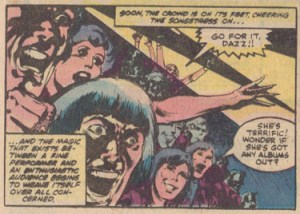
The fans react to Dazzler’s singing – from Dazzler #7 (August 1981), by DeFalco, Fingeroth & Springer
As a singer, Dazzler is a maker of sounds in addition to a user of the sound already present throughout the medium. As a result, in addition to the visual representation of sound through Dazzler’s glowing light show, the writers were in a position of having to use text to describe the quality of sound more often than usual for their genre. As Tom DeFalco (a co-creator and sometimes writer on the series) said in a 1980 interview with Comics Feature, “I have to put in a lot of sounds in the captions and that I hope that kids who very rarely read captions will read these so they’ll know where the sound is coming from. But the good thing about sound is that you are always surrounded by sound.” DeFalco’s answer illustrates the contradiction at the heart of comic sound—it may be ever-present, but because of this is taken for granted to such a degree that he worries that its source will not be self-evident on the comics page. He adds that one way around this, because of Dazzler‘s focus on music, is through descriptions of the audience’s reactions to it—how it makes them feel is a way to clue the readers into the source and quality of sound present in the panels.
It is the affective relationship to sound that marks Dazzler as very different from other superhero comics. All the super-villain battles and fear of the revelation of her mutant powers are merely the narrative obstacles to her primary goal and obsession—singing. In order for that work, the emotions that emerge from her performance (both for Alison and those listening) needs to be evoked (something that the comics unevenly succeeds at). The colorful lights that are often part of a stage show are, in her case, a direct result of her relationship to not only hearing/absorbing sound, but making sound. She repeatedly explains that rhythmic nature of popular music makes her powers easier to use, because she can feel its pulse. For Alison Blaire, hearing, making and using sounds are conflated by means of the visual and textual, allowing the reader to see what he cannot hear or feel. In other words, Dazzler’s conceit is most successful when it evokes an empathic connection between the reader and the imagined sounds.

Black Bolt’s scream converted into light – From Dazzler #19 (Sept 1982), by Fingeroth & Springer
The feeling around sound can also be evoked through its absence. A common practice in mainstream superhero comics is the guest appearance by a popular hero in a new or poorly-selling comic in order to boost sales, and Dazzler seemed to have cameo by some better known character almost every issue. This practice allowed for writers and artists to depict what had for decades been undepictable. When Dazzler teams up with Black Bolt, King of the Inhumans (a Fantastic Four character from back in the Kirby days) he is finally allowed an opportunity to use his greatest and most feared power, his voice. Black Bolt is forever silent. His voice is so powerful a weapon that even his whisper can inadvertently kill all those around him. Thus, despite being an iconic Silver Age character, the voice of Black Bolt is one that can never be “heard” by comic readers. His silence is part of his identity and grants him a tragic and noble-bearing. As such, when he is teamed up with Dazzler, her power becomes the perfect vehicle for representing the unrepresentable sound—Dazzler absorbs the sound of his voice to emit the energy needed to defeat the super-villain. In having the characters work together, the writer was able to use one character’s power to finally represent the other’s. In this moment there is a sense of relief and emotional release, along with a sense of peril that bound to Black Bolt’s voice gives the unheard sound resonance.

Allison turns up the muzak to power her ability. From Dazzler #8 (Oct 1981) by DeFalco, Fingeroth, Springer & Coletta
As the title continued (and after its cancellation, when Dazzler became a member of the X-Men), Alison Blaire’s powers developed in different ways, the most fascinating was the development of her hearing. While early in the character’s career she was dependent on passive hearing, often carrying a portable radio with her in order to insure she had sufficient sound with which to use her light powers, later she developed acute active listening skills. As this aspect of her power developed, it became clear that it was not necessarily the force of sounds themselves that determined the extent of her power (though clearly loud sounds could be more easily transformed into more powerful forms of light, like ultra-focused lasers), but her attentive listening. The more attention she could pay to sounds and could discern even faint sounds, the more she could absorb and transform—later she is even able to use the sounds of digging insects and worms to save herself when she is accidentally buried alive.

From Dazzler #1 (March 1981) by DeFalco & Romita, Jr.
By the end of her original series, Dazzler‘s new writing team had her mostly abandon her musical ambitions and take the more common (and dare I say, more boring) comic book route of getting a costume and joining a team of liked-minded super-beings. Because of this, the character’s special relationship to sound is lost in the shuffle of convoluted continuities and cosmic crises present in the various X-titles. There is less time and attention paid to song and sound as power and its emotional weight. The abandonment of her career goals also abandons the opportunity to explore a unique representation of sound and identity in a medium where identity is writ large. However, if there is a take-away from the strange, mostly failed, collaborative experiment between comics company and records company, it is that like Alison Blaire, if the comics reader “listens” carefully to the sounds present in the text and pictures there is a potential for a lot more depth and appreciation of how sound’s depiction is crucial to comics’ formal success.
—
Osvaldo Oyola is a regular contributor to Sounding Out! and ABD in English at Binghamton University.
Share this:

SO! Reads: Jonathan Sterne’s MP3: The Meaning of a Format

The promiscuity of the mp3. Borrowed from NYCArthur on Flickr.
 The point that had lingered with me after first reading Jonathan Sterne’s essay “The mp3 as Cultural Artifact,” was the idea that the mp3 was a promiscuous technology. “In a media-saturated environment,” Sterne writes, “portability and ease of acquisition trumps monomaniacle attention . . . at the psychoacoustic level as well as the industrial level, the mp3 is designed for promiscuity. This has been a long-term goal in the design of sound reproduction technologies” (836). A technology, promiscuous? I did not have to look far to find support. Like germs, I could find copies of mp3s that I had downloaded from Napster in 2000 scattered across generations of my old hard drives. Often they were redundant, too – iTunes having archived a copy separate from my original download.
But, for Sterne, mp3s are also socially promiscuous. They accumulate in the hard drives of the working class and are shared, almost anywhere, through the branching left/right wires of iPod earbuds. Since the popularization of the mp3, there have been new opportunities to share how we listen with others. This is promise of the mp3, and the reason it forms such a key point of scholarly meditation.
 MP3: The Meaning of a Format (Duke University Press, 2012) finds Sterne revisiting many of these key themes, with a larger focus on the genealogical beginnings of the mp3 technology. While many of the book’s chapters are extrapolations of prior work Sterne has done regarding the genealogy of listening practices, this work concerns itself less with the 19th century, and more with the 20th century. Perhaps this is related to some of the methodological decisions Sterne has made in planning the book – in seeking out the genealogical origins of the mp3, Sterne worked from archives and manuals described in interviews by engineers who were fundamental to the technology’s production. As such it finds much in common with Trevor Pinch and Frank Trocco’s Analog Days and Dave Tompkins’ How to Wreck a Nice Beach but incorporates the genealogical methods regarding sonic technology present in Sterne’s earlier work The Audible Past and Emily Thompson’s The Soundscape of Modernity. In MP3 Sterne positions himself as a critical cultural studies scholar working between the humanities and sciences, focusing specifically on the mp3 due to its social and technological relevance today. The critical is key here as MP3 is truly a work devised to underscore the economic connections between the construction of our selves as “hearing subjects” and the media industries.
Certainly, the mp3 can still be considered a promiscuous technology, but it is corporate capitalism that had failed to recognize the extent to which it relies on technological promiscuity to support its infrastructure. This focus, ironically, displaces the mp3 as the main object of Sterne’s analysis. It highlights instead the pathological logic of corporate capitalism, and the ways that this rationality has mutated, now, in the wake of mass replicable, malleable, and iterative digital culture. In other words, the mp3 is endemic to a much larger plot, wherein the culture industries adapt to their own deus ex-machina. The naive development of the mp3 by the motion picture industry is a large part of the story here, but it is only a small bit of a much larger whole. The real story involves understanding how a handful of vested corporate interests have shaped the ways that we interpret and understand what listening is. In MP3 Sterne addresses one of the great questions of sound studies: What are the politics of listening? Or, which individuals and institutions have a vested economic interest in questions of how we hear?
Sterne recalls this drama in three parts, each unfolding in a somewhat autonomous fashion, but unified in so far as they explore the economic interests behind the scientific construction of “hearing subjects.” In the first part, Sterne is at his best exploring AT&T’s (and the affiliated Bell Laboratories’) role in funding psychological, physiological, and cybernetic research on hearing. In the second, Sterne explains how this early research has been applied to the visual and technical abstraction of sound in the 1970s. And, in the third part of this genealogy, he explains how these analogs were made digital, specifically the corporate politics which went into the construction of the mp3 standard. Throughout this surprising and detailed trajectory, Sterne makes the invisibility of corporate interests apparent and explicit.

AT&T and Infrastructure. Borrowed from djbones on Flickr.
Sterne also hints toward several powerful economic rationalities that have guided the construction of the mp3. Key among these insights is the monetization of cybernetic discourse, or the incorporation of the human body within a scientific understanding of technical systems. In order to engineer an efficient technical system, the capacities and limits of how we interact with (or serve as parts of) these systems must be taken into account. Sterne refers to this mode of engineering as “perceptual technics,” and he goes to great lengths to explain it.
Basically, at the turn of the 20th century, AT&T had taken a keen interest in the science of how people listen because they wanted to maximize the amount of simultaneous conversations broadcast through a single telephone wire. More conversations meant the purchase of fewer wires, and therefore greater profits. Eventually, drawing on the research of the oft-cited Claude Shannon and Warren Weaver (within SO!: What Mixtapes Can Teach Us About Nois and Pushing Record; and soundBox: Mapping Noise), AT&T recognized an economic problem of technical efficiency within their wires – there was too much ambient noise. Because of this, AT&T sought to limit the audible signal transmitted from one phone to another. This would allow for more signals (and therefore conversations) to be transmitted through the same wire. Physiological research provided clues that some frequencies were more audible than others, so engineers worked to compress audio signals to reflect this scientific abstraction of hearing.

The scientific capture of listening. Borrowed from img.informer.com .
The reduction of listening–as an embodied practice–to the quantification and control of the audible spectrum, is, in other words, the history of compression. Which, according to Sterne, should be understood as the true meaning of the mp3. While the mp3 format, like the CD or cassette, may become obsolete, technologies of compression will not. Sterne argues convincingly that most advances in compression technologies have been guided by the invisible logic of corporate capitalism. It is this exact tendency of compression–to make things smaller and more efficient–that threatened to undo the entire project of corporate and branded music distribution in the year 2000, via platforms like Napster. Sterne is well aware of this irony throughout MP3, and uses the final chapter to discuss, briefly, the moment of cultural transformation that is defined by file-sharing and mass distribution.
Bringing things full circle with a somewhat stoic conclusion about the democratic potentials of this moment, he remarks: “The end of the artificial scarcity of recording is a moment of great potential. Its political outcome is still very much in question, but its political meaning should not be” (224). Sterne points to the globalization and ubiquity of mediated listening as a sign that things may not have changed much even though mass networked society at one point promised freedom from a commodity form which privileged things like “liberal notions of property, alienated labor, and ownership” (224). He argues that even the music industries shall persevere, mostly because people have a sublime attraction to listening and music. In other words: Meet the new boss, same as the old boss. There are few moments of liberation to be found within MP3; it is instead a drama of the status quo where the conspirators of corporate capitalism succeed in spite of themselves.

The ubiquity of listening. Borrowed from κεηι on Flickr.
The disparity in Sterne’s tone, when juxtaposing the nefarious and efficient dispositifs of capitalism with an untroubled and authentic construction of music is striking to say the least. And although Sterne is clear to explain that he locates his scholarship as work on a container technology (the mp3) and not its content (the music), this is a somewhat unsatisfying distinction as an embodied practice, such as listening, must take both into account. And while I agree that the mp3 reflects the promiscuity of corporate capitalism, is this challenged by the plethora of ideological nuance coded into song lyrics and arrangements? Do the corporate ideologies of the music industries flow beyond the container of the mp3 into the music itself? Is there any crosstalk, or overlap between these historical constructions? In other words, what are the limits to theorizing a container technology, and how much does the discursive path of the mp3 sculpt the content of what we listen to?
Despite, or perhaps, because of the rather dystopic scene that Sterne alludes to at the end of MP3, it falls nicely in the space between Sound Studies and Critical Information Studies. It bridges humanistic scholarship on embodied listening practices with a critique of the economic interests that have funded much of the scientific research relating to the phenomenology of sound. To that end, MP3 reveals much about the social construction of hearing and the ways that the familiar mythology of audio fidelity has been produced, discussed and exploited by several communication industries. Even though the mp3 may have been eclipsed by industry as the main object of inquiry in the eponomously titled MP3, Sterne succeeds admirably in detailing the promiscuity of corporate capitalism in the listening practices of our everyday lives.
–
Aaron Trammell is co-founder and Multimedia Editor of Sounding Out! He is also a Media Studies PhD candidate at Rutgers University.
Share this:


Current Top Posts





April 2021

January 2020

November 2019

October 2019

August 2019

April 2014

November 2017

March 2015

December 2017

October 2015
 Sounding Out!
Recent Comments