
SO! Amplifies: The Women in L.A. Punk Archive


Image of Alice Bag used with her permission (thank you!)
For full intro and part one of the series click here. For part two, click here.
Our Punk Sound series implicitly argues that sound studies methodologies are better suited to understanding how punk works sonically than existing journalistic and academic conversations about musical genre, chord progressions, and/or genealogies of bands. Alexandra Vasquez’s sound-oriented work on Cuban music, for example, in Listening in Detail (2014) opens up necessary conversations about the “flashes, moments, sounds” in music that bear its meanings and its colonial, raced, classed, and gendered histories in material ways people can hear and feel. While retaining the specificity of Vasquez’s argument and the specific sonic archive bringing it forth, we too insist on “an ethical and intellectual obligation to the question: what do the musicians sound like” (12) and how do folks identifying with and through these musical sounds hear them?
In this series, we invite you to amplify varied historicized “details” of punk sound–its chunk-chunk-chunk skapunk riffs, screams, growls, group chants, driving rhythms, honking saxophones–hearing/feeling/touching these sounds in richly varied locations, times, places, and perspectives: as a pulsing bead of condensation dripping down the wall of The Smell in Downtown LA (#savethesmell), a drummer making her own time on tour, a drunk sitting too near the amp at a backyard party, a queer teenager in their bedroom being yelled at to “turn it down” and “act like a lady[or a man]”. . .and on and on. Today’s entry is done in conjunction with our SO! Amplifies series. . .a highly-curated, rolling mini-post series by which we editors hip you to cultural makers and organizations doing work we really really dig. Today we round out our series on punk by diving into Alice Bag’s archive of interviews with women in the L.A. punk scene.
SOUND!
–Aaron SO! (Sounding Out!) + Jenny SO! (Sounding Out!)
—
 Alice Bag’s Women in L.A. Punk Archives is a treasure trove of interviews that she has conducted with women in the L.A. punk scene. Today we share with you some of the most insightful and exciting gems we curated from her amazing archive. We encourage you to hear punk in a new way, and to explore her archive for yourself.
***

Joanna Spock Dean of Backstage Pass
[Excerpt from an interview on March, 2006]
Alice Bag: What was/is your contribution to the punk community?
Joanna Spock Dean: I was the ONLY bass player in Backstage Pass (since we had more rotating members than any other band!), and one of the singer/songwriters. I always felt that Backstage Pass was one of the first bands to come out of the Punk Scene (which we loved, of course), and move into the poppier “New Wave” scene, and others were able to do the same thing. We also were unapologetic groupies, and I think the fact that that was a big part of us, and that we were proud of it, added to the band.
AB: Do you have any funny or interesting stories to share?
Joanna Spock Dean: I [do] remember one. We were in San Francisco @ The Mabuhay, maybe opening for Devo, so it was a 2 night thing. The first night, I remember walking into the bathroom, and finding some girl harassing Genny and Marina, and I told her to leave them alone. (I was always the ‘leader’ in that way.) The second night, the same girl comes up to the stage, and starts screaming and throwing popcorn at me as we’re onstage – hey, she probably just thought it was a ‘punk’ thing to do. Well, I exploded. I threw off my bass, jumped off the stage and started pummeling her – I heard that Rod came flying over the top of his drum kit to pull me off. I do remember that as I’m swinging away, she’s yelling “I changed my mind, I changed my mind, I love your band, I love your band!”

Penelope Houston of The Avengers
[Excerpt from an interview on June 2007]
AB:What was/is your contribution to the punk community?
Penelope Houston: As singer/lyricist of the Avengers in the late 70’s and now again leading the band to play all over the world.
PH: What was the role of women in the early punk scene?
Penelope Houston: It seems like there was more freedom and fewer rules in 1977-79, before hardcore took over the mantle of punk. The early scene embraced all comers, be they female, gay, non-white or even older. There was no dress code. Women were pioneers along with everyone else involved. I noticed no separation. I knew women who were musicians, bookers, managers, photographers, visual artists, film makers, journalists, label owners… etc.
***

Heather Valiant Ferguson, scenemaker, style breaker and hairdresser
[Excerpt from an interview on November 2009]
AB:What was/is your contribution to the punk community?
Heather Valiant Ferguson: My name is Heather Ferguson. I now go by the first name Valiant. I became a hairdresser at age 18 and went to San Francisco to work for Vidal Sassoon. I did a lot of free hair for a lot of fellow punks, including The Avengers, The Cramps, The Ramones, Belinda C., The Dils, etc.
AB: Which artist, band concert and/or show had the most impact on your life?
Heather Valiant Ferguson: I lived in Pacific Heights on Broadway and Laguna. It was around 1974-75. The punk rock scene was making its way over the waves from Britain through Sassoon’s. At the very place in time that punk rock came streaming into consciousness, I was hanging around with some very dark and edgy people like myself. We used to go to a place in North Beach and I would smoke Black Sobranie cigarettes in a short black cigarette holder. I wore black clothing and Hats with veils. I was dating a musician lead singer named Bobby Death. He kept crooning on about this band from New York called ‘THE RAMONES’. One night he got tickets to their SF debut at a place called the Savoy Tivoli. Well, he disappeared somewhere, but I didn’t care…..WOW, who were these brilliant moptops?? Beat on the brat, with a baseball bat, Oh yeah, yeah, oohh oohhh. I was in my version of Nirvana. I felt something growing inside me and it wasn’t a baby. It was life alright, but they just knocked me out. Bobby appeared near the end to tell me that he had invited them over to my apartment for champagne and coke……WOW again. We stayed up all night long telling each other all our stories. That was too kewl for words. So that show was me plugging into me, plugging into the whole synchronistic punk scene. I moved to Hollywood a year later to work at Sassoon’s there.
***

Connie Clarksville, a Blackette with Black Randy & The Metro Squad
[Excerpt from an interview on January 2008]
AB: What was/is your contribution to the punk community?
Connie Clarksville: When I moved to Hollywood from Orange County in 1972, I moved into the Canterbury Apartments. Back then it was full of drag queens and pimps and gays. I was a Bowie fan and liked the array of different people. After (the era of) Glitter, Rodney Bingenheimer’s (English Disco), The Real Don Steele Show, The Rainbow, disco and hanging out on Sunset, I went to a show at Larchmont Hall one Saturday afternoon. There was a show at the Whiskey where I met Bruce (Moreland) who would become Bruce Barf (of the Weirdos) later. He told me how this guy named Brendan Mullen was wanting to open a place where we could hang out and bands would play in the basement of the Pussycat Theatre on Hollywood Blvd. He took me over to this mess of a basement where I met Brendan. I loved his accent and had a crush on him rite away. He said he’s naming this mess “the Masque.” I loved the idea and wanted to do something to help so I hauled trash out of the basement. There was a small, cut-out room in the middle, so when bands started playing and people started showing up, I decided to ask Brendan if I could sell sodas. He said, “sure, Clarksville.” Nobody had ever called me that before, so I got used to the name. Brendan was really the only person who called me that.
Soon after, I met this girl named Sheila (Edwards) and we needed a place to stay. I was going to beauty school and had a little money and with her half (of the rent), I suggested the Canterbury. It was close to school and the Masque. Soon after, many bands moved in: The Bags, Nicky Beat from the Weirdos, The Germs, Geza X lived across the hall… so, so many to list.
***

Debbie Dub, scenemaker, producer, management and booking
[Excerpt from an interview on July 2011]
AB: What was/is your contribution to the punk community?
Debbie Dub: In the early days, I think just being part of the scene was a huge contribution. There weren’t very many of us, and we were just making it up as we went along – which means I helped create it! Producing the first Negative Trend single is one of my lasting contributions. The record is famous now but we couldn’t give them away at the time.
AB: Are there any punk women from the early scene that you feel have not been adequately recognized?
Debbie Dub: All of them. I don’t think you can underestimate the impact that women had on the scene. We were equals in standing but also in numbers. When you think about it, for a phenomenon filled with such over the top aggressive music and attitude, it’s amazing how many women played vital roles in shaping the scene. I don’t think there had ever been anything like it before in terms of women’s participation.
Read More in the Women in L.A. Punk Archives
–
All text and images reproduced with the permission of Alice Bag. The featured image is of the Bags Live at the Mabuhay Gardens, January 1978.
–
Alice Bag is a punk rock singer, musician, author, educator and feminist archivist. Alice was lead singer and co-founder of The Bags, one of the first wave of punk bands to form in the mid-1970’s in Los Angeles, CA.
Her first book, Violence Girl, East LA Rage to Hollywood Stage is the story of her upbringing in East LA, her eventual migration to Hollywood and the euphoria and aftermath of the first punk wave. Violence Girl reveals how domestic abuse fueled her desire for female empowerment and sheds a new perspective on the origin of hardcore, a style most often associated with white suburban males.
An outspoken activist, feminist and a self-proclaimed troublemaker, Alice has remained active in music since the late 1970’s and published her second book, Pipe Bomb for the Soul in 2015. The ongoing influence of Alice’s style can be seen in the traveling Smithsonian exhibition, American Sabor. She has been profiled by PBS, AARP and has been an invited speaker at colleges including Stanford, Wellesley and USC. Her memoir, Violence Girl, is now required reading in gender and musicology courses throughout the country.
—
REWIND!…If you liked this post, you may also dig:
SO! Amplifies: Ian Rawes and the London Sound Survey–Ian Rawes
SO! Amplifies: Cities and Memory–Stuart Fowkes
SO! Amplifies: #hearmyhome and the Soundscapes of the Everyday–Cassie J. Brownell and Jon M. Wargo
Share this:

Sounding Out! Podcast #57: The Reykjavik Sound Walk
CLICK HERE TO DOWNLOAD: The Reykjavik Sound Walk
SUBSCRIBE TO THE SERIES VIA ITUNES
ADD OUR PODCASTS TO YOUR STITCHER FAVORITES PLAYLIST
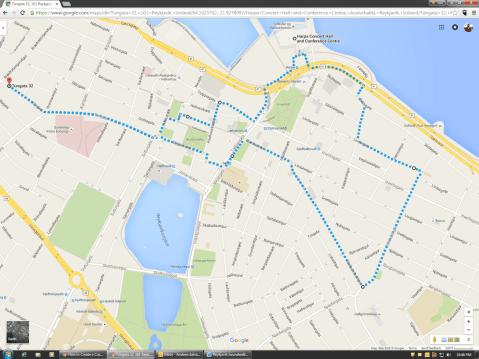
Standing in front of our rented apartment in Túngata, a residential street just a few blocks from central Reykjavík, I am struck by the stillness of the city that surrounds me. Having lived most of my life in the densely-populated suburbs of northern New Jersey, my experience of urban soundscapes has typically been frenetic and noisy. Here, even the busiest parts of town seem subdued. It’s a pleasant contrast. At 8AM on a weekday, the quietness is eerily enveloping, broken only occasionally by a gust of arctic wind, a passing car, or a neighbor closing her door and setting off for work.
Quiet tranquility and natural beauty have attracted a growing number of tourists to Iceland in recent years, my wife and I included. With only 330,000 people inhabiting an area roughly the size of Kentucky (and two-thirds of those settled in and around Reykjavík), one needn’t venture far out into Iceland’s otherworldly landscape to feel far removed from civilization – like exploring a distant planet. While the island may be still now, the belated realization that Iceland’s bizarre terrain, its vast lava fields, meandering fissures, and Dr. Seuss rock formations are the result of earth-shattering eruptions – like Eyjafjallajökull in 2010, Bárðarbunga in 2014-15, or the more recent rumblings around Katla – can be a little unnerving. Travelling through the Icelandic countryside, one imagines the thundering cracks, seething magma, and the infernal growl of the awesome geophysical forces that churned up these vast panoramas.
To a certain extent, the absence of sound here heightens a sense of the sublimity of the world around us; that from certain perspectives, nature is fundamentally ineffable – incapable of being fully represented by language, data, or art. Sound, I think, can complicate this experience. On the one hand, the extraordinary sounds of earthquakes and volcanic eruptions, of great storms, or the roiling of heavy seas, contribute to the overwhelming experience of the grand and fantastic. On the other, these sounds, like perhaps the everyday noise of a busy street corner, may also break the spell by yielding up the audibly familiar. Wandering around Reykjavík at this early hour, a settlement that has clung defiantly to a desolate rock in the North Atlantic for over 1000 years, I become acutely aware of each new sound to disrupt the ethereal silence. Each of these, even the most mundane and urban, seems to take on larger significance and intention as audible signs of the ways in which human beings have forged order and meaning from a wild and indifferent world.
But for now, all remains quiet, and the island’s primordial silence seems to reach even into the capital itself. Of course, Reykjavík is a vibrant international city resonating with the familiar sounds of urban life. But at certain times the quietness that seems to subsume everything else – a subtle reminder of the relatively small scale and frailty of the human compared to the geological.
Soon enough however, as I walk up Túngata there’s a siren in the distance, and the neighborhood begins to echo with the sounds of children playing in the yard at Landakotsskóli, one of Iceland’s oldest schools. I follow the street as it arcs towards the city center, passing several foreign embassies and the imposing gothic edifice of Dómkirkja Krists Konungs. A few other cars motor past and there’s a brief gust of cold wind, but these are momentary disruptions. Soon enough the world returns to the now-familiar stillness.

Grafitti in Reykjavik. Image by Rog01 @Flickr CC-BY-NC-SA.
But the sounds of morning traffic pick up a bit as I walk further down the hill – the rush of passing cars, the groan of a utility truck turning off a side street, and the muffled sounds of a radio floating from a car window. At its end, Túngata bends to the left at the bottom of the hill, where I see a large excursion bus stopped in front of a hotel, and a knot of tourists quietly talking nearby. It’s time for morning pickups, and the idling of these busses, and the hushed, expectant voices of day-trippers outside hotels and guesthouses around the city turn out to be common vignettes along my morning walk. They’re a reminder of the vast growth in tourism this year, which is expected to increase 29% over 2015 to 1.6 million foreign visitors.
Continuing straight onto Kirkjustrӕti, I pass the Alþingishúsið (Parliament House) on my right, and Austurvӧllur, a large public square on my left. The place is relatively quiet now. The cafes lining Vallarstrӕti and Pósthússtrӕti are closed, and there are only a handful of people walking through the square. Later on, the cafes will be buzzing with patrons enjoying the balmy (for Iceland) weather and the long hours of sunlight.
But aside from the nightlife, Austurvӧllur’s proximity to Parliament means that historically it’s been a focal point of political protest in Reykjavík. Two months before our visit, some 24,000 people crowded into this space to demand the resignation of Prime Minister Sigmundur Davíð Gunnlaugsson, who was revealed by the Panama Papers to have undisclosed connections with an offshore shell company with interest in failed Iceland banks. Walking past the square today, I can only imagine the chants, claps, whistles, shouts, barricade-banging, and yogurt-throwing of Icelanders expressing their collective frustration with corrupt officials.

Construction in Reykjavik. Image by Patrick Rasenberg @Flickr CC BY-NC.
This morning however, apart from the early morning sound of chirping birds and pedestrian commuters, there’s a bit of construction going on here – I can hear a few landscapers and a pair of contractors clanking and clunking as they lay out equipment for work on a building next to the Alþingishúsið. From these men and others I pass along this stretch of road, I hear the hushed and slightly groggy speech of early morning. The talk is all in Icelandic of course, a language whose place and street names I valiantly try to pronounce when I visit. Icelandic is a notoriously difficult language for foreigners in general, and its tongue-twisting staccato and subtle consonants, not to mention its intimidating alphabet, usually leave my mouth sounding a bit too awkwardly Jersey (as you can hear for yourself in this podcast!).
Continuing on my walk, I follow Pósthússtrӕti as it threads around Dómkirkjan and out to Lӕkjargata, the main avenue in this section of town. Here, the soundscape is more typically urban. The sound of trucks and cars passing, a bus groaning into gear as it pulls out into traffic, the multi-lingual chatter of pedestrians at a crosswalk, a group of teenage volunteers chatting in Icelandic as they do groundskeeping work near the Stjórnarráðið government offices, all speak the language of a city’s morning routine.

Street art in Reykjavik. Image by Toni Syvänen @Flickr CC BY-NC-SA.
Bankastrӕti, the main commercial district, is also coming to life. It’s still early, and most shops are closed, but heading east up the street, I hear a few snatches of conversations in Icelandic and American English – and there seems to be more of the latter than I remember from the last time we visited, testament to Iceland’s growing attraction for U.S. tourists. All along Bankastrӕti, the sounds of lively conversation, music, and the clinking of tableware floats out of open doors as people pop in and out of cafes and restaurants for breakfast and morning coffee. As I bear right on Skólavӧrðustigur and up the hill towards Hallgrímskirkja – the Lutheran church that dominates the city skyline like an art deco rocket ship – these sounds start to thin out again. Apart from a passing car or pedestrian, and the occasional rumbling of a tour bus or ATV, I am left in the comforting hush of a Reykjavík morning.
At the top of the hill, the large stone plaza before Hallgrímskirkja echoes with the clattering sounds of workers hammering at the roof of a nearby building, as the great green statue of Leifur Erikíksson silently watches on. I turn left on Frakkastígur and head downhill towards Faxa Bay, which looms in the middle distance. Frakkastígur turns out to be the noisiest stretch of my walk: there’s the roofers; the slapping of lanyards on the flagpoles that surround Hallgrímskirkja; the busy bakery where I buy morning croissants surrounded by Beatles music, the English and Icelandic chatter of customers, and the pounding, rolling, and cutting of dough; and finally the two large construction sites that I pass between Laugavegur and Hverfisgata streets. Here, the motoring of earthmovers, the shrieking of a circular saw, and the pounding of a massive pile driver jar the neighborhood with an intense mechanized racket.
I’ve noticed a fair amount of construction around Reykjavík this trip. The skyline bristles with cranes. It’s another marker of the booming tourism industry, and its complicated place in the Icelandic economy. Since the financial collapse of 2008, there’s been pent-up demand for residential housing. But with the local construction industry strained from the current spate of hotel building, it’s been difficult to find builders to work on residential projects. What I hear around me is a sign that Iceland’s economy has improved, but it’s also a reminder that improvement sometimes makes life more difficult for local residents.

Sculpture on the shore of Reykjavik. Image by Ainhoa Sánchez Sierra @Flickr CC-BY-NC-SA.
The sounds of heavy construction fade as I wind my way down to the bay and cross over Sӕbraut to the promenade that lines the shore. Like any highway, at this point in the morning Sӕbraut fairly hums with commuter traffic; here, the ambient sound of suburbanites making the morning drive to work, complete with attendant sound of brakes, horns, and Icelandic drive-time radio mix with the rushing sound of wind rolling off the waterfront. Walking along the promenade now, I pass a few joggers and bicyclists as a walk over to Harpa, the newly-built glass and steel concert hall that is home to the Icelandic Symphony Orchestra and which, every autumn, becomes a focal point of the week-long Iceland Airwaves music festival. It’s this annual event, I muse, that should be the subject of a future sound walk (for me or someone else) – five days in which Reykjavík pulsates with the sound and music of dozens of bands playing formal and informal shows at venues, cafes, bookstores, and basements around the city.
From a large dig site next to Harpa (the possible site of yet another hotel), I cross back over Sӕbraut to the clicking sounds of a crossing signal for blind pedestrians. I pass Bӕjarins Beztu Pylsur (The Best Hot Dog in Town), which is closed for the morning, and walk back into the city center, which is by now clearly awake and buzzing with locals and tourists. After stopping in a 24-hour supermarket for some morning milk, I walk east on Austurstrӕti past the Laundromat Café and other restaurants that are now busy serving the breakfast crowd.
Up through Ingólfstorg square (which appears to double as a skate park, but is right now a stopping point for a walking tour group), south on Aðalstrӕti, and around the turn by the Reykjavík Settlement Museum, I’m soon walking back up through the quiet neighborhood lining Túngata.
—
Featured Image by SambaClub | Camisetas com conteúdo (a t-shirt site) @Flickr CC BY.
—
Andrew J. Salvati is a Media Studies Ph.D. candidate at Rutgers University. His interests include the history of television and media technologies, theory and philosophy of history, and representations of history in media contexts. Additional interests include play, authenticity, the sublime, and the absurd. Andrew has co-authored a book chapter with colleague Jonathan Bullinger titled “Selective Authenticity and the Playable Past” in the recent edited volume Playing With the Past (2013), and has written a recent blog post for Play the Past titled “The Play of History.”
—
REWIND!…If you liked this post, you may also dig:
SO! Podcast #37: The Edison Soundwalk–Frank Bridges
This is What it Sounds Like……..On Prince and Interpretive Freedom–Benjamin Tausig
Soundwalking New Brunswick, NJ and Davis, CA–Aaron Trammell
Share this:




Current Top Posts





April 2021

January 2020

November 2019

October 2019

August 2019

April 2014

November 2017

March 2015

December 2017

October 2015
 Sounding Out!
Recent Comments