
Could I Be Chicana Without Carlos Santana?
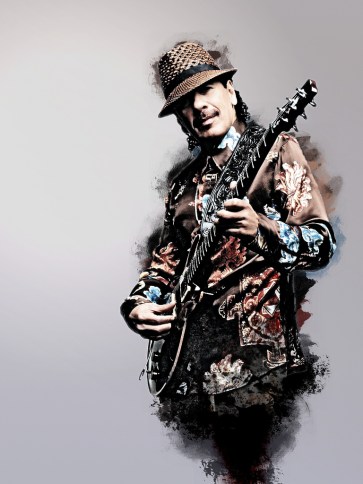
Carlos Santana by Flickr User Momez
This may be a given but I have to ask: Why is the music of Carlos Santana considered “Chicano music?”
It’s true; I am a fan. And as a fan I never question why I love the music, but I often ask myself what it is specifically about the music that resonates so strongly with me. I could say that I love Santana because I love a soulful electric guitar voice, because I admire the musicianship of the band, because I feel the “sabor” they sing about, because I’ve always loved Santana. But these parts surely do not make up a satisfying the “whole.” There is something else, something about listening to the music that amplifies my sense of identification as a Chicana with other Chicanos and Mexicanos. This happens whether I’m among raza, in the various communities I call home, or whether I find myself feeling very far from Aztlán. I’ve witnessed the effect of the music – maybe you have too – when it comes on the car radio, at backyard family BBQs, and friend’s living room dance floors, the music gets your body up and connects you to your Chicano roots.
In this sense, Santana is forever part of the Chicano sounded imaginary. For Chicanos, identifying with the music of Carlos Santana may have a special meaning that has something to do with a particular Chicano/Mexicano subjectivity. Yet, for non-Chicanos, Santana still retains their quintessential American rock band status. Most of their airplay is on mainstream radio, rarely if ever on Spanish-language stations. So Santana can be thought of at once as “puro” Chicano or “classic rock,” except that Santana is a straight up fusion band. This is why I have to ask, is the music of Santana “Chicano” music? And I further wonder, could I be Chicana without Carlos Santana?
…Oye Como Va…
Before the Rob Thomas & Carlos Santana collaboration on the Grammy award-winning album Supernatural (1999), before the phenomenon of “Smooth,” there was classic Santana. The Santana that produced the self-titled debut album Santana (1969) and Abraxas (1970). The songs “Evil Ways,” “Black Magic Woman,” and “Oye Como Va” from these two albums are on constant rotation on “classic rock” stations well after forty years since they first hit the airwaves. Even if you’re not a fan or a music connoisseur, when listening to “Oye Como Va” or “Smooth” it’s easy to recognize a distinct “Latin-ness” about them. In part, this is because of the fusion of Spanish and English lyrics with rock, blues, jazz, and Afro-Latin musical styles. For Chicanos, this particular fusion of language and sound might also resonate as something familiar and close to home – if sound can be a home. A quick search on YouTube will lead you to the classic 2000 Grammy Awards Performance of “Smooth” and a wealth of competing claims by fans (and foes) in the comments section.
Fan 1: “SANTANA ERES LO MAXIMO, VIVA MEXICO!!!!!!!!”
Fan 2: “Salsa baby, Oye Como Va is universal, Carlos is the man!!!!”
This was a special and high-profile performance so these comments are exceptionally spirited. But, YouTube is full of spontaneous, impassioned, (albeit anonymous) examples like this on any given day. I highlight these two as sort of placeholders for the idea of how sound and music mighty carry significant meaning toward subject formation in an everyday sense. These fans claim Santana both for Mexico and for the world, respectively, because they reflect a strong sense of Mexican or Chicano pride. In the first comment, the very enthusiastic fan could easily be a Mexico City native, maybe a Chicano wanting to sound like a Chilango –“ERES LO MAXIMO” is not a Chicano Spanish expression. The second fan’s comment is all in English and could be Chicano simply based on that—but those are slightly secondary points. As I suggested earlier, for Chicanos, Santana’s music has the potential to reflect a sense of ethnic history and culture. Sound can be a home. After all, the first comment claims Santana’s music for a whole country with “VIVA MEXICO!” helping to affirm the feeling that this fan and Carlos are Mexicanos together, across time and place.
When I was studying music in college, Mexican, Chicano, or Latino music was not part of the curriculum. Instead, in my private piano lessons, I would gravitate toward pieces by Spanish or Latin American composers as a sort of “good enough” way to stay in touch with my latinidad. This helped, but the fact is that Latin American art songs have much more in common with the Western musical canon than they do with my experiences and Chicana consciousness. In other words, it was a reach to identify with these composers solely because we shared a language. What would I miss in a too quick move to identify with the Latin-ness of Santana’s music this way? Would I hear only the Spanish spoken in the song? If so, then gaining a sense of my Chicana/o subjectivity by claiming “Oye Como Va” (for Aztlán?) relies on partially subsuming the specific Caribbean contexts and poetics of the song. Is this song originally Cuban, Puerto Rican? It’s really just a party song. “Oye como va, mi ritmo, bueno pa’ gozar, mulatta” Eso! Does it really matter now if Santana’s version has re-defined it for all time?
In a way, the second fan expresses a more complex desire: “Oye Como Va is universal.” Everyone knows that Carlos Santana is Mexican, some know that he is also an immigrant, and still others may have read that he grew up in Tijuana. As part of American rock music history, Santana’s roots are firmly planted in San Francisco and the Bay Area and it is well known that Santana played at the historic Woodstock Festival of 1969. Clearly, amongst other identities, Santana is a classic American rock band with long and wide appeal. But from the beginning, along with creative fusions of rock, jazz, blues, and salsa, it has been the distinctly Afro-Latino percussion core that defines their emblematic sound. And this is exactly how and why dwelling on these details in the sound of Santana matters. If Santana comes to mean or signify something like “pur0 Mexicano” or “pur0 Chicano” (in a brown pride or brown power sense) then that purity is already so productively and interestingly troubled because there is nothing remotely “pure” about Santana’s music.
Therefore, to identify with the music means confronting those complex fusions of language, race, and music that make up the Santana “sound.” To partly answer my earlier question, “Oye Como Va” is a composition by the renowned Puerto Rican timbalero and band leader Tito Puente, but the musical form, a basic cha-cha-cha, is Cuban. The song has other authors as well, that both Santana and Puente name. But ultimately, this song and indeed much of Santana’s music, comes in wake of much older histories of African diaspora, migration, colonization, artistry and spirituality.
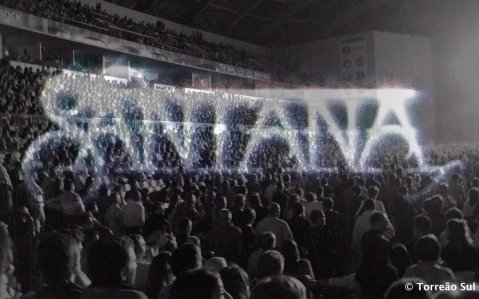
Santana fans. Image by Torreãu Sul.
…Sounding Home…
In a way, I’ve always felt that Santana’s music was making a black/brown connection, that racial boundaries were necessarily crossed or brought together because of the many histories that flow through the music. As a child of Mexican immigrant parents, I grew up listening to a wide repertoire of Afro-Latino music – elegant danzónes, romantic boleros, joyous cumbias, mad mambos, as well as more traditional Mexican music. Maybe that is also part of why listening to Santana reminds me of home. But this is perhaps too simple a response.
Santana’s music and popular image has been engaged in positive but also problematic ways in Chicana/o cultural production. Most recently, I noted this in a performance of the play New Fire, by Cherrie Moraga, in San Francisco. At a critical point in the drama, the evocative love song “Samba Pa’ Ti” is used to introduce a male character and a difficult, sexually violent scene. Moraga’s larger critique is of violent Chicano patriarchy and masculinity. The play is offered as a healing ceremony. But the association of this song, which features a famous guitar solo, with that specific scene is profoundly jarring. My sense was that Moraga selected Santana for the play’s soundscape it served as a shorthand for “Chicano.” Here, it was made to bear the history of violence of brown men against brown women and girls. This made it difficult for me to identify as a Chicana–queer and feminist–with Carlos Santana at that moment, and some time after. Surely this is also part of what “home” means.
Santana’s music interests me for these reasons, which go beyond the sounded Chicano imaginary in my headphones. What I find worthwhile in thinking further about Santana’s “sound” is how in the many acts of claiming Santana for oneself, one’s country, or one’s community, I can trace the way in which Chicano and Caribbean histories, both racialized and gendered, touch and cross in the music. That is, I see this as an invitation for the listener to reimagine notions of race, nation, gender, and sexuality even while dancing and singing along. In these ways, I see meaningful possibilities for imagining Chicana/o as a sounded subjectivity. I am certain that my sense of who I am, how I think, and how I walk in the world has been shaped by a life-long relationship with music and sound. And although being “Chicana” to me is not the same for anyone else, Santana’s music helps me to imagine a connection, a musical lineage I can trace and take part in. Santana is not my parent’s music. It’s not even my generation’s music. And, it’s not my only musical identity. But, even so, I couldn’t imagine being Chicana without Carlos Santana. Because when I listen, I do hear it, I hear how it all goes, together, and that is so, so good. “Give me your heart, make it real, or else forget about it!”
—
Wanda Alarcón is a PhD student in Ethnic Studies at UC Berkeley where her research involves reading Chicana and Caribbean “stories” together in a decolonial feminist vein. When she’s not living the glamorous grad student life she likes to make zines about po’try, learning new songs on her childhood piano, cooking for her loved ones, and exploring NorCal with her main squeeze. A native Los Angelena, she is beginning to appreciate thinking and writing about her beloved hometown from afar. Music helps bridge that distance. So do the trees and ocean breezes. She lives and loves kibbutz-style in Santa Cruz with her partner por vida, Cindy, their two sassy cats Lucy & Mona, and dear housemate, Ella.
Share this:

“Everyone I listen to, fake patois. . .”

It may seem a little crazy to take Das Racist seriously. Their songs are deep in the realm of the ridiculous, but I can’t help but feel that “Combination Pizza Hut/Taco Bell” is a commentary on how the compression of urban space is shaped by our relationship to consumption. Close-reading of their songs provide repeated evidence for the underlying tenor of seriousness in that absurdity—even if they’re being playful about it. As one of my favorite Das Racist songs says, “we’re not joking / just joking / we are joking / just joking / we’re not joking.” (For those who need help parsing, no, they are in fact, not joking). Take for instance Das Racist’s “Fake Patois” off of their free downloadable “mixtape” Shut Up, Dude! (2010). This satirical and intelligent exploration of the sounds of authenticity and their relationship to the reggae-hip hop dyad uses fake patois itself, working off an ironic tension that is as troubling as it is funny—and it’s also a banging song.
The “patois” used in American hip hop is clearly meant to be Jamaican-sounding, mixing elements of Jamaican creole language with a generous sprinkling of terms specific to Rastafarian English. The sounds of “fake patios” are a stylistic choice, reinforced through a dancehall reggae cadence of rapid-fire clipped words, rapped melodically. “Fake Patois” recalls the role of reggae in identifying an authentic origin for hip-hop. And certainly the connection cannot be denied. That Kool Herc brought Jamaican DJ culture with him to the Bronx is originary, and Run D.M.C brought it up in 1984’s “Roots, Rap, Reggae” (featuring Yellowman). If you want a more detailed mapping of a particular reggae meme’s journey through hip hop, check out Wayne Marshall’s fantastic essay on the subject, which demonstrates that even when contemporary artists think they are paying homage by imitating their rap fore-bearers they are also unknowingly paying homage to the influence of Jamaican music on American rap.
.
Das Racist’s “Fake Patois” speaks with a deep awareness of this tradition in rapping, but what may on the surface seem like an indictment of the “fake” nature of the adopted style is actually an example of what George Lipsitz called “strategic anti-essentialism” in Dangerous Crossroads. While critical of reckless appropriation of various ethnic musics by western whites, Lipstiz nevertheless sees this music as a way for individuals to express their identity through solidarity, sharing a respect for that music’s history as it is embedded in a framework of power. The song shows this respect through its knowledge, but also immediately calling out artists that have used the “fake patois,”—respected ones like KRS-One, b ut also “My man Snow,” a white Canadian performer of dancehall reggae. Snow is probably the quintessential example of the “fake patois,” as his 1993 break-out hit, “Informer” was for much of white America the first exposure to the sounds of dancehall reggae. Snow withstood attacks on his authenticity throughout his career and tried to shore it up through his incarceration narratives and associations with blacks of Caribbean descent.
Das Racist doesn’t limit their list to musicians, and their choices highlight the different ways patois is put to work. For example, they mention Miss Cleo of psychic phoneline fame, who claimed to be from Jamaica, but is an actress and playwright from Seattle. Through her patois the Miss Cleo character sold the authentic origins of her mystic powers. Das Racist seems to be suggesting that the use of the patois sound in songs is selling something as well, even as they use it to sell their own song.
.
Similarly, the lyric, “Even Jim Carrey fuck with the patois,” makes reference to the actor’s parody of Snow’s “Informer.” While “Imposter,” is clearly meant to call out Snow’s lack of ‘blackness,’ Carrey’s mocking “Day-O” and his characterization of dancehall lyrics as “gibberish” also underlines a disdain for the music form itself. While potentially problematic, Snow’s performance is clearly born of an earnest appreciation of dancehall reggae. The parody, on the other hand, despite its comedic intent, does not have the performer’s genuine affect to mitigate its buffoonish mimicry.

"Even Jay-Z did a fake patois" by Flickr User NRK P3
Das Racist’s song also reveals a degree of comedic intent. The use of autotune highlights the artificiality of the sung patois. Their straight delivery of ridiculous references (“Crunch like Nestle. . .Snipe like Wesley”) and their use of repetition to re-emphasize the absurdity of their performance is funny. They revel in the dumb fun of referencing Half-Baked—when Dave Chappelle, posing as a Jamaican, is asked what part of Jamaica he is from and he replies “right near the beach.” Das Racist’s demonstrated mix of absurdity and awareness destabilizes their position as a means to open up a field of possibilities. It does not set limits by associating authenticity with a singular origin, but rather to establish it as a connection with an ongoing tradition.
The song continues to question the stability of the authentic by calling out two singers with a “real” patois, Shabba Ranks and Cutty Ranks, for their past homophobic songs and comments. Das Racist sings, “Your M.O. Is ‘mo / Me say no thanks.” That “’mo” is short for “homo,” and that “no thanks”serves to distance them from the popular examples of male Jamaican artists whose homophobia has been linked with a hypermasculine ideal played out through violent fantasy—whether it’s Shabba’s defense of Buju Banton’s “Boom Bye Bye” or Cutty’s “Limb By Limb.” Their apologies attempted to connect their bias with their “culture,” trying to excuse their ideas in terms of how they authentically inform their problematic songs. In this lyric, Das Racist is implicitly rejecting homophobia as a litmus for authenticity, while playing with a homophobic term. In other words, for artists like Shabba and Cutty to defend homophobia in reference to a “realness” in their music is suggesting that bias against gays is a precondition for making “real” music.
For me, the broader question that emerges from this interrogation of “fake patois” is: to what degree can a variety of popular music sound choices (singing style, melodic influence, etc that are associated with a particular culture or nationality) be similarly destabilized or revealed as “fake”? The Beatles sang like fake Americans, imitating their favorite (mostly black) artists, and Green Day have sounded like fake Brits, identifying with some authenticating element found in the sound of English punks. What ground does this destabilization open up? What possibilities for connection does it provide and what framework can we use to discuss it when the results seem problematic?
Lipsitz writes, “In its most utopian moments, popular culture offers a promise of reconciliation to groups divided by power, opportunity and experience,” and Das Racist certainly seems to be doing their best to critically fulfill that promise. Their self-conscious undermining of their position and their willingness to simultaneously suggest that there may be something problematic with mimicking patois–while highlighting that so-called authentic identities are sutured together into a particular kind of sounded performance–articulates a bond through an identification, not a singular origin. In doing so, Das Racist suggest a network of identities bound by points of solidarity, making room for South Asia in the Black Atlantic by way of the Caribbean.
—
Osvaldo Oyola is a regular contributor to Sounding Out! and ABD in English at Binghamton University.
Share this:


Current Top Posts





April 2021

January 2020

November 2019

October 2019

August 2019

April 2014

November 2017

March 2015

December 2017

October 2015
 Sounding Out!
Recent Comments