
Sounding Boards and Sonic Styles: The Music of the Skatepark
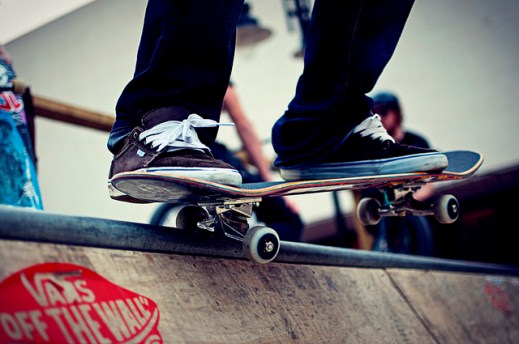
 Welcome back to our summer series on “Sound and Sport.” In today’s post, Josh Ottum discusses the sonorous sounds and unique rhythms of the sport of skateboarding. For an instant replay of last month’s post, click Tara Betts‘s “Pretty, Fast, and Loud: The Audible Ali.” For May’s post, click Melissa Helquist‘s “Goalball: Sport, Silence, and Spectatorship.” Next month’s grand finale will feature a doubleheader on Brasil, with a post by Kariann Goldschmitt on the promotional sounds of FIFA 2014 and a podcast by Andrea Medrado entitled “The Sounds of Rio’s Favelas: Echoes of Social Inequality in an Olympic City.” We’ll close with another take on the Olympics, excerpted from David Hendy‘s recent Noise broadcasts for BBC Radio 4 on the politics of boos at the games. For now, get out your board, strap on your helmet, and prepare to jam. —J. Stoever-Ackerman, Editor-in-Chief
—
Seven layers of screen-printed, sugar pine maple whack the concrete. Aluminum axles pivot on rubber bushings as they slide across steel coping. Circular, molded polyurethane encases lubricated bearings that spin in midair before slamming onto birch. Vocal cords are strained as exclamations are made in response to a maneuver. These are the unmistakeable sounds of the skatepark. As skaters ride through the park, a unique sonic tapestry emerges revealing a constantly shifting array of timbre, pitch, and rhythm. This sliding aural space is similar to the compositional flow between rehearsed maneuvers and improvisatory actions, connecting skaters in the skatepark to musicians improvising in a jam session.
Just as the results of a musical performance depend on acoustics of the venue and the idiosyncrasies of the instrument, the skater is beholden to a similarly complex signal chain. The aural atmosphere of the skatepark relies on the number of other players, as well as their chosen instruments, and unique approach to playing. While surveying the sonic and social dynamics of four skateparks in Ohio and California for this study, the line between performer and listener was often unclear. Skaters are consistently sliding between roles as passive observers and active participants, watching and being watched, making sound and listening to the sounds of others. And, just as an improvising musician aims to develop her own unique voice, the skater intertwines sonic and visual elements into a unique stylistic signature all her own. In this study I will look at the skatepark as a site for skaters to express themselves much in the same way that a musician plays an instrument at a jam session. I will explore the board and terrain, the importance of style, and the culture of the park itself. To begin, I will contextualize the ways in which the skateboard has been constructed as a sonic instrument.
The Instruments
As a skater lands an ollie in the Vans Skatepark in Orange, California, the sound of hard polyurethane wheels slamming against a hollow birch ramp emanates throughout the warehouse, entangling with distinctive sounds made by other participants. The listener is made acutely aware of each skater’s instrument and stylistic approach to performance. What differentiates the rider on a board in the skatepark from a guitarist playing in a rock club? Just as the materials of the electric guitar and its signal chain inform the sonic nature of the instrument, the skateboard and its engaged terrain sound out unique and identifiable characteristics of each device. I spoke with a skater at Flipside Skateboard Shop in Athens, Ohio about the specifics of wheel construction and his own personal preferences:
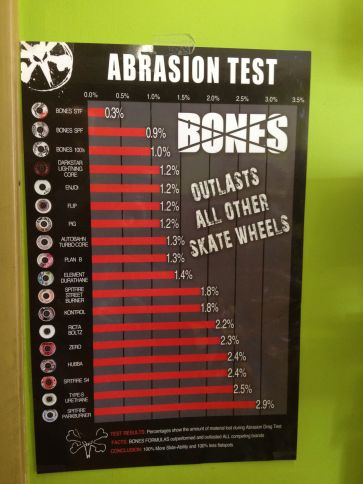
Abrasion test chart, Flipside Skateboard Shop, Athens, Ohio
Just like the layered wood of an electric guitar body, boards are made through a multistep manufacturing process that involves layering thin plies of wood. Maple is most commonly used with the relative flexibility of the deck determining qualities of audible resonance as a skater ollies or railslides. And trucks, which function as axles, can be heard grinding along a surface such as pool coping, a painted curb, or a handrail.
In order for these materials to make sound they must be controlled by a rider and engage with some kind of terrain. The combination of what materials are chosen and how they are used result in a rider’s unique approach. In the skatepark, skaters swathe themselves in clothing, pads, and helmets while riding devices wrapped in visual signposts of self-expression that sound out the priorities of the particular rider.
Sonic Style
Following Henri Lefebvre, Iain Borden speaks of the skateboard as a “lived component of the body, its actions and its self-image in relation to the terrain” (28). Similarly, from my time spent at skateparks in Ohio and California, I have noted the malleability of terrain as a domain to express one’s own unique style. Skaters use their devices as instruments, playing the park, repeating phrases, overlapping with sounds emitted from their peers. All the while, advertisements adorn both bodies and instruments and maneuvers mimic the iconic moves of sponsored skaters viewed in magazines. Visiting Focus Boardshop across the street from the Etnies Skatepark in Lake Forest, California reminds the observer that the elusive, focal point of style in the world of skateboarding is not only confined to the visual realm. As reissued decks from Powell Peralta, Slimeball wheels, and multiple videos adorn the walls of the shop, teenage skaters hang out, asking to bend and stand on decks and spin wheels, all the while watching and listening to newly released videos. Just as guitars and synthesizers reflect the users aesthetic outlook, the look and sound of skateboards signal to a skater’s audience (often other skaters in the park) what kind of skater he or she is.
Tara Rodgers’ insightful article on wood paneling on synthesizers for Sounding Out! has its analogue in the spiritual aura of the object in skateboarding. Bound up in this aura are genre-shaping histories that have taken the sport in innumerable directions. Whether it is the catwalk ethos of Vision Street Wear, Danny Way’s connection with Monster and Red Bull energy drinks, or enjoi’s self-referential marketing, the graphics that wrap around skate gear carry with them weighty connections to the sport’s most original moments. These moments are, of course, defined by marketing campaigns, hosted in influential magazines such as Thrasher and Transworld, and the zietgeist of the time. Intertwined with these branded materials is the sonic quality of the instrument. The sound of the instrument itself reflects the particular ethos of the skater who selected it. In the clip below, an employee working at Focus Boardshop in Lake Forest, California talks about the particular way his board’s sound reflects the idiosyncratic nature of its components. Notice how he skater speaks about the sound of his bearings as a direct link to his style, connecting to Borden’s idea of the board as a lived component of the body.
During my visit to the community skatepark in Athens, Ohio I come across two skaters who have returned to the sport after a two-decade break. One skater sports a longboard with 70a wheels so soft you can’t hear him skate through the concrete pool. Immediately after interacting with the longboarder, another skater finishes a session in the pool at the Athens skatepark with a long slide. I ask him about the role of his wheels and what he calls “the best sound in the world”:
Soft Wheels
Hard Wheels
Skaters related the histories of their boards to me with a sense of fond nostalgia. These histories functioned, primarily, as a mode of individuation, through which those observed were seen refining their identities within the community through conversation. As more time is spent at each of the parks, I begin to notice communal flows of conversation between skaters and their engaged terrain as well. Competitive aspects to out-do each other, synchronized maneuvers, and vocal responses are percolate the soundscape. As listeners perform and performers listen, connections with well-formed cultural codes of improvisational music begin to emerge.
Jamming the Skatepark
Improvising musicians often use the context of the jam session as an opportunity work out new ideas and rehearse repertoire. Minton’s Playhouse in New York is one of the original sites for the jazz jam session. Here, “cutting contests” allowed players the opporunity to outplay each other with virtuosic displays of improvisational prowess. Musicians play to hear each other individually and as a unit, often pushing each other to extremes. The sound is composed, listened to, and then reacted to. Skateparks provide a similar atmosphere. A trick (like an ollie) is immersed in the sonic flows of the surrounding skaters. The skatepark is simultaneously encouraging and competitive, forgiving and relentless.
When I visited the Vans Skatepark on National Go Skateboarding Day park employees tempted skaters to display their best moves throughout the park with the promise of free swag. The environment remained friendly and encouraging as skaters rose to the challenge, welcoming the pressure.
The rituals of the skatepark are varied in their scope. When a skater lands a difficult trick, it is common to hear the tapping of board tails on the ground; applause. Vocal reactions to maneuvers (landed or failed) are also quite common.
What sets the sonic atmosphere of the skatepark apart from the sound of skating outside the park is the palpable lack of intruding sounds from the outside world. As communities continue to accept the skatepark as part of their permanent landscape, the once transgressive sound of the sport takes on a new meaning. The scrapes and slides that once signaled intrusion are now contained in a controlled space. While visiting these jam sessions, it became clear that the sounds of the skatepark remain a mostly male-dominated activity. While the instruments and terrain remain available to the wider public the sound of the skatepark reflects a relatively closed environment often shrouded in platitudes of youth culture. However, once a sense of acceptance and experimentation is cultivated, some other aspects of the skatepark are revealed. The skatepark is a place to play and explore the range of one’s repertoire. It is a place to engage with the limitations of the instrument and one’s own physical faculties. And, it is an environment that encourages friction, noise, and distortion. The skatepark is a communal amplifier, obscuring and reflecting sound as the players immerse themselves in the ultimate sounding board.
Bonus Material:
While immersing myself in the sounds of the skatepark for this project, the idea came up to reimagine the sounds of the skatepark as a musical composition. I asked musicians Michael Deakers, Casey Foubert, Junior High, and Ryan Richter to make a piece that used any portion of the recordings of the four skateparks I visited. Their work reflects a deep connection to the rehearsed and improvisational aspects of music-making and skateboarding. The sounds of these pieces emerged from hours of practice and spontaneous decisions allowing for a particularly effervescent creative outcome. To hear these, check out out my Soundcloud here.
—
Featured Image, “Grinding” courtesy of Luke Hayfield Photography
—
Josh Ottum holds an MFA in Integrated Composition Improvisation and Technology from UC Irvine and is currently a PhD student at Ohio University in the School of Interdisciplinary Arts. His research interests include sound, energy extraction, Van Dyke Parks, Southern California, library music, and synthesizers. As a singer-songwriter, composer, and producer, Josh has released multiple records on various labels, completed numerous international tours, and composed music that has appeared on MTV, AMC’s Mad Men, and NPR.
—
REWIND! . . .If you liked this post, you may also dig:
“Tofu, Steak, and a Smoke Alarm: The Food Network’s Chopped & the Sonic Art of Cooking“–Seth Mulliken
“Sounding Out! Podcast Episode #5: Sound and Spirit on the Highway“–David Greenberg
“Sound-politics in São Paulo, Brazil”–Leonardo Cardoso
Share this:

“I Love to Praise His Name”: Shouting as Feminine Disruption, Public Ecstasy, and Audio-Visual Pleasure
Well, if you don’t believe in shouting,
That’s alright with me
Some folk don’t believe in shouting,
That’s alright with me…
Doubt and ignore it,
But I belong to the Lord’s crew.
David said rejoice in the Lord,
And that’s the way we Christians do.
If you don’t believe in shouting,
That’s alright with me.
–Dorothy Love Coates & the Gospel Harmonettes, “That’s Alright with Me”
A handy catch-all term, “shouting” is actually a euphemism encompassing a range of ecstatic worship behaviors. These can include clapping, dancing, pacing, running, rocking, fainting, as well as using the voice in speaking, singing, laughing, weeping, yelling, and moaning. Certainly, there were men who shouted in the days of my childhood in church; there are men who shout today. The only shouts I can recall and even imitate to this day, however, are those of the women.
There is, in fact, a longstanding association between women and shouting. Perhaps because of the pronounced emotionality involved in the practice, the shouting sphere tends to be prefigured as feminine and in this bears great relevance to women. I am interested in the significances of shouting among black Christian women of struggling populations. In my view, shouting is not only a religious practice for these women, but is also a binary-breaking performance which confounds—if only fleetingly—the divisions which have so often oppressed, menaced, and harmed them. I argue that shouting has worked to codify the disruption of male-dominated services by women who have so often faced sharp sanctions by black church patriarchy. I also contend that shouting places its female practitioners and their observers within a sphere of public ecstasy and visual and auditory pleasure, which makes mischief for notions of what is proper for Christian women and for the entire church community.
.
The Shout, the Sound, and the Shriek: Black Feminine Disruption
In a 2011 post for Sounding Out! entitled “Pentecostal Song, Sound, and Authentic Voices,” Ashon Crawley posits the existence of a black church “public zone,” which serves as the conceptual, holy ground upon which “sound, song, and subject [function] as conduits for the exchange of ecstasy and ecstatics.” I’d like to track Crawley’s public zone into the shouting sphere, the very heart of ecstasy within the black worship experience.
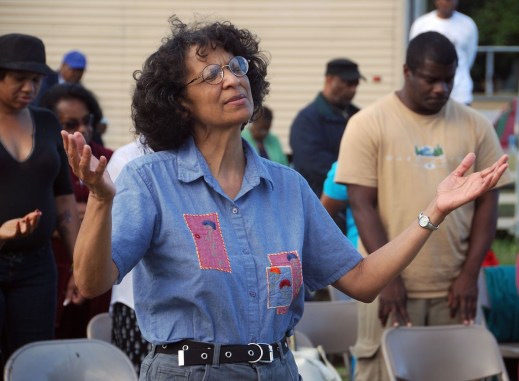
Although culturally codified—even expected and welcomed—within the church community, the shout functions primarily as a disruption. The faces, bodies, and voices of shouting black women disrupt the flow of the service. A shout takes time and has the power to alter the program. Regarding such moments, worshippers—most often women and gay men—often proclaim in retrospect, “Baby, there was no more order!” This disruption of order through the use of the body and the voice has a distinct place within the Christian black feminine tradition of resistance to oppression.

Image by Flickr User Steve Schwartz
In the essay, “The Restorative Power of Sound,” womanist Roxanne Reed has examined the function of gendered sound within black Christianity. For Reed, the feminine “wordless cry, holler, moan, or wail” achieves “primacy over the written text,” “suggests a historical time with relying on a defined chronology,” and is legitimated by an African “ancestral heritage” which presages black musical forms (2). This distinctly feminine worship sound claims space from “patriarchal privilege,” which has often extended to black folk preaching, a tradition which excluded most black women for decades after slavery.
The sound of the black feminine in worship is thus a symbol for black women’s triumph over historically masculine arenas of writing, history, and form. The shout and the gendered worship sound can be placed in critical triangulation with Fred Moten’s “shriek,” as theorized in In the Break (2003) An expression of the distinct suffering of the black female, the shriek is a primal “phono-photo-porno-graphic disruption” of spirit and matter, and other binaries (14). The shout, the feminine worship sound, and the shriek all take center stage as black female performances which disrupt oppressive categories and assert the black woman’s voice as triumphant.
Shouting as Public Ecstasy, Scopophilia, and Sonophilia
Many observers have noted the shout’s resemblance to sexual ecstasy. The shout is often expressed through the sounds, movements, and facial expressions commonly associated with sex. Some shouters close their eyes and moan. Some hug themselves around the waist or bend over the pew in front of them, rubbing their own shoulders, bellies, or thighs. Some roll about the floor, hollering or speaking in tongues. Some whisper His Name, as in closest intimacy to a lover. Some dance with abandon before the altar or in the aisles before collapsing, spent and panting. Some quiver quietly in deepest distraction.
Shouters in the throes of their ecstasy are closely observed by all within the church community. Members of church communities often mark shared remembrances by who shouted, when, and how. Even young children can be called upon to reproduce the shouts of various church members. The conspicuousness of the shout provides reason to consider it as spectacle containing pleasure for both the shouter and those who gaze upon her.
.
Laura Mulvey’s “Visual Pleasure and Narrative Cinema” discusses “scopophilia” as a phenomenon occurring in “circumstances in which looking itself is a source of pleasure, just as, in the reverse formation, there is pleasure in being looked at” (587). In the moment in which a shout goes forth, those shouters who are aware of being watched—not all are—and their gazers may be said to enter into mutual pleasure from being watched and from watching. For the observer, the pleasure arising from the sight-based stimulation is often compounded by the narcissism of the ego which seeks to identify with its source. This may explain why in highly charged church moments, shouts become highly communicable—“thriving in concert,” as Zora Neale Hurston once phrased it. Looking upon another in worship ecstasy can be understood to reinforce one’s own relation to the Holy and to stir desire to engage that relation through shouting.
There is sufficient cause to assign what I call a “sonophilic”aspect to shouting as well, as shouting never fails to take place but within a context of sound. This sonophilic component should be understood as the means by which the sounds of ecstasy coming from a shouter provide stimulation and identification in the listener, who may in turn become a shouter. It must be noted, however, that the sonophilia can emanate from sources other than the shouter. Shouts are often roused by a complex network of sounds. Within a service, preaching and verbal exhortations, prayers, congregational chants and songs, and instrumental music designed to buoy sermonic delivery or to capitalize on swells of emotion often work in tandem to provide the sound-based pleasure essential to shouting.
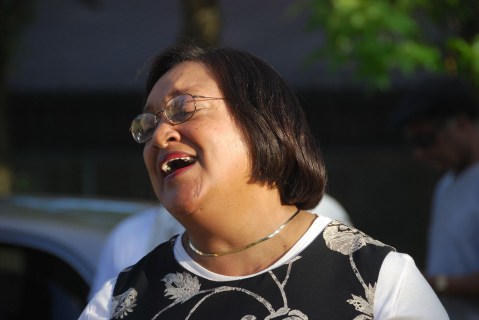
Image by Flickr User Steve Schwartz
A Final Shout-Out to Shouting
From West Africa to North America, from slavery to emancipation, from the eighteenth century into the present day, the black ecstatic in the form of shouting has served several important purposes for black women. Black women’s general and persistent preoccupation with the relationship between the spiritual and the sensual, the cornerstone of black female intellectualism in my view, was first and foremost expressed in the practice of shouting. The shout can be understood as the primary site upon which black women made the spiritual physical and rendered the sensual holy.
.
Furthermore, in eras in which black women were customarily denied the right to preach and were granted but limited authority within church communities, the shout communicated a woman’s ability to engage the Holy. This proven ability undoubtedly helped to open doors for the thousands of black women who now preach and pastor all over the country. Shouting has also provided much needed relief for the unique pressures of the black female in North America, absorbing and transforming her hurts and frustrations and replacing them, down through the centuries, with the hope and strength vital to her survival.
—
Featured Image Credit: Flickr User Steve Schwartz
—
Shakira Holt is a thirteen-year classroom veteran and currently teaches high school English in Los Angeles County. She earned a doctorate degree in English from the University of Southern California, and works primarily in the area of black women’s literature and culture. She is deeply concerned about the intersections of race, religion, gender, sexuality, class, and politics in the public sphere. She is a lazy poet, a latent novelist, an intermittent blogger, a retired songwriter, and a reluctant karaoke singer. A licensed Baptist minister, she is but slowly working her way back to the pulpit. “I Love to Praise His Name” is her first published piece.
Share this:


Current Top Posts





April 2021

January 2020

November 2019

October 2019

August 2019

April 2014

November 2017

March 2015

December 2017

October 2015
 Sounding Out!
Recent Comments