
Finding Resonance, Finding María Lugones
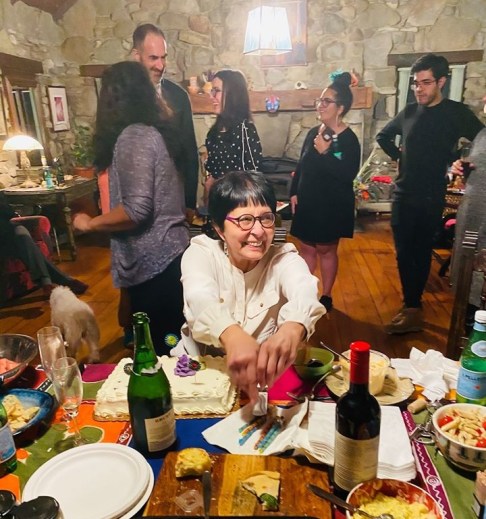
I am always listening for María: I find her most in the traces of words.
Trained as a literary scholar, I relish in the contours of stories; I savor the nuances found between crevices of language and the shades of implication when those languages are strung together. It is no surprise, then, that since the death of my friend and mentor María Lugones, I have turned to many books, particularly her book, Pilgrimages/Peregrinajes: Theorizing Coalition Against Multiple Oppression, to feel connected to her. I have struggled, though, to write about her, talk about her, even think about her for many years. It wasn’t until I found a passage about spirits and hauntings in Cuban-American writer and artist Ana Menéndez’s novel The Apartment that I found language to describe a way through the grief of the last five years.

Menéndez’s novel follows many characters that all, at some point in time, come to live in apartment 2B in Miami Beach. While each person is seemingly disconnected from the next, they all leaves sonic traces of themselves for the next person’s arrival. Each new tenant leaves behind the creak of a dented floorboard, or the rumbling of the air conditioner, the faint melody of a piano, or the swish of spirits looking for a place to sit down. The climax of the novel revolves around Lenin García, a young Cuban migrant who commits suicide in the Miami apartment shortly after arriving. Anna, a journalist who migrated to the US from the Czech Republic during their communist regime, prepares the apartment for rental after the suicide. When looking through Lenin’s belongings she explains that the “Spirits pressed down on her, and again and again she rejects them. Sends them packing, back to the pre-rational past. Not a haunting, but an echo. The boy’s life a gesture pointing back to her own. A dream of a thousand iterations” (131). These spirits that surround her, that remind her of her own life’s ghosts, provide a particularly sonic connection; the tethers that connect one migration tragedy to another is an echo of commonality that creates a kin experience.
The three years I learned with and from María are overshadowed by the physical distance the pandemic required of me in her final moments. When I try to write about her, my hair stands on end, my eyes water, my nose drips, and I stretch out my hand toward a presence I feel, just out of reach. I know it’s her, I just can’t seem to touch her. I have described María’s death as a haunting—as something that haunts me. I defined this haunting as a physical presence that I could not see, but I could feel, sense. But what if, like Anna, I am feeling, not a haunting, but an echo; or more accurately, the resonances of María that echo around me constantly? What Menéndez’s passage provides is the necessity of reinterpreting my awareness of María from one of general sensing to one of specific aural attunement. If I am listening for her, how, then do I keep her with me?

Lenin, from The Apartment, provides a potential answer: when meeting with a curandera in Cuba, she tells him “The ancestors speak to you from the home of your inner life. When your inner life is spare, there is nowhere for the ghosts to sit. When you furnish your spirit, the ancestors will once again find rest in you” (143). Echoes become an analytic that provide furnishings ‘in the soul’ for sustained company of those who have passed. The reverberation of echoes—reverberations as a prolonged sense of resonance that stretches the meeting of two energies—can, quite literally, allow a reader to connect back to people across space and time. My tether to María is a resonance that simultaneously locates and disperses spatially and temporally. I hear this connection as my harmony to her melody. To further the metaphor, that resonance is the strumming of a guitar, where I am the guitar and she is the musician, and that moment where we both hear for each other, even when we do not know the other exists, is the note.
What happens when I use literary methods of analysis to find people in the interstices of sound? To search for María in what she calls the “enclosures and openings of our praxis” as a reader of her text? Now that I had to search the histories of her echo, I turned to her book, Pilgrimages/Peregrinajes.
When María recommends “to women of color in the United States that we learn to love each other by learning to travel to each other’s ‘worlds’,” (78) I imagine our first few encounters; encounters that were strange, difficult, and lessons in learning to listen to her on her terms. I had been invited to her home in Binghamton, New York for a meeting of a political-intellectual group she hosted, and was nervous to meet the woman I had written my Master’s thesis on, and who was the reason I applied to Binghamton for a PhD program. Her voice rang through the room, slow and clear; her mouth pursed a bit as she thought through her next sentence, her finger pointed as she spoke her next idea. In trying to stay out of her way, I became a barrier when she moved backward; she bumped into me and said simply ‘you must be careful not to trip me’ and moved along. I was mortified.
Our next few encounters were similarly odd, and lead me to think that, maybe, María was not the right choice for my mentoring needs. A few months into this first year in graduate school—where tenured male professors were violent toward me, and I was not sure I should stay in academia—I confessed to a friend in the same political-intellectual group that I was not sure María liked me or that I should work with her. Her response changed everything: this friend, who had worked with María many, many years said: “don’t do that. Don’t make her mother you. It’s not who she is. Travel to her, learn her.” I finally understood that traveling to María’s world meant listening to her from her perspective, not my own. That shift in me “from being one person to being a different person” (89) is how I first found María in the haptic world. I learned to listening to her: I learned the catch in her throat meant she wanted tea; I learned the increase in sighs meant she was in more pain that usual; I learned the shuffling of papers probably meant she was looking for her handkerchief to wipe her forehead as she had a hot flash. Each of these sonic gestures, I could respond to—could show up for her.

But with María’s death, this kind of listening is no longer available to me; I could not listen for hem or hmm or tchps. I had to learn to listen differently. In re-reading Pilgrimages/Peregrinajes I learn that it does not just contain her philosophical interventions for liberatory futures. It is a series of stories; her stories of the echoes that resonate inside of her; stories that she weaves together that happen to name philosophical practices of relationality. It is through the coerced placement of her by her father in an asylum that she finds other woman who teach her to resist; this resistance is sonic: a woman repeating over and over “I am busy, I am busy” as they electroshock her (i). It is through wanting desperately to love her mother that she finds ways her mother taught her to listen differently in order to name the capacity of ‘world’-traveling. What I had felt when I first read her work over a decade ago was a resonance; a sonic reverberation across space and time that connected my to her before our physical meeting, during our time as friends and mentor/mentee, and now after her physical death.
Connecting to María through echoes feels effortless now that I have the language. I hear now María’s warning against the dangers in the primacy of the visual. In “Hablando Cara a Cara/Speaking Face to Face: An Exploration of Ethnocentric Racism,” she explains:
I exercise this playful practice. The appreciation of my playfulness and its meaning may be realized when the possibility of becoming playful in this way has been collectively realized, when it has become realized by us. It is here to be appreciated or missed and both the appreciation and the missing are significant. The more fully this playfulness is appreciated, the less broken I am to you, the more dimensional I am to you. But I want to exercise my multidimensionality even if you do not appreciate it. To do otherwise would be to engage in self-mutilation, to come to be just the person that you see. To play in this way is then an act of resistance as well as an act of self- affirmation (41).
What she taught me here is that being herself meant a practice that was more than being seen. To be what others could only see was an act of mutilation to her multidimensionality. That reminder was crucial to becoming her friend during my time at Binghamton, but even more crucial now that she is gone from this world.

I’ll leave you with the most important story she left behind: she provided a method of learning that was based on the senses and focused primarily on the sonic—what she called “tantear.” This tantear has become instrumental in my own research. It is a fumbling around in the dark, a feeling around tactically that focuses on searching “for meaning, for the limits of possibility; putting our hands to our ears to hear better, to hear the meaning in the enclosures and openings of our praxis” (1). The embodied experience of stumbling, of careful and intense feeling for and with others, requires a capacity of listening deeply. It is listening that undergirds the learning. The language of the sonic provides the understanding of the feelings within the body. Listening becomes a profound practice of relationality; echoes become a mechanism of connection; and resonance becomes the confirmation that I can still be with María.
—
Images courtesy of the author, except where noted.
—
Daimys Ester García is a Latinex writer, artist and educator from Miami. She earned her PhD in Comparative Literature at SUNY Binghamton. She is currently an Assistant Professor in English at the College of Wooster, where her research and teaching is at the intersections of Latinx literatures & studies, Native literatures & studies, women of color feminisms, and decolonial praxis with a focus on coalitional politic. She is working on a book manuscript, tentatively titled Comfort is Colonialism: Coalitional Commitments for Cuban-American Women Writers, which offers a repertoire of practices to re-connect Cuban-Americans with other histories of resistance in the US.
—
Thank you to Wanda Alarcón for care in the form of editorial labor.
—

REWIND!…If you liked this post, you may also dig:
Faithful Listening: Notes Toward a Latinx Listening Methodology–Wanda Alarcón, Inés Casillas, Esther Díaz Martín, Sara Veronica Hinojos, and Cloe Gentile Reyes
Enacting Queer Listening, or When Anzaldúa Laughs–Maria Chaves Daza
“Oh how so East L.A.”: The Sound of 80s Flashbacks in Chicana Literature–Wanda Alarcón
Xicanacimiento, Life-giving Sonics of Critical Consciousness–Esther Díaz Martín and Kristian E. Vasquez
Share this:

“Heavy Airplay, All Day with No Chorus”: Classroom Sonic Consciousness in the Playlist Project
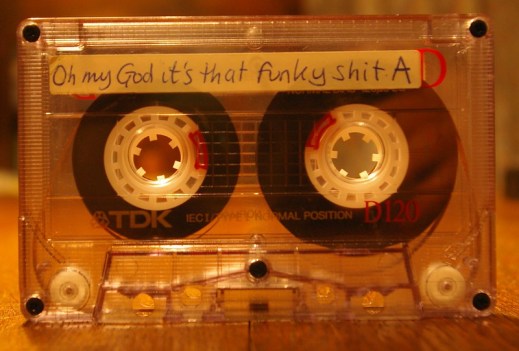
For a number of semesters, I invited composition students to explore the idea of using the mixtape as a lens for envisioning a writing assignment about themselves. Initially called “The Mixtape Project,” this auto-ethnographical assignment employed philosophies from various scholars, but focused on Jared Ball and his concept of the mixtape as “emancipatory journalism.” In I Mix What I Like!: A Mixtape Manifesto, Ball pushed readers to imagine the mixtape as a counter-systematic soundbombing, circumventing elements of traditional record industry copyright practices (2011).
Essentially, a DJ could use a myriad of songs from different artists and labels to curate a mixtape with a desired theme and overarching message, then distribute the mixtape as a “for promotional use only” artifact. Throughout the 1980s, but predominantly in the 1990s and early 2000s, many DJs used mixtapes as the medium to promote their DJ brands and generate income. It wasn’t long before labels began to give hip-hop DJs record deals to release “album-style” mixtapes where the DJs record original content from artists made specifically for the DJ album (see DJ Clue, Funkmaster Flex, Tony Touch). This idea evolved into producer-based compilation albums, best depicted today by global icon DJ Khalid. Rappers also hopped on the mixtape wave, using the medium to jump-start their careers, create a “street buzz” around their music, and ultimately gauge the success of certain songs to craft and promote upcoming albums.
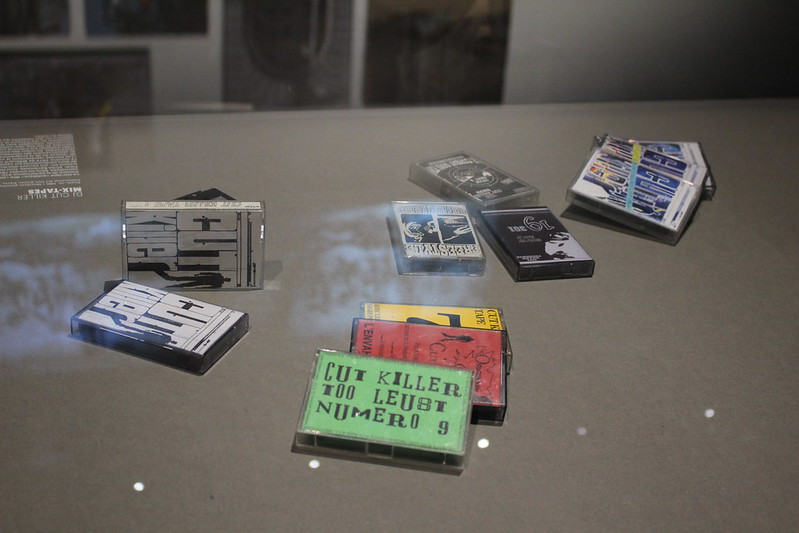
Image by Flickr User Backpackerz: “K7 mixtape – Exposition Hip Hop, du Bronx aux rues arabes (Institut du monde arabe)” (CC BY-SA 2.0)
The assignment revolved around mixtape framework in the earlier portion of my teaching career. Most recently, I began to realize as my students evolve (and I simultaneously age), that the “mixtape” – a sonic artifact distributed on cassette tape or CD – is becoming more remote to students. This thinking led to revising the assignment with a more contemporary twist. Thus, “The Playlist Project” was born: the first in a set of four major writing projects in a first-year writing classroom. The ultimate goal of the assignment was to immediately disrupt students’ relationships with academic writing, and to help them (re)envision the ways they embrace some of the cultural capital they value in college classrooms. Be clear, this was a particular type of mental break for students, a shift that was welcomed yet also uncomfortable for them.
“I Get It How I Live It”: Framing and Foregrounding the Assignment Set-Up
The course started with readings on plagiarism, intertextuality, and the hip-hop DJ’s use of sampling, curating, and storytelling. Next were readings by hip-hop artists describing their creative process and detailing their artistic choices sonically. These early readings helped pivot students from their stereotypical notions of what college writing courses – and writing assignments – looked like, and how they could enter scholarly discourse around composing. This conversation was foregrounded in students’ knowledge that they bring with them into the new academic space in the college classroom. My goal was to really focus on student-centered learning and culturally relevant pedagogy; ideally, if you are immersed in hip-hop music and culture, I want you to share that knowledge with the class. This sharing begins to create a community of thinking peers instead of a classroom with an English professor and a bunch of students who have to take the course “cuz it’s required in the Gen Ed, so I can’t take anything else ‘til I pass this!”
My research is entrenched in both hip-hop pedagogy and culture, specifically looking at the DJ as 21st century new media reader and writer. I liken my role as instructor to that of the DJ: a tastemaker and curator for the ways we understand sonic sources we know, and couple them with new and necessary soundbites that become critical to the cutting edge of the learning we need. I’ve engaged in the craft of DJing for more than half of my life, and use DJ practices as pedagogical strategies in my classroom environments.

DJ Rupture, Image by Flickr User JD A (CC BY-NC-ND 2.0)
The outcome of this curatorial moment was “the Playlist Project.” Students were asked to create their own playlists, which served as mixtapes that either “described the writer as a person” or “depicted the soundtrack to the writer’s perfect day.” This assignment was due during Week 6 of a 16-week semester, and was the first major writing assignment within the course. The assignment called for two specific parts: an actual playlist of the songs and an essay which served as a meta-text, describing not only the songs, but also the reasons why the songs were chosen and sequenced in a specific order. As an example, the guiding text we used was a DJ mixtape I created called “Heavy Airplay, All Day.”
“Heavy Airplay, All Day with No Chorus”: DJ Mixtape by Todd Craig
My playlist was a DJ-crafted tribute to a family friend who passed away in the summer of 2017: Albert “Prodigy” Johnson, Jr. Hearing the news of his untimely death reverberated through my psyche on that warm June afternoon; I remember meeting Prodigy when I was 15 years old. Many avid hip-hop listeners not only know Prodigy as one of the signature vocalists of the 1990s New York hip-hop sound, but also as one of the premier lyricists responsible for a shift in sonic content from emcees in New York and globally. His voice is one of the most sampled in hip-hop music.
One of the most anticipated moments of the mid 1990’s was the release of Prodigy’s first solo album, H.N.I.C. P was already shaking the industry with his lethal and bone-chilling visuals in his verses. But everyone knew he was on his way to dominance upon hearing the single “Keep it Thoro.” On this Alchemist-produced record, P basically broke industry rules in regards to typical hip-hop song construction; his verses were longer than the traditional 16-bar count, and the song had no chorus.
He returned to hip-hop basics: hard-hitting rhymes with undeniable visuals served atop a sonic landscape that kept everyone’s head nodding. P ends the song with the classic line “and I don’t care about what you sold/ that shit is trash/ bang this – cuz I guarantee that you bought it/ heavy airplay all day with no chorus/ I keep it thoro” (Prodigy 2000).
It was only right for me to create a tribute mixtape for Prodigy. And it felt right to start the Fall 2017 semester with the Playlist Project that used a shared text that celebrated and honored his memory. It highlighted the soundtrack to my perfect day: having my friend back to rewind all the memories that come with every song.
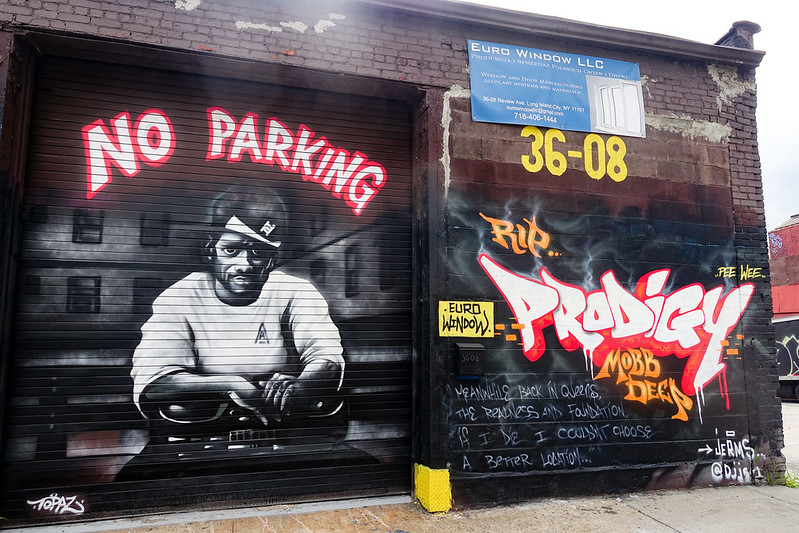
Fan Memorial to Prodigy, Image by Flickr User Nick Normal (CC BY-NC-ND 2.0)
“I Got a New Flex and I Think I Like It”: (Re)inventing Mixtape Sensibilities in the Comp Classroom
The Playlist Project was aimed at achieving three different outcomes. The first goal was to invite students to use audio sources to envision a soundscape that explains a thread of logic. These sonic sources would hold as much value in our academic space as text-based sources, and would allow them to (re)envision what “evidence-based academic writing” looks like. Thus, students could utilize their own cultural capital to negotiate sound sources of their choosing.
 The second was to get students to use DJ framework to think about sorting, sequencing and organization in writing. In our class discussions, one of the critical objectives was to get students to understand the sequencing of divergent sound sources could drastically alter the story one is trying to tell. Overall aspects of mood, tone, and pacing all become critical components of how a message is expressed in writing, but it becomes even more evident when thinking about the sonic sources used by a DJ. Each song – a source in and of itself – is a piece of a puzzle that constructs a picture and tells a story. Starting with one source can create a completely different effect if it is reconfigured to sit in the middle or the end. Explaining these sonic choices in text-based writing would be the second step in the assignment.
Finally, students would engage in editing by joining both sound and text based on a theme they have selected. Again, sequencing becomes a critical DJ tool translated into the comp classroom. Using this pedagogical strategy echoes the ideas of using DJ techniques such as “blends” and “drops” as viable teaching tools (see Jennings and Petchauer 2017). Students would need to critically think through an important question: in creating the playlist, how does one manipulate and (re)configure sound to create a sonic landscape that “writes” its own unique story?
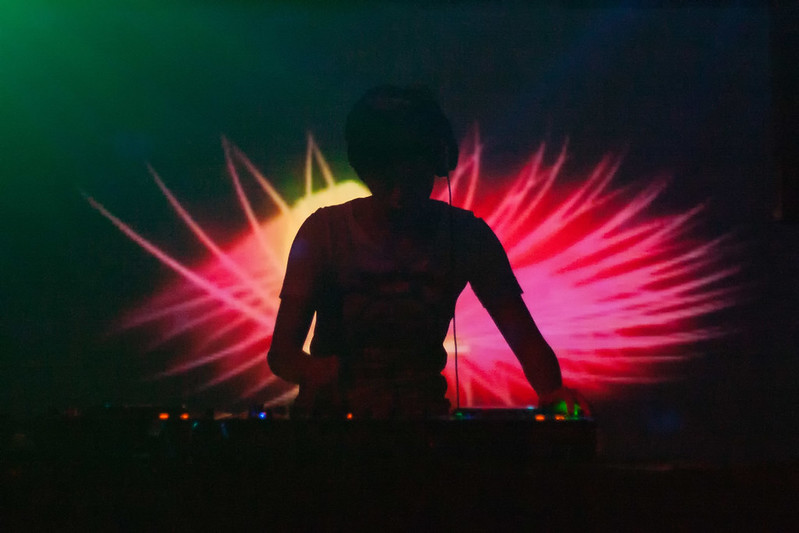
DJ Sai by Flickr User Mixtribe (CC BY 2.0)
“But Does It Go In the Club?”: Outcomes and Initial Findings of The Playlist Project
The first iteration of the Playlist Project bore mixed results. Students found it difficult to think of this project as one whole assignment consisting of three different parts. Instead, they envisioned each of the three different pieces as isolated assignments. So the playlist was one part of the assignment. They picked the songs they liked, however ordering and sequencing to convey a logical theme or argument fell from the forefront of their composing. The essay then became its own piece divorced from the organic creation of the playlist. Thus, students weren’t “engaged in telling the story of the playlist.” Instead, students were making a playlist, then summarizing why their playlists contained certain songs.
For students who were more successful integrating the elements of the assignment, we were able to have rich and fruitful classroom conversations about both selection and sequencing. For example, one student chose the theme of “the Soundtrack to the Perfect Day.” Within that theme, the student chose the song “XO TOUR Llif3” by Lil Uzi Vert.
In the song’s hook, he croons “push me to the edge/ all my friends are dead/ push me to the edge/ all my friends are dead” (Vert 2017). When this song came up in class discussion, we were able to have a formative conversation around the idea that a perfect day entailed all of someone’s friends being “dead.” This also sparked a conversation about the double meaning of the quote; it didn’t stem from traditional print-based sources, but instead arose from a student-generated idea based in the cultural capital of the classroom community. In this moment, I was able to learn more from students about the meteoric rise in relevance of both the artist and the song which seemed to depict an extreme darkness.
“Big Big Tings a Gwaan”: Future Tweaks and Goals for The Playlist Project
Moving forward with this assignment, I have considered breaking the assignment up into three pieces for more introductory composition courses: constructing the playlist, sequencing the playlist, and writing the meta-text. In this configuration, the meta-text would truly become the afterthought (instead of the forethought) of the sonic creation. As well, more in-depth soundwriting could emanate from the playlist construction, manipulation, (re)sequencing and editing. I also plan to use the assignment with a more advanced-level composition course to gauge if the assignment unfolds differently. Using an upper-level course to attain the trajectory of the assignment may be helpful in walking backwards to calibrate the assignment for students in introductory-level classes.
Another objective will be to move away from just a “playlist” and back into a “digital mixtape” format, where the playlist songs and sequencing become the fodder for a one-track, “one-take” DJ-inspired mixtape. While students don’t have to be DJs, creating a singular sonic moment digitally may imbed students in marrying the idea of soundwriting to depicting that sonic work in a meta-text. This work may also engage students in constructing sonic meta-texts, thereby submersing themselves in soundwriting practices. This work can be done in Audacity, GarageBand and any other software students are familiar with and comfortable using.
—
Featured Image: By Flickr User Gemma Zoey (CC BY-NC-ND 2.0)
—
Dr. Todd Craig is a native of Queens, New York: a product of Ravenswood and Queensbridge Houses in Long Island City. He is a writer, educator and DJ whose career meshes his love of writing, teaching and music. Craig’s research examines the hip-hop DJ as twenty-first century new media reader and writer, and investigates the modes and practices of the DJ as creating the discursive elements of DJ rhetoric and literacy. Craig’s publications include the multimodal novel tor’cha, a short story in Staten Island Noir and essays in textbooks and scholarly journals including Across Cultures: A Reader for Writers, Fiction International, Radical Teacher and Modern Language Studies. He was guest editor of Changing English: Studies in Culture and Education for the special issue “Straight Outta English” (2017). Craig is currently working on his full-length manuscript entitled “K for the Way”: DJ Literacy and Rhetoric for Comp 2.0 and Beyond. Dr. Craig has taught English Composition within the City University of New York for over fifteen years. Presently, Craig is an Associate Professor of English at Medgar Evers College, where he serves as the Composition Coordinator and City University of New York Writing Discipline Council co-chair. He also teaches in the African American Studies Department at New York City College of Technology (CUNY).
—
 REWIND!…If you liked this post, you may also dig:
The Sounds of Anti-Anti-Essentialism: Listening to Black Consciousness in the Classroom- Carter Mathes
Making His Story Their Story: Teaching Hamilton at a Minority-serving Institution–Erika Gisela Abad
Deejaying her Listening: Learning through Life Stories of Human Rights Violations– Emmanuelle Sonntag and Bronwen Low
Audio Culture Studies: Scaffolding a Sequence of Assignments– Jentery Sayers
Deep Listening as Philogynoir: Playlists, Black Girl Idiom, and Love–Shakira Holt
Share this:


Current Top Posts





April 2021

January 2020

November 2019

October 2019

August 2019

April 2014

November 2017

March 2015

December 2017

October 2015
 Sounding Out!
Recent Comments