
Hearing Change in the Chocolate City: Soundwalking as Black Feminist Method
 Since its inception at the World Soundscape Project in the 1970s, soundwalking has emerged as a critical method for sound studies research and artistic practice. Although “soundwalking” now describes a diversity of activities and purposes, critical discussions and reading lists still rarely represent or consider the experiences of people of color (POC). As Locatora Radio hosts Diosa and Mala have argued in their 2018 podcast about womxn of color and the sound of sexual harassment in their everyday lives and neighborhoods, sound in public space is weaponized to create “sonic landscapes of unwelcome” for POC.
While we often think of soundwalks as engines of knowledge production, we must also consider that they may simultaneously silence divergent worldviews and perspectives of space and place. In “Black Joy: African Diasporic Religious Expression in Popular Culture,” Vanessa Valdés explored alternate conceptions of space held by practicioners of Regla de Ocha, epistemologies rarely, if ever, addressed via soundwalks. “Within African diasporic religions . . . including Palo Monte, Vodou, Obeah, Macumba, Candomblé – there is respect for the seemingly inexplicable,” Valdés remarks, “there is room for the miraculous, for that which can be found outside the realms of what has been deemed reasonable by systems of European thought. There is room for faith.” Does current soundwalk praxis—either as research method, public intervention, artistic medium, field recording subject, or pop culture phenomenon—impose dominant ideas about space and knowledge production as much as—if not more–they offer access to alternatives? Are there alternate historiographies for soundwalking that predate the 1970s? Can soundwalks provide such openings, disruptions, and opportunities without a radical rethinking? What would a decolonial/decolonizing soundwalk praxis look and sound like?
Soundwalking While POC explores these questions through the work of Allie Martin, Amanda Gutierrez, and Paola Cossermelli Messina. Today, Allie Martin kicks off the series with a powerful reframing of the soundwalk as a black feminist methodology. —JS
In July 2018 I visited Oxford, Mississippi for the first time, to attend a workshop on conducting oral histories. Upon walking with a friend back to our accommodations on the University of Mississippi campus, we heard a voice calling to us from far away, up a hill somewhere. It was a catcalling voice—that much I definitely recognized—but I also felt sure that I heard the word “nigger.” My friend, who is also a black woman, heard the taunting sounds of the voice but not that word specifically. Herein lies one of the difficulties of black womanhood: I was unable to distinguish which of my two most prominent identity markers (blackness and womanhood) the speaker was using to harm me in that moment. I found it ironic that I came to Mississippi to learn best practices for listening to people’s stories, but could not hear my own story, could not say for sure what had happened to me.
In the time since that visit, I have come to embrace the speculative sonic ephemerality of black womanhood and utilize it on my soundwalks. Soundwalks are a popular method for understanding the everyday sonic life of a place. Reminiscent of Michel de Certeau’s “Walking in the City,” soundwalks offer the kind of embodied experience missing from other more static soundscape recordings. I argue here that soundwalks can operate as black feminist method, precisely because they allow me to center the complex, incomplete sonorities of black womanhood, and they are enough in their incompleteness. One of our foremost thinkers on black feminism, Patricia Hill Collins, has argued that black women’s knowledge is subjugated (1990). I understand this to mean that my knowledge is tainted somehow, too specialized or not specialized enough, and not considered fit for application by a broader audience. Soundwalks as method, though, rely on my own subjugated knowledge. What did I hear? Black feminism centers and humanizes black women, and I utilize soundwalks to humanize myself in a soundscape that would otherwise disregard my sonic perceptions in favor of white hearing as the default standard of sound.
I began soundwalking in Washington, DC as a part of my dissertation project, which explores the musical and sonic dimensions of gentrification in the city. Gentrification is often considered in visual terms, meaning that a neighborhood is considered gentrified because new coffeeshops, bike lanes, and dog parks make it “look” different from what was once there. I recognize these new additions as important markers of gentrification, but what do they sound like? And what do these sonic markers reveal about the sonorities of race?

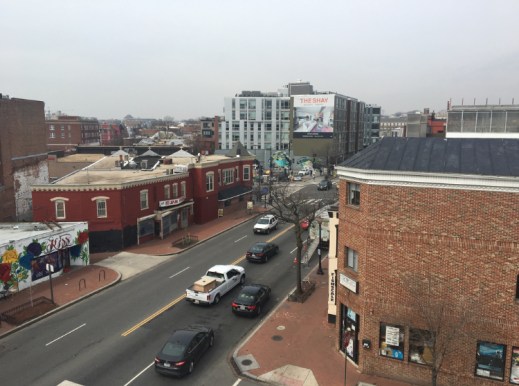
Rowhouses in the Shaw neighborhood, image by author
I have taken up the sonic exploration of gentrification, drawing inspiration from Jennifer Stoever’s Sonic Color Line and Regina Bradley’s exploration of the criminalization of black sound. As SO! writer and ethnic studies scholar Marlén Rios Hernandez has noted in her work on racial and spatial shifts in early punk in 1970s Los Angeles, it is crucial to work on “delinking gentrification as exclusively spatial and analyzing it as also a sonic force of expulsion.” Having spent time researching the auralities of gentrification in DC, I understand it to be a process that silences poor and marginalized populations while amplifying the concerns of those privileged enough to have the ear of the DC Council and developers. Gentrification displaces musicians and music genres, while increasing tensions around music and noise in “public” space. More than these changes, though, gentrification changes the soundscape of the city.
My soundwalks focus on the Shaw neighborhood in the Northwest quadrant of DC, part of the fastest gentrifying zip code in the country. Before the explosion of development, Shaw was a cultural hub of black DC, only blocks away from the U Street Corridor, formerly known as Black Broadway. From Pearl Bailey to James Brown, prominent black entertainers frequented the neighborhood because they were unable to perform in or have accommodations in other areas of the city. As the neighborhood shifts and transforms, the soundscapes grow louder with new nightclubs and quieter due to increased reporting of noise violations. The neighborhood diversifies in terms of languages, increases in siren whoops, and new sounds appear, such as the beep of a dockless scooter. Shaw has seen a concomitant increase in property values, community gardens, and bars; a Whole Foods is set to open in the neighborhood by 2020.
[The recording here is of a soundscape at 7th street and Florida Avenue NW, a busy intersection at the north edge of Shaw. Recorded on a mid-September afternoon, you can hear go-go music (DC’s indigenous subgenre of funk), engines idling, and the whoop of a siren. In the past two months, this intersection has become a battleground for cultural erasure, as artists, activists, and councilmembers attempt to legitimize the go-go music that has been playing in the area since 1995.]
During the day, Shaw oscillates between a quiet neighborhood and a busy city space. Traffic, horns, and sirens are frequent, yet so are the sounds of children at recess and old men chatting outside on their stoops or outside of corner stores.
Conducting soundwalks as a black woman in this gentrifying neighborhood is a curious space to tarry in. I am in some ways an outsider as a non-resident, mindful of who and what I record at any given moment because part of what makes gentrification such a tense and terrifying process is the lack of control that residents (particularly renters) have regarding their futures, and often their presence too. I am also an insider, a black woman in this space where being a black woman is not (yet) anything out of the ordinary. In fact, as the months went on, more of my recordings feature me speaking to people on the street, some I had come to know and some still strangers to me.
One of my favorite interactions on a soundwalk came early on, in late February of 2018. I was running late for an interview, listening intently to what was going around me, when I walked past a black man, seemingly in his 30s, on a narrow sidewalk. The exchange went something like this:
Man: Whoa, whoa, why you running up on people?
Me: My bad, my bad!
Man: It’s okay. Hey sis, you know how to make grits?
Me: [laughing], Nah, I don’t know how to make grits.
Man: What about pancakes?
Me: Yeah, I can make some pancakes.
Man: Ayyyee, I’m tryna get some breakfast!!
Me: I don’t know about all that!
The exchange, not quite a catcall but not quite comfortable either, consistently faded in volume, because during the entire time we spoke, I continued to walk away from him. I was in a position of wanting to speak, because I know the politics of being an outsider in a gentrifying neighborhood and not greeting folks as you walk by. However, I also know the dangers of being a black woman walking alone, and so I negotiated a lighthearted exchange while making my way to my destination. My soundwalks, then, act as a sonic record of gentrifying space as well as my attempts to keep myself safe.
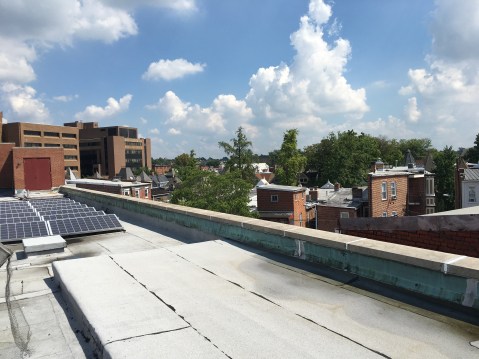
Shaw from a rooftop perspective, Image by author
These moments also inform the contours of my dissertation project on hearing gentrification in DC. The larger project involves passive acoustic recording in the same neighborhood, a methodology that entails creating a large amount of short soundscape recordings over a long period of time. Understanding both my soundwalks and passive acoustic recording as black feminist method allows for the consideration of multiple sonic perspectives of the neighborhood, rather than one record. When once describing passive acoustic recording to a colleague at a digital humanities workshop, they celebrated the idea that I would be able to “objectively” hear what was occurring in the neighborhood, instead of relying only on pieced together accounts from community members.
However, just as black feminist thought amplifies my “tainted” knowledge, it also mutes the authoritative “objective” knowledge of a rooftop recorder. The sounds of the stationary recorder placed on a rooftop at 7th and Florida are as partial and positioned as the recordings of my footsteps as I move around the neighborhood. As I continue to walk, be it through the unfamiliarity of Mississippi or my hometown DC, I do so with the reassurance that what I hear is enough.
—
Featured Image: Shaw From Above, by author.
—
Allie Martin is a PhD Candidate at Indiana University in the Department of Folklore and Ethnomusicology. Her dissertation project explores the musical and sonic dimensions of gentrification in Washington, DC, using a combination of ethnographic fieldwork, archival research, and soundscape recordings. Originally from the Washington, DC, metropolitan area, she received her BAs in music performance and audio production from American University.
—
 REWIND! . . .If you liked this post, you may also dig:
SO! Amplifies: Listening to the City Handbook
Sounding Out! Podcast #2: Springtime in KC: Soundwalking Kansas City—Liana Silva
Unlearning Black Sound in Black Artistry: Examining the Quiet in Solange’s A Seat At the Table–Kimberly Williams
Share this:

SO! Reads: Rebecca Tuhus-Dubrow’s Personal Stereo
 In Personal Stereo, Rebecca Tuhus-Dubrow’s eminently readable history of the Walkman and its kind, it is telling to learn that Sony founders Masaru Ibuka and Akio Morita were prone to conversing in ‘something akin to a private shared language’ or idioglossia. “They would sit there,” recounts Morita’s eldest son, “and we would listen but we had no idea what they were saying” (21). In later life, following strokes, both lost the ability to speak; Ibuka’s son characterises their subsequent relationship as “communicating without words’.” Even the name Sony itself, notes Tuhus-Dubrow, with its origins in the Latin sonus and the English slang “sonny,” was ultimately “a word in no language’” (13). It is as though aural perception, delivered on an intimate scale, is somehow revelatory in a way that transcends the typical organising principles of language. The incorporation of the sonic into everyday life forever approaches a kind of affective intensity.
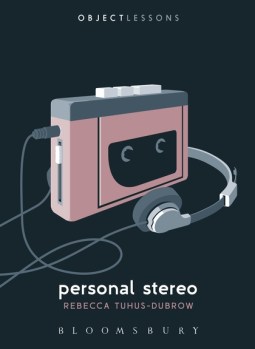 Personal Stereo tunes into this frequency and – by virtue of its array of research and skilful marshalling of social and cultural history – offers a compelling map of its coordinates. If, as part of Bloomsbury’s Object Lessons series, one of its central tasks is to apprehend the affective resonance of the inanimate, it is testament to Tuhus-Dubrow’s work that she is able to manage the breadth of her material into an adroit and concise narrative while at the same time allowing space for her writing to approach these contained moments of intensity. “When I think of [the Walkman] now, I think of joy,” she writes in the introduction (1). While acknowledging that undue celebration of the past can stymie the present, she offers a quietly persuasive case for an examination of nostalgia amid the anxiety of contemporary life, which almost serves as a rallying cry for a generation pinioned between the two: ‘The past, whatever its shortcomings, has the virtue of having already happened. And we survived it.’
As iTunes – like the glory of the world – passes into epilogue, it is again time to consider how we might frame obsolete technologies as echoes of a particular moment in our lives, anchored between progress and decay. As texts, they harbour a kind of degraded cartography: a summation of meaning and collapse.
The story of the Walkman begins in the bombed-out ruins of 1940s Tokyo, as Ibuka and Morita establish the foundations of the company that would become a consumer electronics giant as part of Japan’s ill-fated post-war boom. It is striking how much of the Walkman’s development was shaped by the ravages of warfare: Tuhus-Dubrow notes how its antecedent, the tape recorder, was first used in the German military, and early headphones were issued to fighter pilots. It is possible to read the subsequent commercial adoption of personal listening devices as an attempted refashioning of the domestic interior, transgressed so violently in acts of conflict. One of Ibuka’s founding principles for Sony was to “apply highly advanced technologies…developed in various sectors during the war to common households” (12). Tuhus-Dubrow also recounts the case of Andreas Pavel, a native of post-war Berlin, who emigrated with his family to São Paulo and developed what we might term a “counter-prototype” to the Walkman, partly inspired by the internal acoustics of his mother’s home – “a mecca of sound” – in Cidade Jardim. Object lessons are formed through disintegration and salvaged materials. Morita compares his formative partnership with the older Ibuka to a newly-established familial unit: “It was almost as though an adoption were taking place” (13).

Akio Morita (left) and Masaru Ibuka (right), 1961. Courtesy of Sony
This elides neatly with Tuhus-Dubrow’s central chapter, which is also the strongest. Here, she discusses the reception of private listening within the public domain, and how existing societal norms apprehended this new sonic phenomenon. It is intriguing, and at times hilarious, how much of the reaction operates as moral critique: from a 1923 article comparing the very act of solo listening to alcohol abuse or a drug habit, to rather more recent takes that foreshadow the current intergenerational culture wars. “The personal stereo,” harrumphs A.N. Wilson, ‘became the archetypal accessory of the me-generation” (68).
Tuhus-Dubrow’s research is smart and on point, not least because it leads to a productive consideration of how the cathartic element of the private soundtrack becomes something that society struggles to assimilate. She takes to time to weave in personal testimonies and reminiscences that are effective and somehow touching: “the Walkman,” she admits, “was a source of elation and comfort” (85). A friend recalls how “[my] inner world was enriched by the freedom to explore music on my own” (84). Pavel describes how the first use of his prototype, in the snows of St Moritz, evoked “a state of ecstasy,” in which life temporarily assumed a cinematic quality. “Suddenly,” he remembers, curiously switching to the present tense, “I’m inside a film” (27).

Darryl with a new Walkman, December 25, 1982, Image by Flickr User Kent Kanouse
Others speak of how musical accompaniment aids a more immersive interaction with the world around them, and it is here that perhaps the real strength of Tuhus-Dubrow’s work emerges: the generosity of an approach that permits mutual recognition; the summoning of an experiential quality that is elusive in its definition but vivid and immediate in its resonance. It is a mode of writing – and indeed a mode of listening – that is resolutely contemporary, formed in a firestorm of technological innovation that was both oppressive and liberatory, attuning us to new ways of being at the same time as it degrades and erodes old certainties.
It bears resemblance to what Tuhus-Dubrow recognises as “the logic of our own bodies, with organs and limbs whose motions are connected to their functions, and which are susceptible to injury and gradual breakdown” (102). Earlier she writes, “as one song neared its end, I would begin to hear the opening chords of the next in my head.”
What is it, this sense of auditory anticipation?
It is the forming of new waves. We have blood in our ears.
—
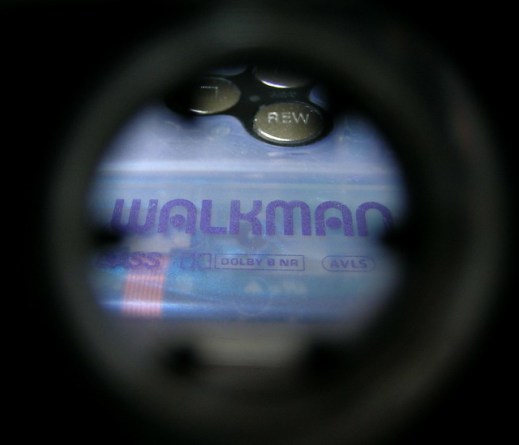
Featured Image: “Walkman through the cassette” by Flicker User Narisa (CC BY-NC-ND 2.0)
—
Lewis Jones is a writer and itinerant based in Brighton, UK. He received an MA in Literature, Culture and Theory from the University of Sussex, having previously graduated in English Literature from the University of Winchester. He is interested in how artistic and aesthetic mediums might be used to develop new theoretical approaches to culture and society. He particularly likes urban spaces, as visual and auditory environments, and the intersections between music, movement and the body. He thinks that dancing about architecture is a perfectly valid exercise.
—
 REWIND! . . .If you liked this post, you may also dig:
SO! Reads: Hiromu Nagahara’s Tokyo Boogie-Woogie: Japan’s Pop Era and Its Discontents–Shawn Higgins
SO! Reads: Janet Borgerson and Jonathan Schroeder’s Designed For Hi Fi Living–Gina Arnold
SO! Reads: Susan Schmidt Horning’s Chasing Sound: Technology, Culture and the Art of Studio Recording from Edison to the LP— Enongo Lumumba-Kasongo
SO! Reads: Steph Ceraso’s Sounding Composition: Multimodal Pedagogies for Embodied Listening–Airek Beauchamp
Share this:


Current Top Posts





April 2021

January 2020

November 2019

October 2019

August 2019

April 2014

November 2017

March 2015

December 2017

October 2015
 Sounding Out!
Recent Comments