
Instrumental: Power, Voice, and Labor at the Airport
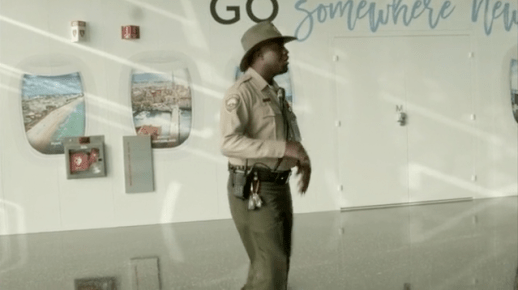
 Welcome to Voices Carry. . . a forum meditating on the material production of human voices the social, historical, and political material freighting our voices in various contexts. What are voices? Where do they come from and how are their expressions carried? What information can voices carry? Why, how, and to what end? Artist Asa Mendelsohn opens the forum with his critical and artistic work on the voice as an instrument of power. We are also honored that he lent Voices Carry a still from his work for our icon!–Jennifer Stoever
important, critical, foundational
Can we all do something about language here, and the frames that we use? […] We need to…stop already pre-redacting ourselves so that we can be quote ‘heard’ by these jackasses! They’re never gonna listen to us! — Mariame Kaba
Instrumental is a body of work featuring a series of vocal performances by airport security workers I filmed at the San Diego International Airport. The work takes up Mariame Kaba’s provocation, that those currently in power are never going to listen. How might relations of power be reordered around a voice? If voices are instruments, operating at once through a body and as a body, what kind of instrument is a voice of authority?
T
In September 2017, my proposal to produce a version of this project is accepted as part of a yearlong program curated by and for the San Diego International Airport. In October I put out a call for participation to airport security workers, in search of singers to perform songs of their choosing in front of a camera. There are emails with curators and security managers, logistics, parameters. I film over the winter and install a version of the work as a public art project in the spring, the first year of my medical gender transition.
When we meet at the far end of Terminal 2 in January, T is a combination of nervous and enthusiastic I wasn’t expecting. He’s so jittery that I almost tell him to stop and rest. I link my sneaking feeling of shame to an assumed position of authority, having arrived like this, multiple cameras, my university affiliation.
But while nervous, T’s also brimming, lighting up. His name tag catches gold light, bouncing against his gray Air Traffic Officer uniform.
T proposes two songs. Neither are in languages that he speaks in his daily life and he keeps forgetting words.
How am I going to forget you?
T says he learned the song from a former partner. He says girlfriend. He says he always felt self-conscious he couldn’t speak more Spanish. I guess that his family are Afro-Caribbean Spanish-speakers. I’m wrong. He’s also wrong about where I’m from. San Francisco, right?
T likes to sing karaoke. A coworker heard him and the rumor started going around: T has a beautiful voice. T’s voice is a soft instrument. In the airport, it is easily swallowed by environmental noise.
I film with T a second time, again meeting the last two hours of his ten-hour shift. He starts tired, nervous: stopping and restarting a song. Slowly, he warms up, dancing a cumbia. I sing with him when he forgets a line. We allow ourselves to take up more space in this quiet zone beyond the Air Canada counters. T dances with a moving chair.
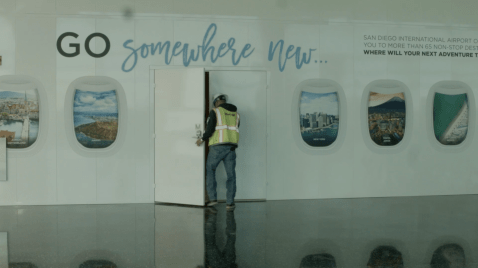
Where will your next adventure take you?
Men in construction vests come in and out of a door beneath a banner: “Go Somewhere.” Construction is in process to expand the space occupied by border security.
Working in security means exercising jurisdiction over how other people move, who can move where, and with what freedom. What kind of freedom or movement is possible between us while someone is watching (an institution, a camera)?
Artist Gregg Bordowitz writes that “posing for the camera in advance of anticipated capture by the lens is a form of self-defense in the age of surveillance. It’s an act of self-authorship.” I don’t feel I understand fully what calls someone forward to perform. Is it a feeling they have something to share, a will towards “self-authorship”? I’m interested in not knowing where a performance starts and ends, not knowing when we become performers or our own authors, when we become complicit, exploited, when we are on or off the job. Most people work and are watched most of the time, without being heard: a series of performances delivered and received with varying degrees of care.
The sterile zone
The post-9/11 commercial airport in the United States is one among other types of places designed to reinforce a culture of surveillance and fear, to remind travelers the state has a say in their freedom of movement. A place designed to instill one kind of horror while thinly concealing another.
Spending time at the airport with people who spend a lot of time at the airport, the intricacy of the place unfolds, resembling what theorist Simone Browne calls a “security theater.” At moments SAN blurs into every other airport in the U.S. I’ve moved through or seen on a screen: streams of moving walkways, escalators — travelers wheeling bags, waiting, scrolling for ticket information on smartphones, scanning, travel-themed advertisements and watery public art commissions — a fragmented, moving stage.
From Asa Mendelsohn, Instrumental (2018)
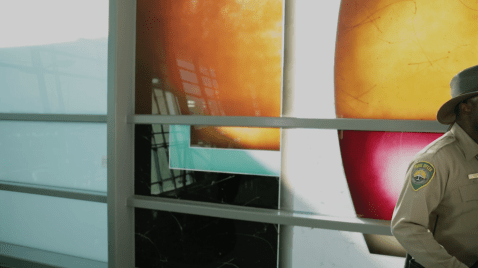
The voice of the overhead announcement is an instrument of the airport security theater, summoning the stress of being read and misread, abused, glibly entertained, and sold overpriced breakfasts, while you are also in fear of missing something: everything that makes airports ultimate theaters for the machinery of the security state. As I edit footage from the airport, I become preoccupied by moments of tension between a singer’s voice and the voice of the overhead security announcement, instructing us about checkpoint procedures, orienting us, interpellating. A singer pauses to wait, or they continue, enduring the interruption. For a security worker vocalizing in uniform, does the space of the airport become an extension of their body? (Does their uniform matter?) In these moments of tension, it becomes more clear that a security worker’s performance as an extension of the airport’s body is an uneven one.
While SAN seems like any other airport in the U.S., there are points of exceptionality. SAN is much smaller than other airports serving international commercial flights. It is located centrally, widely accessible from much of the city. Checkpoint lines are rarely very long. SAN is, of course, primarily the port of entry for travelers with valid state identification and the ability to buy an airline ticket. These factors do not make SAN an equitable place to work, but they do add up to an effect: airport as sanitized space, a clean space, that, in my subjective experience, other airports aspire to but rarely achieve. A small feat of whitewashing, eighteen miles by car from the border crossing at San Ysidro. Friends have suggested about this project: “you would not have been able to do that anywhere else.” I would not have been granted access.
As I prepare to film at SAN, I’m sent mixed messages. Initially, a curator tells me I’ll be granted access to shoot in post-checkpoint areas of the airport, areas I learn that security workers call “the sterile zone.” Shortly before my first shoot, I’m told that, actually, it’d be too much work to get me clearance. I’m restricted to what are called “public” spaces, pre-security, outside the sterile zone.
From Asa Mendelsohn, Instrumental (2018)
Throughout this process, I wonder how I’m seen by people at the airport. I do not doubt that being white, small-bodied, and soft-voiced make me seem non-threatening. I’m a patient director. I smile at my own perversity. Staff approach me cautiously while I’m setting up and ask if I have a permit to be there, but always eventually smile back. A curator overlooks or disregards my pronouns, misgendering me in email correspondences and later in the interpretive text about the work. They eventually apologize.
How are my interests as an artist read? While “speaking up,” or “using your voice,” is often understood as a political right and responsibility of democratic process, appropriating someone else’s is at particular stake in art and documentary ethics. At the airport, I am seeking a form through which to acknowledge the ways we use each other’s voices and labor, to acknowledge the multiple zones within which we work at once.
Instrumentalized: used
A voice is always a shape and product of its body, and, at the same time, something other. Theorist Freya Jarman-Ivens writes: “As my voice leaves me, it takes part of my body with it — the sound of its own production.” The voice in your head that you claim as your own is never, physically, the same voice as that which lands in the ear of another, that you also claim as your own, as when you claim on the phone “it’s me.” Jarman-Ivens names this paradoxical, “looped” quality of the voice its “queerness,” traveling between bodies and between language and non- language.
Increasingly, state terrorism marks the airport as a space in which people are alienated on the basis of identity. The anxiety that comes while waiting in line for your body to be scanned epitomizes that alienation. The invasive acts of being scanned, read and misread, are not one-way operations. Security personnel, particularly those whose classed, raced, and gendered bodies straddle multiple identifications and categories of oppression, occupy a tense space: at once agents of the security apparatus and subjects within it.
At the airport I am trying to represent realities in which a speaker’s voice changes and morphs with and through their body and environment. Through collaborations with non-professional actors — with people performing as versions of themselves — I am hoping to communicate the slip and stutter between performance and real life that José Esteban Muñoz might describe as “failure,” or an “active political refusal.” “Failure” is, as I understand Muñoz’s writing and legacy, an opening into another space of relating, a break from performative norms, from a performance of a norm, such as “real life,” or “gender.” Does the performance start when a security worker starts singing? When they become the airport? A worker? When they become a man?
Featured image still from Asa Mendelsohn’s Instrumental.
—
Asa Mendelsohn is from New York. He makes performances and media projects that develop through a process of recording, writing, and collaboration. His work combines observational and narrative storytelling practices, often focusing on personal relationships and desire as ways to navigate seemingly inaccessible infrastructures, histories, and systems of power.
—
 REWIND! . . .If you liked this post, you may also dig:
Unlearning Black Sound in Black Artistry: Examining the Quiet in Solange’s A Seat At the Table–Kimberly Williams
“Listening to the Border: ‘”2487″: Giving Voice in Diaspora’ and the Sound Art of Luz María Sánchez”-D. Ines Casillas
On Sound and Pleasure: Meditations on the Human Voice– Yvon Bonenfant
Share this:

Cardi B: Bringing the Cold and Sexy to Hip Hop
 In “Asesina,” Darell opens the track shouting “Everybody go to the discotek,” a call for listeners to respond to the catchy beat and come dance. In this series on rap in Spanish and Sound Studies, we’re calling you out to the dance floor…and we have plenty to say about it. Your playlist will not sound the same after we’re through.
Throughout January, we will explore what Spanish rap has to say on the dance floor, in our cars, and through our headsets. We’ll read about trap in Cuba and about Latinx identity in Australia. And because no forum on Spanish rap is complete without a mixtape, we’ll close out our forum on Thursday with a free playlist for our readers. Today we continue No Pare, Sigue Sigue: Spanish Rap & Sound Studies with Ashley Luthers’ essay on femme sexuality in Cardi B’s music.
Liana M. Silva, forum editor
—
“Ran down on that bitch twice” was all I heard in this tight, dark basement filled with black and brown bodies, sweat dripping everywhere from everyone. Girls danced all over, yelling and shouting lyrics as they clapped and pointed along to the fast, upbeat rhythm of the song, feeling their own sensations and pleasure from the vibe, and rapping with the catchiness of the repeated phrase, “Ran down on that bitch twice!” As everyone was jumping, the space around me shook because there was so much body movement and flow; it was lit. This wasn’t the first time I heard Cardi B, but dancing along to her song “Foreva” was definitely the first I remember hearing her. Since that dark basement party, I realized that the attitude and energy Cardi B invokes through her raps and lyrics is addicting.
Listening repeatedly to “Foreva,” and the rest of her debut mixtape Gangsta Bitch Music Vol.1, has attuned me to Cardi B as a stone cold, gangster bitch: someone who is fearless, tough on the outside and inside. She doesn’t hesitate; she doesn’t bluff. She gets straight to the point and lets you know that she will fuck you up if and when necessary. A ‘G’ she is, as some would say when describing a person who shows no fear and is always hustling—except that someone is imagined as a black male from the so-called ‘hood who affiliates with drugs, gangs, etc. The music itself reflects this gangster feel, through the hard trap sounds and beats in every track. Trap music as a style and subset of Hip-Hop, and arguably a genre on its own, originated in Atlanta, and has over time become mainstream all across the U.S. specifically within the Northeast region. Within Cardi’s performed, stone cold bitch lyrical persona, she embodies an aggressive femme sexuality, a racialized femme hunger for sex with black men, and an emotional depth that makes her endearing to listeners. Her embodiment of this multiplicity—stone cold attitude, femme sexual thirst, and emotional complexity—can be heard in her music, through the explosion of beats, rhythms, and lyrics that keep listeners hooked to the sound of her self-image. In other words, Cardi B’s sonic and lyrical movements work in tandem with her audio-visual construction of black, Caribbean, Bronx femme desire.
Nowadays this audio-visual construction is visible across her music and social media, but I want to focus on the image of her debut mixtape cover, Gangsta Bitch Music, Vol.1. This image hailed me and continues to hold me in thrall after lengthy meditations on it. In it, Cardi B sits in the backseat of a car, high-rise apartments peering through the back window, with her legs spread wide open. Between her legs, a big, black, faceless, tatted man gives her head as she casually drinks her Corona. The man’s back sprawls in the place where we might imagine Cardi B’s junk/pussy; he’s her bitch. The audacity of displaying her desire mid-sex-act intrigues me and does more than merely assert black femme sexual desire. The media blew up when Nicki Minaj did her lollipop photoshoot in which her legs are wide open, and her crotch is heavily exposed. But Cardi B’s mixtape cover has a different impact, because of the positioning of its vulgarity and audacity.

I’ve seen pictures of Nicki Minaj and Lil’ Kim where they’re half naked, open to giving men pleasure, and completely distorting the expectation of respectable black women to cover their bodies and assets. But what makes Cardi’s mixtape visual different even from Lil’ Kim’s and Minaj’s visual constructions is that it shouts power from the position often occupied by cis-male desire. Cardi B is seizing her own sexual power and gangster agency while she asserts her business hustle from the seated position of power that is often assumed by cis-male gangster rappers and performers. In the angle and composition of the mixtape image, we, as viewers, are positioned to look up at her as we witness her experiencing pleasure. She’s above us, and her chosen sexual object, who is a big black man, a figure whose masculinity is historically challenged by normative and respectability-obsessed society, and who is historically susceptible to being emasculated, is situated beneath her: there’s a troubling of power’s embodiment, specifically through sex, in this image. She’s visually insisting on getting play.

I connect Gangsta Bitch Mixtape Vol. 1’s cover image to the sounds, vibes, and lyrics of Cardi B’s tracks within the mixtape. In “Foreva,” for example, she raps, “Silly muthafucka who raised you/ a nigga with a pussy how disgraceful.” It’s at this point that we realize that the “bitch” that she “ran down on,” “twice,” is also a dude. In the lyrics, she alternates between beefing with trifling chicks and dudes; for Cardi, bitches breach a gender dyad. She raps from a masculine position as a femme, which ultimately illustrates her mixtape cover’s reversal of who is in the receptive and dominant position of sexual power. In “Foreva,” she’s talking down on black men the same way that most of these men speak on black women in the Hip-Hop industry. Cardi twists the normative misogyny and disrespect that is often demonstrated towards black women in Hip-Hop and instead uses that towards apostrophic black men. The lyrics of “Foreva” and the Gangsta Bitch mixtape cover both sustain this idea of Cardi B working within masculine tropes as a woman in the industry. On the mixtape cover, she is the one who is receiving pleasure, instead of giving it to a man. Lyrically and physically, she’s in a place where she’s on top, looking down on her subject/object of sexual desire, and inviting her audience to watch.
Sonically, “Foreva” and other tracks fits within the genre of trap music. Many of the songs in the mixtape have aggressive beats. The genre is characterized by a deep, hard mood created by the fast beat: Justin Burton describes it as “one of the most iconic sonic elements of trap is the rattling hihat, cruising through subdivisions of the beat at inhuman rates.” This is what we hear and feel from Cardi’s music itself. Specifically, the BPM for “Foreva” is 161 which fits into the range of typical Trap music. The way she sounds is what she embodies. The flow of “Foreva” tells us as listeners that Cardi B isn’t here to play and she damn sure won’t let anybody stop her from making her money. The rest of the music on the mixtape takes a similar route, in that these crisp rhythms speak to her power, her urban upbringing, coming from the Bronx, and her days as a stripper. She owns her sexuality and claims it through the music. The cover reflects this: she is poised and looking directly at us, her stone-cold persona manifested in how she also appears utterly unbothered by you, us, looking at her, looking at us.
Cardi B’s a freak. Clearly. (As if we didn’t know this.) But the way she visually and sonically expresses her sexual yearning is more complicated than the word freak can capture. The thing with Cardi B is, she’s not afraid. In fact, she doesn’t care about respectability. Even when she raps about making money or callin’ shots on someone, she never hesitates to slide in something sex-related because she knows she’s good at getting and giving play, both sexually and musically: “Fuck him so good he gonna want to spend all that/ Pussy got him on the jugg he gonna re-up and come right back.” If you read the lyrics from “With That,” you could think the lyrical subject is a male rapper, like trap’s Future or Gucci Mane. In fact, this song is a remake from Young Thug’s “With That,” which comes from his album Barter 6. Young Thug is one of the big faces in the Atlanta Trap music scene and his track “With That” reflects the life of a rapper like him. Poppin pills, stacking money tall, Thug knows he’s killing the game and shitting on these other rappers with his sounds–Cardi B echoes that bravado in her remake.
Drugs, sex, money, hustle: Cardi B, in a way, replicates the masculine attachment to these tropes. But we are not listening to an abstract, masculinist lyrical subject on her mixtape; we are listening to a black femme subject. So, this goes beyond ‘replication’, as we may wonder whether it has ever historically not been the case in the Americas that black women also had to hustle, grind, find stimulation to escape normative constraints, and take care of their sexual desires. Which is to say, black men are not the OG hustlers; arguably, black women are, and Cardi B channels that historical force in her audio-visual construction of a stone-cold bitch who knows how to get play, and still have feelings in a hatin’ ass world.
We’re introduced to this hard, stone cold Cardi B inside and outside of her music’s lyrics as she repeatedly performs that she is not at all ashamed of the fact that she used to be stripper, aka, someone who hustles hard. Her choice of the trap genre, as a black Latina, acknowledges the existence of that hustle theme within it—even honors it. Her refusal of shame and respectability affects that take a specific toll on black women in the Americas, circles me back to the welcoming aura she displays on the mixtape cover. She wants viewers to see her in her happy place; she wants us listeners to hear how good she is in bed; she wants the world to know she’s a freak. This is her way of fucking with the mythical construction of masculinity in Hip-Hop where cis-men are the most badass, aka, the “most political” subjects; she acts on her own urges and desires, which does a lot more than just show femme as “sexy.” She’s sexy and she’s cold and so is her music too: the kick drums, synth lines, and hihats make her sonically ominous and cold.

In one of Cardi B’s latest tracks, “Money,” I still hear echoes of “Foreva,” but I’m hearing so much more. I find myself paying as much attention to the audio as to the visual constructions that Cardi B’s generous yet cutting aesthetic offers: in the cover image for “Money,” we see her naked body, positioned in a way that shows off her peacock thigh tattoo, suggesting but keeping her junk from you. She’s wearing a plethora of gold watches, almost as if they’re long-sleeve gloves, and a gold hat, the shape of which channels both Beyoncé’s in “Formation” and Jeffery’s (aka, Young Thug) on the cover of Jeffery. Unlike the cover of the first mixtape, Cardi does not give us her hair in this image, and she does not give us her gaze; while she directs her face at the camera, the hat dripping with diamonds conceals her hair and her eyes from us—or, she is giving her gaze to herself, to the inward rewards of her hustle. The ice is cold, but the image is warm as a swarm of gold bling and golden light surrounds her.
Lyrically, on “Money,” she’s doing what she does best, rapping about her hustle, her money, and still managing to throw in a little something about her love for sex. Sonically, this is pure trap. We hear an orchestration of keyboards, brass, and drums. As for us, listening viewers, we not only consume her music, but also continue to take in everything Cardi B has to offer because it fascinates and pleases us. She returns our pleasure (in her pleasure) to us, and nothing less than that.
—
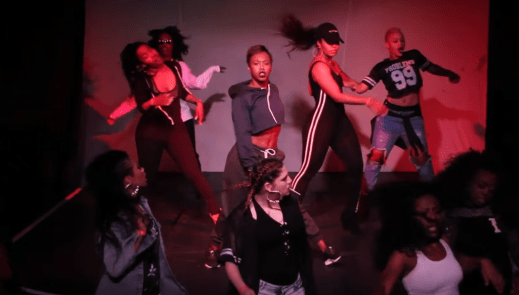
Featured Image: Still from “Cardi B ‘Foreva’ (Live) Choreography By- Hollywood”
—
Ashley Luthers is currently a Senior at Wesleyan University studying English and Economics. She has spent the past year researching and studying Cardi B inside and outside of the classroom. Her final senior essay revolves around Cardi B as a black femme artist in Hip-Hop through an analysis of different theories surrounding the black female body.
—
 REWIND! . . .If you liked this post, you may also dig:
“The (Magic) Upper Room: Sonic Pleasure Politics in Southern Hip Hop“–Regina Bradley
“What Feels Good to Me: Extra-Verbal Vocal Sounds and Sonic Pleasure in Black Femme Pop Music” -Robin James
“I Love to Praise His Name”: Shouting as Feminine Disruption, Public Ecstasy, and Audio-Visual Pleasure–Shakira Holt
Share this:


Current Top Posts





April 2021

January 2020

November 2019

October 2019

August 2019

April 2014

November 2017

March 2015

December 2017

October 2015
 Sounding Out!
Recent Comments