
Sound Designing Motherhood: Irene Lusztig & Maile Colbert Open The Motherhood Archives

A Conversation Article in Chat with Irene Lusztig, Director of The Motherhood Archives and Sound Designer Maile Colbert
In 2011 filmmaker Irene Lusztig contacted me about designing sound and composing for her film project, The Motherhood Archives.
Irene had spent several years buying discarded educational films on eBay and working in historical archives to amass an unusual and fascinating collection of archival films aimed at teaching women how to be pregnant, give birth, and look after babies. The Motherhood Archives uses this extraordinary archival treasure trove to form a lyrical essay film excavating hidden histories of childbirth in the twentieth century, illuminating our changing narratives of maternal success and failure, and raising questions about our social and historical constructions of motherhood.
I was immediately intrigued by her concept and construction process as well as her desire to work with sound design in a very collaborative manner at an earlier stage in the project than most filmmakers would. Geographically distant, Irene and I mostly worked by “satellite,” using email, chat, Skype, phone, and file sharing software to communicate and send files. We did manage to have a few production weeks in New York and Santa Cruz, but the majority of the work was woven back and forth across an ocean and continent…California to Lisbon, Portugal, West Coast to West Coast. Rather than hindering, this method lent itself to an exquisite corpse nature to the work. In the creation of this article we followed much the same process, using an initial Gmail chat.
Maile Colbert (MC): So, I’m both shy and excited about asking this… why me, Irene?
Irene Lusztig (IL): I had heard your work in both Adele Horne’s film [The Tailenders, 2005] and Rebecca Baron’s [How Little We Know of Our Neighbors, 2005], both films with beautiful sound.
.
The sound in How Little We Know of Our Neighbors in particular does something with natural / unnatural that I was really interested in – field recordings that somehow become other kinds of things as they are layered, transformed, and processed. I think of myself as a documentary maker / artist who is invested in actuality, but not very invested in traditional documentary form, and I think your sound has similar investments and disinvestments. It begins with the sounds of the real world but takes those sounds to very unexpected places that are often quite far from their original context.
.
MC: I love that you brought up the “natural/unnatural.” It not only really describes well my work and approach in general, but also the experience we get in your film with mediated motherhood. We would often talk about certain sections being very science fiction…then you think, wow, this really happened, this is part of a history that led up to our experience now, and one I’m currently having, having recently become pregnant for the first time!
IL: I think there is a lot to say about science fiction and sound! First, there is a great tradition of feminist science fiction that I feel like our work is very connected to: Margaret Atwood, Ursula Le Guin, and even stuff like Shulamith Firestone’s futuristic vision of external uteruses. A lot of that work has in common a willingness to “make strange” or denaturalize aspects of female reproduction and mothering in ways that feel radical.
MC: I’m not sure if I was able to contain my excitement when you first mentioned a section felt sci-fi to you. This is something that I think has a root back in my childhood. My father was and is an obsessive science fiction film watcher: I grew up with a soundtrack of The Day the Earth Stood Still and Lost in Space. These soundscapes that “weren’t” became such a part of what I wanted to listen to.
.
IL: I always thought I had no interest in science fiction when I was younger, but I think growing a human inside my own body probably shifted my relationship to that!
I think science fiction is almost always expressing our anxieties about the future, about our technologies, about things that we struggle to control. And of course questions and anxieties about trying and failing to control things are completely at the heart of our experiences with pregnancy, birth, and learning to be new mothers in the 21st century. As are questions around technological mediations that we feel ambivalent about, whether it’s fertility technologies, medicalized birth technologies, or things like baby monitors or worrying about whether the iPad is rewiring your baby’s brain. So science fiction feels like a sonic space that totally makes sense for negotiating these maternal anxieties.
MC: One of our biggest struggles was trying to make sure things weren’t too dark for the audience.
IL: People often respond with anxiety to the film and its sound design. I’ve never before made a film where the sound comes up so often in post-screening discussions, and generally the question is something like “why is the sound so dark / scary / anxiety-provoking?” It seems very specific to the subject of The Motherhood Archives – how anxious we are societally about the whole topic, and also how uncomfortable we are being open about these anxieties.
MC: I’m still shocked at how shocked I am when I realize how some people react to this film, how uncomfortable they are. U.S. society seems just as afraid of birth as death in this manner! We speak of each in such a similar way and we’re not allowed the complexity of, for example, being simultaneously anxious about how this will affect our careers and identity, and how in love we are when we hear that heartbeat!
IL: Do you think of yourself as a feminist artist? I ask because becoming a mother (and making art about motherhood) has made me much more aware of myself as a feminist artist.
MC: I absolutely consider myself a feminist– it’s woven into every part of my life and my work. I’m also beginning to feel this in a new way with the pregnancy: I recently lost a gig I was really looking forward to because there was an assumption that I couldn’t do it somehow because I was pregnant. A recent interviewer asked me about how I navigate motherhood and my work, and I couldn’t help consider that this question would never come up with a male artist.

My recent recordings of my future daughter growing and moving have been wonderful to listen to: watery and subdued, you still feel like you’re only getting a little of her sonic world, so mysterious. But it reminds me of when I was a child – in any body of water I loved to dive down to the bottom, let go of my breath and just rest there as long as I could…it was an ultimate peace. I loved the visual perspective of the world above me, but most loved the deep gentle filter of everything aural coming through this watery world. Some might argue that peace refers to our first soundscape experienced…and listening to my own active womb, it doesn’t seem far-fetched.
IL: There are a lot of watery sounds in the film! My friend Irene Gustafson made this great connection between all the water in the soundtrack and the voiceover passage in the twilight sleep section about how the “soothing sound of running water muffles newborn cries to prevent the formation of what are called islands of memory.” That description of water literally being used to erase memory allows all the water sounds throughout the film to become a metaphor for the erasure of historical memory… the fact that we no longer remember the historical moment where feminists were advocates for anesthetic drugs and medicalized childbirth, for instance…the many ways that the histories in the film are now forgotten.
.
MC: I think sounds are like cells in a way…they carry a memory, even though abstracted.
That’s why I love working with natural sources initially, something comes through from that palette, a shadow is carried from its initial source. As animals, we use sound for information, much processing and translation happens that we aren’t even aware of. So I do feel like when a sound is removed by processing, it still carries its source information with it, and we pick up on some of that.
IL: Talking about cellular memory makes me think about the section of the film that a friend described as “crispy cells:” the image is from a very early 20th century educational film about reproduction – sheep cells that are dividing and reproducing – and the sound is the sound of the magnetosphere, which I love!
.
MC: I find listening to the magnetosphere sort of grounds me. I use a VLF recorder very often when I travel. If there are lightening storms or space weather, like solar storms, you get these very beautiful and strange soundscapes. I often use the recordings in my work, but your film is the first that seemed to demand them as a sound source! That section just called out for them, in their “pure” form. When you placed them there and sent it to me, I was blown away…it seemed like that was the sound of the video itself somehow.
I’ve been collecting and working on my sound library for over a decade now, and I’ve never been in a situation where a client or collaborator was interested in it in such a hands-on way. It seemed so right to share it with you and build upon it together for this project. For each sound – some of them going way back – I still remember the source, recording conditions, what was surrounding it (or rather what it was surrounding usually!). They become symbols, but also memory triggers. Now some of them have changed and were saved with this project, so there are generations as well. And the historic archival sounds you added to it…they come with their own history and memory; your film and their use is then added to that.
IL: Speaking of archival sound, one of the most amazing (to me) moments in our collaboration was really close to the end when you sent me the end credit sound. We’ve actually never talked about this because as soon as you sent it I totally intuitively and immediately knew that it was perfect. The sound is a backwards transformation of the wax cylinder Chopin Waltz recording that is used earlier in the film during the pregnant ballet sequence. There’s something so brilliant about your instinct to bring back that very polite, restrained music at the end, but have it reversed – both because it turns something familiar and half-remembered on its head, but also because I think it says something about history that is so attuned to the way the film works. The film thinks about histories of childbirth, but the chronological structure is circular, not linear – which I think of as a kind of challenge to the conventional forward-marching progress narrative. History is always haunting the present, and history is always circular. It makes amazing and beautiful sense that this music that we’ve heard before returns at the end in this uncanny backwards form.
—
Maile Colbert is a multi-media artist with a concentration on sound and video who relocated from Los Angeles, US to Lisbon, Portugal. She is a regular writer for Sounding Out!
—
 REWIND! . . .If you liked this post, you may also dig:
Wayback Sound Machine: Sound Through Time, Space, and Place— Maile Colbert
Sounds Like a Baby— Liana Silva-Ford
Playing with Bits, Pieces, and Lightning Bolts: An Interview with Sound Artist Andrea Parkins— Maile Colbert
Share this:

“HOW YOU SOUND??”: The Poet’s Voice, Aura, and the Challenge of Listening to Poetry
This post is dedicated to the memory of Amiri Baraka, who passed away on January 9, 2014 in Newark, New Jersey.
I began writing this post while my wife, Sarah, was at a conference on writing curriculum for high school literature. Over the phone one night she asked how to help students better understand the language of Shakespeare, and at a loss for suggestions (not only because I don’t study early modern drama), I recalled my own adolescent struggles with Macbeth, Hamlet, and Julius Caesar. I recalled well-intentioned teachers who gave me recordings, telling me that they would help me get an “ear” for Shakespeare’s language—yet all I remember, maybe all I learned, while listening to the Caedmon recording of Macbeth on vinyl, was that, to my mid-1990s ear, Shakespeare (anachronistically) sounded like Star Wars (which appeared 15 years after the 1960 Caedmon album).
My high school confusion has not completely faded when it comes to the sound of recorded poetic language, even more so when the notion of the poet’s voice is thrown into the mix. As opposed to verse recited by actors (the Caedmon Macbeth featured Anthony Quayle), or the sound of the syllables when we read a poem silently to ourselves, I find it tough to parse the idea of the sound of the poem in terms of the poet’s voice because “voice” is a slippery category—a constructed one, contingent upon the given historical moment of inscription and reception. It is tough because this idea of the sound of the poem, located in the voice of the poet, gets complicated with sonic technologies where voice is subject to the shifting conditions of fidelity.
“Record Player” by DeviantArt user SomeAreLove, CC-BY-NC-ND-3.0
The act of listening to recorded poetry thus poses particular analytic challenges, which become more complex when the politics of identity are brought to bear on these questions of voice and poetry. As a site for identity production, the recorded poetry performance projects a mediated voice that is a potential self. The “sound” of this poetic subjectivity is different from recording to recording, even of the same poem. In an effort to work through these complexities, this post takes up three different recordings of Amiri Baraka’s poem “Black Dada Nihilismus,” which offer variations in delivery and performance that each depend upon the social, political, and aesthetic dimensions of the soundscape that each recording is embedded within.
“Black Dada Nihilismus” is an excellent opportunity to consider the overlapping challenges of voice, performance and the politics of identity in recorded poetry. Published in the early 1960s, this poem was written before Baraka’s shift in politics, which was precipitated by the assassination of Malcolm X in 1965, yet the poem anticipates the intersection of aesthetics and politics during the Black Arts Movement in the late 1960s into the 70s. This shift can be tracked in the sonic details of the first two recordings, made in 1964 and 1965. In the third version, a 1993 remix by DJ Spooky, we can hear how this shift reverberates beyond its historical moment.
In a statement of poetics included in Donald Allen’s classic 1959 anthology The New American Poetry, Baraka (then Leroi Jones) asked: “HOW YOU SOUND??” How a poet’s poem sounded mattered most for him: “you have to start and finish there … your own voice … how you sound” (425). Primarily referencing the poem on the page, he wasn’t whistling in the dark: often thought of as a vocal performance of language, poetry has a long history with sound. One thread of this history is the Homeric tradition of an “oral poetics,” a tradition where, as Albert Lord notes in The Singer of Tales, socialized performances of poetry were simultaneously modes of composition. The feel of language in the body remained inseparable from the poetry that relayed the heroic tales of the ancient world. In The Sounds of Poetry, Robert Pinsky offers a similar account of sound and voice, suggesting that the “sound” of language, the sensuous play of speech, is the material for poetic composition. Or as Charles Bernstein has it in Close Listening, “poetry needs to be sounded” because it is a way to understand it better (7).
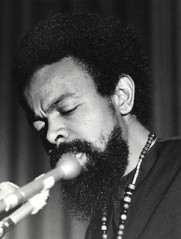
“Le Roi Jones” by Flickr user UIC Digital Collections, CC BY-NC-ND 2.0
Poetry is often said to be difficult—but how would a poet’s “sounding” of a poem help a listener better understand it, as Bernstein suggests? How is the recorded voice resonating in air different from inert marks on a page? What is the status of that difference? Why or how would the sound recording signify differently than the poem on the silent page? In short, is listening easier than reading? My answer to the final question is a resounding “no.” For me, the challenge is how to consider the recorded poetry performance in both formal and aural terms so as to remain tuned in to the aesthetic and the poetic as well as the social and historical dimensions of a particular poet’s work. This is not easily done.
“Black Dada Nihilismus” was first published in The Dead Lecturer (1964) and later included in Transbluesency (1995). Written in two parts, it asserts a black aesthetic by critiquing the dominance of (white) light in Western art and suggesting a connection between this light, ethnic violence, and religious ideology. This is how the poem opens:
.Against what light
is false what breath
sucked, for deadness.
Murder, the cleansed
purpose, frail, against
God, if they bring him
Bleeding, I would not
forgive, or even call him
black dada nihilismus.
The protestant love, wide windows,
color blocked to Modrian, and the
ugly silent deaths of jews […]
(Transbluesency 97)
Through critique the poem develops the connections between aesthetics and racial dominance and violence. These connections take on different inflections in each recorded version of the poem, and with each inflection another aspect of them is amplified.
The first version is a bootleg of a reading at the Asilomar Negro Writers Conference that was held in Pacific Grove, California, in early August, 1964.
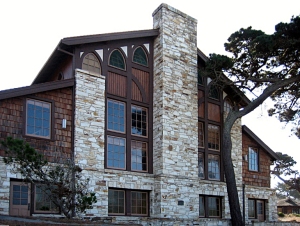
Asilomar Conference Grounds, site of 1964 Negro Writers Conference
In addition to the preamble, where Baraka explains some of the poem’s key terms such as Dada, which he describes as a movement in France (rather than Germany or Switzerland), another sonic detail that marks this as “live” is at the 2:59 minute mark when we hear the flap of a turning page, reminding us that Baraka is treating the poem as a script in these recordings. In this version, the opening lines are sharply delivered, the voice fully pausing at the linebreaks and acutely pronouncing the hard vowels (e.g. “sucked”). Against the continuous background hush of the original reel-to-reel recording, Baraka punches his words into the air, as if trying to find a rhythm between these harder vowels and the softer ones that often denote the poem’s object of critique (e.g. “light”).
The next version is off the A side of New York Art Quartet and Imamu Amiri Baraka (ESP Disk 1965), where the poem’s rhythm is immediately established by the musical accompaniment.
Between the first recording and this one a shift began in Baraka’s development as a poet. The assassination of Malcolm X pushed him to think even more about race, politics, and art. In this version the opening lines, delivered with punch and pause in the bootleg, take on a different register when juxtaposed with the smooth coolness of the quartet. Overall, though, the poem is delivered more militantly here. In the first version the opening lines are delivered forcefully, but ultimately this forcefulness subsides over the course of the reading. The opposite is the case in this studio version that slowly builds to the apex of the poem, the point of most force, this stanza:
Black scream
and chant, scream,
and dull, un
earthly
hollering.
(Transbluesency 99)
In the bootleg, the turn of the page—between “earthly” and “hollering”—interrupts this stanza, and Baraka hesitates and slowly finds his way toward the poem’s close, while in the studio version, the musical accompaniment reaches a fevered pitch here, making it feel as if it is at the edge of the scream that it names. This prepares us for the closing litany of names of black figures of “black dada nihilismus,” which goes like this:
For tambo, willie best, dubois, patrice, mantan, the
bronze buckaroos.
For Jack Johnson, asbestos, tonto, buckwheat,
billie holiday.
(Ibid.)
In the final version, which is DJ Spooky’s remix of the second one, included on the CD Offbeat: A Red Hot Soundtrip (TVT Records 1996), this litany feels more like the outro (that is meant as) against Spooky’s beats and moody reverb.
An aspect of the poem amplified in the remix is the stanzas leading up to the apex stanza of the “black scream.” In a series of tercets that open the second section, the speaker addresses the experience of racial oppression and a growing need to strike back:
The razor. Our flail against them, why
you carry knives? Or brutaled lumps of
heart? Why you stay, where they can
reach? Why you sit, or stand, or walk
in this place, a window on a dark
warehouse […]
(Transbluesency 98)
The “why” is significantly amplified in the remix, forcing us to hear the ironic indictment of the oppressive “light,” not as audible in the other two tracks, explicit in Baraka’s tercets.
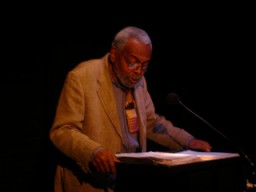
“IMG_0433″ by Flickr user Beyond Baroque, CC-BY-NC-SA-2.0
The original recordings of these versions of “Black Dada Nihilismus” are each in a different format: vinyl LP, tape-to-tape reel, and CD. I have been working with digitized versions, so the way I am hearing these recordings—through a smooth digitized MP3 file or Youtube clip—is not the same as the crackle of a needle running an LP’s groove or a nearly noiseless laser tracing a CD. These variations in format mean that the different ways these versions individual signify—their respective “sounds”—are flattened out by compression. Despite this loss of material context, Baraka still sounds different in each of these tracks. Each version of Baraka’s poem offers us another iteration of his “voice,” and the poem, but listening to each of them does not necessarily provide a better understanding of it. We are, though, given different sonic experiences that depend upon the purpose of Baraka’s performance, the listener imagined during the reading, and the voice enunciated through the mediated environment.
Some of the voice details do remain consistent across these recordings. For example, the delivery of one of the poem’s most memorable phrase—“Hermes, the/the blacker art”—that occurs toward the close of the poem’s first section is steadily delivered in a lower register, in the hush of an aside, and might be taken as the motif of each of these variations.
“Stage Microphone TTV” by Flickr user Keith Bloomfield, CC-BY-NC-ND-2.0
A vast archive of recorded poetry exists. Mid-century recording projects by Caedmon and Folkways made “voices” of well-known poets, such as Robert Frost and Dylan Thomas, available for mainstream consumption. More recent anthologies and series like Poetry Speaks and The Voice of the Poet suggest that the “voice of the poet” still holds appeal. The proliferation of online sound archives such as Penn Sound and From the Fishouse further attest to an ongoing investment in recording, storing, and making available sound files of poets reading their work. And this fascination with the “sound” of poetry is not limited to mainstream cultural spheres or web-based archives. Several scholarly collections on this convergence of sound, voice, and poetry such as Bernstein’s already-mentioned Close Listening, Adelaide Morris’s Sound States, and Marjorie Perloff’s and Craig Dworkin’s The Sound of Poetry/The Poetry of Sound have appeared over the last decade.
The idea of the sound of the poem, located in the mediated voice of the poet, therefore remains relevant today. In many of these instances, however, the poet’s voice falsely takes on an authoritative “aura,” as Walter Benjamin used that word in his (recently re-translated) “The Work of Art in the Age of Its Technological Reproducibility.” Benjamin uses “aura” to talk about authenticity in art and how that is lost when images (or sounds) can be reproduced and widely distributed, and this is not a bad thing: “technological reproducibility emancipates the work of art from its parasitic subservience to ritual. To an ever-increasing degree, the work produced becomes the reproduction of work designed to be reproduced” (24). When Benjamin’s concept is applied to recorded poetry, two key points emerge. First, the “sound” of a poet’s voice is the product of technological conditions. Second, just as a book editor makes aesthetic judgments based on a perceived audience, a listener is imagined when a poetry performance is recorded. Too bad I didn’t know this in high school.
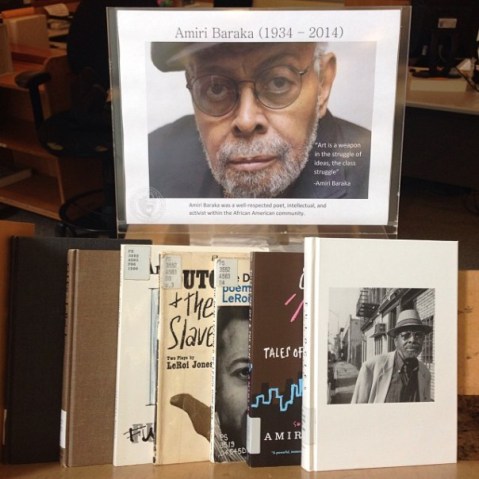
“A Poem for Speculative Hipsters by Amiri Baraka” by Flickr user Shawn Calhoun, CC-BY-NC-2.0
—
Featured image: “Paula Varjack” by Flickr user Very Quiet, CC-BY-SA-2.0
—
John Hyland recently completed his dissertation on sound, poetics, and the black diaspora, titled “Atlantic Reverberations: The Sonic Performances of Black Diasporic Poetries,” at the University at Buffalo, SUNY. His poems, essays, and reviews have appeared (or are forthcoming) in a range of journals, such as The Journal of Postcolonial Writing, College Literature, and Borderlands. Recently, he has enjoyed performing with the Buffalo Poets Theater and co-edited a special issue of the poetry journal kadar koli on the relationship between violence and the expressive arts.
—
 REWIND! . . .If you liked this post, you may also dig:
Hearing the Tenor of the Vendler/Dove Conversation: Race, Listening, and the “Noise” of Texts-Christina Sharpe
Pretty, Fast, and Loud: The Audible Ali–Tara Betts
The Sounds of Anti-Anti-Essentialism: Listening to Black Consciousness in the Classroom-Carter Mathes
Share this:


Current Top Posts





April 2021

January 2020

November 2019

October 2019

August 2019

April 2014

November 2017

March 2015

December 2017

October 2015
 Sounding Out!
Recent Comments