
In Search of Politics Itself, or What We Mean When We Say Music (and Music Writing) is “Too Political”

Music has become too political—this is what some observers said about the recent Grammy Awards. Following the broadcast last week, some argued that musicians and celebrities used the event as a platform for their own purposes, detracting from the occasion: celebration of music itself. Nikki Haley, the U.S. Ambassador to the United Nations, tweeted:
I have always loved the Grammys but to have artists read the Fire and Fury book killed it. Don’t ruin great music with trash. Some of us love music without the politics thrown in it.— Nikki Haley (@nikkihaley) January 29, 2018
I don’t know for sure, but I imagine that the daily grind of a U.N. ambassador is filled with routine realities we refer to as “politics”: bureaucracy, budget planning, hectic meetings, and all kinds of disagreements. It makes some sense to me, then, that Haley would demand a realm of life that is untouched by politics—but why music in particular?
The fantasy of a space free from politics resembles other patterns of utopian thought, which often take the form of nostalgia. “There was a time when only a handful of people seemed to write politically about music,” said Chuck Klosterman, a novelist and critic of pop culture, in an interview in June 2017. He continued:
Now everybody does, so it’s never interesting. Now, to see someone only write about the music itself is refreshing. It’s not that I don’t think music writing should have a political aspect to it, but when it just becomes a way that everyone does something, you see a lot of people forcing ideas upon art that actually detracts [sic] from the appreciation of that art. It’s never been worse than it is now.
He closed his interview by saying: “I do wonder if in 15 years people are going to look back at the art from this specific period and almost discover it in a completely new way because they’ll actually be consuming the content as opposed to figuring out how it could be made into a political idea.” Klosterman almost said it: make criticism great again.
Reminiscing about a time when music writing was free from politics, Klosterman suggests that critics can distinguish between pure content and mere politics—which is to say, whatever is incidental to the music, rather than central to it. He offers an example, saying, “My appreciation of [Merle Haggard’s] ‘Workin’ Man Blues’ is not really any kind of extension of my life, or my experience, or even my values. […] I can’t describe why I like this song, I just like it.” If Klosterman, an accomplished critic, tried to describe the experiences that lead him to like this particular song, he probably could—but the point is that he doesn’t make explicit the relationship between personal identity and musical taste.

Screen Capture of Merle Haggard singing “Workin’ Man Blues,” Live from Austin, Texas, 1978
The heart of Klosterman’s concern is that critics project too many of their own problems and interests onto musicians. Musician and music writer Greg Tate recently made a similar suggestion: when reviewing Jay-Z’s album 4:44, Tate focuses on how celebrities become attached to public affects. In his July 2017 review, “The Politicization of Jay-Z,” he writes:
In the rudderless free fall of this post-Obama void […] all eyes being on Bey-Z, Kendrick, and Solange makes perfect agitpop sense. All four have become our default stand-ins until the next grassroots groundswell […] Bey-Z in particular have become the ready-made meme targets of everything our online punditry considers positive or abhorrent about Blackfolk in the 21st century.
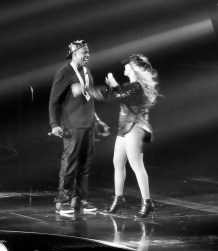
Jay and Bey perform live in 2013, by Flickr user sashimomura,(CC BY 2.0)
He suggests that critics politicize musicians, turning them into repositories of various projections about the culture-at-large. Although writing from a very different place than Klosterman, Tate shares the sense that most music criticism is not really about music at all. But whereas Klosterman implies that criticism resembles ideological propaganda too much, Tate implies that criticism is a mere “stand-in” for actual politics, written at the expense of actual political organizing. In other words, music criticism is not political enough.
In 1926, W.E.B. Du Bois wrote about this problem, the status of art as politics. In his essay “Criteria of Negro Art,” he dissects what he perceives to be the hypocrisy of any demand for pure art, abstracted from politics; he defends art that many others would dismiss as propagandistic—a dismissal revealed to be highly racialized. He writes:
Thus all Art is propaganda and ever must be, despite the wailing of the purists. I stand in utter shamelessness and say that whatever art I have for writing has been used always for propaganda for gaining the right of black folk to love and enjoy. I do not care a damn for any art that is not used for propaganda. But I do care when propaganda is confined to one side while the other is stripped and silent.
Du Bois’s ideas would be engaged extensively by later authors, including Amiri Baraka. In his 1963 essay “Jazz and the White Critic,” he addresses politics in terms of “attitude.” Then-contemporary white critics misunderstood black styles, he argued, because they failed to fully apprehend the attitudes that produced them. They were busy trying, and failing, to appreciate the sound of bebop “itself,” but without considering why bebop was made in the first place.
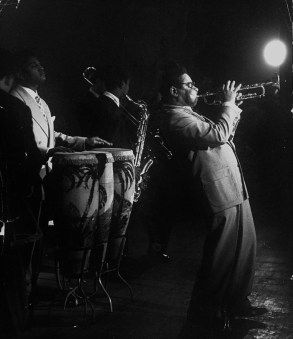
Dizzy Gillespie, one of BeBop’s key players, in Paris, 1952, Image courtesy of Flickr User Kristen, (CC BY 2.0)
As Baraka presents it, white critics were only able to ignore black musicians’ politics and focus on the music because the white critics’ own attitudes had already been assumed to be superior, and therefore rendered irrelevant. Only because their middle-brow identities had been so thoroughly elevated in history could these middle-brow critics get away with defining the object of their appreciation as “pure” music. Interestingly, as Baraka concludes, it was their ignorance of context that ultimately served to “obfuscate what has been happening with the music itself.” It’s not that the music itself doesn’t matter; it’s that music’s context makes it matter.
In response to morerecent concerns about the politicization of popular music, Robin James has analyzed the case of Beyoncé’s Lemonade. She performs a close reading of two reviews, by Carl Wilson and by Kevin Fallon, both of whom expressly seek the album’s “music itself,” writing against the many critical approaches that politicize it. James suggests that these critics can appeal to “music itself” only because their own identities have been falsely universalized and made invisible. They try to divorce music from politics precisely because this approach, in her words, “lets white men pop critics have authority over black feminist music,” a quest for authority that James considers a form of epistemic violence.
That said, James goes on to conclude that the question these critics ask—“what about the music?”—can also be a helpful starting point, from which we can start to make explicit some types of knowledge that have previously remained latent. The mere presence of the desire for a space free from politics and identity, however problematic, tells us something important.
 Our contemporary curiosity about identity—identity being our metonym for “politics” more broadly—extends back at least to the 1990s, when music’s political status was widely debated in terms of it. For example, in a 1991 issue of the queercore zine Outpunk, editor Matt Wobensmith describes what he perceived to be limitations of thinking about music within his scene. He laments what he calls “musical purism,” a simplistic mindset by which “you are what you listen to.” Here, he capitalizes his points of tension:
Suddenly, your taste in music equates you with working class politics and a movement of the disenfranchised. Your IDENTITY is based on how music SOUNDS. How odd that people equate musical chops with how tough or revolutionary you may be! Music is a powerful language of its own. But the music-as-identity idea is a complete fiction. It makes no sense and it defies logic. Will someone please debunk this myth?
Wobensmith suggests that a person’s “musical chops,” their technical skills, have little to do with their personal identity. Working from the intersection of Klosterman and Tate, Wobensmith imagines a scenario in which the abstract language of music transcends the identities of the people who make it. Like them, Wobensmith seems worried that musical judgments too often unfold as critiques of a musician’s personality or character, rather than their work. Critics project themselves onto music, and listeners also get defined by the music they like, which he finds unsettling.
 That same year, in an interview published in the 1991 issue of the zine Bikini Kill, musicians Kathleen Hanna and Jean Smith addressed a similar binary as Wobensmith, that of content and technique. But they take a different view: in fact, they emphasize the fallacy of this dualism in the first place. “You just can’t separate it out,” said Hanna, questioning the possibility of distinguishing between content—the “music itself”—and technique on audio recordings.
Female-fronted bands of this era were sometimes criticized for their lack of technique, even as terrible male punk bands were widely admired for their cavalier disregard of musical rules. Further still, disparagement of women’s poor technique often overlooked the reasons why it suffered: many women had been systematically discouraged from musical participation in these scenes. Either way, as Tamra Lucid has argued, it is the enforcement of “specific canons of theory and technique,” inevitably along the lines of identity, that cause harm if left unexamined.
All of these thinkers show that various binaries in circulation—sound and identity, personality and technique, music and politics—are gendered in insidious ways, an observation arrived at by the same logic that led Du Bois to reveal the moniker of “propaganda” to be racialized. As Hanna puts it, too many people assumed that “male artists are gonna place more importance on technique and female artists’ll place more on content.” She insists that these two concepts can’t be separated in order to elevate aspects of experience that had been implicitly degraded as feminine: the expression of righteous anger, or recollection of awkward intimacy.

Bikini Kill at Gilman Street, Berkeley, CA, 1990s, Image by Flickr User John Eikleberry, CC BY-NC 2.0
Punk had never pretended not to be political, making it a powerful site for internal critique. Since the 1970s, punk had been a form in which grievances about systemic problems and social inequality could be openly, overtly aired. The riot grrrls, by politicizing confessional, femme, and deeply private forms of expression within punk, demonstrated that even the purest musical politics resemble art more than is sometimes thought: “politics itself” is necessarily performative, personal, and highly expressive, involving artifice.
Even the act of playing music can be considered a form of political action, regardless of how critics interpret it. In another punk zine from c. 1990, for example, an anonymous author asks:
What impact can music have? You could say that it’s always political, because a really good pop song, even when it hasn’t got political words, is always about how much human beings can do with the little bag of resources, the limited set of playing pieces and moves and words, available […] Greil Marcus calls it ‘the vanity of believing that cheap music is potent enough to take on nothingness,’ and it may be cool in some places to mock him but here he’s dead-on right.
But music is never only political—that is, not in the elections-and-petitions sense of the word. And music is always an action, always something done to listeners, by musicians (singers, songwriters, producers, hissy stereo systems)—but it’s never only that, when it’s any good: no more than you, reader, are the social roles you play.
The author persuades us that music is political, even as they insist that it’s something more. Music as “pure sound,” as a “universal language” seems to have the most potential to be political, but also to transcend politics’ limitations—the trash, the propaganda. Given this potential, some listeners find themselves frustrated with music’s consistent failure to rise to their occasion, to give them what they desire: to be apolitical.

Kelly Clarkson performed at The Chelsea on July 27, 2012, image by Flickr User The Cosmopolitan of Las Vegas, CC BY-NC 2.0
In an interview during the recent Grammys broadcast, pop singer Kelly Clarkson said, “I’m political when I feel like I need to be.” It’s refreshing to imagine politics this way, like a light we turn on and off–and it’s a sign of political privilege to be able to do so. But politics are, unfortunately, inextricable from our lives and therefore inescapable: the places we go, the exchanges we pursue, the relationships we develop, the ways we can be in the world. Thinking with Robin James, it seems that our collective desire for a world free from all this reveals a deeper knowledge, which music helps make explicit: we wish things were different.
I wonder if those who lament the “contamination” of the Grammys with politics might be concerned that their own politics are unfounded or irrelevant, requiring revision, just as many white people who are allergic to identity politics are, in fact, aware that our own identity has been, and continues to be, unduly elevated. When Chuck Klosterman refuses to describe the reason why he likes “Workin’ Man Blues,” claiming that he “just does,” does he fear, as I sometimes do, not that there is no reason, but that this reason isn’t good enough?
Fortunately, there are many critics today who do the difficult work of examining music’s politics. Take Liz Pelly, for example, whose research about the backend of streaming playlists reminds us of music’s material basis. Or what about the astute criticism of Tim Barker, Judy Berman, Shuja Haider, Max Nelson, and others for whom musical thought and action are so thoroughly intertwined? Finally, I think of many music writers at Tiny Mix Tapes, such as Frank Falisi, Hydroyoga, C Monster, or Cookcook, for whom creation is a way of life—and whose creative practices themselves are potent enough to “take on nothingness.”
“Music is never only political,” as the anonymous ‘zine article author argues above, but it is always political, at least a little bit. As musicians and critics, our endeavor should not be to transcend this fact, but to affirm it with increasing nuance and care. During a recent lecture, Alexander Weheliye challenged us in a lecture given in January 2018 at New York University, when listening, “To really think: what does this art reflect?” Call it music or call it politics: the best of both will change somebody’s mind for real, and for the better.
—
Featured Image: Screen Capture from Kendrick Lamar’s video for “HUMBLE,” winner of the 2018 Grammy for “Best Music Video.”
—
Elizabeth Newton is a doctoral candidate in musicology. She has written for The New Inquiry, Tiny Mix Tapes, Real Life Magazine, the Quietus, and Leonardo Music Journal. Her research interests include musico-poetics, fidelity and reproduction, and affective histories of musical media. Her dissertation, in progress, is about “affective fidelity” in audio and print culture of the 1990s.
—
 REWIND!…If you liked this post, you may also dig:
SO! Reads: Jace Clayton’s Uproot–Elizabeth Newton
Re: Chuck Klosterman – “Tomorrow Rarely Knows”–Aaron Trammell
This is What It Sounds Like . . . . . . . . On Prince (1958-2016) and Interpretive Freedom–Ben Tausig
Share this:

Unapologetic Paisa Chingona-ness: Listening to Fans’ Sonic Identities


For the full intro to the series by Michelle Habell-Pallan, click here.
The forum’s inspiring research by scholars/practioners Wanda Alarcón, Yessica Garcia Hernandez, Marlen Rios-Hernandez, Susana Sepulveda, and Iris C. Viveros Avendaño, understands music in its local, translocal and transnational context, and insists upon open new scholarly imaginaries. . .
Current times require us to bridge intersectional, decolonial, and gender analysis. Music, and our relationship to it, has much to reveal about how power operates within a context of inequality. And it will teach us how to get through this moment. –MHP
—

Que Buena Epoca Instagram Post (reposted by El Original)
I am a self-identified Paisa, a Paisa Girl from Playa Larga – my home – in the Eastside of Long Beach, California. The term paisa/s is slang for paisanos (homies) and it references someone who takes pride in listening, dancing, and attending nightclubs where Banda music, corridos, and norteños are performed. I am part of a generation that has been referenced as the Chalinillos; youth with an urban gangsta aesthetic that was influenced by Chalino Sanchez, The Riveras, Saul Viera, Adan Sanchez, Los Dos Grandes, Tigrillo Palma, Los Amos; later came the Alterado, Progressivo (DEL) and now people like El Fantasma, Lenin Ramirez, Alta Consigna, Grupo Codiciado, Jesus Mendoza, and Los Perdidos de Sinaloa.
As they say, “Fierro Parriente!” “Andamos al Millon,” “Pa que vayan y digan” and “Puro Pa Delante!”
In the mid 2000s, besides partying hard in the paisa nightclub music scene, I also partied with several paisa party crews in Long Beach. The songs, “Las Malandrinas,” “Parrandera,” “Rebelde, y Atrevida,” and “Mi Vida Loca” by Jenni Rivera were my anthems. These songs described the music scene we were a part of, and how we situated ourselves within a male-dominated subculture. “La Malandrinas” for instance says that we make a lot of noise, we drink, ask for corridos at clubs (a masculine tradition) and do not care about what people say about us.
Thus, Jenni’s participation in this music genre was important because she created paisa sonic identities for the women in this subculture. “Sonic identities”, is a term that I use to describe the process fans engage in when they use a song to create a nickname and identity for themselves. This is a common practice among party crews and fan clubs. For instance, the nickname that I gave myself was “La Yaquesita” which is a title of a song. My participation in this nightlife shapes my analysis of this subculture. The gender dynamics and negotiations I had to engage with in this space made me an unapologetic feminist (although I did not call myself that at the time) who was fierce and defended herself but who—despite the slut shaming—approached this nightlife through a sex-positive attitude. Our attitude was “Fuck Haters!” and having this mentality was liberating. So, it makes sense that now I write about haters –or what Jonathan Gray calls anti-fans. I am interested in analyzing sonic haterism and how it tries to police Latina women-centered and sex-positive spaces like fan clubs and paisa party crews.
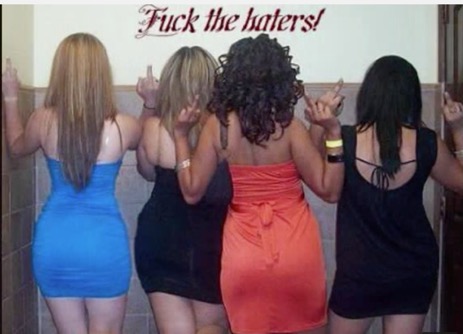
Las Malandrinas de Long Beach, 2008
In my dissertation entitled, “Boobs and Booze: Jenni Rivera, the Erotics of Transnational Fandom and Sonic Pedagogies,” the intertwined themes of sound and home emerges via a loud shout-out of my hometown that sounds like “Playa Larga, Baby” or a louder shout out that says “Son Ovarios de Playa Larga, Chaooowww, Baby.” Similar to “Fuck Haters!,” the latter shout-out implies a particular attitude and feminisms rooted in unapologetic paisa chingona-ness. Paisa Chingona-ness is the sonic condition, the rebellious and intoxicating state of being a chingona “rancherota.” Chicana feminists such as Sandra Cisneros and Josefina Lopez have defined and theorized being a chingona in multiple ways. In her poem titled “Chingona,” Lopez for instance defines a chingona as a sex-positive Chicana who refuses to be slut-shamed for owning her fat body, sexuality (literally she loves to be on top), and agency. There are overlaps with how Lopez, Jenni and her fans practice being chingonas; however, the added layer with Paisa Chingona-ness is that Jenni’s music and fandom shapes the way they embody it.
Activist and Writer, Raul Alcaraz Ochoa, has written a piece titled “Jenni Rivera y los 9 Puntos del Feminismo Chingona” here he acknowledges that Chingona Feminism is rooted in the barrio, the hood and is born from within and in response to a machista context, where the priority is always given to men. According to Ochoa, Chingona Feminism is also born from race oppression and class-struggle. Ochoa states that Jenni “dice lo que piensa sin pelos en la lengua, te agrede si eres injusto porque su lengua es una bala que te deja con los huevos estrellados.” My work shows how chingona feminism is also practiced and embraced among fans. I expand on Ochoa’s analysis to think through Paisa Chingona-ness which asks us to listen to the “details” that Chingonas make when they are surrounded by each other.
Heard through my experiences, identifications, and stance toward the world, it makes sense why home manifests itself in the approach that I use to study popular music: that of fandom, that prioritizes fans and their approach to what I call sonic pedagogies. Which is a concept that was inspired by scholars such as Deborah Vargas, Alicia Schmidt Camacho, Jillian Hernandez, Anya Wallace, Gloria Anzaldúa, and Martha Gonzalez. These scholars write about the power of music as “sung theory,” the power of music to create “sonic imaginaries,” or inspire teachings between the artists and the listener, that oftentimes creates “an erotic of feminist solidarity.”
For me, sonic pedagogies is a concept that centers the fan and what John Fiske has called their “textual, enunciative, and semiotic productivity.” Sonic pedagogies allows me to think about the affective and corporeal fan-to-fan teachings that are inspired even when the artist is dead and yet their legacy and conocimientos are being used to teach fans to understand each other. Sonic Pedagogies centers the practice that Lawrence Grossberg explains when he states, that fans give “authority to that which he or she invests in, letting the object of such investments speak for and as him or herself” (59).

A J-unit’s Altar: Andrea’s Jenni Collection, photo taken by author, 2015
Listening to sonic pedagogies asks us to write about music from a different perspective, from the perspective of its fans. Oftentimes we listen and write about music from the perspective, the voice, the body, and lyrics of the artist. But what if we start from their re-interpretation of a song in a YouTube video for instance? What if we start from a fan shout-out during a concert? What if we start from the conversations that emerge when fans talk about their favorite songs to non-fans? What if we make anti-fans our starting point to understand an artist or a music genre? Analyzing music in this way allows us to hear the multiple sonic layers that a song and music in general inspires.
I am also a filmmaker, so the way I understand sound and the reception of music is inspired by how I edit sound for a film. When we edit film, we layer the sound, we usually have at least three layers of sound: the interview (main story and Track 1), music (Track 2), and background noise (Track 3). However, sometimes you can have up to 20 sonic tracks layered at once and, actually, is how I have experienced fandom. There’s a song that we usually are listening to because we identify with it (Track 2), then we add our own conocimiento to the song (Track 1), that conocimiento or what many times turns into “archisme” provokes background noise of solidarity (Track 3), either to show the other fan that you understand, acknowledge, and relate to what they are sharing. Fans ask us to listen to the study of music from a perspective of “love” (Duffet), “magic” (Guy) and “erotics.”
Scholars in the field of fan studies such as Daniel Cavicchi have defined fandom as “not some particular thing one has or does. Fandom is a process of being; it is the way one is” (59 ). Alexandra Vasquez, in particular, reminds us of the importance of “listening to details” when thinking about fandom, music and performance. Sonic Pedagogies requires that I listen to the “details” of audience members, fans, and anti-fans that tell me about how Chicana/ Mexicana/Latina women resist structures of governmentality by questioning gender norms, and traditional ideas about sexuality. In Listening on Detail, Vasquez explains that details are “interruptions that catch your ear, musical tic that stubbornly refuse to go away. They are things you might first dismiss as idiosyncrasies. They are…saludos, refusals, lyrics, arrangements, sounds, grants, gestures, bends in voice” (19). In my work, Jenni chants, removal of clothing, mobile recordings, posters, fliers, fan shirts, and sing alongs, are the details that allows me to examine Jenni Rivera.
For instance, I analyze the deschichadera “removal of bra” ritual that both Jenni and her fans engaged in during concerts. I am fascinated by the deschichadera ritual and Jenni’s concerts in general because these fans are constantly redefining home, embodying Cherrie Moraga’s feminist praxis of “making familia from scratch” (58).
Thus for fans, home is found in the affective, erotic, collective, and intimate aspects of music reception and its sociality. Home is found in fan clubs, fan gatherings, tribute events, living room, and the travels of bumping music in the car. Listening to the details of fans allows me to view audience responses to Jenni’s performance part of Jenni’s own presentation and music, not separate from them. Engaging music through fans allows me to see that songs, concerts, and albums do not end when the music stops.
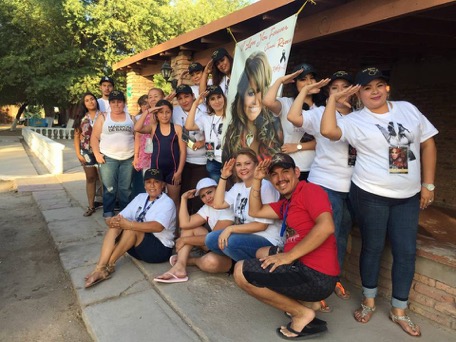
J-units in Mexicali celebrating Jenni’s Birthday, 2017
In “Boobs & Booze,” home also appears in murals, particularly their visual representations of Mexican music. In the vein of Deborah Paredes’s study of Selenidad, I write about the visual politics of Jenni’s remembering, particularly Jenni Rivera Memorial Park, dedicated by the city of Long Beach in 2015. Home appears in the fashion that we decide to dress our bodies in, especially the femme challinillo aesthetic, and homegirl/Pachuca/partygirl look that Jenni performed on stage. We also find home in the memories we make when we listen to a particular song. So for me, listening to” Mi Vida Loca” for instance always bring me back to Long Beach, the barrio that has shaped me as a chingona feminist, scholar, and artivist.

Sergio Ramirez working on the Jenni Rivera Mural (2015) photo taken by author.
Home is the music that we take with us, the music and sounds that we carry in our backs when we enter white or middle-class dominated spaces where our paisa music is not acknowledged or it is even looked down upon and critiqued for being “too Mexican,” “too chunti,” “too low.” Home and sound makes me think of how people of color co-exist with each other sonically. In the EastSide of Long Beach, for instance, home and sound is black and brown relations, tensions, and solidarity. Home and sound is acknowledging that both corridos, hip-hop, and G-Funk relationally, has formed paisas. I mean, I also get an adrenaline rush when I hear Snoop Dog, Warren G, Nate Dogg, O.T Genasis, and Ladies of Beach City referencing their roots to Long Beach, as Snoop says, “it’s an Eastside thang.”
The recent example of Playa Larga’s black and brown sonic solidarity is Snoop Dog’s recent Instagram video listening to Jenni’s music. Watching two Playa Larga finest artists being fans of each other, despite the differences in music genre, language, and spatial politics (East vs. West) is powerful, it tells us that we listen to each other even when they try to put us against each other. In this video, Snoop Dogg embodies the “We have each other” solidarity with which Gaye Theresa Johnson ends Spaces of Conflict, Sounds of Solidarity: Music, Race, and Spatial Entitlement in Los Angeles (189).
Rip jenni rivera- sweet lady n a beautiful voice she will b missed we were supposed to do a song together Im so sad!
— Snoop Dogg (@SnoopDogg) December 10, 2012
Listening to Chingona-ness pushes me to theorize a new framework for anti-fandom, one that centers race, class, sexuality, and is not only about an artist’s music– or what Gray calls the “text” – but also about their bodies and the bodies of the fans, their ontologies, and existence. Focusing particularly on Jenni and her fans allows me to think about gender, sexuality, class, pleasure, music reception in relation to anti-immigrant sentiments, war on drugs, war on poverty, and the war on Latina reproduction and fatness. Jenni as a case study allows me to explore how unapologetic paisa chingona-ness triggers anti-fans, exposes what I am calling agitations and their “agitated responses.” Agitated responses refers to the hater comments that anti-fans (or non-fans) make towards Jenni, (and there are many), while agitation is the carnal disgust that anti-fans display when they police the behavior of Jenni and her fans. In this anti-fandom framework, agitation is the disaffection – the visceral aggression or enmity – that people who hate Jenni and her fans express when they write, say, or gesture agitated responses towards them, a form of sonic haterism.
I entered academia to theorize my home and write the paisa girl epistemology since there is little literature written on our sonic identities, and to show how sonic haterism, in conversation with fandom, allows me to understand the historical, social, and cultural realities working-class Latinas face. Here is how Jenni Rivera once expressed this same intersection in the song “Mi Vida Loca,” which asks listeners to hear what Paisa Chingona-ness sounds like in Playa Larga, her sonic home, and mine too.
—
Featured Image: Paisa Party Crews in Long Beach, The Myspace Days , courtesy of author
—
Yessica Garcia Hernandez is a doctoral candidate and filmmaker in the Department of Ethnic Studies at the University of California San Diego. Her scholarship bridges fan studies, sound studies, women of color feminisms, fat studies, girl studies, and sexuality/porn studies to think about intergenerational fans of Mexican regional music. Yessica earned her B.A. in Chicanx Studies from University of California, Riverside and an M.A. in Chicanx and Latinx Studies at California State University Los Angeles. She has published in the Journal of Popular Music, New American Notes Online, Imagining America, Journal of Ethnomusicology, and the Chicana/Latina Studies Journal. Her dissertation entitled, “Boobs and Booze: Jenni Rivera, the Erotics of Transnational Fandom, and Sonic Pedagogies” examines the ways in which Jenni Rivera fans reimagine age, gender, sexuality, motherhood, and class by listening to her music, engaging in fandom, and participating in web communities. She explores the social element of their gatherings, both inside and outside the concert space, and probe how these moments foreground transmissions of Latina power. Yessica’s broader research interests includes paisa party crews, Banda Sinaloense, Contestaciones, and Gordibuena/BBW erotics. She is a co-founder and member of the Rebel Quinceañera Collective, a project that utilizes art, music, photography, creative writing, filmmaking, and charlas to activate spaces for self-expression and radical education by and for youth of color in San Diego.
—
 REWIND! . . .If you liked this post, you may also dig:
Deep Listening as Philogynoir: Playlists, Black Girl Idiom, and Love –Shakira Holt
Listening (Loudly) to Spanish-language Radio—Dolores Inés Casillas
Feeling Through the Keen and Grind: Team Dresch’s Personal Best –Gretchen Jude
New Wave Saved My Life—Wanda Alarcón
Share this:


Current Top Posts





April 2021

January 2020

November 2019

October 2019

August 2019

April 2014

November 2017

March 2015

December 2017

October 2015
 Sounding Out!
Recent Comments