
Something’s Got a Hold on Me: ‘Lingering Whispers’ of the Atlantic Slave Trade in Ghana

Interior of Men’s Slave Cells – Cape Coast Castle – Ghana, Image by Flickr User Adam Jones, PhD
I am standing in the mouth of the female dungeon. I hesitate to breathe for fear the hole will swallow me. It is competing with a rising tide of anguish that also threatens to eat me alive. The hole is dark, dank and noisome yet oddly comforting. After all, this is why I, and others, come to this site of torture—to fill in the gaps of our history, to make better sense of our lives, to find some comfort. But how does one find home in throbbing loss? Why must one dig for answers—that, ultimately, produce new questions—within the locus of pain? I run my fingers across the length of the thick, cavernous rock. It is brown like my skin…I can’t tell where it ends or begins.
In a 2010 interview with FADER Magazine, poet Gil Scott-Heron declared, “The spirit should be material. It’s your blood. Inside your bloodstream is your parents and their parents and their parents and their parents and they want you to make it, because when you do what you do and you’re successful, then they’re happy you made it. You’re the link with immortality” (88). What Scott-Heron articulates here is an ontological claim to spirit as inherently material and always already an eternal force over life’s struggles. The answers to the puzzle are embedded underneath the skin in an internal dialogue between spirit, mind, blood, bone and mass. This same ideological force is what pulls so many African American tourists back to Elmina and Cape Coast Castles in Ghana, in search of what Anne Bailey calls “lingering whispers” in African Voices of the Atlantic Slave Trade (3). We spin back the wheel of time to re-trace its deep grooves and recover the loss/lost in dungeons, burial sites, Donkor Nsuo (The Slave River), and the Atlantic Ocean.

Marks made by slaves in the Cape Coast Castle slave dungeons, Image by Flickr user Floris van Halm
Perhaps one’s DNA is a recording that is not only biological and racial but cultural and cosmological. Carolyn Cooper, in Noises In the Blood: Orality, Gender, and the “Vulgar” Body of Jamaican Popular Culture discusses “noises in the blood and reverberating echoes in the bone” as genealogical discourses of race. Can one’s DNA be an embedded and embodied soundtrack that charts particular and interconnecting nodes of history? Are those memories, experiences, dreams and longings then “recorded on my body,” as Nancy Frey suggests in “Stories of the Return: Pilgrimage and Its Aftermaths” (101) ? If we broke down the strands into coherent codes, or notes, or rearranged them into other combinations, what would they sound like? Would it produce a series of mixtapes, like hip hop records that sample older Black music—blues, R&B, funk, soul and jazz—and re-articulate them with new and emerging sounds? Perhaps it’s like Nathaniel Mackey muses in Bedouin Hornbook, “The last thing I remember is coming to the realization that what I was playing already existed on a record” (5). The slave forts become the ontological point of racial and cultural identity because, according to Saidiya Hartman’s Lose Your Mother: A Journey Along the Atlantic Slave Route, “the dungeon was a womb in which the slave was born” and where, by the performance of walking through the “Door of Return” one’s social life can be recovered, revitalized or remade (111).
I strain to hear any forms of life. As Slavoj Žižek suggests in “‘I Hear You With My Eyes’; or, The Invisible Master,” “ultimately we hear things because we cannot see everything” (90 and 92). According to tour guides at Elmina and Cape Coast Castles, the brick slave pens reverberate with the loss/lost of life, particularly at night, where bodiless moans, sobbing, screams and litanies can be heard rocking through the forts. But I can only detect distant sounds of activity beyond the back of the castle doors and “The Door of No Return.” The predominant noise is the Atlantic Ocean, crashing against the seashore. I hear the fishermen speak in rapid, hushed tones as their bodies struggle against the tiny canoes, their oars pulse against the waves as nets are thrown in with great precision. At the entrance of the castle, teenaged boys patronize African American tourists with “Sister! Brother!,” “Akwaaba”(Welcome), or “Welcome Home” as they pass folded letters with requests for contact information, money, or school donations, colorfully braided bracelets or other trinkets for sale. Market women pierce the air with unique calls for customers to try their products of bagged ice water, oranges, sugarcane, pineapple, and groundnuts. Cab drivers compete for tourists’ attention with loud, intermittent honks, verbal petitions or hisses.

Outside Cape Coast Castle, Image by Flickr User Abby Flatcoat
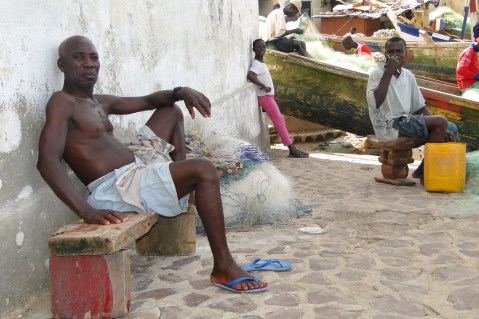
Outside the Door of No Return – Cape Coast Castle – Ghana, Image by Flickr User Adam Jones, PhD
The shops in the courtyard just beyond the reception area are now filled with traditional instruments—drums, guitars, piano boxes, and rattles—beads, cloth, masks, paintings, rugs and postcards. It is no longer a market in Black flesh but of “African” objects, or cultural artifacts that amplify the racial identity of diasporic visitors, and make them more “real” once they return home. Shop owners busy themselves making crafts, passing the day chatting with one another and potential customers.
This cell in which I stand is one of many at the Twin Castles, the gargantuan fortresses that after five hundred years continue to hold fast to the southern coast of Ghana. The intersecting trails of fine cracks rupture the once-pristine white paint on the walls. . .possibly one for every person stolen out of the dungeons. The hull is transfixing, the hold captivating. For some reason, I am suddenly reminded of Rev. James Cleveland’s gospel song, “Something’s Got A Hold On Me” where he proclaims, “Something hit me/Up over my head/And run right to my feet.”
.
Cleveland is talking about the power of the Holy Ghost to re-fashion his troubled life through spiritual re-birth. He sings of transformation from a life of misery to a brand new liberation that is manifested like a shock through his entire being and body. This new shock counters the crisis he regularly experiences “in the world.” This new bodily sensation permeates his entire being and acts as a shield against daily strife. Similarly, Etta James’ secular version, “Something’s Got A Hold On Me” attests, “My heart feels heavy/my feet feel light/I shake all over/ but I feel alright.”
.
James’ something is more possessive of her person; it is the overwhelming yoke of romantic love that seeps into her pores and won’t let up. This occupation of James’ senses is so startlingly pleasurable that she longs for and needs it. Similarly, The Miracles’, “You’ve Really Got A Hold On Me” pronounces, “Don’t want to leave you/don’t want to stay here/don’t want to spend another day here/oh, oh, oh, I wanna sit now/I just can quit now.”
.
Robinson expresses the ambivalence of love and longing—frustration, disappointment, ecstasy and desire—that crowds the senses with the sheer torture of being powerless over this structure of feeling. The protagonist is unable to shake hold of the beloved object, which makes him question his own capacity.
The “hold” becomes embodied and acts out in ways the mind cannot comprehend or prevent. It is the same hold the castles have on many African American visitors—an enigmatic narrative of love, loss and longing that the progeny of slaves refuse to relinquish and attempt to retell by inserting their bodies into slave histories. African Americans tour the castles as a way of tracing what Ralph Ellison calls “the grooves of history” in Invisible Man (443). Like a phonograph record, grooves are meant to be linear and progressive, but diasporic African history is awkward, uneven and full of odd ruptures, gaps and distortions. As James Clifford insists in “Diasporas,” “Diaspora discourse articulates, or bends together, both roots and routes” (251). These grooves consist of a series of complex and overlapping relationships that are multi-directional and non-linear. Like an album record, the records of history indicate particular events of static (crisis), interludes (junctures), and rhythms (discourse).

78 Record grooves by Flickr User Roger Smith
“The music is mysteriously ‘in’ these physical recesses, pressed into the vinyl,” Steven Feld argues in Music Grooves: Essays and Dialogues, “and listeners may imagine journeying there to merge right ‘into the groove’” (111). Grooves are doubly intentioned as: 1) the tracing of deep historical roots through specific routes of migration and 2) a physical and/or psychic space where utopic possibilities are imagined, alternative choices can be sought out, and past and future events are persistently contextualized within the present moment. To be “in a groove” is to be in tune with multiple realities simultaneously, to compress or stretch out time and space and one’s capacity in extraordinary ways.
Strangely, this cell is absent of all sound, even the static, white noise of silence. But it refuses to sound for me and tell me its history. I hear nothingness in the emptied hole. All that remains is a heavy vastness of what once was. As Mackey so profoundly articulates, “I wept for the notion of kin, as though the very idea were an occasion for tears, a pitiful claim to connection, a bleeding socket whose eye’d been plucked out” (21).
Over time, the cold stone has absorbed the blood, sweat, feces and bones of its inhabitants. It is the only material trace that proves the enslaved were once there.
—
Sionne R. Neely received her Ph.D. in August 2010 in American Studies & Ethnicity from the University of Southern California. Her dissertation examines how music artists in Ghana create transnational work alliances in response to shifting political regimes under independence, from Kwame Nkrumah’s administration to the present. Since 2005, Dr. Neely has recorded and archived more than 150 interviews with creative artists and industry professionals based in Ghana. In 2010, Dr. Neely co-founded ACCRA [dot] ALT, a cultural organization that promotes the alternative work of emerging Ghanaian artists through innovative programming and international exchange with artists worldwide. In 2011, she co-produced the Accra homecoming concert and documentary film for hip hop artist Blitz the Ambassador and Afro-Pean soul duo, Les Nubians. She is co-producer of Gbaa Mi Sané (Talk To Me), a short documentary film that explores the creative process of young visionary artists in Ghana (to be released in Summer 2013). Dr. Neely will also publish an article on hip hop practices in Ghana in the forthcoming Cambridge Companion Series (Fall 2013).
Share this:

Hearing “Media-Capitalism” in Egypt

As I began researching my first book Ordinary Egyptians, a study of Egyptian culture from the 1870s until the eve of the 1919 revolution, sounds and early sound media were the last thing on my mind. However, When I dug more deeply into the historical sources, I realized the importance of music and the comedic theater in the urban culture of turn of the century Egypt. This made me expand the scope of my research to incorporate the vernacular culture of Egypt as an entire media-system, which as I showed in my book, was instrumental in constructing a modern Egyptian national identity. Music, songs, plays, chants, speeches, conversations and chatter, were very influential in forming an Egyptian national culture at the end of the nineteenth century, especially in a society with low literacy rates. By incorporating performance and sound media–especially the rising record industry–my book strives to expand the historical study of this period beyond just the visual and the printed to include sound, and aural/oral expressions of culture.
“Muski Street, Cairo, 1903.” Source: William Herman Rau. From Library of Congress Prints and Photograph Division.
Ordinary Egyptians also engages with some of the theories of nationalism and tests their applicability to Egypt and the Arab world. It introduces the concept of “media-capitalism,” which expands the historical analysis of Egyptian nationalism beyond just print and silent reading, through the incorporation of audiovisual, sound, and performance media. By integrating these new media, especially the burgeoning record industry, my book attempts to make room for both the “ear” and the “eye”—for the aural and oral alongside the visual—and in the process provides a more comprehensive explanation for how individuals and communities digest and embody cultural information. As this excerpt explains, cultural productions, in any form, are not socially relevant unless they are communally and socially activated; they must be discussed, breathed, and animated in the routine of everyday life.
The following is an excerpt from Ordinary Egyptians, with thanks to Stanford University Press. Notes have been included in the text to conform to Sounding Out!‘s style sheet.
—
Mundane Nationalism
Egypt’s new mass media reflected on relevant everyday political, economic, and cultural concerns, and amplified them on the national stage in a comprehensible, locally pertinent and entertaining form. The repeated themes of many of these media included: bemoaning the lack of economic opportunities for native Egyptians, portraying the economic exploitation of Egyptians by foreigners, warning of perceived declines in national “morality,” satirizing and at times insulting British and native officials, and rousing patriotism and a sense of collective national solidarity.
However, the most effective way that national identity and a sense of nationhood was ‘absorbed’ was not only through these overstated themes and methods, but through the mundane media portrayals and representations of everyday “national” life and the internalization of these modes in actual practice. As Michael Billig describes in Banal Nationalism, nationalist ideology “might appear banal, routine, almost invisible,” however, these “subconscious” matter-of-fact representations create a common sense “naturalness of belonging to a nation” (15-16). Billig explains that often there is “continual ‘flagging’, or reminding, of nationhood,” as on a daily basis, citizens are reminded of their national identity. This reminding however, is “so familiar, so continual, that it is not consciously registered as reminding” (8). Mundane and unstated representations of Egyptian-ness abounded in most forms of mass culture, where “Egyptians” distinctively spoke and acted and were clearly, though tacitly, differentiated from non-Egyptians. Most of the media examined in this study implicitly addressed their listeners, viewers and readers as members of an Egyptian “nation.” To be sure, the most influential aspect of vaudeville and the satirical press were not necessarily the outwardly nationalistic messages of many of their articles, cartoons, and dialogues, but the recurring and mundane representations of colloquial Cairene as the de-facto dialect of all Egyptians, and the implicit understanding that flawlessly speaking and understanding it was the basic marker of a “modern” Egyptian national identity. Only an “authentic” ibn or bint al-balad (son or daughter of the country) would employ Egyptian Arabic and grasp its multiple meanings and nuances and hence participate in this new mass-produced colloquial culture. In fact, many of the comedic dialogues depicted in political cartoons and vaudeville repeatedly contrasted the mispronunciations of foreigners—who often played unsympathetic or villainous roles—with the “correct” pronunciation of affable Egyptian characters. This repeated portrayal of Cairene as the only “authentic” Egyptian accent reified it as an unofficial dialect of all Egyptians, even if back in the villages and towns of the Sa‛id more localized modes of expression were employed. By way of media-capitalism, Cairo’s dialect and culture was overwhelming—colonizing, if you will— the multitude of other localized dialects and cultures in Egypt. Thus, paradoxically, Cairene Arabic was the primary tool for nationalist, anti-imperialist discourse, and simultaneously, through internal-colonialism, it imposed its own culture on the “nation” [Note: This is very similar to what was happening in France during roughly the same time period. See Eugen Weber’s Peasants Into Frenchmen: The Modernization of Rural France, 1870-1914, 486-88].

“Egyptian crowds with Italian flag during 1919 Revolution.” Source: From L’Illustration (Paris), May 3, 1919.
The Sensorium and the Public Sphere
The efficacy of the new mass media and its potential for mass mobilization was best demonstrated during times of national crisis. The 1906 Dinshaway Incident and the 1919 Revolution in particular reveal how all forms of mass media functioned together to effectively document, memorialize, celebrate, and mobilize on a national scale. The growth of popular Egyptian mass culture, articulated almost exclusively in colloquial Egyptian, was the pivotal factor in the popularization and dissemination of an Egyptian national identity. The evolution and universalization of a colloquial Egyptian middle culture, made possible especially through the utilization of sound and audiovisual media, allowed for a shared and “uniquely” Egyptian cultural landscape. It is primarily within this non-official web of colloquial Egyptian mass culture, driven in large part by media-capitalism, that Egyptian national identity was widely disseminated and popularized.
One crucial aspect of this study was the critical role coffee shops played as cultural hubs, where differing mass media from newspapers to recorded music were publicly merged, negotiated, and digested. Many of the songs initially written for musical and comedic plays were recorded and played, or performed by street musicians at coffee shops and even in the streets and sidewalks. The role of the thousands of urban cafés and other public meeting areas in the broadcasting and reception of these new cultural productions is central to understanding the potency and effectiveness of this developing nationwide culture. Indeed, coffeehouses, as Peter Burke has remarked in A Social History of the Media, “inspired the creation of imagined communities of oral communication” (30).
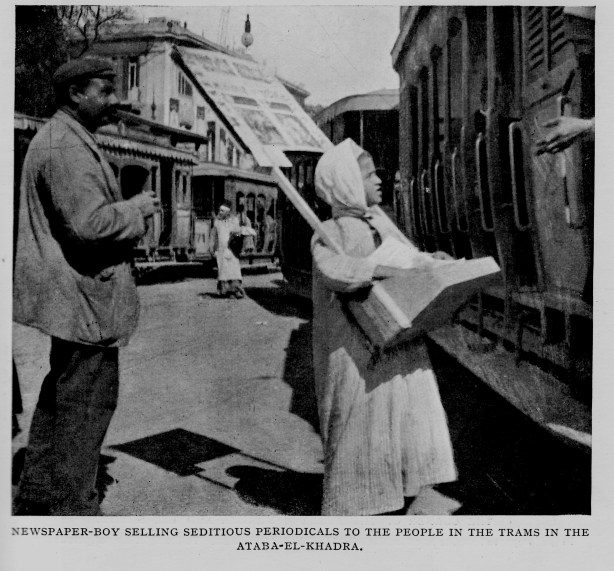
“Egyptian newspaper boy yelling out the latest headlines, Cairo, 1907.” Source: From Douglas Sladen, Oriental Cairo (London: 1911), 64.
However, as discussed in previous chapters, this was never a one way conversation, as writers of these vernacular media were plugged into the streets and public squares through these very same cafés. As we have observed in this study, it can be said that the entire vaudeville theater industry arose out of the cafés on ‘Imad al-Din Street, where most of the vaudeville theaters were housed [Note: See Ibrahim Ramzi, Masrahuna ’Ayyam Zaman wa Tarikh al-Fananin al-Qudama’ (Cairo: Matba‘at al-Salam (1984), 25. There were at least three major cafés in Imad al-Din Street that were frequented by actors, singers, writers, and musicians— Qahwat al-Fan (The Arts Café), Qahwat Barun (The Baron Cafés), and Qahwat Misr (The Egypt Café)]. It was through these dialogical “physical” interactions with the people in the streets, market places, and cafés that the writers, musicians and performers of these media (re)calibrated with the subtleties, textures, and flavors of everyday Egyptian life. As Mikhail Bakhtin cautions in The Dialogic Imagination, we must not ignore the “social life of discourse outside the artist’s study, discourse in the open spaces of public squares, streets, cities and villages;” for it is in these public spheres that Egyptian mass culture is embodied into everyday life, acquiring its socio-economic, political relevance, and more importantly perhaps, its perceived authenticity, and contemporaneity (259). Indeed, access to any form of knowledge— be it visual, aural, tactile, gustatory or olfactory—is corporally mediated and is acquired through a living dialogical engagement. Or as Bakhtin elaborates in Problems of Dostoevsky’s Poetics, “the single adequate form to verbally expressing authentic human life is the open ended dialogue . . . In this dialogue a person participates wholly and throughout his whole life, with his eyes, lips, hands, soul, spirit, within his whole body and deeds” (293). In other words texts alone are meaningless when viewed in isolation of the socially embodied realities of their production, and more importantly perhaps, their reception on the street. It is in their interrelationship with social life that texts become meaningfully activated and authenticated as genuinely reflecting popular concerns and realities. As we have seen throughout this book, colloquial Egyptian culture is better equipped in engaging in this dialogue with the everyday, and hence guaranteeing its circulation and popularity.
(Ordinary Egyptians, p. 170-172)
—
Featured Image: View 042: Egypt – Street in Native Quarter, Cairo., n.d., T. H. McAllister, Manufacturing Optician. 49 Nassau Street, New York. Brooklyn Museum Archives (S10|08 General Views_People, image 9785).
—
Ziad Fahmy is an Assistant Professor of Modern Middle East History at the department of Near Eastern Studies. Professor Fahmy received his History Ph.D. in 2007 from the University of Arizona, where his dissertation “Popularizing Egyptian Nationalism” was awarded the Malcolm H. Kerr Dissertation Award (2008) from the Middle East Studies Association. His first book, Ordinary Egyptians: Creating the Modern Nation through Popular Culture (Stanford University Press, 2011), examines how, from the 1870s until the eve of the 1919 revolution, popular media and culture provided ordinary Egyptians with a framework to construct and negotiate a modern national identity. His articles have appeared in the International Journal of Middle East Studies and in Comparative Studies of South Asia, Africa and the Middle East. Professor Fahmy is currently beginning another book project tentatively titled, Listening to the Nation: Sounds, Soundscapes, and Mass Culture in Interwar Egypt. In 2011-2012, he was a Faculty Fellow at the Society for the Humanities at Cornell University, where the focal theme was “Sound: Culture, Theory, Practice, and Politics.”
Share this:


Current Top Posts





April 2021

January 2020

November 2019

October 2019

August 2019

April 2014

November 2017

March 2015

December 2017

October 2015
 Sounding Out!
Recent Comments