
Evoking the Object: Physicality in the Digital Age of Music

In our current relationship with technology, we bring our bodies, but our minds rule–Linda Stone, “Conscious Computing”
I begin with an epigraph from Linda Stone, who coined the phrase ‘continuous partial attention’ to describe our mental state in the digital age. The passive cousin of multi-tasking, continuous partial attention is a reaction to our constantly connected lifestyles in which everything is happening right now and where value is increasingly equated with our ability to digest it all. Almost everything we do has the potential to be interrupted, be it by an email, a text or a tweet; often we will give only partial attention to any one thing in anticipation of the next thing that will require our attention. In this internal fight for mental attention, listening to music has been seriously impacted.
The digital era has seen more music releases than ever before. Unfortunately, the massive influx of quantity is by no means a measure of how we are engaging with said music. iPhones and similar devices, for which music players have become mere features, enable listening to become a thing of partial attention. From allowing the shuffle or random modes to choose music selections for you, or even streaming music algorithms to calculate things you might like, to listening while playing Angry Birds or reading your Twitter stream, less commitment is made to the act of listening, and as such only a portion of our working memory is committed to the experience. Without working memory actively processing musical information, it is less likely to be stored for the long term, particularly if other information is continuously vying for space and attention.
These days video games sell better than music. Despite being a digital product, games are able to instill memories (even of the music) into one’s consciousness, because the game interface allows our sensory memories to work together in an active manner with the medium. Iconic memory stores visual cues from the game, echoic memory takes the audible cues from the game and the haptic memory is engaged in controlling game play. There is only so much more which can be done while playing a video game. If something were to interrupt game play, the game would be paused to address the new information rather than giving it partial attention. This is quite different from music which plays a background role in so much of our lives even when we are actively putting music on we tend to only engage it with partial attention.
When I began thinking about turning Concrète Sound System into a record label, one of my main goals was to create works that could engage the audience in active musical experiences that could create long term memories. I felt that as important as the music would be, it would take something material to create these memories, a physical product more evocative of earlier moments in recording history than the CD, its most recent gasp. I wondered if, by creatively evoking the physical object, the listener could be engaged in an active manner that would enable the memory of music and its power to persist through the everyday waves of digital noise.
The first mass duplicated audio medium was the Gold Moulded Edison Cylinder at the turn of the twentieth century. Imagine two cylinder copies of one of these recording today, as musical objects. Each of them would have over a hundred years of physical history. From the wear of the cases to the condition of the wax based on the temperature in which they were stored, each of these cylinders would be unique musical objects, with completely different histories, despite having the same origin. It is reasonable to assume that if the cylinders were played today on the same playback device, despite the fact that the compositions and performances are exactly the same, the differences between the recordings would be audible.

Wax Cylinders in the Library of Congress preservation Lab, Image by Flickr User Photo Phiend
Even without a century of history, there would likely be audible differences between the cylinders. If one cylinder was the first copy made, and another the 150th –master cylinders of Gold Moulded Edison Cylinders could only produce 150 copies reliably–the physical wear in the process of reproduction would leave its own imprint, making each of those copies distinct musical objects. In the analog world, as the technology improved the differences between copies decreased substantially. Cassettes were manufactured in batches of ten to hundreds of thousands without audible differences. But even in circulations so high, over time each of those analog copies took on their own identity and collected their own memories.
The listener as an active agent contributed to the development of these unique musical objects. After a purchase, any number of variables played into the ritual of the first experience of the music. Was there a way to listen upon walking out of the store? Were there liner notes or lyric sheets inside? Would you read those prior to listening or as you listen? Where would you listen? Through headphones? The listening chair in front of the hi-fi stereo? Or on the boombox with some friends? All of these possibilities shaped memories as musical objects that defined the music consumption culture of the past.
 For example, I bought the debut 2Pac album 2Pacalypse Now on cassette the day it was released. I loved the album so much I kept it in regular rotation in my Walkman for months until finally the tape popped. Rather than go out and buy a new copy I decided to perform a surgery. It was in a screwless reel case which meant I couldn’t just open it up to retrieve the ends of the tape trapped inside, but rather had to crack the reel case open and transplant the reels into a new body. So, my copy of the 2Pacalypse Now cassette is now inside of a clear reel holder with no visual markings. It also has a piece of tape that was used to splice it back together, which makes an audible warp when played back. I can pretty much be sure that there is no other copy of 2Pacalypse which sounds exactly like mine. While this probably detracts from the resale value of the cassette (not that I’d sell it), it is imbued with a personal history that is priceless.
Cassettes, in particular, played a significant role in the attachment of physical memories to music beyond the recordings they held. They gave birth to the mixtape. The taper community was born from personal tape recorders that allowed concert-goers to record performances they attended, and, prior to the rise of peer to peer sharing online, these communities were trading tapes internationally via regular postal mail. European jazz and rock concerts were finding their way back to the states and South Bronx hip-hop performances were traveling with the military in Asia. All of these instances required a physical commitment with which came memories that inherently became their own musical objects.
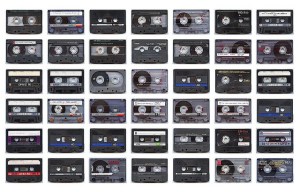
Needless to say the nature of musical exchange has changed with the rise of the digital age of music. This is not to say that memories as musical objects have gone away, but they are being taken for granted as the objects lose their physicality. I remember going to The Wiz on 96th Street with $10 to spend on music. I spent at least ten minutes trying to decide between Sid and B-Tonn and Arabian Prince. I ended up with Arabian Prince and have regretted it since I got home and listened that day, as I never found Sid and B-Tonn for sale again. Today I could download both in the time it took me to walk to the train station. After skimming through the first few songs of Arabian Prince I could decide it was not for me and drag drop it in the trash where the memory of it would disappear with the files. No matter how I felt about the music then, the memory of it is a permanent fixture in my mind because of the physical actions it took to listen.
The first release for Concrète Sound System, Schrödinger’s Cassette, tackled this issue head on by presenting the audience with its own paradox, an update of physicist Erwin Schrödinger’s famous Thought Experiment, where the ultimate fate of the cassette inside is left up to the individual. Schrödinger’s Cassette sought to take listeners out of digital modes of consumption by using an analog medium to evoke the physical. The cassette release trend has been growing over the last few years, almost in parallel to the rise of the digital music and speaking to the need to separate music from our digital lives and to a desire to work harder for it. At the minimum, listening to a cassette requires having a cassette player, and acquiring one these days takes commitment. Unlike digital media, listeners cannot instantly skip a song on a cassette or put a favorite on repeat. It takes physical manipulation of the medium to move through its songs and doing so is a time investment. All these limitations make the cassette a medium that is best for linear listening, from beginning to end (unless you physically cut, rearrange, and splice it yourself).

Schrödinger’s Cassette, Image Courtesy of The Wire
Schrödinger’s Cassette took the required commitment a step further by encasing the cassette itself in industrial grade concrete. This required the user to actively crack the concrete (or the french concrète meaning ‘real’, from which the label derives its name) in order to listen to the music. The paradox is that, depending on the listener’s method for cracking, harm could be done to the cassette that might render it ‘unlistenable’. Upon receiving one of these pieces, the listener holds in their hands a musical object which they must physically act upon in order to create an unrepeatable musical event. Schrödinger’s Cassette has a look, a sound (if shaken you can hear the cassette reels), a feel, a smell, and a taste as well (though I wouldn’t advise it). All of the senses can be actively focused on the object and, as such, the whole of one’s working memory is engaged in the discernment of the object’s musical contents.

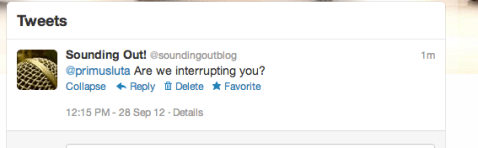
The Wire breaks open Schrödinger’s Cassette courtesy of their Twitterstream
For many, Schrödinger’s Cassette was taken as a work of art and left uncracked. The Wire magazine successfully cracked one edition open, revealing a portion of the musical contents on their regular radio program. For those that decided not to crack it, digital versions were made available so that they could listen, though this option was only made available after the listener spent some time with their physical object. In this way, the music from the project, a compilation called Between the Cracks, was directly connected to physical memories spurred by a material presence.
Triggering active memory during the consumption of music through physical objects need not be this complex. Old medium such as vinyl and cassette releases inherently have the physical properties required without the concrete or much else. Perhaps for this reason they show new signs of life despite the rise of digital. No matter how much our reality is augmented by our digital lives, we still inhabit those bodies that we bring with us, and, as far as the memories those bodies carry with them go, physicality rules.
—
Featured Image: Wax Cylinders in the Library of Congress, Image by Flickr User Photo Phiend
—
Primus Luta is a husband and father of three. He is a writer and an artist exploring the intersection of technology and art, and their philosophical implications. He is a regular guest contributor to theCreate Digital Music website, and maintains his own AvantUrb site. Luta is a regular presenter for the Rhythm Incursions Podcast series with his monthly showRIPL. As an artist, he is a founding member of the live electronic music collectiveConcrète Sound System, which spun off into a record label for the exploratory realms of sound in 2012.
Share this:

Easy Listening: Spreading and the Role of the Ear in Debating

Photo courtesy of Sounding Out! intern, Sky Stage. All rights reserved.
As I write, my institution, the University of Denver, is gearing up to host the first of the 2012 Presidential Debates. The debate promises a polite and eloquent exchanging of reasons on matters of public concerns. This image of “the good man [sic] speaking well,” roughly represented by Obama and Romney, pervades popular culture representations of debate. While there are certainly some forms of debate that stress public reason, like Worlds style debate, most other competitive styles of debate, look and sound very different.
American “Policy Debate,” the type of debate I will explore today, is a high school and collegiate competitive activity where two-person teams argue the merits of governmental legislation. In every round there is an affirmative that advocates an action and a negative defending the status quo, or some alternative. The debate prompts, or resolutions, change yearly and produce research collections comparable to a master’s thesis. But, it is not the research that captures newcomers’ attention. No, it is the velocity that information travels. Indeed, highly successful debaters transform their voice into a high-speed information weapon, sometimes speaking up to 400 words per minute (wpm).
Nobody really knows who decided that speaking quicker than her/his opponents would be a viable strategy. Some allege that David Seikel and Mike Miller, a dominant team from the University of Houston in the late 1960s invented the strategy. However, Miller denies this fact, insisting that the practice of speaking quickly, or “spreading,” predated their success by a couple years. While it is difficult to pin down exactly when talking becomes spreading, studies indicate passive comprehension has a threshold of around 210 wpm. Simply put, spreading is a vocal practice that propagates more arguments than an opponent can rebut, forcing the opposing team into a strategic choice of conceding and/or inadequately responding to some positions.

Almost immediately after its introduction, spreading became a polarizing issue. While some alleged that speed undermined communicative argumentation, others applauded its ability to foster critical thinking. Rate of delivery became a site for what Douglas Ehninger called in 1958 the debate about debate: should debate be concerned with public reason or technical proficiency? Spreading figured prominently in these discussions because it circumscribed debate to the technical sphere, the quick pace precluding lay comprehension. As a site for cultivating what argumentation theorists Ron Greene and Darrin Hicks call “the ethical attributes required for democratic citizenship” (101), debate operates as an ideal problem space to inquire about the relationship between listening and judgment that underwrite argumentative exchanges.
Extracting meaning from a spread requires a trained ear that can delineate the nuance of tone, rhythm, code, and breathing, while translating these sounds into symbols that are then recorded onto a “flow” (a document where participants keep notes of the debate). This technical sphere of argumentation, then, requires what cultural historian Jonathan Sterne calls in The Audible Past: Cultural Origins of Sound Reproduction an “audile technique,” or a set of culturally defined listening practices. Here, spreading denotes not just rate of delivery, but encompasses a range of other practices that attend to the debate. Yoking velocity with technical proficiency, spreading requires an audile technique that attunes the ear to speed, while calibrating the viscera to quickly appraise each position espoused. Extending Sterne’s observations into an embodied theory of listening, I argue that spreading entrains visceral judgment that organizes expertise under the banner of “exchange-value,” instead of its veracity. Reflecting what Jodi Dean calls in Blog Theory: Feedback and Capture in the Circuits of Drive capitalism’s communicative style, I contend, audition in this case privileges flow over content.
Today, debaters are much faster than their 1960s counterparts. Take for example the championship round of this year’s (2012) National Debate Tournament (NDT). The 2012 topic debated the merits of the United States’ democracy assistance in the Middle East.
Finals – NDT 2012 Northwestern BK v Georgetown AM – 1AC + CX
In the speech linked to above, dubbed the first affirmative constructive (1AC), the speaker’s first words are easily audible, but as the seconds expire, the affirmative’s words increase in velocity; syllables collide and contort. The speaker pushes through, taking a split second to take a short, fast breath (called a clutch) before he begins his next word. To the seasoned ear, the voice is instructive; a slower, deeper tone signifying an assertion. also known as a “tag,” and a faster tempo indicating evidence. Out of this buzz, debaters’ are able to discern distinct phrases, like “Arab Spring,” “economic down turn,” and “nuclear war.” In 9 minutes the speaker outlined his advocacy, consisting of multiple scenarios for planetary extinction.
During the 1AC, the negative team is carefully listening, gathering the affirmative’s evidence, and translating the speech into symbolic shorthand, termed flowing. In addition to its purely functional use—to keep track of positions—the flow also provides third party adjudicator(s) a document to evaluate the debate.

Image of flow notes taken during a debate
After a period of questioning, the first negative speaker, linked to below, elaborates his positions: a procedural concern that the affirmative is outside the confines of the resolution; two philosophical objections (or critiques); two alternative courses of action that resolve the affirmatives exigencies, while conserving the president’s political capital, so Obama can push for Jackson-Vanik legislation; and finally direct responses to the affirmative position.
Finals – NDT 2012 Northwestern BK v Georgetown AM – 1NC + CX
Coupled with the “burden of rejoinder,” which dictates a conceded argument is a true argument, speed becomes a strategic weapon. The more positions, the more likely one will be missed, granting the other team an advantage. For example, failure to address the negative’s concerns about the Jackson-Vanik legislation means that the affirmative position would result in a US-Russian nuclear war culminating in extinction and probably losing the affirmative the debate. Even less dire claims exert force in the round. For instance, missing the relatively innocuous claim that Obama does not have political capital abrogates the negative’s whole Jackson-Vanik position. After all, what would be the point of Obama conserving capital, if he has none to begin with?
Debating thus requires a refined ear capable of quickly determining a argument’s merit, while allotting the proper amount of attention. If a claim is deemed irrelevant, the debater can focus on a more relevant position, keeping her/his ear piqued for beginning of the next position.
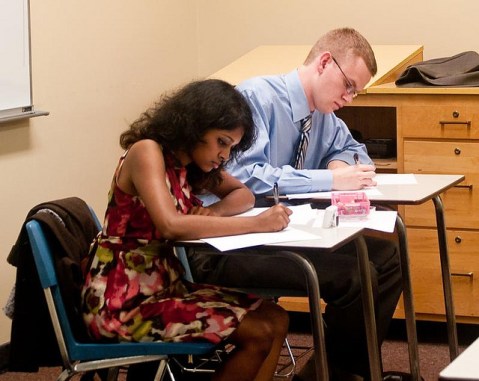
Debate team members listening to the flow at a 2009 Tournament at University of the Pacific; Image by Flickr User Inkyhack
This confluence of speed, evidence, time constraints, and a burden of rejoinder cultivates an instrumental relationship to expertise. Media theorist Jayson Harsin suggests in “The Rumour Bomb: Theorising the Convergence of New and Old Trends in Mediated US Politics” that these “conditions encourage a relationship of viewer to text (slogan, soundbite, fragment) which is essentially fiduciary, based on trust, not critical understanding”(101). Indeed, time constraints coupled with a proliferation of positions, produces a sound to listener relationship, where the veracity is assumed and significance is dictated by strategies, not the least of which is vocal. This is because there is simply not enough time to evaluate the credibility of each piece of evidence read. Patrick Speice and Jim Lyle, two debate coaches, explain that “Debaters have to be focused on the arguments being offered, have to be able to understand them very quickly, and they have to be able to discern which arguments are of the greatest significance for the round.” Evidence, then, is reorganized along a strategic continuum—the more likely an argument may help or hinder a team’s chances of winning, the more important it becomes. This can precipitate a “race to the margins,” where one side tries to find an obscure argument to beat back more probable analysis. This is not to say that one kind of argument is better than the other. But, the rationality used to organize the evidence relegates veracity to the epiphenomenal. This fosters an epistemic leveling, indexing expertise according to its exchange-value.
The repetitive nature of debate inscribes these listening habits into the body, shaping future interaction. Writing on the pious ear, cultural anthropologist Charles Hirschkind explains in The Ethical Soundscape: Cassette Sermons and Islamic Counterpublics, “patterns of sensory attunement configured through continuous practice of such a listening constitute an intensifying perceptual background for […]ethical agency and public reason”(28). Similarly, the practice of listening to debate rounds, along with the movement of the hands, quickness of thought, and so on are burned into an affective substrate, defining the horizons of future action. That is, through the repetition of debates, audile technique is entrained into motor memory, residing just below the conscious register of thought, acting as a potentiality. Most often, this listening technique is activated in the next debate round, the spread’s distinctive sound generating an anamnestic effect, activating the policy debate ear.
In sum, spreading proffers an audile technique concerned with the exchange-value of evidence, where the “best claim” is the one that wins the round. It entrains a technical mode of audition, aiding the debater in making quick decisions. This listening style underwrites a knowledge economy, where expertise becomes just another commodity that is bought, sold, and traded to support pre-formulated opinions. “Under communicative capitalism,” Jodi Dean writes, “an excess of polls, surveys, and assessments circulates, undercutting not only the efficacy of any particular poll or survey but the conditions of possibility for knowledge and credibility as such. There is always another survey, done by another group or association with whatever bias and whatever methodology, displacing whatever information one thought one had” (103).
—
Justin Eckstein is a doctoral candidate and former director of debate at the University of Denver. His work explores the intersection of listening, affect, and argumentation. Justin’s writing has appeared in Argumentation & Advocacy, Relevant Rhetoric, and Argumentation in Context. Currently, he is writing his dissertation on the micropolitics of podcasting in the post-deliberative moment.
Share this:


Current Top Posts





April 2021

January 2020

November 2019

October 2019

August 2019

April 2014

November 2017

March 2015

December 2017

October 2015
 Sounding Out!
Recent Comments